
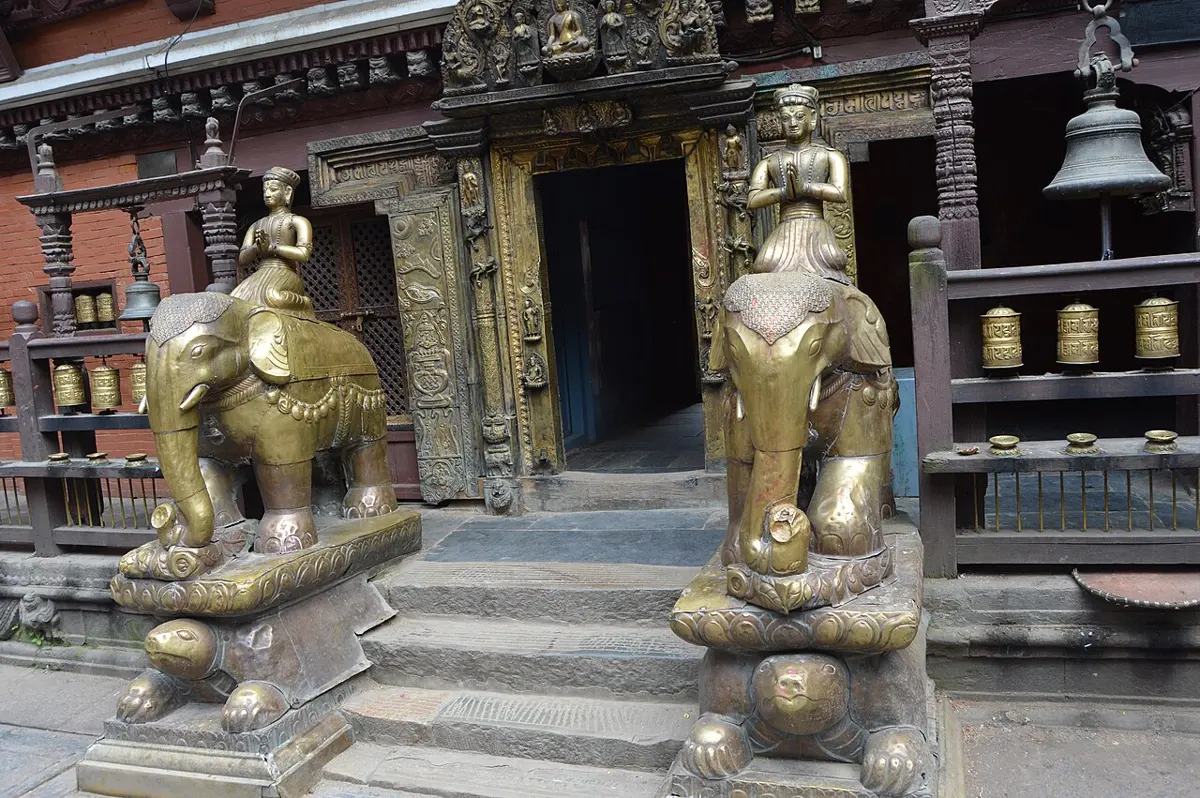
Walk down the lanes of Patan behind the Golden Temple and you hear it before you see it: the tapping of hammers on copper. Patan’s metalworkers have cast and beaten copper, brass and bronze into statues, water jars and temple roofs for more than a thousand years. The copper in a karuwa, the zinc on a tin roof, the mercury in an old thermometer, the iron in a rod of TMT steel and the silver of a wedding bracelet were all once dull rock, and each metal needed its own chemistry to get out of it.
This unit studies five such metals, one at a time: copper, zinc, mercury, iron and silver. They are called heavy metals because they are dense (from 7.1 g/cm³ for zinc to 13.5 g/cm³ for mercury, against 2.7 for aluminium), and all five sit in the d-block of the periodic table. For each you will see where it is found, how it is extracted from its chief ore, how it behaves with air, water, acids and other substances, what it is used for, and its most important compounds: blue and white vitriol, calomel and corrosive sublimate, lunar caustic and horn silver. Iron gets the most space, with the blast furnace, the making of steel and rusting, which with other corrosion costs the world about 3% of everything it produces (NACE’s estimate, 2016).
7.1 Copper (Cu)
7.1.1 Introduction
Copper is one of the first metals humans ever used: copper beads more than ten thousand years old have been found in the Middle East, and smelting copper from its ores began about seven thousand years ago. Its name comes from the island of Cyprus, the Romans’ main source of it, whose copper they called aes Cyprium, later cuprum; hence the symbol Cu. In Nepali it is तामा (tama).
Along with silver and gold, copper is a coinage metal. It has atomic number 29 and atomic mass 63.55 u. It melts at 1085 °C, boils at 2562 °C, and has a density of 8.96 g/cm³ (specific gravity 8.96).
7.1.2 Occurrence
Copper occurs both native (as the metal itself) and combined. Native copper is found in Canada, the USA, Mexico, Russia and China, around Lake Superior in lumps weighing tons. Most copper, though, is combined, as sulphides, oxides and carbonates. In Nepal it is found in minerals such as chalcopyrite, malachite, azurite and cuprite; known deposits include Okharbot (Myagdi), Gyazi (Gorkha) and Wapsa (Solukhumbu). None is mined on a large scale today: Nepal’s copper is imported.
The main ores of copper are:
| Ore | Formula | Copper by mass |
|---|---|---|
| Chalcopyrite (copper pyrites) | CuFeS₂ (that is, Cu₂S·Fe₂S₃) | 35% |
| Chalcocite (copper glance) | Cu₂S | 80% |
| Malachite (green) | CuCO₃·Cu(OH)₂ | 57% |
| Cuprite (ruby copper) | Cu₂O | 89% |
| Azurite (blue) | 2CuCO₃·Cu(OH)₂ | 55% |
| Bornite (peacock ore) | Cu₅FeS₄ | 63% |
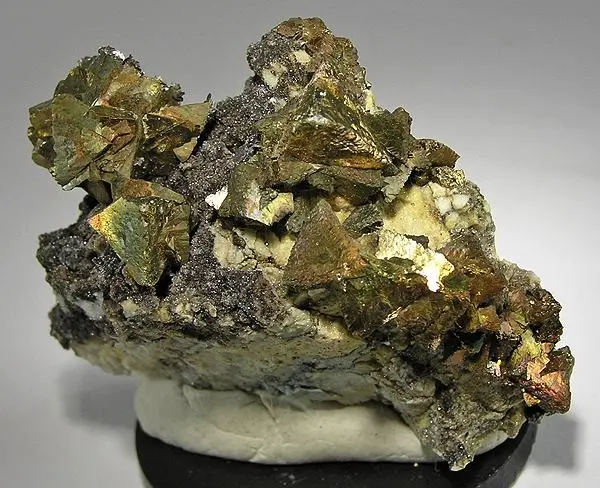
The chief ore of copper is chalcopyrite. It holds less copper than cuprite or chalcocite, but it is found in huge deposits all over the world, and froth flotation concentrates it cheaply. Grade 11 explains this difference between a mineral and an ore in Unit 10.
Which of these is the chief ore of copper?
Pick an answer to see why.
7.1.3 Extraction of copper from copper pyrites
Copper is extracted from chalcopyrite by pyrometallurgy, metallurgy by heat. The steps are those of Grade 11, but with a twist: the ore holds as much iron as copper, and most of the work is getting rid of the iron. The steps are:
- crushing and pulverization
- concentration by froth flotation
- roasting
- smelting to matte
- bessemerization (converting) to blister copper
- refining
1. Crushing and pulverization
The big lumps of ore are broken into small pieces in a jaw crusher, then ground to a fine powder in a ball mill, a turning steel drum full of steel balls. Grinding frees the grains of ore from the grains of rock, so the next step can separate them.
2. Concentration by froth flotation
Chalcopyrite is a sulphide, so it is concentrated by froth flotation (Figure 7.4). The powdered ore is mixed with water, a little pine oil (the frother) and a collector such as sodium ethyl xanthate, in a big tank. Air is blown in and the mixture is stirred hard. The sulphide grains, made water-repelling by the collector, cling to the air bubbles and rise into the froth, which overflows and is collected; the rock grains (the gangue), wetted by water, sink to the bottom. An ore of about 1% copper comes out as a concentrate of about 25–30% copper.
3. Roasting
The concentrated ore is heated strongly in an excess of air in a reverberatory furnace (Grade 11’s Figure 7.5), below its melting point. Copper pyrites breaks up into cuprous sulphide and ferrous sulphide, and some of its sulphur burns off:
The ferrous sulphide is partly oxidized to ferrous oxide, and a little cuprous sulphide to cuprous oxide:
Iron is oxidized far more readily than copper: iron holds oxygen more strongly than sulphur does, copper the other way round. So the roasting attacks mainly the iron, and the copper stays mostly as Cu₂S. Roasting also burns off the impurities of phosphorus, arsenic, antimony and extra sulphur as their volatile oxides, which leave as gases:
A carbonate ore such as malachite is calcined instead: heated, it breaks up into black cupric oxide, carbon dioxide and water.
The sulphur dioxide of roasting is recognized by acidified potassium dichromate, which it turns from orange to green: SO₂ reduces the orange dichromate ion, Cr₂O₇²⁻, to green Cr³⁺, and is itself oxidized to sulphate.
A gas given off when a copper ore is roasted turns paper soaked in acidified potassium dichromate from orange to green. What is the gas, and what happens to the dichromate?
Pick an answer to see why.
4. Smelting
The roasted ore is mixed with a little coke and silica (sand, the flux) and charged into a small blast furnace (Figure 7.6). Hot air blown in through the tuyeres (nozzles) near the bottom burns the coke and the remaining sulphides, and the furnace reaches about 1200 °C. More ferrous sulphide is oxidized:
Any cuprous oxide formed during roasting is turned back into cuprous sulphide by the ferrous sulphide that is still there, because iron has the greater pull for oxygen and copper the greater pull for sulphur:
This is why the furnace keeps some FeS until the end: while any FeS remains, no copper is lost as Cu₂O into the slag. The ferrous oxide combines with the silica flux into slag, ferrous silicate:
Two liquid layers collect at the bottom of the furnace. The light slag floats on top and runs out of its own hole; below it is a heavy molten mixture of cuprous sulphide with some ferrous sulphide, called copper matte (Cu₂S + FeS). Matte holds about 50% copper or more (modern smelters make matte of 60–70%), and it is tapped from the bottom.
5. Bessemerization
Copper matte is turned into copper in a Bessemer converter (Figure 7.7), a large pear-shaped steel vessel lined with a refractory (heat-resisting) basic lining, that can be tilted to pour. The molten matte is poured in with silica, and air is blown through it from the tuyeres. The air does two jobs, one after the other.
First, the rest of the iron is removed. The ferrous sulphide is oxidized, and the ferrous oxide joins the silica as slag, which is poured off:
Then the copper is set free by self-reduction. Once all the iron has gone, part of the cuprous sulphide is oxidized to cuprous oxide, which then reacts with the cuprous sulphide that is left:
No coke is needed: the copper’s own sulphide is the reducing agent, its sulphur leaving as SO₂. This is called self-reduction (auto-reduction). Both reactions give out heat, so once started, the converter keeps itself hot without any fuel.
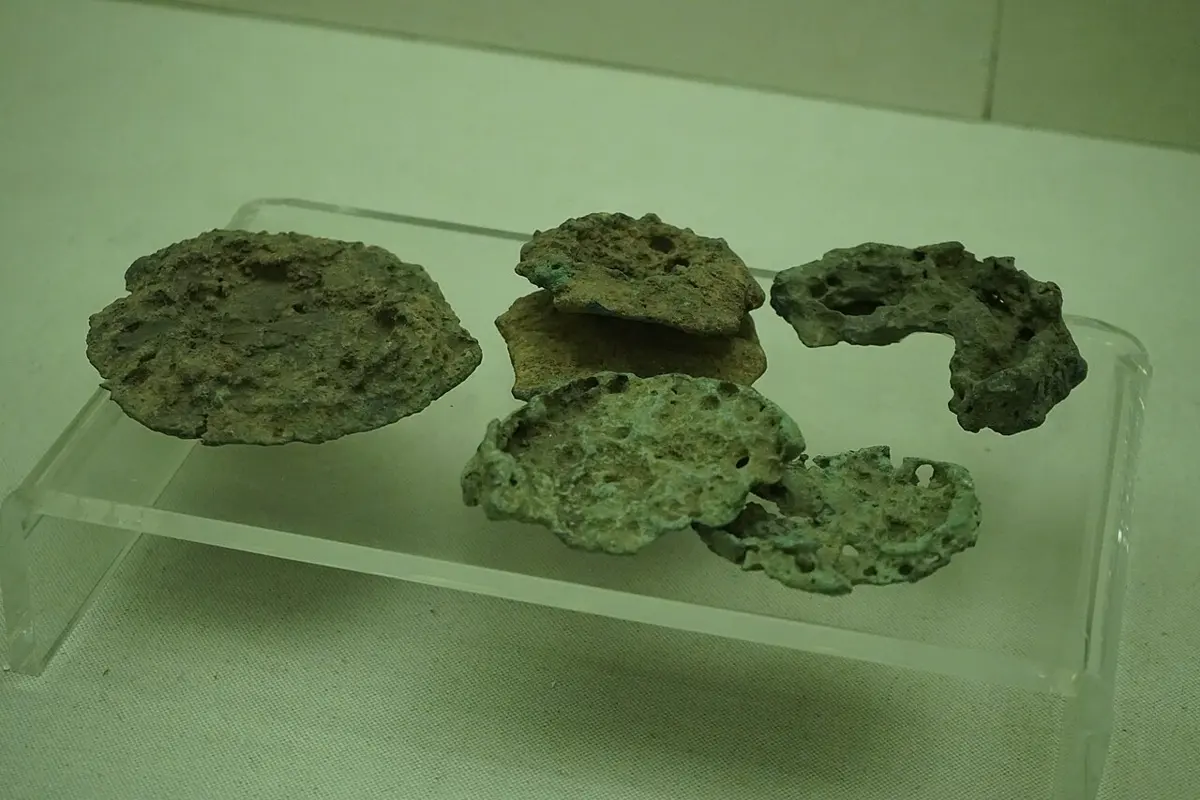
The molten copper is poured out and allowed to cool. As it solidifies, the sulphur dioxide dissolved in it escapes and leaves big bubbles, blisters, on its surface. This copper, 98–99% pure, is called blister copper.
In the Bessemer converter, what reduces the cuprous oxide to copper?
Pick an answer to see why.
6. Refining
Blister copper still holds oxides and sulphides of copper and iron, and traces of other metals (silver, gold, zinc, nickel). It is good enough for brass, but not for electric wire: a few hundredths of a percent of some impurities, such as phosphorus or arsenic, lower copper’s conductivity noticeably. It is refined in two stages.
i. Poling. The molten blister copper is first stirred with poles of green wood, traditionally bamboo or sal (Grade 11’s poling). The hot wood gives off hydrocarbon gases such as methane, which reduce the copper oxide back to copper, and the stirring brings the other impurities up as a scum:
Written with carbon from the wood, . The copper is now about 99.5% pure. Today refineries do the same job by blowing natural gas or ammonia into the melt, but the copper is still called “poled”.
ii. Electrolytic refining. This is the modern method, used for nearly all copper. A thick slab of impure copper is made the anode, a thin sheet of pure copper the cathode, and both hang in a solution of copper sulphate acidified with sulphuric acid (Figure 7.9). When a current passes, the anode dissolves and pure copper is deposited on the cathode:
At the anode (oxidation): (impure copper dissolves)
At the cathode (reduction): (pure copper is deposited)
Metals less reactive than copper, such as silver, gold and platinum, don’t dissolve: they fall from the anode as anode mud, and their value often pays for the whole refinery. Metals more reactive than copper, such as iron, zinc and nickel, dissolve but stay in solution, because copper ions are reduced far more easily than theirs. The cathode copper is about 99.9–99.99% pure.
7.1.4 Physical properties of copper
Copper is a reddish-brown metal, the only common metal (with gold) that isn’t gray or silvery.
- i.Appearance: a shiny reddish-brown solid at room temperature.
- ii.Conductivity: an excellent conductor of heat and electricity, second only to silver.
- iii.Workability: very malleable (beaten into sheets) and ductile (drawn into wire).
- iv.Density: 8.96 g/cm³ (specific gravity 8.96).
- v.Melting and boiling points: it melts at 1085 °C and boils at 2562 °C.
7.1.5 Chemical properties of copper
1. Action of air
Copper is not affected by dry air. In moist air containing carbon dioxide, though, it slowly gets a green coat of basic copper carbonate, CuCO₃·Cu(OH)₂, the same compound as malachite:
This green layer is called patina or verdigris. It is why copper roofs, domes and old statues turn green over the years. The patina sticks well and protects the copper underneath from further attack.

2. Action of heat
Heated in air, copper turns black as a coat of cupric oxide, CuO, forms. Above about 1100 °C, cupric oxide is no longer stable, and red cuprous oxide, Cu₂O, forms instead:
3. Action of acids
Copper lies below hydrogen in the electrochemical series, so it cannot set hydrogen free from acids.
i. Dilute HCl and dilute H₂SO₄. Copper doesn’t react with these acids alone. But in the presence of air, the oxygen oxidizes the copper, and the oxide then dissolves in the acid:
This is why pickles and lemon kept in a copper vessel slowly turn it green and pick up copper: the vessel needs a lining of tin (kalai) for sour food.
ii. Hot, concentrated H₂SO₄ oxidizes copper, and is itself reduced to sulphur dioxide:
iii. Nitric acid is an oxidizing acid, and the product depends on how concentrated it is:
a. With concentrated HNO₃, brown nitrogen dioxide comes off:
b. With cold, dilute (1 : 1) HNO₃, colorless nitric oxide comes off (it turns brown at the mouth of the tube, as it meets air):
Copper is never reactive enough to take the nitrogen further down, to N₂O or ammonium nitrate, as zinc does. Try the widget below: choose a metal and the acid’s strength.
4. Action with metal ions (displacement)
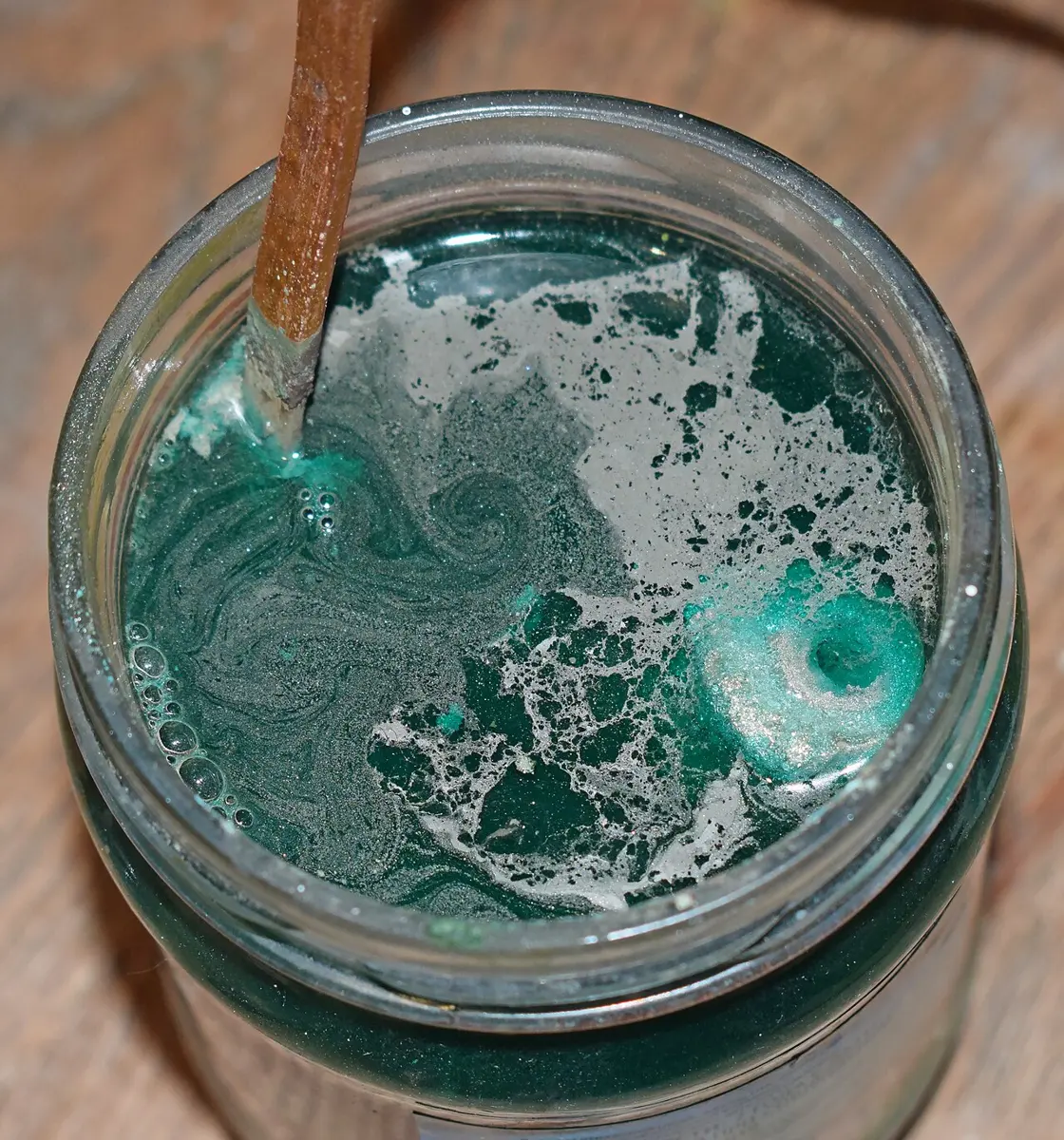
Copper displaces (reduces) the ions of metals below it in the electrochemical series from their solutions. A copper wire in silver nitrate solution grows a tree of shining silver crystals, and the solution turns blue as copper ions go into it:
5. Action with aqueous ammonia
Copper doesn’t react with ammonia alone. But in the presence of air, copper slowly dissolves in aqueous ammonia, giving a deep blue solution of a complex, tetraamminecopper(II) hydroxide:
7.1.6 Uses of copper
- i.Electricity: wires, cables, motors, transformers, circuit boards: more than half of all copper.
- ii.Alloys: brass, bronze, bell metal, gun metal, German silver (table below).
- iii.Utensils and plumbing: pots, karuwas, water pipes, and electroplating other metals with copper.
- iv.Farming: copper compounds, such as copper sulphate in Bordeaux mixture, kill fungi and pests on crops.
- v.Coins: hence the name coinage metal; Nepal’s old paisa and many coins today are copper alloys.
- vi.The body: copper is part of several enzymes, such as cytochrome c oxidase, which our cells use to burn food with oxygen; adults need about 0.9 mg a day.
| Alloy | Composition (approximate) | Uses |
|---|---|---|
| Brass (pital) | Cu 60–80%, Zn 20–40% | utensils, taps, statues, musical instruments |
| Bronze | Cu about 88%, Sn about 12% | statues, medals, bearings |
| Bell metal (kasa) | Cu about 78%, Sn about 22% | bells, bowls, plates |
| Gun metal | Cu about 88%, Sn about 10%, Zn about 2% | valves, gears, castings |
| German silver (nickel silver) | Cu about 60%, Zn about 20%, Ni about 20% | cutlery, ornaments (it holds no silver) |
Which alloy contains copper and tin only?
Pick an answer to see why.
7.1.7 Compounds of copper
A. Blue vitriol (CuSO₄·5H₂O)
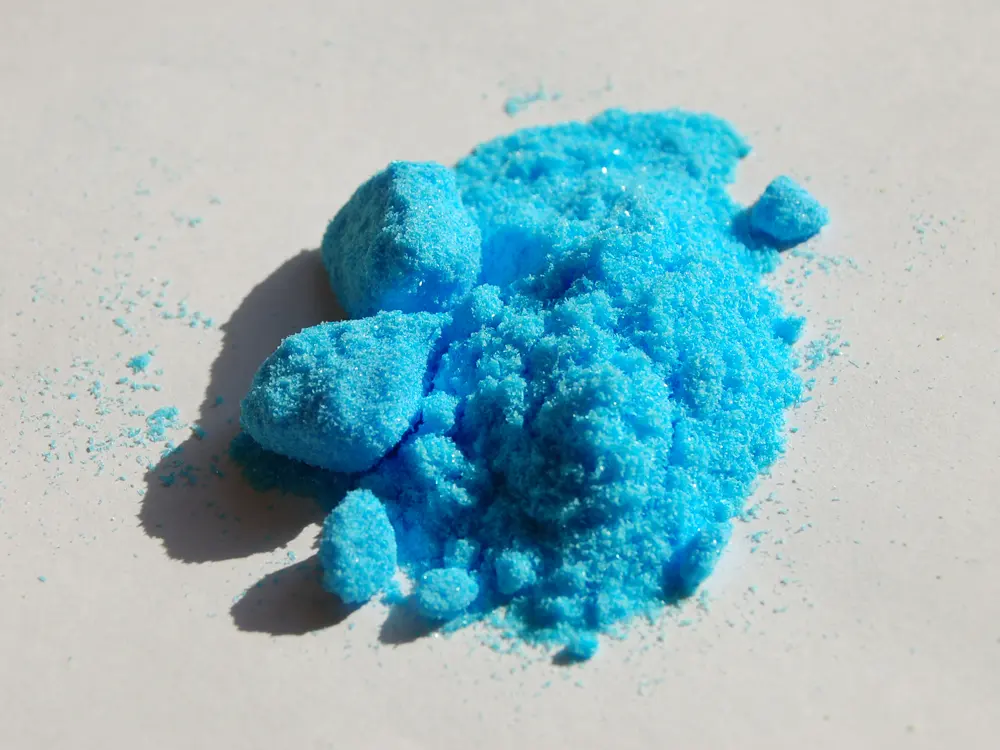
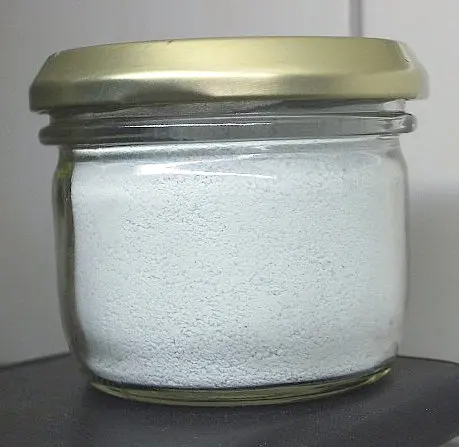
Introduction. Copper sulphate pentahydrate, CuSO₄·5H₂O, is called blue vitriol. In Nepali it is निलो तुथो (nilo tutho). A vitriol is an old name for a shining, glassy crystal of a metal sulphate (Latin vitrum, glass): blue vitriol (copper), white vitriol (zinc) and green vitriol (iron, FeSO₄·7H₂O); sulphuric acid, made from them, was “oil of vitriol”.
Preparation. Blue vitriol is made by dissolving copper, or copper(II) oxide, hydroxide or carbonate, in dilute sulphuric acid, then crystallizing the solution. Copper itself dissolves only when air is bubbled through (or with hot concentrated acid):
The solution is evaporated until it is concentrated and left to cool: blue crystals of the pentahydrate form.
Physical properties.
- i.A blue crystalline solid, soluble in water (about 32 g per 100 g of water at 20 °C).
- ii.Insoluble in alcohol.
- iii.Its anhydrous form is white.
Chemical properties.
1. Action of heat. On heating, blue vitriol loses its water of crystallization in stages, turning pale blue and then white; from about 650 °C the anhydrous salt itself decomposes, completely by about 750 °C, to black copper(II) oxide and sulphur trioxide:
(The first stage really goes in two steps, to CuSO₄·3H₂O at about 60 °C and to CuSO₄·H₂O at about 110 °C. The last water molecule is held by the sulphate ion and needs the most heat.)
2. Action with alkali. Sodium hydroxide gives a pale blue precipitate of copper(II) hydroxide:
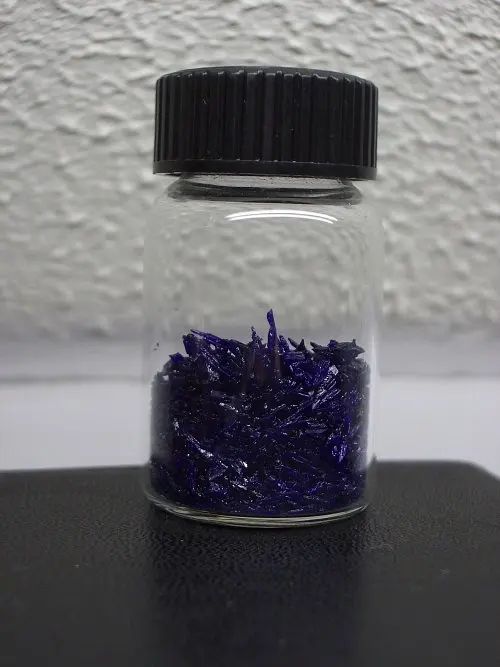
3. Action with ammonia (a complex). A little ammonia solution first gives the same pale blue precipitate of copper(II) hydroxide. More ammonia dissolves it, giving a deep blue solution of tetraamminecopper(II) sulphate (Figure 7.14):
Overall, with excess ammonia: . In the complex ion, four ammonia molecules are joined to the copper ion through their lone pairs. Its deep blue color is a test for Cu²⁺ ions.
4. Action with potassium iodide (oxidizing nature). Copper(II) ions oxidize iodide ions to iodine, and are themselves reduced to white copper(I) iodide (written Cu₂I₂ in older books); the iodine colors the mixture brown:
Copper(II) iodide, CuI₂, never really exists: it breaks up at once. This reaction is used to find the amount of copper in a sample, by titrating the iodine set free with sodium thiosulphate (iodometry, Unit 1).
5. Displacement. Metals above copper in the electrochemical series, such as iron and zinc, displace copper from its solution:
That is why copper sulphate solution can’t be kept or carried in a vessel of zinc or iron. Try any pair in the widget:
6. Action with hydrogen sulphide. H₂S passed through an acidified copper sulphate solution gives a black precipitate of copper(II) sulphide:
Uses of blue vitriol.
- i.As a laboratory reagent.
- ii.In electroplating and electrotyping, and as the electrolyte for refining copper.
- iii.In Fehling’s and Benedict’s solutions, which test for reducing sugars (the blue Cu²⁺ is reduced to red Cu₂O).
- iv.As a fungicide and insecticide, above all in Bordeaux mixture.
- v.To preserve wood and gum, and to kill algae in water tanks.
- vi.Anhydrous copper sulphate detects traces of water, turning blue.
B. Black oxide (CuO) and red oxide (Cu₂O)
Copper(II) oxide, cupric oxide, CuO, is black: the black oxide of copper. Copper(I) oxide, cuprous oxide, Cu₂O, is red: the red oxide.
Uses of the black oxide, CuO:
- i.As an oxidizing agent.
- ii.To give glass and glazes a blue or green color.
- iii.To find the carbon and hydrogen in an organic compound: the compound is burnt over hot CuO, which oxidizes its carbon to CO₂ and its hydrogen to water, which are absorbed and weighed.
Uses of the red oxide, Cu₂O:
- i.To prepare copper(I) chloride and other copper(I) compounds.
- ii.To give glass and enamel a red color.
- iii.In anti-fouling paints for the bottoms of ships, where its copper keeps barnacles and weed from growing (red, anticorrosive and anti-fouling paint).
Exercise (7.1 Copper)
A. Multiple choice questions
- Which of the following is an ore of copper?
Pick an answer to see why.
- Which metallurgical process is used to extract copper?
Pick an answer to see why.
- Which method is used to purify blister copper?
Pick an answer to see why.
- In electrolytic refining of copper, where is the pure copper deposited?
Pick an answer to see why.
- What are the impurities that settle below the anode in the electrolytic refining of copper called?
Pick an answer to see why.
- Which method of dressing (concentration) is used for the chief ore of copper?
Pick an answer to see why.
- What is copper matte?
Pick an answer to see why.
- Which of the following is not a coinage metal?
Pick an answer to see why.
- What is the formula of malachite?
Pick an answer to see why.
- What is bell metal made of?
Pick an answer to see why.
B. Short answer questions
Give reasons:
- a.A copper statue turns green after standing for a long time.
- b.Copper sulphate solution should not be stored in a nickel vessel.
- c.A brown gas is given off when copper is treated with concentrated nitric acid.
Answer
Give the balanced equation for the preparation of blue vitriol from metallic copper. Write one use of blue vitriol.
Answer
What happens when ammonia is passed through copper sulphate solution?
Answer
Write the formula of:
a. blue vitriol b. malachite c. ruby copper d. black oxide of copper
Answer
Write the formula and one important use of:
a. black oxide b. red oxide c. blue vitriol
Answer
Copper sulphate pentahydrate is called blue vitriol.
- a.Starting from metallic copper, how would you prepare blue vitriol?
- b.Write the action of heat on blue vitriol.
- c.What happens when its aqueous solution is treated with KI?
- d.Why is this compound called a vitriol?
Answer
Write the balanced equation for:
- a.roasting of copper sulphide ore
- b.thermal decomposition of blue vitriol
- c.the action of air on a copper coin
Answer
Write a note on blue vitriol.
Answer
Starting from copper pyrites, how would you obtain pure copper? Explain the steps, with a diagram.
Answer
What is blister copper? How is it obtained from the chief ore of copper?
Answer
C. Long answer questions
A transition metal M with atomic mass 63.5 u lies in Group 11 of the periodic table.
- a.Identify M.
- b.Write the formula of the chief ore of M.
- c.How would you extract M from its chief ore?
- d.What happens when M is treated with dilute sulphuric acid, followed by crystallization?
- e.What happens when M is heated in dry air below and above 1100 °C?
- f.Write any two uses of M.
Answer
A blue crystalline compound X is commonly called blue vitriol.
- a.Write the formula of X.
- b.Describe the preparation of X from copper(II) oxide.
- c.Write the physical properties of X.
- d.What changes occur when X is heated?
- e.What happens when excess ammonia gas is passed through an aqueous solution of X?
- f.Give two agricultural uses of X.
Answer
7.2 Zinc (Zn)
7.2.1 Introduction
Zinc is a bluish-white metal. People were using it in brass (pital) for two thousand years before they could make the metal itself, because zinc boils at 907 °C, below the temperature needed to reduce its ore, so in an open furnace it simply escaped as vapor. The first people to collect it, by condensing the vapor, were the smelters of Zawar, in Rajasthan, India, from about the 9th century; their clay retorts are still found there by the thousand. The name comes from the German Zink, perhaps from Zinke, a prong or tooth, for the spiky crystals of zinc that grew in old furnaces.
Zinc has atomic number 30 and atomic mass 65.38 u. It melts at 420 °C, boils at 907 °C, and has a density of 7.14 g/cm³.
Zinc is in the d-block, but it is a non-typical transition element: its d subshell is completely filled (3d¹⁰), in the atom and in the Zn²⁺ ion, so it doesn’t show variable oxidation states or form colored compounds as other transition elements do. (Unit 6 explains why a partly filled d subshell gives color.)
7.2.2 Occurrence
Zinc is too reactive to be found free. It occurs combined, as its sulphide, carbonate, oxide and silicate. In Nepal it is found as its sulphide, with lead sulphide (galena), at Ganesh Himal, Phulchoki and in parts of the Mahabharat range. The main ores of zinc are:
| Ore | Formula |
|---|---|
| Zinc blende (sphalerite) | ZnS |
| Calamine (smithsonite) | ZnCO₃ |
| Zincite (red zinc ore) | ZnO |
| Willemite | Zn₂SiO₄ (2ZnO·SiO₂) |
| Franklinite | ZnO·Fe₂O₃ (ZnFe₂O₄) |
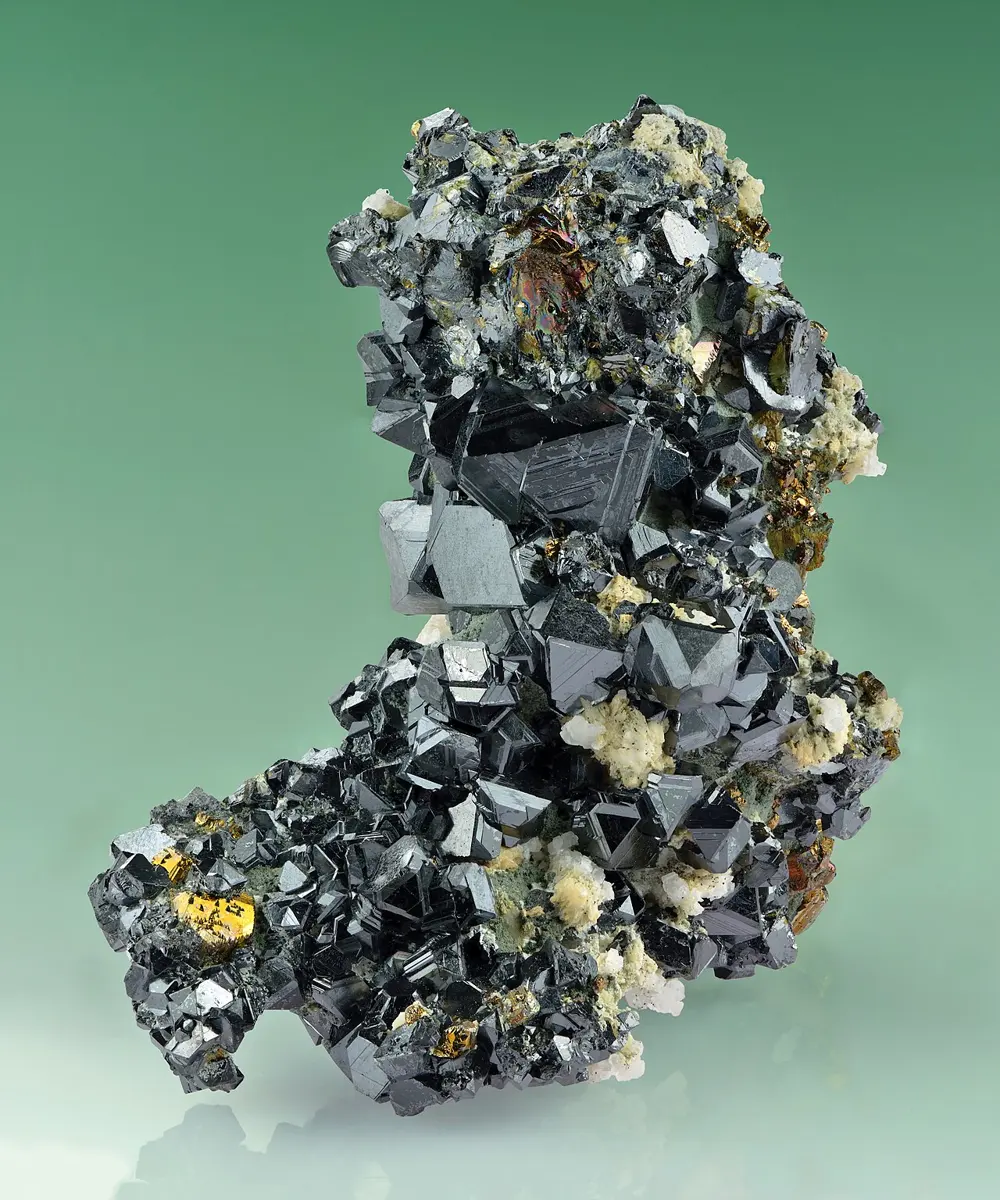
The chief ore is zinc blende, ZnS: it makes up most of the world’s zinc deposits, and as a sulphide it is concentrated cheaply by froth flotation.
7.2.3 Extraction of zinc from zinc blende
Zinc is extracted from zinc blende by pyrometallurgy. Its steps:
1. Crushing and pulverization
The ore is broken in a jaw crusher and ground to powder in a ball mill.
2. Concentration by froth flotation
Zinc blende is a sulphide, so it is concentrated by froth flotation, as for copper (Figure 7.4). Zinc blende often comes with galena, PbS: with sodium cyanide as a depressant, the zinc blende stays down while the galena floats off first; then copper sulphate is added as an activator, and the zinc blende floats.
3. Roasting
The concentrate is heated strongly in excess air in a reverberatory furnace (Figure 7.5), below its melting point. Zinc sulphide becomes zinc oxide:
Some zinc sulphide is first oxidized to zinc sulphate, which then breaks down to zinc oxide at a higher temperature:
So the roasting is finished at a high temperature (about 900 °C) to break down any zinc sulphate. Impurities of phosphorus, sulphur, arsenic and antimony burn off as their volatile oxides, as in copper roasting. The SO₂ is not wasted: zinc smelters turn it into sulphuric acid.
4. Reduction (carbon reduction in a vertical retort)
The zinc oxide is reduced with carbon (coke). The roasted ore and coke are pressed into small briquettes, about 2 parts of oxide to 1 of coke by mass, and fed in at the top of a tall vertical retort of silicon carbide brick (Figure 7.16). The retort is heated from outside by burning producer gas (CO + N₂) in the space around it, to 1400–1500 °C. Zinc oxide is reduced to zinc, which at that temperature is a vapor:
The zinc vapor and carbon monoxide are drawn off near the top into a condenser, where the zinc condenses to liquid zinc; the carbon monoxide passes on and is burnt as fuel. Fresh briquettes are fed in at the top and spent ones (the residue) drawn off at the bottom, so the retort works without stopping. The zinc obtained, cast into slabs, is called spelter; it is about 97–98% pure.
The retort is needed because zinc boils at 907 °C, below the 1100 °C or more at which carbon can reduce zinc oxide. In an open furnace, the zinc vapor would meet the air and the carbon dioxide of the furnace and burn back to zinc oxide. In a closed retort, heated from outside, the vapor meets neither, and can be condensed.
5. Purification
Spelter contains lead, cadmium, iron and arsenic. It is purified by one of two methods.
i. Fractional distillation. The method uses the different boiling points of the metals:
| Metal | Boiling point |
|---|---|
| Cadmium | 767 °C |
| Zinc | 907 °C |
| Lead | 1749 °C |
| Iron | 2862 °C |
The impure zinc is heated to about 1000 °C: zinc and cadmium boil off together, leaving lead and iron behind. The distillate is then distilled again at about 800 °C, above cadmium’s boiling point but below zinc’s: cadmium distills off, and pure zinc (about 99.5%) is left behind.
ii. Electrolytic refining. As for copper (Figure 7.17): the impure zinc is the anode, a thin sheet of pure zinc the cathode (an aluminium sheet in modern cells, from which the zinc is stripped), and the electrolyte is zinc sulphate solution acidified with sulphuric acid:
At the anode: (impure zinc dissolves)
At the cathode: (pure zinc is deposited)
Less reactive impurities (lead, copper, cadmium) fall to the bottom as anode mud. The zinc on the cathode is 99.9–99.99% pure.
Zinc is collected as a vapor and condensed during its extraction because
Pick an answer to see why.
7.2.4 Physical properties of zinc
Zinc is a bluish-white metal.
- i.Appearance: a solid at room temperature; in moist air it soon tarnishes to a dull gray.
- ii.Conductivity: a good conductor of heat and electricity.
- iii.Workability: brittle at room temperature, but malleable and ductile between 100 and 150 °C, when it can be rolled into sheets and drawn into wire; above 200 °C it becomes brittle again and can be powdered.
- iv.Density: 7.14 g/cm³.
- v.Melting and boiling points: it melts at 420 °C and boils at 907 °C.
7.2.5 Chemical properties of zinc
1. Action of air
Zinc is not affected by dry air. In moist air containing carbon dioxide it gets a thin, dull gray coat of basic zinc carbonate, which sticks tightly and protects the metal below from further attack:
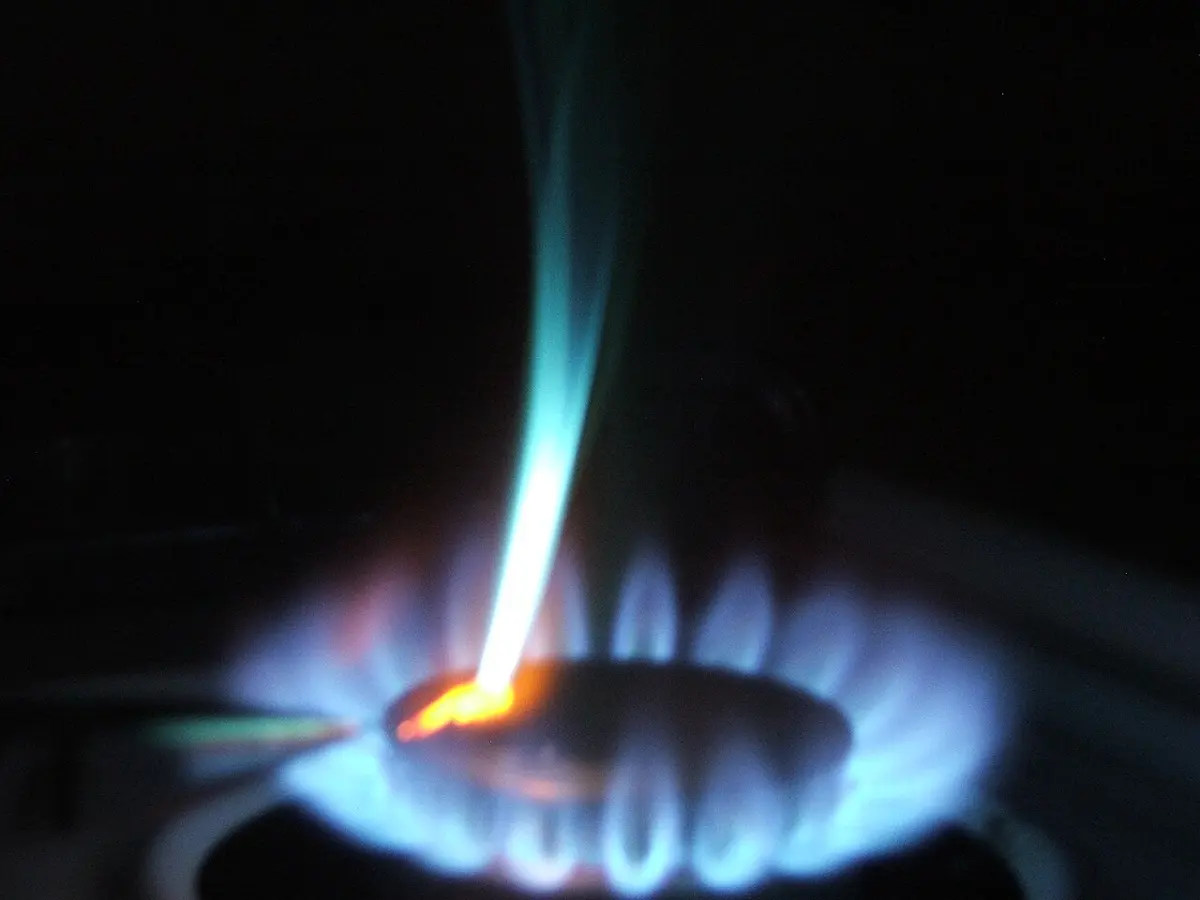
Heated strongly in air, zinc burns with a bluish-green flame, giving dense white smoke of zinc oxide, which settles as a light, woolly powder called philosopher’s wool:
Zinc oxide is yellow when hot and white when cold. Heated with a drop of cobalt nitrate solution, it turns green: Rinmann’s green, a cobalt zinc oxide (written CoZnO₂ or CoO·ZnO), a test for zinc.
Red-hot zinc also decomposes steam, giving zinc oxide and hydrogen:
2. Action of acids
Zinc lies above hydrogen in the electrochemical series, so it sets hydrogen free from dilute acids that aren’t oxidizing.
i. Dilute HCl and dilute H₂SO₄ give hydrogen:
Hot, concentrated H₂SO₄, an oxidizing agent, gives sulphur dioxide instead:
ii. Nitric acid is an oxidizing agent at every strength, so zinc never gives hydrogen with it. The product depends on the concentration (try zinc in the widget in 7.1.5):
a. Concentrated HNO₃:
b. Moderately concentrated (1 : 1) HNO₃:
c. Dilute HNO₃:
d. Very dilute HNO₃:
The more dilute the acid, the further the nitrogen is reduced: from +5 in HNO₃ to +4, +2, +1 and finally −3.
3. Action with alkali
Zinc dissolves in hot, concentrated sodium hydroxide solution, giving sodium zincate and hydrogen:
In solution the zincate is really the ion [Zn(OH)₄]²⁻: Zinc reacts with both acids and alkalis: it is amphoteric, like aluminium.
4. Displacement
Zinc displaces the less reactive metals below it in the electrochemical series from solutions of their salts:
7.2.6 Uses of zinc
- i.Galvanizing: coating iron and steel with zinc to stop rusting (7.4.9), the biggest use, about half of all zinc: corrugated roofs (jasta), buckets, wires, poles, pipes.
- ii.Dry cells: the case and anode of zinc–carbon cells, and the powdered zinc anode inside alkaline cells.
- iii.Alloys: brass (with copper), German silver (copper, zinc, nickel), and die-casting alloys such as zamak (zinc with about 4% aluminium).
- iv.Reducing agent: zinc dust recovers silver and gold from their cyanide solutions (7.5.3).
- v.Laboratory: granulated zinc with dilute acid to make hydrogen.
7.2.7 Compounds of zinc
A. White vitriol (ZnSO₄·7H₂O)
Introduction. Zinc sulphate heptahydrate, ZnSO₄·7H₂O, is called white vitriol; in Nepali, सेतो तुथो (seto tutho).
Preparation. Zinc, zinc oxide or zinc carbonate is dissolved in dilute sulphuric acid, and the solution crystallized:
The solution is concentrated and cooled below about 39 °C, and colorless crystals of the heptahydrate form:
Physical properties.
- i.A colorless (white) crystalline solid, very soluble in water.
- ii.Efflorescent: in dry air it slowly loses some of its water of crystallization, and the crystals’ surfaces turn to a white powder.
Chemical properties.
1. Action of heat. White vitriol loses six of its waters below about 100 °C and the last near 280 °C, becoming anhydrous zinc sulphate; above about 800 °C this decomposes to zinc oxide and sulphur trioxide (try white vitriol in the widget in 7.1.7):
2. Action with alkali. Sodium hydroxide gives a white precipitate of zinc hydroxide, which dissolves in excess alkali as sodium zincate (zinc hydroxide is amphoteric):
3. Action with barium sulphide (lithopone). Zinc sulphate and barium sulphide solutions together give a white precipitate of zinc sulphide and barium sulphate, both insoluble, formed together in intimate mixture. This mixture is lithopone, a white pigment:
4. Action with potassium ferrocyanide. A white precipitate of zinc ferrocyanide forms:
Uses of white vitriol.
- i.Its dilute solution as an astringent eye lotion (in the past).
- ii.As a fungicide, and to correct zinc deficiency in soils and in animal feed (rice in the Terai often suffers from it).
- iii.As the electrolyte in zinc electroplating and galvanizing.
- iv.To make lithopone.
- v.As a preservative for animal skins and leather.
- vi.As a laboratory reagent.
What is lithopone?
Pick an answer to see why.
Exercise (7.2 Zinc)
A. Multiple choice questions
- Which of the following is an ore of zinc?
Pick an answer to see why.
- What is the formula of Rinmann’s green?
Pick an answer to see why.
- What is the formula of white vitriol?
Pick an answer to see why.
- In the electrolytic refining of zinc, what is the cathode made of?
Pick an answer to see why.
- Which reducing agent is used in the smelting of zinc oxide?
Pick an answer to see why.
- Which reaction takes place during the smelting (reduction) of zinc oxide?
Pick an answer to see why.
- Which of the following is an ore of zinc?
Pick an answer to see why.
- What is the major use of zinc?
Pick an answer to see why.
- Which of the following is not a transition element?
Pick an answer to see why.
- What is X in the reaction ZnSO₄ + BaS → X?
Pick an answer to see why.
B. Short answer questions
Give reasons:
- a.Iron is coated with zinc.
- b.Zinc is not considered a typical transition element.
- c.Zinc does not form colored salts.
Answer
What is spelter? How is pure zinc obtained from spelter?
Answer
What is lithopone? How is it prepared? Write one use.
Answer
Write the formula of:
a. zincite b. calamine c. zinc blende d. white vitriol
Answer
A student evaporated zinc sulphate solution in an iron vessel by mistake. Predict and explain what happens, with equations and observations. How would you change the procedure to avoid the problem?
Hint
Answer
Zinc sulphate heptahydrate is called white vitriol.
- a.Starting from metallic zinc, how would you prepare white vitriol?
- b.Write the action of heat on white vitriol.
- c.What happens when its aqueous solution is treated with barium sulphide?
Answer
Write the balanced equation for:
- a.roasting of zinc sulphide ore
- b.thermal decomposition of white vitriol
- c.the action of air on zinc
Answer
Write a note on white vitriol.
Answer
Starting from zinc blende, how would you obtain pure zinc? Explain the steps, with a diagram.
Answer
C. Long answer questions
A non-typical transition metal M with atomic number 30 lies in Group 12 of the periodic table. It is most commonly used on house roofs.
- a.Identify M.
- b.Write the formula of the chief ore of M.
- c.How would you extract M from its chief ore?
- d.What happens when M is treated with dilute sulphuric acid, followed by crystallization?
- e.What happens when steam is passed over M heated to about 500 °C?
- f.Write two uses of M.
Answer
A newly found ore deposit contains a sulphide, a carbonate and silica (SiO₂). Analysis shows a non-typical transition element of Group 12, which forms compounds mainly in the +2 oxidation state. The sulphide and carbonate are its main sources; silica is an important impurity.
- a.Identify the element and write its chief ore.
- b.Describe the steps to extract it from its chief ore, with a diagram.
- c.How does this element react with nitric acid under different conditions?
- d.Write two uses of the element.
Answer
7.3 Mercury (Hg)
7.3.1 Introduction
Mercury is the only metal that is liquid at room temperature. It is silvery-white, melts at −38.83 °C, boils at 356.73 °C, and is very dense: 13.53 g/cm³, so dense that an iron nail floats on it. It was known to the ancient Chinese, Indians and Egyptians, who made it from cinnabar and used it in medicine, cosmetics, alchemy, and to extract gold and silver. In Nepali it is पारो (paro).
Until recently mercury was used in thermometers, barometers, fluorescent lamps and electrical switches. Because it and its compounds are poisonous, these uses are being given up, country by country, under the Minamata Convention (below).
7.3.2 Occurrence
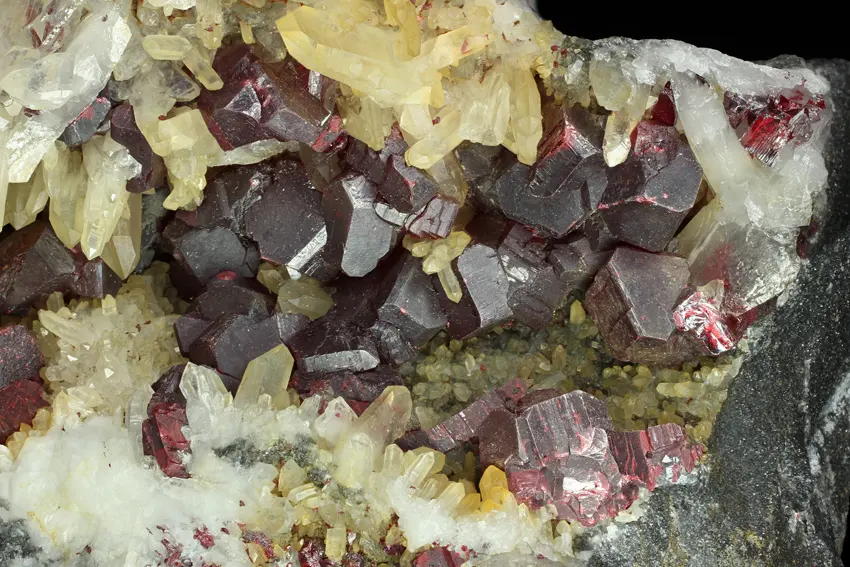
Mercury is found free, as small droplets in rock, in very small amounts. Most of it is combined, as the sulphide, cinnabar. Small showings of cinnabar have been reported in Nepal, near the Khimti river and at Tirchepani (Taruka), but none is mined. The chief ore is cinnabar, HgS; almost all the world’s mercury comes from it, much of it mined at Almadén in Spain for two thousand years until 2003, and now mostly in China.
7.3.3 Extraction of mercury from cinnabar
Mercury is extracted from cinnabar by pyrometallurgy; no reducing agent is needed, because roasting in air gives the metal directly (mercury(II) oxide breaks down at that heat).
1. Crushing and pulverization
The ore is broken in a jaw crusher and ground in a ball mill.
2. Concentration
The powdered ore is concentrated by froth flotation (Figure 7.4). (Cinnabar is also very dense, 8.1 g/cm³, so gravity separation works too.)
3. Roasting and distillation
Because mercury boils at only 357 °C, roasting and distillation are done in one closed furnace: a shaft furnace with a condenser (Figure 7.21). The concentrated ore, mixed with a little charcoal as fuel, is fed in at the top, and heated in a current of air. Cinnabar is oxidized to mercuric oxide, which at once breaks up into mercury vapor and oxygen:
or, adding the two:
The mercury vapor and the furnace gases are led out through iron pipes, bent down and up in a row of U (or Y) shapes, cooled by water. The mercury condenses and runs down into a receiver, under water; the sulphur dioxide and the volatile oxides of impurities (As₂O₃, P₂O₅, SO₂) pass on and leave by the outlet:
In the shaft furnace, what reduces the mercury of cinnabar to the metal?
Pick an answer to see why.
4. Purification
The condensed mercury contains dust, soot, mercuric oxide and dissolved metals (lead, zinc, copper, bismuth). It is purified in three steps.
i. Filtration. The impure mercury is squeezed through chamois leather (or thick canvas). The liquid mercury passes through the pores; soot, oxides and other suspended particles stay behind.
ii. Chemical washing (5% nitric acid). The filtered mercury is dropped as a fine spray from the top of a tall glass column of dilute (5%) nitric acid (Figure 7.22). As the droplets fall through the acid, a little mercury dissolves as mercury(I) nitrate:
The metals dissolved in the mercury, such as zinc, lead and copper, are more reactive than mercury: as each droplet falls, they displace mercury from the mercury(I) nitrate and go into the acid as their own nitrates, while the mercury returns to the droplet:
The clean mercury collects at the bottom and is drawn off through a side tube.
iii. Vacuum distillation. Finally the mercury is distilled under reduced pressure, which lowers its boiling point and so the risk of oxidizing it. Mercury boils off and is condensed; metals with higher boiling points (lead, copper, cadmium) are left behind. The mercury is about 99.9% pure; triple distillation gives 99.9999%.
7.3.4 Physical properties of mercury
Mercury is a silvery-white metal.
- i.Appearance: a shiny liquid at room temperature. Pure mercury stays bright in air; impure mercury soon gets a dull gray skin of oxide.
- ii.Conductivity: it conducts heat and electricity, though not as well as most metals (about a sixtieth as well as copper).
- iii.Solubility: practically insoluble in water and in ordinary solvents; it dissolves many other metals, forming amalgams.
- iv.Density: 13.53 g/cm³ at 25 °C.
- v.Melting and boiling points: it melts at −38.83 °C and boils at 356.73 °C.
- vi.Surface tension: very high, so it forms round beads and doesn’t wet glass (its meniscus curves down).
- vii.Toxicity: its vapor is poisonous. Even at room temperature, the air above a spill can hold dangerous amounts.
7.3.5 Chemical properties of mercury
1. Action of air
Mercury is not affected by air at ordinary temperatures. Heated in air near its boiling point, at about 350 °C, it slowly forms red mercuric oxide:
At a higher temperature, above about 450 °C, mercuric oxide breaks up again into mercury and oxygen:
2. Action of acids
Mercury lies below hydrogen in the electrochemical series, so it can’t set hydrogen free from dilute acids.
i. Hydrochloric acid. Mercury doesn’t react with hydrochloric acid alone. In the presence of an oxidizing agent such as chlorine (or nitric acid), it forms mercuric chloride:
ii. Nitric acid oxidizes mercury.
a. Cold, dilute nitric acid, with mercury in excess, gives mercury(I) (mercurous) nitrate:
b. Hot, concentrated nitric acid, in excess, gives mercury(II) (mercuric) nitrate:
iii. Aqua regia. Aqua regia (“royal water”) is a mixture of one volume of concentrated nitric acid with three of concentrated hydrochloric acid. It is so called because it dissolves even the “royal” metals gold and platinum, which neither acid dissolves alone. The two acids react to give nitrosyl chloride and chlorine, powerful oxidizing agents, written as nascent chlorine [Cl]:
Mercury dissolves in aqua regia as mercuric chloride:
iv. Sulphuric acid. Hot, concentrated sulphuric acid oxidizes mercury to mercuric sulphate:
3. Action of water and alkalis
Mercury reacts with neither water nor alkalis.
4. Action of ozone
Ozone oxidizes mercury to mercury(I) oxide:
The thin film of oxide makes the mercury lose its round shape: it sticks to glass and leaves a trail, or tail, when made to run down a slope, and its surface no longer curves down. This is called the tailing of mercury, and it is a test for ozone. Shaking the mercury with water removes the film.
5. Formation of amalgams
Mercury dissolves many metals, forming alloys called amalgams: with sodium (sodium amalgam), gold, silver, tin, zinc, copper and others.
The amalgam is written as a mixture, not one formula, because its composition varies.
7.3.6 Uses of mercury
- i.Extracting gold and silver by amalgamation (now restricted, see below).
- ii.In thermometers, barometers and blood-pressure instruments (being replaced).
- iii.In amalgams, including dental fillings (silver amalgam: about half mercury, with silver, tin and copper).
- iv.As the cathode in the mercury cell for making chlorine and caustic soda (being closed down).
- v.In laboratory instruments and research (manometers, mercury pumps, diffusion pumps).
- vi.In electrical switches and relays that are worked by tilting.
- vii.In mercury cells (button batteries) for hearing aids and cameras, now banned.
- viii.In mercury vapor lamps, which give a bluish light rich in ultraviolet, and in fluorescent tubes and CFLs, whose glowing mercury vapor makes UV that the coating turns into visible light.
Mercury, health and the Minamata Convention
Mercury and its compounds are poisonous, and they don’t break down: they go round and round between air, water and living things. Mercury vapor, breathed in, passes into the blood and on to the brain and kidneys; it causes tremors, irritability, memory loss and kidney damage (hatters, who used mercury to make felt, were famously ill from it: the “mad hatter”). Soluble mercury salts such as HgCl₂ corrode the gut and destroy the kidneys. The worst is methylmercury, CH₃Hg⁺, made from mercury by bacteria in mud: it builds up along food chains, so that big fish can carry a million times more than the water, and it damages the nervous system, above all of an unborn child.
Nepal and mercury. Nepal signed the Minamata Convention on 10 October 2013, but by November 2026 it had still not ratified it (made it binding by a decision of Parliament), according to the Convention’s own list of parties (154 parties then). In health care, Nepal has been replacing mercury thermometers and BP instruments with digital ones. Mercury is still met in dental amalgam, in the work of metal platers and gilders (the fire gilding of statues, 7.1.6), in broken CFLs, and in some cosmetics and cheap sindur.
Methylmercury is especially dangerous because
Pick an answer to see why.
7.3.7 Compounds of mercury
A. Calomel (mercurous chloride, Hg₂Cl₂)
Introduction. Mercury(I) chloride, or mercurous chloride, is called calomel. Its formula is Hg₂Cl₂, not HgCl. Calomel has been used in medicine for centuries and in reference electrodes. Being almost insoluble, it is far less poisonous than mercuric chloride, but it is not harmless.
Preparation.
- From mercurous nitrate (the laboratory method): a soluble chloride, such as dilute HCl or NaCl solution, is added to mercurous nitrate solution, and white calomel precipitates:
- From mercuric chloride:
a. by heating mercuric chloride with mercury (the calomel sublimes):
b. by reducing mercuric chloride with a limited amount of stannous chloride:
- From mercuric sulphate: by heating mercuric sulphate, mercury and sodium chloride together; the calomel sublimes:
Physical properties.
- i.A white powder, practically insoluble in water.
- ii.It dissolves in aqua regia (by being oxidized to HgCl₂).
- iii.Tasteless; much less poisonous than mercuric chloride because so little dissolves, but still toxic in larger or repeated doses.
Chemical properties.
1. Action of heat. On strong heating, calomel sublimes, and part of it breaks up into mercuric chloride and mercury (the mercury(I) disproportionates: one Hg goes up to +2, the other down to 0):
2. Action with alkali. Sodium hydroxide turns calomel black: mercury(I) oxide forms, which itself is really a mixture of mercuric oxide and finely divided mercury:
3. Action with ammonia. Calomel turns black with ammonia solution: a mixture of white mercuric amidochloride and black, finely divided mercury forms:
This is a test that tells calomel from other white chlorides (AgCl dissolves in ammonia; PbCl₂ doesn’t change).
4. Action with aqua regia. Calomel is oxidized to mercuric chloride (corrosive sublimate):
5. Action with stannous chloride. Calomel is reduced to gray-black mercury:
Uses of calomel.
- i.As a laxative (purgative) in medicine, from the 1500s to the mid-1900s, now given up.
- ii.In the calomel electrode, a secondary reference electrode.
- iii.As an antiseptic, and in teething powders for babies (both long abandoned: the powders caused “pink disease” in children).
B. Corrosive sublimate (mercuric chloride, HgCl₂)
Introduction. Mercury(II) chloride, mercuric chloride, HgCl₂, is called corrosive sublimate: corrosive because it attacks living tissue (and many metals), and sublimate because it is purified by sublimation. It is highly poisonous (a gram or two can kill). It was long used as a disinfectant, antiseptic and pesticide, uses now given up because of its toxicity.
Preparation.
- From calomel, by dissolving it in aqua regia:
- From mercury, by heating it in excess chlorine:
- From mercuric oxide, by dissolving it in dilute hydrochloric acid:
- From mercuric sulphate (the industrial method), by heating it with sodium chloride and a little manganese dioxide; the HgCl₂ sublimes:
The manganese dioxide, an oxidizing agent, oxidizes any mercury(I) to mercury(II), so no calomel forms.
Physical properties.
- i.White crystals, sparingly soluble in cold water (about 7 g per 100 g at 20 °C) and much more soluble in hot water and alcohol.
- ii.It melts at 276 °C, and it sublimes easily (it boils at 304 °C).
- iii.It dissolves in aqua regia.
- iv.Very poisonous.
Chemical properties.
1. Action of heat. Heated, corrosive sublimate melts and sublimes unchanged; it doesn’t decompose at the temperatures of a laboratory burner. (Its vapor condenses back to white crystals on a cool surface.)
2. Action with alkali. Sodium hydroxide gives a yellow precipitate of mercuric oxide:
3. Action with ammonia. Ammonia solution gives a white precipitate of mercuric amidochloride (“infusible white precipitate”):
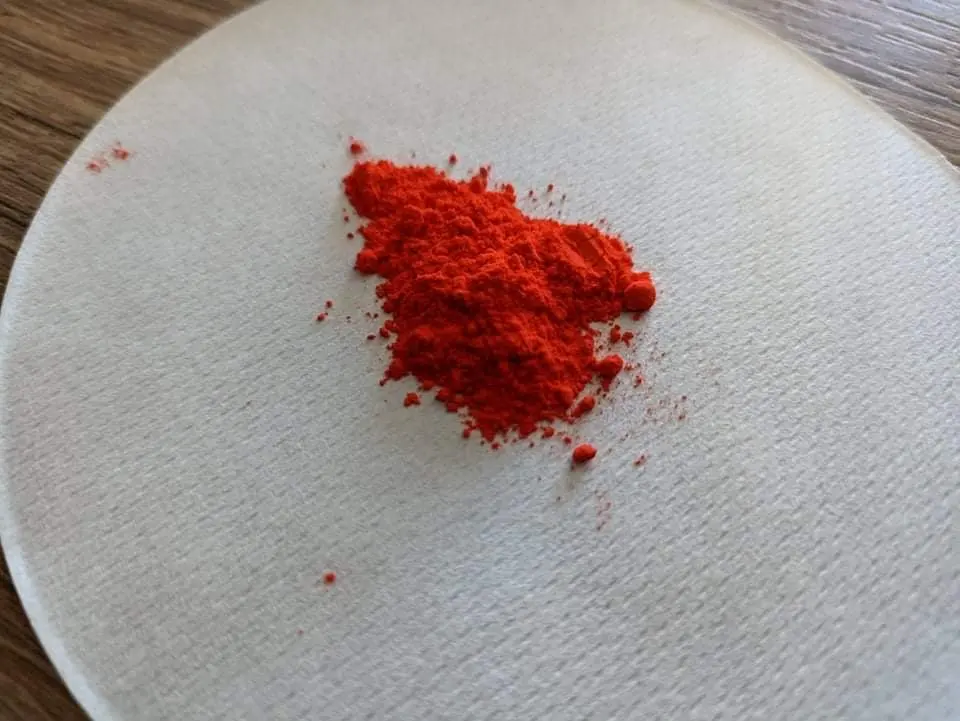
4. Action with potassium iodide. A little KI gives a scarlet precipitate of mercuric iodide; excess KI dissolves it, forming the colorless complex potassium tetraiodomercurate(II):
A solution of K₂[HgI₄] made alkaline with KOH is Nessler’s reagent. It gives a yellow-brown color or precipitate with even traces of ammonia or ammonium salts, so it is used to test for ammonia, for example in drinking water.
5. Action with potassium thiocyanate. White mercuric thiocyanate precipitates:
Uses of corrosive sublimate.
- i.Formerly as a pesticide, especially a fungicide, and to treat seed.
- ii.Formerly, a very dilute solution (about 0.1%, 1 g in a liter) as a disinfectant and antiseptic.
- iii.To prepare calomel and Nessler’s reagent.
- iv.To preserve timber and museum specimens (stuffed animals, herbarium sheets) against insects.
Exercise (7.3 Mercury)
A. Multiple choice questions
- Which of the following is the chief ore of mercury?
Pick an answer to see why.
- What is the formula of corrosive sublimate?
Pick an answer to see why.
- What is the formula of calomel?
Pick an answer to see why.
- What happens when mercury is mixed with other metals?
Pick an answer to see why.
- Which was the traditional antidote for poisoning by corrosive sublimate?
Pick an answer to see why.
- Which gas is given off from cinnabar during the extraction of mercury?
Pick an answer to see why.
- Which of the following is an ore of mercury?
Pick an answer to see why.
- Which of the following is also known as quicksilver?
Pick an answer to see why.
- Which of the following sublimes on heating?
Pick an answer to see why.
- What is X in the reaction HgCl₂ + 4KI (excess) → X + 2KCl?
Pick an answer to see why.
B. Short answer questions
Give reasons:
- a.Mercury(II) chloride is called corrosive sublimate.
- b.Mercury(II) chloride is more toxic than mercury(I) chloride.
- c.Distillation is the most common and efficient method of purifying mercury.
Answer
What is the chief ore of mercury? How is pure mercury obtained from it?
Answer
What is Nessler’s reagent? How is it prepared? Write one use.
Answer
Write the formula of:
a. cinnabar b. Nessler’s reagent c. corrosive sublimate d. calomel
Answer
A student added ammonia solution to a solution of mercury(II) chloride. Predict and explain what happens, with the equation and observations.
Answer
Mercury(II) chloride is called corrosive sublimate.
- a.Starting from metallic mercury, how would you prepare corrosive sublimate?
- b.What is the action of heat on corrosive sublimate?
- c.What happens when its aqueous solution is treated with excess KI?
- d.Write two uses of corrosive sublimate.
Answer
Write the balanced equation for:
- a.roasting of cinnabar
- b.the action of aqua regia on mercury
- c.the action of ozone on mercury
Answer
Write a note on calomel.
Answer
Starting from cinnabar, how would you obtain pure mercury? Explain the steps, with a diagram.
Answer
Write the chemistry of corrosive sublimate.
Answer
Discuss the purification of mercury obtained from cinnabar.
Answer
C. Long answer questions
A liquid metal M with atomic number 80 lies in Group 12 of the periodic table. It is used as a thermometric and barometric liquid.
- a.Identify M.
- b.Write the formula of the chief ore of M.
- c.How would you extract M from its chief ore?
- d.What happens when M is treated with aqua regia?
- e.What happens when M is heated in air at about 350 °C?
- f.Write two uses of M.
Answer
A newly found ore deposit contains a sulphide and some impurities. Analysis shows a metal of Group 12 with atomic number 80, which forms compounds in the +1 and +2 oxidation states.
- a.Identify the element and write its chief ore.
- b.Describe the steps to extract it from its chief ore, with a diagram.
- c.Write the formulas of two important compounds of this element, one with oxidation state +1 and one with +2.
- d.Write two uses of this element.
Answer
7.4 Iron (Fe)
7.4.1 Introduction
Iron is the fourth most common element in the Earth’s crust (about 5% of it) and the most used metal of all: the world makes about 1.9 billion tons of steel a year, about 230 kg for every person on Earth. People first used iron from meteorites, then learned to smelt it from its ores more than three thousand years ago, which began the Iron Age. In Nepali it is फलाम (phalam); its symbol Fe comes from the Latin ferrum.
Iron is a transition metal of the 3d series, in period 4 and Group 8. Its atomic number is 26 and its atomic mass 55.85 u. It melts at 1538 °C, boils at 2862 °C, and has a density of 7.87 g/cm³.
7.4.2 Occurrence
Iron is too easily attacked by air and water to be found free, except in meteorites. It is found combined, as oxides, carbonates and sulphides; the red, brown and yellow colors of many soils and rocks are iron oxides. In Nepal, iron ore is found at Phulchoki (Lalitpur), Thoshe (Ramechhap), Jhumlabang (Rukum East) and Dhaubadi (Nawalparasi East). Nepal’s steel mills today melt imported scrap, sponge iron and billets in electric furnaces and roll them into rods.
The main ores of iron:
| Ore | Formula | Iron by mass |
|---|---|---|
| Hematite (red) | Fe₂O₃ | 70% |
| Limonite (brown hematite) | 2Fe₂O₃·3H₂O | 60% |
| Magnetite (black, magnetic) | Fe₃O₄ | 72% |
| Siderite (spathic iron ore) | FeCO₃ | 48% |
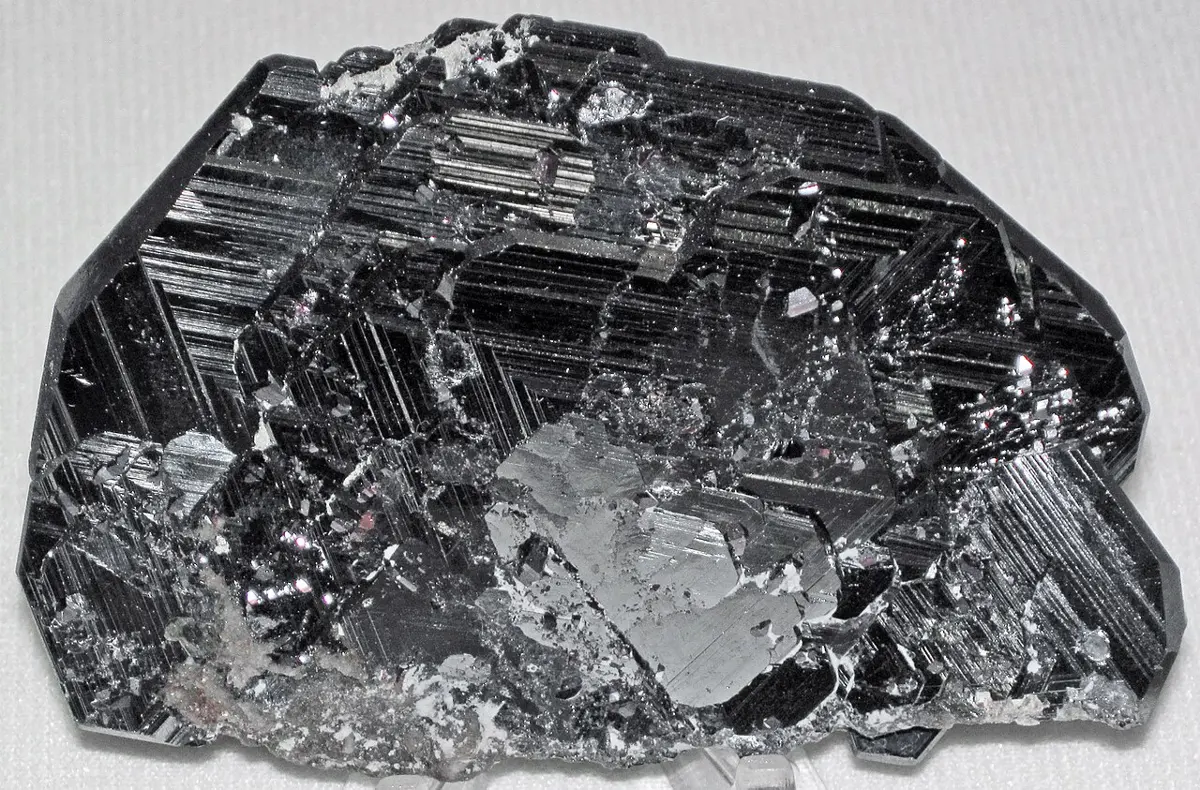
| Iron pyrites (fool’s gold) | FeS₂ | 47% |
| Copper pyrites | CuFeS₂ | 30% |
Limonite is not one compound but a mixture of hydrated iron oxides (mostly FeO(OH)·nH₂O); 2Fe₂O₃·3H₂O is its traditional formula, and some books write Fe₂O₃·3H₂O.
Iron pyrites and copper pyrites are not used as ores of iron: their sulphur would make the iron brittle, and copper pyrites is mined for copper. The chief ore is hematite: it is rich in iron, found in enormous deposits (Australia, Brazil, India), and as an oxide needs no roasting to remove sulphur.
7.4.3 Extraction of iron from hematite
Iron is extracted from hematite by pyrometallurgy, by reduction with carbon. The steps:
1. Crushing and pulverization
The ore is broken in jaw crushers and ground in ball mills.
2. Concentration
Hematite is an oxide, much denser (about 5.3 g/cm³) than its sand and clay (about 2.6 g/cm³), so it is concentrated by gravity separation (Figure 7.25): the powdered ore is washed down a sloping, shaking table with running water; the heavy ore grains settle and the light gangue is washed away. If the ore is magnetite, or has magnetic impurities, magnetic separation is used as well.
3. Calcination (and roasting)
The concentrated ore is heated strongly with a little coal in a current of air, in a shaft furnace or rotary kiln. This:
- drives off water from hydrated ores:
- breaks up any siderite, and oxidizes the ferrous oxide formed to ferric oxide:
- burns off sulphur, phosphorus and arsenic as their volatile oxides:
- and leaves the ore porous, so the gases in the blast furnace can get into it.
Since there is air, this is strictly roasting for the ferrous compounds, but the step is usually called calcination. It is important that ferrous oxide is oxidized to ferric oxide, because ferrous oxide would otherwise combine with the silica of the gangue into slag, and that iron would be lost:
4. Reduction in the blast furnace (smelting)
The calcined ore is reduced in a blast furnace (Figure 7.26): a tall steel tower, 30 m or more high, lined with fire bricks to stand the heat. Its parts:
- the stack or shaft, where the raw materials go in and move slowly down, wider towards the bottom so that the charge doesn’t jam as it swells;
- the cup and cone (bell) at the top, which let the charge in without letting the gases out;
- the bosh, the part that narrows below the widest point, where the charge softens and melts;
- the tuyeres, water-cooled nozzles near the bottom through which hot air is blown in;
- the hearth, at the bottom, where the molten iron and slag collect, with tap holes for each;
- the Cowper stoves beside it, tall towers of brickwork heated by burning the waste gas from the top, through which the air is blown to preheat it to about 1000 °C.
The charge, called the burden, is calcined ore, coke and limestone, in roughly the proportion 8 : 4 : 1 by mass (ore : coke : limestone). Coke is both the fuel and the reducing agent; limestone is the flux. As the charge moves down and the hot gases rise through it, the furnace sorts itself into zones of different temperature, and different reactions happen in each:
i. Zone of combustion (1300–1500 °C). Just above the tuyeres, at the bottom, the hot air meets the coke, which burns fiercely:
This gives out the heat that drives the whole furnace, the hottest part, at up to 1500 °C (and even 2000 °C right at the tuyeres).
ii. Zone of fusion (1200–1300 °C). Just above it, the carbon dioxide meets more hot coke and is reduced to carbon monoxide, the furnace’s real reducing agent:
This reaction takes in heat, so the temperature falls a little. Here the spongy iron coming down from above melts, and dissolves carbon, silicon, phosphorus and sulphur from the coke and the slag; some of the carbon forms iron carbide (cementite):
Any iron oxide that has got this far unreduced is reduced by the coke directly:
The molten iron trickles down into the hearth, and the slag with it.
iii. Zone of slag formation (700–1000 °C). In the middle of the furnace, the limestone breaks up, and the lime formed combines with the silica of the gangue into slag, calcium silicate:
The molten slag runs down and floats on the iron in the hearth, which it also protects from the air blast.
iv. Zone of reduction (400–700 °C). In the upper part of the stack, the rising carbon monoxide reduces the iron oxide to iron. The temperature here is too low to melt the iron, so it forms as a porous solid, spongy iron:
(In fact the oxide is reduced step by step as it goes down: Fe₂O₃ to Fe₃O₄, then FeO, then Fe.)
The spongy iron melts as it reaches the zone of fusion. The molten iron is tapped from the bottom every few hours and run into molds, where it sets as big blocks: pig iron. Pig iron remelted with scrap and a little coke and poured into molds to set in the shape needed (pipes, manhole covers, the bodies of motors) is cast iron. The waste gas from the top, still rich in carbon monoxide, is burnt in the Cowper stoves to heat the air blast.
7.4.4 Different forms of iron
Iron is grouped by how much carbon it holds, which changes its properties completely:
- a.Cast iron: 2–4.5% carbon. Hard and brittle: it can be cast in molds but not hammered into shape.
- b.Steel: about 0.1–2% carbon. Hard, tough and strong, yet malleable: it can be rolled, forged and drawn. The more carbon, the harder and less ductile.
- c.Wrought iron: under 0.1% carbon. The purest commercial iron, about 99.5–99.8% iron. Soft, malleable and ductile.
Why carbon matters so much shows on the iron–carbon diagram (above, in the figure). Carbon lowers iron’s melting point, from 1538 °C for pure iron to 1147 °C at 4.3% carbon, the eutectic: so cast iron, near that composition, melts far more easily than steel and runs into molds. Below its melting range, steel is austenite, a hot solid in which carbon dissolves; it can be rolled and forged. On cooling below 727 °C (723 °C in older books), austenite of 0.8% carbon, the eutectoid, turns all at once into pearlite, fine layers of soft iron and hard iron carbide (cementite, Fe₃C). How fast steel is cooled through this change decides how hard it ends up, which is what quenching and tempering (7.4.8) use.
7.4.5 Physical properties of iron
Pure iron is a soft, silvery-white metal.
- i.Appearance: a lustrous gray solid at room temperature; carbon makes it hard.
- ii.Conductivity: a good conductor of heat and electricity.
- iii.Workability: malleable and ductile, though less ductile than copper.
- iv.Density: 7.87 g/cm³.
- v.Melting and boiling points: it melts at 1538 °C and boils at 2862 °C.
- vi.Ferromagnetism: iron is strongly attracted by magnets and can be made into a magnet. It loses this property above 770 °C, its Curie temperature.
7.4.6 Chemical properties of iron
1. Action of air
Pure iron isn’t affected by dry air. Ordinary iron in moist air slowly gets a reddish-brown, flaky coat of hydrated ferric oxide, rust:
Finely divided iron heated in oxygen (or iron wire burnt in oxygen, with brilliant sparks) gives black ferrosoferric oxide, magnetite:
2. Action of water
Cold water has no effect on iron (without air). Red-hot iron decomposes steam, giving ferrosoferric oxide and hydrogen:
3. Action of alkalis
Alkalis don’t attack iron.
4. Action of acids
Iron lies above hydrogen in the electrochemical series, so it sets hydrogen free from dilute non-oxidizing acids.
i. Dilute HCl gives iron(II) chloride and hydrogen:
ii. Dilute H₂SO₄ gives iron(II) sulphate and hydrogen:
Hot, concentrated sulphuric acid, an oxidizing agent, gives sulphur dioxide, and the iron is oxidized all the way to iron(III):
(Cold, concentrated sulphuric acid hardly attacks iron at all, which is why it is carried in steel tankers.)
- iii.Nitric acid:
- a.Concentrated HNO₃ makes iron passive: a thin, tight film of oxide (Fe₃O₄) forms at once on the surface, and the reaction stops. Passive iron no longer dissolves in dilute acids or displaces copper from copper sulphate, until the film is scratched. This is the passivity of iron:
b. Moderately concentrated, hot HNO₃ gives iron(III) nitrate and nitrogen dioxide:
c. Cold, dilute HNO₃ gives iron(II) nitrate and ammonium nitrate, and no gas:
5. Displacement
Iron displaces the less reactive metals below it in the electrochemical series from their solutions:
6. Action of carbon monoxide
Iron heated with carbon monoxide under pressure (about 200 °C and 100 atmospheres) forms a yellow liquid, iron pentacarbonyl:
On stronger heating, it breaks up again into very pure, fine iron powder and CO; this is used to make pure iron for magnetic cores.
7.4.7 Uses of iron
Iron is used mostly as steel and cast iron:
- i.As a construction material, for buildings, bridges and roads (rods, beams, sheets).
- ii.To make steel and other alloys.
- iii.In ships, vehicles, railways, machines, pipes and many household things.
- iv.In cooking pots, karahis, tawas and utensils.
- v.As iron oxide in magnetic materials: the coating of old cassette and computer tapes, transformer cores and magnets.
- vi.In the body, in hemoglobin, which carries oxygen in the blood; iron tablets treat anemia.
7.4.8 Manufacture of steel by the open hearth and basic oxygen processes
Steel is an alloy of iron with about 0.1–2% of carbon and small amounts of other elements. Pure iron is soft and bends easily; a little carbon makes it hard and strong. Steel holding only carbon is plain (carbon) steel; steel with other metals added on purpose, such as nickel, chromium, manganese, tungsten, vanadium or cobalt, is alloy (special) steel. Stainless steel, for example, is iron with at least 10.5% chromium (usually about 18%) and, often, about 8% nickel. The chromium forms the invisible, self-healing film of chromium oxide that keeps it from rusting.
Steel’s carbon content lies between that of cast iron and wrought iron, so steel is made either by lowering the carbon of cast (pig) iron, or by adding carbon to wrought iron. The methods:
- i.Bessemer process (from pig iron)
- ii.Open hearth process (from pig iron and scrap)
- iii.Basic oxygen process (from pig iron and scrap)
- iv.Crucible process (from wrought iron)
- v.Cementation process (from wrought iron)
- vi.Electric furnace process (from scrap or sponge iron)
Here we study the open hearth process and the basic oxygen process.
Manufacture of steel by the open hearth process
In the open hearth process, steel is made from a charge of about 70–80% pig (cast) iron, 20–30% scrap iron and steel, and a little hematite, with lime as the flux, melted in a long, shallow hearth (Figure 7.31). The furnace is heated by burning producer gas with air, both preheated by the regenerators, to about 1600–1700 °C. The impurities in the pig iron (carbon, silicon, manganese, sulphur and phosphorus) are oxidized, partly by the air of the flame and mostly by the oxygen of the hematite, and removed as gases or slag.
The lining of the hearth must suit the impurities. Basic impurities (oxides of metals such as MnO) need an acidic lining of silica (SiO₂); acidic impurities (P₂O₅, SiO₂) need a basic lining of calcined dolomite (CaO·MgO) or magnesite. So the process is either acidic or basic.
Acidic process. The hearth is lined with an acidic material, silica. It is used for pig iron low in phosphorus and sulphur, because an acidic lining can’t take up P₂O₅. The hematite oxidizes the impurities, which leave as gases or form slag:
Basic process. The hearth is lined with a basic material, calcined dolomite or magnesite, and limestone is added. It removes acidic impurities, and works even for pig iron high in phosphorus. The same oxidations happen, and the phosphorus is oxidized and taken up by lime as calcium phosphate:
This phosphate slag, called basic slag, is ground and sold as a phosphate fertilizer.
In both processes, samples are taken from time to time and tested. When the impurities have gone, a calculated amount of spiegeleisen (a pig iron rich in manganese, about 15–30% Mn and 5% C) or ferromanganese is added: its manganese removes the last dissolved oxygen and sulphur, and its carbon brings the steel to the carbon content wanted. The steel is tapped and cast into molds. A batch takes 8–10 hours.
Advantages of the open hearth process (it made most of the world’s steel from about 1900 to 1970):
- i.It produces large amounts of steel of good, even quality.
- ii.The carbon content can be controlled exactly, since the process is slow and samples can be tested.
- iii.It uses scrap iron and steel as well as pig iron.
- iv.It removes impurities such as Si, P and S effectively.
- v.It is versatile: many grades of steel can be made.
Disadvantages of the open hearth process:
- i.It is slow: 8–10 hours a batch.
- ii.It needs a great deal of fuel and energy.
- iii.The furnace and its regenerators are costly to build.
- iv.It gives off harmful gases (CO, CO₂, SO₂) and dust.
- v.Because of these, it has been almost entirely replaced, by the basic oxygen process and electric arc furnaces: by the 2020s it made under 1% of the world’s steel.
Manufacture of steel by the basic oxygen process (BOP)
The basic oxygen process makes steel from molten pig iron (with up to about a quarter scrap) in an LD converter (Figure 7.32): a pear-shaped steel vessel lined with basic refractory bricks (magnesite or dolomite), which can be tilted. It is a modern form of the Bessemer process, using pure oxygen instead of air.
The converter is tilted, and scrap and then molten pig iron are poured in. It is turned upright, and a water-cooled lance is lowered into its mouth, through which pure oxygen is blown at supersonic speed onto the surface of the metal. The oxygen burns the carbon to carbon monoxide (much of which burns to CO₂ at the mouth) and oxidizes silicon, manganese and phosphorus to their oxides:
The bubbling of CO stirs the metal violently. Lime (CaO), the basic flux, is added during the blow; it takes up the acidic oxides as slag, and with them most of the sulphur:
These oxidations give out so much heat that the process needs no fuel: it is autogenous (self-heating), and scrap is added to keep the temperature down. When samples show the carbon is right, the blow is stopped, the converter is tilted, and the steel is poured out through a tap hole in its side, below the slag; then the slag is poured off from the mouth by tilting the other way. A 300-ton batch takes only about 40 minutes, tap to tap.
Advantages of the basic oxygen process:
- i.It is fast: 30–45 minutes a batch, against 8–10 hours for the open hearth.
- ii.It gives steel of high quality, low in nitrogen, phosphorus and sulphur.
- iii.It is now the main method: about 70% of the world’s steel is made this way (the rest mostly in electric arc furnaces from scrap).
- iv.It is autogenous: the oxidation of the impurities gives all the heat needed, so no fuel is burnt.
- v.Its gases are collected and cleaned (and the CO used as fuel), so it causes far less air pollution than older methods.
7.4.9 Corrosion of iron and its prevention
Corrosion is the slow wearing away of a metal by chemical or electrochemical reaction with its surroundings (air, water, acids, salts), which turns it back into a compound such as an oxide. The corrosion of iron is called rusting. When iron is exposed to moist air for a long time, its surface gets covered with a reddish-brown layer of hydrated ferric oxide, Fe₂O₃·xH₂O, called rust:
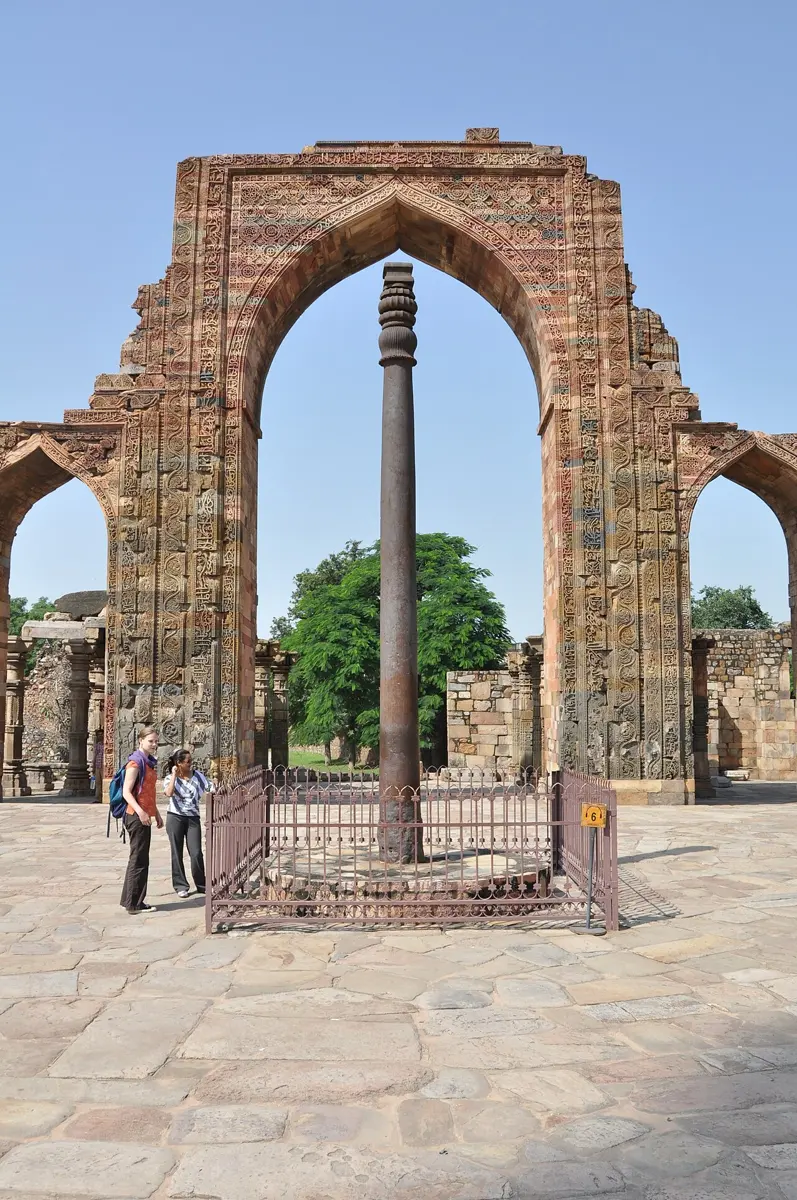
Rust is porous and flaky: unlike the patina on copper or the film on zinc, it doesn’t protect the iron underneath, so rusting goes on until the iron is eaten through. Rusting needs both oxygen and water; salt and acids (from CO₂, SO₂ in the air) speed it up.
Try it in the widget: which nails rust?
Theory of rusting
Rusting has been explained by two theories.
1. Electrochemical theory. According to this theory, which is now accepted, tiny electrochemical (voltaic) cells form on the surface of the iron itself (Figure 7.33). The surface is never uniform: impurities, strains and, above all, differences in how much oxygen reaches each spot make some parts more easily oxidized than others. The part with the lower reduction potential becomes the anode, and the part with the higher reduction potential the cathode. The film of water on the iron, with gases such as oxygen, carbon dioxide and sulphur dioxide dissolved in it, is the electrolyte.
At the anode, iron atoms are oxidized to ferrous ions, which go into the water, leaving their electrons in the metal:
The electrons flow through the iron to the cathode region. At the cathode, they reduce dissolved oxygen. The water there is made slightly acidic by dissolved carbon dioxide:
and the hydrogen ions and oxygen take up the electrons:
(This can be thought of in two steps: , then . In neutral water the cathode reaction is .) Adding the half reactions, the anode’s twice:
The ferrous ions move through the water and are oxidized further by dissolved oxygen to iron(III), which separates as hydrated ferric oxide, rust:
That is why rust often forms a little away from the pits where the iron is eaten: the iron dissolves at the anode, but rust is deposited where the Fe²⁺ ions meet oxygen.
2. Chemical theory (acid theory). According to this older theory, carbon dioxide and water form carbonic acid, which attacks iron, forming soluble ferrous bicarbonate and hydrogen:
The ferrous bicarbonate is then oxidized by oxygen and water to ferric hydroxide, which becomes rust:
The weakness of this theory: iron rusts even where there is no carbon dioxide at all, which it can’t explain. The electrochemical theory explains this, and why salt water, which conducts better, speeds rusting so much.
In the electrochemical theory of rusting, the iron where the pit forms acts as
Pick an answer to see why.
Prevention of rusting
Rust weakens iron and steel: it eats away bridges, buildings, vehicles and machines, which can then fail without warning, and costs every country huge sums in repair and replacement, by some estimates over 3% of the world’s total income each year. Preventing it makes iron last longer, keeps it safe and saves money. The methods:
i. Galvanization. The iron or steel is coated with a thin layer of zinc, by dipping it in molten zinc (hot-dip galvanizing) or by electroplating. The zinc protects the iron in two ways. It is a barrier that keeps air and water off. And because zinc is more electropositive (more reactive) than iron, if the coating is scratched, the zinc becomes the anode and corrodes instead of the iron: the iron is the cathode and is protected. This is sacrificial protection (or cathodic protection): a more reactive metal sacrifices itself. Blocks of magnesium or zinc bolted to ships’ hulls, buried pipelines and water heaters protect them in the same way.
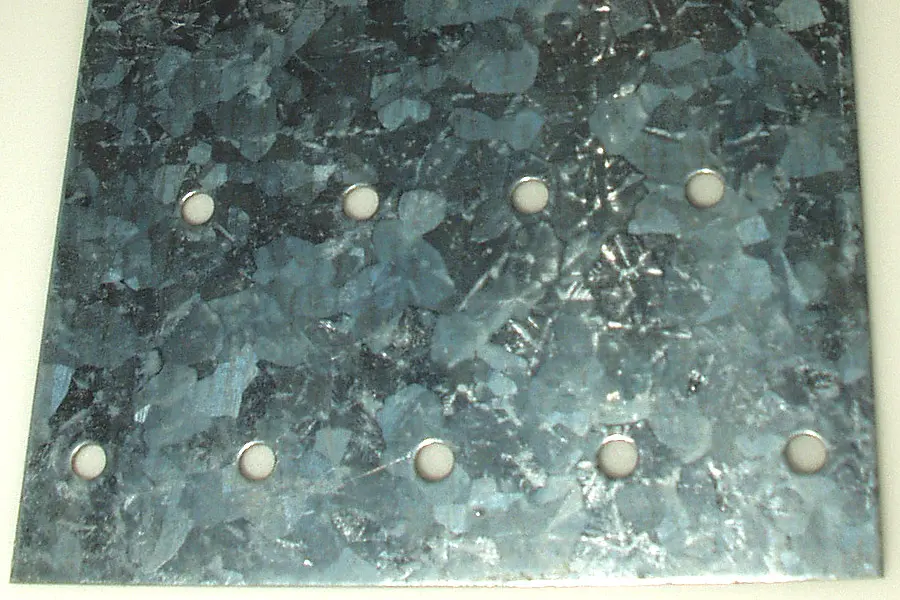
ii. Alloying. Iron alloyed with chromium, nickel, manganese or silicon resists rusting. Chromium is the most effective: stainless steel (at least 10.5% chromium) is covered by a thin, invisible film of chromium oxide that heals itself when scratched.
iii. Protective barriers. A coat of paint, grease, oil, enamel, varnish, plastic or tar keeps air and water away from the iron: this is barrier protection. Steel is often first painted with a red oxide primer, an iron oxide paint (older primers used red lead, Pb₃O₄, now avoided because lead is poisonous), then with top coats. Tin plating (tin cans) is a barrier too.
iv. Bower–Barff process. The iron is heated to a high temperature in superheated steam (Barff, 1876) or in air followed by carbon monoxide (Bower). A thin, hard, tightly fixed film of black ferrosoferric oxide, Fe₃O₄, forms on the surface, , and protects the iron below. (Gun barrels are still “blued” in a similar way.)
v. Corrosion inhibitors. Some chemicals, added in small amounts to the water or the paint, slow corrosion down, by forming a protective film on the metal or taking up the oxygen: phosphates, chromates, amines and soaps. Engine coolants and the water in central heating carry them.
Exercise (7.4 Iron)
A. Multiple choice questions
- From which ore is iron extracted in the blast furnace?
Pick an answer to see why.
- What is the main reducing agent in the blast furnace?
Pick an answer to see why.
- What is used as a flux in the blast furnace?
Pick an answer to see why.
- Which reaction actually reduces the iron ore in the blast furnace?
Pick an answer to see why.
- Which is also called the open hearth process?
Pick an answer to see why.
- Which is used as the refractory lining in the acidic open hearth process?
Pick an answer to see why.
- What is the main raw material in the basic oxygen process?
Pick an answer to see why.
- What does the pure oxygen do in the basic oxygen process?
Pick an answer to see why.
- Which best describes the rusting of iron?
Pick an answer to see why.
- What is the formula of rust?
Pick an answer to see why.
- In the electrochemical theory of rusting, how does the iron (where it is eaten away) behave?
Pick an answer to see why.
- Which of these speeds up the rusting of iron?
Pick an answer to see why.
- Which of these is not required for iron to rust?
Pick an answer to see why.
- Which of these does not prevent rusting?
Pick an answer to see why.
- Which is the hottest zone of the blast furnace?
Pick an answer to see why.
B. Short answer questions
Give reasons:
- a.Iron is coated with zinc.
- b.Coke acts as both fuel and reducing agent in the blast furnace.
- c.Pure iron is not commonly used for making tools or structures.
- d.Water and oxygen are both needed for iron to rust.
Answer
What is spiegeleisen? Why is it important?
Answer
What is rusting? Write a balanced equation for the rusting of iron, and suggest two ways of preventing it.
Answer
Write the formula of:
a. hematite b. magnetite c. limonite d. siderite
Answer
A student mistakenly stored copper sulphate solution in an iron vessel. Predict and explain what happens, with equations and observations. How would you change the procedure to avoid the mistake?
Answer
A farmer noticed that the iron tools left in the field during the rainy season had got a reddish-brown coat and become weaker. He plans to buy new tools and wants to stop this happening again.
- a.What is the reddish-brown coat, and how is it formed?
- b.Why did the tools rust more in the rainy season?
- c.Suggest two ways the farmer can protect his new tools from rusting.
- d.If he paints them, what should he keep in mind for lasting protection?
Answer
Write the balanced equation for:
- a.the action of dilute nitric acid on iron
- b.the action of steam on iron
- c.the reduction of ferric oxide in the blast furnace
Answer
Write a note on the electrochemical theory of rusting.
Answer
Starting from hematite, how would you obtain iron? Explain the steps, with a diagram.
Answer
What are the quenching and tempering of steel?
Answer
What is steel? Write the principle of making steel by the open hearth process.
Answer
Describe the principle of making steel by the basic oxygen process.
Answer
Distinguish between the open hearth process and the basic oxygen process.
Answer
What are the advantages of:
- a.the open hearth process
- b.the basic oxygen process?
Answer
A heavy metal is extracted from its oxide ore. The calcined ore is smelted in a blast furnace.
- a.Identify the metal and write the formula of its ore.
- b.Draw a neat, labeled diagram of the blast furnace showing its zones.
- c.Write the reactions in the zone of slag formation.
Answer
C. Long answer questions
A transition metal M with the electron configuration [Ar] 3d⁶ 4s² lies in Group 8 of the periodic table. It is the metal most used for tools and structures.
- a.Identify M.
- b.Write the formula of the chief ore of M.
- c.How would you extract M from its chief ore?
- d.What happens when M is treated with sulphuric acid?
- e.What happens when M is left in moist air for a long time?
- f.Write two uses of M.
Answer
A geologist studying a newly found ore deposit in a hilly region finds that it contains iron carbonate and iron oxide, with impurities such as silica (SiO₂) and alumina (Al₂O₃). The local government plans to set up a blast furnace to extract iron from it.
- a.Which ore of iron would be suitable, and what impurities does it contain?
- b.What method of concentration would clean the ore?
- c.Describe the steps of extracting the metal in the blast furnace, with a diagram.
- d.What are cast iron and wrought iron? Write their uses.
- e.What is this metal called when coated with zinc?
Answer
A steel company has improved its plant to make high-quality steel by the open hearth process. Because strength and formability matter for vehicle body parts, it wants to make low-carbon steel.
- a.Write the principle of making steel by this process.
- b.What are its raw materials?
- c.What impurities are in the raw materials, and how are they removed?
- d.Why is this process suited to making low-carbon steel?
- e.Write its merits and demerits.
Answer
A modern steel plant has adopted the basic oxygen process to replace older methods, to make high-strength steel for construction (beams and reinforcing rods).
- a.Write the principle of making steel by this process.
- b.List its main raw materials.
- c.What environmental advantages does it offer?
- d.List its advantages.
Answer
A construction company used iron pillars to build a bridge in a coastal area. After a few months, reddish-brown patches had appeared on them, weakening the structure.
- a.What causes the reddish-brown patches?
- b.Write their formula.
- c.Why does iron corrode faster near the sea than inland?
- d.Explain the electrochemical theory of rusting.
- e.Give some methods of preventing rusting.
Answer
7.5 Silver (Ag)
7.5.1 Introduction
Silver is a white, shiny, soft, malleable metal, valued for thousands of years for its beauty and its usefulness, in jewelry, coins, utensils and decorations. In Nepali it is चाँदी (chandi). It is a d-block element of Group 11 (with copper and gold, the coinage metals), with atomic number 47 and atomic mass 107.87 u. It melts at 962 °C, boils at 2162 °C, and has a density of 10.49 g/cm³.
7.5.2 Occurrence
Silver is unreactive enough to be found native (as the free metal), in Mexico, Canada, the USA, Peru and elsewhere. Combined, it is found mainly as sulphide and chloride. Its main ores:
| Ore | Formula |
|---|---|
| Argentite (silver glance) | Ag₂S |
| Horn silver (chlorargyrite) | AgCl |
| Argentiferous galena | PbS with a little Ag₂S |
| Ruby silver (pyrargyrite) | Ag₃SbS₃ |
| Silver copper glance (stromeyerite) | CuAgS |
Most of the world’s silver is in fact a by-product: from argentiferous galena, and from the anode mud of copper and zinc refining (as in 7.1.3).
7.5.3 Extraction of silver from argentite by the cyanide process
Silver is extracted from argentite by the cyanide process, a hydrometallurgical method. The steps:
1. Crushing and pulverization
The ore is broken in a jaw crusher and ground to a fine powder in a ball mill, so that the solution can reach every grain.
2. Concentration
The powdered ore is concentrated by froth flotation (Figure 7.4), as a sulphide ore.
3. Formation of the soluble cyanide complex (leaching)
The concentrated ore is stirred with a dilute (0.4–0.6%) solution of sodium cyanide, while air is blown through it. Silver sulphide dissolves, forming the soluble complex sodium dicyanoargentate(I) (sodium argentocyanide):
The reaction is reversible. The air oxidizes the sodium sulphide to sodium sulphate, removing it, so the equilibrium shifts to the right and the silver dissolves completely:
Native silver dissolves too, oxidized by the air:
4. Reduction by precipitation (displacement with zinc)
The solution is filtered from the insoluble rock. Zinc dust is added to the clear filtrate; zinc, more reactive than silver, displaces it, and silver falls as a dark, amorphous powder, spongy silver:
The silver is filtered off, washed and dried, and melted with a flux (borax, potassium nitrate) into a bar.
5. Purification
The silver obtained contains zinc, lead, copper and gold. It is refined by one of two methods.
i. Cupellation. Used when the impurity is lead (from argentiferous galena), for silver and gold. The impure silver is heated strongly in a shallow, porous dish of bone ash (a cupel) in a blast of air. Lead is oxidized to litharge, lead(II) oxide, which melts and is blown off or soaks into the porous cupel; silver is not oxidized:
Heating goes on until the silver suddenly gleams bright as the last film of oxide breaks: the silver “flashes”.
ii. Electrolytic refining. The modern method, as for copper (Figure 7.35). The impure silver is the anode, a thin sheet of pure silver the cathode, and the electrolyte is silver nitrate solution acidified with a little nitric acid:
At the anode: (impure silver dissolves)
At the cathode: (pure silver is deposited)
Gold and platinum, less reactive than silver, don’t dissolve: they fall to the bottom as anode mud, from which they are recovered. The silver on the cathode is 99.9% pure or better.
In the cyanide process, why is air blown through the cyanide solution?
Pick an answer to see why.
7.5.4 Physical properties of silver
Silver is a shiny white metal.
- i.Appearance: a soft, lustrous solid at room temperature. It tarnishes (turns black) in air containing hydrogen sulphide.
- ii.Conductivity: the best conductor of heat and electricity of all metals.
- iii.Workability: very malleable and ductile, after gold the most: a gram can be drawn into a wire about 2 km long, or beaten into leaf (varak) thinner than a thousandth of a millimeter.
- iv.Density: 10.49 g/cm³.
- v.Melting and boiling points: it melts at 962 °C and boils at 2162 °C.
- vi.Reflectivity: polished silver reflects about 95% of visible light, more than any other metal, which is why it is used on mirrors.
7.5.5 Chemical properties of silver
1. Action of air
Silver is not affected by pure air, dry or moist, even when heated. But it tarnishes in air containing traces of hydrogen sulphide, forming a thin black film of silver sulphide:
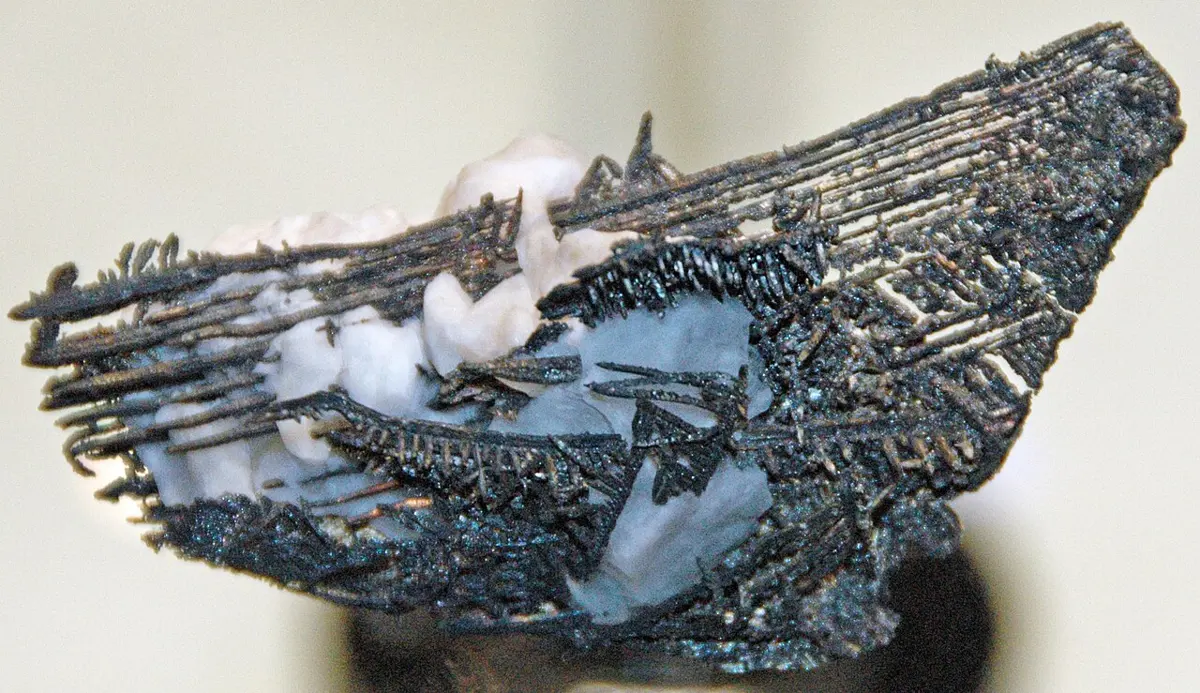
2. Action of acids
Silver lies below hydrogen in the electrochemical series, so it can’t set hydrogen free from dilute acids. It doesn’t react with dilute hydrochloric or sulphuric acid:
It dissolves in oxidizing acids. With hot, concentrated sulphuric acid:
With nitric acid:
Silver doesn’t dissolve in aqua regia, though it dissolves gold: the silver is coated at once with a film of insoluble silver chloride, which stops the attack. So a gold–silver alloy rich in silver can’t be parted with aqua regia; refiners part it with nitric acid instead, which dissolves the silver and leaves the gold.
3. Action with non-metals
Silver combines directly with sulphur, and with the halogens, chlorine most easily:
7.5.6 Uses of silver
- i.In electrical contacts, switches, circuit boards and the paste on solar cells (the biggest industrial use today), and in silver-oxide button cells.
- ii.In coins and medals.
- iii.In jewelry, utensils and decorative items.
- iv.In photography (silver halides), now largely replaced by digital cameras; and in X-ray film.
- v.In alloys: sterling silver (92.5% silver, 7.5% copper, harder than pure silver), silver solders, and dental amalgam.
- vi.In mirrors, a thin film of silver on glass.
- vii.In medicine: wound dressings and water filters with silver, which kills bacteria.
Silver tarnishes because it reacts with
Pick an answer to see why.
7.5.7 Compounds of silver
A. Lunar caustic (silver nitrate, AgNO₃)
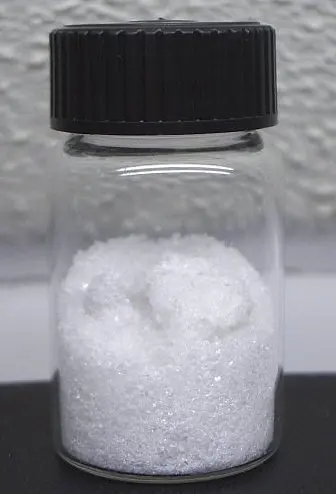
Introduction. Silver nitrate, AgNO₃, is a colorless crystalline solid, very soluble in water, sensitive to light, and caustic (corrosive to living tissue). It is the starting point for almost all other silver compounds.
Preparation. By dissolving silver in nitric acid, in a fume cupboard because nitrogen oxides are given off:
The solution is evaporated and cooled, and colorless crystals of silver nitrate form.
Physical properties.
- i.A colorless (white) crystalline solid, very soluble in water.
- ii.Its solution and crystals darken slowly in light, so both are stored in dark bottles.
- iii.It also dissolves in some organic liquids, such as alcohol, acetone and pyridine.
- iv.It melts at 212 °C.
Chemical properties.
1. Action of heat. Silver nitrate melts at 212 °C, and above about 440 °C it decomposes, giving silver, nitrogen dioxide and oxygen:
(Some silver nitrite, AgNO₂, may form on the way, , but it breaks down to silver too.) Unlike the nitrates of more reactive metals, it leaves the metal, not an oxide, because silver oxide itself breaks up above about 200 °C.
2. Action with alkalis. Sodium hydroxide gives a brown precipitate of silver oxide:
A little ammonia solution does the same:
but with excess ammonia, the precipitate dissolves, forming the colorless complex diamminesilver(I) nitrate:
This solution is Tollens’ reagent, which deposits a silver mirror with aldehydes (it is used in organic chemistry to tell aldehydes from ketones). It must be made fresh and used at once: left standing, it can form an explosive solid.
3. Action with organic matter. In light, organic matter such as skin, paper, wood or cloth reduces silver nitrate to finely divided black silver:
This is used in the indelible ink that marks voters’ fingers in elections in Nepal, India and many other countries: a solution of silver nitrate, which stains the skin and nail for a week or more and can’t be washed off, so no one can vote twice.

4. Action with potassium cyanide. A little potassium cyanide gives a white precipitate of silver cyanide; excess dissolves it as the complex K[Ag(CN)₂]:
5. Precipitation reactions. Silver nitrate gives precipitates with many anions, a set of tests used in qualitative analysis:
| Anion | Precipitate | Color | In ammonia |
|---|---|---|---|
| Chloride, Cl⁻ | AgCl | white | dissolves easily |
| Bromide, Br⁻ | AgBr | pale yellow | dissolves only in concentrated |
| Iodide, I⁻ | AgI | yellow | doesn’t dissolve |
| Phosphate, PO₄³⁻ | Ag₃PO₄ | yellow | dissolves |
| Chromate, CrO₄²⁻ | Ag₂CrO₄ | brick red | dissolves |
| Sulphide, S²⁻ | Ag₂S | black | doesn’t dissolve |
Silver sulphate, Ag₂SO₄, is only sparingly soluble (about 0.8 g per 100 g of water), so it precipitates, as white crystals, only from concentrated solutions: .
6. Displacement reactions. Metals above silver in the electrochemical series, such as zinc, iron, lead and copper, displace silver from silver nitrate:
Uses of silver nitrate.
- i.As a laboratory reagent (tests for halides; titrations of chloride).
- ii.In indelible ink.
- iii.To prepare Tollens’ reagent.
- iv.In making photographic film and paper (the silver halides).
- v.In silvering mirrors.
- vi.In medicine, as an antiseptic, and in sticks (“lunar caustic pencils”) to burn off warts and stop small bleeding.
B. Horn silver (silver chloride, AgCl)
Introduction. Silver chloride, AgCl, is a white crystalline solid, very sparingly soluble in water. Its mineral is called horn silver (chlorargyrite).
Preparation. By adding a soluble chloride to silver nitrate solution: a curdy white precipitate forms.
Physical properties.
- i.A white crystalline solid, practically insoluble in water (about 2 mg per liter).
- ii.It turns gray or violet in sunlight.
- iii.It dissolves in ammonia solution, and in sodium thiosulphate and cyanide solutions (as complexes).
Chemical properties.
1. Action of light. In sunlight, silver chloride decomposes into silver and chlorine:
The tiny particles of silver turn it gray or violet.
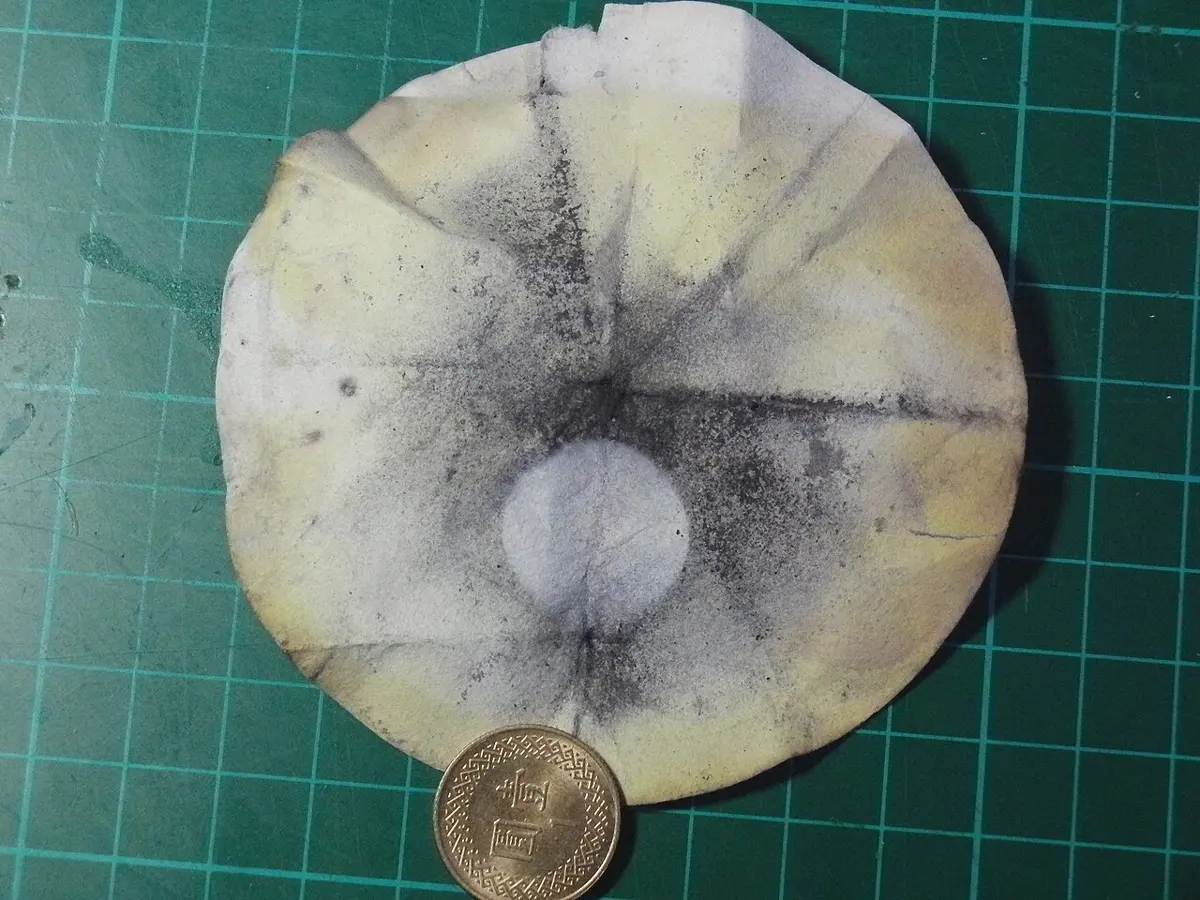
2. Action with ammonia. Silver chloride dissolves in ammonia solution, forming the soluble complex diamminesilver(I) chloride:
When this solution is made acidic with nitric acid, the ammonia is taken up as ammonium ions, and silver chloride precipitates again:
Uses of silver chloride.
- i.In photography, for its sensitivity to light (mostly as silver bromide).
- ii.As an antimicrobial agent, in wound dressings and water treatment.
- iii.In photochromic lenses, which darken in sunlight and clear indoors: tiny crystals of silver chloride (with a little copper) in the glass give silver in bright light, which recombines in the dark.
- iv.In the silver–silver chloride electrode, the commonest reference electrode today, in pH meters and ECG pads.
Exercise (7.5 Silver)
A. Multiple choice questions
- Which is the chief ore of silver?
Pick an answer to see why.
- Which ore is treated by the cyanide process?
Pick an answer to see why.
- Which brown gas is released when silver nitrate is heated strongly?
Pick an answer to see why.
- Which is lunar caustic?
Pick an answer to see why.
- Which of these is decomposed by light?
Pick an answer to see why.
- Which is used to make indelible ink?
Pick an answer to see why.
- Which metal is extracted by the MacArthur–Forrest process?
Pick an answer to see why.
- What is the formula of horn silver?
Pick an answer to see why.
- Which compound is used in silvering mirrors?
Pick an answer to see why.
- Which metal cannot displace silver from silver nitrate?
Pick an answer to see why.
B. Short answer questions
Give reasons:
- a.A silver coin turns black in air.
- b.Silver chloride turns gray in light.
- c.Silver nitrate is stored in dark bottles.
Answer
What is the MacArthur–Forrest process? Which kind of metal is extracted by it?
Answer
Write the chemistry of lunar caustic.
Answer
Write a note on horn silver.
Answer
A student put a piece of copper wire into a vessel of silver nitrate solution by mistake. Predict and explain what happens, with equations and observations. How would you change the procedure to avoid the mistake?
Answer
Silver nitrate is called lunar caustic.
- a.Write one method of preparing it.
- b.How does it make a black stain on the skin?
- c.What happens when silver nitrate is heated?
Answer
Write the balanced equation for:
- a.the action of sodium cyanide on argentite
- b.the action of ammonia solution on silver chloride
- c.the action of alkali on silver nitrate
Answer
Describe the extraction of silver from its chief ore, with balanced equations. What is frosting of silver?
Answer
C. Long answer question
A coinage metal Q with atomic number 47 lies in Group 11 of the periodic table. It is commonly used in jewelry and photography.
- a.Identify Q.
- b.Write the formula of the chief ore of Q.
- c.How would you extract Q from its chief ore?
- d.What happens when Q is exposed to air?
- e.What happens when Q is heated in air?
- f.Write two uses of Q.
Answer
Printable PDFs
- Study notes 3 pages
- Worksheet 4 pages Answer key
Quiz yourself: Materials and Chemicals We Use, Grades 5–12 →
Practice every question in the book, and keep track of the ones you miss →
A companion to your textbook, not a replacement for it: study from the book your school uses, and where the two differ, follow your teacher. Found a mistake? Please tell us.