
Strike a match and it flares in a fraction of a second; leave an iron bolt out in the monsoon and it takes months to rust through. Milk left on the kitchen shelf in Kathmandu’s summer turns sour by evening, but the same milk keeps for days in the fridge. Chemistry can say which reactions are possible; this unit asks the other question: how fast do they go, and why?
The study of how fast reactions go is chemical kinetics. This unit shows how a rate is measured and written as a rate law, what the order of a reaction tells you, how long it takes for half a reactant to go (the half-life), and why reactions speed up with concentration, with temperature and with a catalyst: because molecules must collide, the right way round and hard enough to climb an energy barrier.
3.1 Introduction
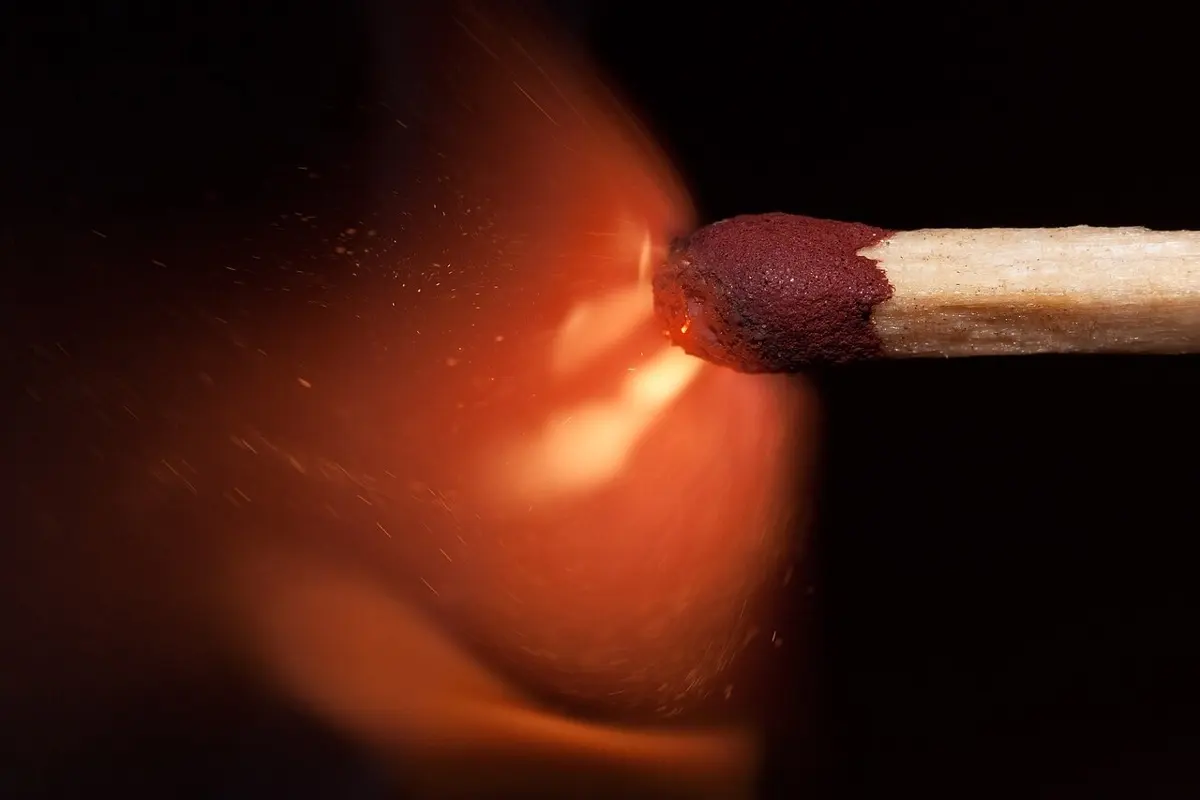

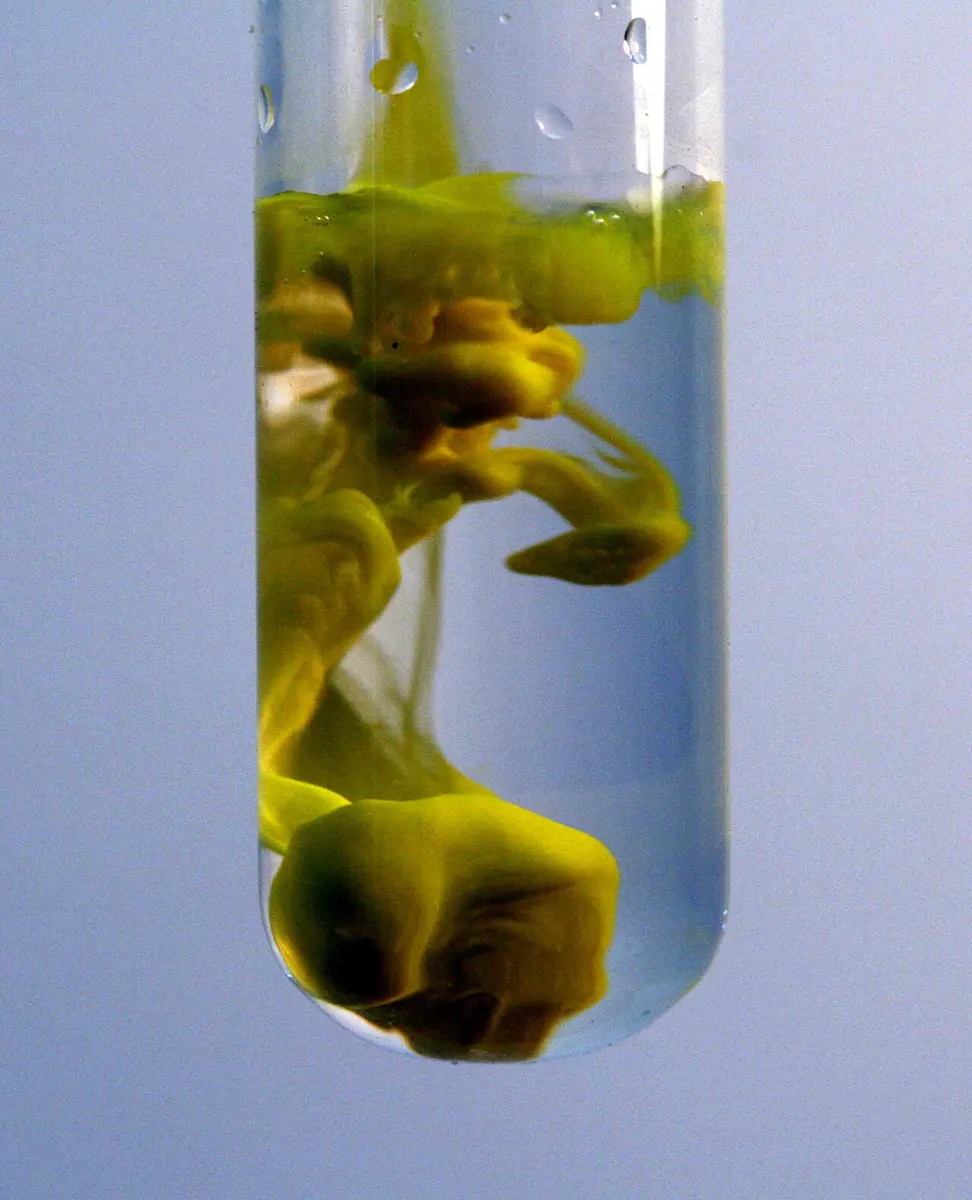
Some changes are so slow that no one could watch them. Carbon turns into diamond under the heat and pressure of the Earth’s mantle over millions of years; half of any sample of uranium-238 decays to other elements in about 4.5 billion years, roughly the age of the Earth. Others are over almost at once: when two clear solutions are mixed to make a precipitate, the solid appears the instant they meet, and an explosion releases its energy in millionths of a second.
Chemical kinetics is the branch of chemistry that studies the rates of chemical reactions, the factors that affect those rates, and the mechanisms, the steps by which reactions happen. It answers questions such as: why are some reactions fast and others slow? What makes one particular reaction faster or slower? What actually happens, step by step, as reactants turn into products?
Kinetics is how chemists control reactions. A factory chooses its temperature, pressure and catalyst so that a reaction gives enough product each hour; a drug company works out how fast a medicine breaks down, which sets its expiry date; a cook, without the word, uses kinetics every time a pressure cooker or a fridge is used.
3.2 Rate of reactions: average and instantaneous rate of reactions
Reactions go at very different speeds, depending on what the reactants are, what kind of change happens, the temperature and other conditions. The rate of reaction is the change in concentration of a reactant or a product per unit time. A reaction that turns reactants into products quickly has a high rate; a slow one has a low rate.
Concentration is in mol/L and time in seconds (or minutes, hours…), so the unit of rate is mol L⁻¹ s⁻¹, also written mol/(L s) or M/s.
Average rate of reaction
The average rate of a reaction is the change in concentration of a reactant or product over a measured interval of time, Δt:
Δ[reactant] and Δ[product] are the changes in concentration over the time Δt. The concentration of a reactant falls, so its Δ is negative; the minus sign makes the rate a positive number. A product’s concentration rises, so its sign is plus. The average rate gives an overall picture of how fast the reaction went during that interval.
On a graph of concentration against time, the average rate between two times is the slope of the straight line (chord) joining the two points on the curve, with its sign changed for a reactant.
How is the concentration measured while a reaction runs? Usually not by taking samples out and analyzing them, but by watching a property that changes with it:
- a.pH, for reactions that use up or make an acid or a base;
- b.electrical conductivity, for reactions in which ions are used up or formed;
- c.mass or volume, for reactions that give off a gas (a flask on a balance loses mass as CO₂ escapes; a gas syringe fills);
- d.color, for reactions with a colored substance (such as compounds of transition metals, or iodine), measured with a colorimeter.
Instantaneous rate of reaction
The rate keeps changing as a reaction goes, so the average rate depends on the interval chosen. Make the interval shorter and shorter, Δt → 0, and the average rate becomes the instantaneous rate: the rate at one particular moment.
If the concentration of a product changes by a tiny amount dx in a tiny time dt, the instantaneous rate is : for a reactant A,
where is the derivative of the concentration of A with respect to time. On the graph it is the slope of the tangent to the concentration–time curve at that moment. The instantaneous rate at the very start, t = 0, is the initial rate: the slope of the tangent at the beginning.
Both kinds of rate are useful. The average rate gives a broad picture over an interval; the instantaneous rate shows what the reaction is doing at one moment, and it is the one that rate laws describe.
Relative rates of reaction
The rate can be followed by the change in concentration of any reactant or product, and the different rates are linked by the coefficients of the equation. When water is split by electricity,
the rate can be followed by the loss of water, or by the formation of hydrogen or of oxygen. For every 2 mol of water that decompose, 2 mol of hydrogen and 1 mol of oxygen form: water is used up as fast as hydrogen forms, and twice as fast as oxygen forms. To give the reaction one rate, each change is divided by its coefficient:
For a general reaction
3.3 Rate law and its expressions
Concentrated hydrochloric acid fizzes much faster on zinc than dilute acid does. Figure 3.6 shows why: the more molecules there are in the same space, the more often they collide, and the faster they react. For a reaction between A and B, the rate depends on the concentrations of A and B. Experiments show a relation of the form
This is the rate law (rate equation) of the reaction. The square brackets are molar concentrations, k is the rate constant, and the powers x and y are the orders of the reaction with respect to A and to B (section 3.5).
The rate law is found by experiment, not from the equation. Nitrogen dioxide and carbon monoxide react at 100 °C:
The equation has one of each, yet measurements show that the rate depends on the square of [NO₂] and does not depend on [CO] at all: the reaction is second order in NO₂ and zero order in CO:
The rate law states how the rate of a reaction depends on the concentrations of its reactants; it is found by experiment and gives clues to the reaction’s mechanism.
Why the rate law matters:
- a.It gives clues to the steps of the mechanism. The slowest step, the rate-determining step, often sets the rate law. For NO₂ + CO, the slow step is thought to be two NO₂ molecules colliding (NO₂ + NO₂ → NO₃ + NO); CO only joins in a fast step after it (NO₃ + CO → NO₂ + CO₂), so [CO] doesn’t appear in the rate law.
- b.It tells how changing a concentration will change the speed: doubling [NO₂] makes this reaction four times as fast; doubling [CO] does nothing.
- c.It is used to choose the best conditions in industry: in catalysis, polymerization and combustion, for example.
3.4 Rate constant, its unit and significance
For a first-order reaction
the constant k is the rate constant (also called the rate coefficient): the proportionality constant in the rate law that links the rate to the concentrations of the reactants. Its value depends on the reaction and on the temperature, but not on the concentrations: k is the rate when every concentration in the rate law is 1 mol/L. A larger k means a faster reaction at the same concentrations.
The unit of k depends on the order. It is whatever makes the units of the rate law come out as mol L⁻¹ s⁻¹. For a third-order reaction such as with rate = k[A][B]²:
| Order | Rate law | Unit of k | Meaning |
|---|---|---|---|
| zero | rate = k | mol L⁻¹ s⁻¹ | the rate doesn’t depend on concentration |
| first | rate = k[A] | s⁻¹ | the rate is proportional to one concentration |
| second | rate = k[A]² or k[A][B] | L mol⁻¹ s⁻¹ | the rate depends on the square, or the product, of two concentrations |
| third | rate = k[A]²[B] | L² mol⁻² s⁻¹ | the rate depends on a product of three concentrations |
In general, for overall order n:
So the unit of k tells you the order: s⁻¹ means first order, L mol⁻¹ s⁻¹ second order. (With time in minutes, write min⁻¹ for s⁻¹.)
A rate constant is 2.5 × 10⁻³ L mol⁻¹ min⁻¹. What is the overall order of the reaction?
Pick an answer to see why.
3.5 Order and molecularity
For a reaction
x is the order with respect to A, y the order with respect to B, and the overall order of the reaction is x + y.
The order of a reaction is the sum of the powers of the concentrations of the reactants in its experimental rate law.
The order is found by experiment. It is usually 0, 1 or 2, but it can be a fraction, and occasionally negative. A positive order means more of that substance makes the reaction faster. A negative order means more of it makes the reaction slower: ozone breaking down, 2O₃ → 3O₂, has rate = k[O₃]²[O₂]⁻¹, because oxygen molecules recapture the O atoms that would otherwise attack more ozone. A fractional order, such as the ½ in rate = k[H₂][Br₂]^½ for hydrogen and bromine, is a sign of a mechanism with several steps.
Zero-order reactions
In a zero-order reaction the rate does not depend on the concentration of the reactant: it stays the same as the concentration falls, so the concentration falls in a straight line with time (Figure 3.9). The rate is always equal to the rate constant:
A zero-order reaction is one in which the rate is independent of the concentration of the reactant.
True zero-order reactions are rare: usually a reaction behaves as zero order only over a range of conditions, while something other than the reactant’s concentration limits its rate, so such reactions are often called pseudo-zero-order. Most often this happens when a gas decomposes on the surface of a solid catalyst: once the surface is covered, adding more gas can’t make it react any faster. Examples:
1. The photochemical reaction of hydrogen and chlorine in light. Its rate is set by how much light is absorbed, not by the concentrations of the gases:
2. Nitrous oxide decomposing on a hot platinum surface, at pressures high enough to cover the surface:
3. The iodination of acetone, catalyzed by acid:
It is zero order with respect to iodine: changing [I₂] doesn’t change the rate, because iodine reacts only in a fast step after the slow one (the acetone turning into its enol form, helped by H⁺). The famous experiment is to time how long the brown iodine color takes to vanish: the color fades at a steady rate, in a straight line.
4. Alcohol in the body: the liver’s enzyme oxidizes ethanol to acetaldehyde, CH₃CH₂OH → CH₃CHO. At all but the lowest levels the enzyme is working flat out, so the body clears alcohol at a roughly steady amount per hour, whatever is in the blood: zero order in ethanol.
Unit of the rate constant. Since rate = k, k has the unit of rate, concentration ÷ time:
Characteristics of a zero-order reaction:
- a.The rate does not depend on the concentration of the reactant.
- b.The concentration of reactant falls in a straight line with time (and the concentration of product rises in a straight line).
- c.The rate constant equals the rate at every concentration.
- d.The unit of k is mol L⁻¹ s⁻¹.
First-order reactions
In a first-order reaction the rate is directly proportional to the concentration of one reactant. Several substances may take part, but only one concentration controls the rate, and the rate changes in the same proportion as that concentration:
A first-order reaction is one whose rate is directly proportional to the concentration of a single reactant.
Since the rate falls as the reactant is used, the concentration falls along a curve that gets flatter and flatter, halving in equal times (Figure 3.10, top). For example, hydrogen peroxide decomposes by first-order kinetics:
Pseudo-first-order reactions
In a pseudo-first-order reaction the rate law contains two concentrations, but one of them stays practically constant, because that substance is in large excess or is a catalyst. Methyl iodide (iodomethane) reacts with water:
The methyl iodide is dissolved in water, so there is far more water than methyl iodide, [CH₃I] ≪ [H₂O]. Pure water is about 55.5 mol/L; using up a few hundredths of a mole of it changes that by a fraction of a percent. So [H₂O] can be treated as constant and joined to k:
The reaction is second order really, but behaves as first order: pseudo-first-order. The hydrolysis of an ester in dilute acid, and of sucrose (cane sugar) into glucose and fructose, are other examples.
Second-order reactions
When the overall order is 2, the reaction is second order: rate = k[A]², or rate = k[A][B]. The rate rises faster with concentration than in a first-order reaction: double the concentration of A in rate = k[A]² and the rate becomes four times as great. For example,
For a second-order reaction in one reactant, integration gives (not derived here)
so 1/[A] against t is a straight line of slope k, and each half-life is twice as long as the one before.
Methods to determine the order of reaction
The order is found from experiments. Three common ways:
a. Differential method. Measure the rate at different concentrations (the slope of the concentration–time curve at several points) and see how it changes. Write rate = k[A]ˣ: if doubling [A] doubles the rate, x = 1; if it makes it four times as great, x = 2; if the rate doesn’t change, x = 0.
b. Initial rates method. Run the reaction several times, changing the starting concentration of one reactant at a time, and measure the initial rate of each run. Comparing two runs in which only [A] changed gives the order in A. More generally, taking logs of rate = k[A]ˣ,
so a graph of ln (rate) against ln [A] is a straight line whose slope is the order x.
c. Integral method. Measure the concentration at many times in one run, and test which integrated rate equation (section 3.6) gives a straight line. For a first-order reaction,
so if ln [A] against t is a straight line, the reaction is first order (slope −k). If [A] against t is straight, it is zero order; if 1/[A] against t, second order. This method is often used to confirm an order found by initial rates.
Molecularity, first look
3.6 Integrated rate equations for zero and first order reactions
A rate law says how fast the concentration changes; integrating it gives the concentration at any time, which is what an experiment measures.
Zero-order reaction
Take a zero-order reaction A → products. Let a be the initial concentration of A and x the concentration that has reacted by time t:
| [A] | reacted | |
|---|---|---|
| at t = 0 | a | 0 |
| at time t | a − x | x |
The rate is rate = k₀[A]⁰ = k₀, so the differential rate equation is
Integrating both sides,
where I is the constant of integration. At t = 0, x = 0, so I = 0, and
Equation (ii) is the integrated rate equation of a zero-order reaction. Since [A] = a − x,
which has the form y = mx + c: a graph of [A] against t is a **straight line of slope −k₀** and intercept [A]₀ (Figure 3.9). The rate itself, plotted against concentration or against time, is a flat line until the reactant runs out (Figure 3.8).
First-order reaction
Take a first-order reaction A → products, with the same table: [A] = a at t = 0 and a − x at time t. The rate law is
Integrating both sides,
At t = 0, x = 0, so
Putting C into (i),
Equation (iii) is the integrated rate equation of a first-order reaction. It can be rearranged as
Equation (iv) has the form y = mx + c: a graph of log (a − x) against t is a **straight line of slope −k₁/2.303** and intercept log a (Figure 3.10, bottom). In the same way, log [a/(a − x)] against t is a straight line through the origin, of slope +k₁/2.303. In exponential form, [A] = [A]₀ exp(−k₁t).
Characteristics of a first-order reaction:
- a.The unit of the rate constant is s⁻¹ (or time⁻¹).
- b.So the value of k doesn’t depend on the unit of concentration used: mol/L, mmol/L or pressure all give the same k.
- c.The rate constant stays the same throughout the reaction.
- d.The time needed to use up a given fraction of the reactant (half, three-quarters…) does not depend on the initial concentration.
3.7 Half-life of zero and first order reactions
The half-life (t½) of a reaction is the time taken for the concentration of a reactant to fall to half its initial value. It is measured in any unit of time: seconds for a fast reaction, years for radioactive decay.
a. Half-life of a zero-order reaction
The integrated rate equation is x = k₀t. At the half-life, t = t½ and x = a/2, where a is the initial concentration:
where k₀ is the zero-order rate constant. The half-life of a zero-order reaction depends on both the rate constant and the initial concentration: it is proportional to [A]₀, so the more you start with, the longer the first half takes. Each later half-life is half as long as the one before.
b. Half-life of a first-order reaction
The integrated rate equation is
At the half-life, t = t½ and x = a/2:
The half-life of a first-order reaction does not depend on the initial concentration: from any starting amount, half goes in the same time, then half of the rest in the same time again. After n half-lives, (½)ⁿ of the reactant is left: an eighth after three, about a thousandth after ten. (For a second-order reaction, t½ = 1/(k[A]₀), and the half-life gets longer as the concentration falls.)
The same equation gives the time for any fraction to react. For 90%, x = 0.9a, so a/(a − x) = 10 and log 10 = 1:
Ninety percent takes about 3⅓ half-lives (after three, 87.5% has reacted), and 99.9% takes 2.303 × 3/k₁ = 6.909/k₁, about ten half-lives.
A first-order reaction has a half-life of 15 min. How long does it take for 87.5% of the reactant to react?
Pick an answer to see why.
Molecularity of a reaction
Most reactions happen in several steps. Each single step, in which particles actually collide and react, is an elementary reaction. The reaction of nitrogen monoxide with ozone seems to happen in one collision between an NO molecule and an O₃ molecule, suitably oriented and energetic enough:
The number of particles (molecules, atoms or ions) that take part as reactants in an elementary reaction is its molecularity:
- unimolecular: one particle breaks up or rearranges by itself, as when ozone splits, , or cyclopropane opens into propene;
- bimolecular: two particles collide, as in ;
- termolecular: three particles collide at the same moment, as in .
The idea was introduced by van ’t Hoff. Molecularity is a theoretical idea, from the proposed mechanism; order is measured. Molecularity is the number of reacting particles (molecules, atoms or ions) that collide in an elementary step, such as the rate-determining step, to form the products.
- Molecularity is always a whole number, 1, 2 or 3: it can’t be zero, negative or a fraction.
- It is never more than three, because the chance of four particles colliding at the same moment is far too small.
- For a reaction of several steps, molecularity belongs to each step, not to the overall equation. The overall rate is set by the slowest step, the rate-determining step.
- For an elementary step, the order equals the molecularity (a bimolecular step A + B → products has rate = k[A][B]); for a complex reaction, the order comes from experiment and may differ from any molecularity.
| Order | Molecularity |
|---|---|
| sum of the powers in the experimental rate law | number of particles colliding in an elementary step |
| found by experiment | found from the mechanism |
| can be 0, a fraction or negative | always 1, 2 or 3 |
| belongs to the overall reaction | belongs to each step |
3.8 Collision theory, concept of activation energy and activated complex
Collision theory was worked out by Max Trautz (1916) and William Lewis (1918) from the kinetic theory of gases. It treats the molecules of the reactants as hard spheres and says that a reaction happens only when these molecules collide. But not every collision leads to reaction. For a collision to give products,
- the colliding particles must have the correct orientation, the right parts facing each other;
- they must collide with enough kinetic energy to break the old bonds.
The rate of a reaction therefore depends on the frequency of effective collisions, those that have both. In a gas at room temperature each molecule is hit billions of times a second, yet most reactions are far slower than that, because only a tiny fraction of collisions are effective. The energy needed to break bonds comes from the kinetic energy of the colliding molecules: as they collide, their kinetic energy turns into potential energy, stretching and bending the bonds. Anything that makes effective collisions more frequent makes the reaction faster: higher concentration, higher temperature, a larger surface area and a catalyst (section 3.9).
Activation energy
To start a reaction, bonds in the reactants must be stretched and broken, and that takes energy. The activation energy (Eₐ) is the minimum energy that colliding particles must have for a reaction to occur: the energy barrier between reactants and products.
- When the activation energy is low, enough molecules have that energy at room temperature, and the reaction starts by itself, often fast.
- When it is high, few molecules have enough energy at any moment, and the reaction is slow; if it is high enough, the reaction doesn’t go at all unless energy is supplied.
Burning wood gives out a lot of energy, yet a wooden table doesn’t catch fire by itself: the activation energy is high. A flame from a lighter gives a few molecules enough energy to react; the heat they give out then activates their neighbors, and the fire keeps itself going.
At the same temperature, a reaction with a higher activation energy is slower. Raising the temperature gives more molecules enough energy to get over the barrier. The equation linking the rate constant, the activation energy and the temperature is the Arrhenius equation:
Here k is the rate constant, A the frequency factor (or pre-exponential factor: how often molecules collide with a suitable orientation), e = 2.718…, Eₐ the activation energy, R the gas constant (8.314 J mol⁻¹ K⁻¹) and T the absolute temperature in kelvin; exp(x) means e to the power x, so the equation is also written k = A e^(−Eₐ/RT). The factor exp(−Eₐ/RT) is the fraction of collisions with energy Eₐ or more: a larger Eₐ makes it much smaller, and a higher T makes it larger. Taking logs gives the activation energy from rate constants (section 3.9).
Activated complex
An energy profile diagram (Figure 3.17) shows the potential energy of the reacting system as the reaction goes from reactants to products. The highest point of the path is the activated complex (transition state): a short-lived, unstable arrangement of atoms in which old bonds are partly broken and new bonds partly formed. It has the highest energy on the path and lasts only about as long as one molecular vibration, around 10⁻¹³ s; it either goes on to form products or falls back to reactants. The activation energy is the height of the activated complex above the reactants, and ΔH is the difference between products and reactants.
3.9 Factors affecting rate of reactions: concentration, temperature (Arrhenius equation) and catalyst (energy profile diagram)

Look again at Figure 3.6: in which box are collisions more frequent, and why? Box A, because its molecules are more crowded, so they meet more often. The main factors that change the rate are these.
a. Nature of the reactants. Some substances react faster than others. Reactions between ions in solution, such as precipitation and neutralization, are usually very fast: no bonds need to break, and oppositely charged ions attract. Reactions that break strong covalent bonds are slower, and simple molecules usually react faster than complex ones, in which more bonds must be rearranged. The physical state matters too: gases and solutions react faster than solids, whose particles meet the other reactant only at their surface.
b. Concentration. Concentrated acid reacts faster than dilute acid. A higher concentration packs more particles into the same space, so they collide more often and there are more effective collisions each second. (For gases, raising the pressure raises the concentration.) The rate law says exactly how much faster.
For a solid, surface area works the same way: a powder reacts faster than a lump of the same mass, more of its particles are on a surface, where the other reactant can reach them. Flour dust in a mill can even explode, though flour in a sack only burns slowly.
c. Effect of temperature
Nearly every reaction goes faster when warmer. As the temperature rises, particles move faster, so they collide a little more often, but much more importantly, a larger fraction of the collisions have energy equal to or greater than the activation energy. A rule of thumb: for many reactions near room temperature, a rise of 10 °C roughly doubles the rate (a reaction with Eₐ about 53 kJ/mol exactly doubles between 300 K and 310 K); for reactions with higher activation energies the increase is larger.
Figure 3.20 shows why. At any temperature the molecules of a gas have a spread of energies: a few very slow ones, most near the middle, and a long tail of fast ones. The total area under each curve is the same, because the number of molecules is the same. At the higher temperature the curve is lower, wider and moved to higher energies, and **the area beyond Eₐ grows** much more than the average energy does. The activation energy itself doesn’t change with temperature.
The Arrhenius equation
Taking natural logs of k = A exp(−Eₐ/RT),
This has the form y = mx + c: a graph of ln k against 1/T is a straight line of slope −Eₐ/R (or log k against 1/T, slope −Eₐ/(2.303 R)). This is how activation energies are measured.
Two temperatures. With rate constants at only two temperatures, write the equation for each. At T₁, with rate constant k₁:
and at T₂, with rate constant k₂:
Subtracting (1) from (2), ln A cancels:
The ratio of the rates at the two temperatures can be used in place of k₂/k₁, when the concentrations are the same.
d. Effect of a catalyst
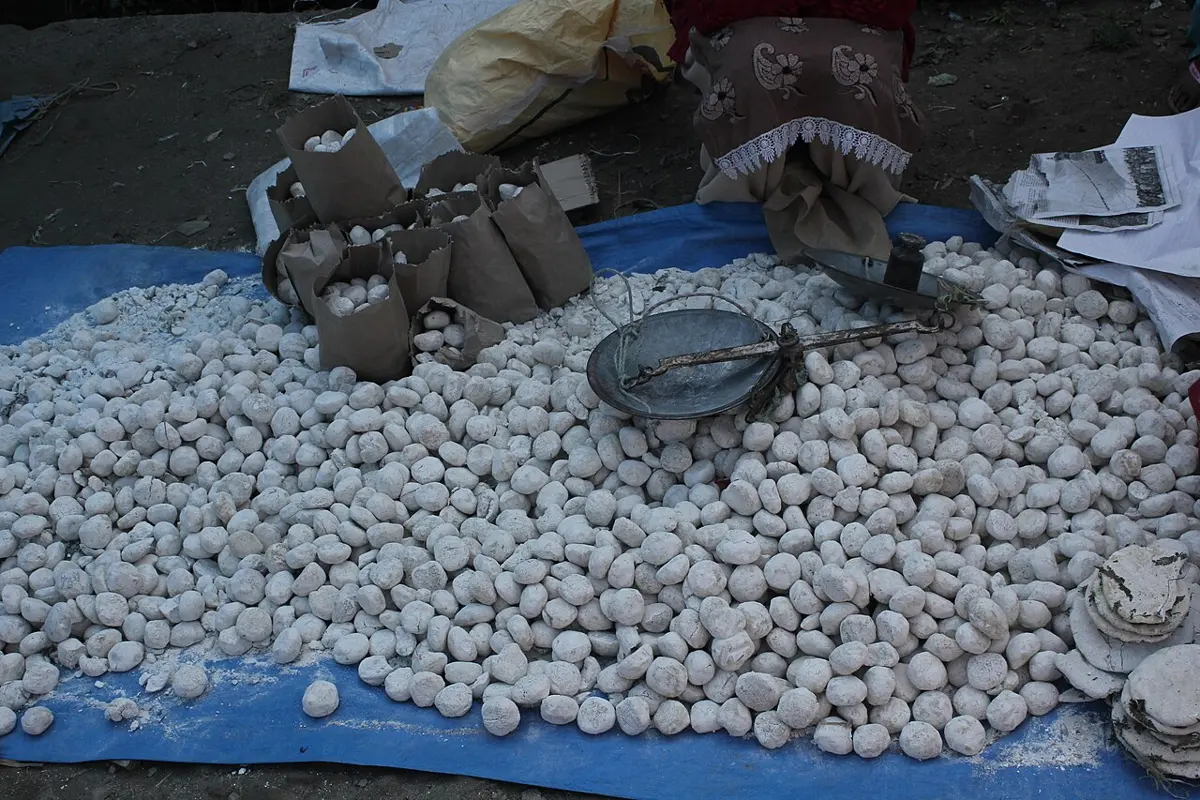
Marcha is made of rice or millet flour with herbs, and it carries a mixed culture of microbes: molds, whose enzymes break the grain’s starch into sugars, and yeasts (Saccharomyces cerevisiae and others), which produce zymase, a group of enzymes that turns the sugars (glucose, maltose) into ethanol and carbon dioxide: alcoholic fermentation. The enzymes are catalysts: a small cake of marcha ferments a whole pot of cooked grain.
A catalyst is a substance that increases the rate of a reaction without being used up itself: it takes part in the reaction but is given back unchanged at the end, so it can be used again and again. It works by providing another path for the reaction, with a lower activation energy (Figure 3.24). With a lower barrier, many more molecules have enough energy to get over it at the same temperature, so a larger fraction of collisions are effective.
3.10 Catalysis and types of catalysis: homogeneous, heterogeneous and enzyme catalysis
Catalysts can be solids, liquids or gases, and they may be in the same phase as the reactants or in a different one.
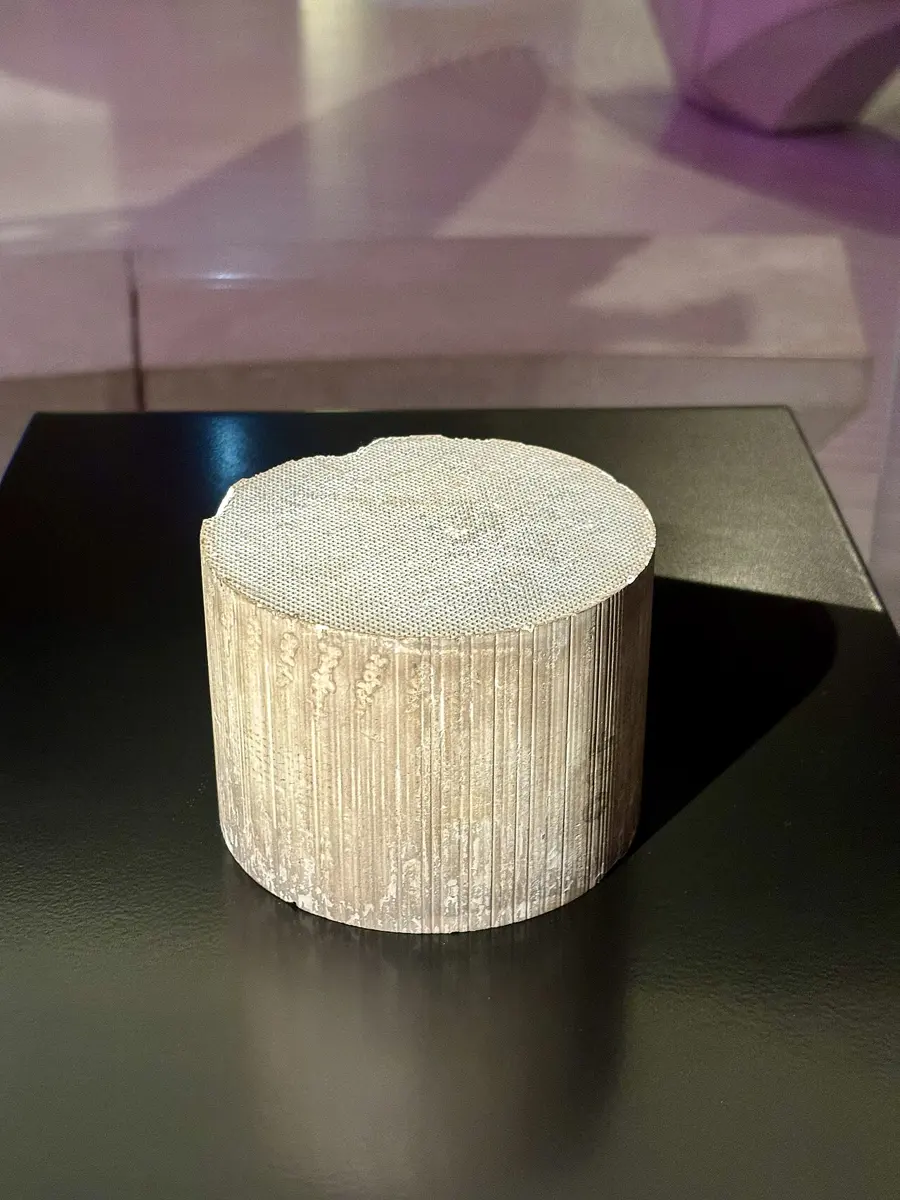
The catalytic converter in a vehicle’s exhaust is a catalyst at work. Exhaust gases pass through a honeycomb of fine channels coated with a thin layer of platinum, palladium and rhodium, and on these metals the poisonous gases, unburnt hydrocarbons, carbon monoxide and nitrogen oxides, react to give carbon dioxide, water and nitrogen:
The honeycomb gives the metals a huge surface in a small box; the metals are heterogeneous catalysts. A converter works only once it is hot, at about 250 °C or more, which is why a car pollutes most in its first minutes.
If the catalyst is in the same phase as the reactants, it is a homogeneous catalyst; if it is in a different phase, it is a heterogeneous catalyst. The processes are homogeneous catalysis and heterogeneous catalysis.
Homogeneous catalysis. The esterification of acetic acid with methanol is catalyzed by an acid (H⁺); the reactants and the catalyst are all in one liquid solution:
The decomposition of hydrogen peroxide by iodide ions, above, is another example.
Heterogeneous catalysis. The catalyst is usually a solid, and the reactants gases or liquids touching its surface. Many of industry’s most important reactions happen on solid surfaces. In cracking, large hydrocarbon molecules from crude oil are broken and rearranged into the smaller ones of petrol on solid zeolite catalysts.
Such reactions go in steps on the surface. Reactant molecules are held on the surface (adsorbed), where their bonds are weakened or broken; the fragments react with each other on the surface; and the product, held less strongly, leaves (desorbs), freeing the surface for more. In the Haber process, nitrogen and hydrogen molecules are adsorbed on iron and split into atoms, which combine into NH₃ step by step. The same happens when ethene is hydrogenated on nickel (Figure 3.26).
Inhibitors. A substance that slows down or stops a reaction is an inhibitor (sometimes called a negative catalyst). Antioxidants added to cooking oil and to rubber, and preservatives in food, are inhibitors.
Enzyme catalysis
Amylase, an enzyme in saliva, starts to break starch into sugars while we chew: it catalyzes the hydrolysis of starch. Chew a piece of plain rice or roti for a minute and it starts to taste sweet. This is enzyme catalysis: the speeding up of reactions by enzymes, the catalysts of living things. Enzymes are proteins (a few are RNA), and every cell uses thousands of different ones, each catalyzing its own reaction. They are what make bread rise, milk set into dahi and fruit juice ferment.
Enzymes are very powerful catalysts: they commonly make their reactions millions of times faster, some by far more. One molecule of carbonic anhydrase, the enzyme that helps the blood carry carbon dioxide, converts about a million CO₂ molecules a second.
The word enzyme comes from Greek en zymē, “in leaven” (in yeast), because it was first used of the catalysts in yeast.
Properties of enzyme catalysis:
- a.Specificity. Each enzyme acts on only one substance (its substrate) or a small group of similar ones, because of the shape of its active site (the lock-and-key or induced-fit model, below).
- b.Efficiency. An enzyme provides another reaction path with a much lower activation energy, so the reaction is very fast.
- c.Small amounts are enough. A little enzyme converts a large amount of substrate, and the enzyme is unchanged at the end.
- d.Control. Enzyme activity depends on conditions: each works best at an optimum temperature (about 37 °C for ours; most stop working when heated much above that, as their protein shape is destroyed) and an optimum pH (pepsin in the stomach near pH 2, the enzymes in the small intestine near pH 8), and it is switched up or down by inhibitors, activators and the cell’s own feedback.
| Enzyme | Where it is | What it does |
|---|---|---|
| amylase | saliva, pancreas | breaks down starch into sugars during digestion |
| protease | stomach and intestine; meat tenderizers, washing powders | breaks down proteins |
| lactase | small intestine; tablets for lactose intolerance | breaks down lactose, the sugar of milk |
| zymase | yeast | turns sugars into ethanol and carbon dioxide (fermentation) |
Mechanism of enzyme catalysis
An enzyme is usually a large protein molecule folded into a particular shape, with one or more active sites: pockets where the substrate binds and reacts. An active site fits only its own substrate, as a lock fits only its key. When the substrate binds to the active site, an enzyme–substrate complex forms; the reaction happens in the complex, the products are released, and the enzyme is left unchanged, ready to catalyze the reaction again:
(E is the enzyme, S the substrate, ES the complex and P the products.) This lock-and-key model was proposed by Emil Fischer in 1894. In 1958 Daniel Koshland improved it as the induced-fit model: the active site is not rigid but changes shape a little as the substrate binds, closing round it like a glove round a hand.
This mechanism also explains the zero order of many enzyme reactions. When there is a lot of substrate, every enzyme molecule is busy all the time, its active site always full (the enzyme is saturated), so adding more substrate can’t speed the reaction up: the rate stays at its maximum.
Project work
Exercise
Choose the correct option
- Which statement about the rate of reaction is correct?
Pick an answer to see why.
- The rate law for A + 2B → C is rate = k[A][B]. If the concentration of B is doubled and that of A kept the same, the rate becomes:
Pick an answer to see why.
- According to collision theory, which statement is true?
Pick an answer to see why.
- According to collision theory, why does the rate increase with temperature?
Pick an answer to see why.
- The rate of the first-order reaction A → products is 7.5 × 10⁻⁴ mol L⁻¹ s⁻¹ when [A] = 0.2 mol L⁻¹. What is the rate constant?
Pick an answer to see why.
- For the reaction H₂(g) + Br₂(g) → 2HBr(g), the rate law is rate = k[H₂][Br₂]^½. Which statement is true?
The textbook prints “The molecularity of the reaction is two” as its fourth option, and then none of its four options is true (the explanation shows why). So the book’s options don’t work; that option has been changed.
Pick an answer to see why.
- The half-life of a first-order reaction is 20 min. How long does it take for the concentration of the reactant to change from 0.08 M to 0.01 M?
Pick an answer to see why.
- What is the main difference between the average rate and the instantaneous rate of a reaction?
Pick an answer to see why.
- In the reaction A → B, the concentration of A falls from 0.8 M to 0.6 M in 20 s. What is the average rate?
Pick an answer to see why.
- Which is true of the rate constant k in a rate law?
Pick an answer to see why.
- Molecularity is the number of particles taking part in the rate-determining collision. In which kind of reaction can the number of particles in the overall equation be more than 3?
The textbook prints “Which of the following reactions can have a molecularity greater than 3?”, but none can: every elementary step has a molecularity of 1, 2 or 3, and a complex reaction’s overall equation has no molecularity at all. So the book’s question doesn’t work as printed; it is asked here about the particles in the overall equation, keeping the book’s answer.
Pick an answer to see why.
- For the reaction 2A + B → C + D the experimental rate law is rate = k[A]². What does this say about the reaction?
Pick an answer to see why.
- Which plot shows a zero-order reaction?
Pick an answer to see why.
- The half-life gives an idea of the rate. What does the half-life of a first-order reaction depend on?
Pick an answer to see why.
- According to collision theory, which factor does NOT directly affect the rate?
Pick an answer to see why.
- What is the activated complex in a chemical reaction?
Pick an answer to see why.
- Which of these can be calculated with the Arrhenius equation?
Pick an answer to see why.
- Catalysts are used in many industrial processes. How does a catalyst change the rate of a reaction?
Pick an answer to see why.
- Which of these always increases the rate of reaction but does not change the equilibrium constant?
The textbook prints “increases the rate”, with “Reactant concentration” as an option. But more of a reactant also speeds up most reactions without changing K, and so does more pressure on a reaction of gases, so more than one option would be right. So the book’s options don’t work; “always” has been added and that option changed.
Pick an answer to see why.
- Which is an example of heterogeneous catalysis?
Pick an answer to see why.
- How are enzymes different from other catalysts?
Pick an answer to see why.
- In enzyme catalysis, why does the rate reach a maximum at a high concentration of substrate?
Pick an answer to see why.
- The rate of a reaction doubles when the temperature is raised from 300 K to 310 K. What is the activation energy? (R = 8.314 J mol⁻¹ K⁻¹)
The textbook gives the options 57.9, 48.2, 34.7 and 23.5 kJ/mol, but none of them is the activation energy these temperatures give (worked out in the explanation). So the book’s numbers don’t work; one option has been changed.
Pick an answer to see why.
- Hydrochloric acid reacts with large pieces of calcium carbonate; then the reaction is repeated with calcium carbonate powder. How does this change the activation energy and the frequency of collisions?
Pick an answer to see why.
- These data were measured for the reaction of nitrogen monoxide with hydrogen, 2NO(g) + 2H₂(g) → N₂(g) + 2H₂O(g):
| Experiment | [NO] (M) | [H₂] (M) | Initial rate (M/s) |
|---|---|---|---|
| 1 | 0.10 | 0.10 | 1.23 × 10⁻³ |
| 2 | 0.10 | 0.20 | 2.46 × 10⁻³ |
| 3 | 0.20 | 0.10 | 4.92 × 10⁻³ |
What is the overall order of the reaction?
Pick an answer to see why.
Answer these questions
Define:
- a.rate of reaction and rate constant
- b.activation energy and activated complex
Answer
Tell the difference between:
- a.average rate and instantaneous rate
- b.order and molecularity
- c.a first-order and a second-order reaction
- d.homogeneous and heterogeneous catalysis
Answer
What is meant by the rate of a chemical reaction? What are its units? Suggest two reactions that are very slow (days or longer) and two that are very fast (over in seconds or minutes).
Answer
Distinguish between the average rate and the instantaneous rate. Which of the two gives the more precise measure, and why?
Answer
Define the initial rate. What are the advantages of measuring the initial rate of a reaction?
Answer
What is a rate law? Write the rate expressions for these reactions in terms of the disappearance of the reactants and the appearance of the products:
- a.H₂(g) + I₂(g) → 2HI(g)
- b.N₂ + 3H₂ → 2NH₃
Answer
Define the rate constant. State the units of k for each rate equation:
- a.rate = k[NO]²
- b.rate = k[NH₃]⁰
- c.rate = k[BrO₃⁻][Br⁻][H⁺]²
Hint
Answer
Nitrogen monoxide reacts with oxygen at 0.066 mol L⁻¹ s⁻¹ to form nitrogen dioxide:
- a.Write the rate expression for this reaction in terms of each substance.
- b.Calculate the rate of formation of NO₂.
Hint
Answer
The rate constant for the decomposition of dinitrogen pentoxide, N₂O₅, dissolved in chloroform (CHCl₃) at 45 °C is 6.2 × 10⁻⁴ min⁻¹.
- a.What is the order of the reaction, and how do you know?
- b.What is its molecularity?
- c.What is the rate of the reaction when [N₂O₅] = 0.40 M?
Answer
For the reaction Q → W + X these data were obtained at 30 °C:
| [Q] initial (M) | 0.170 | 0.212 | 0.357 |
|---|---|---|---|
| Rate (mol L⁻¹ s⁻¹) | 6.68 × 10⁻³ | 1.04 × 10⁻² | 2.94 × 10⁻² |
- a.What is the order with respect to Q?
- b.What is the value of the rate constant?
- c.Write the rate law.
Hint
Answer
What is meant by the rate law of a reaction? What are the units of the rate constants of zero-order, first-order and second-order reactions?
Answer
For the reaction A + B → C:
| Initial rate of disappearance (mol L⁻¹ s⁻¹) | [A] (mol/L) | [B] (mol/L) |
|---|---|---|
| 0.053 | 0.10 | 0.50 |
| 0.127 | 0.20 | 0.30 |
| 1.02 | 0.40 | 0.60 |
| 0.254 | 0.20 | 0.60 |
| 0.509 | 0.40 | 0.30 |
- a.Find the order with respect to A and to B.
- b.Find the rate when [A] = 0.5 mol/L and [B] = 0.3 mol/L.
Hint
Answer
For a first-order reaction, how long does it take for the concentration of the reactant to fall to one-eighth of its starting value? Give the answer in terms of the half-life t½ and in terms of the rate constant k.
Answer
At the same concentrations, the reaction CO(g) + Cl₂(g) → COCl₂(g) is 1.50 × 10³ times as fast at 250 °C as at 150 °C. Calculate the activation energy, assuming the frequency factor is constant.
Hint
Answer
The half-life of a first-order reaction is 20 min. How long does it take for the concentration of the reactant to change from 0.08 M to 0.01 M?
Answer
Distinguish between homogeneous and heterogeneous catalysis. Describe three important industrial processes that use heterogeneous catalysis.
Answer
When the concentration of A in the reaction A → B was changed from 1.20 M to 0.60 M, the half-life rose from 2.0 min to 4.0 min at 25 °C. Find the order of the reaction and the rate constant.
Hint
Answer
The reaction NH₄⁺(aq) + NO₂⁻(aq) → N₂(g) + 2H₂O(l) was studied:
| Experiment | Initial [NH₄⁺] (M) | Initial [NO₂⁻] (M) | Initial rate (M/s) |
|---|---|---|---|
| 1 | 0.0100 | 0.200 | 5.4 × 10⁻⁷ |
| 2 | 0.0200 | 0.200 | 10.8 × 10⁻⁷ |
| 3 | 0.0400 | 0.200 | 21.5 × 10⁻⁷ |
| 4 | 0.200 | 0.0202 | 10.8 × 10⁻⁷ |
| 5 | 0.200 | 0.0404 | 21.6 × 10⁻⁷ |
| 6 | 0.200 | 0.0808 | 43.3 × 10⁻⁷ |
- a.Compare the initial [NH₄⁺] and the initial rate in experiments 1 and 2. How are concentration and rate related?
- b.Find the order with respect to each reactant and the rate constant.
Answer
Hydrogen reacts with nitrogen monoxide to form dinitrogen monoxide (laughing gas):
Find the rate law, the rate constant and the order with respect to each reactant from these data:
| [NO] (M) | 0.30 | 0.60 | 0.60 |
|---|---|---|---|
| [H₂] (M) | 0.35 | 0.35 | 0.70 |
| Rate (mol L⁻¹ s⁻¹) | 2.835 × 10⁻³ | 1.134 × 10⁻² | 2.268 × 10⁻² |
The textbook gives the first two rates as 835 × 10⁻³ and 134 × 10⁻², which can’t be right with the third: 0.835 mol L⁻¹ s⁻¹ would be faster than 0.0227 at higher concentrations. So the book’s numbers don’t work; the rates here are the ones that fit the third, 2.268 × 10⁻².
Hint
Answer
How much, and in which direction, will each change affect the rate of CO(g) + NO₂(g) → CO₂(g) + NO(g), if its rate law is rate = k[NO₂]²?
- a.Lowering the pressure of NO₂ from 0.50 atm to 0.250 atm.
- b.Raising the concentration of CO from 0.01 M to 0.03 M.
Answer
Use the data for H₂O₂ + 2I⁻ + 2H⁺ → I₂ + 2H₂O:
| Experiment | [H₂O₂] (mol dm⁻³) | [I⁻] (mol dm⁻³) | [H⁺] (mol dm⁻³) | Initial rate (mol dm⁻³ s⁻¹) |
|---|---|---|---|---|
| 1 | 0.0200 | 0.0100 | 0.0100 | 3.50 × 10⁻⁶ |
| 2 | 0.0300 | 0.0100 | 0.0100 | 5.30 × 10⁻⁶ |
| 3 | 0.0050 | 0.0200 | 0.0200 | 1.75 × 10⁻⁶ |
| 4 | 0.0200 | 0.0100 | 0.0200 | 3.50 × 10⁻⁶ |
The textbook gives only experiments 1–3. In experiment 3, [I⁻] and [H⁺] both change at once, so those three can show only that the orders in I⁻ and H⁺ add up to 1, not what each is. So the book’s numbers don’t work; experiment 4, which changes [H⁺] alone, has been added.
- a.Find the order with respect to each reactant.
- b.Write the rate law.
- c.Calculate the value of k.
Hint
Answer
Figure 3.29 shows the Maxwell–Boltzmann distribution at two temperatures, used to explain how temperature affects the rate of reaction.
- a.Name the quantities on the x- and y-axes.
- b.Does the activation energy change at the higher temperature?
- c.Use the graph to explain the effect of a higher temperature on the rate.
Answer
Long answer questions
Nitrogen monoxide reacts with chlorine: 2NO(g) + Cl₂(g) → 2NOCl(g). These initial rates were measured:
| [NO] (mol/L) | [Cl₂] (mol/L) | Rate (mol L⁻¹ h⁻¹) |
|---|---|---|
| 0.50 | 0.50 | 1.14 |
| 1.00 | 0.50 | 4.56 |
| 1.00 | 1.00 | 9.12 |
- a.What rate equation describes how the rate depends on [NO] and [Cl₂]?
- b.What is the order with respect to each reactant?
- c.What is the value of the rate constant?
- d.Find the rate when each concentration is 2.0 mol/L.
Hint
Answer
Figure 3.30 shows how the concentration of a reactant changes with time.
- a.Define half-life. Why is it important to know the half-life of a reaction or process?
- b.Identify the order of the reaction from the plot, and give a reason.
- c.Calculate the average rate as the concentration falls from 0.15 mol/L to 0.05 mol/L.
- d.Assuming the reaction is first order, find its rate constant.
- e.When will the reaction be complete?
Hint
Answer
The Haber process for ammonia, N₂(g) + 3H₂(g) ⇌ 2NH₃(g), ΔH = −92 kJ/mol, is carried out with an iron catalyst.
- a.Define a catalyst. How does a catalyst change the rate of a reaction?
- b.What type of catalysis is this? Define it.
- c.Give the reason why a low temperature and a high pressure would increase the yield of ammonia.
- d.Does the catalyst change the position of equilibrium? Why?
Answer
The initial rate of A + B → C was measured for several starting concentrations:
| Experiment | [A] (M) | [B] (M) | Initial rate (M/s) |
|---|---|---|---|
| 1 | 0.100 | 0.100 | 4.0 × 10⁻⁵ |
| 2 | 0.100 | 0.200 | 4.0 × 10⁻⁵ |
| 3 | 0.200 | 0.100 | 16.0 × 10⁻⁵ |
Find:
- a.the rate law
- b.the rate constant
- c.the rate when [A] = 0.5 M and [B] = 0.05 M
Answer
A reaction, X + Y → XY, is zero order in X and second order in Y.
- a.Write its rate law.
- b.What is its overall order?
- c.If the rate constant is 2.0 × 10⁻² L mol⁻¹ s⁻¹, find the initial rate of disappearance of X when [X] = 0.30 M and [Y] = 0.40 M.
Answer
Figure 3.31 shows the energy profiles of two reactions.
- a.What is an energy profile diagram?
- b.Is each reaction endothermic or exothermic? Why?
- c.What is the activation energy in each?
- d.Which reaction goes faster, and why?
- e.Which reaction gives the more stable product, and why?
Answer
Printable PDFs
- Study notes 3 pages
- Worksheet 4 pages Answer key
Quiz yourself: Matter, Atoms and Reactions, Grades 5–12 →
Practice every question in the book, and keep track of the ones you miss →
A companion to your textbook, not a replacement for it: study from the book your school uses, and where the two differ, follow your teacher. Found a mistake? Please tell us.