
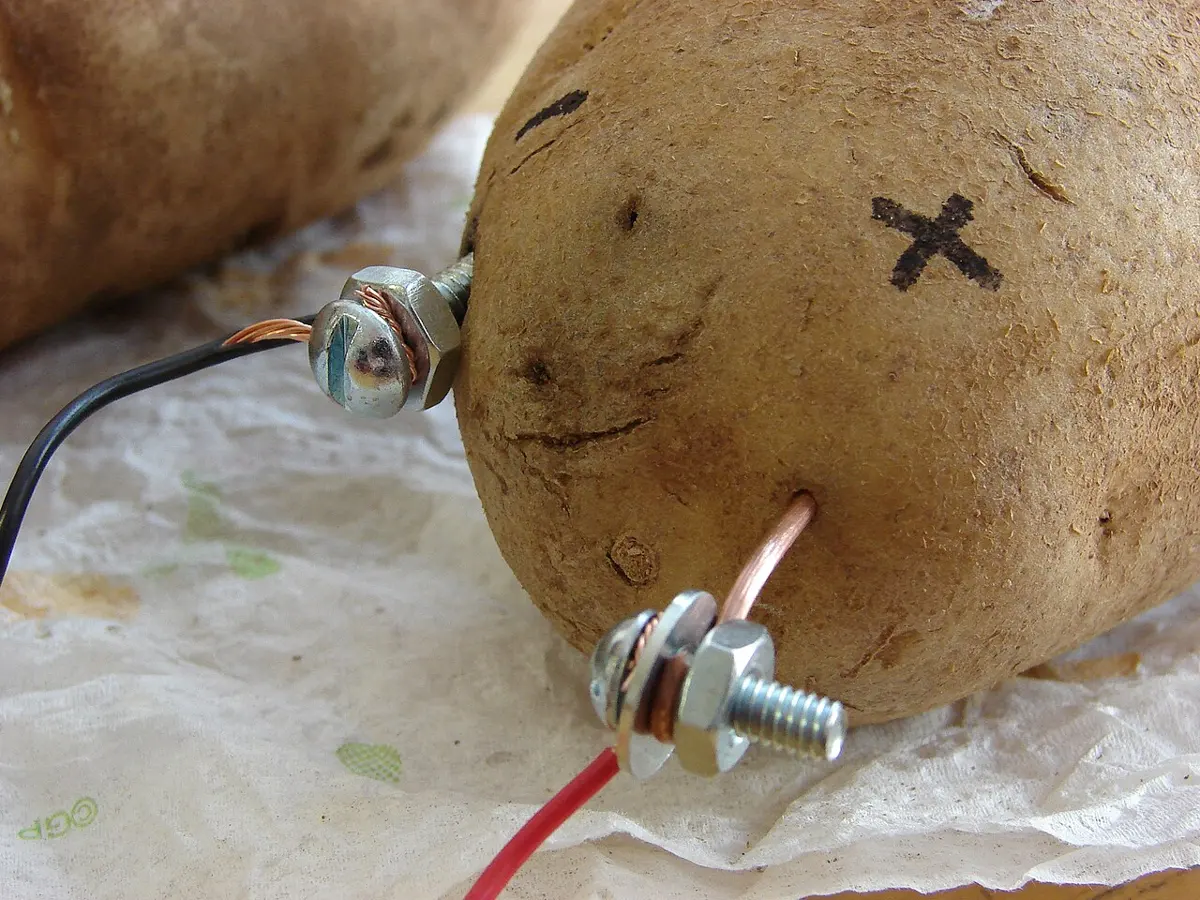
Press the button on a television remote and a small cylinder of zinc and manganese dioxide pushes electrons through a circuit. Start a motorbike and six lead cells under the seat turn its starter. Leave an iron gate unpainted through a Bhaktapur monsoon and it rusts, which is the same kind of chemistry running where nobody wants it. A tin roof of galvanized iron stays gray for years because a thin coat of zinc is quietly being eaten in place of the iron. All of these are electrochemistry.
In Grade 11 you used electricity to drive reactions that would not go by themselves: electrolysis. This unit runs the other way. A reaction that does go by itself, zinc dissolving and copper plating out, is split into two halves in two beakers, so that its electrons have to travel through a wire on the way, and that flow is a current you can use. The unit builds the tools to predict it: electrode potentials, the standard hydrogen electrode they are measured against, the electrochemical series, the cell potential and its link to free energy, and the cells in your remote, your motorbike and on the way to the Moon.

Electrochemistry is the branch of chemistry that studies the relationship between electrical energy and chemical reactions. All of it rests on redox reactions, in which electrons pass from one substance to another. It covers how chemical energy is turned into electrical energy, as in batteries, and how electrical energy drives reactions, as in electrolysis. Its main uses are storing and producing electrical energy, preventing corrosion, and electroplating.
There are two kinds of electrochemical cell:
- In an electrolytic cell, a redox reaction that is not spontaneous is driven by an outside source of electricity. Electrical energy is turned into chemical energy. The two electrodes usually dip into the same electrolyte.
- In a galvanic or voltaic cell, a spontaneous redox reaction produces a current. Chemical energy is turned into electrical energy. The two electrodes usually dip into different electrolytes, in two half-cells.
Grade 11 dealt with electrolytic cells; this unit is about galvanic cells and the ideas behind them.
In which cell does a reaction that would not go by itself take place?
Pick an answer to see why.
5.1 Electrode potential and standard electrode potential
Where an electrode potential comes from
Dip a zinc rod in a solution of zinc ions. Two things start at its surface at once. Some zinc atoms give up two electrons each and leave as Zn²⁺ ions, so the electrons stay behind in the metal:
And some Zn²⁺ ions from the solution come up against the metal, take two electrons and settle as zinc atoms. For zinc the first happens a little more than the second. The rod is left with a few extra electrons, so it becomes negative, and the positive Zn²⁺ ions in the solution are drawn to it, forming a thin layer against its surface. Very quickly the two processes come to the same rate, an equilibrium:
For copper in Cu²⁺ it goes the other way: Cu²⁺ ions plate onto the rod faster than copper atoms leave, so the copper is left short of electrons, positive, with a layer of the solution’s negative ions (here SO₄²⁻) held against it. Either way the charges separate into two layers of opposite sign, one on the metal and one in the solution beside it: an electrical double layer (Figure 5.7). A separation of charge is a potential difference.
Electrode potential is the potential difference between a metal and the solution of its ions at their surface, set up by the electrical double layer. It measures how strongly the electrode tends to lose or gain electrons. It is also called the single electrode potential, but a single one cannot be measured by itself: a voltmeter needs two terminals, and the moment you dip a second wire into the solution you make a second electrode with a potential of its own. So electrode potentials are always measured against a reference electrode and are comparisons (5.2).
An electrode potential depends on:
- the concentration of the ions in the solution;
- the temperature;
- the nature of the metal and its ions: zinc and copper differ even under the same conditions.
Standard electrode potential
To compare different electrodes fairly, they must be measured under the same conditions. The potential measured under standard conditions is the standard electrode potential, E°:
- the ions at a concentration of 1 mol/L (1 M);
- a temperature of 298 K (25 °C);
- any gas at a pressure of 1 atm (IUPAC now uses 1 bar, only 1.3% less, which changes the potentials by less than a millivolt).
The standard electrode potential gives the tendency of an electrode to gain or lose electrons compared with the standard hydrogen electrode (SHE), whose potential is fixed at exactly 0 V. Potentials are written today as reduction potentials, for the half-reaction written as a gain of electrons (, E° = +0.34 V). Then:
- A positive E° means the electrode takes electrons (is reduced) more readily than hydrogen does: Cu²⁺/Cu, +0.34 V.
- A negative E° means the electrode gives electrons away (is oxidized) more readily than hydrogen does: Zn²⁺/Zn, −0.76 V.
The standard reduction potential of a metal is −0.76 V. What does that tell you?
Pick an answer to see why.
5.2 Types of reference electrodes
5.2.1 Why a reference electrode
A single electrode potential can be measured only against a reference electrode. The two in common use are the standard hydrogen electrode and the calomel electrode.
5.2.2 Standard hydrogen electrode
The standard hydrogen electrode (SHE) is the primary reference electrode: its electrode potential is fixed, by agreement, at 0 V under standard conditions. It is a piece of platinum foil coated with platinum black (finely divided platinum), dipped in a solution of a strong acid with H⁺ at 1 mol/L, usually HCl, while pure hydrogen gas at 1 atm is bubbled over it continuously, at 25 °C (Figure 5.8). The platinum does not react; it only gives the hydrogen, the H⁺ ions and the electrons a large surface to meet on and carries the electrons in or out:
To measure another electrode’s standard potential, it is joined to an SHE in a cell and the cell’s voltage is read. Because the SHE is exactly 0 V, the voltage measured is the other electrode’s potential, and its sign comes from which way the electrons flow. The voltage of a cell is
where both are reduction potentials, and the cathode is the electrode where reduction happens.
Zinc against the SHE (Figure 5.9): the meter reads 0.76 V, with electrons flowing out of the zinc. Zinc gives up electrons more readily than hydrogen, so zinc is the anode and the SHE the cathode:
Copper against the SHE (Figure 5.10): the meter reads 0.34 V, with electrons flowing into the copper. Copper is the cathode and the SHE the anode:
How to tell anode from cathode against the SHE. A metal more electropositive than hydrogen (one with a negative reduction potential, like zinc) is the anode, the negative electrode, when it is joined to the SHE; its potential is given a negative sign. A metal less electropositive than hydrogen (a positive reduction potential, like copper) is the cathode, the positive electrode, and its potential is positive.
Limitations of the hydrogen electrode:
- It needs very pure hydrogen and platinum, which make it expensive.
- It is awkward for routine work: the gas must flow all the time at exactly 1 atm, and the platinum black is easily spoiled (“poisoned”) by traces of sulphur compounds, arsenic or mercury in the solution.
A metal electrode is joined to an SHE, and electrons are found to flow from the SHE into the metal. What is the sign of the metal’s standard reduction potential?
Pick an answer to see why.
5.2.3 Calomel electrode
The calomel electrode is the most common secondary reference electrode: its potential has been measured once against the SHE, and after that it stands in for it. It is simple and easy to use. The saturated calomel electrode (SCE) has a reduction potential of +0.241 V at 298 K.
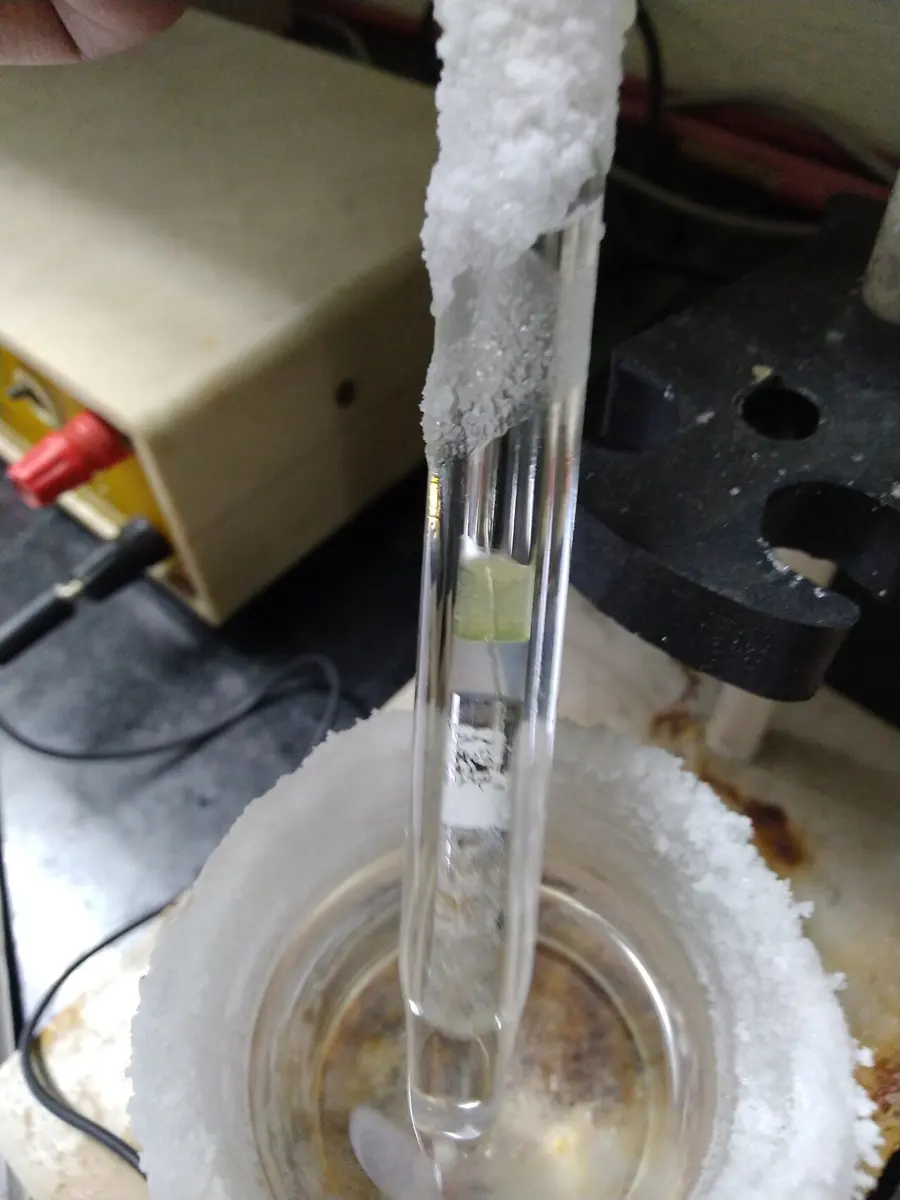
It has a glass tube with a porous plug at its tip (Figure 5.11). Inside, a platinum wire makes electrical contact with mercury (Hg), which sits in a paste of mercury and mercury(I) chloride, Hg₂Cl₂, called calomel; all of it is in saturated KCl solution, which reaches the other half-cell through the porous plug. The reaction at the electrode is
Its potential depends only on the concentration of Cl⁻, which the saturated KCl (with a few crystals left undissolved) holds fixed.
Advantages of the calomel electrode:
- It is reliable and easy to keep, so it is the most often used secondary reference electrode.
- It needs no supply of gas, so it is easy to use.
It does contain toxic mercury and mercury(I) chloride, so it must be handled with care and never thrown away with ordinary waste. Many laboratories now use the silver–silver chloride electrode (+0.197 V in saturated KCl) instead, for that reason: it is the reference electrode inside most pH meters.
5.3 Electrochemical series and its applications
The electrochemical series (or activity series) is a list of electrodes arranged in order of their standard reduction potentials, each measured against the standard hydrogen electrode (Figure 5.13). Here they are in increasing order, the most negative at the top.
The series tells us a great deal:
1. Oxidizing and reducing agents. The higher an electrode’s reduction potential, the more strongly its oxidized form takes electrons: the substance with the highest reduction potential is the strongest oxidizing agent (F₂, +2.87 V). The lowest reduction potential belongs to the strongest reducing agent (Li, −3.04 V).
2. A cell’s voltage. The series gives the potentials of both electrodes:
For the zinc–copper cell, V.
3. Whether a cell works by itself. For a galvanic cell to run spontaneously, the electrode with the higher reduction potential must be the cathode and the one with the lower the anode; then E°cell is positive and a current flows. In the zinc–copper cell, Zn²⁺/Zn (−0.76 V) is the anode and Cu²⁺/Cu (+0.34 V) the cathode.
4. Metal displacing metal. A metal with a lower reduction potential displaces a metal with a higher one from a solution of its salt: a metal above another in the series displaces it.
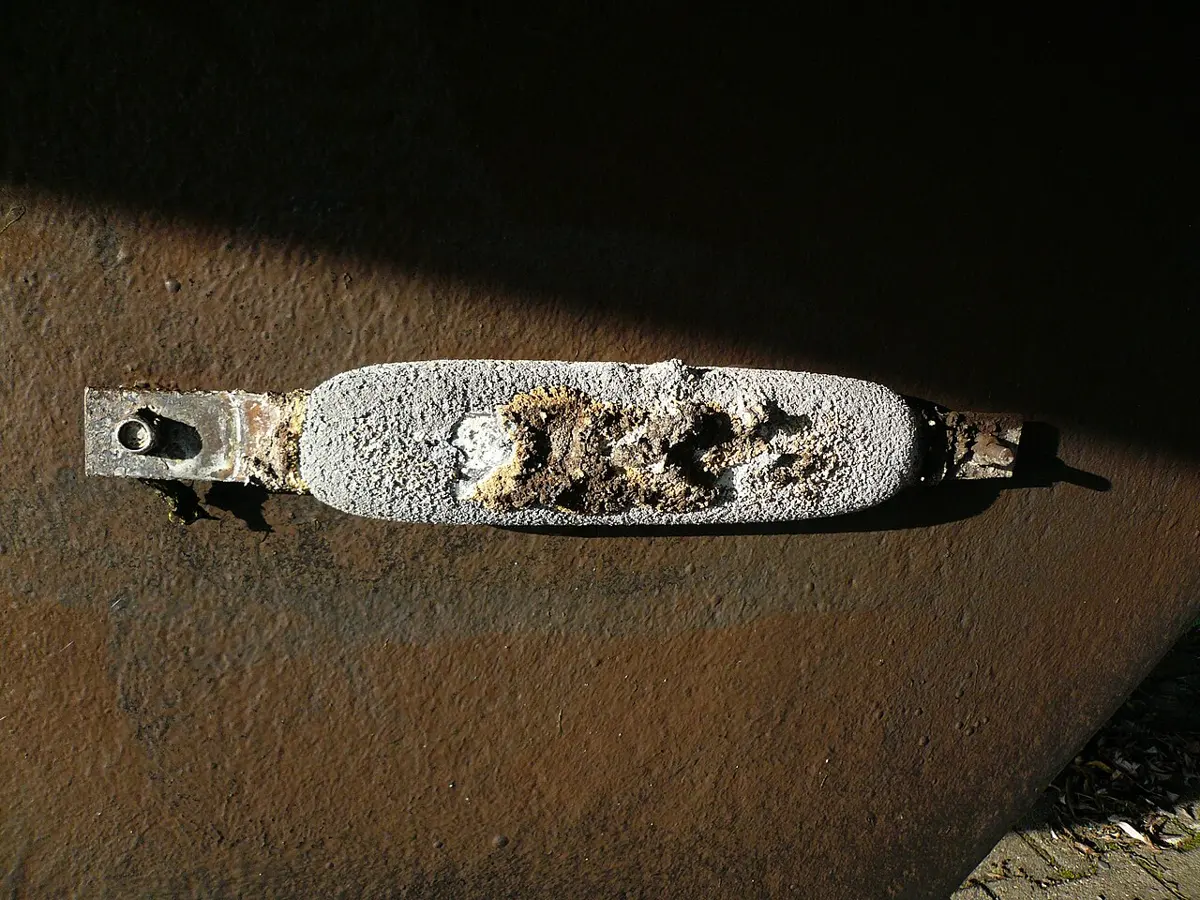
5. Corrosion, and how to stop it. The metals near the top of the series are oxidized most easily, so they corrode most readily. A metal that corrodes can be protected by joining it to a sacrificial anode, a metal with an even lower reduction potential, which corrodes in its place (below).
6. Products of electrolysis. In electrolysis, when several ions could react at an electrode, the series helps predict which does: at the cathode the cation easiest to reduce (the highest reduction potential) is discharged first, and at the anode the species easiest to oxidize (the lowest). In copper sulphate solution, Cu²⁺ (+0.34 V) is reduced at the cathode in preference to water, which gives hydrogen at about −0.41 V in neutral solution (−0.83 V in 1 M alkali); in sodium chloride solution water is reduced before Na⁺ (−2.71 V), which is why Grade 11’s brine gave hydrogen, not sodium.
7. Hydrogen from acids. Only metals with a negative reduction potential, those above hydrogen in the series, displace hydrogen from dilute non-oxidizing acids (dilute HCl or H₂SO₄):
Which of these metals would displace copper from copper sulphate solution?
Pick an answer to see why.
Corrosion: a cell nobody built
Rust is a galvanic cell. On a wet piece of iron, one part of the surface becomes the anode, where iron dissolves:
The electrons run through the iron itself to another part, often at the edge of the water drop where air reaches it, which becomes the cathode, where oxygen takes them:
The Fe²⁺ and OH⁻ meet in the water and form iron(II) hydroxide, which air oxidizes further to rust, hydrated iron(III) oxide, . The water drop is the cell’s electrolyte. That is why iron rusts only where it is wet and has air, and why it rusts much faster in salt water: dissolved salt makes the water a far better conductor of ions, so the little cells on the iron’s surface run faster. Iron railings by the sea, and cars on roads salted against ice, rust fastest of all.

Two ways to stop it come straight from the series:
- Sacrificial protection. Join iron to a metal higher in the series, which is oxidized more easily. That metal becomes the anode and dissolves; the iron becomes the cathode, where only oxygen is reduced, and is left alone. Blocks of zinc are bolted to the steel hulls of ships, and buried pipelines are wired to blocks of magnesium, which are replaced when they have worn away.
- Galvanizing. Iron is coated with a thin layer of zinc. The zinc keeps air and water off, and where the coat is scratched it still protects the iron underneath as a sacrificial anode.
5.4 Voltaic cells: Zn–Cu cell, Cu–Ag cell
5.4.1 Electrochemical, galvanic or voltaic cell
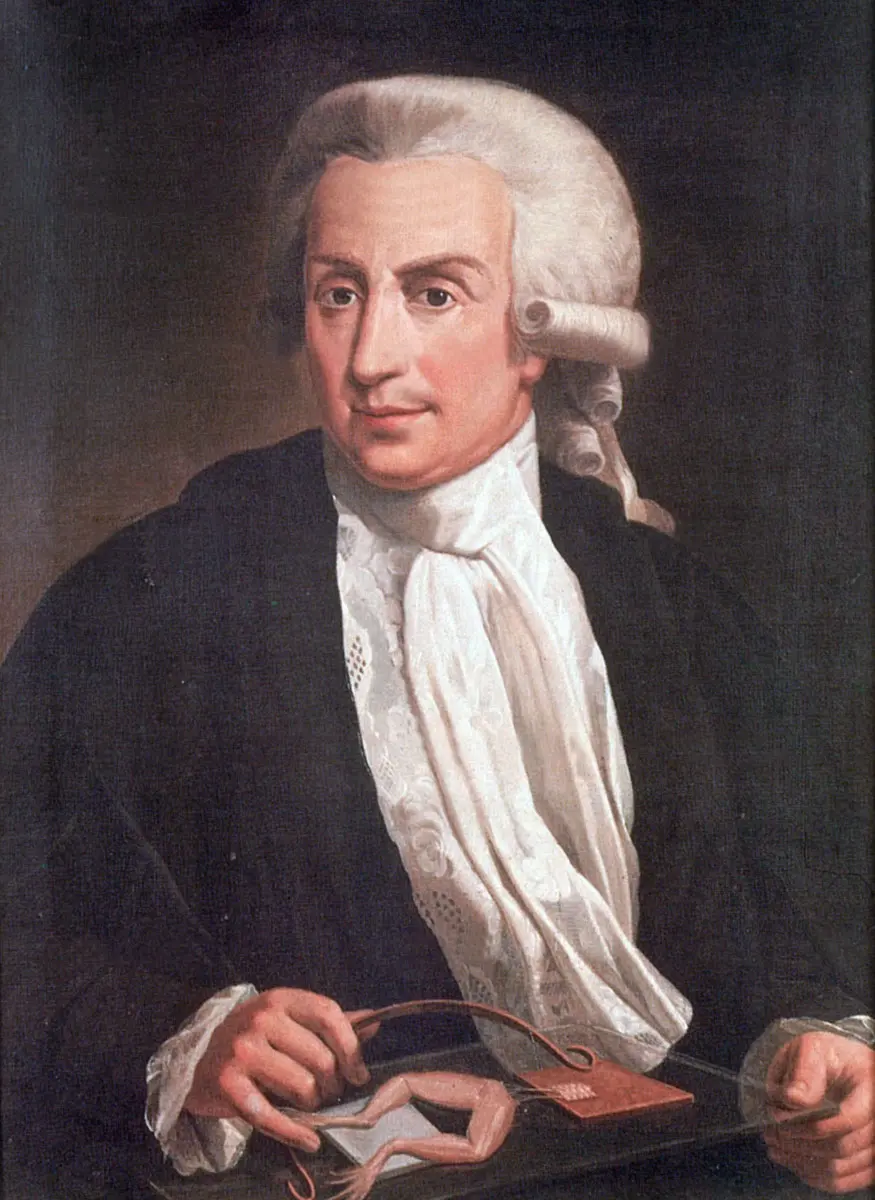
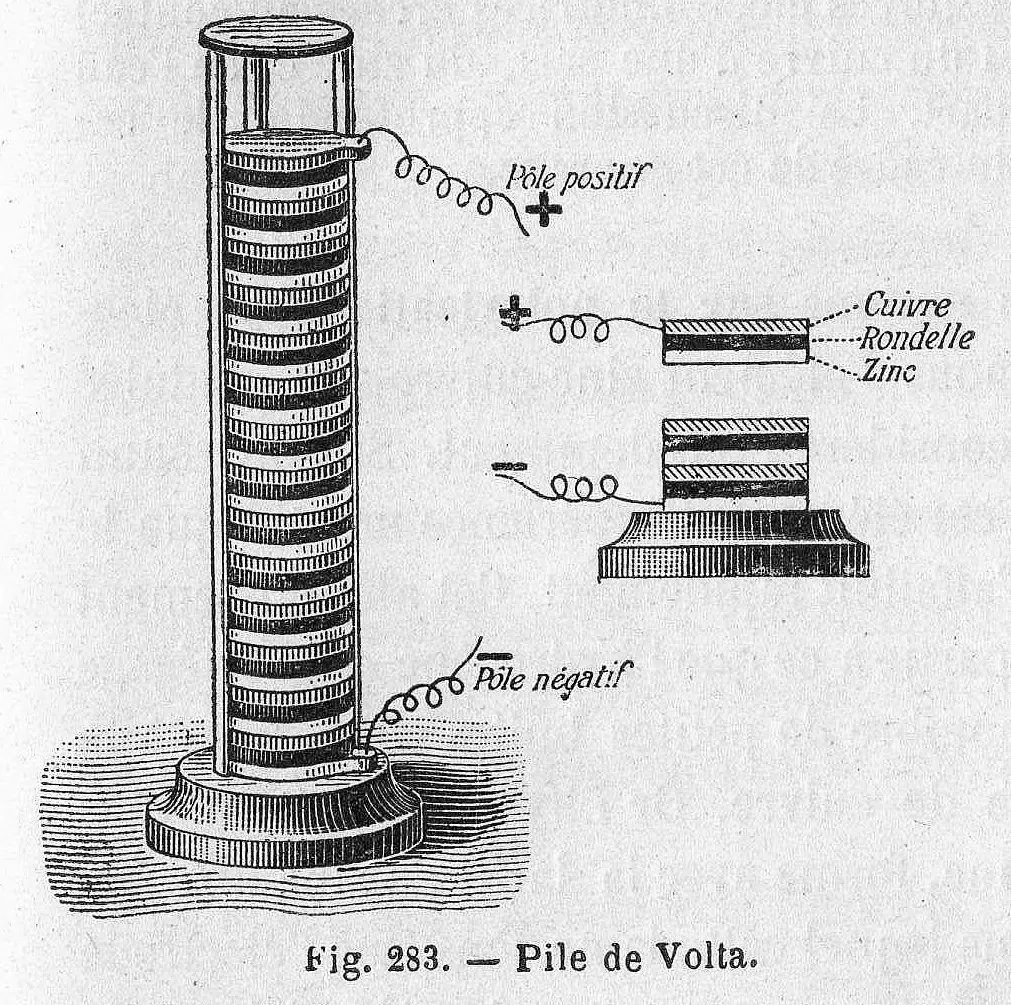
A voltaic or galvanic cell is a device that turns chemical energy into electrical energy through a spontaneous redox reaction. Its two electrode reactions happen apart, in two vessels called half-cells. The half-cell with the higher reduction potential is the cathode, and the one with the lower the anode. The two are joined outside by a wire, through a voltmeter or whatever the cell is to run, and inside by a salt bridge, which keeps the solutions from mixing. The two half-reactions add up to the cell reaction.
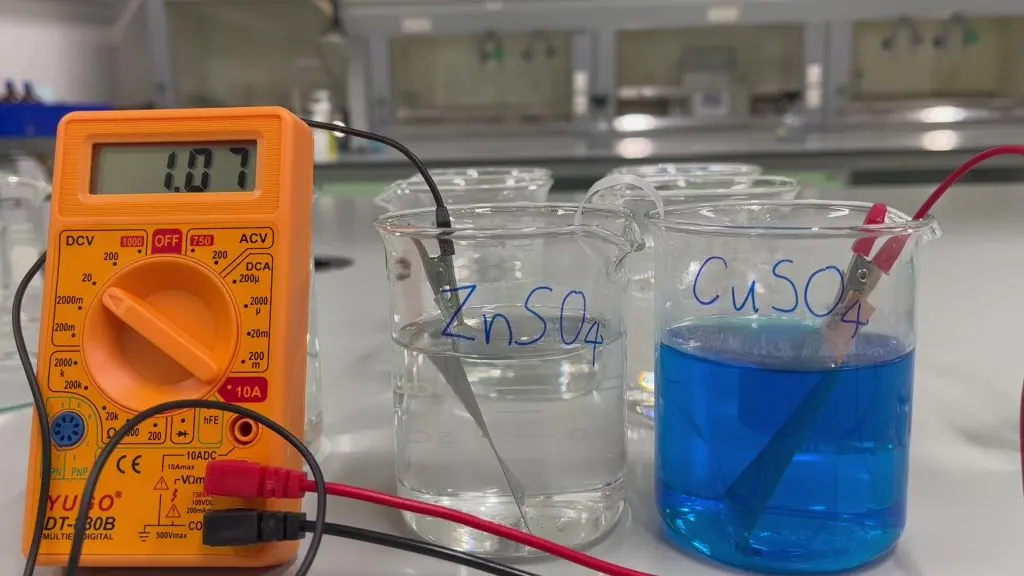
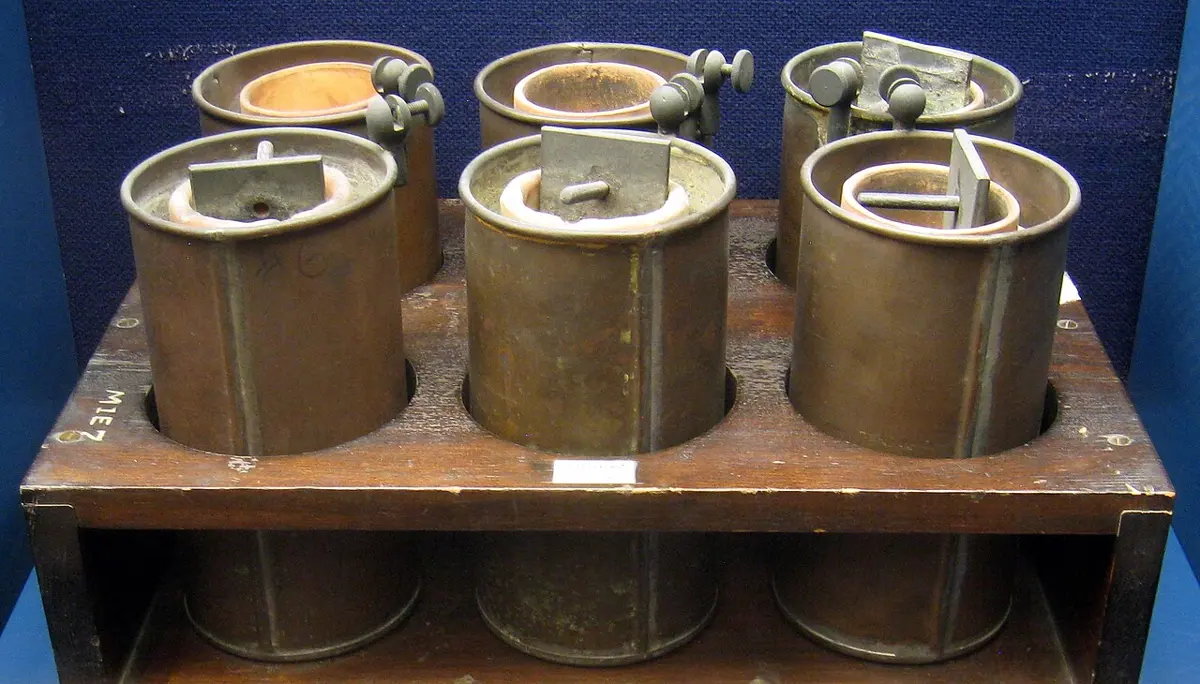
Take the zinc–copper cell, called the Daniell cell after John Frederic Daniell, who made it in 1836 (Figure 5.18).
At the anode (zinc), oxidation: zinc atoms give up electrons and go into the solution as ions.
At the cathode (copper), reduction: copper ions from the solution take electrons from the cathode and are deposited on it.
The cell reaction is the sum of the two:
Electrons flow through the wire from the zinc (anode) to the copper (cathode), so the conventional current flows the other way, from copper to zinc. Over time the zinc rod thins, copper builds up on the copper rod, and the blue of the copper sulphate fades.
Cell notation
A galvanic cell is written in a short form called cell notation:
- The anode (−) is written on the left, the cathode (+) on the right.
- A single vertical line, |, is a boundary between phases, here solid metal and solution.
- A double vertical line, ‖, is the salt bridge joining the two half-cells.
- The concentration of each solution goes in brackets.
So a cell notation reads from left to right in the direction the electrons go, from the anode through the outer circuit to the cathode. Where a half-cell has no metal of its own (both forms are ions, or one is a gas), an inert electrode, usually platinum, is written at its end: the SHE is .
The voltage the Daniell cell gives is
A positive cell potential means the reaction is spontaneous and the cell can produce a current.
The salt bridge
A salt bridge joins the two half-cells’ solutions. It is usually a U-shaped glass tube filled with a concentrated solution of an inert electrolyte, such as KCl or KNO₃, set in a jelly of agar-agar so that it doesn’t run out; a strip of filter paper soaked in such a solution is sometimes used instead, as in Activity 3. Its jobs:
- It completes the circuit inside the cell by giving the ions a path between the two solutions.
- It keeps the two solutions from mixing directly. (If Cu²⁺ reached the zinc, it would plate straight onto it, and the electrons would never go round the wire.)
- It keeps each half-cell electrically neutral. As the cell runs, the zinc beaker gains Zn²⁺ and the copper beaker loses Cu²⁺; without the bridge they would soon carry opposite charges, which would stop the flow of electrons at once. Anions from the bridge move into the zinc beaker and cations into the copper beaker to balance them.
- It keeps the small extra potential at the meeting of the two solutions (the liquid junction potential) low. K⁺ and Cl⁻, or K⁺ and NO₃⁻, move through water at almost the same speed, so neither runs ahead of the other to build up a charge.
One electrode, two jobs. A metal with a positive reduction potential can still be oxidized, and one with a negative potential can be reduced: whether an electrode is the anode or the cathode depends on the electrode it is joined to. The electrode with the higher reduction potential is the one reduced in a cell. Copper (+0.34 V) is the cathode against zinc, but the anode against silver.
The copper–silver cell
In a cell of copper in Cu²⁺ and silver in Ag⁺, copper is the anode and silver the cathode. Why? Ag⁺/Ag has the higher reduction potential, +0.80 V against copper’s +0.34 V, so silver ions take electrons more readily than copper ions do (Figure 5.20).
At the anode (copper), oxidation:
At the cathode (silver), reduction:
The cell reaction. Each copper atom gives up two electrons and each silver ion takes one, so the silver half-reaction is doubled before adding:
Cell notation:
The cell potential:
The silver half-reaction was doubled, but its E° was not: an electrode potential doesn’t depend on how many moles react.
5.5 Cell potential and standard cell potential
5.5.1 Cell potential and standard cell potential
The cell potential, Ecell, is the potential difference between the two electrodes of an electrochemical cell, measured when no current is being drawn. Under a given set of conditions it is the driving force of the cell’s reaction: the bigger it is, the harder the reaction pushes the electrons round.
where Ecell is the cell potential, Ecathode the electrode (reduction) potential of the cathode and Eanode that of the anode. The cell potential changes with temperature, pressure (where a gas takes part) and concentration. Measured under standard conditions, 298 K (25 °C), 1 atm and every solution at 1 M, it is the standard cell potential, E°cell, always relative to the standard hydrogen electrode. It belongs to the cell’s reaction, and tells whether that reaction tends to go by itself:
The Nernst equation
How much does the cell potential change away from 1 M? In 1889 the German chemist Walther Nernst worked out the answer. For a cell reaction in which n electrons are transferred,
where Q is the reaction quotient, written like an equilibrium constant from the concentrations at that moment (pure solids left out), R = 8.314 J/(mol K), T the temperature and F the faraday, 96,485 C/mol. At 25 °C, V, and with ordinary logarithms
For the Daniell cell, , n = 2 and :
More of the product ions, or fewer of the reactant ions, makes Q bigger and the voltage smaller: the reaction has less left to push for. A tenfold change in Q changes a two-electron cell’s voltage by only 0.030 V, so cell potentials are not very sensitive to concentration. When the cell runs down, Q grows until Ecell reaches 0: the cell is then at equilibrium, and flat.
In the Daniell cell, which change makes the voltage rise above 1.10 V?
Pick an answer to see why.
5.6 Relation between cell potential and free energy
When a cell’s reaction moves n moles of electrons, it pushes nF coulombs of charge through the cell potential Ecell. Charge times potential difference is work, so the maximum work an electrochemical cell can do is
From Unit 4, the most useful work a system can do is equal to the decrease in its free energy:
Putting the two together,
and under standard conditions
For a process to be spontaneous, ΔG must be negative, which needs Ecell to be positive. So the sign of a cell’s potential and the sign of its free energy change say the same thing, the opposite way round:
| E°cell | ΔG° | The reaction |
|---|---|---|
| positive | negative | spontaneous: the cell gives a current |
| zero | zero | at equilibrium: no current |
| negative | positive | not spontaneous: it goes only if driven, as in electrolysis |
5.7 Commercial batteries and fuel cells
5.7.1 Commercial batteries
Commercial batteries are electrochemical cells, turning chemical energy into electrical energy, made for practical everyday use in a wide range of things. (Strictly a battery is several cells joined together, but the word is used for single cells too.) They are of two kinds.
1. Primary batteries can’t be recharged and are used only once: their reaction can’t be run backwards in practice. An example is the dry cell.
The dry cell (Leclanché cell) runs wall clocks, remotes, torches and toys. Its zinc can is the anode (−); a carbon (graphite) rod in the middle collects electrons for the cathode (+), where the real reactant is manganese dioxide, packed round the rod with carbon powder; between them is a moist paste of ammonium chloride and zinc chloride, the electrolyte (Figure 5.21). It is “dry” because the electrolyte is a paste, not a liquid that can spill.
At the anode:
At the cathode:
The zinc ions and ammonia then combine, so the overall reaction is
A new dry cell gives about 1.5 V. Its voltage sags as it is used, and an old one leaks when the zinc can is eaten through. The alkaline cell, the commoner kind today, uses the same zinc and manganese dioxide but potassium hydroxide as the electrolyte, and lasts longer.
2. Secondary batteries can be recharged and used many times: a current pushed through them the other way runs their reaction backwards.
The lead-acid battery (lead storage battery) is used in vehicles and in the inverters of homes and offices. Each cell has plates of lead (the anode) and of lead dioxide, PbO₂ (the cathode), in dilute sulphuric acid. As it discharges, both plates turn to lead sulphate and the acid turns towards water:
At the anode:
At the cathode:
Overall:
Each cell gives about 2 V; six in series make the 12 V battery of a car or motorbike. Charging runs the reaction backwards, turning the lead sulphate back into lead and lead dioxide and remaking the acid. Because the acid gets thinner as the battery discharges, the density of the acid (measured with a hydrometer) tells how much charge is left.
The nickel–cadmium battery has nickel oxyhydroxide, NiO(OH), as its positive plate, cadmium as its negative plate, and aqueous potassium hydroxide as the electrolyte. While it discharges:
At the anode (cadmium):
At the cathode (nickel):
Overall: the two electrons given up at the anode are the two taken at the cathode, and the hydroxide ions cancel:
It gives about 1.2 V a cell, can be recharged hundreds of times, and was the rechargeable battery of cordless tools and early mobile phones. Cadmium is toxic, so nickel–cadmium batteries have mostly been replaced by nickel–metal hydride and lithium-ion ones, and they must be recycled, never thrown away.
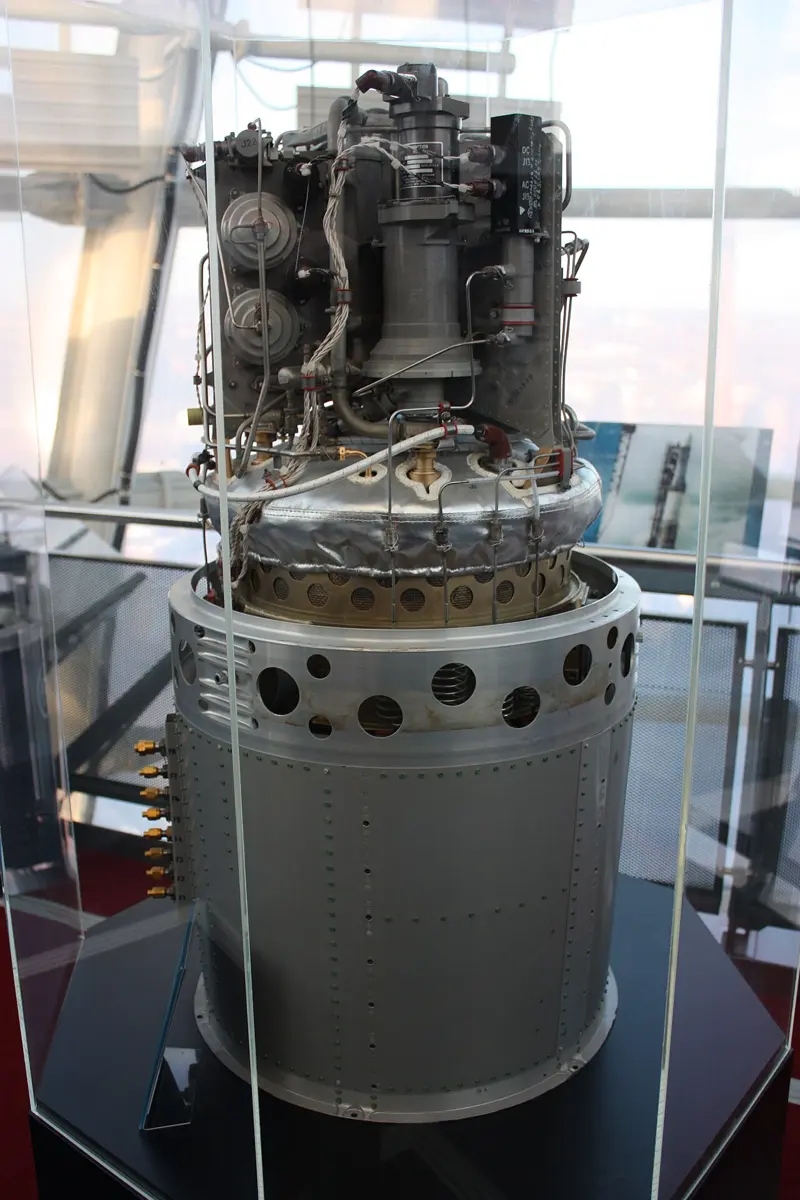
3. Fuel cells turn the chemical energy of a fuel, such as hydrogen, into electrical energy directly, for as long as the fuel and oxygen are fed in: they are never charged and never run down. An example is the hydrogen–oxygen fuel cell, with porous carbon electrodes containing a catalyst, and hot concentrated potassium hydroxide as the electrolyte in the alkaline kind (Figure 5.22):
At the anode:
At the cathode:
Overall:
Its only product is water. In practice a cell gives about 0.7–1 V while it works, and many are stacked in series. Grade 11’s fuel cell, the kind in today’s hydrogen cars, has an acid membrane in place of the KOH; its reactions are written with H⁺ instead of OH⁻, and its overall reaction and voltage are the same.
Exercise
A. Multiple choice questions
- Electrode potential is
Pick an answer to see why.
- The conditions required for an electrode potential to be standard are
The textbook prints “25 °C, 1 atm pressure and 0.1 M concentration” as both options a and c, so none of its options is right and the book’s options don’t work; option c is put right here.
Pick an answer to see why.
- The standard electrode potential of hydrogen is taken as
Pick an answer to see why.
- The standard hydrogen electrode is commonly used as
Pick an answer to see why.
- The calomel electrode is mainly used
Pick an answer to see why.
- Metals in the electrochemical series are arranged on the basis of their
Pick an answer to see why.
- Which of the following has the highest reduction potential?
Pick an answer to see why.
- Which of the following would displace copper from copper sulphate solution?
Pick an answer to see why.
- The reaction at the cathode of a Zn–Cu voltaic cell is
Pick an answer to see why.
- The standard cell potential of a Zn–Cu cell is
Pick an answer to see why.
- If the cell potential of a galvanic cell is positive, the reaction is
Pick an answer to see why.
- The relationship between cell potential and free energy is
Pick an answer to see why.
- The electrolyte in a lead storage battery is
Pick an answer to see why.
- The battery commonly used in smartphones is
Pick an answer to see why.
- The by-product of a hydrogen–oxygen fuel cell is
Pick an answer to see why.
- Standard conditions are needed when standard electrode potentials are measured because
Pick an answer to see why.
- If the standard reduction potential of a metal is −0.76 V, comparing it with the standard hydrogen electrode shows that it has
Pick an answer to see why.
- In a voltaic cell, the function of the salt bridge is
Pick an answer to see why.
- To build a voltaic cell from two different metals, what is the first step in predicting its cell potential?
Pick an answer to see why.
- In real-world use, the electrochemical series is best used for
Pick an answer to see why.
- Engineers choose a cathode material with a high reduction potential (and an anode with a low one) when designing a commercial battery, to
Pick an answer to see why.
- Metals X and Y, with reduction potentials +0.80 V and −0.76 V, are used in a galvanic cell. For the cell to be spontaneous,
Pick an answer to see why.
- If a voltaic cell has a cell potential of +1.0 V, then
Pick an answer to see why.
- To prevent marine corrosion of an iron structure, a suitable sacrificial metal is
The textbook gives aluminium as option d. But aluminium alloys are sacrificial anodes on ships too (Exercise 5.2, question 2), so two options would be right and the book’s options don’t work; d is tin here.
Pick an answer to see why.
B. Exercise 5.2
Given V and V:
- a.Which is the better reducing agent, Na or Au?
- b.Can Au³⁺ oxidize Na to Na⁺? Write the reaction if it is feasible.
- c.Why is gold found in nature in its elemental form?
Answer
The electrochemical series has many applications. It can also help protect a metal from corrosion.
- a.Why does iron corrode faster in salt water? Use the electrochemical series to explain.
- b.Suggest why aluminium is used as a sacrificial anode for iron ships, with .
- c.Write the oxidation half-reaction for aluminium acting as a sacrificial anode.
Answer
A galvanic cell is made from these half-cells:
, E° = −0.26 V
, E° = −0.74 V
- a.Identify the anode and the cathode. Write the cell notation.
- b.Write the cell reaction, showing the electrode reactions.
- c.Calculate the standard e.m.f. of the cell.
- d.What happens to the cell potential if the concentration of Ni²⁺ is raised to 2 M while Cr³⁺ stays at 1 M?
Answer
A galvanic cell of zinc and iron is built on this reaction:
- a.Turn the reaction into cell notation.
- b.Calculate ΔG° using the standard cell potential, E°cell = 0.32 V.
- c.Is the reaction spontaneous under standard conditions? Justify.
- d.What happens to the mass of the zinc electrode as the reaction proceeds?
Answer
These standard reduction potentials are given: V and V.
- a.Design a galvanic cell using Mg and Ni. Label the anode, the cathode and the electron flow.
- b.Write the cell notation and the cell reaction.
- c.Calculate the cell potential.
- d.Which acts as the oxidizing agent? Explain.
Answer
While a galvanic cell was being built, no voltage was seen.
- a.List three possible reasons.
- b.How can the problem be overcome, so that the cell works properly?
- c.Explain the role of the salt bridge in keeping the cell working.
Answer
Five metals P, Q, R, S and T behave like this: R displaces P and Q from solutions of their salts, while S does not react with a solution of any of the other metals. T displaces hydrogen from an acid, but not R. P displaces Q from its solution.
- a.Arrange the metals in an activity series, with hydrogen.
- b.The standard reduction potentials are , E° = −0.44 V, and , E° = −0.34 V.
- i.Construct a galvanic cell and show its anode and cathode.
- ii.Calculate the e.m.f. of the cell with 1 M solutions.
- iii.Predict whether the reaction will occur. Explain.
The textbook gives E°(T⁺/T) = +0.34 V. A metal with a positive reduction potential can’t displace hydrogen from an acid, so the book’s numbers don’t work with “T displaces hydrogen”; −0.34 V is used here. (With +0.34 V the answer to ii would be 0.78 V, and the reaction in iii still would not occur.)
Answer
Printable PDFs
- Study notes 3 pages
- Worksheet 4 pages Answer key
Quiz yourself: Matter, Atoms and Reactions, Grades 5–12 →
Practice every question in the book, and keep track of the ones you miss →
Project work
A companion to your textbook, not a replacement for it: study from the book your school uses, and where the two differ, follow your teacher. Found a mistake? Please tell us.