
A mango drops from its branch in Bhaktapur. Some 384,000 km away, the Moon swings round the Earth on its monthly circle. A television satellite hangs, apparently motionless, in the southern sky above Nepal, and the dish on your roof never has to move to follow it. Isaac Newton’s great idea was that all three are the same force: the pull every piece of matter has on every other.
In this unit you will write that pull as a law, use it to weigh the Earth, follow how gravity changes as you climb Everest or dig a mine, measure the energy it stores, and work out how fast a satellite must go to stay up, and how fast a rocket must go to get away for good. At the end you will see how a phone uses satellites and the speed of light to find where you are standing.
7.1 Introduction
People argued about why things fall for two thousand years. Aristotle (384–322 BCE) thought heavy things fall because they belong at the center of the universe; medieval scholars in the Islamic world and in Europe added ideas of their own; and in the 1600s Galileo, Kepler and Robert Hooke came close to the answer. Isaac Newton (1642–1727) put it together: the story says he wondered, when an apple fell, whether the pull that brought it down reached all the way to the Moon. The word gravity comes from the Latin gravitas, “weight”. Newton did not discover that things fall; he discovered why, and that the same law rules the sky.
The force of attraction between any two bodies because of their masses is called gravitation. When one of the two is the Earth, the force is called gravity. So gravity is one case of gravitation: the pull of the Earth on a mango is gravity, the pull between the Sun and Jupiter is gravitation.
Gravitation is the weakest of the four fundamental forces of nature: the electric force between a proton and an electron is about 10³⁹ times stronger than the gravitational force between them. It rules the sky only because it always attracts and never cancels, while electric charges come in two kinds that cancel out in bulk matter.
7.2 Newton’s law of gravitation
Newton published his law in 1687, in the Principia:
Every particle in the universe attracts every other particle with a force that is directly proportional to the product of their masses and inversely proportional to the square of the distance between them.
is the universal gravitational constant:
What means: put kg and m; then . So is the force of attraction between two masses of 1 kg each, placed 1 m apart: 6.67 × 10⁻¹¹ N, about the weight of a speck of dust.
- Universal: has the same value everywhere and for all bodies, a stone, a planet or a star, whatever they are made of and whatever lies between them. Nothing can shield a body from gravity.
- The forces form an action–reaction pair (Newton’s third law): the Earth pulls a mango down exactly as hard as the mango pulls the Earth up.
- For spheres (the Earth, the Moon, a ball), is the distance between their centers: a uniform sphere pulls things outside it as if all its mass were at its center.
The distance between two bodies is halved and one mass is doubled. The gravitational force becomes:
Pick an answer to see why.
7.3 Acceleration due to gravity
The acceleration of a body falling freely under the Earth’s gravity alone is the acceleration due to gravity, . Near the Earth’s surface it is about 9.8 m/s², the same for every body, whatever its mass, size or shape (in a vacuum, a feather and a hammer fall together). A ball thrown straight up loses 9.8 m/s of speed every second; a falling ball gains 9.8 m/s every second.
Derivation:
Take a body of mass on the surface of the Earth, mass and radius , treated as a uniform sphere.
- By Newton’s law of gravitation, the Earth pulls it with .
- By Newton’s second law, this force gives it an acceleration : .
- So , and cancels:
The body’s mass has canceled: that is why all bodies fall with the same acceleration. And depends only on the planet’s mass and radius, so for a planet .
The Earth is not a perfect sphere: spinning has made it bulge at the equator, where the surface is about 21 km farther from the center than at the poles, and the spin itself lessens the pull a body feels there (see below). So varies over the Earth:
- at the poles, m/s²;
- at the equator, m/s².
Weighing the Earth
Rearranged, gives the mass of the Earth from three things we can measure: (with a pendulum), (Eratosthenes did it in about 240 BCE; see the project at the end), and (Cavendish).
Dividing by the volume gives the Earth’s mean density, about 5,500 kg/m³: twice that of surface rocks, so the inside must be much denser (it has an iron core).
Things worth knowing about gravity
- The Moon falls, and misses. The Earth’s pull on the Moon is at right angles to the Moon’s velocity: it does no work, changes only the Moon’s direction, and provides the centripetal force for its nearly circular orbit (Unit 6). The Moon is falling towards the Earth all the time, but it moves sideways fast enough that it keeps missing.
- A satellite’s speed stays the same, in a circular orbit, for the same reason: the pull is always at right angles to its motion, so it turns the satellite without speeding it up or slowing it down. The field certainly acts on it: without the pull, the satellite would fly off in a straight line.
- Nothing shields gravity. No material placed between two bodies changes the pull between them.
- Why the mango falls, not the Earth. The mango and the Earth pull each other with the same force . But the mango’s acceleration is , and the Earth’s is . So
For a 0.3 kg mango, : the Earth does move towards the mango, but far too little ever to notice.
A planet has the same mass as the Earth but half its radius. The value of g on its surface is:
Pick an answer to see why.
7.4 Inertial and gravitational mass
The word “mass” is used for two things that are, on the face of it, different.
- Inertial mass is how much a body resists a change in its velocity. It is measured by pushing: apply a known force , measure the acceleration , and (Newton’s second law). It could be measured in deep space, far from any planet.
- Gravitational mass is how strongly a body is pulled by gravity (and pulls). It is measured by weighing: in a field where the pull on it is at distance from a mass , . A beam balance compares gravitational masses.
Experiments find the two exactly equal for every body: only the method of measuring differs. That is why all bodies fall with the same : a body with twice the gravitational mass is pulled twice as hard, but has twice the inertial mass to move, so its acceleration is the same.
7.5 Gravitational field strength
The gravitational field of a body is the region round it in which another mass feels its gravitational pull. In principle it reaches to infinity, getting weaker with distance.
The gravitational field strength (or intensity) at a point is the force on a unit mass placed at that point:
It is a vector, pointing the way the force on the mass points. Its SI unit is N/kg (which is the same as m/s²). The test mass is taken small enough not to disturb the field it measures.
The field of a point mass, or a sphere
Place a test mass at a distance from the center of a body of mass (a point mass, or a uniform sphere with outside it).
- By Newton’s law, .
- The field strength is the force per unit mass:
directed towards the center of .
At the Earth’s surface, :
So the gravitational field strength at a point equals the acceleration due to gravity there: 9.8 N/kg is the same as 9.8 m/s². A 1 kg mass feels a pull of 9.8 N, and falls with 9.8 m/s².
Force and field strength
- The gravitational field strength at a point is a property of the place: the pull on each kilogram there.
- The gravitational force is the pull on a particular body: the field strength times the body’s mass, . “Gravitational pull” is just an everyday name for this force.
The field is different round different bodies because depends on the mass that makes it. At its surface the Moon, with 1/81 of the Earth’s mass and 0.27 of its radius, has a field of only 1.6 N/kg, a sixth of the Earth’s. The Moon stays in orbit because it moves in the Earth’s field.
Field strength from the potential
The field and the gravitational potential (next section) are linked: the field strength is minus the slope (gradient) of the graph of potential against distance:
The potential rises (becomes less negative) as grows, so is positive, and the minus sign makes the field point inwards, towards smaller . Its size is , just as above. The steeper the potential graph, the stronger the field; far away the graph is nearly flat, and the field nearly zero.
At a point the gravitational field strength is 4 N/kg. What force acts on a 3 kg mass there?
Pick an answer to see why.
7.6 Gravitational potential
The gravitational potential at a point in a gravitational field is the work done in bringing a unit mass from infinity to that point, without accelerating it. Its SI unit is the joule per kilogram (J/kg). It is a scalar.
“Infinity” is a place so far away that the pull of the body is zero there; we take the potential there to be zero.
Derivation:
Measure distances outwards from O, the center of the Earth (mass ).
- At A, a distance from O, the Earth pulls a unit mass inwards with a force .
- To bring the mass in without accelerating it, we hold it back with an equal force pointing outwards, in the direction of increasing .
- As it moves from A to B, changes by (a negative amount, since is getting smaller). The work we do is force × displacement along the force:
- Add up the work from infinity () to P ():
- This work, per unit mass, is the potential at P:
At the Earth’s surface, with m/s² and m, MJ/kg.
Why is it negative? Gravity attracts, so on the way in the field pulls the mass along and we only hold it back: we do negative work. The potential is greatest, zero, at infinity, and less (more negative) everywhere closer. To lift a kilogram from the Earth’s surface right out of its field, you must give it 62.7 MJ.
7.7 Gravitational potential energy
Near the surface, where hardly changes, lifting a mass by a height stores of potential energy: you met this in earlier grades. But when the height is comparable with the Earth’s radius, changes along the way, and we need the general form.
The gravitational potential energy of a body at a point in a gravitational field is the work done in bringing the body from infinity to that point, without accelerating it.
Derivation:
Repeat the derivation of 7.6 for a body of mass instead of a unit mass (Figure 7.4).
- At a distance from the center, the pull on the body is , inwards; we hold it back with the same force outwards.
- Moving it by , we do work .
- From infinity to P, at distance :
The potential energy of a body is its mass times the potential at its position. On the Earth’s surface:
It is negative for the same reason: the field does the work of bringing the body in. Only changes in potential energy are measured, and the zero is chosen at infinity.
A 2 kg body is at a point where the gravitational potential is −40 MJ/kg. Its gravitational potential energy is:
Pick an answer to see why.
7.8 Variation of the acceleration due to gravity
7.8.1 Variation of g with altitude
Take a body at a height above the surface of the Earth (mass , radius ). Its distance from the center is (Figure 7.5).
- On the surface: (i)
- At the height : (ii)
- Dividing (ii) by (i):
Since , : g decreases with height, falling as .
For a height small compared with the Earth’s radius (), the binomial approximation gives
7.8.2 Variation of g with depth
Go down a mine to a depth . Two effects compete: you are closer to the center, which strengthens the pull, but the rock above you no longer pulls you inwards. A uniform spherical shell of rock pulls nothing inside it at all (its pulls from all sides cancel exactly), so only the ball of Earth beneath you, of radius , counts.
Take the Earth as a uniform sphere of density . A body at depth is from the center (Figure 7.5).
- The mass of the ball of radius beneath it: .
- The field it feels:
- On the surface the same formula with gives (since ).
- Dividing:
So inside a uniform Earth, falls in a straight line with depth, to zero at the center (). A body there has no weight: it is pulled equally in every direction.
Putting 7.8.1 and 7.8.2 together, is greatest at the surface and less above and below it:
Variation of g with latitude
The shape. The Earth bulges at the equator: its equatorial radius is 6,378 km and its polar radius 6,357 km. A body at a pole is closer to the center, so is larger there.
The spin. A body on the equator is carried round a circle of radius 6,378 km once a day. Part of the Earth’s pull is used up as the centripetal force for this circle, , so less of it presses the body on the scale. With s rad/s:
At the poles, on the axis, the body goes round no circle, and the whole pull counts. The two effects together make about 9.78 m/s² at the equator and 9.83 m/s² at the poles. (The bulge itself is caused by the spin, too: a soft spinning ball flattens.)
At what depth below the surface does g become half its surface value (uniform Earth)?
Pick an answer to see why.
7.9 Center of mass and center of gravity
7.9.1 Center of mass
The center of mass of a body is the point where its whole mass can be taken to be concentrated, for working out its motion as a whole. A force through the center of mass gives the body a linear acceleration with no turning; a force anywhere else turns it as well.
A body is made of many particles, of masses , at positions .
- Let forces act on the particles, giving them accelerations , and so on. Adding Newton’s second law for every particle (along ):
- Write for the total mass, and divide and multiply by it:
- So the whole body moves as if its total mass were at the single point and all the forces acted there:
That point is the center of mass: the mass-weighted average of the particles’ positions.
Two bodies. For two masses and a distance apart, the center of mass lies on the line joining them, at distances from and from such that
It is nearer the heavier mass: a seesaw with a heavy and a light child balances closer to the heavy one.
Center of gravity
The center of gravity (C.G.) of a body is the point through which the resultant of the weights of all its particles acts, vertically downwards, in whatever position the body is held. It is the average position of the body’s weight.
- Where the gravitational field is uniform across the body (any ordinary object on the Earth), the center of gravity is at the same point as the center of mass. They differ only for a body so large that changes across it (a tall mountain, or a long satellite pointing at the Earth).
- The C.G. need not be inside the material of the body: for a ring, a hollow ball or a horseshoe it is at an empty point.
- Builders and designers of buildings, bridges, ships, aircraft and kites must know where it is: a structure is most stable with its C.G. low and over the middle of its base.
Conditions for stable equilibrium
A body stands most stably when:
- its center of gravity is as low as possible;
- its base is as wide as possible;
- the vertical line through its C.G. falls within its base. If the line passes outside the base, the weight turns the body over.
Everyday examples:
- A ship carries heavy ballast (or its cargo) low in its hull, to keep its C.G. low.
- A double-decker bus with many passengers upstairs has its C.G. raised, so it tips over at a smaller tilt; such buses are tested on a tilt table with weights upstairs.
- Passengers who stand up in a small boat raise its C.G., and it capsizes more easily.
- A racing car is built wide and low.
Why is it dangerous for passengers to stand up in a small boat?
Pick an answer to see why.
7.9 Motion of a satellite
A satellite is a body that orbits a larger body, held by its gravity. The Moon is the Earth’s natural satellite; the Earth and the other planets are satellites of the Sun; and since 1957 people have launched thousands of artificial satellites round the Earth, for communication (telephone, TV, internet), weather forecasting, mapping, navigation, science and defense. In every case the gravitational pull of the larger body provides the centripetal force that keeps the satellite on its curved path.
How a satellite gets into orbit. Throw a stone horizontally from a high mountain: it falls in a curve (a projectile’s path, Unit 3) and lands some distance away. Throw it faster, and it lands farther. The Earth is round, so the ground curves away beneath a fast enough stone; at the right speed the stone falls round the curve as fast as the ground drops away, and never lands: it is in orbit. This was Newton’s own thought experiment. In practice a rocket carries a satellite above the air (which would slow it down) and gives it this sideways speed.
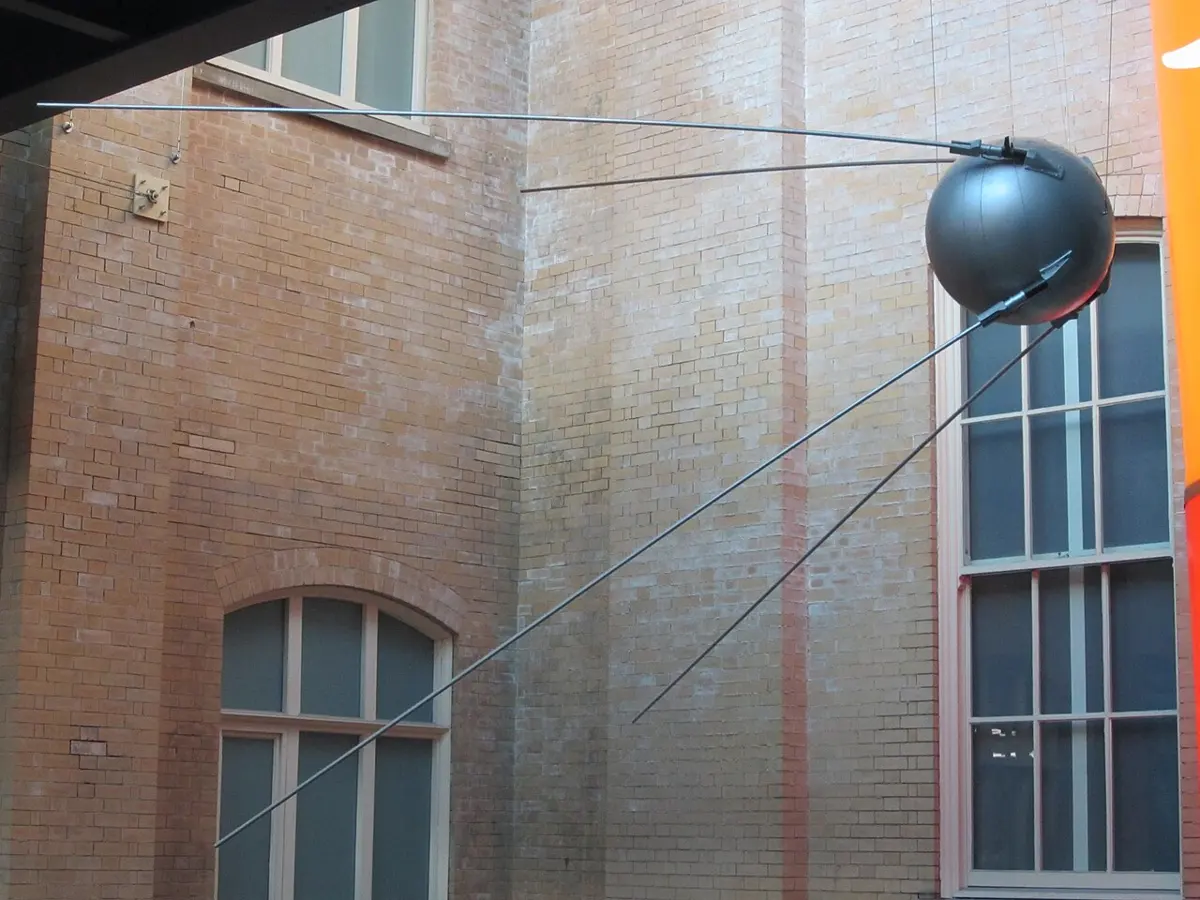
The first artificial satellite, Sputnik 1, was launched by the Soviet Union on 4 October 1957. Nepal’s first satellite, NepaliSat-1, a cube of about 1 kg built by Nepali engineers in Japan, was launched in 2019 and released into orbit from the International Space Station.
7.9.1 Orbital velocity of a satellite
The orbital velocity of a satellite is the velocity with which it moves round its (circular) orbit.
Take a satellite of mass moving in a circular orbit at a height above the surface of the Earth (mass , radius ), with orbital velocity . The radius of its orbit is .
- The gravitational pull provides the centripetal force:
- So , and
- Since at the surface, :
- does not depend on the satellite’s mass: a 1 kg cube and the 420,000 kg International Space Station at the same height go equally fast.
- The higher the orbit, the slower the satellite.
Close to the surface (, an orbit just above the air):
About 28,500 km/h: from Kathmandu to Pokhara, about 140 km in a straight line, in under 20 seconds.
7.9.2 Time period of a satellite
The time period of a satellite is the time it takes to go once round its orbit.
- Its speed is , so .
- With :
(Equivalently, from and .)
- Squaring: , so for every satellite of the same planet. This is Kepler’s third law, which Kepler found from the planets’ orbits in 1619 and Newton explained.
Close to the surface, :
The International Space Station, about 420 km up, takes about 92 minutes.
The height for a given period. Rearranging :
Satellite A orbits at a greater height than satellite B. Compared with B, A has:
Pick an answer to see why.
7.10 Escape velocity
Throw a stone up and it comes back. Throw it faster and it goes higher before it returns. Since gravity weakens with height, there is a speed at which the stone climbs forever, slowing all the time but never stopping and never coming back.
The escape velocity is the least velocity with which a body must be projected from the surface of a planet so that it escapes the planet’s gravitational pull and never returns (ignoring air resistance).
Derivation:
- At P, a distance from the center, the Earth pulls the body (mass ) back with .
- As it moves out by , the work done against gravity is .
- The total work against gravity from the surface () to infinity:
(This is just the rise in potential energy, from to 0.)
4. This work comes out of the body’s kinetic energy. It just escapes if its kinetic energy is used up exactly as it reaches infinity:
- So
using . For the Earth:
- Below this speed the body cannot escape: it stops and falls back (or goes into orbit, if it is going sideways).
- Like the orbital velocity, it does not depend on the body’s mass, nor (ignoring air) on the direction it is launched in.
- Comparing with the speed of an orbit just above the surface: km/s.
- It is different for every planet, since it depends on . On the Moon it is only 2.4 km/s, which is why the Moon has no air: its gas molecules, moving at hundreds of meters a second (some much faster), have slowly leaked away into space.
A planet has twice the Earth’s radius and the same density. Its escape velocity is:
Pick an answer to see why.
7.11 Potential energy and kinetic energy of a satellite
A satellite going round a planet has kinetic energy, because it moves, and potential energy, because it is in the planet’s field.
Take a satellite of mass in a circular orbit of radius round the Earth (mass ).
- The pull gives the centripetal force: , so .
- Kinetic energy:
- Potential energy (7.7):
- Total energy:
So, for any circular orbit,
- The kinetic energy is positive and the potential energy negative, twice as large.
- The total energy is negative: that is what it means for the satellite to be bound to the Earth. To set it free (to bring its total energy up to zero, at rest at infinity), an amount must be supplied from outside, for instance by its rocket. This is the satellite’s binding energy.
- A higher orbit (larger ) has more total energy (less negative) but less kinetic energy: to raise a satellite, its rocket must add energy, yet it ends up going slower.
7.12 Geostationary satellites
A satellite whose period is the same as the Earth’s period of rotation is in a synchronous orbit. If its orbit is also circular, in the plane of the equator, and goes round from west to east (the way the Earth turns), it stays over the same point on the equator: seen from the ground it is at rest. It is a geostationary satellite, in a geostationary (or parking) orbit. Geostationary satellites carry television, telephone and internet links and watch the weather: one dish, pointed once, receives a satellite all the time.
Its height. With h s, m/s² and m, from 7.9.2:
Its speed:
(The Earth really turns once in 23 h 56 min, its sidereal day, relative to the stars; with that, the exact height is 35,786 km.)
Weightlessness and free fall
A body is in free fall when gravity is the only force acting on it. A body feels weightless when nothing pushes up on it, no floor, seat or scale: what we feel as our weight is really the push of the floor on us.
Free fall is the cause, weightlessness the effect. In a lift whose cable has snapped, you and the lift fall together with acceleration : the floor no longer presses on you, a scale under you reads zero, and you float.
A body feels weightless:
- at the center of the Earth, where the pull is zero (7.8.2);
- in free fall, as in a falling lift or a diving aircraft;
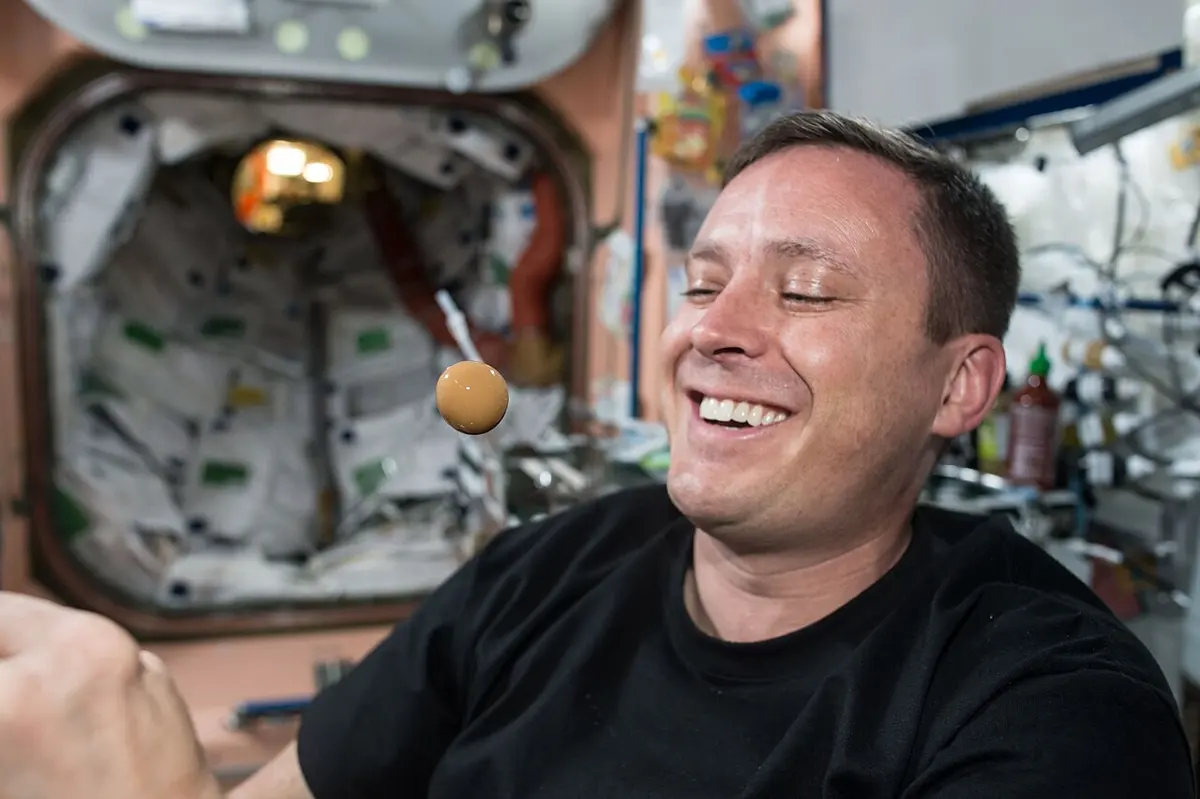
- in an orbiting spacecraft: the spacecraft and everything in it fall freely round the Earth together (7.9), so nothing presses on anything else;
- at the point between the Earth and the Moon where their pulls are equal and opposite (about 346,000 km from the Earth’s center), where a body at rest feels no resultant pull.
7.13 Global Positioning System (GPS)
When a map app shows a blue dot where you stand, a ride app finds you at your door, or a trekker’s watch records a route over Thorong La, they are using satellites. The Global Positioning System (GPS) is a global navigation satellite system: it lets a receiver anywhere on or near the Earth find its position, its velocity and the exact time, in any weather, day and night. Its main uses:
- finding a location, where you are;
- navigation, the way from one place to another, by air, sea and road;
- tracking the movement of a vehicle, an animal or a person;
- mapping and surveying the land;
- timing: its clocks give the exact time to banks, power grids and phone networks.
It is also used in farming and rescue work, and it is in every smartphone.
How GPS works
The satellites. GPS has at least 24 satellites, in six orbital planes with four slots each, so that at least four are above the horizon from anywhere on the Earth; with spares, around 30 are usually in use. They orbit about 20,200 km above the Earth, going round twice a day, at about 3.9 km/s (14,000 km/h). Each carries atomic clocks and sends out, all the time, a radio (microwave) signal that says which satellite it is, where it is, and the exact time the signal left.
Distance from time. A receiver picks up the signal and notes when it arrived. The signal travels at the speed of light, m/s, so
A signal from a satellite overhead takes about 0.07 s. An error of only one microsecond in the timing would put the distance out by 300 m.
Place from distances: trilateration. Knowing its distance from one satellite puts the receiver somewhere on a sphere round that satellite. A second distance narrows it to the circle where two spheres meet; a third, to the two points where three spheres meet, one of which is usually far out in space or deep in the Earth, so the receiver picks the other. Finding a place from distances is called trilateration (finding it from angles would be triangulation, which GPS does not use).
Why four satellites. The satellites have atomic clocks, but a phone has an ordinary quartz clock, which can easily be thousandths of a second out. So every distance the receiver works out is wrong by the same amount, and three spheres no longer meet at one point. The receiver uses a fourth satellite to work out its own clock error as well: four unknowns (three for its position, one for its clock), four distances. So a receiver needs signals from at least four satellites, and uses all it can see (often 8 to 12) for a better fix. Its clock then keeps time as well as the satellites’ atomic clocks.
The three segments
- The space segment: the satellites, each sending its signal.
- The control segment: a master control station (in Colorado, with a backup), about 16 monitoring stations round the world, and ground antennas. They track the satellites, work out their exact orbits and clock errors, and upload corrections to them.
- The user segment: the GPS receivers in phones, cars, planes and ships, which pick up the signals and work out their position. They only receive; they send nothing back to the satellites.
What limits its accuracy
- The atmosphere: the signals slow down slightly in the ionosphere (charged gas 80–1,000 km up, disturbed by solar storms) and in the lower air.
- Obstructions and reflections: steep hillsides, tall buildings and trees block satellites or bounce their signals, so a signal arrives by a longer path. In a deep gorge or a narrow Kathmandu street the fix is worse.
- Satellite geometry: satellites bunched in one part of the sky give a poor fix; spread round the sky, a good one.
- Orbit and clock errors in the data the satellites send (the ephemeris, their predicted positions), and the receiver’s own electronics.
A phone usually finds its place to within about 5 m; survey equipment, by comparing signals with a base station, to within a centimeter.
GPS and GNSS
GPS is run by the United States. It is one of several systems, together called GNSS (Global Navigation Satellite Systems): Russia’s GLONASS, the European Union’s Galileo and China’s BeiDou also cover the whole world, and India’s NavIC and Japan’s QZSS cover their own regions (NavIC covers Nepal). Most phones today receive several systems at once: more satellites in view give a quicker and more accurate fix.
What is the least number of GPS satellites a receiver needs signals from to find its position on the Earth and its time?
Pick an answer to see why.
Project work
Exercise
Choose the correct option
- What happens to the period of a simple pendulum as it is taken higher above the Earth’s surface?
Pick an answer to see why.
- What is the value of g on a planet with 1/80 of the Earth’s mass and half its radius? (g on the Earth = 9.8 m/s²)
Pick an answer to see why.
- If the Earth kept its mass but its radius shrank by 1%, the value of g at its surface would:
Pick an answer to see why.
- The orbital speed of a satellite of mass m is proportional to:
Pick an answer to see why.
- At what height above the Earth’s surface is g half its value at the surface? (Radius of the Earth 6400 km)
Pick an answer to see why.
- How deep inside the Earth (radius R) must a person go for their weight to be a quarter of its value at the surface?
Pick an answer to see why.
- If the distance between the Earth and the Sun were half what it is, how many days would there be in a year?
Pick an answer to see why.
- What is the period of a geostationary satellite?
Pick an answer to see why.
- A missile misses its target and goes into a circular orbit of radius 4 times the radius of the geostationary orbit. What is its period?
Pick an answer to see why.
- What is the value of g at the center of the Earth?
Pick an answer to see why.
- What is the period of a satellite in a parking (geostationary) orbit?
The textbook’s options are 1 year, 365 days, 8760 hours and “all of the above”, and none of them fits: a parking orbit takes 24 hours, so the book’s options don’t work. The options below are corrected.
Pick an answer to see why.
- For a body in a falling lift to be weightless, the lift’s acceleration must be:
Pick an answer to see why.
- What is the force on a body due to the Earth called?
Pick an answer to see why.
- Where is the value of g greatest?
Pick an answer to see why.
- The value of g at the center of the Earth is:
Pick an answer to see why.
Answer these questions
- a.Why is G called the universal gravitational constant?
- b.Treating the Earth as a uniform sphere of mass M and radius R, show that the acceleration of free fall at its surface is .
- c.What is the acceleration of a satellite moving in a circular orbit of radius 2R round the Earth?
Answer
- a.Define escape velocity.
- b.Describe how you would deduce the value of the escape velocity at the Earth’s surface.
- c.Why is its value different on different planets?
Answer
- a.Define weightlessness.
- b.Find the apparent weight of a 50 kg body in a lift moving downwards with an acceleration of 5 m/s². (Take g = 10 m/s².)
- c.Find its apparent weight when the lift accelerates upwards at 5 m/s².
Answer
The gravitational potential at a point is the work done in bringing a body of unit mass from infinity to that point, without acceleration. On the basis of this:
- a.What happens when the unit mass is replaced by a body of a larger mass?
- b.How does gravitational potential differ from gravitational potential energy?
- c.How is the potential at the Earth’s surface related to the acceleration due to gravity there?
Answer
- a.What are the center of mass and the center of gravity of a body?
- b.A uniform rod 200 cm long, of mass 500 g, is balanced on a wedge at its 40 cm mark. A 2 kg mass hangs from the rod at the 20 cm mark, and an unknown mass m at the 160 cm mark, as in Figure 7.12. Find m for the rod to be in equilibrium. (g = 10 m/s²)
Answer
- a.How does GPS find a position?
- b.What is the least number of satellites needed to find one’s position with GPS?
- c.Name the global navigation satellite systems that can be used instead of GPS.
Answer
- a.Define acceleration due to gravity. Derive an expression showing how it varies with altitude.
- b.At what height above the Earth’s surface is g reduced by 36% of its value at the surface? (Radius of the Earth 6400 km)
Answer
- a.Estimate your weight at the center of the Earth.
- b.Find an expression for how the acceleration due to gravity changes with depth below the Earth’s surface.
- c.Calculate the force of the Earth’s gravity on a 75 kg astronaut repairing the Hubble Space Telescope, 600 km above the Earth’s surface. (Radius of the Earth 6400 km, g = 9.8 m/s²)
- d.Compare this force with the astronaut’s weight on the Earth’s surface.
Answer
An object launched from the Earth’s surface fast enough rises into space and never returns; the least such speed is the Earth’s escape velocity.
- a.Why must this velocity be so large?
- b.Derive an expression for it at the Earth’s surface.
- c.The Earth has 9 times the mass and twice the radius of the planet Mars. Find the least velocity a rocket needs to escape the gravity of Mars. (Escape velocity at the Earth’s surface 11.2 km/s)
Answer
A satellite in a parking orbit has a period of 24 hours, equal to that of the Earth’s rotation.
- a.Why is a satellite in this orbit called a geostationary satellite?
- b.Derive an expression for the height of the parking orbit above the Earth’s surface.
- c.An artificial satellite orbits the Earth in a circle 300 km above its surface. Find its orbital speed and its period. (Radius of the Earth 6400 km, g = 980 cm/s²)
Answer
- a.Distinguish between gravitational potential and gravitational potential energy.
- b.Obtain the formula for the gravitational potential energy of a body on the surface of the Earth.
- c.In an otherwise empty universe, two planets, each of mass kg and radius m, are m apart and nearly at rest. What are their speeds when they collide?
Answer
- a.What is the orbital velocity of a satellite?
- b.Find expressions for the orbital velocity and the period of a satellite.
- c.An Earth satellite moves in a circular orbit at 6200 m/s. Find i. the time of one revolution and ii. its radial (centripetal) acceleration. ( N m²/kg², mass of the Earth kg)
Answer
Numerical problems
Find the period of a satellite in a circular orbit 3.6 × 10⁶ m above the Earth’s surface. Take the Earth as a uniform sphere of radius 6.4 × 10⁶ m and mass 6 × 10²⁴ kg, and N m²/kg².
Answer
Taking the mean density of the Earth as 5500 kg/m³, N m²/kg² and the Earth’s radius as 6400 km, find the acceleration of free fall at the Earth’s surface.
Answer
Two stars of masses kg and kg, m apart, go round their common center of mass with angular velocity ω. The only force on each is their gravitational pull on each other. Find ω. ( N m²/kg²)
Answer
On its way to the Moon, Apollo 11 was first put in a circular “parking orbit” 189 km above the Earth’s surface. Taking the gravitational field strength in this orbit as 9.4 N/kg, calculate i. the spacecraft’s speed and ii. the time for one orbit. (Radius of the Earth 6370 km)
Answer
Explorer 38, a radio astronomy satellite of mass 200 kg, circles the Earth in an orbit of average radius 3R/2, where R is the Earth’s radius. Taking the gravitational pull on 1 kg at the Earth’s surface as 10 N, calculate the pull on the satellite.
Answer
The Earth is flattened, with a polar radius of 6.357 × 10⁶ m and an equatorial radius of 6.378 × 10⁶ m. Find the difference Δg between the acceleration of free fall at a pole and at the equator due to this difference in radii alone. What other factors affect Δg? (Mass of the Earth 5.957 × 10²⁴ kg, N m²/kg²)
Answer
Find g from the motion of the Moon, given that it goes round the Earth in 27 days 8 hours in an orbit of radius 60.1 times the radius of the Earth. (Radius of the Earth 6.36 × 10⁶ m)
Answer
The Moon’s orbit is approximately a circle of radius 60 times the Earth’s equatorial radius. Find the time the Moon takes to complete one orbit, neglecting the rotation of the Earth. (g at the Earth’s poles 9.8 m/s², equatorial radius 6.4 × 10⁶ m, 1 day = 8.6 × 10⁴ s)
Answer
Two particles of masses 1 kg and 2 kg are at x = 0 and x = 3 m. Find the position of their center of mass.
Answer
With what velocity must a satellite be launched at a height of 600 km above the Earth’s surface to move in a circular orbit? ( N m²/kg², radius of the Earth 6.4 × 10⁶ m, mass of the Earth 5.98 × 10²⁴ kg)
Answer
Printable PDFs
- The unit as a book (A5) 23 pages Answers as an A4 booklet, 6 sheets
- Study notes 2 pages
- Worksheet 4 pages Answer key
- Harder practice questions 2 pages Answer key
Quiz yourself: Force, Motion and Machines, Grades 5–12 →
Practice every question in the book, and keep track of the ones you miss →
A companion to your textbook, not a replacement for it: study from the book your school uses, and where the two differ, follow your teacher. Found a mistake? Please tell us.