
A bus on a hill road swings round a hairpin bend, and every passenger slides towards the window. Nobody pushed them. A stone whirled on a string pulls at your hand; let go, and it does not fly outward from the center, as most people expect, but off along a straight line that just grazes the circle. A satellite falls towards the Earth all the time and never comes any closer.
All three are the same physics. A body moving in a circle is always changing its direction, so it is always accelerating, towards the center, and something must be pulling it there. In this unit you will measure turning with angles and radians, derive the acceleration that every circle demands, and use it to explain swing rides, a bucket of water whirled over your head, why roads are tilted at bends, and why a cyclist leans into a turn.
6.1 Introduction to circular motion
A body is in circular motion when it stays at the same distance from a fixed point. The fixed point is the center of the circle, and the line from the center to the body is the radius vector; its length is the radius .
At every point of the circle, the body’s velocity is along the tangent at that point, at right angles to the radius. As the body goes round, the tangent keeps turning, so the direction of the velocity changes all the time, even when the speed stays the same:
A change in velocity is an acceleration, so every body moving in a circle is accelerating, even at a constant speed. By Newton’s second law an acceleration needs a resultant force: something must keep pulling the body towards the center.
A stone is whirled in a horizontal circle on a string. The string breaks when the stone is at the north side of the circle, moving east. Just after that, seen from above, the stone moves:
Pick an answer to see why.
6.1.1 Centripetal force, and the “centrifugal force”
The resultant force that keeps a body moving in a circle is the centripetal force (“center-seeking”). It always points towards the center. It is not a new kind of force: it is whatever force happens to be pulling the body inwards.
- A stone on a string: the tension in the string.
- The Moon round the Earth, a satellite round the Earth: gravity.
- A car turning on a level road: friction between the tyres and the road.
- An electron round the nucleus, in the simple Bohr picture: the electric attraction of the nucleus.
Watched from the ground (an inertial frame), that inward force is the only sideways force on the body, and it is unbalanced. That is exactly why the body’s path keeps bending.
So why does it feel as if something throws you outwards on a turning bus? Because of your inertia. Your body tends to keep moving in a straight line (Newton’s first law). The bus turns under you, and the seat and the side of the bus must push you inwards to turn you with it. Until they do, you slide, relative to the bus, towards the outside of the bend. To someone sitting in the bus, using the bus as their frame, it looks as if a force pushed them outwards. That apparent outward force is the centrifugal force (“center-fleeing”). It is a pseudo-force (a fictitious force): it appears only when we describe the motion from the rotating frame, it equals in size, and no body exerts it.
The everyday examples, explained correctly:
- A bucket of water whirled in a vertical circle. At the top, the bucket is upside down, yet the water stays in. The water must move in a circle, so it needs a downward (towards the center) force of . Its weight provides part of it and the bucket’s bottom pushes down for the rest. As long as is at least , the water is pressed against the bucket instead of falling out (Section 6.6).
- Leaning outwards in a turning bus. Your inertia keeps you going straight while the bus turns; the seat and the friction on you pull you round. It feels like an outward push only in the bus’s frame.
- A stone whirled on a string. The string pulls the stone inwards; the stone pulls the string outwards. If the string breaks, the stone goes off along the tangent.
- Mud flying off a tyre. The mud needs an inward force to go round with the wheel. When its stickiness can’t provide that much, it leaves the tyre along the tangent.
- A satellite orbiting the Earth. Gravity provides its centripetal force.
- The Earth’s bulge. The Earth spins on its axis. Matter at the equator moves round a circle of about 6400 km radius once a day and needs an inward force to do so, so a little less of gravity is left to press it down: the spinning Earth settled into a shape slightly flattened at the poles and bulging at the equator. Its equatorial radius is about 21 km greater than its polar radius. (Its yearly orbit round the Sun has nothing to do with this.)
A body moving in a circle at a constant speed has no work done on it. The centripetal force points to the center and the motion is along the tangent: the angle between the force and the displacement is 90°, and . So its speed and kinetic energy don’t change; only its direction does.
A girl whirls a stone in a horizontal circle on a string. Which force on the stone keeps it in its circle?
Pick an answer to see why.
A car goes round a roundabout at a steady 20 km/h. The work done on it by the resultant force over one full turn is:
Pick an answer to see why.
6.1.2 Angular displacement and angular velocity
Angular displacement
The angular displacement of a body moving round a circle is the angle swept out at the center by its radius vector: the angle AOB as the body goes from A to B.
Angles in circular motion are measured in radians (rad). An angle in radians is the arc length divided by the radius:
So 1 radian is the angle whose arc is as long as the radius (about 57.3°). A whole circle has an arc of , so
A radian is a ratio of two lengths, so it has no dimensions; we write “rad” to remind ourselves that an angle is meant.
Angular velocity
The angular velocity (omega) is the rate of change of angular displacement:
Its SI unit is the radian per second, rad/s. Machines often give it in revolutions per minute (rpm): one revolution is rad, so rad/s.
Angular acceleration
The angular acceleration (alpha) is the rate of change of angular velocity, in rad/s². If the angular velocity changes uniformly from to in a time ,
This is the turning version of . In the same way, for uniform angular acceleration, and .
Time period and frequency
The time period is the time for one complete revolution. In one period the body turns through rad, so
The frequency is the number of revolutions made in one second, in hertz (Hz, or rev/s). Since each revolution takes seconds,
Which way does ω point?
The angular velocity can be given a direction along the axis of rotation, by the right-hand rule: curl the fingers of your right hand the way the body goes round, and your thumb points along . For a body going round anticlockwise as you look down on it, points up, towards you; for clockwise, down. Its size tells how fast it turns, its direction the plane and sense of the turning. (Small angular displacements can be given a direction the same way; large ones don’t add like vectors, as you can see by turning a book through 90° about two different axes in the two orders.)
A wheel turns at 120 rpm. Its angular velocity is:
Pick an answer to see why.
6.2 Relation between linear velocity and angular velocity
The speed along the circle, the linear velocity , and the angular velocity are tied together by the radius.
Derivation. A body moves round a circle of radius , center O, from A to B in a time (Figure 6.2). The arc AB, of length , subtends an angle at O:
- By the definition of the radian, .
- Differentiate with respect to time; is constant: .
- So
- Differentiate once more: , that is
where is the tangential acceleration, the rate at which the speed along the circle changes, and the angular acceleration.
Every point of a turning wheel has the same , but the farther a point is from the axis, the faster it moves: the rim of a bicycle wheel goes much faster than a point near the hub.
Uniform circular motion is circular motion in which the body sweeps out equal angular displacements in equal intervals of time, however small: is constant, and so is the speed . As you saw in 6.1.1, no work is done on the body: the force is at 90° to the motion.
A bicycle wheel of radius 0.35 m turns at 10 rad/s. How fast is a point on its rim moving?
Pick an answer to see why.
6.3 Centripetal acceleration
A body in uniform circular motion has a constant speed but a changing velocity, so it has an acceleration. This centripetal acceleration always points towards the center along the radius, and it is what keeps the body on its circle. Its size is
Derivation
- A body of mass moves at a steady speed round a circle of radius , center O (Figure 6.3). At time 0 it is at A, with velocity ; a short time later it is at B, with velocity . Both have size ; the radius has turned through .
- Draw the two velocities from one point P: and . By the triangle law, , so , the change in velocity.
- Each velocity is at right angles to its radius, so the angle between and is the same as between OA and OB. Triangles OAB and PQR are both isosceles (OA = OB = ; PQ = PR = ) with the same angle between the equal sides, so they are similar:
- When is very small, the chord AB is almost the arc, which the body covers at speed : . So
- In the limit , becomes the instantaneous acceleration:
- Its direction. As , B moves to A, R moves to Q, and the angle θ shrinks to zero. The base angles of the isosceles triangle PQR then become 90°, so (QR) ends up at right angles to , pointing along the radius towards the center. So the centripetal acceleration is always perpendicular to the velocity, and its direction keeps turning as the body goes round.
Using , and , the same acceleration can be written in four ways:
Because it points along the radius, it is also called the radial acceleration. It is a vector, always directed towards the center.
When the speed changes too
If the speed is also changing (a car speeding up round a bend, a wheel spinning up), the body has two accelerations at right angles:
- the centripetal (radial) acceleration , towards the center, which changes the direction;
- the tangential acceleration , along the tangent, which changes the speed.
Its total acceleration is their vector sum:
In uniform circular motion , and only the centripetal acceleration is left.
A car goes round a bend of radius 50 m at 10 m/s. Its centripetal acceleration is:
Pick an answer to see why.
A stone goes round a circle at a steady speed. If its speed is doubled on the same circle, its centripetal acceleration becomes:
Pick an answer to see why.
6.4 Centripetal force
A body of mass moving round a circle of radius at speed has an acceleration towards the center. By Newton’s second law, the resultant force on it must point towards the center too, with size
This is the centripetal force: the resultant force needed to keep a body moving in a circle, directed towards its center.
- When a body is whirled on a string, the tension in the string provides the centripetal force. If the string breaks, the inward pull is gone, and the body leaves along the tangent at the point of breaking (Figure 6.4), then falls like any projectile.
- On a road with many bends, the friction between the tyres and the road provides the bus’s centripetal force. The seat, through friction, pulls the lower part of your body round with the bus, but your upper body, by its inertia, tends to keep going straight, so it tips towards the outside of the bend. To you, in the turning bus, it feels as if an outward centrifugal force acts on you, of size ; seen from the road, your body simply isn’t being turned as quickly as the bus.
- says that at the same angular velocity, a longer string (larger ) needs more force: it is harder to whirl a stone at the same number of turns per second on a longer string. (At the same speed , is smaller for a larger circle: a gentle bend needs less grip than a sharp one.)
- The force is always at right angles to the velocity, , so it does no work and does not change the speed, only the direction.
A 0.5 kg ball is whirled in a horizontal circle of radius 1 m at 4 m/s (ignore its weight). The tension in the string is:
Pick an answer to see why.
6.5 Motion in a horizontal circle: the conical pendulum
A conical pendulum is a bob on a string that, instead of swinging to and fro, goes round in a horizontal circle at a steady speed. The string keeps a constant angle with the vertical and sweeps out a cone.

Real-life conical pendulums: a chair-swing ride at a fair (above); a ball whirled on a string at an angle; and the centrifugal governor (flyball governor) that controlled the speed of steam engines in the 1800s: two heavy balls on arms spun by the engine swing outwards as it speeds up, and the rising arms close the steam valve.
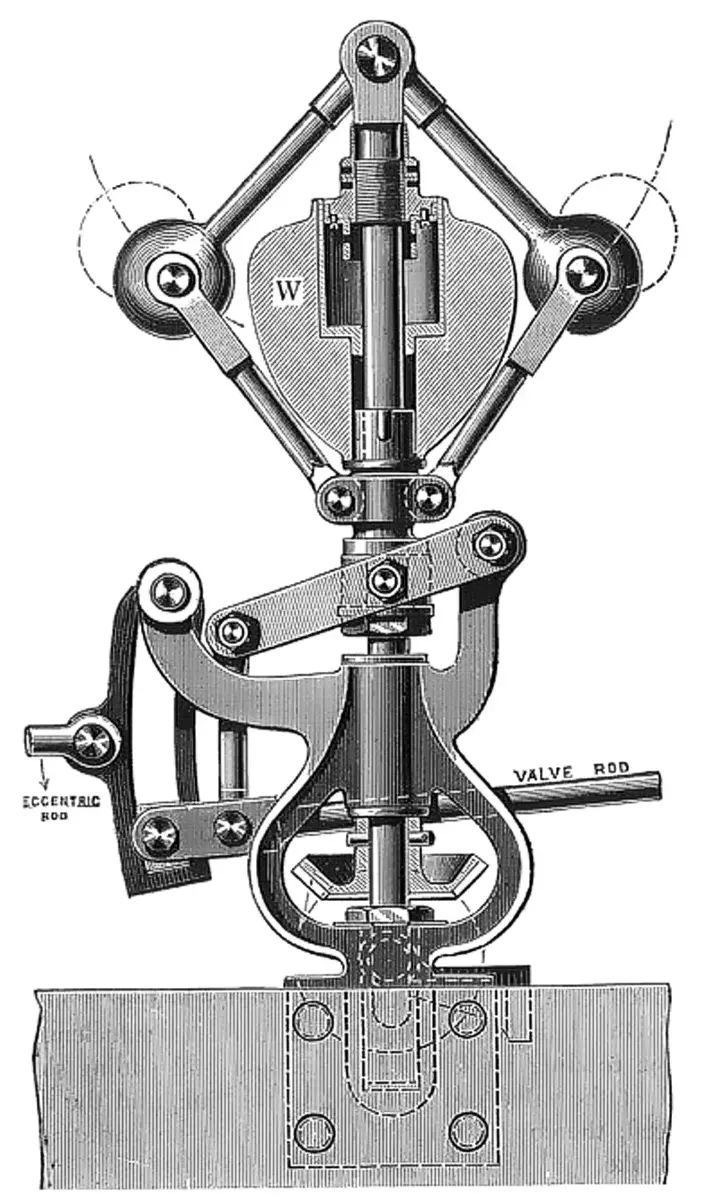
Derivation. A bob of mass on a string of length moves round a horizontal circle of radius at speed , the string at an angle to the vertical (Figure 6.7). Two forces act on it: its weight , down, and the tension , along the string.
- Vertically the bob doesn’t move, so the forces balance:
- Horizontally the resultant is the centripetal force:
- Divide (6.2) by (6.1):
- From the figure, , where is the height of the cone. So
where (tau) is the time for one revolution (we use here, because is the tension).
- So the time period of a conical pendulum is
- The tension. Square (6.1) and (6.2) and add; :
which is the same as .
Notice what the period depends on: only , the depth of the cone below the point of support. Two conical pendulums with different strings but the same go round in step. And a conical pendulum with a small angle has nearly the same period as a simple pendulum of the same length, , because then .
In a horizontal circle at a steady speed, the speed, the kinetic energy and the angular momentum about the center of the circle stay constant; the velocity, the acceleration and the force keep changing direction.
A conical pendulum is made to go round faster. Its string:
Pick an answer to see why.
6.6 Motion in a vertical circle
In a vertical circle, gravity acts along the path, so the tension in the string changes from point to point, and (unless a motor keeps it steady) the speed changes too: the body slows down as it climbs and speeds up as it falls. A Ferris wheel, a roller-coaster loop, a bucket of water whirled over your head and a pilot looping the loop all move in vertical circles.
Derivation of the tension. A body of mass on a string of length goes round a vertical circle, center O (Figure 6.8). At a point P, where the string makes an angle with the downward vertical, its speed is . Two forces act on it: the tension , along the string towards O, and its weight .
- Resolve the weight: along the string, away from O; along the tangent (this part changes the speed).
- Along the string, the resultant towards the center is the centripetal force:
Three special points. Here means the speed at that point.
- At the lowest point A (, ): the tension must hold the body up and pull it round, so it is greatest:
The string is most likely to break here.
- At the highest point C (, ): the weight itself points to the center and does part of the job, so the tension is least:
- At B and D, level with the center (, ): the weight is along the tangent, so the tension alone is the centripetal force:
The critical velocity at the top
A string can pull but never push: the tension can’t be negative. As the speed at the top falls, falls, and the slowest the body can go at the top while the string stays tight is when :
This is the critical velocity: the least speed at the highest point for the body to go round the vertical circle. Then gravity alone provides the centripetal force. Below it, the string goes slack before the top, and the body leaves the circle and falls inside it as a projectile.
The least speed at the bottom
If nothing but the string and gravity act (no motor driving it, no air resistance), the body’s mechanical energy is conserved, and it slows as it climbs. To arrive at the top C with at least , how fast must it go at the bottom A? C is higher than A:
This is the least speed at the lowest point for the body to go safely round the whole circle. With it, the tension at the bottom is : six times the weight.
At any point P, energy conservation also gives the speed: P is above A, so .
A bucket of water is whirled in a vertical circle of radius 1 m. The least speed at the top for the water to stay in (g = 9.8 m/s²) is about:
Pick an answer to see why.
In a vertical circle, the tension in the string is greatest:
Pick an answer to see why.
6.7 Applications of centripetal force
Every vehicle that takes a bend is moving on an arc of a circle, and something must supply its centripetal force. On a flat road it is friction between the tyres and the road; on a tilted (banked) road, part of it is the road’s normal reaction.
6.7.1 A car on a level curved road
A car of mass goes round a level bend of radius at speed (Figure 6.9). Without enough grip, its tyres would slide outwards, away from the center; friction on the tyres opposes that slide, so it points towards the center, and it is the only horizontal force on the car. So friction provides the centripetal force.
- Let and be the friction on the inner and outer tyres, and and the normal reactions. The most friction the road can give is times the normal reaction ():
- Vertically the car doesn’t move, so . The greatest total friction is .
- The friction must provide the centripetal force: . So
This is the greatest speed at which the car can take the bend. Faster than this, friction can’t supply , and the car skids outwards, off the road. Notice that doesn’t depend on the car’s mass: a heavy truck and a small car on the same road have the same limit. A wet or icy road (small ) and a tight bend (small ) both lower it.
6.7.2 Banking of roads
On highways and race tracks, the outer edge of the road at a bend is raised above the inner edge. This tilting is called banking, and the angle that the road makes with the horizontal is the angle of banking.
Why? On a tilted road, the normal reaction is no longer vertical: it leans towards the center of the bend, so its horizontal part supplies centripetal force. The car can then take the bend without relying on friction, which is a great help on a wet or icy road, and it saves the tyres from wear.
Derivation. A car of mass goes round a bend of radius at speed , on a road banked at , and we want friction not to be needed at all (Figure 6.10). Let be the total normal reaction, at right angles to the road, so at to the vertical.
- Vertically, no acceleration:
- Horizontally, the resultant is the centripetal force:
- Divide (6.4) by (6.3):
A road banked at this angle is just right for one speed , its design speed. Slower than that, a car tends to slide down the bank, and friction must act up the slope; faster, it tends to slide up and out, and friction acts down the slope. Within limits, friction covers both.
On a railway, the bend is banked by raising the outer rail above the inner one by a height . With the rails a distance apart (the gauge), , and for small angles . Without the raised rail, the flanges of the wheels would press on the outer rail, and the rail’s sideways push on them would supply the centripetal force.
6.7.3 A cyclist rounding a bend
A cyclist going round a bend leans inwards, towards the center, by an angle from the vertical (Figure 6.11). Why?
On a level road, the road gives the tyre two forces: the normal reaction , upwards, and friction , inwards, which is the centripetal force. Their resultant, the total contact force, is tilted inwards. If the line of that force did not pass through the cyclist’s center of gravity G, it would have a turning effect and topple the cyclist. Leaning so that G lies on that line keeps the cyclist balanced:
- Vertically: .
- Horizontally, towards the center: .
- The resultant makes an angle with the vertical, with . So
The faster the cyclist, or the sharper the bend, the more they must lean. And the lean needs friction: can be at most , which is why a cyclist who leans hard on gravel or a wet road slides out.
Some books describe the road’s force on a leaning cyclist as a single reaction R along the line of lean; that R is this total contact force, the normal reaction and friction added together, and its parts R cos θ and R sin θ are and .
An airplane turns the same way: it banks, tilting its wings so that the lift on them, at right angles to the wings, leans towards the center of the turn. The lift’s vertical part holds the plane up and its horizontal part is the centripetal force, with again.
A road bend of radius 200 m is to be banked for a speed of 20 m/s. The angle of banking is about (g = 9.8 m/s²):
Pick an answer to see why.
On a level road with μ = 0.5, the greatest speed for a bend of radius 20 m is about (g = 10 m/s²):
Pick an answer to see why.
Circular motion all around
Speed, acceleration and force are the three quantities that describe any circular motion: the speed , the acceleration towards the center, and the force that must provide it.
Circular, or nearly circular, motion is everywhere: the Moon round the Earth, the Earth round the Sun (both very nearly circles), satellites round the Earth, electrons round the nucleus in Bohr’s model, the wheels of every vehicle, the drum of a washing machine, and centrifuges that separate cream from milk and blood cells from plasma. A closed path in nature is rarely a perfect circle, but a circle is often a very good first description.
Three points from this unit sum up the rest:
- Newton’s first law says a body can’t change its direction by itself; in circular motion a centripetal force changes it. The tendency of the body to keep going straight is what is felt, in the rotating frame, as a centrifugal force.
- In uniform circular motion the only acceleration is centripetal; in non-uniform circular motion there is a tangential acceleration too, and the total is .
- The angular velocity has a direction along the axis, by the right-hand rule: up for anticlockwise rotation seen from above, down for clockwise.
Exercise
Choose the correct option
- What type of motion does the Moon execute around the Earth?
Pick an answer to see why.
- A body goes ¾ of the way round a circular track of radius r at a constant speed v. Which is true?
Pick an answer to see why.
- A fighter plane pulls out of a dive at 900 km/h, moving in a vertical circle of radius 2 km. Its mass is 5000 kg. What force does the air exert on it at the lowest point? (g = 10 m/s²)
Pick an answer to see why.
- A 2 kg mass is whirled in a horizontal circle on a string at 5 rpm. Keeping the radius the same, the tension in the string is doubled. Its new speed is about:
Pick an answer to see why.
- A stone on an 80 cm string is whirled in a horizontal circle at a constant speed. It makes 14 revolutions in 25 s. Its acceleration is:
Pick an answer to see why.
- A car travels at 30 m/s on a circular road of radius 500 m. Its acceleration is:
Pick an answer to see why.
- A stone on a 20 cm string is whirled in a horizontal circle with a centripetal acceleration of 9.8 m/s². Its angular speed is:
Pick an answer to see why.
- The Earth’s diameter is 12,800 km and it turns once on its axis in 24 hours. What is the acceleration of a particle on the equator due to the Earth’s rotation?
The textbook’s options are 0.34, 0.28, 1.4 and 3.2 m/s², and none of them fits: the answer is about 0.034 m/s², so the book’s options don’t work. The options below are corrected.
Pick an answer to see why.
- A cyclist goes round a circle at 15 km/h. If her speed doubles on the same circle, the centripetal force on her is:
Pick an answer to see why.
- An ant crawls 22 cm along the arc of a circular track and turns through 45° about its center. The radius of the track is:
Pick an answer to see why.
- In uniform circular motion:
Pick an answer to see why.
- A particle moves round a circle, describing equal angles in equal times. Its velocity vector:
Pick an answer to see why.
- A 2 kg body moves round a circle of radius 1 m at an angular velocity of 2 rad/s. The centripetal force on it is:
Pick an answer to see why.
- A point on the rim of a circular object of radius 25 cm turns at 20 rev/s. Its acceleration is:
Pick an answer to see why.
- By nature, the centrifugal force is a:
Pick an answer to see why.
- A car races round a circular track of radius 747 m at 65 m/s. The banking angle needed is about (g = 9.8 m/s²):
Pick an answer to see why.
- A body moves round a circle of radius r at a steady frequency f. Its centripetal (radial) acceleration is:
Pick an answer to see why.
- A uniform ring with inner radius R₁ and outer radius R₂ rolls down a slope without slipping. Two small bodies of equal mass sit on its inner and outer surfaces. The ratio of the centripetal forces on them (inner : outer), about the ring’s center, is:
Pick an answer to see why.
Answer these questions
- a.Differentiate between linear and circular motion.
- b.Show that , where f is the frequency and T the time period.
- c.A particle in uniform circular motion has a constant speed, yet a net force acts on it. Why?
Answer
- a.Define the angle of banking. Why is banking necessary?
- b.At what angle should a circular road be banked so that a car running at 50 km/h can go round a bend of radius 200 m safely? (g = 9.8 m/s²)
Answer
- a.What provides the centripetal force in a conical pendulum?
- b.Differentiate between a simple pendulum and a conical pendulum.
- c.Find the angular velocity of a particle that goes round a circle 100 times in a minute.
Answer
- a.Why is a body in circular motion accelerating, even though it moves at a constant speed?
- b.The positive nucleus of an atom attracts the electrons, yet in Bohr’s model the electrons don’t fall into it. Why?
- c.Calculate the force needed to keep a 0.2 kg mass moving in a horizontal circle of radius 0.5 m with a period of 0.5 s.
Answer
- a.A particle moves in a circle at a constant speed. Is its acceleration constant?
- b.What provides the centripetal force on a car going round a level bend?
- c.Two bodies move round circles whose radii are in the ratio 2 : 3. If their accelerations are the same, find the ratio of the squares of their speeds.
Answer
- a.Why does an airplane tilt while flying round a curve?
- b.A racing car at a constant speed of 50 m/s takes 40 s for one lap of a circular track. Find the size of its acceleration.
Answer
- a.Define angular displacement.
- b.Derive an expression for the force towards the center on a body of mass m moving at a constant speed v round a circle of radius r.
- c.The tip of the hour hand of a clock moves 1/20 as fast as the tip of the minute hand. If the minute hand is 10 cm long, how long is the hour hand?
Hint
Answer
- a.What is a conical pendulum?
- b.Show that the period of a conical pendulum of length l whose string makes an angle θ with the vertical is .
- c.A 10 kg object is whirled round a horizontal circle of radius 4 m by a string inclined to the vertical, at a steady 5 m/s. Find i. the tension in the string and ii. the angle of the string to the vertical (g = 10 m/s²).
Answer
- a.What is meant by the banking of a track?
- b.Find the angle through which the outer edge of a road must be raised at a bend of radius r, for a speed v.
- c.A train of mass 10⁵ kg rounds a curve of radius 150 m at 20 m/s. Find the horizontal thrust on the outer rail if the track is not banked. At what angle must the track be banked so that there is no thrust on the rail? (g = 9.8 m/s²)
Answer
- a.What is motion in a vertical circle?
- b.Find the critical velocity a body needs at the top to go safely round a vertical circle.
- c.A construction team wants cars to go round a level bend without skidding even in bad conditions. Find the least radius the bend can have if a car may travel at 110 km/h when the coefficient of static friction between the tyres and the road is only 0.60. (g = 9.8 m/s²)
Answer
Numerical problems
A 100 g mass hangs on a string 40 cm long. Keeping the string taut, it is made to go round a horizontal circle of radius 10 cm. Find its angular speed. (g = 9.8 m/s²)
Answer
What is the angular velocity of the minute hand of a clock? What is its angular displacement in 20 minutes? If the minute hand is 5 cm long, what is the linear velocity of its tip?
Answer
A 0.8 kg stone is tied to one end of a string 0.9 m long, which breaks if its tension goes above 600 N. The stone is whirled in a horizontal circle about the fixed other end. Find the greatest speed it can reach without breaking the string. (Ignore its weight.)
Answer
A 200 g bob is whirled in a horizontal circle of radius 50 cm on a string inclined at 30° to the vertical. Find the tension in the string and the speed of the bob. (g = 9.8 m/s²)
Answer
On a meter-gauge railway (the rails 1 m apart), a bend has a radius of curvature of 50 m. A train goes round it at 36 km/h. For no side thrust on the rails, how high must the outer rail be above the inner one? (g = 9.8 m/s²)
Answer
A stone on an 80 cm string is whirled in a horizontal circle at a constant speed, making 14 revolutions in 25 s. Find the size and direction of its acceleration.
Answer
A car moves round a horizontal circular track of radius 10 m at a constant 10 m/s. A plumb bob hangs from the roof of the car on a light rigid rod. Find the angle the rod makes with the vertical. (g = 10 m/s²)
Answer
A 500 g stone on a string 50 cm long, which breaks if its tension goes above 20 N, is whirled in a vertical circle whose center is 100 cm above the ground. The angular speed is increased very slowly until the string breaks. Where is the break most likely, at what angular speed, and where does the stone hit the ground? (g = 10 m/s²)
Answer
A spaceman in training is whirled round in a seat 5 m from the axis of rotation. He can withstand an acceleration of up to 9g. What is the greatest number of revolutions per second allowed? (g = 10 m/s²)
Answer
A 0.4 kg mass is whirled on a string at a constant speed v in a vertical circle of radius 1 m. The least tension in the string is 3 N. Find i. v, ii. the greatest tension, iii. the tension when the string is horizontal. (g = 10 m/s²)
Answer
Printable PDFs
- The unit as a book (A5) 21 pages Answers as an A4 booklet, 6 sheets
- Study notes 2 pages
- Worksheet 4 pages Answer key
- Harder practice questions 2 pages Answer key
Quiz yourself: Force, Motion and Machines, Grades 5–12 →
Practice every question in the book, and keep track of the ones you miss →
A companion to your textbook, not a replacement for it: study from the book your school uses, and where the two differ, follow your teacher. Found a mistake? Please tell us.