
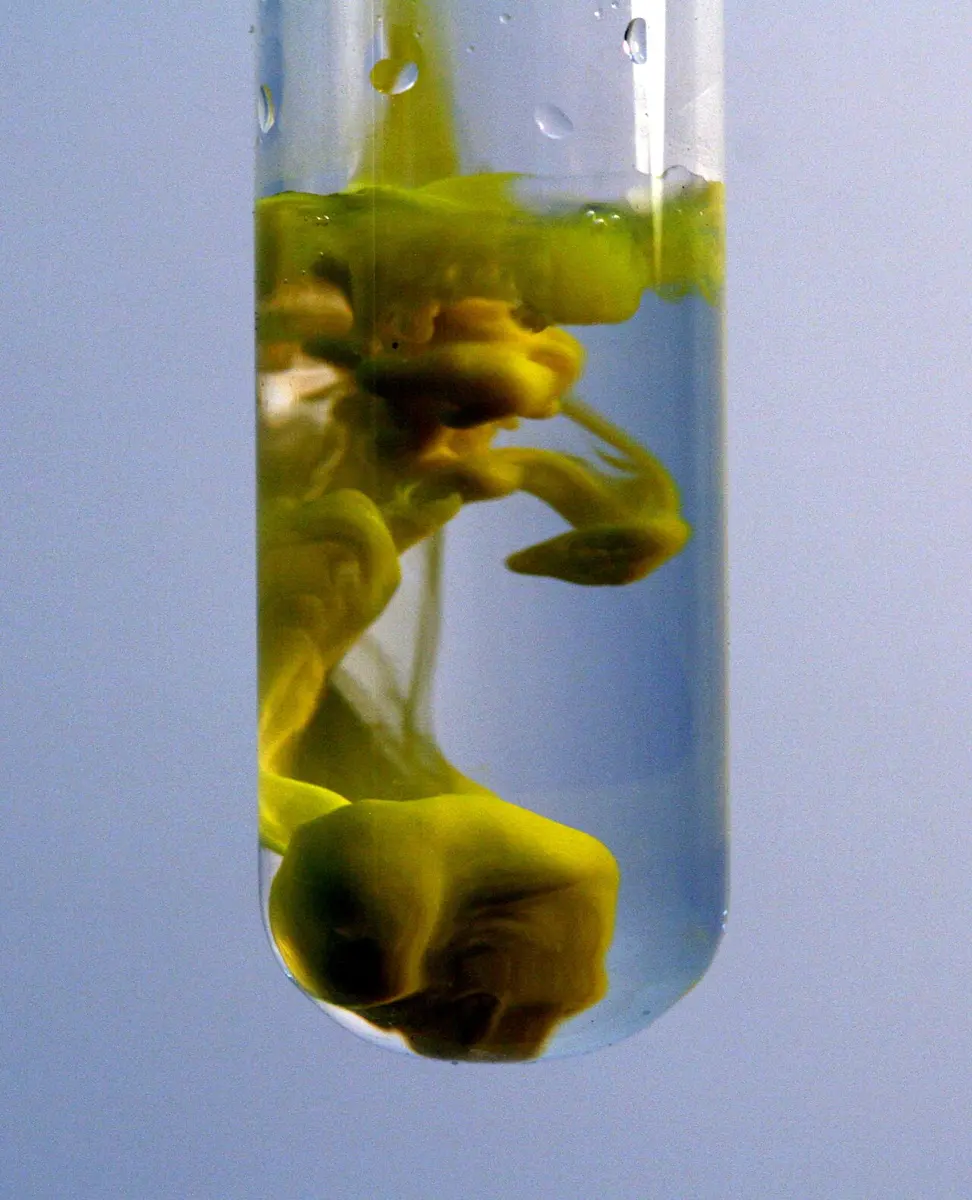
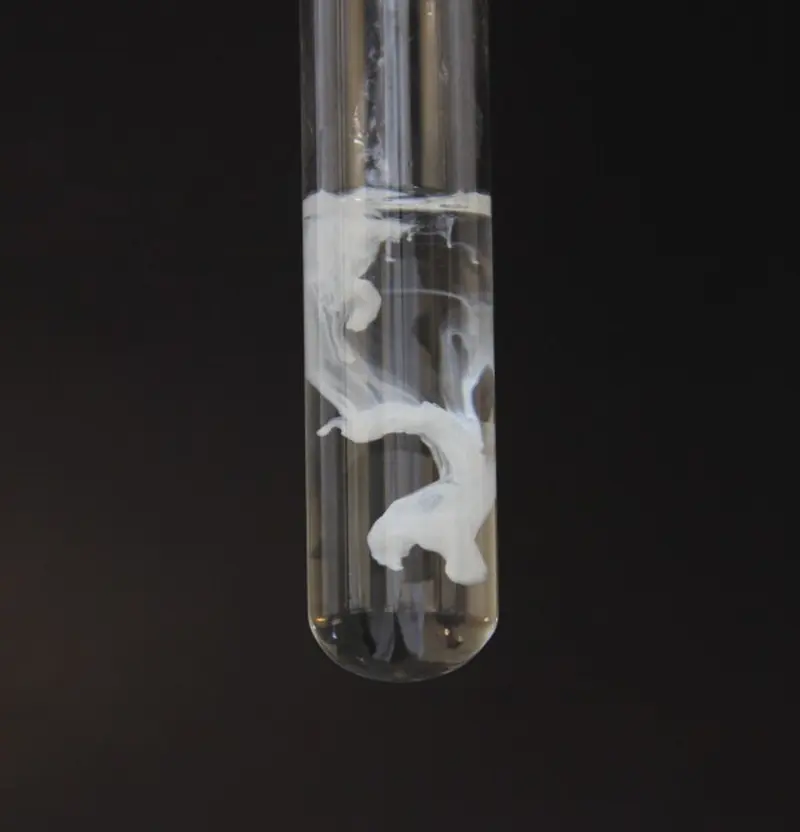
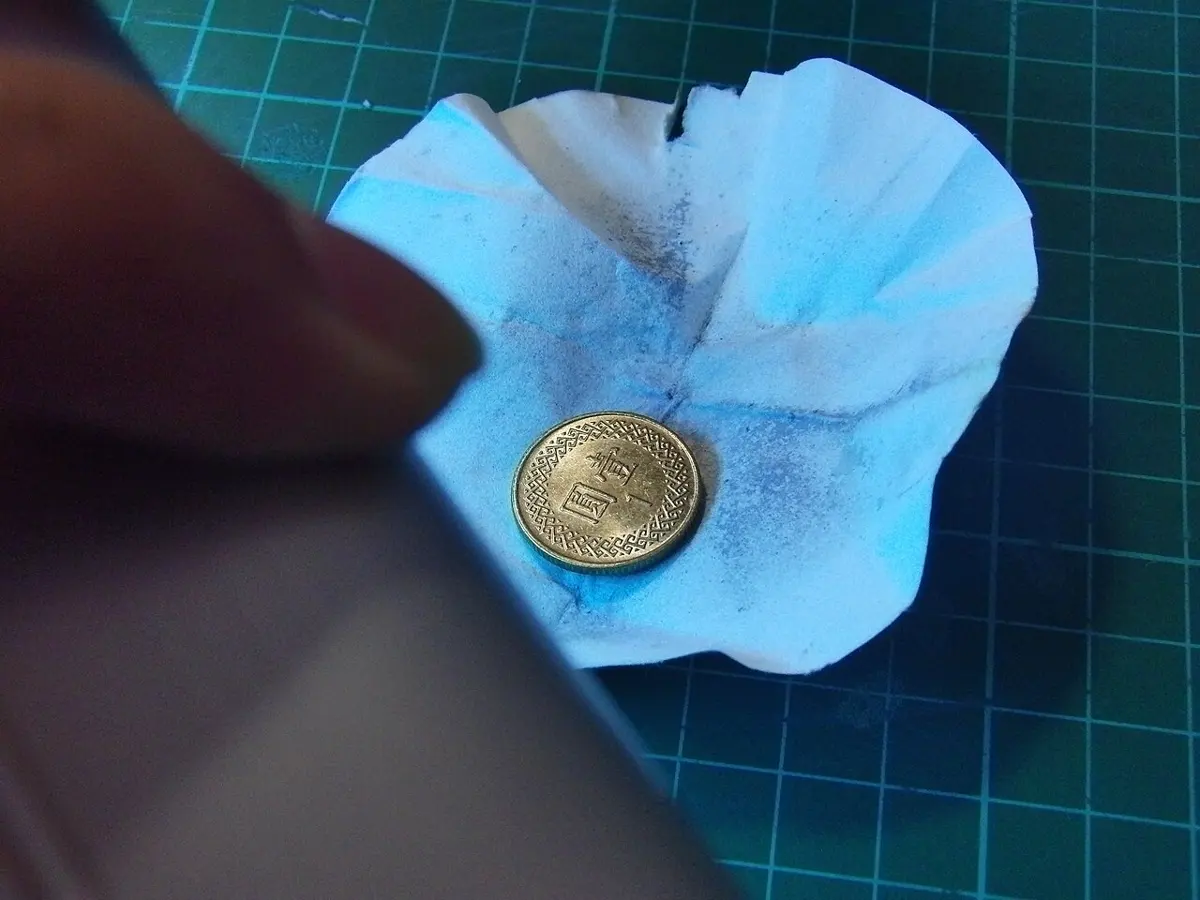
Pour a few drops of salt water into a test tube of silver nitrate solution. Both liquids are as clear as water, yet the moment they meet, a thick white cloud swirls through the tube and slowly sinks. Pour the white solid onto a piece of filter paper, lay a coin on it and leave it on a sunny windowsill. Within minutes the paper around the coin turns violet-gray, while the patch under the coin stays white. Lift the coin, and its shadow is printed on the paper.
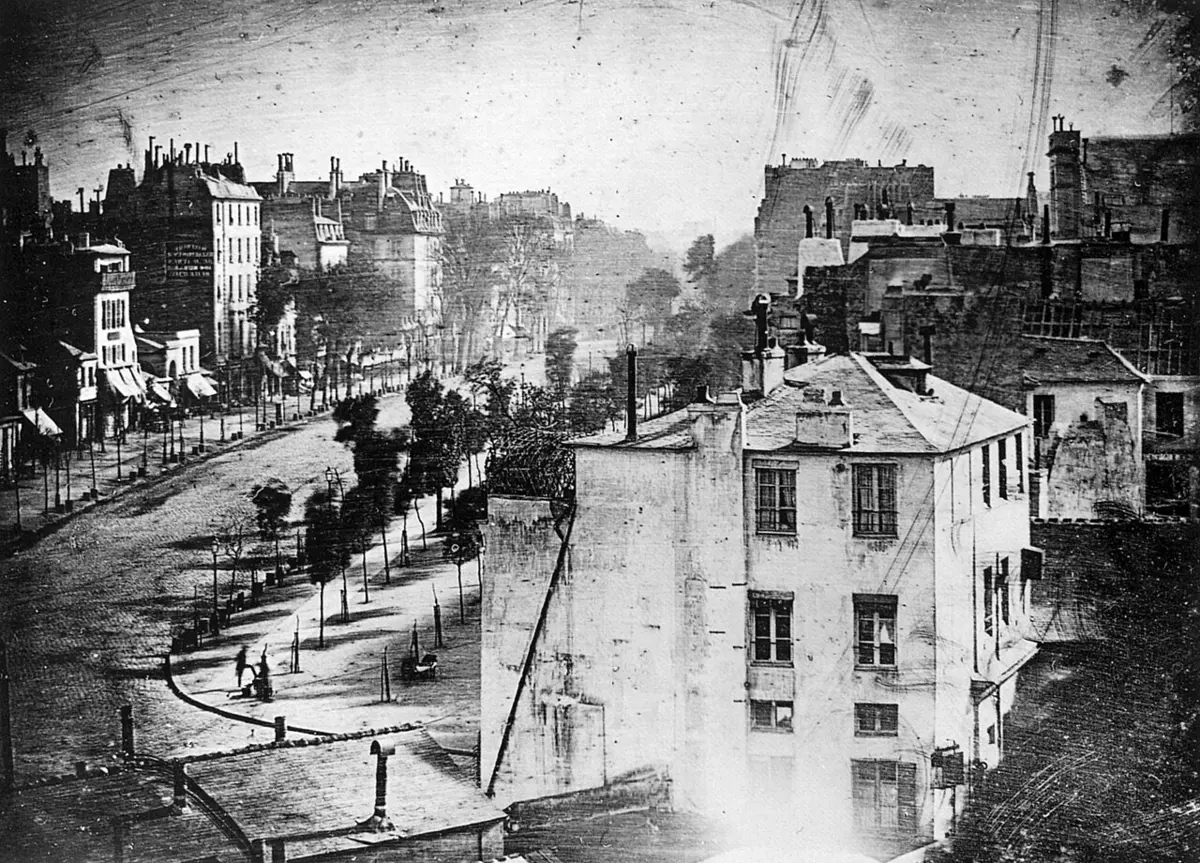
Two reactions happened there, and they have different names. The first made a solid out of two solutions: a precipitation reaction. The second was driven by light: a photochemical reaction, the same one that made every photograph for a hundred and fifty years. In this unit you will meet seven kinds of reaction by what drives them or what they make (precipitation, hydrolysis, catalytic, photochemical, electrolytic, oxidation and reduction), and then the reactions that join thousands of small molecules into one long chain, the polymers of plastic buckets, nylon ropes, rubber, cotton and the rice on your plate.
8.1 Chemical reaction and chemical equation
Introduction
A chemical reaction is a change in which one or more substances, the reactants, turn into new substances, the products, with new properties. In every reaction, bonds between atoms break and new bonds form: the atoms are rearranged, but no atom is made or destroyed. So the products contain exactly the same atoms as the reactants, and their total mass is the same.
How can you tell that a reaction has happened? Look for one or more of these signs:
- a new color: an iron nail in copper sulphate solution turns reddish-brown, and the blue solution fades to pale green;
- a gas given off: marble fizzes in acid, giving carbon dioxide;
- a solid formed from two solutions: the white cloud of silver chloride above;
- heat or light given out or taken in: a burning matchstick; the cold of an instant ice pack;
- a new smell or taste: milk turning sour, rice turning sweet as you chew it.
None of these signs proves a reaction on its own: a color also changes when a solution is diluted, and bubbles also rise from boiling water. The test is always the one from Grade 9: has a new substance formed?
Which of these is not a chemical reaction?
Pick an answer to see why.
Chemical equation
A chemical equation is a short way of writing a reaction with symbols and formulas: the reactants on the left, the products on the right, and an arrow between them, read “gives” or “forms”. It is balanced when every element has the same number of atoms on both sides, which is the law of conservation of mass written in symbols:
A bare equation leaves a lot out. Chemists add more to it with a few signs:
| Sign | Meaning | Example |
|---|---|---|
| (s), (l), (g), (aq) | solid, liquid, gas, dissolved in water | NaCl(aq) |
| ↑ after a product | a gas that escapes | CO₂↑ |
| ↓ after a product | a precipitate, a solid that forms in a solution | AgCl↓ |
| Δ or “heat” over the arrow | the reactants are heated | CaCO₃ →(Δ) CaO + CO₂ |
| a catalyst over the arrow | it speeds the reaction and is not used up | 2H₂O₂ →(MnO₂) 2H₂O + O₂ |
| “light” or hν over the arrow | light drives the reaction | 2AgCl →(light) 2Ag + Cl₂ |
| ⇌ | a reversible reaction, going both ways | N₂ + 3H₂ ⇌ 2NH₃ |
With these, the equation for the white cloud says a great deal:
Ionic equations
In the solutions, silver nitrate, sodium chloride and sodium nitrate are all split into ions (Grade 9 Optional Science showed why). The Na⁺ and NO₃⁻ ions are in the water before the reaction and still in the water after it: they take no part, and are called spectator ions. Leave them out, and what is left is the ionic equation, the change that really happens:
It says something the full equation hides: any silver salt in solution and any chloride in solution give the same white precipitate. That is why silver nitrate is the test for a chloride, whatever the chloride is.
What a balanced equation tells you, in amounts
The numbers in front of the formulas count particles, so they count moles too (Unit 7, Mole concept). Read the decomposition of hydrogen peroxide in three ways:
| 2H₂O₂ | → | 2H₂O | + | O₂ | |
|---|---|---|---|---|---|
| molecules | 2 molecules | 2 molecules | 1 molecule | ||
| moles | 2 mol | 2 mol | 1 mol | ||
| masses (H = 1, O = 16) | 2 × 34 = 68 g | 2 × 18 = 36 g | 32 g | ||
| gas volume at STP | 22.4 L |
68 g of reactant gives 36 g + 32 g = 68 g of products: mass is conserved, as it must be.
What an equation doesn’t tell you
Even a balanced equation with every sign says nothing about:
- whether the reaction happens at all. Cu + 2HCl → CuCl₂ + H₂ balances perfectly, but copper doesn’t react with dilute hydrochloric acid;
- how fast it goes: rusting and an explosion are both written with one arrow;
- how far it goes: many reactions stop before the reactants are used up;
- the concentrations of the solutions, unless they are written in;
- how the atoms rearrange, step by step, on the way from reactants to products.
Examples
| Reaction | Equation |
|---|---|
| LPG (propane) burning on the stove | C₃H₈ + 5O₂ → 3CO₂ + 4H₂O |
| lime water turning milky with your breath | Ca(OH)₂ + CO₂ → CaCO₃↓ + H₂O |
| an antacid tablet in the stomach | Mg(OH)₂ + 2HCl → MgCl₂ + 2H₂O |
| photosynthesis in a leaf | 6CO₂ + 6H₂O →(light, chlorophyll) C₆H₁₂O₆ + 6O₂ |
| respiration in your cells | C₆H₁₂O₆ + 6O₂ → 6CO₂ + 6H₂O |
| yeast making sel roti dough rise | C₆H₁₂O₆ →(yeast enzymes) 2C₂H₅OH + 2CO₂ |
8.2 Introduction to some chemical reactions
Grade 10 Science sorted reactions by how the atoms rearrange: combination, decomposition, displacement and neutralization. Here they are sorted in other ways: by what is formed (a precipitate), by what drives them (light, electricity, a catalyst), by what water does in them, and by what happens to their electrons. So one reaction can have several names. When silver chloride darkens in sunlight, 2AgCl → 2Ag + Cl₂, it is a decomposition (one reactant gives two products), a photochemical reaction (light drives it), and an oxidation and reduction (silver ions gain electrons, chloride ions lose them). An exam asks which name fits what it describes.
Precipitation reaction
A precipitation reaction is a reaction in which two solutions react to form an insoluble solid, called a precipitate. The precipitate makes the clear liquid cloudy, then slowly settles to the bottom. It is shown by ↓ or (s) after its formula.
Most precipitation reactions are double displacement reactions: the ions of two soluble salts swap partners, and one of the new pairs doesn’t dissolve in water. Which ones don’t? A few rules cover most cases:
| These dissolve in water | Except |
|---|---|
| all nitrates | none |
| all salts of sodium, potassium and ammonium | none |
| most chlorides (and bromides, iodides) | silver and lead(II) |
| most sulphates | barium and lead(II) (calcium sulphate only slightly) |
| These don’t dissolve | Except |
| most hydroxides | sodium, potassium, ammonium (calcium hydroxide slightly) |
| most carbonates | sodium, potassium, ammonium |
So mixing a solution of any salt with that of another gives a precipitate if the swap makes one of the pairs in the lower half of the table, or one of the exceptions in the upper half.
The four in Figure 8.1, as full equations and as ionic equations:
Two more are worth knowing: iron(III) chloride and sodium hydroxide give a reddish-brown precipitate of iron(III) hydroxide, FeCl₃ + 3NaOH → Fe(OH)₃↓ + 3NaCl; and carbon dioxide bubbled through lime water gives the white precipitate of calcium carbonate that turns it milky, Ca(OH)₂ + CO₂ → CaCO₃↓ + H₂O. That one is not two solutions mixing, but it is a precipitate all the same.
Uses of precipitation
- Testing for ions. Each precipitate’s color tells which ion was there: a white precipitate with silver nitrate (and a little dilute nitric acid) means a chloride; a white precipitate with barium chloride means a sulphate; with sodium hydroxide, a blue precipitate means copper(II), a dirty green one iron(II) and a reddish-brown one iron(III). Lime water turning milky is the test for carbon dioxide.
- Making insoluble salts. Barium sulphate for X-ray meals is made by precipitation, filtered and washed (Grade 10 Science tells its story: Double displacement reaction).
- Softening hard water. Washing soda precipitates the calcium and magnesium ions that stop soap from lathering: CaCl₂ + Na₂CO₃ → CaCO₃↓ + 2NaCl Grade 10: Soap and hard water.
- Cleaning water. Water works add chemicals that make a fluffy precipitate, which sweeps mud and germs down with it as it settles (alum, in the next section).
Which pair of solutions gives a precipitate when mixed?
Pick an answer to see why.
Hydrolysis reaction
Hydrolysis means “splitting by water” (from Greek hydro, water, and lysis, loosening). A hydrolysis reaction is a reaction in which a substance reacts with water, and the water molecule is split: its H goes to one part of the substance and its OH to the other.
This is more than dissolving. Sugar dissolves in water and stays sugar. In hydrolysis the water itself takes part, and new substances form.
Hydrolysis of salts
Dissolve some salts in water and the solution is neutral; dissolve others and it turns litmus red or blue, though the salt itself contains no H⁺ or OH⁻. The salt has reacted with water. Every salt is made from an acid and a base, and what its solution does depends on how strong each was (Grade 9 Optional Science explained strong and weak):
| Salt made from | Examples | Hydrolysis? | Its solution |
|---|---|---|---|
| strong acid + strong base | NaCl, KNO₃, Na₂SO₄ | no | neutral (pH 7) |
| strong acid + weak base | NH₄Cl, CuSO₄, FeCl₃, alum | yes | acidic (turns blue litmus red) |
| weak acid + strong base | Na₂CO₃, CH₃COONa, NaHCO₃ | yes | basic (turns red litmus blue) |
| weak acid + weak base | CH₃COONH₄ | yes | close to neutral |
Ammonium chloride is the salt of a strong acid (HCl) and a weak base (ammonia). With water it gives back a little of each:
The hydrochloric acid formed is strong, so it is fully split into H⁺ and Cl⁻ ions; the ammonium hydroxide is weak and stays mostly together. So the solution has more H⁺ than OH⁻ ions, and it is acidic. Copper sulphate (from strong sulphuric acid and weak copper hydroxide) and iron(III) chloride are acidic for the same reason:
Sodium ethanoate (sodium acetate) is the salt of a weak acid (ethanoic acid) and a strong base (sodium hydroxide):
This time the strong one formed is the base, fully split into Na⁺ and OH⁻; the weak ethanoic acid stays mostly together. The solution has more OH⁻ than H⁺: it is basic. Sodium carbonate (washing soda) is basic the same way, and strongly so:
Sodium chloride comes from a strong acid and a strong base. Any NaOH and HCl formed would split into ions at once and give back exactly what was there, so nothing changes: its solution is neutral, and we say a salt of a strong acid and a strong base doesn’t hydrolyze.
The rule in one line: the solution takes the side of the stronger partner. The ⇌ in each equation shows that only a small part of the salt reacts; the rest stays as it is.
Hydrolysis of other compounds
Water splits many other compounds, often with an acid, a base or an enzyme as a catalyst:
- Esters split into an acid and an alcohol. Ethyl ethanoate, the fruity-smelling liquid in some nail-polish removers: CH₃COOC₂H₅ + H₂O ⇌ CH₃COOH + C₂H₅OH.
- Fats and oils heated with sodium hydroxide split into soap and glycerol. This hydrolysis by a base is called saponification, “soap-making” Grade 10: Soap.
- Sugar (sucrose) splits into two simpler sugars, glucose and fructose: C₁₂H₂₂O₁₁ + H₂O → C₆H₁₂O₆ + C₆H₁₂O₆. Honey is mostly these two, made from the sucrose of nectar by an enzyme of the bees.
- Calcium carbide gives ethyne gas (acetylene): CaC₂ + 2H₂O → C₂H₂ + Ca(OH)₂. This is the gas that some traders use, unsafely, to ripen fruit Grade 10: Chemicals that ripen fruit.
- Food in your gut. Digestion is hydrolysis: enzymes split the starch of rice into sugars, proteins into amino acids and fats into fatty acids and glycerol, each step taking in water. You will see in 8.3 that this is polymer-making run backward.
Which of these salts gives a basic solution in water?
Pick an answer to see why.
Catalytic reaction
A catalytic reaction is a reaction whose rate is changed by a catalyst. A catalyst is a substance that changes the rate of a chemical reaction without itself undergoing any permanent chemical change. It is written over the arrow, not among the reactants.
Grade 10 Science showed what a catalyst does to the rate, and why: it gives the reaction a path with a lower activation energy, so more collisions succeed Grade 10: Catalyst. Grade 9 Optional Science had you prove it, by recovering the manganese dioxide unchanged after it made hydrogen peroxide froth Grade 9: Making oxygen with a catalyst. Here are the catalytic reactions you will meet most often:
| Reaction | Catalyst | Where |
|---|---|---|
| 2KClO₃ → 2KCl + 3O₂ | manganese dioxide, MnO₂ | oxygen in the laboratory |
| 2H₂O₂ → 2H₂O + O₂ | manganese dioxide, MnO₂ | oxygen without heating |
| N₂ + 3H₂ ⇌ 2NH₃ | iron, Fe | the Haber process: ammonia for fertilizers |
| 2SO₂ + O₂ ⇌ 2SO₃ | vanadium pentoxide, V₂O₅ | the contact process: sulphuric acid |
| 4NH₃ + 5O₂ → 4NO + 6H₂O | platinum, Pt | the first step to nitric acid |
| vegetable oil + H₂ → vanaspati ghee | nickel, Ni | hydrogenation of oils |
| C₆H₁₂O₆ → 2C₂H₅OH + 2CO₂ | enzymes of yeast | fermentation: dough, jand, ethanol |
| starch + water → maltose | amylase in saliva | digestion |
The catalysts of living things are proteins called enzymes, or biocatalysts. Every reaction in your body has its own.
Characteristics of a catalyst
- It is not used up. At the end of the reaction it has the same mass and the same chemical composition as at the start, so it can be recovered and used again. (It may change physically: lumps of manganese dioxide can crumble to powder.)
- A small amount is enough. A pinch of manganese dioxide decomposes a whole bottle of hydrogen peroxide; one molecule of an enzyme can handle millions of reactant molecules a minute.
- It doesn’t start a reaction that can’t happen. It only speeds up a reaction that would go anyway, however slowly. No catalyst makes copper react with dilute hydrochloric acid.
- It doesn’t change how much product forms. With or without manganese dioxide, a bottle of hydrogen peroxide gives the same volume of oxygen in the end: the catalyst only gets there sooner. In a reversible reaction it speeds up the forward and the backward reactions equally.
- It is specific. A catalyst works for one reaction or a few. Amylase splits starch but not protein; iron works for ammonia, vanadium pentoxide for sulphur trioxide.
- It works best at a certain temperature. Enzymes work best at about body temperature, 37 °C, and are destroyed by boiling; industrial catalysts each have their own range.
- It can be poisoned or helped. Small amounts of some substances, poisons, stop a catalyst working (arsenic poisons platinum; lead poisons a car’s catalytic converter). Others, promoters, make it work better (a little molybdenum or potassium oxide improves the iron of the Haber process).
A catalyst that speeds a reaction up is a positive catalyst; one that slows a reaction down is a negative catalyst, or inhibitor (Grade 10 Science explains the difference). The phosphoric acid added to hydrogen peroxide, and the antioxidants in packed food and in oil, are inhibitors.
Which statement about a catalyst is wrong?
Pick an answer to see why.
Photochemical reaction
A photochemical reaction is a reaction that is started or driven by light. A molecule absorbs light, and the energy of the light breaks one of its bonds, so the reaction can go. Each needs light of the right color, often violet or ultraviolet, whose energy is greatest (sunlight has both; photosynthesis uses red light as well as blue); in the dark the same reactants hardly react at all.
The most important photochemical reaction on Earth is photosynthesis, in which green plants use the energy of light, absorbed by chlorophyll, to make glucose:
Silver chloride and silver bromide decompose in light into silver and the halogen. The silver forms in grains so fine that they look not shiny but violet-gray or black:
Hydrogen and chlorine don’t react in the dark. In diffused light they combine steadily; in bright sunlight the mixture explodes:
Methane and chlorine react the same way in diffused sunlight, a substitution you will meet in Unit 9 Grade 10: Substitution reaction.
Ozone is made in the stratosphere by sunlight. Ultraviolet light splits oxygen molecules into atoms, and each atom joins an oxygen molecule:
Others you have met: hydrogen peroxide and silver nitrate decompose in light, which is why they are sold in brown bottles Grade 10: Light; concentrated nitric acid turns yellow in light, as a little of it breaks down into brown nitrogen dioxide; colors of clothes and posters fade in the sun; and your skin makes vitamin D when sunlight’s ultraviolet falls on it.
Why does silver nitrate solution come in brown bottles?
Pick an answer to see why.
Electrolytic reaction
An electrolytic reaction is a reaction brought about by passing an electric current through an electrolyte, molten or in solution. Electrical energy is turned into chemical energy, and the electrolyte decomposes at the electrodes. Grade 9 Optional Science explained how it works, with the ions moving to the electrodes and the rules for which ions are discharged Grade 9: Arrhenius theory of electrolysis. Some important electrolytic reactions:
The third is how most of the world’s sodium hydroxide and chlorine are made; the fourth is how every aluminium can and window frame begins. Copper is purified, and spoons and ornaments are silver- or gold-plated, by electrolysis too.
At the cathode, ions gain electrons (Na⁺ + e⁻ → Na); at the anode, ions lose electrons (2Cl⁻ → Cl₂ + 2e⁻). Gaining and losing electrons are exactly what the next two kinds of reaction are about. A cell or battery runs the other way: in the lead-acid cell a chemical reaction pushes electrons round the circuit, turning chemical energy into electrical energy, and charging it is an electrolytic reaction Grade 10: Secondary cell.
Which of these is an electrolytic reaction?
Pick an answer to see why.
Oxidation reaction
The word comes from oxygen, and its first meaning was just that. In the older (classical) sense, oxidation is:
- the addition of oxygen to a substance: 2Mg + O₂ → 2MgO; C + O₂ → CO₂; 2SO₂ + O₂ → 2SO₃;
- the removal of hydrogen from a substance: in H₂S + Cl₂ → 2HCl + S, hydrogen sulphide loses its hydrogen and is oxidized to sulphur;
- by extension, the addition of an electronegative element (such as chlorine) or the removal of an electropositive element (such as a metal): 2FeCl₂ + Cl₂ → 2FeCl₃, where iron(II) chloride gains chlorine and is oxidized.
These all have one thing in common, which is the modern meaning. When magnesium burns, each magnesium atom gives two electrons to an oxygen atom and becomes an Mg²⁺ ion. When iron(II) chloride takes more chlorine, each Fe²⁺ ion gives one more electron away and becomes Fe³⁺. So in the electronic sense:
Oxidation is the loss of electrons by an atom, ion or molecule.
The electronic meaning is wider: it covers reactions with no oxygen at all. When sodium burns in chlorine, 2Na + Cl₂ → 2NaCl, each sodium atom loses an electron to a chlorine atom, Na → Na⁺ + e⁻, and sodium is oxidized.
A substance that oxidizes another, by giving it oxygen, taking its hydrogen, or taking its electrons, is an oxidizing agent. Oxygen, chlorine, hydrogen peroxide, potassium permanganate and concentrated nitric acid are strong oxidizing agents.
Oxidation is all around you: burning of fuels, the rusting of iron (4Fe + 3O₂ + 2xH₂O → 2Fe₂O₃·xH₂O), the respiration in your cells that oxidizes glucose to carbon dioxide and water, the browning of a cut apple, and rancidity, the stale smell and taste of oily food left in air. Packets of chips are filled with nitrogen, not air, for this reason: with no oxygen inside, the oil in the chips can’t go rancid.
Reduction reaction
Reduction is the opposite of oxidation. In the classical sense, it is:
- the removal of oxygen from a substance: CuO + H₂ → Cu + H₂O, in which copper oxide loses its oxygen and is reduced to copper; ZnO + C → Zn + CO;
- the addition of hydrogen to a substance: H₂ + Cl₂ → 2HCl, in which chlorine gains hydrogen and is reduced;
- by extension, the removal of an electronegative element or the addition of an electropositive element: 2FeCl₃ + SnCl₂ → 2FeCl₂ + SnCl₄, where iron(III) chloride loses chlorine and is reduced.
In the electronic sense:
Reduction is the gain of electrons by an atom, ion or molecule.
A substance that reduces another, by taking its oxygen, giving it hydrogen, or giving it electrons, is a reducing agent. Hydrogen, carbon, carbon monoxide, hydrogen sulphide and reactive metals such as zinc and sodium are reducing agents. Getting metals from their ores is mostly reduction: in a blast furnace, carbon monoxide reduces iron oxide, Fe₂O₃ + 3CO → 2Fe + 3CO₂ (Reduction; Unit 10 goes through the furnace step by step).
Oxidation and reduction go together: redox
Electrons don’t vanish, and oxygen doesn’t either. Whatever one substance loses, another must gain. So oxidation and reduction always happen together, in the same reaction, and such a reaction is called a redox reaction (reduction + oxidation).
Take hydrogen passed over hot copper(II) oxide:
Copper oxide loses oxygen: it is reduced. Hydrogen gains oxygen: it is oxidized. Copper oxide gives the oxygen, so it is the oxidizing agent; hydrogen takes it, so it is the reducing agent. The oxidizing agent is itself reduced, and the reducing agent is itself oxidized.
Or take the iron nail in copper sulphate solution from Grade 10 Science:
Split it into two half-equations: Fe → Fe²⁺ + 2e⁻ (iron loses electrons: oxidized) and Cu²⁺ + 2e⁻ → Cu (copper ions gain them: reduced). The two electrons that one iron atom loses are exactly the two that one copper ion gains. The sulphate ions take no part.
| Oxidation | Reduction | |
|---|---|---|
| oxygen | added | removed |
| hydrogen | removed | added |
| electronegative element | added | removed |
| electropositive element | removed | added |
| electrons | lost | gained |
| in electrolysis, at the | anode | cathode |
| the substance this happens to is the | reducing agent | oxidizing agent |
Not every reaction is a redox reaction. In a precipitation such as Ag⁺ + Cl⁻ → AgCl, or a neutralization such as H⁺ + OH⁻ → H₂O, ions only join; no electrons pass from one to another.
In Cu²⁺ + Zn → Cu + Zn²⁺, which is the reducing agent?
Pick an answer to see why.
Which of these is not a redox reaction?
Pick an answer to see why.
8.3 Monomer, polymer, and polymerization
Introduction
Going Further 6–8 showed how ethene molecules from oil join end to end into polythene, the plastic of bags and water tanks (From oil to a plastic bucket). Here are the words for it, exactly:
- A monomer (“one part”) is a small molecule that can join with others of its kind, or of another kind, into a long chain.
- A polymer (“many parts”) is a very large molecule, a macromolecule, made of many monomer units joined by covalent bonds, one after another.
- Polymerization is the chemical reaction in which monomers join to form a polymer.
The part that repeats along the chain is the repeating unit, and the number of repeating units in one chain is the degree of polymerization, n. A polymer is written as its repeating unit in brackets with n after it:
Here n is a few thousand or more, so the molar mass of the polymer is enormous: n times the mass of the repeating unit. (The ends of the chain differ a little, but in a chain thousands of units long they make no difference you could measure.) A real sample is a mixture of chains of different lengths, so its n and its molar mass are averages.
Examples: two ways to make a polymer
Monomers join in two different ways.
Addition polymerization
In addition polymerization, monomers with a double bond (C=C) add on to one another. The second bond of each double bond opens, and the freed electrons form the bonds to the neighbors on either side. Nothing is given off: the polymer contains every atom of the monomers, so its repeating unit has the same formula as the monomer.
It is the addition reaction of Unit 9 Grade 10: Addition reaction, done thousands of times in a row, usually at high pressure or with a catalyst.
| Monomer | Polymer | Equation |
|---|---|---|
| ethene | polythene (polyethylene) | n CH₂=CH₂ → [–CH₂–CH₂–]ₙ |
| propene | polypropylene | n CH₂=CH–CH₃ → [–CH₂–CH(CH₃)–]ₙ |
| chloroethene (vinyl chloride) | polyvinyl chloride, PVC | n CH₂=CHCl → [–CH₂–CHCl–]ₙ |
| tetrafluoroethene | polytetrafluoroethene, PTFE (Teflon) | n CF₂=CF₂ → [–CF₂–CF₂–]ₙ |
| phenylethene (styrene) | polystyrene | n CH₂=CH–C₆H₅ → [–CH₂–CH(C₆H₅)–]ₙ |
| propenenitrile (acrylonitrile) | polyacrylonitrile (acrylic) | n CH₂=CH–CN → [–CH₂–CH(CN)–]ₙ |
Condensation polymerization
In condensation polymerization, each monomer has two reactive groups, one at each end. The group at the end of one monomer reacts with the group at the end of the next, and at every new link a small molecule is given off, usually water (sometimes hydrogen chloride or methanol). So the polymer has fewer atoms than the monomers that made it.
Nylon-6,6 is made from two monomers, hexane-1,6-diamine, with an –NH₂ group at each end, and hexanedioic acid (adipic acid), with a –COOH group at each end. An –NH₂ and a –COOH join into an amide link, –CO–NH–, and a molecule of water leaves:
(Each of its two monomers has six carbon atoms, hence the name 6,6. Strictly, a chain of n repeating units gives off 2n − 1 water molecules, as the chain keeps an end group at each end; for a long chain that is 2n.)
Polyester (PET, or terylene) is made the same way from a diol and a dicarboxylic acid, ethane-1,2-diol and benzene-1,4-dicarboxylic acid, which join through ester links, –CO–O–, giving off water. It is the plastic of soft-drink bottles and the polyester of clothes. Bakelite is made from phenol and methanal (formaldehyde), giving off water; its chains are joined to one another in every direction into one hard network.
Nature makes its polymers by condensation:
- Proteins are chains of amino acids. The –COOH of one amino acid and the –NH₂ of the next join into a peptide bond, –CO–NH–, the same link as nylon’s, giving off water. The widget above builds a chain of glycine, the simplest amino acid; your body uses twenty different ones.
- Starch and cellulose are chains of glucose units, joined through oxygen atoms, each link giving off a water molecule: n C₆H₁₂O₆ → (C₆H₁₀O₅)ₙ + n H₂O. They differ in the way the links are turned, which is why you can digest the starch of rice but not the cellulose of its husk.
- DNA and RNA are chains of nucleotides, joined by condensation too Grade 10: The three parts of a nucleotide.
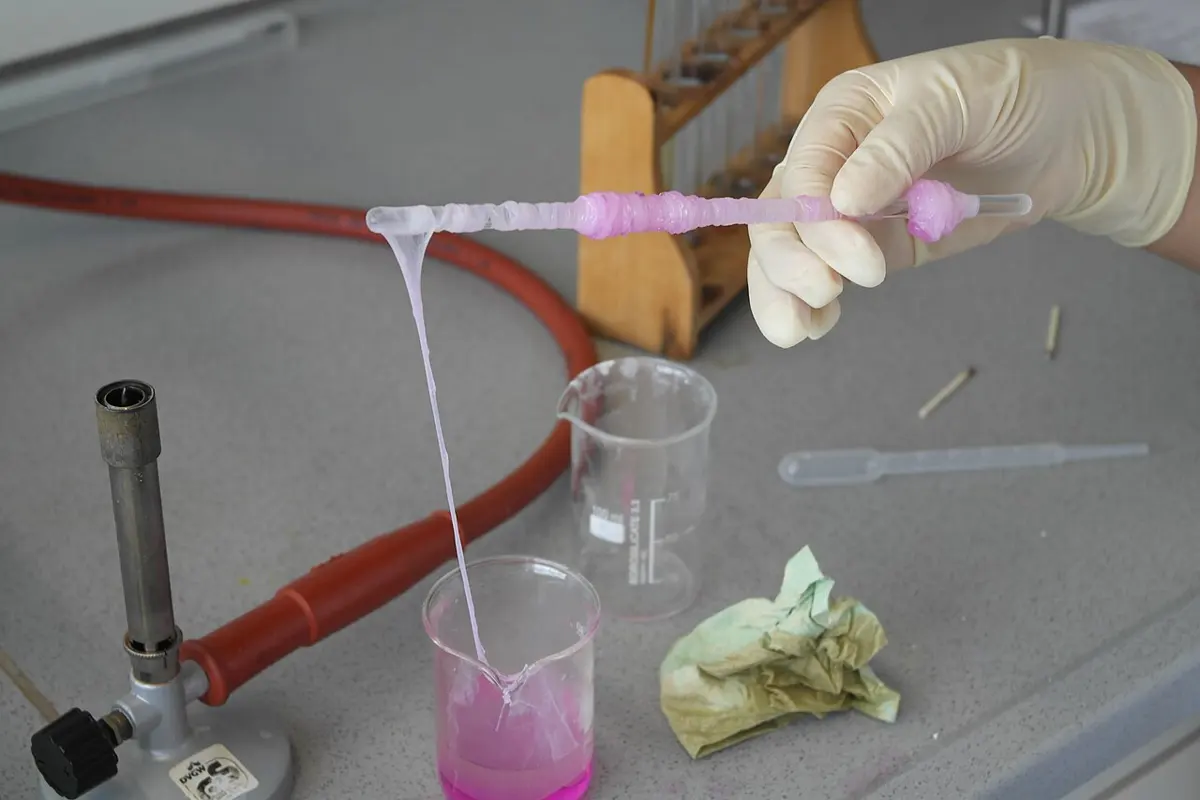
| Addition polymerization | Condensation polymerization |
|---|---|
| Monomers have a double bond (C=C). | Monomers have two reactive groups (–OH, –COOH, –NH₂). |
| Nothing is given off. | A small molecule (usually water) is given off at each link. |
| The repeating unit has the same formula as the monomer. | The repeating unit has fewer atoms than the monomers. |
| The chain grows quickly, one unit at a time, at its end. | Monomers and short chains join anywhere, step by step. |
| Polythene, PVC, polypropylene, PTFE, natural rubber | Nylon, polyester, Bakelite, proteins, starch, cellulose |
A polymer is formed from monomers with no double bond, and water is given off at every link. It is formed by:
Pick an answer to see why.
Types of polymers: natural and man-made
Natural polymers are made by living things:
| Natural polymer | Monomer | Found in |
|---|---|---|
| starch | glucose | rice, wheat, maize, potatoes |
| cellulose | glucose | cotton (almost pure cellulose), wood, paper, jute |
| proteins | amino acids | silk, wool, hair, nails, muscle, enzymes, casein in milk |
| natural rubber | isoprene, C₅H₈ | the latex (milky sap) of the rubber tree |
| DNA and RNA | nucleotides | every living cell |
Man-made polymers are made by people. Most are synthetic, made entirely from small molecules, most of them from oil and natural gas: polythene, polypropylene, PVC, polystyrene, PTFE, acrylic, nylon, polyester, Bakelite, synthetic rubber. Some are semi-synthetic, made by changing a natural polymer: rayon (viscose, “artificial silk”) is cellulose from wood pulp dissolved and spun back into shiny threads, and vulcanized rubber is natural rubber cross-linked with sulphur.
Natural rubber
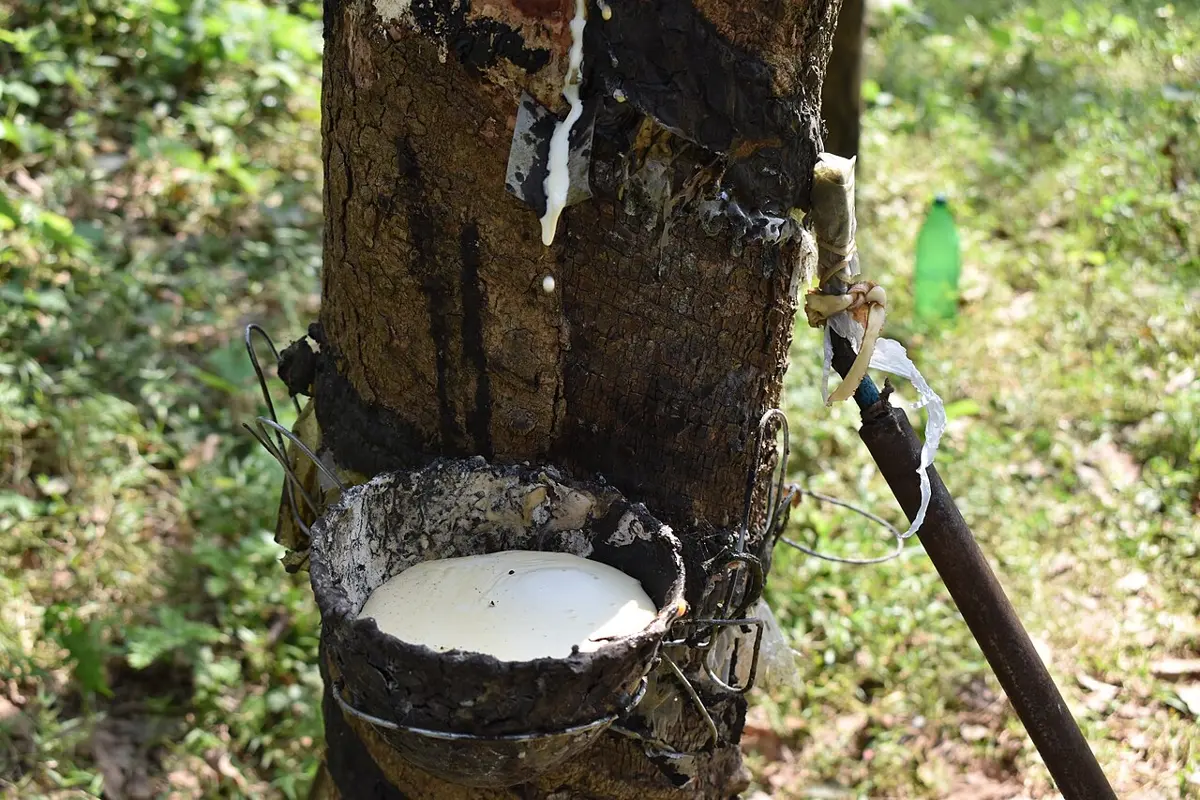
Cut a shallow groove in the bark of a rubber tree, Hevea brasiliensis, and a milky white liquid, latex, drips out into a cup. It is tiny droplets of rubber in water. Rubber is polyisoprene, an addition polymer of isoprene (2-methylbuta-1,3-diene, CH₂=C(CH₃)–CH=CH₂). Its long chains are coiled and tangled, like a plate of noodles: pull, and they straighten; let go, and they coil back. That is why rubber stretches and springs back.
Raw rubber has two faults: it turns soft and sticky in the heat and hard and brittle in the cold. In 1839 the American inventor Charles Goodyear found the cure, as the story goes, when a mixture of rubber and sulphur he was working with touched a hot stove: it charred at the edges but stayed firm and springy. Heating rubber with a little sulphur makes short chains of sulphur atoms that link the rubber chains to one another at many points. This vulcanization keeps the chains from sliding apart, so the rubber stays elastic from cold to heat and wears much more slowly. Tyres, chappals, rubber bands and pressure cooker gaskets are vulcanized rubber; with a lot more sulphur (about a third of its mass), rubber becomes hard ebonite.
Thermoplastics and thermosetting plastics
Man-made polymers are also sorted by what heat does to them:
| Thermoplastic | Thermosetting plastic |
|---|---|
| softens when heated and hardens again when cooled, again and again | sets hard once, when it is made; heated again, it doesn’t soften but chars |
| its chains are separate, and slide past each other when warm | its chains are cross-linked into one rigid network |
| can be melted down, remolded and recycled | can’t be remolded or melted down for recycling |
| polythene, PVC, polypropylene, polystyrene, nylon, PET | Bakelite, melamine, epoxy glue |
Which pair is a natural polymer and a semi-synthetic one, in that order?
Pick an answer to see why.
Application of polymers
Polymers can be made hard or soft, rigid or stretchy, clear or colored, and they are light, waterproof, cheap and resistant to rust and rot. That is why they are everywhere:
| Polymer | Property that matters | Uses |
|---|---|---|
| polythene | light, flexible, waterproof, cheap | carry bags, milk pouches, black water tanks, pipes |
| polypropylene | tough, stands boiling water | chairs, buckets, bottle caps, lunch boxes, ropes, sacks |
| PVC | rigid (or soft with additives), insulates, doesn’t rot | water pipes, electric wire coating, raincoats, flooring |
| polystyrene | rigid, or a light foam (thermocol) | packaging, disposable plates and cups, insulation |
| PTFE (Teflon) | nothing sticks to it; stands heat and chemicals | non-stick pans and tawa, plumbers’ tape |
| acrylic | soft, warm, like wool | sweaters, blankets |
| nylon | strong, elastic, smooth | ropes, fishing nets, toothbrush bristles, socks, parachutes |
| polyester (PET) | strong, doesn’t crease; clear as a bottle | clothes, soft-drink and water bottles |
| Bakelite | hard, insulates, doesn’t soften when hot | electric switches and plugs, pressure cooker and pan handles |
| vulcanized rubber | elastic, tough, waterproof | tyres, chappals, gaskets, pipes, balls |
| natural polymers | cotton and silk clothes, paper, wood; starch and proteins as food |
Polymers save lives too: sterile plastic syringes used once and thrown away, blood bags and drips of soft PVC, nylon threads for stitching wounds, and body armor of Kevlar, a polymer whose chains line up into fibers stronger, for their weight, than steel wire.
Their strength is also their problem. The world made about 400 million tonnes of plastic in 2022, and most synthetic polymers don’t rot: a polythene bag or a PET bottle thrown away stays in the soil or a river for centuries, breaking into smaller and smaller microplastics that are now found in fish, drinking water and people. Burning plastic in the open is worse: PVC gives off hydrogen chloride gas and poisonous dioxins. The answers are to use less, reuse, collect plastics for recycling (thermoplastics can be melted and remolded), and develop polymers that bacteria can digest, such as polylactic acid, made from the starch of maize. Going Further 6–8 weighs up what plastic gives and costs, in Nepal too: What plastic gives, and what it costs.
Electric switches are made of Bakelite rather than polythene because Bakelite:
Pick an answer to see why.
Exercise
1. Choose the correct option
a. Which of these mixtures gives a yellow precipitate?
Pick an answer to see why.
b. An aqueous solution of sodium carbonate is basic because:
Pick an answer to see why.
c. Which reaction is photochemical?
Pick an answer to see why.
d. In CuO + H₂ → Cu + H₂O, the oxidizing agent is:
Pick an answer to see why.
e. The monomer of PVC is:
Pick an answer to see why.
f. Which is a condensation polymer?
Pick an answer to see why.
g. Which of these is a natural polymer?
Pick an answer to see why.
h. A sample of polythene has a molar mass of 42,000 g/mol. Its degree of polymerization is: (C = 12, H = 1)
Pick an answer to see why.
2. Give reasons
An aqueous solution of ammonium chloride turns blue litmus red.
Hint
Answer
A catalyst is written over the arrow of an equation, not among the reactants.
Hint
Answer
Silver bromide is used in photographic films.
Hint
Answer
Oxidation and reduction always take place together.
Hint
Answer
Natural rubber is vulcanized before it is made into tyres.
Hint
Answer
The handle of a pressure cooker is made of Bakelite, not polythene.
Hint
Answer
3. Differentiate between
Oxidation and reduction
Hint
Answer
Precipitation reaction and hydrolysis reaction
Hint
Answer
Addition polymerization and condensation polymerization
Hint
Answer
Natural polymers and synthetic polymers
Hint
Answer
Thermoplastic and thermosetting plastic
Hint
Answer
4. Answer the following questions
What is a precipitation reaction? Write the balanced equations for two precipitation reactions and name the color of each precipitate.
Hint
Answer
What is hydrolysis? Explain, with equations, why a solution of sodium ethanoate is basic and a solution of sodium chloride is neutral.
Hint
Answer
What is a catalyst? Write any four characteristics of a catalyst.
Hint
Answer
Describe an experiment to show a photochemical reaction using a silver compound. Write the equation.
Hint
Answer
Define oxidation and reduction in terms of oxygen, hydrogen and electrons. Identify the substance oxidized and the substance reduced in Fe₂O₃ + 3CO → 2Fe + 3CO₂.
Hint
Answer
Show, with half-equations, that the reaction of zinc with copper sulphate solution is a redox reaction.
Hint
Answer
What is an electrolytic reaction? Give two examples with equations.
Hint
Answer
Define monomer, polymer and polymerization. Write the equation for the formation of polythene.
Hint
Answer
Write the uses of any four polymers.
Hint
Answer
Think: Rice and a cotton cloth are both made of chains of glucose. You can digest the rice but not the cotton, yet a cow lives on grass, whose cellulose is the same polymer as cotton’s. What does this tell you about hydrolysis and enzymes?
Hint
Answer
5. Numerical problems
3.19 g of copper sulphate in solution is mixed with enough sodium hydroxide solution. a. What mass of copper(II) hydroxide is precipitated? b. What mass of sodium hydroxide is needed for this? (Cu = 63.5, S = 32, O = 16, H = 1, Na = 23)
Hint
Answer
6.8 g of hydrogen peroxide is decomposed completely with 1 g of manganese dioxide. Find a. the volume of oxygen at STP, b. the mass of water formed, c. the mass of manganese dioxide left. (H = 1, O = 16)
Hint
Answer
How many grams of potassium chlorate must be heated, with manganese dioxide, to give 3.36 L of oxygen at STP? (K = 39, Cl = 35.5, O = 16)
Hint
Answer
A sample of PVC has an average degree of polymerization of 1,600. Find its average molar mass. (C = 12, H = 1, Cl = 35.5)
Hint
Answer
16.2 g of starch, (C₆H₁₀O₅)ₙ, is hydrolyzed completely to glucose: (C₆H₁₀O₅)ₙ + n H₂O → n C₆H₁₂O₆. What mass of water is used, and what mass of glucose is formed? (C = 12, H = 1, O = 16)
Hint
Answer
A nylon-6,6 chain has a molar mass of 22,600 g/mol, and its repeating unit is C₁₂H₂₂N₂O₂. How many repeating units does it have, and about how many water molecules were given off in making it? (C = 12, H = 1, N = 14, O = 16)
Hint
Answer
Printable PDFs
- The unit as a book (A5) 31 pages Answers as an A4 booklet, 8 sheets
- Study notes 3 pages
- Worksheet 5 pages Answer key
- Harder practice questions 3 pages Answer key
Practice every question in the book, and keep track of the ones you miss →
Found a mistake? Please tell us.