
Turn on a tap in a city and the water sometimes smells faintly of a swimming pool: chlorine has been added to kill the germs in it. The soap you wash your hands with was made from sodium hydroxide, a chemical so strong it can burn skin. Your own stomach is making hydrochloric acid as you read this, and the salt in your dal is half of a poisonous gas, chlorine, joined to a metal that bursts into flame in water, sodium. Each of these substances has its own character: what it reacts with, what it makes, and why we can use it.
This unit looks at seven substances found in every laboratory and most homes, oxygen, sulphur, chlorine, water, hydrochloric acid, sodium hydroxide and sodium chloride, and at how each reacts, with balanced equations. On the way you will do two practicals on how fast reactions go. Then it turns to alloys: why your plate is steel and your gagri brass, and how a little of one metal changes another.
10.1 General chemical properties of oxygen, sulphur, chlorine, water, HCl, NaOH and NaCl
The chemical properties of a substance are the ways it reacts with other substances to form new ones: what it combines with, what it pushes out of a compound, whether it behaves as an acid or a base. To describe them clearly, chemists write balanced equations, with the conditions over the arrow (Δ for heat). Before you read on, two words you will meet often:
Oxidation is the addition of oxygen to a substance (or the removal of hydrogen from it). Reduction is the removal of oxygen (or the addition of hydrogen). A substance that gives oxygen to another, or takes hydrogen from it, is an oxidizing agent; one that takes oxygen away, or gives hydrogen, is a reducing agent. In , copper oxide is reduced to copper and hydrogen is oxidized to water: copper oxide is the oxidizing agent, hydrogen the reducing agent.
Oxygen
Oxygen (O₂) is the most reactive gas in the air. It doesn’t burn itself, but it supports burning, and it combines with almost every other element to form oxides. It is a strong oxidizing agent.
1. With metals: basic oxides. Most metals burn in oxygen, or slowly tarnish in it, forming metal oxides:
Iron left in moist air rusts instead: it combines slowly with oxygen and water to form hydrated iron(III) oxide, , the brown rust.
2. With non-metals: acidic oxides.
Nitrogen is so unreactive that it joins oxygen only in a lightning flash or a hot car engine.
3. With compounds. Oxygen oxidizes many compounds, burning them to oxides:
4. Into ozone. In a spark or in the Sun’s ultraviolet light high in the air, oxygen molecules join into ozone, O₃: .
Four kinds of oxide
What an oxide does in water, and with acids and bases, sorts it into one of four kinds:
| Kind | What it does | Examples |
|---|---|---|
| Basic oxide (oxides of metals) | reacts with acids to give a salt and water; if it dissolves, it gives an alkali, which turns red litmus blue | Na₂O, MgO, CaO, CuO |
| Acidic oxide (oxides of most non-metals) | reacts with bases to give a salt and water; in water it gives an acid, which turns blue litmus red | CO₂, SO₂, SO₃, P₂O₅ |
| Amphoteric oxide | reacts with both acids and bases | ZnO, Al₂O₃ |
| Neutral oxide | neither acidic nor basic | CO, NO, N₂O, H₂O |
An element burns in oxygen, and its oxide dissolves in water to give a solution that turns red litmus blue. The element is most likely:
Pick an answer to see why.
Making oxygen with a catalyst
In the laboratory, oxygen is made by letting hydrogen peroxide break down into water and oxygen. On its own, hydrogen peroxide decomposes so slowly that a bottle keeps for months. Add a pinch of black manganese dioxide, and it froths with oxygen at once:
The manganese dioxide is written over the arrow, not among the reactants, because it is not used up. It is a catalyst: a substance that changes the rate of a chemical reaction without itself being permanently changed. The rate of a reaction is how fast the reactants turn into products: the amount of product formed (here, the volume of oxygen) in each second or minute.
Why does anything change the rate? Particles can react only when they collide, and only a collision with enough energy, the activation energy, breaks the old bonds so the new ones can form. A catalyst gives the reaction an easier path with a lower activation energy, so many more collisions succeed. Anything that makes the particles collide more often or harder also speeds a reaction up:
- Heat. Warmer particles move faster, so they collide more often, and many more of the collisions have enough energy. For many reactions a rise of 10 °C roughly doubles the rate.
- Concentration. A stronger solution has more reacting particles in each milliliter, so they collide more often.
- Surface area. Only the particles on the surface of a solid can be hit. A powder has far more surface than a lump of the same mass, so it reacts faster.
Sulphur
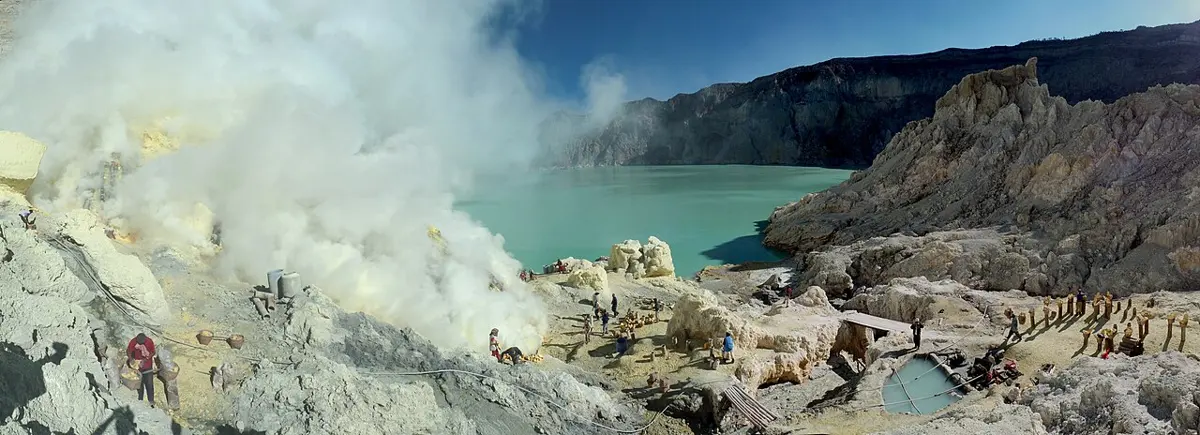
Sulphur is a yellow, brittle non-metal, found near volcanoes and hot springs and taken out of crude oil and natural gas. Its molecules are rings of eight atoms, S₈, but equations usually write it simply as S. Sulphur is less reactive than oxygen, but when it is heated it combines with most metals and many non-metals.
1. With oxygen. Heated, sulphur melts to an amber liquid, which darkens to red-brown as it gets hotter, and burns with a blue flame, faint in air and bright in oxygen, giving sulphur dioxide, a choking gas:
2. With metals: sulphides. Heated with iron, zinc or copper, sulphur forms the metal’s sulphide; mercury and sulphur react even cold:
That last reaction is why sulphur powder is sprinkled over spilled mercury: it turns the poisonous droplets into solid mercury sulphide, which doesn’t give off vapor.
3. With hydrogen and carbon. Hydrogen passed over boiling sulphur gives hydrogen sulphide, the gas with the smell of rotten eggs; red-hot charcoal gives carbon disulphide:
4. With concentrated acids. Hot concentrated sulphuric acid and nitric acid, both strong oxidizing agents, oxidize sulphur:
Dilute acids have no effect on sulphur.
Uses. Most sulphur is turned into sulphuric acid, for fertilizers. It also hardens rubber for tires (vulcanization), and goes into matches, gunpowder, fungicides sprayed on fruit and vegetables, and some skin ointments.
Chlorine
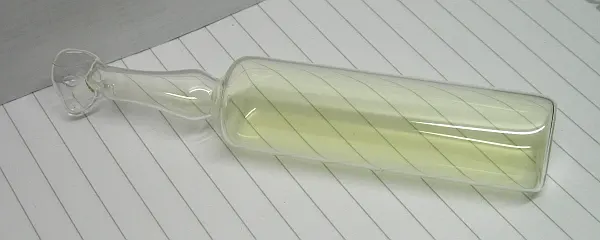
Chlorine (Cl₂) is a greenish-yellow gas with a sharp, choking smell, about two and a half times as dense as air, and poisonous. Its name comes from the Greek chloros, pale green. It is one of the most reactive non-metals: its atoms need only one more electron to fill their outer shell. In the laboratory it is made by heating manganese dioxide with concentrated hydrochloric acid:
1. With hydrogen. A mixture of hydrogen and chlorine reacts slowly in dim light and explodes in bright sunlight, giving hydrogen chloride:
2. With metals: chlorides. Hot sodium burns in chlorine with a yellow flame, and hot iron wool and copper glow in it:
Chlorine gives iron its higher valency, 3, forming iron(III) chloride.
3. With water, and how it bleaches. Chlorine dissolves in water and partly reacts with it, giving hydrochloric acid and hypochlorous acid, HOCl:
Hypochlorous acid is unstable and gives up its oxygen easily, written as nascent oxygen, [O], a very reactive form:
The nascent oxygen oxidizes colored substances into colorless ones: colored matter + [O] → colorless matter. That is bleaching by oxidation, and the same oxidizing kills bacteria. Because it needs water, dry chlorine doesn’t bleach: a dry colored flower or cloth stays colored in dry chlorine and loses its color in moist chlorine. In sunlight, chlorine water slowly gives off oxygen: .
4. With alkalis. With cold, dilute sodium hydroxide, chlorine gives sodium hypochlorite, the bleach sold in bottles; with hot, concentrated sodium hydroxide it gives sodium chlorate. With slaked lime it gives bleaching powder:
5. Pushing out bromine and iodine. Chlorine is more reactive than bromine and iodine, so it displaces them from their salts. Chlorine water added to colorless potassium iodide solution turns it brown with iodine:
6. With hydrogen sulphide. Chlorine takes hydrogen away from hydrogen sulphide (it is an oxidizing agent), leaving yellow sulphur: .
Uses. Killing germs in drinking water and swimming pools; bleaching paper and cotton; making bleaching powder, PVC plastic, hydrochloric acid and many medicines and pesticides.
A piece of dry colored cloth is put into a jar of dry chlorine, and another piece, wet, into a second jar. What happens?
Pick an answer to see why.
Water
Water (H₂O) is a neutral compound: pure water doesn’t change the color of litmus. Yet it reacts with many substances, and it is the solvent in which most reactions on Earth happen.
1. With metals. Very reactive metals react with cold water, giving an alkali and hydrogen; less reactive ones need hot water or steam:
Copper, silver and gold don’t react with water at all, which is why they make good water pipes and long-lasting ornaments.
2. With non-metals. Steam passed over red-hot coke gives water gas, a fuel (and chlorine dissolves in water to give chlorine water, as above):
3. With oxides. Water turns basic oxides into alkalis and acidic oxides into acids. Water poured on quicklime hisses and steams as it forms slaked lime, the white of whitewash:
4. With salts: water of crystallization. White anhydrous copper sulphate takes up water and turns blue. This color change is the usual test for water:
5. By electricity. Water with a little acid in it is split by electrolysis into hydrogen and oxygen, two volumes to one: (you did this in Unit 8).
Hydrochloric acid (HCl)
Hydrogen chloride is a colorless gas with a sharp smell, made of HCl molecules. It dissolves very readily in water, and the solution is hydrochloric acid. In water the molecules split into ions, , almost completely, so hydrochloric acid is a strong acid. Concentrated hydrochloric acid is about 36% HCl and gives off choking fumes; the dilute acid used in most experiments is much weaker. Your stomach makes dilute hydrochloric acid to digest food and kill germs: gastric juice has a pH of about 1 to 3.
1. Acidic nature. It turns blue litmus red and methyl orange red.
2. With metals above hydrogen in the reactivity series, it gives a salt and hydrogen:
Copper, silver and gold, below hydrogen, don’t react with it.
3. With bases and metal oxides (neutralization), it gives a salt and water:
4. With carbonates and hydrogen carbonates, it fizzes, giving a salt, water and carbon dioxide (which turns lime water milky):
An antacid tablet works this way: a carbonate or hydrogen carbonate neutralizes some of the stomach’s acid.
5. With silver nitrate: the test for chloride. It gives a white precipitate of silver chloride, which darkens in sunlight:
6. With ammonia. Hydrogen chloride gas and ammonia gas meet in dense white fumes of ammonium chloride (the white ring in the Graham’s law tube of Unit 7):
Uses. Cleaning rust and scale off steel before it is coated (pickling); making chlorides and PVC; cleaning tiles and toilets (as a dilute acid); in laboratories everywhere. Mixed with nitric acid (3 : 1) it makes aqua regia, which dissolves gold.
Which of these does NOT react with dilute hydrochloric acid?
Pick an answer to see why.
Sodium hydroxide (NaOH)
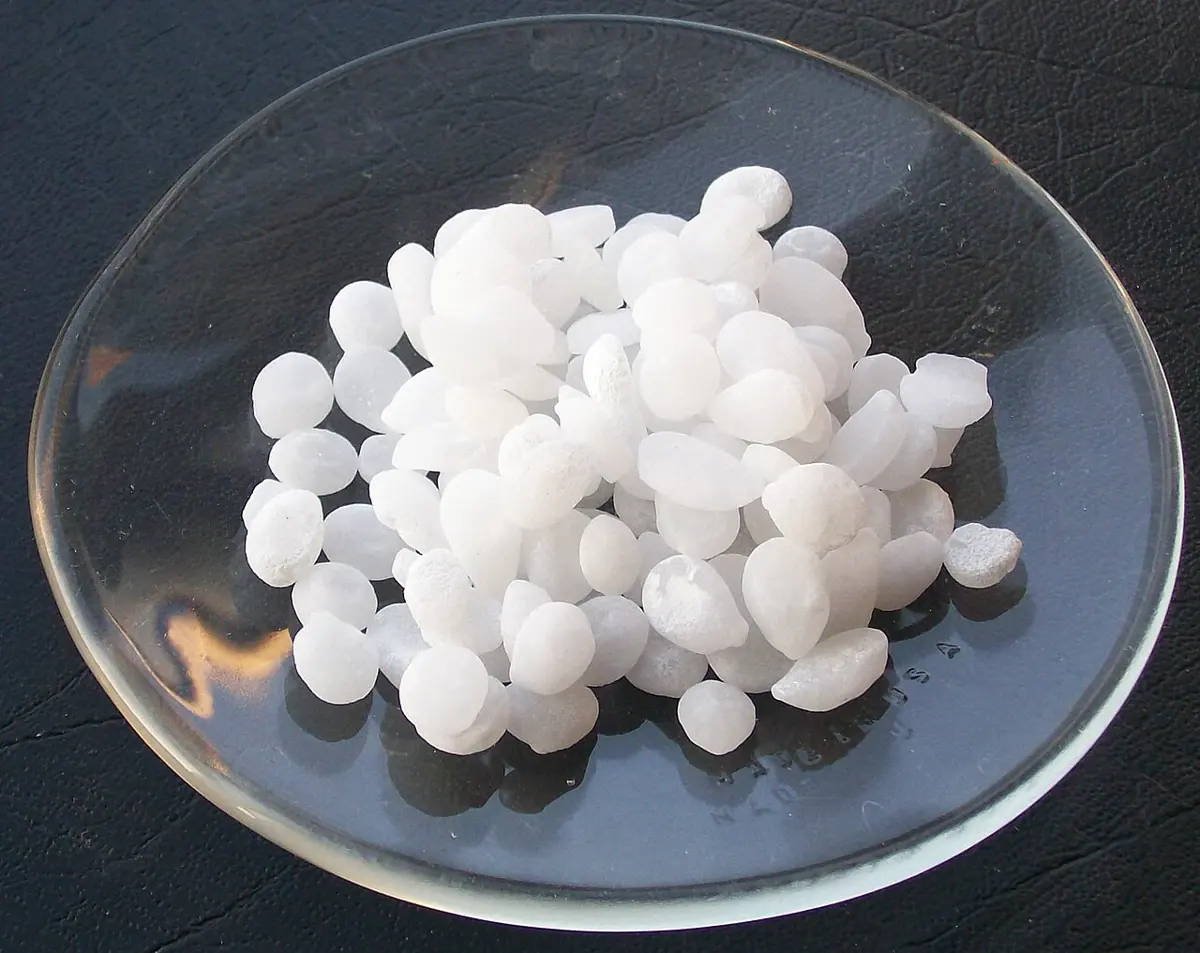
Sodium hydroxide, caustic soda, is a white solid sold as pellets or flakes. It dissolves in water with a lot of heat, and the solution feels soapy, because it turns the fats of your skin into soap. It is caustic: it burns skin and is very dangerous to the eyes. In water it is fully split into Na⁺ and OH⁻ ions, so it is a strong alkali: it turns red litmus blue and phenolphthalein pink. It is made by the electrolysis of brine Grade 9: Unit 8.
1. With acids (neutralization), it gives a salt and water:
2. With acidic oxides. It absorbs carbon dioxide and sulphur dioxide. A bottle of solid caustic soda left open turns damp (it takes water from the air: it is deliquescent) and crusty with sodium carbonate:
3. With salts of heavy metals: colored precipitates. Most metal hydroxides don’t dissolve in water, so sodium hydroxide solution added to a metal’s salt solution throws down its hydroxide, each with its own color, which helps to identify the metal:
4. With ammonium salts: the test for ammonium. Warmed with an ammonium salt, it gives off ammonia, which turns damp red litmus blue:
5. With zinc and aluminium. Unlike most metals, zinc and aluminium dissolve in hot sodium hydroxide solution, giving hydrogen:
That is why an aluminium pot should never be cleaned with caustic soda or washing soda: the alkali eats into it.
6. With fats: soap. Boiled with oils or fats, sodium hydroxide makes soap and glycerol. This is saponification: fat + sodium hydroxide → soap + glycerol.
Uses. Making soap, detergents, paper and rayon; refining vegetable oil; clearing blocked drains; and in many laboratory tests.
A few drops of sodium hydroxide solution are added to a solution, and a blue precipitate forms. The solution contained:
Pick an answer to see why.
Sodium chloride (NaCl)
Sodium chloride, common salt, is the neutral salt of a strong acid and a strong base: . It is an ionic solid of Na⁺ and Cl⁻ ions; its solution doesn’t change litmus and conducts electricity. It comes from seawater, salt lakes and rock salt mines. Most table salt sold in Nepal is iodized: a tiny amount of an iodine compound is added, because too little iodine in food causes goiter and holds back children’s growth and learning.
1. With concentrated sulphuric acid. It gives hydrogen chloride gas, which is how hydrogen chloride is made in the laboratory:
2. With silver nitrate. A white precipitate of silver chloride, the test for chloride ions:
3. By electrolysis. Molten salt gives sodium metal and chlorine; brine (a strong solution in water) gives sodium hydroxide, hydrogen and chlorine, the three chemicals of the chlor-alkali industry:
4. Into baking soda and washing soda (the Solvay process). Brine saturated with ammonia and carbon dioxide gives sodium hydrogen carbonate, baking soda, which on heating gives sodium carbonate, washing soda:
Uses. In food, and to preserve pickles, meat and fish; in oral rehydration solution for diarrhea, with glucose and other salts; as the raw material for sodium hydroxide, chlorine, hydrochloric acid, sodium metal, baking soda and washing soda; to melt ice on roads in cold countries.
10.2 Alloys
Introduction and types
An alloy is a homogeneous mixture of a metal with one or more other metals, or with a non-metal such as carbon, made by melting them together and letting them cool. Pure metals are often too soft, rust too easily or melt at the wrong temperature for the job; mixing in a little of something else changes that. An alloy is usually harder and stronger than its main metal, often resists corrosion better, often melts at a lower temperature, and may have a different color, conductivity or magnetism.
Why harder? In a pure metal all the atoms are the same size and sit in regular rows, and the rows can slide over each other when the metal is hammered or bent. In an alloy, atoms of a different size upset the rows, so they can’t slide so easily. How the second element fits in gives the two kinds of alloy shown in Figure 10.5:
- In a substitutional alloy, atoms of the added metal, about the same size as the main metal’s, take the places of some of its atoms. Brass is one: zinc atoms take the places of some copper atoms.
- In an interstitial alloy, much smaller atoms, such as carbon, fit into the gaps between the main metal’s atoms. Steel is one: carbon atoms sit in the gaps between iron atoms.
Alloys are also grouped by their main metal:
1. Ferrous alloys contain iron as the main metal.
- Steel: iron with a little carbon (up to about 2%). More carbon makes it harder but more brittle: mild steel for rods and sheets, high-carbon steel for knives, springs and tools.
- Stainless steel: iron with at least 10.5% chromium, often with nickel; the common “18/8” steel of plates and pressure cookers has 18% chromium and 8% nickel. The chromium forms an invisible oxide film that heals itself when scratched.
- Invar: iron with 36% nickel, which hardly expands when heated; used in clocks, measuring tapes and precision instruments.
- Alnico: iron with aluminium, nickel and cobalt, for strong permanent magnets.
2. Non-ferrous alloys contain no iron (or very little) as the main metal.
- Brass: copper and zinc, usually about two parts copper to one of zinc.
- Bronze: copper and tin. Bell metal, a bronze with more tin (about 78% copper, 22% tin), rings well and is used for bells and kansa plates.
- Gunmetal: copper with about 8–10% tin and 2–4% zinc, for valves, gears and statues.
- German silver (nickel silver): about 60% copper, 20% nickel and 20% zinc; silvery, with no silver in it.
- Duralumin: aluminium with about 4% copper and a little magnesium and manganese; light and strong.
- Magnalium: aluminium and magnesium; light, for aircraft parts and balance beams.
- Solder: tin and lead (63% tin, 37% lead is common), melting at about 183 °C, or lead-free tin with a little silver and copper; joins wires and pipes.
- Nichrome: 80% nickel and 20% chromium; high resistance, and doesn’t oxidize when red hot, so it is the heating wire of heaters, irons and kettles.
- Gold of 22 carats: 22 parts in 24 gold, the rest copper and silver.
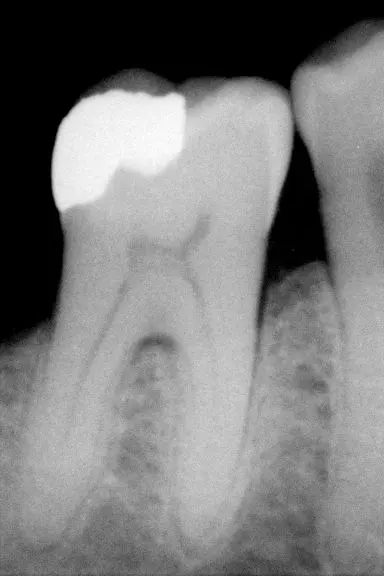
3. Amalgams are alloys of mercury with other metals. Dental amalgam, mercury mixed with silver, tin and copper, is soft enough to press into a tooth and then sets hard. Sodium amalgam is used in chemistry as a gentle reducing agent. Iron and platinum don’t form amalgams, which is why mercury is stored in iron flasks.
Which pair is an interstitial alloy and a substitutional alloy, in that order?
Pick an answer to see why.
Application
| Alloy | Made of | Property that matters | Used for |
|---|---|---|---|
| steel | Fe + up to about 2% C | hard, strong, cheap | buildings, bridges, vehicles, tools |
| stainless steel | Fe + Cr (+ Ni) | doesn’t rust | utensils, pressure cookers, surgical tools |
| brass | Cu + Zn | golden, easy to cast and machine, doesn’t rust | gagri, puja items, taps, screws |
| bronze, bell metal | Cu + Sn | hard, rings when struck | kansa plates, bells, statues, medals |
| German silver | Cu + Ni + Zn | silvery, hard | cutlery, ornaments, musical instruments |
| duralumin | Al + Cu, Mg, Mn | light and strong | aircraft, bicycle and car parts |
| solder | Sn + Pb (or Sn + Ag + Cu) | low melting point | joining wires and pipes |
| nichrome | Ni + Cr | high resistance, no oxidizing when hot | heating coils |
| invar | Fe + Ni | hardly expands when heated | clocks, measuring tapes |
| dental amalgam | Hg + Ag, Sn, Cu | soft when mixed, sets hard | filling teeth |
Exercise
1. Choose the correct option
a. Which of these is an amphoteric oxide?
Pick an answer to see why.
b. When iron reacts with dilute hydrochloric acid, the products are:
Pick an answer to see why.
c. Which property makes nichrome suitable for the heating coil of an electric heater?
Pick an answer to see why.
2. Give reasons
Dry chlorine doesn’t bleach a dry flower, but moist chlorine does.
Hint
Answer
Sulphur powder is sprinkled over mercury spilled from a broken thermometer.
Hint
Answer
Alloys are used more than pure metals in daily life.
Hint
Answer
3. Differentiate between
Acidic oxide and basic oxide
Hint
Answer
Substitutional alloy and interstitial alloy
Hint
Answer
4. Answer the following questions
Write the balanced equations for the reactions of chlorine with (i) hydrogen, (ii) iron, (iii) cold dilute sodium hydroxide, (iv) slaked lime, (v) potassium iodide.
Hint
Answer
How does dilute hydrochloric acid react with (i) zinc, (ii) sodium carbonate, (iii) copper oxide, (iv) silver nitrate? Write balanced equations and what you would see.
Hint
Answer
Complete and balance, and name each product: (i) Zn + S →, (ii) Na + H₂O →, (iii) CaO + H₂O →, (iv) NaCl + H₂SO₄ (conc., warm) →, (v) NH₄Cl + NaOH (warm) →, (vi) NaCl + H₂O (brine, electrolyzed) →.
Hint
Answer
What is an alloy? Write the composition and one use each of brass, bronze, stainless steel, solder and duralumin. What is an amalgam? Give one example.
Hint
Answer
5. Numerical problems
A gold necklace of 18 carats has a mass of 35 g. Find the mass of pure gold in it.
Hint
Answer
A craftsman in Lalitpur melts 3.9 kg of copper with 1.1 kg of tin to cast a bell. What is the percentage of copper in the alloy? Is it ordinary bronze or bell metal?
Hint
Answer
Think: Riya adds 0.5 g of marble powder to 40 mL of dilute hydrochloric acid, and Nabin adds 0.5 g of marble chips to another 40 mL of the same acid. Riya’s fizzing stops within a minute; Nabin’s goes on for many minutes. Nabin says, “My chips must give more carbon dioxide, since they fizz for longer.” Is he right? Explain.
Hint
Answer
Printable PDFs
- The unit as a book (A5) 22 pages Answers as an A4 booklet, 6 sheets
- Study notes 3 pages
- Worksheet 5 pages Answer key
- Harder practice questions 2 pages Answer key
Practice every question in the book, and keep track of the ones you miss →
Found a mistake? Please tell us.