
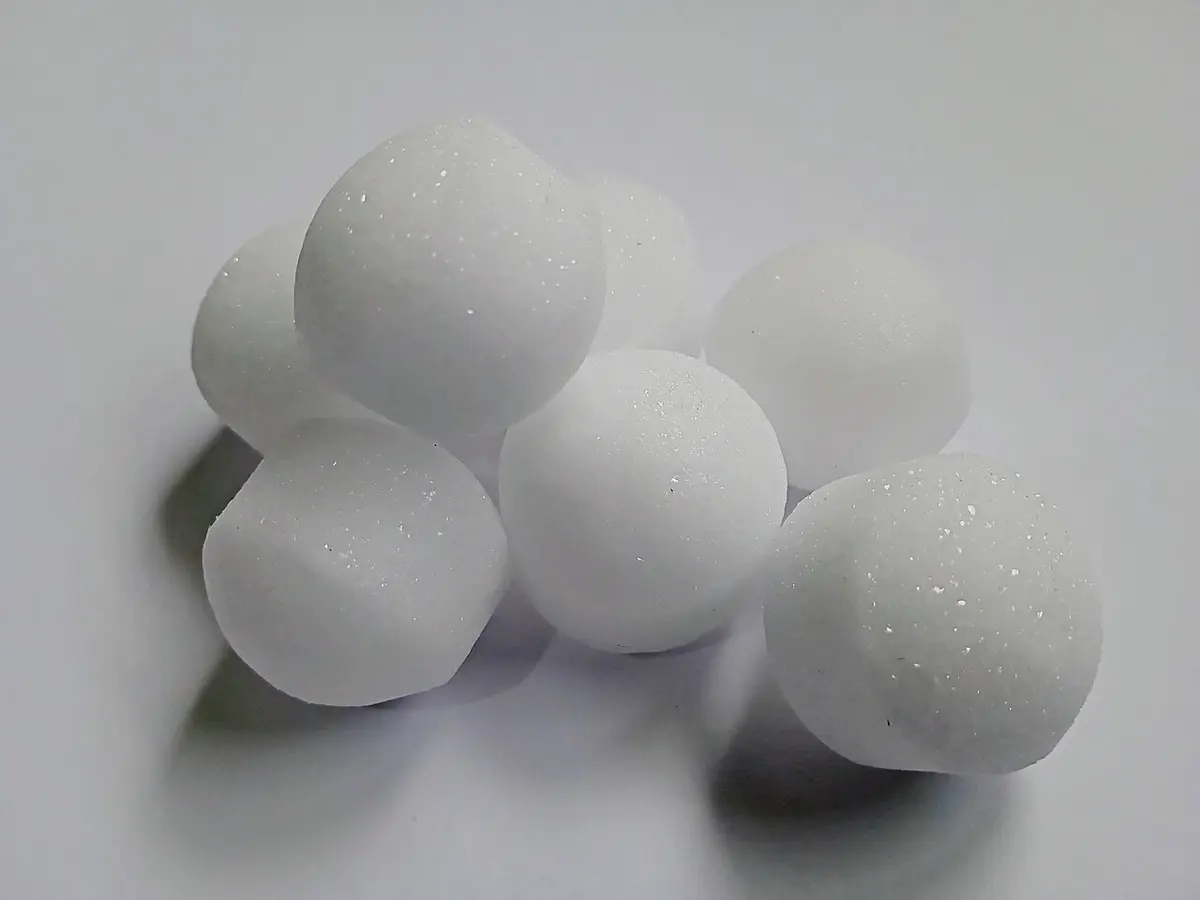
Open a packet of naphthalene balls, the white mothballs sold in every Nepali bazaar to keep insects out of wool clothes, and you smell them at once. Leave one in a drawer and, over a few months, it shrinks to nothing: the solid turns straight into vapor without melting. Its molecule, C₁₀H₈, is two rings of carbon atoms joined side by side. Compare it with the butane in an LPG cylinder, C₄H₁₀, a short open chain of carbon atoms. Both are hydrocarbons, compounds of only carbon and hydrogen, yet one is a gas that burns in your stove and the other is a smelly solid made of rings.
And here is a stranger fact. The cylinder’s butane gas is often mixed with another gas that has exactly the same formula, C₄H₁₀, but boils at a different temperature: same atoms, a different compound. In Grade 9 you learned to name organic compounds. This unit goes further: how organic compounds are sorted by the shape of their carbon skeleton, open chains and rings; why some rings, like benzene’s, are unusually stable; how the same atoms can make different compounds; and how organic molecules react.
9.1 Organic compounds
Introduction
You met organic compounds in Grade 9: the compounds of carbon, mostly with hydrogen, and the compounds made from them by putting other atoms (oxygen, nitrogen, a halogen) in place of hydrogen. Carbon can form so many of them because of its three unique properties: it makes four bonds (tetracovalency), it bonds to itself in chains and rings (catenation), and it makes double and triple bonds (multiple bonding). With millions of compounds, chemists sort them in two ways at once:
- by their functional group, the atom or group that decides how they react (alcohols, aldehydes, acids…), which you met in Grade 9;
- by the shape of their carbon skeleton: whether the carbon atoms form an open chain or close up into a ring. That is the sorting this unit begins with.
Examples
| Compound | Formula | Skeleton | Where you meet it |
|---|---|---|---|
| butane | C₄H₁₀ | open chain | LPG (cooking gas) |
| ethanol | C₂H₅OH | open chain | hand sanitizer, spirit lamps |
| ethanoic acid | CH₃COOH | open chain | vinegar, achar |
| cyclohexane | C₆H₁₂ | ring of carbon atoms | a solvent; making nylon |
| benzene | C₆H₆ | ring of carbon atoms | in petrol (a little); making plastics, dyes and medicines |
| naphthalene | C₁₀H₈ | two rings of carbon atoms | mothballs |
| glucose | C₆H₁₂O₆ | in water, mostly a ring of five carbons and one oxygen | fruit, honey, your blood |
| pyridine | C₅H₅N | ring of five carbons and one nitrogen | a solvent; making medicines |
Classification of organic compounds
Chemists divide organic compounds into two big groups by their carbon skeleton, and divide the second group again.
Each kind is explained in the sections that follow: open-chain compounds in 9.2; closed-chain compounds, alicyclic and aromatic, in 9.3; and how to tell an aromatic compound by Hückel’s rule in 9.4.
Which of these is a closed-chain compound?
Pick an answer to see why.
9.2 Open chain organic compounds
Statement and examples
Open-chain (acyclic) compounds are organic compounds whose carbon atoms are joined in chains, straight or branched, with no ring. They are also called aliphatic compounds, from the Greek aleiphar, oil or fat, because the first ones studied came from fats and oils.
Every family you named in Grade 9 is a family of open-chain compounds: alkanes, alkenes, alkynes, alcohols, ethers, aldehydes, ketones and carboxylic acids, as long as their carbons form a chain and not a ring.
- Straight (unbranched) chain: every carbon is joined to at most two others, in one line of bonds: butane, CH₃CH₂CH₂CH₃; propan-1-ol, CH₃CH₂CH₂OH; ethanoic acid, CH₃COOH.
- Branched chain: at least one carbon is joined to three or four others: 2-methylpropane, CH₃CH(CH₃)CH₃; 2-methylpropan-2-ol, (CH₃)₃COH.
Open-chain compounds are also sorted by their bonds:
- Saturated: only single bonds between carbon atoms, each carbon holding as many hydrogens as it can. The alkanes, CₙH₂ₙ₊₂: methane, ethane, propane.
- Unsaturated: at least one double or triple bond between carbon atoms. The alkenes, CₙH₂ₙ (ethene, CH₂=CH₂), and the alkynes, CₙH₂ₙ₋₂ (ethyne, CH≡CH). They are called unsaturated because they can still take on more atoms, hydrogen or a halogen, at the multiple bond (you will see how in 9.6).
Bonds and shapes: single, double and triple
Each kind of carbon–carbon bond gives the molecule its own shape:
| Single bond (alkane) | Double bond (alkene) | Triple bond (alkyne) | |
|---|---|---|---|
| Example | ethane, CH₃–CH₃ | ethene, CH₂=CH₂ | ethyne, CH≡CH |
| Electron pairs shared between the two carbons | 1 | 2 | 3 |
| Shape round each carbon | tetrahedral | flat (planar) | straight (linear) |
| Angle between bonds | 109.5° | about 120° | 180° |
| C–C bond length | 154 pm | 134 pm | 120 pm |
| Can the two ends spin about the bond? | yes | no | (a straight line: spinning changes nothing) |
A double bond is not two identical bonds. One of its two shared pairs lies along the line joining the carbons, like a single bond: a sigma (σ) bond. The other lies above and below that line: a pi (π) bond, weaker and more easily broken. A triple bond is one σ bond and two π bonds. You meet how σ and π bonds form in Unit 7 (Chemical Bonding). What matters here is that π bonds are where unsaturated compounds react, and that the π electrons are the ones Hückel’s rule counts in 9.4.
In which molecule do all the atoms lie in one straight line?
Pick an answer to see why.
How many σ and π bonds join the two carbon atoms in ethyne?
Pick an answer to see why.
9.3 Closed chain organic compounds
Statement
Closed-chain (cyclic) compounds are organic compounds in which some of the atoms are joined in a ring. When the ring is made of carbon atoms only, the compound is homocyclic (or carbocyclic). Homocyclic compounds are of two kinds: alicyclic and aromatic.
To close a chain into a ring, its two end carbons must bond to each other. Each gives up one hydrogen to free a bond, so a ring has two hydrogens fewer than the open chain with the same carbons: hexane is C₆H₁₄, cyclohexane C₆H₁₂.
Alicyclic compounds
Alicyclic compounds are closed-chain compounds whose ring of carbon atoms behaves like an aliphatic (open-chain) compound: the name is short for aliphatic cyclic. The simplest are the cycloalkanes, rings of CH₂ groups joined by single bonds. Their general formula is CₙH₂ₙ (from n = 3), and each is named by putting cyclo- before the alkane with the same number of carbons.
Other examples: cyclohexene, C₆H₁₀, a six-carbon ring with one double bond, which behaves like an alkene; methylcyclohexane, a cyclohexane ring with a CH₃ in place of one hydrogen. Many natural compounds have alicyclic rings: menthol, the cooling compound of pudina (mint), has a cyclohexane ring, and so do the steroids, including cholesterol.
Cycloalkanes behave much like alkanes. Cyclohexane, like hexane, is a colorless liquid that burns, doesn’t mix with water and reacts with chlorine in light by substitution. Small rings are the exception: in cyclopropane the angle between the ring’s bonds is forced to 60°, far from the 109.5° that carbon’s bonds prefer, so the ring is strained and breaks open more easily. Larger rings avoid strain by not being flat: cyclohexane puckers into a “chair” shape in which every angle is close to 109.5° (turn its model in the widget above).
Aromatic compounds
In 1825 Michael Faraday, in London, studied an oily liquid left behind in the containers of a gas sold for lighting, and found it was made of carbon and hydrogen alone, in the proportion that we now know means equal numbers of the two atoms. It was later named benzene, C₆H₆. Six carbons and only six hydrogens: if benzene were an open chain it would need several double or triple bonds, and should react like an alkene, taking the color from bromine at once. It doesn’t. Benzene is strangely unreactive for such an unsaturated formula.
Kekulé’s ring has a problem. If the bonds really took turns, single and double, three of the six bonds would be long (154 pm) and three short (134 pm), and the hexagon would be lopsided. In fact all six carbon–carbon bonds in benzene are the same length, 139 pm, between the two. Benzene is not either of Kekulé’s two structures but something in between: its six π electrons are not fixed in three double bonds but spread evenly round the whole ring, above and below it. Chemists call this delocalization, and draw benzene either as one Kekulé structure (knowing it stands for the real molecule) or as a hexagon with a circle inside, the circle standing for the six shared π electrons.
Aromatic compounds are cyclic compounds containing one or more flat rings in which the π electrons are delocalized all round the ring, like benzene’s, which makes them unusually stable. Most aromatic compounds contain one or more benzene rings. They were first called “aromatic” because many of the early ones had strong pleasant smells: benzaldehyde (bitter almonds), vanillin (vanilla) and cinnamaldehyde (dalchini, cinnamon) all contain a benzene ring. Today the word means only the special, stable ring; many aromatic compounds have no smell at all, and plenty of compounds with a smell are not aromatic.
| Aromatic hydrocarbon | Formula | Where it is found or used |
|---|---|---|
| benzene | C₆H₆ | coal tar and petroleum; making plastics (polystyrene), nylon, dyes, detergents and medicines |
| methylbenzene (toluene) | C₆H₅CH₃ | a solvent in paints and glues; making explosives (TNT) |
| naphthalene | C₁₀H₈ | mothballs; making dyes and plastics |
| anthracene | C₁₄H₁₀ | coal tar; making dyes |
Aromatic rings behave very differently from alkenes. Their delocalized π electrons are so stable that they resist addition (which would break up the ring of π electrons) and instead take part in substitution: a hydrogen on the ring is replaced, and the ring survives. Benzene doesn’t take the color from bromine water; with bromine and an iron(III) bromide catalyst it gives bromobenzene, C₆H₅Br, and hydrogen bromide, replacing one hydrogen.
Heterocyclic compounds
The rings of a few cyclic compounds contain an atom other than carbon, usually nitrogen, oxygen or sulphur. These are heterocyclic compounds (Greek heteros, other): pyridine, C₅H₅N, has a nitrogen in a benzene-like ring, furan, C₄H₄O, an oxygen in a five-membered ring. They are everywhere in living things: the bases of DNA, adenine, guanine, cytosine and thymine, are heterocyclic rings, and so are caffeine (in tea and coffee) and nicotine (in tobacco).
What is the molecular formula of cyclopentane?
Pick an answer to see why.
All six carbon–carbon bonds in benzene are 139 pm long. This shows that:
Pick an answer to see why.
9.4 Huckel’s rule
Statement
Benzene is not the only aromatic ring. In 1931 the German physicist Erich Hückel worked out, from the quantum theory of electrons, which rings share their π electrons in the special stable way that benzene does. The answer came down to a count.
Hückel’s rule: a cyclic molecule (or ion) is aromatic if
- it is cyclic and planar (flat), so that the electrons above and below the ring can join up all the way round;
- every atom of the ring takes part in the ring of π electrons (completely conjugated): each ring atom is part of a double bond, or has a lone pair or an empty orbital to share, with no CH₂ or other atom with four single bonds in the ring;
- the ring holds (4n + 2) π electrons, where n = 0, 1, 2, 3… : that is, 2, 6, 10, 14, 18… π electrons.
A ring that is cyclic, planar and conjugated but has 4n π electrons (4, 8, 12…) is not aromatic; it is unusually unstable, and is called antiaromatic. A ring that fails conditions 1 or 2 is simply non-aromatic.
Counting π electrons
- Each double bond in the ring gives 2 π electrons.
- A ring carbon with a negative charge (a lone pair) that can join the ring gives 2.
- A ring carbon with a positive charge (an empty orbital) gives 0, but still completes the ring.
- A CH₂ (or any carbon with four single bonds) in the ring gives nothing and breaks the ring of π electrons.
Then solve 4n + 2 = (number of π electrons) for n. If n comes out as a whole number (0, 1, 2…), the count fits.
How many π electrons does an aromatic ring with n = 2 in Hückel’s rule have?
Pick an answer to see why.
Cyclobutadiene, C₄H₄, is a flat ring of four carbons with two double bonds. By Hückel’s rule it is:
Pick an answer to see why.
9.5 Description of isomerism
What isomers are
In Grade 9 you saw that butane, CH₃CH₂CH₂CH₃, and 2-methylpropane, CH₃CH(CH₃)CH₃, are both C₄H₁₀. They are not two drawings of one compound: butane boils at −0.5 °C and 2-methylpropane at −12 °C; they are two different substances. Compounds like these are called isomers (Greek isos, equal, and meros, part: made of equal parts).
Isomers are compounds that have the same molecular formula but different structural formulas, and so different properties. The existence of such compounds is called isomerism.
Isomers have the same molecular mass and the same percentage of each element, but their atoms are joined differently. When the difference is in the order in which the atoms are joined, it is structural isomerism, which has three kinds: chain, position and functional.
Chain isomerism
Chain isomers have the same molecular formula but different carbon skeletons: a longer chain, or a shorter one with branches. The functional group (if any) is the same.
Pentane, C₅H₁₂, has three chain isomers: pentane (boils at 36 °C), 2-methylbutane (28 °C) and 2,2-dimethylpropane (9.5 °C). The more branched the molecule, the more nearly round it is, the less surface it has to touch its neighbors, and the lower it boils.
Chain isomerism happens in other families too: butan-1-ol, CH₃CH₂CH₂CH₂OH, and 2-methylpropan-1-ol, (CH₃)₂CHCH₂OH, are chain isomers (C₄H₁₀O, both with the –OH on an end carbon); so are butanoic acid, CH₃CH₂CH₂COOH, and 2-methylpropanoic acid, (CH₃)₂CHCOOH.
Position isomerism
Position isomers have the same molecular formula, the same carbon skeleton and the same functional group, but the functional group (or a double or triple bond, or a substituent such as a halogen) is in a different position on the chain.
More examples:
- pent-1-ene, CH₂=CHCH₂CH₂CH₃, and pent-2-ene, CH₃CH=CHCH₂CH₃ (C₅H₁₀);
- but-1-yne, CH≡CCH₂CH₃, and but-2-yne, CH₃C≡CCH₃ (C₄H₆);
- pentan-2-one, CH₃COCH₂CH₂CH₃, and pentan-3-one, CH₃CH₂COCH₂CH₃ (C₅H₁₀O);
- 1-chloropropane, CH₃CH₂CH₂Cl, and 2-chloropropane, CH₃CHClCH₃ (C₃H₇Cl).
Aldehydes and carboxylic acids have no position isomers of this kind: their group is always on carbon 1, at the end of the chain.
Functional isomerism
Functional isomers have the same molecular formula but different functional groups, so they belong to different families and have different chemical properties.
The common pairs follow from the general formulas you learned in Grade 9:
| General formula | Functional isomers | Example (same formula) |
|---|---|---|
| CₙH₂ₙ₊₂O | alcohols and ethers | ethanol, CH₃CH₂OH, and methoxymethane, CH₃OCH₃ (C₂H₆O) |
| CₙH₂ₙO | aldehydes and ketones | propanal, CH₃CH₂CHO, and propanone, CH₃COCH₃ (C₃H₆O) |
| CₙH₂ₙ | alkenes and cycloalkanes | propene, CH₂=CHCH₃, and cyclopropane (C₃H₆) |
Functional isomers differ far more than chain or position isomers do. Ethanol, with its –OH, is a liquid that mixes with water and reacts with sodium to give hydrogen; methoxymethane is a gas (it boils at −24 °C) that doesn’t react with sodium at all.
Finding every isomer
To write all the isomers of a formula without missing any or writing one twice, work step by step:
- Decide the family or families the formula allows from the general formulas: CₙH₂ₙ₊₂ is an alkane only; CₙH₂ₙ₊₂O an alcohol or an ether; CₙH₂ₙO an aldehyde or ketone.
- Chain: write the longest possible chain of carbons first, then chains one carbon shorter with the missing carbon as a methyl branch at each different place, then two carbons shorter, and so on.
- Position: on each skeleton, put the functional group (or double bond) at each different place.
- Name each one. Two structures with the same IUPAC name are the same compound: cross one out.
Propanal, CH₃CH₂CHO, and propanone, CH₃COCH₃, are:
Pick an answer to see why.
How many structural isomers does C₄H₁₀O have?
Pick an answer to see why.
9.6 Introduction to some organic reactions
An organic reaction usually happens at the functional group, or at a double or triple bond, while the rest of the molecule stays as it is. Three kinds of reaction are met again and again in aliphatic compounds, sorted by what happens to the molecule.
Addition reaction
An addition reaction is a reaction in which two molecules join to form a single product, with nothing left over. In organic chemistry it happens at a double or triple bond: the π bond opens, and an atom or group adds to each of its two carbons. So only unsaturated compounds (alkenes, alkynes) take part in addition; the product is more saturated than what you started with.
Here we take addition of homoatomic molecules, molecules made of two atoms of the same element: hydrogen (H₂), chlorine (Cl₂) and bromine (Br₂). The molecule splits, and one atom joins each carbon of the double bond.
Addition of hydrogen (hydrogenation). Ethene and hydrogen, passed over heated, finely divided nickel (or with platinum or palladium at room temperature), give ethane:
An alkyne adds hydrogen twice: first to an alkene, then to an alkane.
The same reaction turns liquid vegetable oils, whose molecules have C=C double bonds, into solid fat: this is how vanaspati ghee is made.
Addition of chlorine (chlorination). Ethene and chlorine react at room temperature to give 1,2-dichloroethane, each carbon taking one chlorine atom:
1,2-Dichloroethane is made in huge amounts: it is the first step in making PVC, the plastic of water pipes and electric cable covers.
Addition of bromine (bromination). Ethene and bromine (in an organic solvent) react at room temperature to give 1,2-dibromoethane. The red-brown color of the bromine disappears as it is used up:
Ethyne adds two molecules of bromine, one to each of its π bonds, giving 1,1,2,2-tetrabromoethane:
Which of these will take part in an addition reaction with hydrogen?
Pick an answer to see why.
Substitution reaction
A substitution reaction is a reaction in which an atom or group in a molecule is replaced by another atom or group. Saturated compounds, which can’t add anything, react this way.
Chlorination of methane. Methane and chlorine don’t react in the dark. In diffused sunlight (or ultraviolet light) one hydrogen atom of methane is replaced by a chlorine atom, giving chloromethane and hydrogen chloride:
With more chlorine, the other hydrogens are replaced one by one:
The products are chloromethane, dichloromethane, trichloromethane (chloroform, once used to put patients to sleep for surgery) and tetrachloromethane (carbon tetrachloride, once used in fire extinguishers and now banned in most uses because it destroys the ozone layer). Ethane reacts the same way: C₂H₆ + Cl₂ → C₂H₅Cl + HCl.
Replacing a halogen. A halogen atom on a carbon chain can itself be replaced. Boiling bromoethane with aqueous potassium hydroxide replaces its bromine by –OH, giving ethanol:
In the reaction CH₄ + Cl₂ → CH₃Cl + HCl, the chlorine atom:
Pick an answer to see why.
Elimination reaction
An elimination reaction is a reaction in which atoms or groups are removed from two neighboring carbon atoms of a molecule, and a double (or triple) bond forms between those carbons. It is the reverse of addition: a saturated compound becomes an unsaturated one, and a small molecule (water, a hydrogen halide, hydrogen) is given off.
Removing water (dehydration) from an alcohol. Ethanol heated to 170 °C with excess concentrated sulphuric acid loses an –OH from one carbon and an H from the next, which leave as water:
Concentrated sulphuric acid takes up water strongly, which is why it is used. (Passing ethanol vapor over hot aluminium oxide, at about 350–400 °C, does the same.)
Removing a hydrogen halide (dehydrohalogenation). Bromoethane heated with potassium hydroxide dissolved in alcohol (alcoholic KOH) loses HBr and gives ethene:
Removing hydrogen (dehydrogenation). Heated briefly with steam to about 850 °C, ethane loses hydrogen and gives ethene. This “steam cracking”, of ethane from natural gas and of naphtha from petroleum, is where most of the world’s ethene comes from:
The three kinds compared
| Addition | Substitution | Elimination | |
|---|---|---|---|
| What happens | two molecules join into one | one atom or group replaces another | atoms leave from neighboring carbons |
| Compounds that do it | unsaturated (alkenes, alkynes) | saturated (alkanes), and compounds with a group that can be replaced | saturated (alcohols, haloalkanes) |
| Change in the bonds | a double or triple bond becomes single (or double) | no change in the bonds between carbons | a single bond becomes double |
| Number of products | one | two | two (the organic product and a small molecule) |
| Example | CH₂=CH₂ + Br₂ → CH₂BrCH₂Br | CH₄ + Cl₂ → CH₃Cl + HCl | C₂H₅OH → CH₂=CH₂ + H₂O |
Exercise
1. Choose the correct option
a. Which of these is an aliphatic compound?
Pick an answer to see why.
b. The general formula of the cycloalkanes is:
Pick an answer to see why.
c. The length of each carbon–carbon bond in benzene is:
Pick an answer to see why.
d. According to Hückel’s rule, an aromatic ring contains:
Pick an answer to see why.
e. Which of these is aromatic?
Pick an answer to see why.
f. Butan-1-ol and butan-2-ol are:
Pick an answer to see why.
g. Ethanol and methoxymethane are functional isomers because they have:
Pick an answer to see why.
h. Which reaction is an elimination?
Pick an answer to see why.
i. Methane reacts with chlorine in diffused sunlight to give chloromethane. This is an example of:
Pick an answer to see why.
j. When ethene is passed through bromine water, the solution:
Pick an answer to see why.
2. Give reasons
Benzene is an unsaturated compound, yet it doesn’t decolorize bromine water.
Hint
Answer
Cyclohexane is alicyclic, while benzene is aromatic.
Hint
Answer
Butane and 2-methylpropane are isomers, but they have different boiling points.
Hint
Answer
Alkanes undergo substitution reactions, but not addition reactions.
Hint
Answer
Aldehydes don’t show position isomerism of the functional group.
Hint
Answer
Chlorination of methane is carried out in diffused sunlight, not in the dark or in bright sunlight.
Hint
Answer
3. Differentiate between
Open-chain and closed-chain compounds
Hint
Answer
Alicyclic and aromatic compounds
Hint
Answer
Chain isomerism and position isomerism
Hint
Answer
Addition reaction and substitution reaction
Hint
Answer
Addition reaction and elimination reaction
Hint
Answer
4. Answer the following questions
What are aliphatic compounds? Give two examples each of saturated and unsaturated aliphatic compounds.
Hint
Answer
What are closed-chain compounds? How are they classified? Give an example of each kind.
Hint
Answer
State Hückel’s rule. Use it to show that benzene and naphthalene are aromatic.
Hint
Answer
Why is benzene drawn as a hexagon with a circle inside? What does the circle show?
Hint
Answer
What is isomerism? Describe chain, position and functional isomerism with one example each.
Hint
Answer
How does ethanol react with concentrated sulphuric acid at 170 °C and at 140 °C? Name the kind of reaction in the first case.
Hint
Answer
A hydrocarbon X, C₂H₄, decolorizes bromine water. X adds hydrogen in the presence of nickel to give Y. Y reacts with chlorine in diffused sunlight to give Z and hydrogen chloride. Identify X, Y and Z, write the equations, and name the kind of each reaction.
Hint
Answer
5. Write the structures and names
Write the condensed formulas and IUPAC names of all the isomers of C₅H₁₂, and name the kind of isomerism they show.
Hint
Answer
Write the structures and IUPAC names of two position isomers of C₄H₈ that have an unbranched chain.
Hint
Answer
Write a functional isomer of each, with its IUPAC name: a. ethanol, CH₃CH₂OH; b. propanone, CH₃COCH₃; c. propene, CH₂=CHCH₃.
Hint
Answer
Write the structures and IUPAC names of the four alcohols with the formula C₄H₁₀O. Pick out one pair of chain isomers and one pair of position isomers among them.
Hint
Answer
Draw the structure of cyclohexane and of benzene, and write the molecular formula of each.
Hint
Answer
6. Complete the reactions
Complete and name the kind of each reaction:
- i.CH₂=CH₂ + Cl₂ →
- ii.CH≡CH + 2H₂ → (Ni)
- iii.CH₄ + Cl₂ → (diffused sunlight)
- iv.CH₃CH₂Br + KOH (aq) →
- v.CH₃CH₂Br + KOH (alc) →
- vi.CH₃CH₂OH → (conc. H₂SO₄, 170 °C)
Hint
Answer
Propene, CH₂=CHCH₃, reacts with bromine. Write the equation, name the product and the kind of reaction, and say what you would see.
Hint
Answer
7. Numerical problems
How many π electrons does the anthracene molecule, C₁₄H₁₀, have (seven double bonds in its Kekulé structure)? Find n in Hückel’s rule and say whether it is aromatic. It is flat.
Hint
Answer
The cycloheptatrienyl cation, C₇H₇⁺, is a flat ring of seven carbons with three double bonds; the seventh carbon carries the positive charge (an empty orbital). Count its π electrons and decide whether it is aromatic.
Hint
Answer
A cycloalkane has a molecular mass of 84. Find its molecular formula and name it. (C = 12, H = 1)
Hint
Answer
What mass of hydrogen is needed to change 14 g of ethene into ethane? (C = 12, H = 1)
Hint
Answer
When 8 g of methane reacts with chlorine in diffused sunlight to give chloromethane only, what mass of chloromethane and what volume of hydrogen chloride at STP form? (C = 12, H = 1, Cl = 35.5; 1 mole of gas at STP = 22.4 L)
Hint
Answer
Adding hydrogen to one mole of cyclohexene gives out about 120 kJ, and to one mole of benzene about 208 kJ. Estimate how much more stable benzene is than a ring of three separate double bonds would be.
Hint
Answer
An alkyne has a molecular mass of 40. Find its formula, draw its structure and name it. How many σ and π bonds does it contain? (C = 12, H = 1)
Hint
Answer
Printable PDFs
- The unit as a book (A5) 32 pages Answers as an A4 booklet, 8 sheets
- Study notes 2 pages
- Worksheet 5 pages Answer key
- Harder practice questions 2 pages Answer key
Practice every question in the book, and keep track of the ones you miss →
Found a mistake? Please tell us.