
Boil a pot of water for dal and the water turns to steam at 100 °C. But the steam is still water: every molecule is still one oxygen atom holding two hydrogen atoms. To pull those atoms apart you would need a flame of well over 2,000 °C. So there are two very different holds in a glass of water: a weak one between the molecules, which a kitchen stove breaks, and a strong one inside each molecule, which it can’t. The strong one is a covalent bond: a pair of electrons shared by two atoms.
In this unit you will see how a covalent bond forms when two atoms’ electron clouds overlap, why that gives two kinds of bond, sigma and pi, and why covalent compounds melt and boil so much lower than salts. You will meet a bond in which one atom gives both electrons (it holds together the ammonium in your fertilizer and the ozone high above Nepal), and then the chemist’s way of counting atoms you can never see: the mole, and Avogadro’s law for gases.
Why atoms bond
Of all the elements, only the noble gases (helium, neon, argon and the rest) are found in nature as single atoms. Every other atom joins others: oxygen as O₂, sodium and chlorine as salt, carbon in a chain. Atoms join because a bonded group of atoms has less energy than the same atoms apart, and anything left to itself settles into its lowest energy, as a ball rolls to the bottom of a bowl. The noble gases already have the lowest energy they can: their outer shell is full, with 2 electrons (helium) or 8 (the others).
Other atoms reach a full outer shell, a duplet or an octet, in one of two ways:
- Transferring electrons. A metal atom, which holds its outer electrons loosely, gives them to a non-metal atom, which pulls on electrons strongly. The two become oppositely charged ions held by their attraction: an electrovalent (ionic) bond, as in sodium chloride, Na⁺Cl⁻.
- Sharing electrons. Two non-metal atoms both pull strongly on electrons; neither will let go of its own. Instead each puts one electron into a pair that both atoms share: a covalent bond.
Which happens depends on how differently the two atoms pull on electrons, their electronegativity (Unit 6). A common rule of thumb: if the two electronegativities differ by more than about 1.7, the bond is mostly ionic (sodium 0.93 and chlorine 3.16 differ by 2.23); if they differ by less, it is covalent. It is a guide, not a sharp line: hydrogen fluoride differs by 1.78 and is still a covalent molecule.
7.1 Covalent bond
Formation
A covalent bond is the bond formed between two atoms by the mutual sharing of a pair of electrons, each atom giving one electron to the pair. The shared pair counts for both atoms, so each can reach a duplet or an octet. Covalent bonds usually form between non-metal atoms: of the same element (H₂, Cl₂, O₂, N₂) or of different elements (HCl, H₂O, CO₂, CH₄).
What the shared pair does
Why should sharing two electrons hold two atoms together? Take two hydrogen atoms, each a proton with one electron round it. Far apart, they don’t notice each other. As they come closer, each proton starts to pull on the other atom’s electron as well as its own, and the two electron clouds begin to overlap. The two electrons then spend much of their time between the two nuclei, where each electron is attracted by both protons at once. That attraction, of both nuclei for the shared pair between them, is the bond.
The atoms can’t come too close, though: the two protons repel each other, and very close up the repulsion wins. So there is one distance at which the energy is lowest. Two hydrogen atoms settle there, 74 pm (picometers; 1 pm = 10⁻¹² m) apart.
The distance between the nuclei of two bonded atoms is the bond length, and the energy needed to break one mole of the bonds (to pull the atoms apart again) is the bond energy. For H–H they are 74 pm and 436 kJ/mol. The same energy is given out when the bond forms, which is why hydrogen burns so fiercely: making new, stronger bonds gives out more energy than breaking the old ones takes.
Overlap of orbitals
You know from Unit 6 that electrons live in orbitals, each holding at most two electrons, and two electrons in the same orbital must spin in opposite directions. A covalent bond is formed when a half-filled orbital of one atom (holding one electron) overlaps a half-filled orbital of the other, and the two electrons, with opposite spins, pair up in the region where the orbitals overlap. The more the orbitals overlap, the stronger the bond.
This tells you how many covalent bonds an atom can make: one for each half-filled orbital, that is, each unpaired electron in its outer shell. That number is its covalency.
| Atom | Outer configuration | Unpaired electrons | Covalency | Example |
|---|---|---|---|---|
| hydrogen | 1s¹ | 1 | 1 | H–H |
| chlorine | 3s² 3p⁵ (↑↓ ↑↓ ↑) | 1 | 1 | H–Cl |
| oxygen | 2s² 2p⁴ (↑↓ ↑ ↑) | 2 | 2 | H–O–H |
| nitrogen | 2s² 2p³ (↑ ↑ ↑) | 3 | 3 | NH₃, N≡N |
| carbon | 2s² 2p² (↑ ↑ and an empty 2p) | 2, but 4 in compounds | 4 | CH₄ |
Carbon is the odd one. In its ground state it has only two unpaired electrons, yet it almost always makes four bonds. When carbon bonds, one of its 2s electrons moves up into the empty 2p orbital, leaving four unpaired electrons, and the energy of two extra bonds more than pays for the move. (Why the four bonds of methane then come out exactly alike, 109.5° apart, is explained in Grade 11 chemistry by hybridization.)
Showing covalent bonds
Bonds are shown in two ways. A dot-and-cross diagram (an electron dot or Lewis structure) shows every outer electron, one atom’s as dots and the other’s as crosses, with the shared pairs where the shells overlap. Pairs that belong to one atom alone are lone pairs. A structural formula shows each shared pair as a line: one line for a single bond (one shared pair), two for a double bond (two pairs), three for a triple bond (three pairs).
Why does nitrogen form three covalent bonds with hydrogen in ammonia, NH₃?
Pick an answer to see why.
Examples of covalent compounds
Compounds whose atoms are held together by covalent bonds are covalent compounds. Most compounds of non-metals with each other are covalent, and so are almost all organic compounds.
| Compound | Formula | Bonds | Where you meet it |
|---|---|---|---|
| water | H₂O | two O–H | everywhere |
| methane | CH₄ | four C–H | biogas, about half to three quarters of it |
| ammonia | NH₃ | three N–H | fertilizer factories, the smell of urine left standing |
| carbon dioxide | CO₂ | two C=O | breath, soda drinks, burning |
| hydrogen chloride | HCl | one H–Cl | dissolved in water, hydrochloric acid (in your stomach) |
| ethanol | C₂H₅OH | C–C, C–H, C–O, O–H | spirit, hand sanitizer |
| glucose | C₆H₁₂O₆ | many single bonds | blood sugar, fruit |
| urea | CO(NH₂)₂ | C=O, C–N, N–H | the white fertilizer sold all over Nepal |
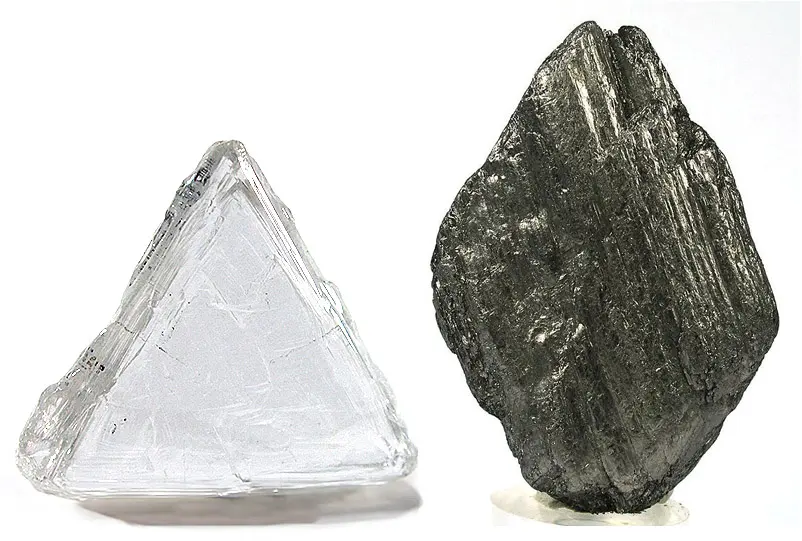
Most covalent substances are made of separate molecules, small groups of atoms bonded together, held to other molecules only weakly. A few are giant covalent (network) solids, in which covalent bonds run through the whole crystal, with no separate molecules: diamond and graphite (carbon), and quartz, SiO₂, the mineral of sand.
Characteristics of covalent compounds
A covalent molecule is held together inside by strong bonds, but one molecule holds the next only by weak forces of attraction between molecules (the intermolecular forces of Going Further). Almost every property of covalent compounds follows from that.
- Physical state. Many are gases (CH₄, CO₂, NH₃) or liquids (water, ethanol, petrol) at room temperature; the solids are usually soft (wax, sugar, naphthalene). Ionic compounds are hard crystalline solids.
- Low melting and boiling points. Melting or boiling a molecular substance only separates its molecules, against weak forces; the covalent bonds inside them are not broken. So covalent compounds melt and boil far lower than ionic ones, whose ions are held by strong attraction in every direction through the crystal (methane melts at −182 °C, sodium chloride at 801 °C).
- Poor conductors of electricity. They contain no ions and no free electrons, so neither the solid, the liquid nor a solution in water conducts (sugar water doesn’t light a bulb), while a molten salt or salt water does. Exceptions: graphite conducts, and a few polar molecules such as HCl react with water to form ions, so hydrochloric acid conducts.
- Solubility. Most are insoluble in water but dissolve in organic solvents such as kerosene, alcohol or benzene: oil and wax don’t dissolve in water but do in petrol. Like dissolves like: non-polar substances mix with non-polar ones. Polar covalent compounds that can attract water molecules, such as sugar, ethanol, ammonia and HCl, do dissolve in water. Most ionic compounds dissolve in water but not in kerosene.
- Slow reactions. Reactions of ionic compounds in solution are almost instant, because their ions are already free. Reactions of covalent compounds need bonds to be broken and remade, so they are often slow: cooking takes time.
- Fixed shapes. A covalent bond points in a definite direction, from one atom to the other (an ion pulls equally all round), so covalent molecules have definite shapes (water bent, methane tetrahedral, CO₂ straight). That is also why the same atoms can be joined in different ways to give different compounds, isomers, which you meet in Unit 9.
Turn these three molecules and compare their shapes: water bent, methane a tetrahedron, carbon dioxide a straight line.
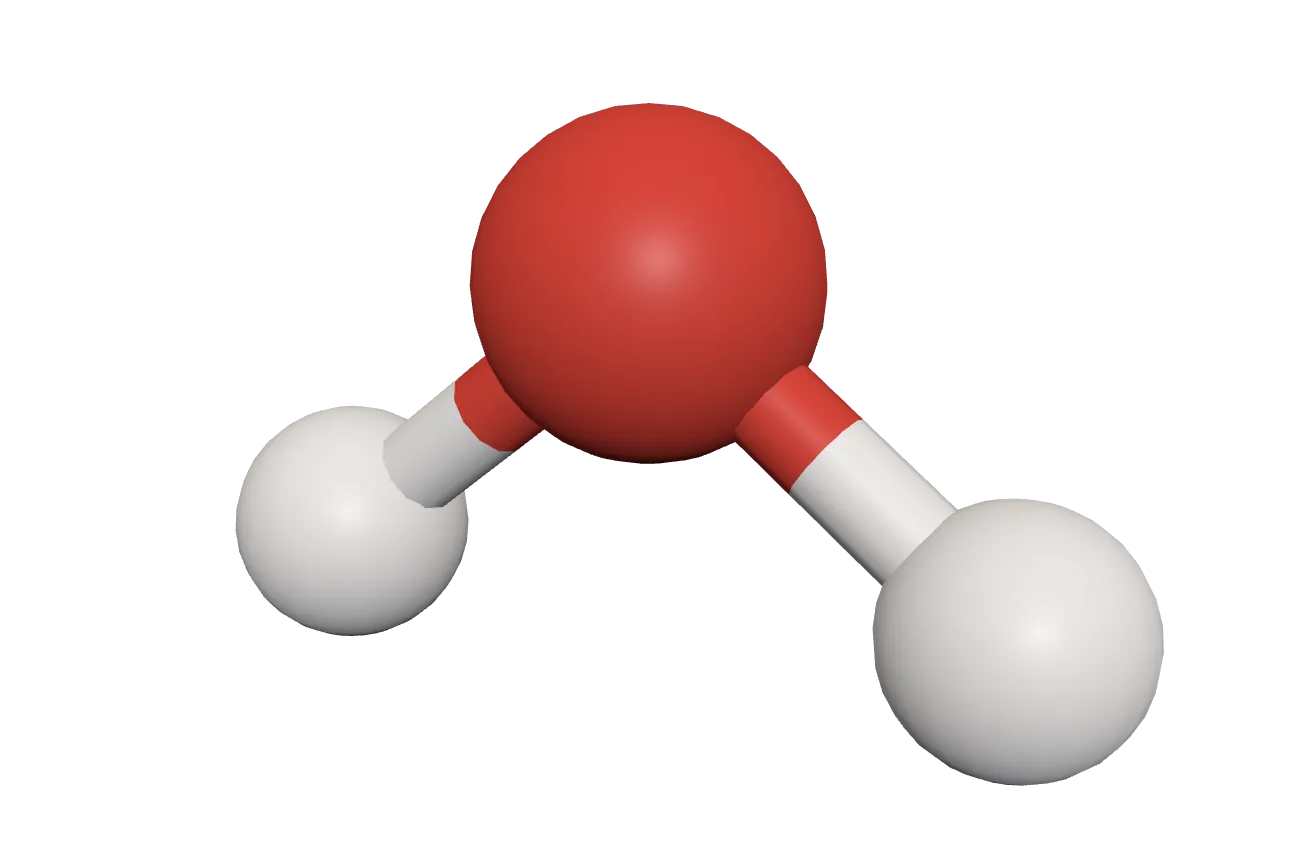
This browser can’t show the 3D model. The picture above is the same model.
Bent, not straight: the two O–H bonds are 104° apart in this computed model (about 104.5° in real water). Oxygen’s two lone pairs, not drawn, are on the side away from the hydrogens.
Oxygen atom: one single bond to each hydrogen.
Hydrogen atom: one single bond.
A tetrahedron: the four hydrogens are as far apart as they can be, every two bonds 109.5° apart. Stood on three hydrogens, the fourth points straight up.
Carbon atom: four single bonds, one to each hydrogen.
Hydrogen atom: one single bond.
Straight: O=C=O in a line, 180°. Each oxygen is joined to the carbon by a double bond.
Carbon atom: a double bond to each oxygen.
Oxygen atom: one double bond, to the carbon.
Drag to turn it. Tap an atom to see what it is.
Molecules: computed 3D conformers from PubChem, National Library of Medicine (public domain): pubchem.ncbi.nlm.nih.gov, CID 962, 297, 280
Most organic compounds are covalent and most of the familiar inorganic compounds (salts, metal oxides) are ionic, so organic compounds melt and boil lower than inorganic ones:
| Organic (covalent) | Melts at | Boils at | Inorganic (ionic) | Melts at | Boils at |
|---|---|---|---|---|---|
| methane | −182 °C | −162 °C | sodium chloride | 801 °C | 1,413 °C |
| ethanol | −114 °C | 78 °C | calcium chloride | 772 °C | 1,935 °C |
| ethanoic acid | 17 °C | 118 °C | calcium oxide (quicklime) | 2,613 °C | 2,850 °C |
| naphthalene | 80 °C | 218 °C | magnesium oxide | 2,852 °C | 3,600 °C |
| candle wax | about 60 °C | above 370 °C | aluminium oxide | 2,072 °C | 2,977 °C |
Types of covalent bond: sigma and pi
Two orbitals can overlap in two different ways, and they give two kinds of covalent bond.
Sigma (σ) bond. When two orbitals overlap end to end, along the axis joining the two nuclei (head-on or axial overlap), they form a sigma bond. The shared pair spends its time on that axis, between the nuclei. Any orbitals can do it:
- s–s overlap: two s orbitals, as in H₂;
- s–p overlap: an s and a p orbital, as in H–Cl (hydrogen’s 1s and chlorine’s 3p);
- p–p overlap (head-on): two p orbitals pointing at each other, as in Cl–Cl.
Pi (π) bond. Two p orbitals that lie parallel to each other, side by side, can overlap sideways (lateral overlap). Their overlap is in two parts, above and below the axis, with none on the axis itself. This is a pi bond.
A π bond never forms alone. Two atoms are always joined first by one σ bond, and only then can their other, parallel p orbitals overlap sideways. So:
| Bond | Made of | Example |
|---|---|---|
| single | 1 σ | H–H, H–Cl, C–H |
| double | 1 σ + 1 π | O=O, C=C in ethene |
| triple | 1 σ + 2 π | N≡N, C≡C in ethyne |
Take nitrogen. Each N atom has three half-filled p orbitals, at right angles to each other: px, py and pz. The two px orbitals point at each other along the axis and overlap head-on: one σ bond. The py orbitals are then parallel, side by side, and overlap above and below: one π bond. The pz orbitals, parallel too, overlap in front and behind: a second π bond. So N≡N is one σ bond and two π bonds, and its six shared electrons fill the space round the axis. It is one of the strongest bonds there is (945 kJ/mol), which is why the nitrogen that makes up 78% of the air hardly reacts.
Why a π bond is weaker than a σ bond
A head-on overlap is large, and the shared pair sits right between the two nuclei, where both pull on it hardest. A sideways overlap is smaller and off the axis. So a π bond is weaker. Compare bond energies:
| Bond | Bond energy | Bond length |
|---|---|---|
| C–C (1 σ) | 347 kJ/mol | 154 pm |
| C=C (1 σ + 1 π) | 614 kJ/mol | 134 pm |
| C≡C (1 σ + 2 π) | 839 kJ/mol | 120 pm |
Adding a π bond to C–C adds only 614 − 347 = 267 kJ/mol, less than the 347 of the σ bond. That is why alkenes and alkynes react at their π bonds and alkanes don’t (Unit 9’s addition reactions). Each extra bond also pulls the atoms closer together.
A σ bond lets the two atoms turn about it, like a wheel on an axle: the overlap stays the same as they turn. A π bond doesn’t: turning one atom would twist its p orbital out of line with the other’s and break the overlap. That is why a double bond holds a molecule flat and rigid (you can turn the models in Unit 9’s Bonds and shapes).
| Sigma (σ) bond | Pi (π) bond |
|---|---|
| Formed by head-on (axial) overlap of orbitals. | Formed by sideways (lateral) overlap of parallel p orbitals. |
| s–s, s–p or p–p orbitals can form it. | Only p–p (or d) orbitals can form it. |
| Overlap is large, on the axis between the nuclei. | Overlap is smaller, above and below the axis. |
| Stronger. | Weaker. |
| Can exist alone (every single bond). | Forms only after a σ bond between the same atoms. |
| The atoms can rotate about it. | No rotation about it. |
7.2 Coordinate covalent bonds
Formation
In an ordinary covalent bond, each atom gives one electron to the shared pair. But a shared pair can also come entirely from one atom. A bond formed by sharing a pair of electrons that both come from the same atom is a coordinate covalent bond (also written co-ordinate, and called a dative bond).
- The atom that gives the pair is the donor. It must have a lone pair in its outer shell.
- The atom that receives it is the acceptor. It must have room for two more electrons: an empty orbital, so that it is two electrons short of a duplet or octet.
A coordinate bond is shown by an arrow from the donor to the acceptor, A→B (or as a line, once you know which atom gave the pair).
The best-known example is the ammonium ion. In ammonia, NH₃, nitrogen has an octet: three shared pairs and one lone pair. A hydrogen ion, H⁺, is a hydrogen atom that has lost its electron: it has an empty 1s orbital. When ammonia meets an acid, the nitrogen’s lone pair is shared with H⁺:
Once it has formed, a coordinate bond is exactly like any other covalent bond: a shared pair of electrons between two atoms. In NH₄⁺ all four N–H bonds are identical, the same length and strength, with the four hydrogens at the corners of a tetrahedron, 109.5° apart. Nobody could tell which hydrogen came last. The arrow only records where the pair came from.
| Covalent bond | Coordinate covalent bond |
|---|---|
| Each atom gives one electron to the shared pair. | Both electrons of the shared pair come from one atom. |
| Each atom needs an unpaired electron. | The donor needs a lone pair; the acceptor an empty orbital. |
| Shown by a line, A–B. | Shown by an arrow from donor to acceptor, A→B. |
| Examples: H₂, Cl₂, H₂O, CH₄. | Examples: NH₄⁺, H₃O⁺, O₃, SO₃. |
Examples of coordinate covalent compounds
Hydronium ion, H₃O⁺. An acid such as HCl, dissolved in water, gives H⁺ ions. A bare H⁺ never stays free in water: it is grabbed at once by a lone pair of a water molecule’s oxygen, H₂O + H⁺ → H₃O⁺. So the “H⁺” of every acid is really H₃O⁺, as Grade 9 Optional Science’s Arrhenius theory mentions.
Ammonium compounds. Every ammonium salt, ammonium chloride (NH₄Cl, nausadar, used in soldering and dry cells), ammonium sulphate and DAP, the diammonium phosphate that Nepal’s farmers use as fertilizer, contains NH₄⁺ ions, each with one coordinate bond.
Ozone, O₃. Ozone, the gas whose layer in the stratosphere shields us from the Sun’s ultraviolet rays Grade 9: Grade 9 Science, has three oxygen atoms. As usually drawn, the first two share two pairs, a double bond, and the middle atom then gives one of its lone pairs to the third oxygen, which has six electrons and needs two more: O=O→O.
Sulphur trioxide, SO₃. In the contact process for making sulphuric acid, sulphur dioxide is turned into sulphur trioxide, which with water gives the acid: SO₃ + H₂O → H₂SO₄. As usually drawn, sulphur makes one double bond with one oxygen, and gives each of the other two oxygens one of its pairs: two coordinate bonds.
Other examples. A molecule with a lone pair can give it to one with an empty orbital: ammonia gives its lone pair to boron trifluoride (boron has only six outer electrons), H₃N→BF₃. Carbon monoxide, C≡O, has two ordinary shared pairs and one pair given by oxygen to carbon.
Which of these can act as the donor in a coordinate bond?
Pick an answer to see why.
7.3 Mole concept
Counting by weighing
Atoms are far too small and far too many to count one by one: a single drop of water holds more than a thousand billion billion molecules. Chemists count them the way a shopkeeper counts coins, by weighing. If you know what one atom weighs, you know how many are in a heap.
The trick is to weigh atoms in grams in batches of a fixed, enormous number. That number is the Avogadro number (Avogadro constant), :
It was chosen so that this many atoms of an element weigh, in grams, exactly as much as the element’s atomic mass. Twelve grams of carbon (atomic mass 12) holds 6.022 × 10²³ carbon atoms; 16 g of oxygen atoms (atomic mass 16) holds the same number. (Going Further shows how big that number is, and how it was measured.)
Gram atom
The atomic mass of an element expressed in grams is its gram atomic mass, or one gram atom of it. One gram atom of any element contains 6.022 × 10²³ atoms.
| Element | Atomic mass | 1 gram atom | Atoms in it |
|---|---|---|---|
| hydrogen | 1 | 1 g | 6.022 × 10²³ |
| carbon | 12 | 12 g | 6.022 × 10²³ |
| sodium | 23 | 23 g | 6.022 × 10²³ |
| iron | 56 | 56 g | 6.022 × 10²³ |
Gram mole
The molecular mass of a substance expressed in grams is its gram molecular mass, one gram molecule or gram mole of it. One gram mole of any substance contains 6.022 × 10²³ molecules.
This leads to the general unit. A mole (symbol mol) is the amount of a substance that contains 6.022 × 10²³ particles, whether atoms, molecules or ions. (Since 2019 this is the mole’s exact definition: 6.022 140 76 × 10²³ particles.) One mole of a substance has a mass equal to its atomic or molecular mass in grams: its molar mass, , in g/mol. A gram atom is a mole of atoms; a gram mole is a mole of molecules.
where is the number of moles, the mass in grams, the molar mass in g/mol and the number of particles.
Which contains the largest number of atoms?
Pick an answer to see why.
Molar volume
A mole of a gas has a definite volume at a given temperature and pressure. At STP (0 °C and 1 atm, the STP of Nepal’s books and exams, Grade 9 Optional Science), the volume of one mole of any gas is 22.4 L. (At IUPAC’s newer standard, 0 °C and 1 bar, it is 22.7 L; use 22.4 L unless a question says otherwise.) This is the molar volume, or gram molecular volume: the volume occupied by one gram mole of any gas at STP.
You can check it from measured densities at STP:
| Gas | Molar mass | Density at STP | Volume of 1 mol |
|---|---|---|---|
| hydrogen, H₂ | 2.016 g/mol | 0.0899 g/L | 2.016 ÷ 0.0899 = 22.4 L |
| nitrogen, N₂ | 28.01 g/mol | 1.2506 g/L | 22.4 L |
| oxygen, O₂ | 32.00 g/mol | 1.429 g/L | 22.4 L |
| carbon dioxide, CO₂ | 44.01 g/mol | 1.977 g/L | 22.3 L |
The volumes agree although the gases’ masses differ 22 times: the volume of a gas depends on how many molecules it has, not what they are. (Carbon dioxide comes out a little less because it is a real gas whose molecules attract each other: real and ideal gases.) The reason is Avogadro’s law, in 7.4.
For a gas at STP,
So the mole links four things: mass, number of particles and, for a gas, volume.
7.4 Avogadro’s law
Statement
In 1808 the French chemist Joseph Louis Gay-Lussac found that gases react in simple whole-number ratios by volume: 2 liters of hydrogen burn with exactly 1 liter of oxygen to give 2 liters of steam, and 1 liter of hydrogen with 1 liter of chlorine gives 2 liters of hydrogen chloride. In 1811 the Italian scientist Amedeo Avogadro explained why:
Avogadro’s law: equal volumes of all gases, at the same temperature and pressure, contain equal numbers of molecules.
So at a fixed temperature and pressure the volume of a gas is directly proportional to the number of its molecules, and so to its number of moles:
(at constant temperature and pressure). Twice the moles, twice the volume.
Why it is true. By the kinetic theory Grade 9: Grade 9 Optional Science, the molecules of a gas are tiny compared with the spaces between them, and at the same temperature the molecules of every gas have the same average kinetic energy. A heavy molecule moves more slowly than a light one, but it hits the wall harder, and the two effects cancel: each molecule adds the same push to the pressure. So the same number of molecules, in the same space at the same temperature, gives the same pressure, whatever the gas.
Applications of Avogadro’s law
1. Molar volume. One mole of any gas contains the same number of molecules, , so by Avogadro’s law one mole of any gas fills the same volume at the same temperature and pressure: 22.4 L at STP.
2. The atomicity of gases. The atomicity of an element is the number of atoms in one of its molecules. Hydrogen and chlorine react:
| hydrogen | + chlorine | → hydrogen chloride | |
|---|---|---|---|
| by experiment | 1 volume | 1 volume | 2 volumes |
| by Avogadro’s law | n molecules | n molecules | 2n molecules |
| for one | 1 molecule | 1 molecule | 2 molecules |
One molecule of hydrogen gives two molecules of hydrogen chloride. Each HCl molecule contains at least one hydrogen atom, so one molecule of hydrogen must contain at least two atoms: hydrogen is H₂. The same reasoning shows chlorine is Cl₂, and the 2 : 1 : 2 volumes of hydrogen, oxygen and steam show oxygen is O₂.
3. Molecular mass and vapor density. The vapor density (VD) of a gas is how many times heavier a volume of it is than the same volume of hydrogen at the same temperature and pressure:
By Avogadro’s law, the two volumes hold the same number of molecules, say . So
since hydrogen is H₂, molecular mass 2. Therefore
A gas’s vapor density can be found by weighing a flask of it; this gives its molecular mass.
4. Volumes in gas reactions. In a balanced equation for gases, the numbers in front of the formulas give the ratio of their volumes, as well as of their molecules and moles (at the same temperature and pressure). For making ammonia,
1 volume of nitrogen and 3 volumes of hydrogen give 2 volumes of ammonia.
At the same temperature and pressure, 1 L of hydrogen and 1 L of carbon dioxide have:
Pick an answer to see why.
The vapor density of sulphur dioxide, SO₂, is:
Pick an answer to see why.
Exercise
1. Choose the correct option
a. The number of σ and π bonds in a nitrogen molecule, N₂, is:
Pick an answer to see why.
b. Which overlap gives a π bond?
Pick an answer to see why.
c. Which of these contains a coordinate covalent bond?
Pick an answer to see why.
d. The volume of 2 moles of oxygen gas at STP is:
Pick an answer to see why.
2. Give reasons
Noble gases rarely form compounds.
Hint
Answer
A π bond is weaker than a σ bond.
Hint
Answer
Covalent compounds are poor conductors of electricity.
Hint
Answer
In the ammonium ion all four N–H bonds are identical, though one of them is a coordinate bond.
Hint
Answer
Organic compounds have lower melting and boiling points than inorganic compounds such as common salt.
Hint
Answer
The molar volume of every gas at STP is the same.
Hint
Answer
3. Differentiate between
Sigma bond and pi bond
Hint
Answer
Covalent bond and coordinate covalent bond
Hint
Answer
4. Answer the following questions
What is a covalent bond? Explain its formation in a chlorine molecule by orbital overlap, and draw its dot-and-cross diagram.
Hint
Answer
Write any five characteristics of covalent compounds.
Hint
Answer
What are σ and π bonds? With diagrams, show how a σ bond can form from s–s, s–p and p–p overlap, and how a π bond forms.
Hint
Answer
Explain the formation of a nitrogen molecule in terms of σ and π bonds.
Hint
Answer
What is a coordinate covalent bond? What conditions are needed for it to form? Explain its formation in the hydronium ion with a diagram.
Hint
Answer
Draw the structures of ozone and sulphur trioxide, showing the coordinate bonds.
Hint
Answer
Define (i) Avogadro number, (ii) gram atom, (iii) gram mole, (iv) molar volume.
Hint
Answer
State Avogadro’s law. Using it, show that molecular mass = 2 × vapor density.
Hint
Answer
Use Avogadro’s law to show that a molecule of hydrogen has two atoms.
Hint
Answer
5. Numerical problems
(Atomic masses: H = 1, C = 12, N = 14, O = 16, Na = 23, Mg = 24, S = 32, Cl = 35.5, Ca = 40. = 6.022 × 10²³; molar volume at STP = 22.4 L.)
Find the number of moles and of molecules in 4.4 g of carbon dioxide.
Hint
Answer
Find the mass of 3.011 × 10²³ molecules of sulphur dioxide, SO₂.
Hint
Answer
Find the mass and the number of molecules of 2.24 L of methane, CH₄, at STP.
Hint
Answer
How many atoms of each element are there in 4.9 g of sulphuric acid, H₂SO₄?
Hint
Answer
Find the mass of one molecule of water.
Hint
Answer
A gas has a vapor density of 8.5. Find its molecular mass, and the volume of 34 g of it at STP. Which gas could it be?
Hint
Answer
0.56 L of a gas at STP weighs 1.1 g. Find its molar mass and its vapor density.
Hint
Answer
Ammonia is made by N₂ + 3H₂ → 2NH₃. What volumes of nitrogen and hydrogen are needed to make 40 L of ammonia, all at the same temperature and pressure? What mass of ammonia is that, if the volume was measured at STP?
Hint
Answer
How many liters of hydrogen at STP are given off when 6 g of magnesium reacts with excess hydrochloric acid? Mg + 2HCl → MgCl₂ + H₂
Hint
Answer
Think: Mingma says, “A liter of hydrogen and a liter of oxygen at the same temperature and pressure must hold different numbers of molecules, because oxygen molecules are 16 times heavier and much bigger.” Explain what is wrong, and find how much heavier the liter of oxygen is.
Hint
Answer
Printable PDFs
- The unit as a book (A5) 27 pages Answers as an A4 booklet, 7 sheets
- Study notes 2 pages
- Worksheet 5 pages Answer key
- Harder practice questions 3 pages Answer key
Practice every question in the book, and keep track of the ones you miss →
Found a mistake? Please tell us.