
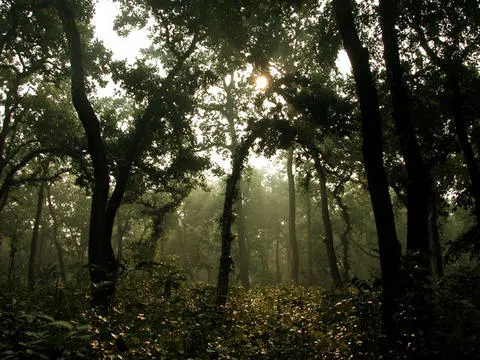
Walk through a sal forest in Chitwan or Bardiya in March or April and your feet crunch on dry brown leaves. Sal trees drop most of their leaves in these months, and new ones come within weeks. A sal forest drops several tonnes of dead leaves on every hectare each year: in a sal plantation in India’s Doon Valley, measured for a year, the leaves alone came to 8.3 tonnes per hectare.
So why isn’t the forest floor buried meters deep? Go back after the monsoon and most of those leaves have gone. They didn’t walk away. Most of what they were made of is now in the air, and some of it is already in new leaves. And the energy that the leaves caught from the sunlight is gone for good, as heat. This topic follows both: the stuff a leaf is made of, which goes round and round, and the energy, which passes through once.
Two rules: energy flows, matter cycles
You learned in Grade 9 how food passes along a food chain, from producers to primary, secondary and tertiary consumers, each one a trophic level Grade 9: Food chain, how the chains join into a food web Grade 9: Food web, and how decomposers, bacteria and fungi, break down the dead Grade 9: Biotic components. You also met the rough rule that only about a tenth of the energy at one level reaches the next.
This topic goes further, with numbers. It rests on two rules that every ecosystem obeys.
- Energy flows through, once. It comes in as sunlight, passes from level to level in food, and at every step most of it leaves as heat. Heat can’t be turned back into food, so energy is never used twice. An ecosystem needs new sunlight every day.
- Matter goes round and round. The atoms in food, carbon, hydrogen, oxygen, nitrogen and the rest, are never used up and never destroyed. They pass from the air and soil into plants, into animals, into decomposers, and back to the air and soil, to be used again.
Both rules are the laws of conservation you already know. Energy is never destroyed: all the sunlight’s energy that plants catch is still there at the end, but as heat, spread out and given off into space. Atoms are never destroyed in chemistry either: a carbon atom stays a carbon atom, whatever molecule it is in. The difference is that heat is no use to a plant, while a carbon atom is as good as new.
A dead chital in a sal forest is eaten by vultures, then the rest by bacteria and fungi. What happens to its energy and its carbon?
Pick an answer to see why.
Where the energy goes
Inside one animal
Why does only a small part of the energy pass up the chain? Look inside one animal. Scientists measure an animal’s energy budget: how much energy it takes in with its food, and where that energy goes. In 1986, two American biologists worked out the budget of eastern tent caterpillars, which eat the leaves of cherry trees. For every 100 kJ of leaves the caterpillars ate:
- 50.2 kJ came out in their droppings. Half the food was never digested.
- 34.5 kJ was used in respiration, to move, chew and build, and ended up as heat.
- 12.8 kJ became new caterpillar body and eggs.
- 2.7 kJ went into silk for their tents and the skins they shed as they grew.
The energy in droppings is not wasted for the ecosystem: it feeds dung beetles and decomposers. But it is lost to the next level of this chain. And the energy used in respiration is lost to everyone: it becomes heat.
Caterpillars are good at turning food into body. Warm-blooded animals are much worse, because they burn a large part of their food just to keep warm. Measurements on many animals show that birds and mammals turn only about 2% of the energy they absorb into new body; insects, fish and other cold-blooded animals about 20%, ten times as much (some insects even more).
From level to level
Put all the animals of one level together and you can ask: of the energy taken in by one level, what fraction does the next level take in? This fraction is the transfer efficiency (or ecological efficiency) between the two levels:
In real ecosystems it is usually between about 5% and 20%. A study of 48 water ecosystems around the world, in 1995, found an average close to 10%: the ten per cent rule you met in Grade 9. It is a rough average, not a law of nature.
Why is a food chain rarely longer than four or five links?
Pick an answer to see why.
Pyramids of energy and mass
If you draw each level as a bar as wide as its energy, the bars make a pyramid of energy. One of the first ecosystems ever measured this way was Silver Springs, a clear, spring-fed river in Florida, USA, studied by the American ecologist Howard Odum in the early 1950s.
A pyramid of biomass shows the mass of living things at each level at one moment, often as dry mass, or as the mass of carbon in them. In a forest or a grassland it looks like the pyramid of energy: tonnes of trees and grass, much less deer, very little tiger. But in the sea it is upside down. There is about five times as much carbon in the ocean’s animals and other consumers as in all its producers.
How can a small mass of producers feed a mass of consumers five times bigger? Because the sea’s producers are tiny phytoplankton that live for only days. They grow and divide so fast, and are eaten so fast, that a small crop at any moment adds up to a huge amount of food over a year. Think of a small tea stall that serves hundreds of cups a day: at any moment there are only a few cups on the counter, but the stall makes far more tea in a day than the counter could ever hold.
A pyramid of numbers counts the individuals. It can be upside down too: one sal tree can feed thousands of caterpillars, beetles and other insects, and they feed hundreds of birds. But a pyramid of energy can never be upside down. Each level can only get its energy from the level below, and some is always lost as heat on the way, so each bar must be narrower than the one under it.
In a pond, the mass of zooplankton (tiny animals) at one moment is greater than the mass of the phytoplankton they eat. Which statement is true?
Pick an answer to see why.
Following the atoms
Now follow the matter. Where did the leaf’s material come from in the first place? The answer surprised the first person who measured it.
In photosynthesis, a plant uses the energy of sunlight to join carbon dioxide and water into sugar, and gives out oxygen:
In respiration, every living thing, plants included, does the opposite: it uses oxygen to break sugar down to carbon dioxide and water, and gets the energy back (Respiration: what goes in, what comes out). Count the atoms on each side of photosynthesis:
| Atom | In (6 CO₂ + 6 H₂O) | Out (C₆H₁₂O₆ + 6 O₂) |
|---|---|---|
| carbon | 6 | 6 |
| hydrogen | 12 | 12 |
| oxygen | 12 + 6 = 18 | 6 + 12 = 18 |
No atom is made or lost. Photosynthesis puts carbon, hydrogen and oxygen into sugar; respiration takes them out again. That is why the two together make a cycle.
Not only carbon
The same goes for every element in a living thing. Here is where the main ones go round in a sal forest.
| Atom | From | Into living things by | Back by |
|---|---|---|---|
| carbon | carbon dioxide in the air | photosynthesis | respiration of plants, animals and decomposers (and fire) |
| hydrogen | water | photosynthesis (water is split) | respiration (water is made), and the water in breath, sweat and urine |
| oxygen | carbon dioxide and water | photosynthesis; oxygen gas in breathing | photosynthesis gives oxygen gas out; respiration gives water and carbon dioxide |
| nitrogen | nitrates and ammonium in the soil | roots take them up, to build proteins and DNA | decomposers turn the nitrogen in dead matter and dung back into ammonium |
Plants and animals can’t use the nitrogen gas that is 78% of the air: bacteria in the soil and in the root nodules of beans and other legumes turn it into compounds that plants can use, and other bacteria turn some back into nitrogen gas (Where the nitrogen comes from). So nitrogen goes round too, through the soil and the air.
Decomposers finish the job
The last step of every cycle is the decomposers. A fallen sal leaf is first chewed by termites, millipedes and earthworms, then eaten from inside by fungi and bacteria, which respire most of its carbon away as carbon dioxide. What they don’t respire becomes humus, the dark, slowly rotting matter in soil, which can last for decades or centuries. Where there is no oxygen, as in a flooded paddy, a different team of microbes does the job more slowly and gives out methane (Matter and energy without oxygen).
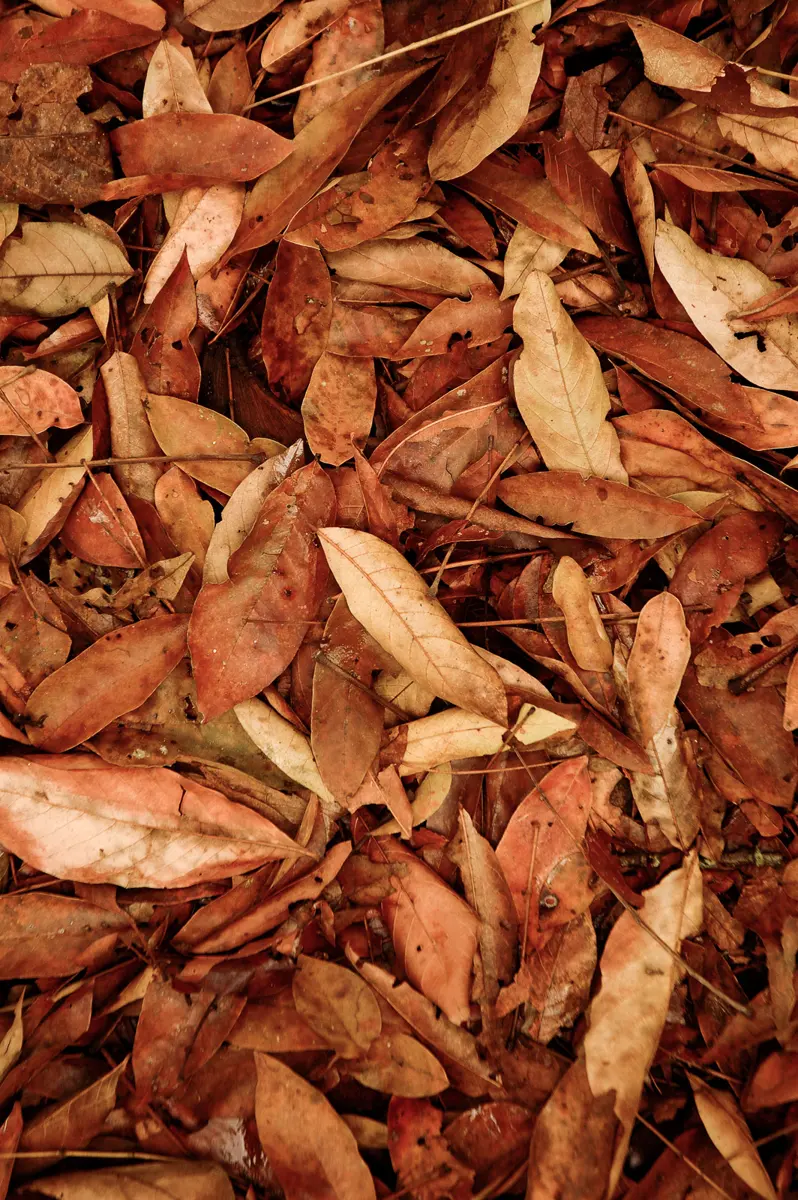
How fast does it happen? At Hetauda, in Makwanpur, foresters put weighed leaves of five tree species into net bags on the forest floor and weighed what was left over a year. Sal leaves were the slowest: after a year they had lost 54% of their mass. Leaves of sindure (Mallotus), the fastest, had lost 73%. Tough, leathery leaves rot slowly; soft ones fast.
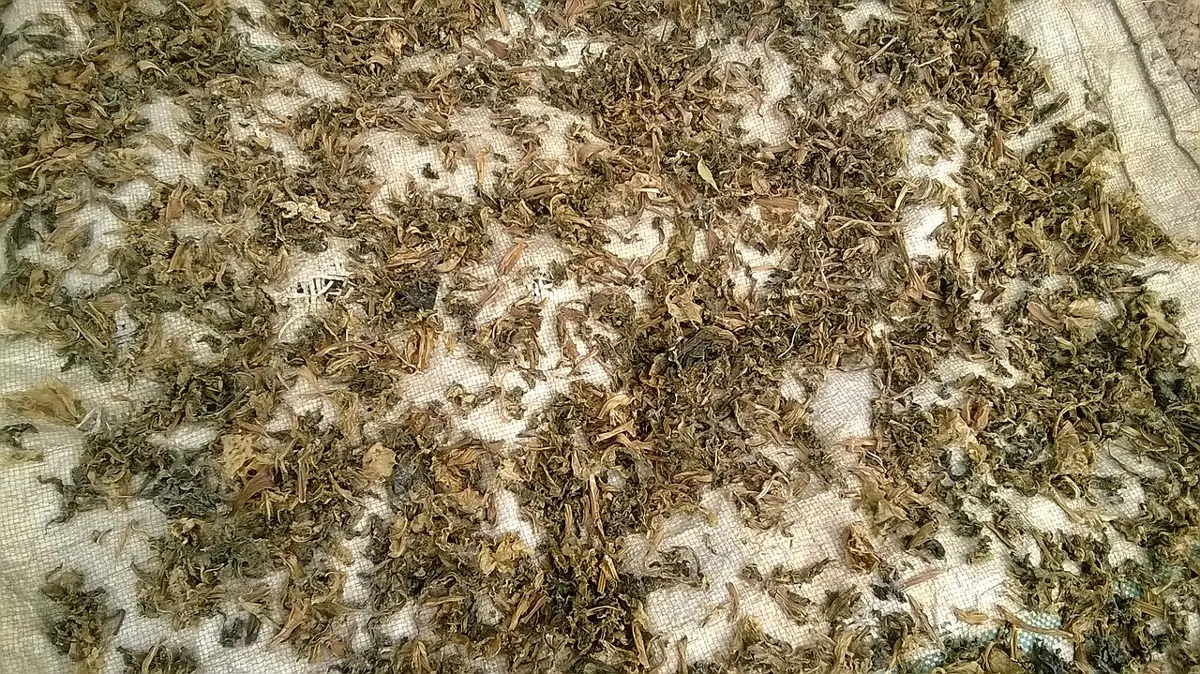
Decomposers need water, warmth and oxygen. Take those away and decay stops, which is how people have always kept food. Gundruk is made by letting chopped mustard, radish or cauliflower leaves ferment in a closed jar for a week or so: bacteria turn some of their sugar into acid, and the sour, airless jar keeps decomposers out. Then the leaves are dried in the sun. Dry and sour, gundruk keeps for months. A compost heap does the opposite: kept moist, warm and turned to let air in, it helps decomposers turn kitchen waste into crumbly compost in a few months.
A farmer in the hills buries one bag of dry sal leaves in moist soil and another in a dry, sandy spot. After six months, the leaves in moist soil have lost much more mass. Where did most of the lost mass go?
Pick an answer to see why.
The carbon cycle
A carbon atom in a fallen sal leaf can go almost anywhere: into the air, into a new leaf, into a chital, into the sea, into rock. Scientists picture the carbon cycle as a set of stores (or reservoirs), places where carbon is held, linked by flows (or fluxes), the amounts that move between them each year. Stores are measured in billions of tonnes of carbon; flows in billions of tonnes a year.
Look at the two biggest arrows on land. Every year photosynthesis takes about 109 billion tonnes of carbon out of the air, and respiration (of plants, animals and decomposers) and fires put back about 107. In the sea, the water takes in about 61 and gives back 60. These flows are nearly equal, and so for thousands of years before 1750 the carbon dioxide in the air stayed between about 260 and 285 parts per million (ppm), as air bubbles trapped in the Antarctic ice show. The cycle was in balance.
The slow part of the cycle is in the rocks. A little carbon each year sinks to the sea floor in shells and dead plankton, and over millions of years becomes limestone. Plants buried in swamps millions of years ago became coal, and plankton buried in the sea became oil and gas. Volcanoes return a tiny 0.1 billion tonnes a year. Burning fossil fuels has opened a fast road from the rocks to the air: about 10 billion tonnes of carbon a year (38 billion tonnes of carbon dioxide in 2025), a hundred times what volcanoes give out. That is why the carbon dioxide in the air has risen, and why it is warming the Earth Grade 10: The greenhouse effect.
How long does carbon stay?
If you know a store and the flows out of it, you can work out how long, on average, an atom stays in it, its residence time:
It is like the students in a school: if a school has 1,000 students and 100 leave each year, a student stays 1,000 ÷ 100 = 10 years on average.
In the widget, an atom usually goes back and forth between the air, plants and soil many times before it reaches the deep sea. Why?
Pick an answer to see why.
The Earth breathes
In 1958 an American chemist, Charles David Keeling, began measuring the carbon dioxide in the air at an observatory high on Mauna Loa, a volcano in Hawaii, far from cities and forests. Within a few years he saw two things. The amount rose every year: the line you saw in Grade 10. And every year it went down and up, like breathing.
At Mauna Loa the carbon dioxide is highest in May and lowest in September. Most of the world’s land, and so most of its forests and fields, is in the northern half of the Earth. In the northern summer they photosynthesize fast and take in more carbon dioxide than all living things are giving out. In autumn the leaves fall; through the winter, photosynthesis almost stops, but decomposers keep breaking down the fallen leaves and respiring. So the carbon dioxide rises again, until the new leaves of spring take over. You are watching the two biggest flows of the carbon cycle, photosynthesis and respiration, take turns.
Investigate: how fast do leaves disappear?
Questions
Which of these can be upside down (narrower at the bottom than the top)?
Pick an answer to see why.
The carbon dioxide in the air was nearly constant for thousands of years before 1750. This shows that
Pick an answer to see why.
Explain why energy can’t be recycled in an ecosystem, while carbon can.
Answer
Energy is conserved, but at every step of a food chain most of it is turned into heat by respiration. Heat spreads out into the surroundings and is given off into space. Plants can’t use heat to make food; they need light. So energy passes through an ecosystem once, and new sunlight is needed all the time.
Carbon atoms are not changed by any of these processes: they only change partners. A carbon atom breathed out in carbon dioxide by a fungus is exactly as useful to a plant as any other, and can be taken in by photosynthesis again. So carbon cycles.
In a Terai grassland, the grass takes in 25,000 kJ of energy per square meter in a year. Rabbits and grasshoppers take in 2,500 kJ of it; the snakes, birds and foxes that eat them take in 200 kJ. (The numbers are made up, but typical.)
- i.Work out the transfer efficiency at each step.
- ii.Using the second efficiency, how much energy would reach an eagle that ate the snakes?
- iii.Draw the pyramid of energy roughly to scale.
Answer
- i.Grass to plant-eaters: 2,500 ÷ 25,000 × 100% = 10%. Plant-eaters to meat-eaters: 200 ÷ 2,500 × 100% = 8%.
- ii.8% of 200 kJ = 0.08 × 200 = 16 kJ per square meter per year.
- iii.Four bars, each centered over the one below, with widths in the ratio 25,000 : 2,500 : 200 : 16. If the bottom bar is 10 cm wide, the others are 1 cm, 0.8 mm and about 0.06 mm (a line).
A villager burns 10 kg of dry sal wood for cooking. Dry wood is about 50% carbon.
- i.What mass of carbon dioxide does the fire give out?
- ii.If the wood had been left on the forest floor to rot, where would the carbon have gone, and where would the energy have gone?
- iii.A student says “burning wood adds carbon to the air, but rotting doesn’t.” Use your answers to correct the student.
Answer
- i.Carbon: 50% of 10 kg = 5 kg. CO₂: 5 × 44/12 = 18.3 kg.
- ii.Decomposers would have respired it: the carbon would have gone into the air as carbon dioxide (with some staying a while in the soil as humus), and the energy would have been released as heat in the soil, more slowly.
- iii.Both put the wood’s carbon back into the air as carbon dioxide; rotting is just slower, taking years instead of minutes, and keeps a little in the soil. Either way the carbon came from the air when the tree grew, so burning or rotting wood from a forest that regrows only returns carbon the trees took in. (Burning wood faster than the forest regrows does add carbon to the air overall, just as burning fossil fuels does.)
Draw a model of the carbon cycle with four stores: air, land plants, soil, and the sea. Draw and label the flows between them, and mark which flows are photosynthesis and which are respiration. Then use your model to predict what would happen to the carbon dioxide in the air if
- i.all the decomposers in the world suddenly stopped working;
- ii.a large area of forest were cut down and burned.
Answer
The model: air → land plants (photosynthesis); land plants → air (respiration); land plants → soil (dead leaves, wood, roots; dung of animals that ate them); soil → air (respiration of decomposers, and of the animals in the soil); air → sea (carbon dioxide dissolving); sea → air (carbon dioxide coming out); in the sea, sea life takes carbon in by photosynthesis and gives it back by respiration.
- i.The flow from soil to air would stop, while photosynthesis went on. The carbon dioxide in the air would fall year by year, and dead matter would pile up on the ground. (In the end the plants would starve for carbon dioxide and for the minerals locked in the dead matter.)
- ii.Burning would move the trees’ carbon into the air quickly, so the carbon dioxide would rise; and with fewer trees, less would be taken in by photosynthesis each year. (If the forest grew back, it would slowly take the carbon in again.)
The world’s soils hold about 1,950 billion tonnes of carbon (the middle of the range), and about 55 billion tonnes leave them each year.
- i.What is the residence time of carbon in soil?
- ii.Why do soils in cold or waterlogged places, like peat bogs and the frozen soils of the far north, hold far more carbon for their area than soils in warm, dry places?
Answer
- i.1,950 ÷ 55 = about 35 years on average (some carbon stays only months, some, in humus, for centuries).
- ii.Decomposers work slowly where it is cold, and slowly without oxygen, as in waterlogged ground. Dead plants keep falling, but they rot slower than they arrive, so dead matter builds up for thousands of years. In warm, airy soils decomposers break it down almost as fast as it falls.
A food chain in a pond is phytoplankton → zooplankton → small fish → kingfisher. Explain, with numbers, why a pond can support many small fish but only one or two kingfishers.
Answer
At each step only about 10% (5–20%) of the energy taken in by one level is taken in by the next; the rest is used in respiration and lost as heat, or passes to decomposers in droppings and uneaten parts. If the phytoplankton take in 100,000 kJ in a year, the zooplankton get about 10,000 kJ, the small fish about 1,000 kJ and the kingfishers only about 100 kJ. The kingfishers have a hundredth of the energy the small fish have, and each kingfisher is a large, warm-blooded bird that burns a lot of energy, so the pond’s energy can keep only one or two of them, who often have to feed at other ponds too.
Look at the Mauna Loa graph in the widget. A student says, “The carbon dioxide in the air falls in summer because people burn less fuel.” Give two pieces of evidence against this, and the real explanation.
Answer
Evidence: (1) the carbon dioxide doesn’t just rise more slowly in summer, it falls, by about 6.8 ppm at Mauna Loa from May to September. Burning less fuel could only slow the rise: even if people stopped burning fuel completely every summer, the carbon dioxide would stop rising, not fall. Something must be taking carbon out of the air, and a lot: if the whole atmosphere swung like Mauna Loa’s air, about 14 billion tonnes in four months, more than all the fuel people burn in a whole year (about 10 billion tonnes). (2) In the southern half of the Earth, where there is much less land, the swing is much smaller (about 1 ppm in New Zealand), though people there burn fuel too. (Also, the swing was there in Keeling’s first measurements in 1958, when the yearly rise was much smaller.)
The real explanation: in the northern summer the land plants of the north photosynthesize fast and take in more carbon dioxide than living things give out; in autumn and winter photosynthesis slows while respiration, especially by decomposers, goes on, and the carbon dioxide rises again.
Where to go next
- Can Life Run Without Oxygen? How decomposers and other microbes get energy where there is no oxygen, in pond mud and paddy fields, and why they give out methane.
- How Many Tigers Can Chitwan Hold? The energy that reaches the top of a food chain sets a limit on how many animals can live there: carrying capacity, in numbers.
- Where Does the Carbon Go? The carbon cycle of the whole Earth: how much of the carbon we release ends up in the sea and on land, and what it does to them.