

Francis Halzen
born 1944 in Belgium
A particle physicist who had the idea in the 1980s and then led the teams that built it, for more than thirty years.
Hold up your thumb. Every second, about 65 billion tiny particles from the Sun pass straight through your thumbnail. They pass through you at night too, after going right through the Earth. You never feel them, and almost none of them touches a single atom of you on the way.
They are neutrinos. They are so hard to catch that a detector for them must be enormous. In 2026 the Nobel Prize in Physics went to Francis Halzen, who had the idea of catching them in the ice at the South Pole, and led the building of the IceCube Neutrino Observatory: a cubic kilometer of ice watched by 5,160 light sensors.
The problem: messengers that get lost on the way
For thousands of years, everything we knew about the stars came from light: first what our eyes could see, later radio waves, X-rays and gamma rays.
But space also sends us particles. In 1912 an Austrian scientist, Victor Hess, carried instruments up in a balloon and found that something from space was striking the air all the time. These particles are called cosmic rays. Most of them are protons, the nuclei of hydrogen atoms Grade 9: Structure of an atom. A few carry an astonishing amount of energy: up to a million times more than the most powerful machines on Earth can give a particle.
Something out there must speed them up. What it is, and where it is, is one of the oldest puzzles in astronomy. We can’t simply look back along a cosmic ray’s path, because:
- protons are charged, and the magnetic fields in space bend their paths, again and again. By the time a proton reaches us, it is coming from a different direction, and we can’t tell where it started;
- light and gamma rays are made at the same places, but clouds of dust and gas can block them, and over very long distances the highest-energy gamma rays are used up on the way.
Why neutrinos?
A neutrino has no electric charge and almost no mass. Neutrinos are made in nuclear reactions: in the Sun’s core, where hydrogen nuclei join to make helium (nuclear fusion, Nuclear fusion), in radioactive decay, and wherever fast protons smash into other particles.
Because it has no charge, a neutrino is not bent by magnetic fields. Because it hardly ever touches anything, dust and gas can’t stop it. So a neutrino comes straight from where it was made, even from the other side of the universe. The places that speed up cosmic rays should also make high-energy neutrinos. Catch those neutrinos, and they point back to the answer.
The same property makes them almost impossible to catch. A neutrino from the Sun could pass through a light-year of lead, nearly ten million million kilometers, with a good chance of touching nothing Grade 9: Light-year.
Why does a neutrino point back to where it was made, when a proton from space does not?
Pick an answer to see why.
How to see a ghost
Very rarely, a neutrino does hit the nucleus of an atom. The crash makes new charged particles, which shoot on in almost the same direction as the neutrino. One of them, the muon, a heavy cousin of the electron, can travel for kilometers through ice.
Light travels more slowly in ice than in empty space: about 1.31 times more slowly Grade 10: Refraction of light. A very fast muon goes faster than light can travel in the ice (never faster than light in empty space). When that happens, the ice gives out a faint blue glow along the muon’s path, in a cone, like the V-shaped wave behind a fast boat on a lake. This glow is called Cherenkov light.
Place light sensors all through a huge block of clear ice, and from when each sensor sees the glow you can work out which way the muon went, and so where the neutrino came from. The brighter the glow, the more energy the neutrino had.
That needs three things:
- a huge volume, because high-energy neutrinos from space are so rare: a cubic kilometer of ice catches only about a hundred in a year;
- darkness, so the sensors see only the glow;
- very clear material, so the glow travels far enough to reach the sensors.
Why it was so hard
The idea of using water to catch neutrinos is from around 1960. But where do you find a cubic kilometer of clear, dark water, and how do you put thousands of sensors into it? A team called DUMAND spent years trying in the deep ocean off Hawaii, where the sea is hard to work in and sea creatures give off light of their own. It ended in 1995.
The South Pole has the opposite problems. It is the coldest place on Earth, reachable only by aircraft, and only in the short summer from November to February. For the rest of the year it is too cold for aircraft to fly there. And no one knew how clear the ice was, deep down.
What he did, step by step
1. The idea (1988)
Francis Halzen was born in 1944 in Tienen, in Belgium, studied physics in Leuven, and moved to the University of Wisconsin–Madison in the United States, where he still works. He studied particles from space.
In the 1980s he heard that Soviet scientists planned to listen for neutrinos in Antarctica with radio receivers. He thought: why not look for the light from neutrinos in the ice instead? Ice is solid water, and glacier ice, deep down, should be dark, pure and still. With John Learned, who worked on DUMAND, he presented the idea at a conference in Poland in 1988. The South Pole had extra advantages: a research station already there, solid ice to work on, few radioactive substances in the ice, no living things giving off light, and no earthquakes.
2. AMANDA: learning to drill and listen (1993–2000)
Scientists from many countries joined Halzen. Glaciologists, who study ice, showed them how to make holes more than a kilometer deep with hot water: a drill like a giant shower head melts its way down, and a cable of sensors is lowered into the hole before the water freezes again. Each sensor, Halzen says, is “a light bulb in reverse”: it turns light into an electrical signal.
After a test in Greenland, the team began a smaller detector at the South Pole, AMANDA. On Christmas Eve 1993, Halzen sat at the dinner table with his computer on his lap, waiting for the message that the first cable was in the ice.
The first results were a disappointment. The upper ice was full of tiny air bubbles, which scattered the light in all directions, like the cloudy middle of an ice cube from the freezer. So they went deeper. Below about 1,400 meters the pressure has squeezed the bubbles away, and the ice turned out to be clearer than anyone had expected: light could travel a couple of hundred meters through it. AMANDA was finished in January 2000. It worked, but it was too small to catch the rare neutrinos from deep space.
3. IceCube: a cubic kilometer (2004–2011)
Halzen led the proposal for something a thousand times bigger: IceCube. Construction began in 2004.
- Teams drilled 86 holes, each about 2.5 kilometers deep, in a six-sided pattern 125 meters apart.
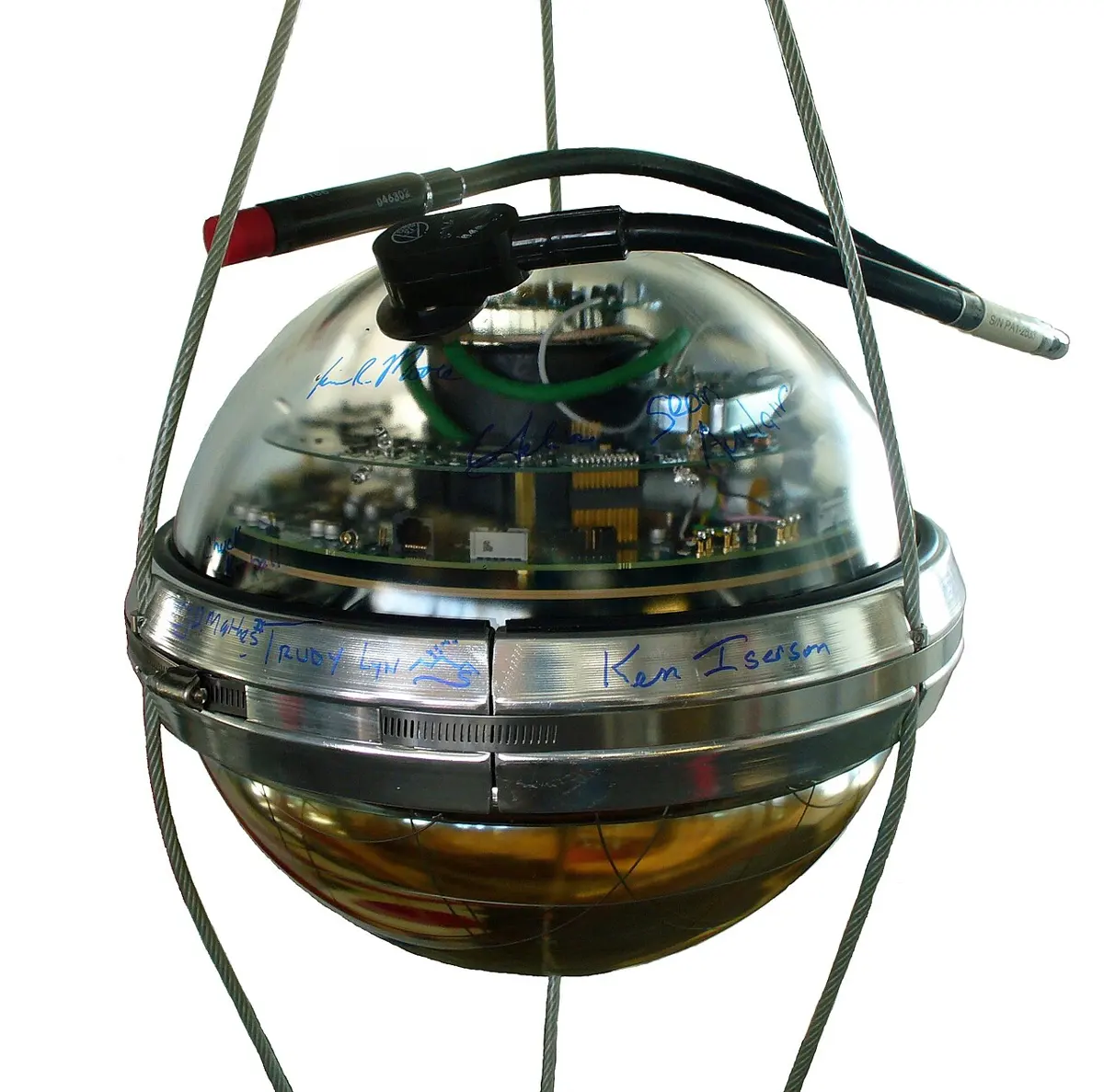
- Down each hole went a cable carrying 60 light sensors, 17 meters apart, between 1,450 and 2,450 meters below the surface.
- Each sensor is a glass ball about a third of a meter across, holding a light detector so sensitive it can notice a single particle of light.
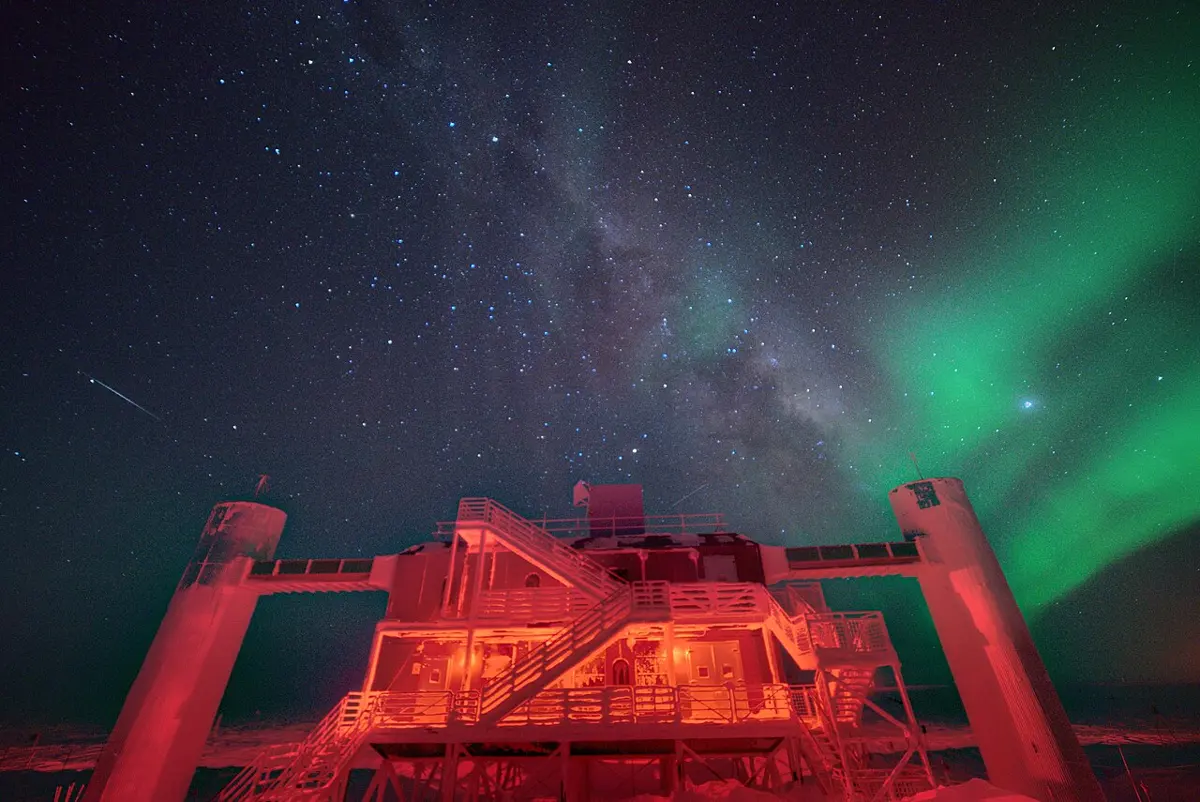
- All the drilling had to be done in the short summers. Building took seven years, to 2010, and the finished IceCube has watched the sky since 2011, more than 99 % of the time.
4. The discovery (2013)
Most of what IceCube sees is not from deep space. Every day more than 100 million muons made by cosmic rays hitting the air above Antarctica rain down through the ice. And neutrinos made in the Earth’s own air arrive all the time. The team had to find the rare neutrinos from deep space among them.
Two tricks help:
- Look down. Muons from the air can’t get through the whole Earth, but neutrinos can. So a muon traveling upwards through the ice must have been made by a neutrino.
- Start inside. A glow that starts in the middle of the ice, with nothing coming in from outside, must be a neutrino hitting a nucleus there.
In 2013, searching through the first two years of data, the team found two neutrinos with far more energy than any made in the Earth’s air. The team nicknamed them Bert and Ernie, after two puppets on a children’s television show. Then they found 28 in all in the same data, and by 2014 they were sure: these neutrinos came from far outside our solar system. Astronomy with high-energy neutrinos had begun.
How it works now: where do they come from?
IceCube keeps watching, and sends out an alert within a minute when it sees a neutrino likely to have come from deep space, so that telescopes around the world can look in that direction.
- A blazar (2017). On 22 September 2017 IceCube caught a high-energy neutrino from the direction of TXS 0506+056, a blazar: a galaxy with a giant black hole at its center, shooting a jet of matter almost straight at us. The galaxy was flaring brightly in gamma rays at the time.
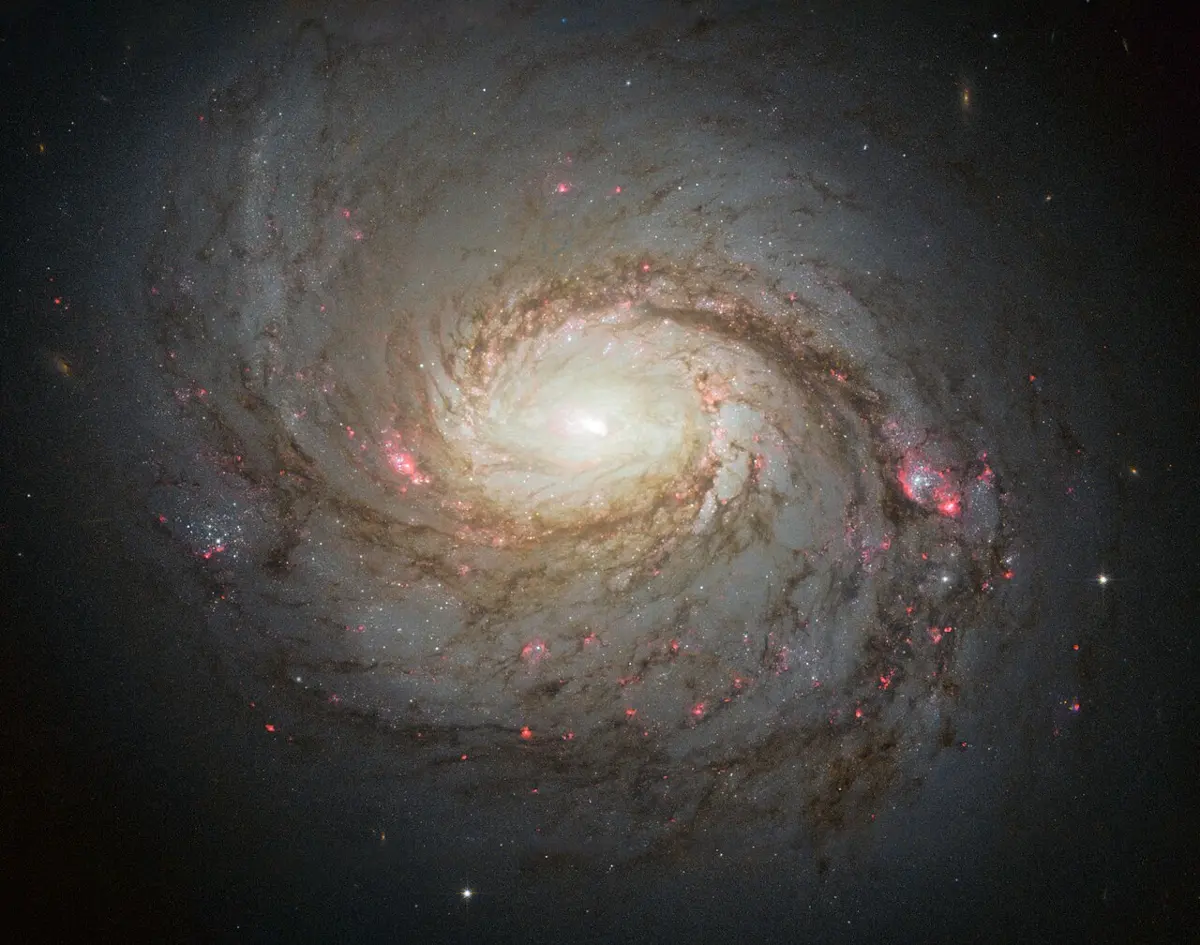
- A hidden galaxy (2022). IceCube found 79 neutrinos coming from the direction of the galaxy NGC 1068 (also called Messier 77), 46 million light-years away. Its center is a giant black hole wrapped in thick dust and gas. Light from the center is mostly blocked, but neutrinos get out. The evidence is strong but, as of October 2026, not yet certain.
- Our own galaxy (2023). IceCube saw high-energy neutrinos from the band of the Milky Way Grade 10: Our galaxy, probably made when cosmic rays hit the thin gas between the stars.
What can a neutrino tell astronomers that light from the same galaxy may not?
Pick an answer to see why.
In your life today
- Neutrinos from the Sun pass through you every second, day and night. They are a message from the Sun’s core, made by the same fusion that gives us sunlight (A message from the core).
- A new way of seeing. Just as X-rays showed the inside of the body, neutrinos let astronomers look into the hearts of galaxies. About 450 scientists in 14 countries work on IceCube (as of 2025), and its results are shared with everyone.
What came next
- More detectors are being built in water: KM3NeT in the Mediterranean Sea and another in Lake Baikal in Russia. In 2025 KM3NeT reported a single neutrino with about 20 times the energy of the highest seen by IceCube.
- IceCube grows. New cables with better sensors are being added in the middle of IceCube, and a much bigger IceCube-Gen2, eight cubic kilometers of ice, is being planned.
- The open question. What, exactly, speeds up the most energetic cosmic rays: giant black holes, exploding stars, or something no one has thought of yet? As of October 2026 no one is sure.
In your science books
- Grade 9: the structure of an atom (protons and nuclei), nuclear fusion (where the Sun’s neutrinos come from), supernovae and the light-year.
- Grade 10: refraction of light (why light is slower in ice) and our galaxy, the Milky Way.
- Going further: beta decay and the neutrino and a message from the Sun’s core.
Learn more
- The Nobel Prize’s own explanation: Ice at the South Pole reveals cosmic particle accelerators (nobelprize.org).
- The IceCube Neutrino Observatory’s own website, with news of its latest results.
The official reason
The prize was given “for decisive contributions to the IceCube Neutrino Observatory and the discovery of high-energy neutrinos of astrophysical origin.”