
Light and electrons: the most exact theory
Nobel Prize in Physics, 1965: Sin-Itiro Tomonaga, Julian Schwinger, and Richard Feynman

Sin-Itiro Tomonaga
1906–1979, born in Tokyo, Japan
He did much of his prize-winning work in wartime Tokyo, cut off from the rest of the world’s physicists.
Photo: Shigeru Tamura, Public domain
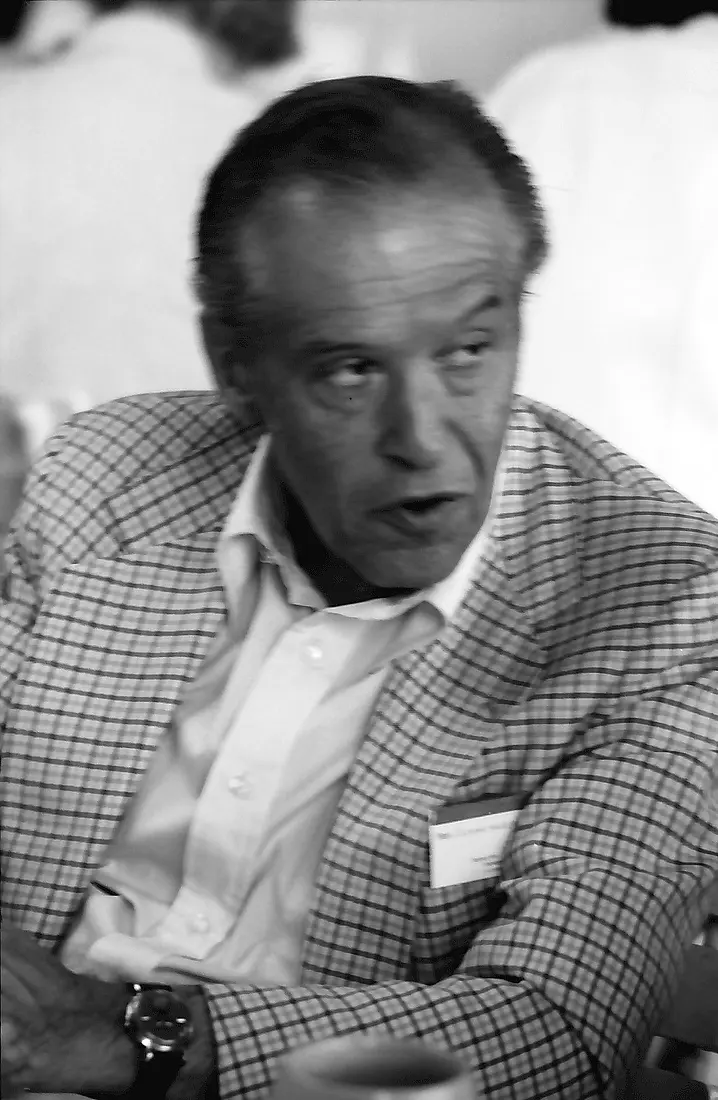
Julian Schwinger
1918–1994, born in New York, United States
He published his first physics paper at sixteen, and liked to work at night, alone.
Photo: Willy Pragher, CC BY 4.0
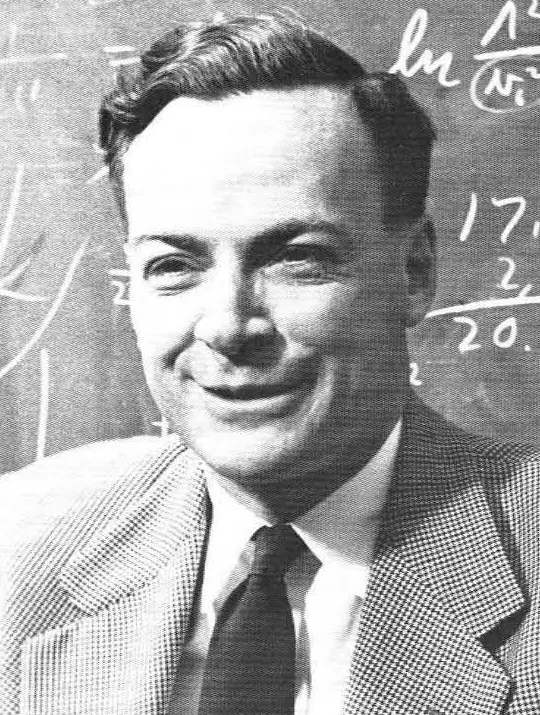
Richard Feynman
1918–1988, born in New York, United States
He turned pages of hard mathematics into little drawings that physicists everywhere now use.
Photo: Unknown author, Public domain
The glow of your phone screen, the red of a rhododendron, the spark of static when you take off a sweater: all of these are electrons and light acting on each other. Even when you press on a table, it is electrons in your hand pushing on electrons in the wood.
The theory that describes how electrons and light act on each other is called quantum electrodynamics, or QED for short. In the 1930s, whenever physicists asked it a precise question, the answer came out infinite. In the late 1940s three physicists, working separately, fixed it. Their theory now agrees with experiments to about ten digits, better than any other theory in science. In 1965 Sin-Itiro Tomonaga, Julian Schwinger and Richard Feynman shared the Nobel Prize in Physics.
The problem: answers that came out infinite
By 1930 physicists had two great ideas.
- Quantum mechanics (from 1925) explained electrons in atoms. An electron in an atom can only have certain fixed amounts of energy, called energy levels or shells Grade 9: Shells and their energy. When it drops from a higher level to a lower one, it gives out the difference as a tiny packet of light, a photon.
- Einstein’s relativity explained how things behave when they move close to the speed of light.
Around 1928–1930, Paul Dirac, Werner Heisenberg and Wolfgang Pauli joined these ideas with the laws of electricity, magnetism and light. The result was the first quantum electrodynamics. It worked very well, as long as you only asked for a rough answer.
But when they tried to be more exact, something went badly wrong. They asked: how much does an electron’s own electric field add to its mass? The answer came out infinite. The same thing happened for the electron’s charge. An electron clearly has a mass you can measure (about 9 × 10⁻³¹ kg), so a theory that says “infinity” is broken somewhere. For almost twenty years nobody could find where.
In the 1930s, what was wrong with quantum electrodynamics?
Pick an answer to see why.
How light and electrons act on each other
Photons are messengers
Two electrons repel each other: both are negative (Two kinds of charge). But how does one electron “know” the other is there, across empty space? In QED, the push is carried by photons. One electron gives out a photon and the other takes it in, like two people on skateboards throwing a heavy ball between them: each throw and each catch pushes them apart.
Every electron carries a cloud
Here is the strange part. An electron doesn’t only pass photons to other electrons. It also gives out photons and takes them back again itself, all the time, so every electron travels surrounded by a cloud of short-lived photons (right-hand drawing in Figure 1). For very short moments the cloud can even hold pairs of electrons and positrons (anti-electrons, with positive charge) that appear and disappear again.
This cloud changes the electron a little: its mass, its charge, how strong a magnet it is. But when physicists added up the cloud’s effect, with photons of every possible energy, the sum grew without end. That was the infinity.
Two tiny surprises in 1947
Two experiments in 1947 showed that the cloud was real, and measured what it does.
The Lamb shift
The simplest atom is hydrogen: one proton with one electron. Dirac’s theory said that two of hydrogen’s energy levels, called 2s and 2p (two of the subshells you meet in Grade 10, Shells, subshells and orbitals), should have exactly the same energy.
At Columbia University in New York, Willis Lamb and his student Robert Retherford tested this with microwaves, the same kind of waves used in radar during the war and in microwave ovens today Grade 9: Microwaves. They found that the two levels were not the same: the 2s level was very slightly higher. The difference matched microwaves of about 1,000 million waves per second (1,000 MHz). It is tiny, about a millionth of the energy that holds the electron in the atom, but clearly there: the Lamb shift.
The electron’s magnet
Every electron is also a tiny magnet. Dirac’s theory gave an exact value for how strong a magnet it is. In 1947–1948, also at Columbia, Polykarp Kusch and Henry Foley measured it and found it slightly stronger: about 1.001 19 times Dirac’s value.
Lamb’s result was the talk of a small meeting of American physicists at Shelter Island, near New York, in June 1947, where early hints about the electron’s magnet were discussed too. Everyone there guessed the reason: the cloud of photons around the electron. Dirac’s theory had left the cloud out. Now someone had to calculate its effect properly, without getting infinity.
(Lamb and Kusch shared the Nobel Prize in Physics in 1955 for these two measurements.)
Why it was hard: hiding the infinity
The trick that saved QED is called renormalization. The idea behind it is simpler than the mathematics.
Nobody has ever seen an electron without its cloud. The electron can’t switch its cloud off. So the mass you measure for an electron, 9 × 10⁻³¹ kg, is already the mass of the electron together with its cloud. The theory had been working out the mass of a “bare” electron and then adding the cloud on top, as if they were two separate things. Both parts were infinite, but nobody ever measures either one on its own.
So the fix is: write the measured mass and charge into the equations, and never ask about the bare electron at all. When this is done carefully, the infinite parts cancel, and what is left are small, finite answers that can be checked.
Think of finding how much taller you are than your sister. You could measure each of you from the center of the Earth, 6,400 km down, and subtract. Or you could stand back to back on the same floor: the huge distance to the center of the Earth is the same for both of you, so it cancels. The Lamb shift is a difference like this, the gap between two levels. The huge part is the same for both, and only the small difference is left.
What made it hard was doing this in a way that agrees with relativity at every step. In earlier attempts, a small slip in the bookkeeping left an infinity behind.
What they did, step by step
Three people found the answer, by three different routes.
Tomonaga: in wartime Tokyo
Sin-Itiro Tomonaga studied at Kyoto, in the same class as Hideki Yukawa (Physics prize, 1949), and worked with Heisenberg in Germany from 1937 to 1939.
- 1942–1943, the groundwork. In wartime Tokyo he rewrote quantum electrodynamics so that it agreed with relativity at every step. He published it in 1943, in Japanese, so almost nobody outside Japan saw it; an English version came out in 1946. (He was also set to work on radar, on the magnetron, the part that makes microwaves, also found in microwave ovens.)
- 1947–1948, the answer. In a ruined, hungry Tokyo after the war, he and his students went back to an older calculation that had failed, and found it had left out one term. With it put back, and the measured mass and charge written in, the infinities canceled. Their Lamb shift agreed with Lamb’s measurement.
- 1948, he sent his results to the American physicist Robert Oppenheimer, who had them published in America. Physicists there were surprised to learn that, cut off by the war, Tomonaga had reached many of the same ideas first.
Schwinger: the electron’s magnet
Julian Schwinger was a prodigy. He grew up in New York, wrote his first physics paper at sixteen, and finished his PhD at Columbia in 1939. During the war he worked on radar at the MIT Radiation Laboratory.
- 1947, as a young professor at Harvard, he heard about the Lamb shift at Shelter Island, and set to work.
- Late 1947, the magnet. Using renormalization, he calculated how much the cloud strengthens the electron’s magnet. His answer: Dirac’s value times 1.001 16. Kusch had measured 1.001 19. They agreed to within the experiment’s error. He published it in 1948.
- 1948–1949, he wrote out the whole theory, powerful but so long and careful that few could follow all of it.
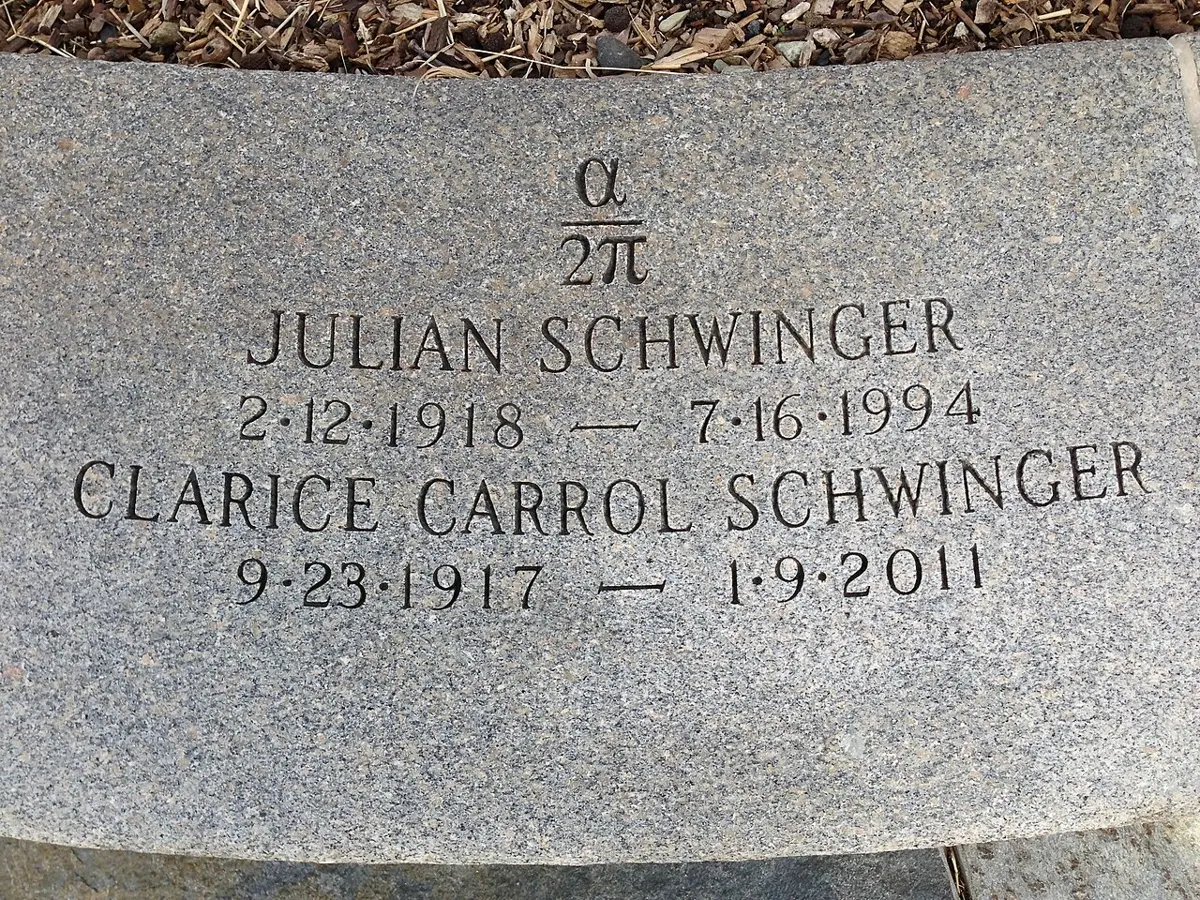
His result is written in symbols as α/2π, where α (the Greek letter alpha) is the number that measures how strongly electrons and light act on each other, about 1/137. It is carved on his gravestone.
Feynman: the pictures
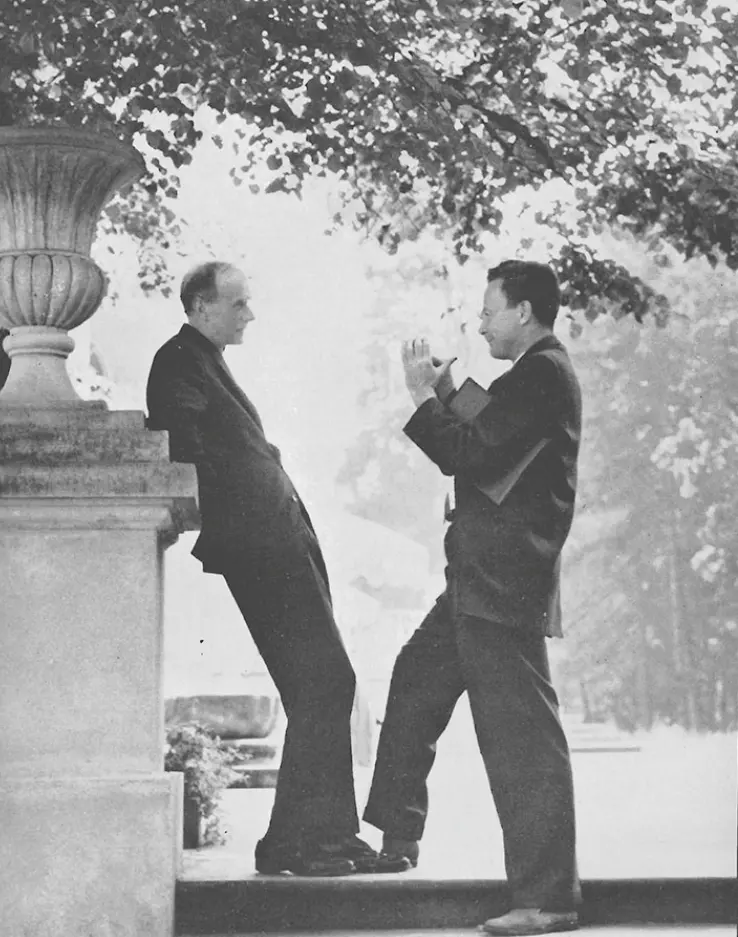
Richard Feynman also grew up in New York (the same year as Schwinger), studied at MIT and Princeton, and worked during the war on the atomic bomb at Los Alamos. He then went to Cornell University.
- 1947–1948, a new way of thinking. Feynman pictured an electron going from one place to another by trying every possible path at once, and he added up all the paths. Instead of long equations, he drew little pictures like those in Figure 1: a straight line for an electron, a wavy line for a photon. Each picture stands for one piece of the calculation, and he had rules for turning each picture into a number.
- Spring 1948, not understood. At a meeting in the Pocono mountains, Schwinger spoke for most of the day, with long mathematics that impressed everyone. Then Feynman showed his drawings, and nobody could see how he got his answers.
- 1949, the papers. He published his method. With his pictures, a calculation that took others months could be done in days.
How it works now: drawing to calculate
Physicists still calculate with Feynman diagrams. To work out how strong the electron’s magnet is, for example:
- Draw the simplest picture: an electron, with no cloud. That gives Dirac’s value, exactly 1.
- Add every picture with one extra photon in it (like the right-hand drawing in Figure 1). That gives Schwinger’s α/2π, about 0.001 16.
- Add every picture with two extra photons or pairs. Each extra photon makes a picture’s part hundreds of times smaller (because α is about 1/137), so these add only about a millionth.
- Keep going: three, four, five extra photons, each step adding smaller digits. There are 12,672 pictures with five extra photons; computers added up the last of them in the 2010s.
In 2023 a team at Northwestern University in the United States, holding a single electron in a trap for months, measured its magnet as 1.001 159 652 18 times Dirac’s value. QED’s calculation agrees to better than one part in a billion. Feynman liked to say that this is like measuring the distance from Los Angeles to New York, about 4,000 km, to within the thickness of a human hair.
In a Feynman diagram, what does a wavy line stand for?
Pick an answer to see why.
In your life today
- Chemistry and color. Every chemical reaction, from cooking dal to a burning candle, is electrons moving between atoms, and the colors of dyes, flowers and fireworks come from electrons jumping between energy levels. QED is the theory behind all of it, though a chemist rarely needs its tiniest corrections.
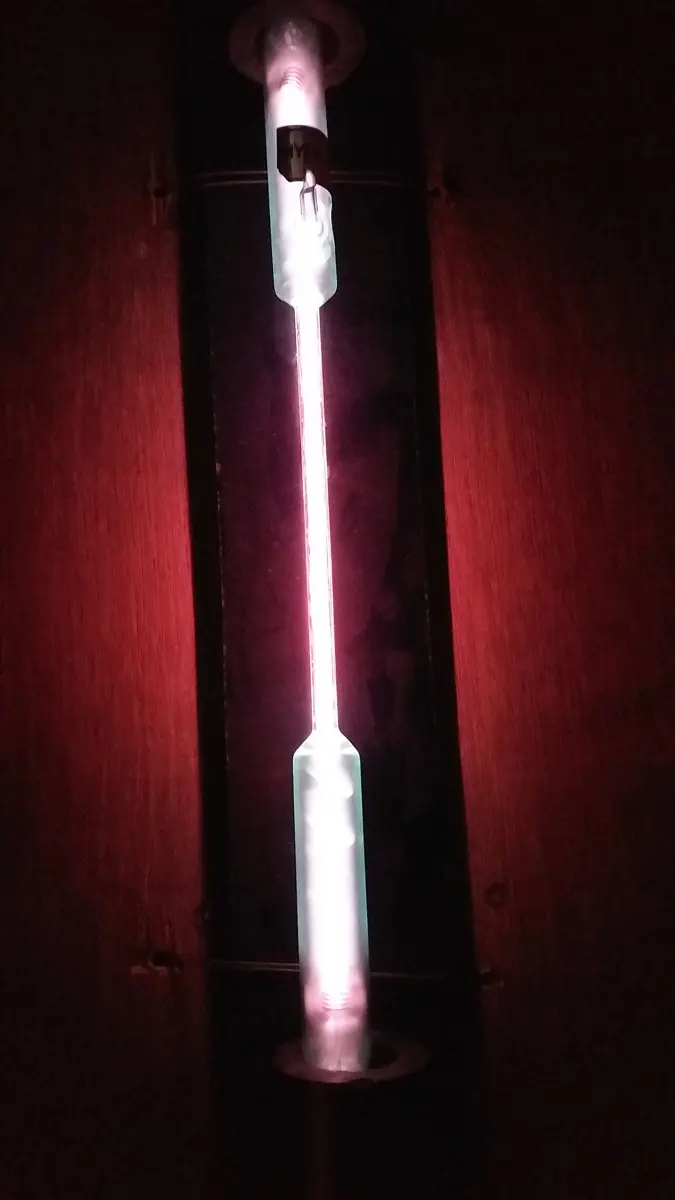
- Light from atoms. Each element gives out its own colors of light, its “barcode” (Why each element has its own lines). The most exact measurements of them, in hydrogen above all, are checked against QED.
- Atomic clocks. The clocks in GPS satellites, which let your phone’s map find where you are, keep time by the energy levels of atoms, measured with microwaves, just as Lamb did.
- Particle physics. At CERN, near Geneva, physicists use Feynman diagrams every day to work out what should come out when particles collide.
What came next
- The other forces. QED was the model for the theories of the other forces. In the 1960s the weak force was joined with electromagnetism, using the same kind of mathematics (Two forces that turned out to be one). Then came the theory of the strong force, which holds the nucleus together.
- The muon’s magnet. The muon is a heavier cousin of the electron. For twenty years its magnet seemed slightly stronger than theory said, and physicists hoped it was a sign of new, unknown particles. In 2025 the final measurement, at Fermilab in the United States, was published along with a new and better calculation, and the two now agree. The hope of a crack in the theory has, for now, gone.
- Why 1/137? QED uses the number α, about 1/137, but it can’t explain why α has that value. Nobody can. Feynman called it one of the greatest mysteries of physics.
- Gravity. When physicists try the same trick on gravity, the infinities don’t cancel. A quantum theory of gravity is still one of the biggest open problems in physics.
In your science books
- Grade 8: the electron and the structure of an atom.
- Grade 9: shells and their energy, the electromagnetic spectrum and microwaves.
- Grade 10: shells, subshells and orbitals, where the 2s and 2p levels of the Lamb shift come from.
- Going further: two kinds of charge, Einstein’s packets of light and why each element has its own lines.
Learn more
- The Swedish Academy’s presentation speech (nobelprize.org).
- The Nobel lectures: Tomonaga, Schwinger and Feynman, whose lecture tells the story of how he came to his ideas.
- Feynman’s own short book for everyone, QED: The Strange Theory of Light and Matter (1985).
The official reason
The prize was given “for their fundamental work in quantum electrodynamics, with deep-ploughing consequences for the physics of elementary particles.”