
Optogenetics: a light switch for the brain
Nobel Prize in Physiology or Medicine, 2026: Karl Deisseroth, Peter Hegemann, and Georg Nagel

Karl Deisseroth
born 1971 in the United States
A doctor for illnesses of the mind who wanted to understand his patients’ brains, and needed a better tool to do it.
Photo: Cmichel67, CC BY-SA 4.0

Peter Hegemann
born 1954 in Germany
A biologist who spent years asking one curious question: how does a tiny alga see light so fast?
Photo: Millencolin, CC BY-SA 4.0

Georg Nagel
born 1953 in Germany
An expert in measuring the tiny electric currents of proteins, who showed what the alga’s protein really does.
Photo: Millencolin, CC0
Fill a glass jar with green water from a pond and leave it by a window. After a while the water on the side facing the light is greener than the rest. Some of the tiny living things in it have swum towards the light.
One of them is a green alga called Chlamydomonas. A scientist in Germany wanted to know how it sees the light. His curiosity led, twenty years later, to a way of switching nerve cells in the brain on and off with flashes of light. It is called optogenetics, and it has changed how scientists study the brain. In 2026 the Nobel Prize in Physiology or Medicine went to Peter Hegemann, Georg Nagel and Karl Deisseroth.
The problem: a brain you can’t switch
Your brain weighs about 1.3 kg, about as much as a big papaya. It holds close to 90 billion nerve cells (neurons), and each one is joined to thousands of others Grade 9: Neuron or nerve cell. A nerve cell sends a message as a tiny, very fast electrical signal, the nerve impulse. Your memories, your fears, your hunger and every movement you make come from these signals.
In the 20th century, scientists learned a lot about which part of the brain does which job: the cerebrum for thinking, the cerebellum for balance, and so on Grade 9: The brain. But their tools were blunt.
- They could listen to nerve cells with fine wires. But if a cell fires while a mouse is afraid, does that cell cause the fear, or does it just happen at the same time?
- They could damage a small part of an animal’s brain and see what changed. But that part held many different kinds of nerve cells, all mixed together.
- They could poke the brain with a tiny electric current. But the current spreads, and it switches on every cell near the wire.
What they really wanted was a switch: a way to turn on just one kind of nerve cell, at exactly the moment they chose, and leave all its neighbors alone. Then they could see what that kind of cell really does.
Francis Crick, who had helped discover the shape of DNA, wrote about this dream in 1979. Twenty years later he suggested that the best signal for such a switch would be light: it is fast, and it can be turned on and off in a moment. But how could light switch on a nerve cell? Nerve cells in the brain don’t react to light at all. Crick himself called the idea far-fetched.
Scientists could already switch on nerve cells with a small electric current through a wire. Why wasn’t that good enough?
Pick an answer to see why.
An alga that sees
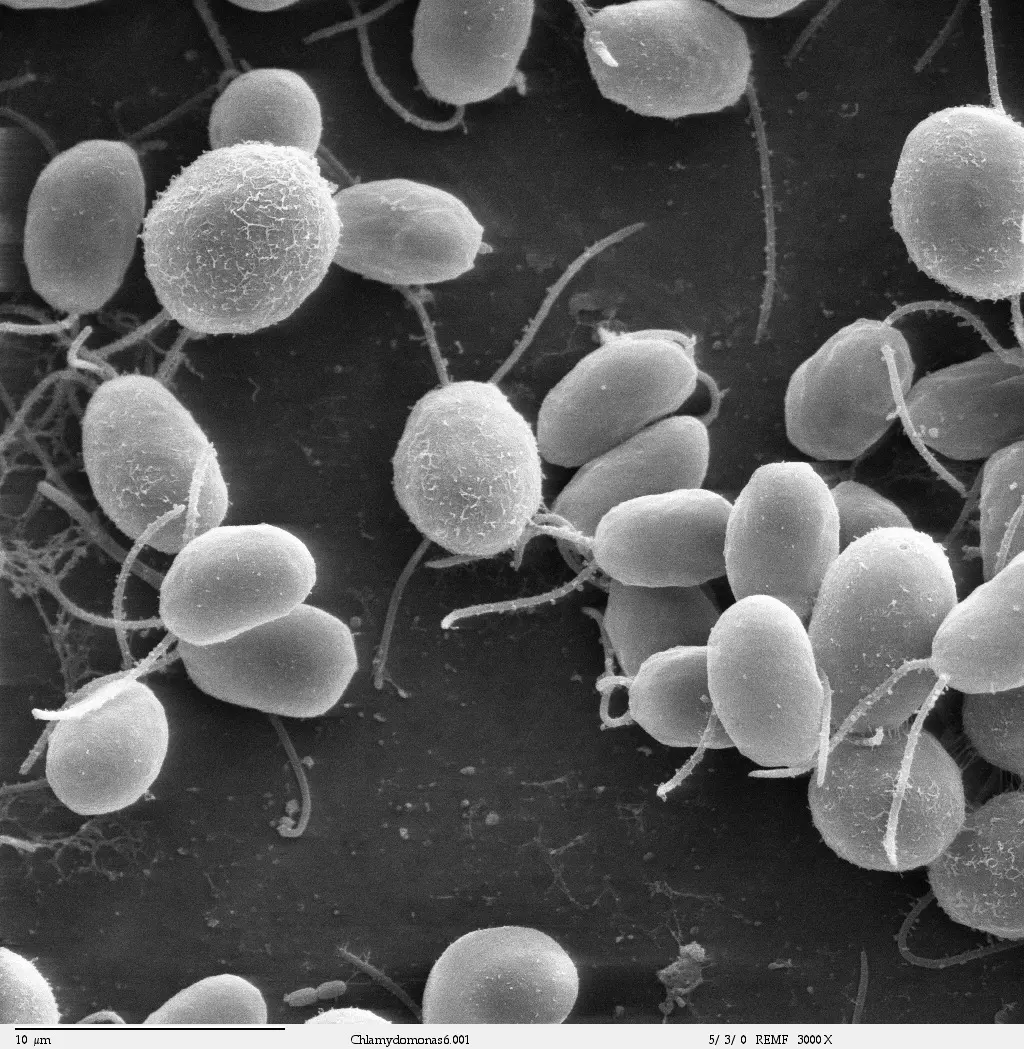
Chlamydomonas is a single green cell, about 0.015 mm long, that lives in ponds and wet soil all over the world. You may meet it in your Grade 10 book among the algae Grade 10: Algae. It swims by beating two flagella, thin hair-like threads at its front, like a swimmer doing breaststroke.
It makes its food by photosynthesis, so it needs light. To find light, it has an eyespot: a tiny orange spot on the side of the cell. When light falls on the eyespot, the cell steers towards the light.
How does your own eye see? In the retina at the back of your eye, light is caught by a molecule called retinal, which is made from vitamin A. Retinal sits inside a protein. When light hits it, a long chain of chemical steps follows, one after another, and only at the end of the chain does an electrical signal start. All those steps take at least 10 thousandths of a second (10 milliseconds).
The alga’s eyespot also uses retinal. But in the early 1990s Peter Hegemann, at a research institute near Munich, measured the electrical signal in Chlamydomonas and found it started far faster: in less than a thousandth of a second, more than twenty times faster than in our eyes.
There wasn’t time for a long chain of steps. So Hegemann made a bold guess: in the alga, one single protein catches the light and is itself the channel. Light hits it, it opens, and that’s all.
Many scientists doubted him. They knew of plenty of channels in cells, but none that opened by itself when light hit it.
How a channel makes an electrical signal
To see why a light-opened channel matters so much, you need to know how a cell makes an electrical signal.
Every cell is wrapped in a thin skin, the cell membrane Grade 8: The covering of the cell. On each side of it the water is full of ions: atoms that carry an electric charge because they have lost or gained electrons, such as sodium ions (Na⁺) and potassium ions (K⁺) Grade 9: Ion. Ions can’t pass through the membrane on their own. A resting nerve cell keeps a small voltage across its membrane, with the inside negative.
Here and there, the membrane has ion channels: proteins with a tunnel through the middle, like a gate in a wall. When a channel opens, ions rush through it. Positive ions flowing into a nerve cell make its inside less negative. If enough of them flow in, the cell fires: a nerve impulse races along it to the next cells.
So a protein that opens a channel when light hits it would be exactly Crick’s switch: shine light, and positive ions flow in, and the cell fires.
In Hegemann’s idea, why was the alga’s response to light so much faster than ours?
Pick an answer to see why.
What they did, step by step
Hegemann and Nagel: finding the protein (1990s–2003)
- Years of failing. Hegemann tried to take the light-catching protein out of the alga’s eyespot to study it. Out of the cell, the proteins fell apart. For years, nothing worked.
- Around 2000, a list of genes. Scientists in Japan had read thousands of the alga’s genes and put them where everyone could see them. In this list Hegemann’s team found two genes that looked like the genes for light-catching proteins.
- Frog eggs. Hegemann sent the two genes to Georg Nagel in Frankfurt, who had known him for years. Nagel was an expert in a useful trick: put a gene into a large frog egg cell, and the egg makes that protein and places it in its own membrane. Then you can measure, with fine electrodes, the current that flows through it.
- 2002, the first channel. The first protein worked just as Hegemann had guessed: when green light shone on the frog eggs, a channel opened and ions flowed through. The team named it channelrhodopsin-1.
- 2003, the second, better one. Channelrhodopsin-2 opened in blue light, within 0.2 milliseconds, and let positive ions such as sodium flow in. Nagel and Hegemann put it into human and hamster kidney cells too, and those cells also made an electric signal when light hit them. Any cell, it seemed, could be made light-sensitive. In their paper, they suggested channelrhodopsin-2 could be used to make cells fire with light.
Deisseroth: putting the switch into nerve cells (2004–2007)
Karl Deisseroth trained as a doctor at Stanford University in the United States. Working with patients in a psychiatric clinic (a hospital for illnesses of the mind, such as depression and schizophrenia), he saw how much they suffered, and how little the medicines helped. To find better treatments, he thought, doctors first had to understand how the brain’s circuits work. He went looking for a switch for nerve cells.
- 2004, the gene arrives. When Deisseroth read about channelrhodopsin-2, he wrote to Nagel and asked for the gene. Nagel sent it.
- 2005, nerve cells fire on command. Deisseroth’s team, with Nagel, put the gene into rat nerve cells growing in a dish. Deisseroth had worried that the nerve cells would be harmed by a protein from an alga, but they made channelrhodopsin-2 without any trouble. Each short flash of blue light made a nerve cell fire once. Flash ten times a second, and it fired ten times a second. Even better, the nerve cells already had enough retinal of their own, so nothing else had to be added.
- 2006, a name. Deisseroth and other scientists called the new method optogenetics: “opto” for light, and “genetics” because a gene carries the switch into the cells.
- 2007, in a living mouse. The team used a harmless virus to carry the gene into one kind of nerve cell in the part of a mouse’s brain that controls movement. Through a tiny hole in the skull they slid in a thin optical fiber, a glass thread that carries light Grade 10: Optical fiber. When they sent blue light down the fiber, the mouse’s whiskers moved.
The trick that makes optogenetics so precise is the gene. Scientists can attach the channelrhodopsin gene to a short piece of DNA that only works in one kind of nerve cell. Then only that kind makes the switch. The light may fall on thousands of cells, but only the chosen ones fire.
What optogenetics has shown
Since 2005, thousands of laboratories around the world have used optogenetics. A few examples:
- Waking up. In 2007 Deisseroth and Luis de Lecea switched on one small group of nerve cells in sleeping mice. The mice woke up. Those cells could wake an animal on their own.
- A memory you can switch on. In 2012, with Susumu Tonegawa, Deisseroth helped mark the nerve cells that stored a frightening memory in a mouse: a cage where it had felt a small electric shock. Later, in a safe cage, they shone light on just those cells. The mouse froze in fear: it was remembering (Two kinds of memory).
- One job, one circuit. Looking after babies seems like one behavior. Optogenetics showed that in mice, different groups of nerve cells control different parts of it: one makes a parent gather its young into the nest, another makes it groom (clean) them.
- Heart and mind. Deisseroth’s team made a mouse’s heart beat faster with light, and the mouse became more anxious. A racing heart doesn’t just follow fear: it can feed it.
A mouse’s motor nerve cells contain channelrhodopsin-2. Its whiskers twitch when blue light shines through an optical fiber. What happens if the scientists shine red light instead?
Pick an answer to see why.
In your life today
Optogenetics is still mostly a tool for research: as of October 2026 it isn’t a treatment you can get in a hospital. But it is already helping in three ways.
- Understanding illness. It has shown which circuits go wrong in depression, anxiety, addiction and Parkinson’s disease, in animals. Better medicines and treatments start from that.
- Seeing again. In retinitis pigmentosa, an illness that runs in families, the light-catching cells of the retina slowly die, but the other nerve cells of the retina live on. In 2021 doctors and scientists in France and Switzerland put a gene for a channelrhodopsin from another alga into the eye of a blind man. With special goggles that turned what a camera saw into pulses of bright amber light, he could find, touch and count objects on a table, which he couldn’t do before. As of October 2026, more trials are going on.
- Hearing. A cochlear implant gives some hearing to deaf people by stimulating the hearing nerve with electric currents. Light could be aimed more finely than electric current, so scientists are working on implants that use light instead.
What came next
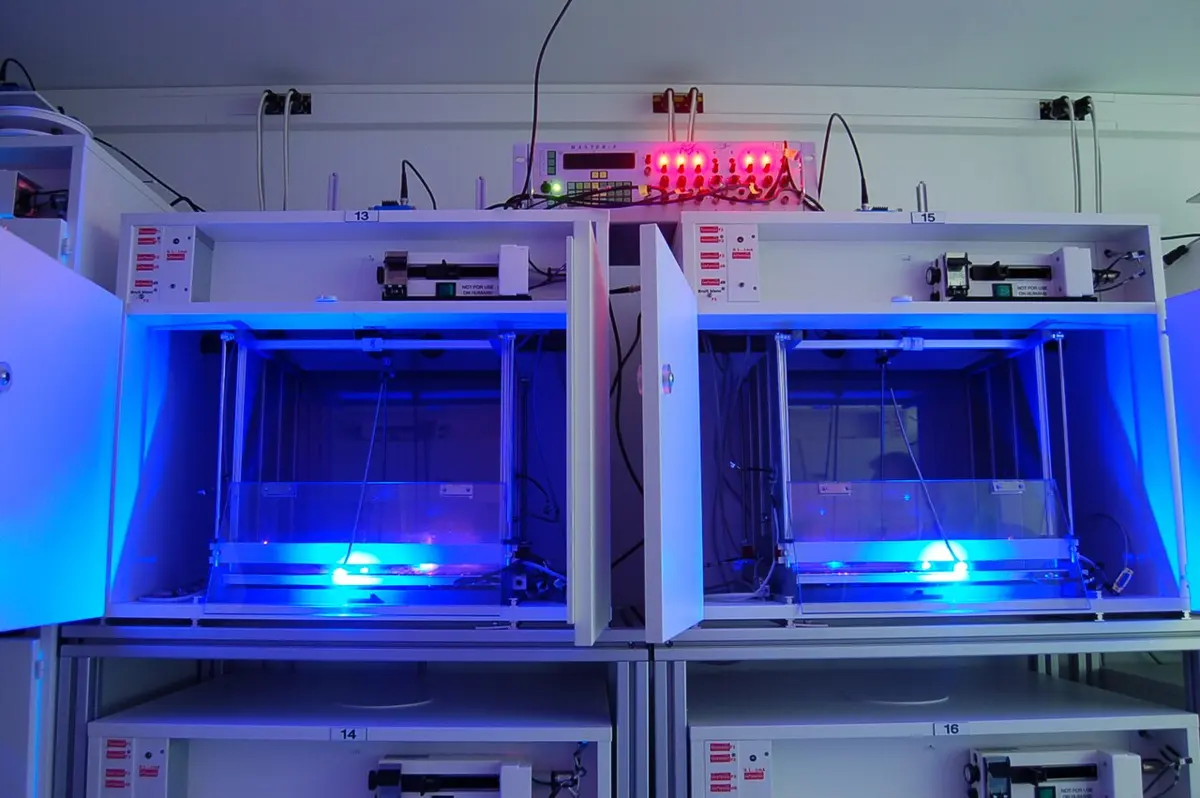
- More colors, more switches. Scientists have found or made dozens of new light-switch proteins: ones that open in red light (which goes deeper into the body), ones that switch cells off, and ones that stay open until a second flash closes them.
- Light in, light out. Other proteins glow when a nerve cell fires. With both kinds, scientists can switch cells on with one color and watch hundreds of others answer in another.
- The big question. How do 90 billion nerve cells make a single thought, a memory of your grandmother’s house, or the decision to stand up? Optogenetics lets scientists test one circuit at a time, but nobody yet knows how it all fits together.
In your science books
- Grade 8: the cell membrane.
- Grade 9: the neuron, the human nervous system and the brain; ions.
- Grade 10: algae, with Chlamydomonas; the optical fiber.
- Going further: messages along nerves and memory, and how a gene becomes a protein, copying the gene.
Learn more
- The prize at nobelprize.org: The Nobel Prize in Physiology or Medicine 2026, with the press release and the popular explanation, A light-sensitive algal protein energized neuroscience.
- For older students, the committee’s scientific background.
The official reason
The prize was given “for their discoveries concerning light-gated ion channels and optogenetics.”