
Hepatitis C: the hidden virus in the blood
Nobel Prize in Physiology or Medicine, 2020: Harvey J. Alter, Michael Houghton, and Charles M. Rice

Harvey J. Alter
born 1935 in the United States
A doctor at a hospital blood bank who noticed that many patients got sick after a transfusion, and kept asking why.
Photo: NIH/Chiachi Chang, Public domain
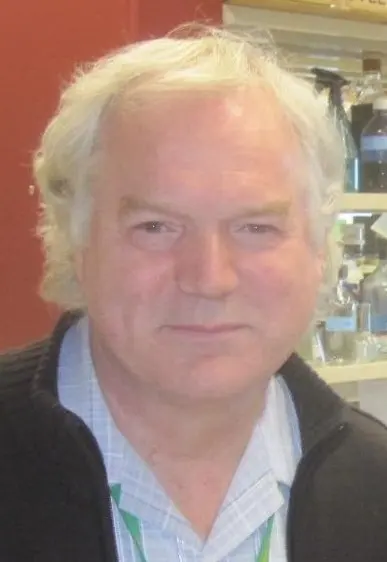
Michael Houghton
born 1949 in the United Kingdom
A company scientist who searched for the virus for seven years. He later turned down another big prize because it left out his two co-workers.
Photo: Kerry Angelo Piper, CC BY 2.0

Charles M. Rice
born 1952 in the United States
A virus expert who built the virus from its own instructions and proved that it alone causes the disease.
Photo: John Sears, CC BY-SA 4.0
After a road accident, a difficult birth or a big operation, a patient may need blood from someone else: a blood transfusion. In Nepal, people give blood at camps in schools and colleges, and on festival days, even at Pashupatinath. Before a bag of that blood reaches a patient, a laboratory tests it for several germs. One of them is the hepatitis C virus.
Fifty years ago, nobody knew this virus existed. Yet it was hiding in donated blood and making patients ill, years later, without anyone knowing why. In 2020 the Nobel Prize in Physiology or Medicine went to the three scientists who tracked it down.

The problem: sick after a transfusion
The liver is the large organ on the right side of your belly, under the ribs. It does hundreds of jobs: it stores sugar, makes bile to digest fat, and breaks down poisons such as alcohol and many medicines.
When the liver is swollen and damaged, the illness is called hepatitis (from the Greek words for “liver” and “inflammation”). A person with hepatitis may feel tired and sick, lose their appetite, and turn yellow in the skin and eyes: jaundice (कमलपित्त). Most hepatitis is caused by viruses: tiny germs, much smaller than bacteria, that can only multiply inside living cells Grade 8: Virus.
By the 1940s doctors knew there were two kinds of infectious hepatitis:
- One spreads through dirty water and food. It is now called hepatitis A. It can make a person quite ill, but they usually recover completely.
- The other spreads through blood. It is far more dangerous, because it can stay in the body for years and slowly destroy the liver. The liver becomes hard and scarred (cirrhosis), and some patients get liver cancer.
In the 1960s Baruch Blumberg found the virus behind much of the blood-borne kind, hepatitis B. A blood test for it followed, then a vaccine, and Blumberg won the Nobel Prize in 1976. Blood banks began testing donated blood for hepatitis B. Everyone expected hepatitis after transfusions to disappear.
It didn’t.
What they did, step by step
Alter: a disease without a name (1970s)
Harvey Alter worked at the blood bank of the National Institutes of Health (NIH), a large research hospital in the United States. He and his colleagues followed patients who had received blood, testing their blood again and again for months afterwards.
They found that even with hepatitis B tested out, many patients still got hepatitis after a transfusion. In 1975 they showed that most of these cases were not hepatitis A either. Some unknown germ was causing them. Doctors gave the disease a name that only said what it was not: “non-A, non-B hepatitis”.
This disease was sneaky. Most people who caught it felt nothing at first. But in many of them the germ stayed, and the liver was damaged slowly, over twenty or thirty years.
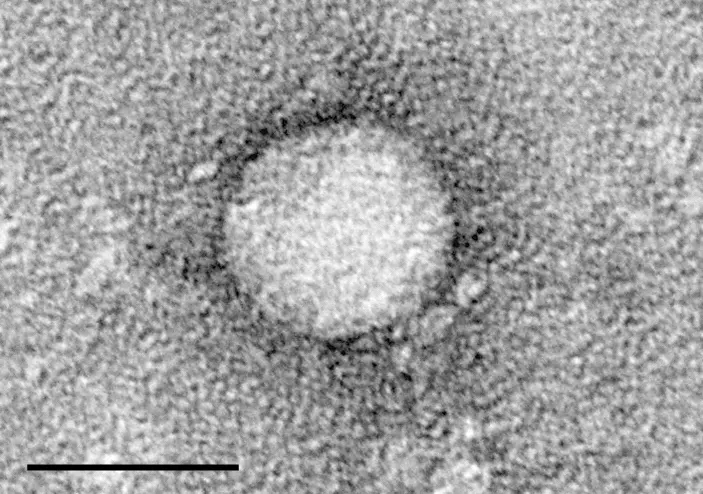
In 1978 Alter’s team showed that the disease could be passed on: blood from patients gave the same hepatitis to chimpanzees, the only animal besides humans that catches it. Further tests on the chimpanzees showed that the germ behaved like a virus: it passed through very fine filters, so it was tiny, about 30 to 60 nanometers across, and it had a fatty outer coat.
So it was a virus. But which? For more than ten years, scientists tried every usual way to find it, and failed.
Why it was so hard to find
How do you find a new virus? Usually in one of three ways:
- See it with an electron microscope. But there was very little of this virus in the blood, and nobody could pick it out.
- Grow it in cells in the laboratory. This virus refused to grow in any cells they tried.
- Catch it with antibodies. When a germ invades, some of your white blood cells make antibodies: proteins that stick to that one germ and nothing else Grade 10: White blood cells. A patient’s blood is full of antibodies against the germ that infected them. But to use them as a test, you need to have the germ first.
Why couldn’t scientists in the 1970s simply look at the new virus in a patient’s blood?
Pick an answer to see why.
Houghton: fishing with antibodies (1982–1989)
Michael Houghton, a British scientist, worked at Chiron, a medicines company in California. In 1982 he began hunting for the virus a new way: not by looking for the virus, but for its genetic material, the instructions it carries.
For years nothing worked: every piece of genetic material his team found turned out to belong to the chimpanzee, not the virus. Then Houghton and his colleagues Qui-Lim Choo and George Kuo tried a cleverer method.
- They took blood from an infected chimpanzee and copied all the genetic material in it, the chimpanzee’s and any virus’s, into short pieces of DNA.
- They put the pieces into bacteria, one piece per bacterium. Each bacterium multiplied into a little spot, a colony, and each colony read its piece and made the protein it described.
- If a piece came from the virus, its colony would be making a scrap of virus protein.
- They tested the colonies with the blood of a patient who had non-A, non-B hepatitis. The patient’s antibodies would stick to virus protein, and to nothing else.
They tested about one million colonies. One of them reacted. Its piece of DNA came from neither a chimpanzee nor a human. It was the virus.
From that one piece, the team read the rest of the virus’s instructions. It was an RNA virus, with about 10,000 letters, a relative of the viruses that cause dengue and yellow fever. They named it hepatitis C virus, and announced it in 1989. Almost at once they made a blood test that finds antibodies to it, and showed that patients with non-A, non-B hepatitis in Italy, Japan and the United States had them.
Rice: the final proof (1997)
One question was left. Patients with the hepatitis had this virus. But did the virus alone cause the disease, or did it need help from something else in the blood?
To be sure, you would need to make the virus from scratch, with nothing else at all, and show that it causes the disease. Charles Rice, at Washington University in St. Louis, set out to do exactly that.
It was harder than it sounds. When this virus copies itself, it makes many mistakes, so the virus in a patient’s blood is really a crowd of slightly different versions, and many of them are broken and can’t multiply. Rice, and Kunitada Shimotohno’s team in Tokyo, had also found a short piece at the end of the virus’s RNA that earlier copies had missed. Rice’s first tries, with copies that had the end piece, still made no virus.
So Rice built an RNA that had the end piece and, at every position, the letter that most versions of the virus had. This left out the broken versions’ mistakes. He injected this RNA, and nothing else, into the liver of chimpanzees. This time, virus appeared in their blood, and the animals developed the same liver damage as patients. The virus alone causes hepatitis C.
How it works now
A person catches hepatitis C when blood carrying the virus gets into their blood. Once inside, the virus makes its way to the liver and multiplies inside the liver cells.
What happens next differs from person to person. About three in ten people fight the virus off by themselves within six months. In the other seven, the virus stays, often for life. For many years they may feel well, but the liver is slowly scarred. After twenty or thirty years, some of them get cirrhosis or liver cancer.
Because the infection is so quiet, most people who have it don’t know. The only way to find out is a blood test. Today there are two kinds: one looks for antibodies (which show the person has met the virus), and another looks for the virus’s RNA (which shows it is still there).
And now there is a cure. In the 2010s, new medicines arrived that block the tools the virus needs to copy itself. A course of tablets for about three months cures more than 95 in every 100 patients. Before them, treatment meant a year of injections that made people feel ill and often failed.
Why is hepatitis C called a “silent” disease?
Pick an answer to see why.
In your life today
- Safe blood. From 1990, blood banks in many countries began testing donated blood for hepatitis C. In Nepal, every unit of donated blood is tested for hepatitis B and C, HIV and syphilis before it is given to a patient. In countries that test all their blood, catching hepatitis C from a transfusion has almost disappeared.
- How it still spreads. Today, most new infections come from needles and medical tools that are reused without being properly cleaned, and from people who inject drugs sharing needles. It does not spread through food, water, hugging, or sharing a plate. Insist on a new, sealed needle for any injection.
- A cure, if you know. Worldwide, about 47 million people live with hepatitis C, and about a quarter of a million die of it each year (WHO, as of 2024). Most don’t know they have it. The tablets can cure them, but only once a blood test finds them.
What came next
- Getting rid of it. Because there is a blood test and a cure, the World Health Organization has set the goal of ending hepatitis C as a public health threat by 2030. That means testing millions of people who feel well, and making the tablets cheap enough for every country.
- Medicines from the virus’s own parts. Once the virus could be grown in the laboratory (in 1999 Ralf Bartenschlager’s team in Germany got parts of its RNA to copy themselves in liver cells, and the whole virus followed in 2005), companies could test thousands of chemicals against it. That is how the tablets were found.
- The open question. Can we make a vaccine against a virus that keeps changing its coat? The same question is being asked about HIV, and the answers may help with both.
In your science books
- Grade 8: viruses and the harmful effects of microorganisms.
- Grade 10: white blood cells, which make antibodies; why a blood group must match in a transfusion; and RNA, the kind of genetic material hepatitis C carries.
Learn more
- The prize at nobelprize.org: The Nobel Prize in Physiology or Medicine 2020, with the press release that explains the discovery.
- The laureates’ Nobel lectures: Alter, Houghton and Rice.
The official reason
The prize was given “for the discovery of Hepatitis C virus.”