
IVF: the first baby started in a dish
Nobel Prize in Physiology or Medicine, 2010: Robert G. Edwards
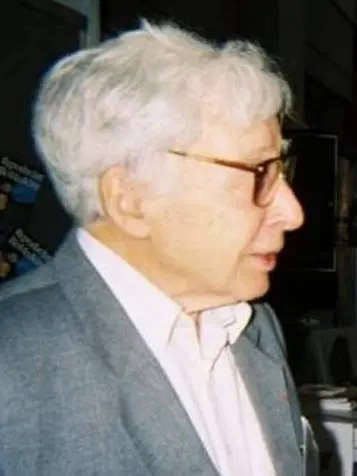
Robert G. Edwards
1925–2013, born in Britain
As a student in Edinburgh he often worked through the night, because that was when his mice released their eggs. He kept at IVF for twenty years against fierce opposition.
Photo: Susannny, CC BY-SA 4.0
On 25 July 1978, just before midnight, a baby girl was born in a hospital in Oldham, in the north of England. She weighed 2.6 kg and was perfectly healthy. Two days later her photo was on the front page of newspapers all over the world. Her name was Louise Brown, and she was the first baby ever to begin life outside her mother’s body, in a small glass dish in a laboratory.
The newspapers called her a “test-tube baby”. The method is called in vitro fertilization, or IVF (in vitro is Latin for “in glass”). Since then, at least 12 million children have been born by IVF, perhaps someone in your own school. The 2010 Nobel Prize in Physiology or Medicine went to Robert Edwards, the British scientist who spent about twenty years making it work.
The problem: when a baby doesn’t come
Many couples want children but can’t have them. A couple who have tried for a year or more without the woman becoming pregnant are said to be infertile. It is common: in 2023 the World Health Organization estimated that about one person in six, worldwide, is affected by infertility at some time in their life. In Nepal, as in many countries, a childless couple, and especially the woman, may face hard questions from relatives and neighbors, even when the cause is not hers at all.
To see where things go wrong, first see how a baby normally begins Grade 8: Fertilization in animals.
- About once a month, one of a woman’s two ovaries releases an egg. A human egg is one cell, about 0.1 mm across: just big enough to see as a dot.
- The egg is swept into a thin tube, the fallopian tube, that leads to the uterus (womb).
- If sperm from the man are there, one sperm may join with the egg in the fallopian tube. This joining is fertilization, and the new single cell is called a zygote.
- The zygote divides into 2 cells, then 4, then 8, while it drifts slowly along the tube. It is now an embryo.
- After four or five days it reaches the uterus, and at about a week old it buries itself in the soft lining. There it grows into a baby over about nine months.
Many things can stop this. The man may make too few sperm, or sperm that swim badly. The woman may not release eggs regularly. Or the fallopian tubes may be blocked, often by scars left by an old infection. Then the egg and the sperm can never meet. In the 1960s, doctors could do very little for these couples.
Where does fertilization normally happen in a woman’s body?
Pick an answer to see why.
The idea: bring the egg out
Edwards had a simple idea. If egg and sperm can’t meet inside the body, take the egg out, let it meet the sperm in a dish, and then put the early embryo back into the uterus. The blocked tube would simply be skipped.
Scientists had already done this with rabbits: rabbit eggs fertilized in a dish had grown into healthy baby rabbits. But a human is not a rabbit, and nobody knew whether it could work for people.
Why it was hard
- Getting eggs. A woman’s eggs are deep inside her body, inside the ovaries. In the early 1960s the only eggs Edwards could get were from small pieces of ovary removed during operations for other reasons. There were very few of them.
- The eggs weren’t ready. Eggs taken from an ovary are not yet mature. Inside the body, an egg finishes ripening just before it is released. In a dish, Edwards’s human eggs at first refused to ripen at all.
- The sperm weren’t ready. Sperm also change after they leave the man’s body, as they swim through the woman’s body, before they can enter an egg. Nobody knew how to make that happen in a dish.
- The embryos stopped. Even when an egg was fertilized, the embryo had to grow for a few days, in exactly the right warm liquid, without germs.
- People were against it. Many people felt that making human embryos in a laboratory was wrong. Some scientists thought it was unsafe, or that the babies might be born with defects.
What they did, step by step
Edwards: learning the timetable of an egg
Robert Edwards grew up in Yorkshire and Manchester, and served in the army in the Second World War before he went to university. As a student in Edinburgh in the early 1950s he studied how mice reproduce. He often worked at night, because that was when his mice released their eggs. It was there that the idea of fertilization outside the body first came to him.
- Late 1950s and early 1960s, London. Edwards began working with human eggs from pieces of ovary, given to him by a gynecologist (a doctor for women’s reproductive organs). He tried the timings that worked for rabbit eggs, then changed the hormones, the liquids and the times again and again. The eggs would not ripen.
- 1965, the timetable. By then based in Cambridge, he finally found the answer: human eggs simply need much longer. They took about a day and a half (Edwards measured about 37 hours) to ripen in the dish, far longer than rabbit or mouse eggs. Now he knew when an egg would be ready.
- 1968, the right liquid. His student Barry Bavister had found that hamster sperm work much better in a liquid that is slightly alkaline, the opposite of acidic, like water with a pinch of baking soda in it. Edwards tried Bavister’s liquid with human sperm and eggs.
- 1969, the first human fertilization in a dish. It worked: human eggs were fertilized outside the body for the first time. On 15 February 1969 Edwards, Bavister and Steptoe reported it in the journal Nature. Their report ended calmly: there “may be certain clinical and scientific use” for eggs fertilized this way. The newspapers were not calm at all.
Edwards and Steptoe: a window into the body
There was still a problem. Eggs that had ripened in a dish made embryos that stopped after one division. Edwards guessed that eggs which had ripened naturally, inside the ovary, would do better. But how could you collect a ripe egg without a big operation?
- 1968, a partner. Edwards read about Patrick Steptoe, a gynecologist at the hospital in Oldham, near Manchester. Steptoe used a new tool, the laparoscope: a thin tube with lenses, pushed in through a small cut near the navel, that lets a surgeon look inside the body. Through it, Steptoe could find a ripe egg on the ovary and gently suck it out with a needle.
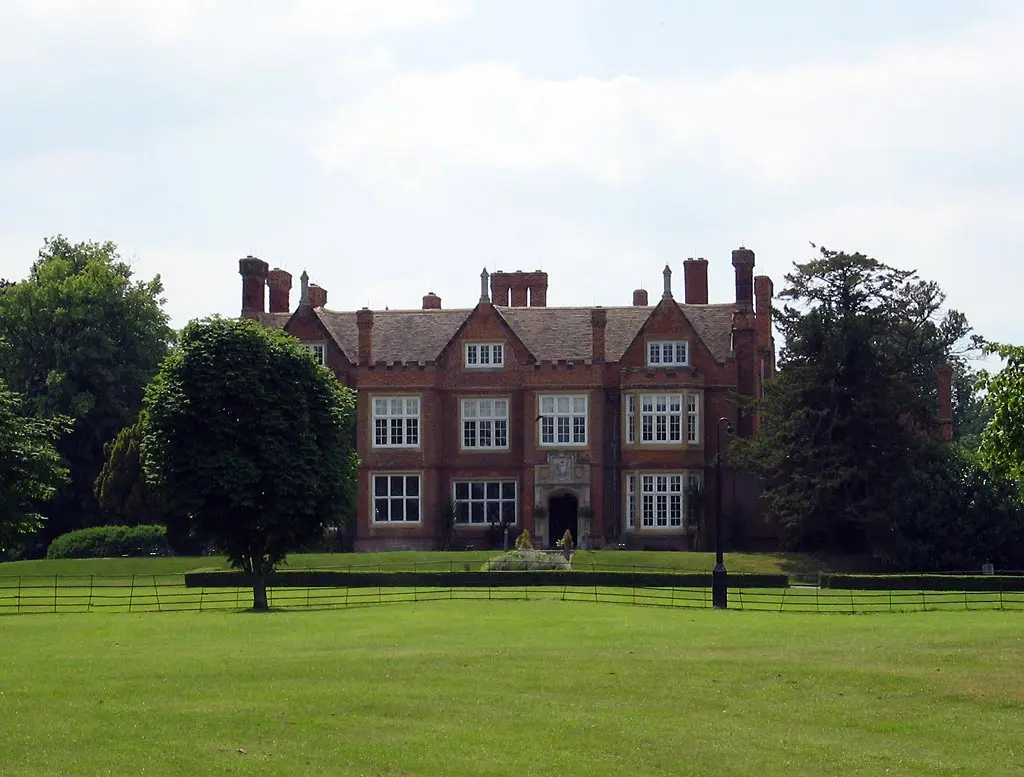
- The team. Edwards’s assistant Jean Purdy, a nurse who became an expert in the laboratory work, ran the laboratory and kept careful records. Edwards and Purdy traveled the nearly 300 km between Cambridge and Oldham again and again, for years.
- Early 1970s, real embryos. With ripe eggs from Steptoe, the fertilized eggs now divided into embryos of 8 cells and more. But in 1971 the government’s Medical Research Council refused to pay for the work. A private gift of money kept it going.
- More than a hundred failures. Steptoe put embryos back into the uteruses of women who had volunteered. For years, none of them led to a baby. The hormones given to make women produce several eggs at once seemed to be part of the problem.
- 1977, one natural egg. The team changed their plan. They gave no hormones and waited for the one egg that ripens naturally each month. By measuring the woman’s hormone levels again and again, they could tell almost exactly when it would be ready.
- November 1977, Lesley Brown. Lesley and John Brown, from Bristol, had tried for nine years to have a child. Lesley’s fallopian tubes were blocked. On 10 November 1977, Steptoe collected one egg; it was fertilized with John’s sperm, and when the embryo had 8 cells it was put into Lesley’s uterus. Jean Purdy was the first person to see it dividing.
- 25 July 1978. Louise Joy Brown was born, healthy, by cesarean section. A few months later the second IVF baby, a boy, was born in Scotland.
Before Louise Brown, the team had more than a hundred failures. What change finally worked?
Pick an answer to see why.
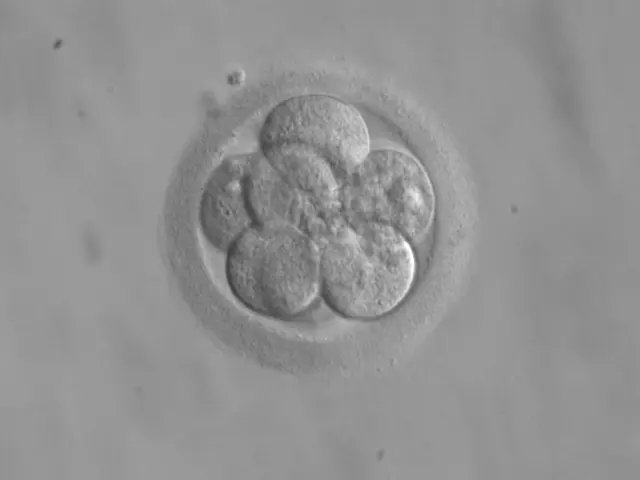
How IVF is done now
The idea is the same as in 1978, but almost every step has become easier and safer.
- Many eggs. The woman takes hormone injections for about ten days to two weeks, so that several eggs ripen at once instead of one. Doctors now know how to do this safely.
- Collecting eggs. Using ultrasound (a picture made with sound waves, the same as for checking an unborn baby) to see the ovaries, the doctor collects the eggs with a fine needle. No cut is needed.
- Fertilization. The eggs are put in a dish with the man’s sperm and kept warm at body temperature, 37 °C.
- Growing. The embryos grow for three to five days. The best one is chosen.
- Putting back. A thin, soft tube places the embryo in the uterus. Two weeks later, a test shows whether the woman is pregnant.
Two newer tricks help many more people:
- One sperm, one needle. If the man has very few sperm, or sperm that can’t swim well, a single sperm can be injected straight into the egg with a needle much thinner than a hair. This is called ICSI (intracytoplasmic sperm injection). The first baby born this way was born in Brussels, in Belgium, in 1992.
- Freezing. Spare embryos can be frozen in liquid nitrogen, at −196 °C, and used months or years later. The first baby from a frozen embryo was born in Melbourne, in Australia, in 1984.
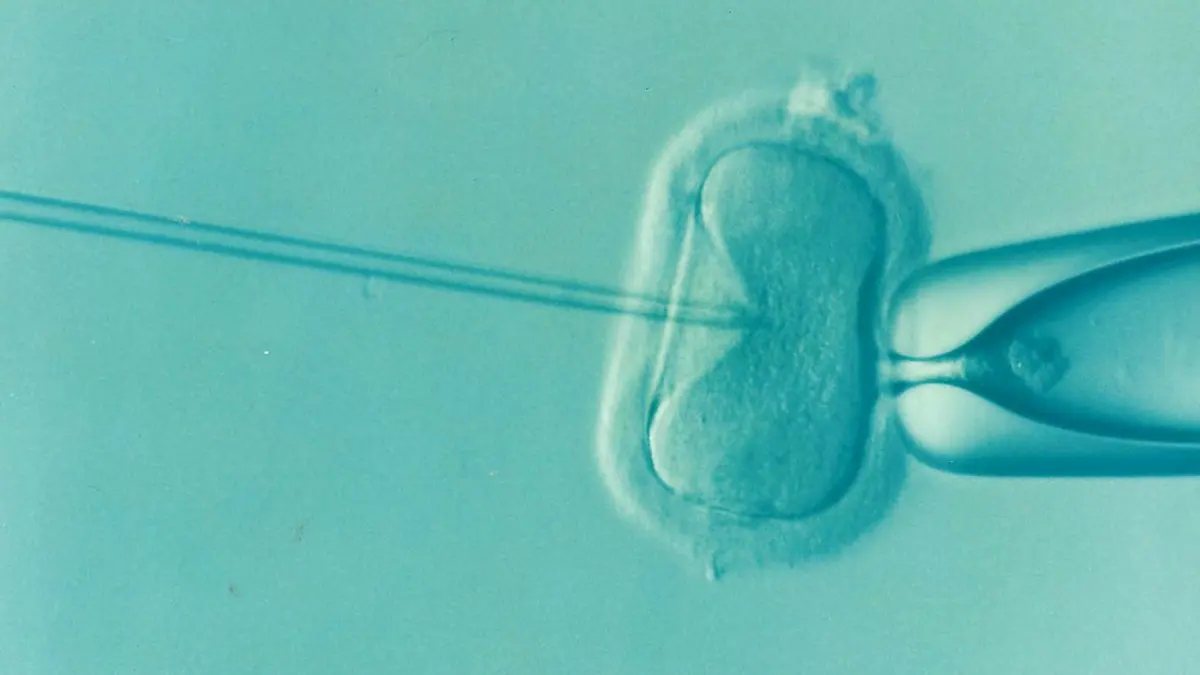
IVF does not always work. In the press release for the prize, the Nobel committee wrote that about 20 to 30% of fertilized eggs that are put back lead to a baby. The chances are much better for younger women, because eggs become fewer and less healthy with age. Putting back one embryo at a time is safest: twins and triplets are more often born too early.
In your life today
- Millions of people. About four million children had been born by IVF when the prize was given in 2010. In 2023 the International Committee for Monitoring Assisted Reproductive Technologies estimated at least 12 million. The babies grow up as healthy as other children, and Louise Brown and many others have had children of their own.
- In Nepal. The first IVF center in Nepal opened at Om Hospital in Kathmandu in 2004, and Nepal’s first IVF baby, a boy, was born there in March 2005. Today there are IVF clinics in Kathmandu, Pokhara and other cities, though the treatment is still too costly for many families Grade 10: In vitro fertilization.
- Animals too. The same methods help save rare animals and breed better cattle, along with artificial insemination, which farmers in Nepal use for cows and buffaloes Grade 10: Artificial insemination.
A couple’s only problem is that the man makes very few sperm, and the ones he makes swim badly. Which method is most likely to help?
Pick an answer to see why.
What came next
- Testing embryos. A few cells can be taken from a five-day embryo and tested for some serious inherited diseases before it is put back. Parents who carry such a disease can then have a healthy child.
- Hard questions. IVF raised questions that people still argue about. What should happen to frozen embryos that are no longer needed? How long may scientists study a human embryo in the laboratory? Many countries have a rule: no longer than 14 days. Edwards himself wrote about these questions from the very beginning, and asked for clear rules.
- An open question. Even a perfect-looking embryo put back at the right time often fails to settle in the uterus, and nobody fully understands why. Finding out could make IVF work far more often, with fewer tries.
In your science books
- Grade 8: sexual reproduction in animals and fertilization in animals.
- Grade 10: meiosis, the cell division that makes eggs and sperm; sex determination in humans; artificial insemination and in vitro fertilization.
- Going Further (Grades 6–8): one of each pair goes into each egg or sperm.
- Going Further (Grades 9–12): the first week of an embryo.
Learn more
- The Nobel Prize’s own explanation: popular information on the 2010 prize and the press release (nobelprize.org).
- Speed read: Making mothers of invention (nobelprize.org).
- Edwards was too ill to give a Nobel lecture, so his former student Martin Johnson gave one about him: Robert Edwards: Nobel Laureate in Physiology or Medicine (video, nobelprize.org).
The official reason
The prize was given “for the development of in vitro fertilization.”