
How the body’s defenses sound the alarm
Nobel Prize in Physiology or Medicine, 2011: Bruce A. Beutler, Jules A. Hoffmann, and Ralph M. Steinman

Bruce A. Beutler
born 1957 in Chicago, United States
As a boy in California he kept dogs, ducks, mice and chameleons. He learned of his prize from an email he read at 2:30 in the morning.
Photo: Holger Motzkau, CC BY-SA 3.0

Jules A. Hoffmann
born 1941 in Echternach, Luxembourg
He spent his whole career in Strasbourg, France, asking one question: how do insects fight off infections?
Photo: Holger Motzkau, CC BY-SA 3.0
-
Ralph M. Steinman
1943–2011, born in Montreal, Canada
He discovered a new kind of cell in 1973, and spent almost forty years showing what it does. He died three days before his prize was announced.
You fall while playing football and scrape your knee. Dust and germs get into the cut. By the next day the skin around it is red, warm, swollen and sore. That is not the germs doing harm. It is your body fighting back.
But how does your body know that germs have got in? And how does it decide whom to attack? In 2011 the Nobel Prize in Physiology or Medicine went to three scientists who answered these questions: Bruce Beutler and Jules Hoffmann, who found the body’s sensors for germs, and Ralph Steinman, who found the cell that passes the warning on.
The problem: two lines of defense
Germs such as bacteria, viruses and fungi attack us all the time Grade 8: Microorganisms. The body’s defense against them is the immune system. By the 1990s, scientists knew it works in two stages.
| Innate immunity | Adaptive immunity | |
|---|---|---|
| when it acts | at once, within minutes to hours | later, after several days |
| who does the work | white blood cells that swallow germs; small proteins that break germs open | white blood cells called T cells and B cells |
| how it works | inflammation: redness, heat, swelling | B cells make antibodies, T cells kill infected cells |
| does it learn? | no: you are born with it, and it stays the same | yes: it remembers each germ it has fought |
The first line is innate immunity (innate means “born with”). Some white blood cells, such as macrophages (“big eaters”), swallow germs and digest them Grade 10: White blood cells. They also call up inflammation: blood vessels widen and leak, so more blood, warmth and defending cells reach the place. That is why a cut goes red and swollen.
If germs get past the first line, adaptive immunity takes over. Its T cells and B cells are trained against one particular germ. It is slower, but stronger, and when the germ is beaten some of these cells stay on as memory cells. If the same germ comes back, they recognize it at once. This is how vaccines work: they let the adaptive system meet a harmless form of a germ, so that it is ready for the real one.
Earlier Nobel Prizes had explained antibodies and how T cells recognize germs. But two big questions were still open:
- How does the innate system notice that germs are there at all?
- How does it tell the adaptive system to start?
After you have had chickenpox, you almost never catch it again. Which part of the immune system makes that possible?
Pick an answer to see why.
Why it was hard
Many scientists thought the innate system was simple and blind. It seemed to react to any damage in the same way, without telling one kind of germ from another, so it was called the “non-specific” system. Not many people studied it.
And it was known that T cells need help from another cell before they can start an attack. Most scientists were sure that helper was the macrophage. Nobody was looking for a new kind of cell.
What they did, step by step
Steinman: a cell with branches (1973)
Ralph Steinman was a young doctor working at Rockefeller University in New York with Zanvil Cohn, an expert on macrophages. He wanted to know what starts an adaptive immune response.
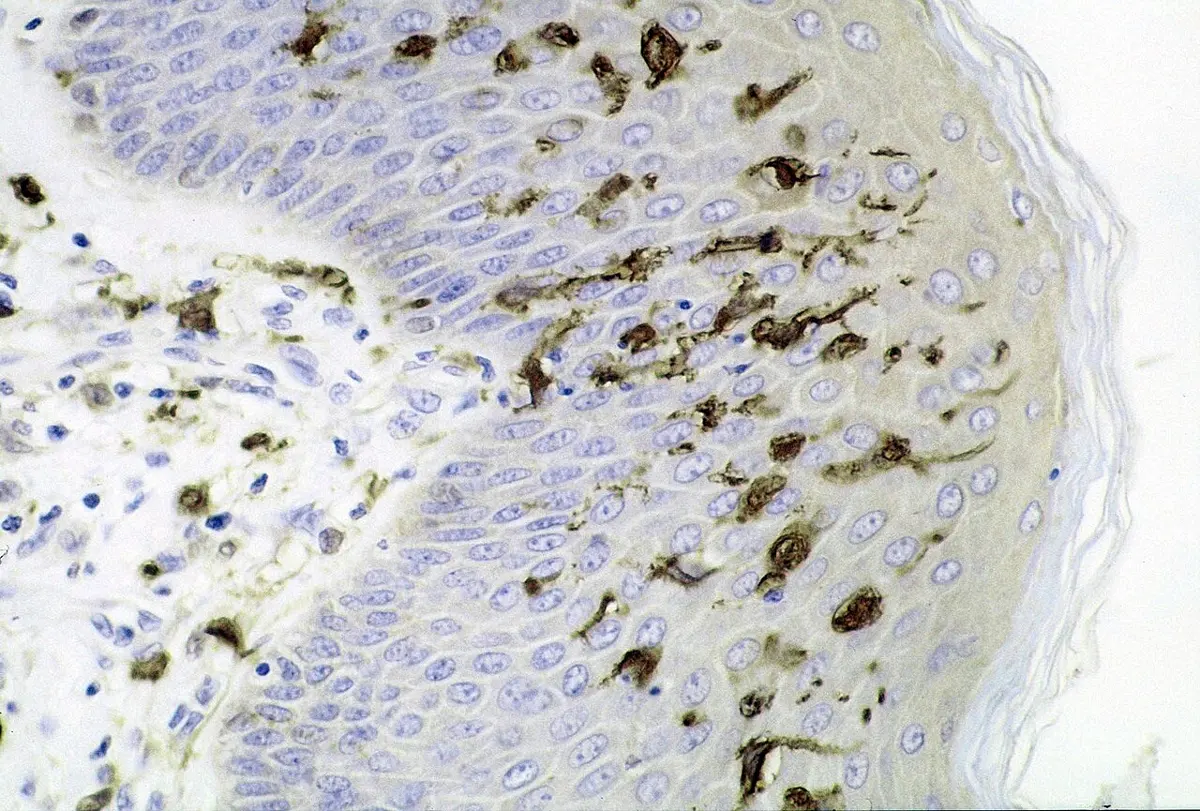
- 1973, a new cell. Studying cells from the spleen of mice under the microscope, Steinman and Cohn saw a cell nobody had described. It kept pushing out and pulling back long, thin branches. Steinman named it the dendritic cell, from the Greek word for tree.
- 1978, the switch. Steinman separated dendritic cells from the other cells, and mixed each kind with T cells in a dish. With dendritic cells, the T cells reacted strongly. Without them, they hardly reacted at all. The dendritic cell, not the macrophage, was the cell that switches T cells on.
- Twenty years of doubt. Many scientists didn’t believe him. Through a long series of experiments, Steinman showed what dendritic cells do: they sit in the skin and the linings of the body, collect pieces of germs, and carry them to the lymph nodes, where they show them to T cells. By the mid-1990s, the scientific world was convinced.
Hoffmann: flies that could not fight a fungus (1996)
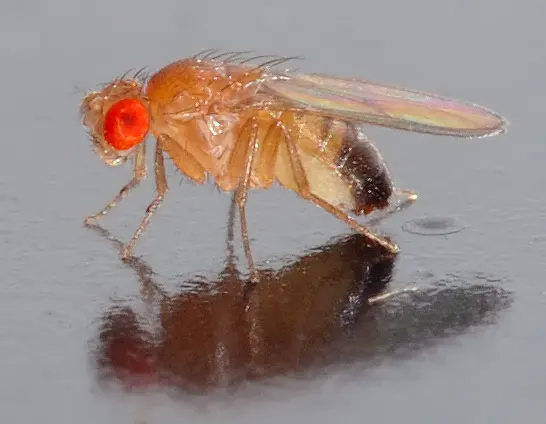
Insects have no adaptive immunity, no antibodies and no T cells. They rely only on the innate system, yet they fight infections well. Jules Hoffmann, at Strasbourg in France, had studied how insects do this for many years. By the 1990s his team was working with fruit flies.
- A gene called Toll. Fruit flies have a gene called Toll, already known because it helps shape the fly as it grows from an egg. (Its discoverer, Christiane Nüsslein-Volhard, won a Nobel Prize in 1995. The story goes that she named it when she saw an odd-looking mutant fly and exclaimed “Das war toll!”, German for “That was great!”)
- 1996, the experiment. In Hoffmann’s laboratory, a team led by Bruno Lemaitre infected fruit flies with bacteria or fungi. Flies whose Toll gene didn’t work died of a fungal infection, their bodies covered with threads of fungus. Normal flies survived.
- The answer. The Toll protein was needed to sense the infection and switch on the fly’s defenses. The innate system was not blind after all: it had a sensor.
Beutler: the mice that ignored a poison (1998)
Bruce Beutler, a doctor working in Dallas, in the United States, was hunting for something else: the cause of septic shock.
Many bacteria have a substance in their outer coat called LPS (lipopolysaccharide). A small amount of LPS sets off a useful immune reaction. A large amount, when bacteria spread through the blood, can make the innate system overreact so violently that blood pressure falls and organs fail. That is septic shock, which kills many people every year.
- The clue. Beutler knew of two strains of laboratory mice that didn’t react to LPS at all. Something in their genes must be broken. If he could find it, he would find the sensor for LPS.
- 1993–1998, the hunt. For about five years his team searched a long stretch of the mice’s DNA, piece by piece. It was slow and expensive, and some colleagues advised him to stop.
- 5 September 1998, the match. Late one night, Beutler saw that the search had found a gene that looked like the fly’s Toll gene: Toll-like receptor 4 (TLR4). Within days his team found the fault in one strain of mice: a change in a single letter of the gene’s DNA. In the other strain, the gene was missing altogether.
So mice, like flies, sense germs with Toll-like proteins. Insects and mammals use the same kind of sensor, kept for hundreds of millions of years of evolution.
How the alarm works
Today we know that humans have ten Toll-like receptors (mice have a few more). Each one sits on the surface of a cell, or inside it, like a sensor, and recognizes one kind of molecule that germs have and our own cells don’t: TLR4 the LPS of bacterial coats, others the parts of a bacterium’s tail or a virus’s genes. When a germ’s molecule fits, the sensor sends a signal into the cell, and the cell sounds the alarm.
The two halves of the prize fit together. Dendritic cells carry Toll-like receptors too. When a dendritic cell in your skin meets a germ, the alarm from its sensors makes it change: it stops collecting, grabs pieces of the germ and travels through the lymph vessels to the nearest lymph node Grade 9: Lymph. There it shows the pieces to T cells. The few T cells that match that germ multiply into an army and go out into the body to find it.
Dendritic cells can also do the opposite: calm T cells down. That matters, because the immune system must attack germs while leaving the body’s own cells alone.
Mice that lack a working TLR4 don’t react to LPS. What would you expect when they are infected with bacteria that have LPS in their coats?
Pick an answer to see why.
In your life today
- Better vaccines. Some modern vaccines contain an extra substance that switches on a Toll-like receptor on purpose, so that dendritic cells take the vaccine seriously and the body builds stronger protection.
- Medicines. A skin cream used to treat some skin cancers and warts works by switching on a Toll-like receptor in the skin, so that the body attacks the abnormal cells.
- Cancer. Doctors are testing ways to use dendritic cells to teach the immune system to recognize cancer cells.
- Sepsis. Knowing how LPS sets off septic shock has helped doctors understand sepsis, though it still kills millions of people every year, many of them in poorer countries.
What came next
These discoveries opened up the study of the innate immune system, which is now one of the busiest fields in medicine. But many questions are still open:
- Why does the immune system sometimes attack the body’s own cells (as in type 1 diabetes or rheumatoid arthritis) or harmless things like pollen (allergies)? Toll-like receptors and dendritic cells are part of the answer, but not all of it.
- Nobody has yet made a vaccine against HIV, and the vaccine against tuberculosis, a serious disease in Nepal, works poorly in adults. Could vaccines aimed at dendritic cells do better? Steinman’s own laboratory began testing one against HIV in 2010.
In your science books
- Grade 8: microorganisms: viruses and bacteria, and lysosomes, with which white blood cells digest germs.
- Grade 9: lymph.
- Grade 10: white blood cells.
- Going Further (Grades 9–12): what an antibiotic does, the other way we fight bacteria.
Learn more
- The Nobel Prize’s own explanation: The gatekeepers of the immune system (nobelprize.org).
- The laureates’ Nobel lectures: Beutler, Hoffmann, and Steinman’s, given on his behalf by his colleague Michel Nussenzweig.
The official reason
The prize was given “for their discoveries concerning the activation of innate immunity.”
The prize was given “for his discovery of the dendritic cell and its role in adaptive immunity.”