
A hen sits on her eggs, and three weeks later chicks peep out. A grain of maize goes into wet soil in Chait, and by Saun the plant carries cobs full of new grains. A forgotten potato in the kitchen corner grows pale shoots from its “eyes”. A starfish that loses an arm grows a new one.
Every living thing makes more of its own kind. Some do it with a partner, through flowers, seeds, eggs and babies. Others need no partner at all: they split in two, grow a bud, or start again from a broken piece. This unit is about all of these ways, and about the most traveled object in the plant world, the seed.
All organisms can produce offspring. Flowering plants do it with seeds, made in their flowers. Some plants grow new plants straight from a root, a stem or a leaf. Some lower plants and fungi make tiny units called spores. Higher animals have separate males and females; they make reproductive cells called gametes, and when a male’s gamete joins a female’s, a new life begins, born from the mother’s body or hatched from an egg. The simplest organisms carry on their kind without any partner, asexually. One way or another, every kind of living thing reproduces, generation after generation.
5.1 Reproduction
There are many kinds of organisms on Earth, and every one of them gives birth to its own kind. Animals do it by laying eggs, by giving birth to young, or by some asexual method. Plants do it with seeds, with spores, or asexually. Reproduction is the biological process by which an organism produces new individuals of its own kind. Through it, each kind of living thing carries on from one generation to the next.
Importance of reproduction
- a.It keeps a kind of organism from dying out (extinction): new individuals replace the old.
- b.New births balance the deaths in a population.
- c.It is the start of every new generation.
- d.It keeps up the variety of living things (biodiversity) in an ecosystem.
Which of these is the best meaning of reproduction?
Pick an answer to see why.
Asexual reproduction
Advanced organisms have male and female reproductive organs. They make male and female gametes, and the two gametes fuse; the fused cell is called a zygote, and it grows into a seed or a baby animal. But many organisms reproduce without any gametes fusing: a new individual grows from a broken piece, from a bud, or from a special reproductive unit. Reproduction by one parent alone, without the fusion of gametes, is called asexual reproduction.
There are six types of asexual reproduction:
- a.fission
- b.budding
- c.fragmentation
- d.regeneration
- e.sporulation
- f.parthenogenesis
(a) Fission
Fission is making new organisms by splitting the parent’s body. It happens mostly in single-celled organisms: prokaryotes such as bacteria (kingdom Monera) and eukaryotes such as amoeba (kingdom Protista). After fission the parent no longer exists: it has become its own young.
Binary fission (binary: in two). A full-grown cell splits into two halves. First its nucleus divides, then its cytoplasm. A cell can split along its length (longitudinal binary fission, as in Euglena) or across it (transverse binary fission, as in Paramecium): the line along which a cell is cut is its axis. Amoeba, Paramecium, Euglena, bacteria, archaea and blue-green algae reproduce by binary fission.
Multiple fission. The cell divides into more than two pieces at once, and each piece becomes a new individual. Plasmodium (the malaria parasite) does this inside our red blood cells; Chlamydomonas, many other protists and some algae do it too.
(b) Budding
In budding, a small outgrowth, a bud, appears on the parent’s body (or cell). It grows into a complete organism and then breaks off. Yeast, hydra, Obelia, corals and sponges reproduce by budding; jellyfish do it at one stage of their life.
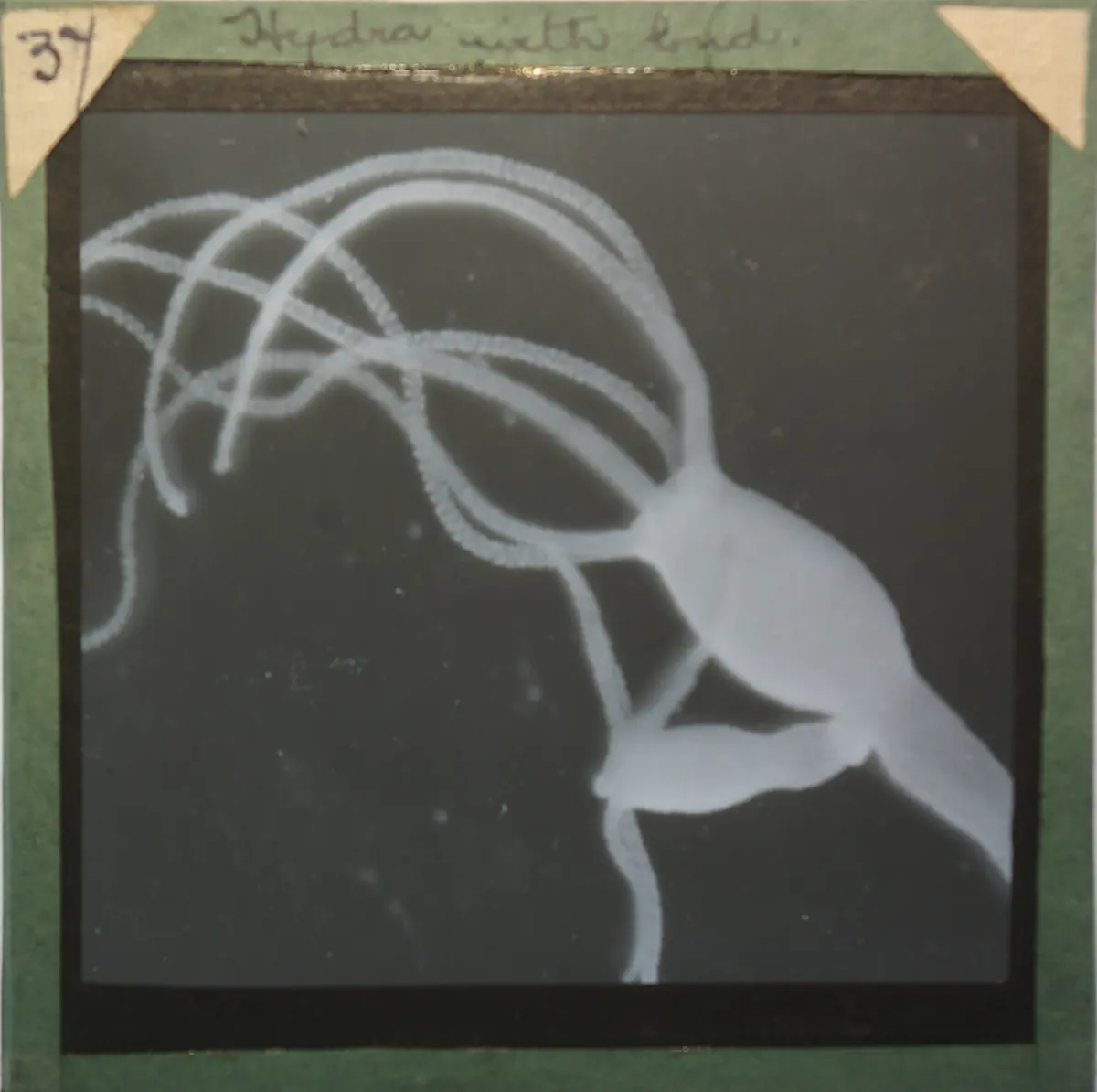
In yeast, a bud often forms before the last one has broken off, so you see little chains of yeast cells. Corals never let go: their buds stay joined, and over thousands of years whole reefs grow this way.
(c) Fragmentation
Some simple plants break into pieces, pushed by water, wind or animals, and each piece grows into a new plant. Growing whole new plants from broken pieces in their natural home is called fragmentation. Spirogyra, the slimy green thread of ponds, does this; so do Marchantia (a liverwort), some ferns, lichens and the bread mold Mucor.
(d) Regeneration
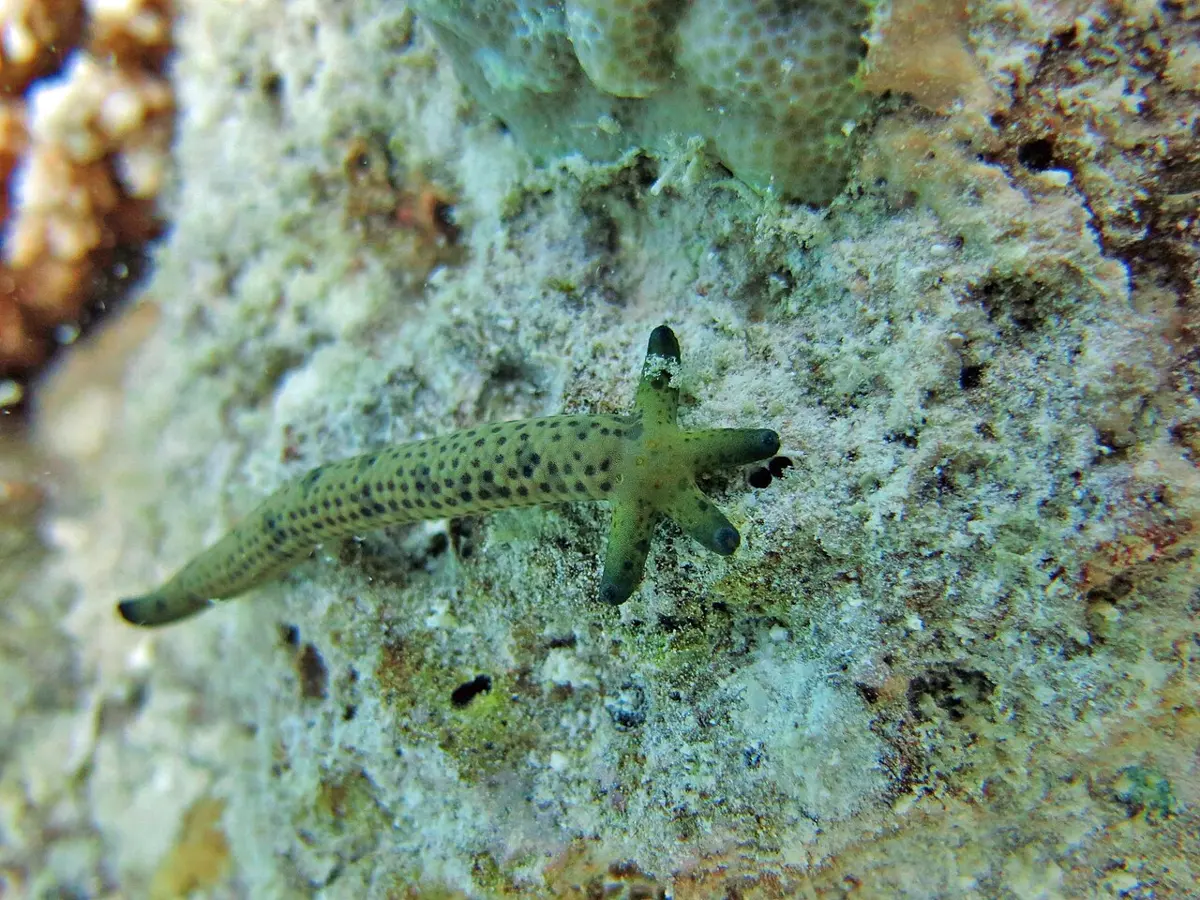
Cut a planarian (a small flatworm of streams) into pieces, and each piece grows into a whole new worm. Growing a whole new body from a cut or broken piece is called regeneration. The piece must stay alive in its natural surroundings while it regrows. The parent also grows back what it lost. Regeneration is common in simple animals: hydra, planaria, starfish and tapeworms; an earthworm can regrow lost segments.
(e) Sporulation
Ferns, mushrooms, Marchantia and Mucor make spores. A spore is a tiny reproductive unit, usually a single cell with a tough coat. Spores are made in capsules called sporangia (singular: sporangium); making spores inside sporangia is called sporogenesis. When the sporangium bursts, the ripe spores drift away on the wind. If one lands somewhere damp, with plenty of food (rotting leaves, an old slice of bread), it grows into a new plant or fungus. Reproduction by spores is called sporulation.
(f) Parthenogenesis
In some animals, an egg that has not been fertilized develops into a new individual. This is parthenogenesis (Greek: “virgin birth”). In honey bees, the drones (males) hatch from the queen’s unfertilized eggs; male ants and wasps do too. Some kinds of aphids, termites, grasshoppers, stick insects and even a few lizards can reproduce this way.
Plants have something similar. A banana, a pineapple, or a seedless cucumber grows a fruit without fertilization, so the fruit has no seeds (or only tiny, empty ones). Fruit forming without fertilization is called parthenocarpy, and growers like it, because people like seedless fruit.
Significance of asexual reproduction
- a.No male and female gametes need to be made or brought together.
- b.There is no male and female: one parent is enough.
- c.It can usually start from ordinary body cells, not special reproductive cells.
- d.The organism grows a particular reproductive unit (a bud, a spore, a piece) that grows on into a new body.
- e.The young are genetically identical to the parent and to each other (copies, or clones); any differences come only from their surroundings.
A single Paramecium splits into two. How are the two new cells related to the parent?
Pick an answer to see why.
Which is an example of budding?
Pick an answer to see why.
Vegetative propagation
A flowering plant has two kinds of parts. The flower is its reproductive part: it makes the seeds, through pollination and fertilization. All the other parts, the root, stem and leaf, are vegetative parts. Asexual reproduction from a vegetative part is called vegetative propagation.
It can happen by itself in nature (natural vegetative propagation), or people can do it on purpose, with tools and skill (artificial vegetative propagation).
Natural vegetative propagation
(a) Root
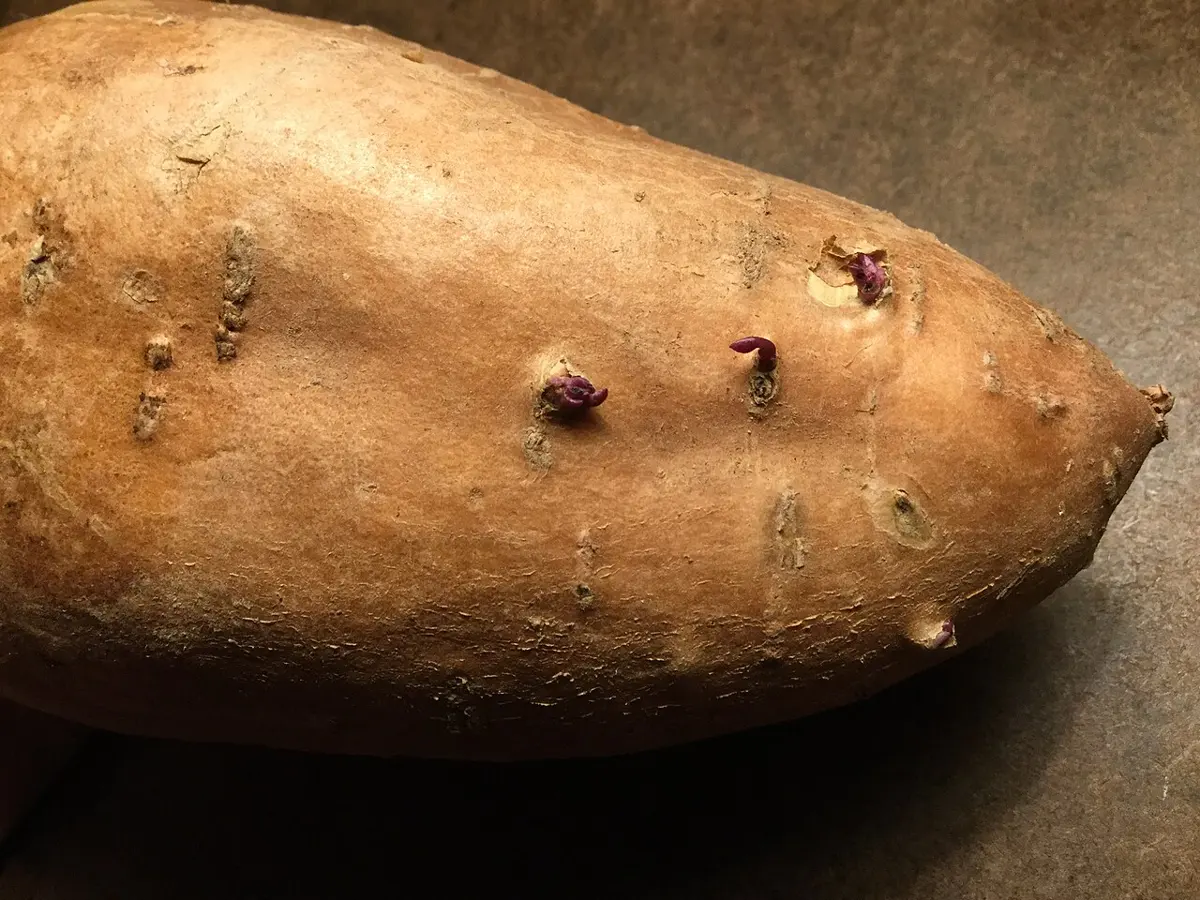
The roots of some plants, like rose, sissoo and guava, carry buds. If a piece of such a root is separated from the stem, its buds grow into new shoots. Sweet potato, asparagus and dahlia store plenty of food and water in their swollen roots, and these roots give rise to new shoots with leaves: a sweet potato sprouts them anywhere on its skin, while a dahlia or asparagus root sprouts only from the buds at its top, where it joins the old stem, so each piece planted needs a bit of that. Roots then grow from the base of each new shoot, and it becomes a separate plant.
(b) Underground stem
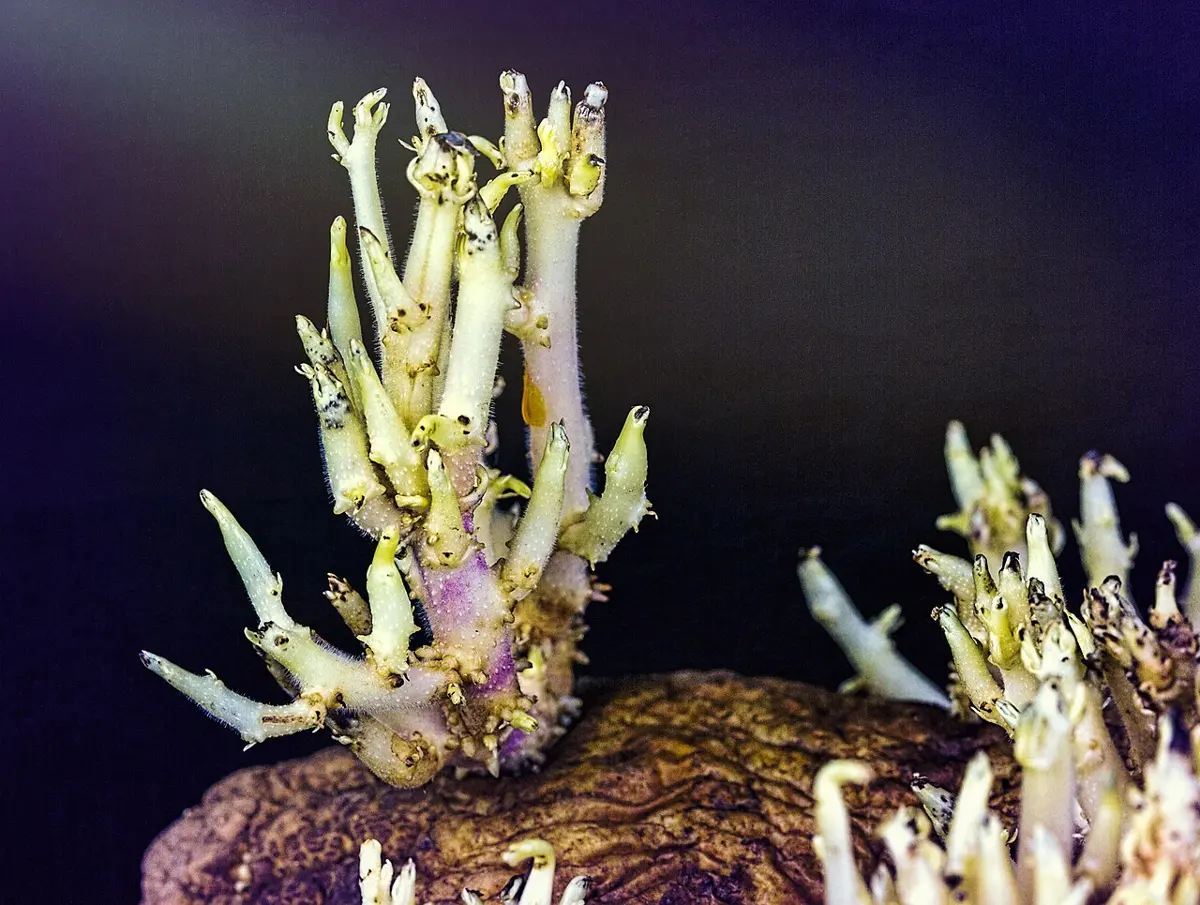
Some stems grow under the soil and are stuffed with stored food. A potato looks like a root, but it is really a stem: it has buds (its eyes), and only stems have buds and nodes. There are five kinds of underground stem, and every one can grow new plants:
- Sucker. A side shoot with its own bunch of roots grows from the base of the main stem underground and comes up as a new plant beside it. Mint, banana, bamboo and ground raspberry spread this way.
- Rhizome. A thick stem that lies flat, just under the surface, full of water and food. It has many buds, and every season some of them grow into new shoots. Ginger, turmeric, calamus root (bojho) and many ferns have rhizomes.
- Corm. A short, swollen, roundish stem at the base of the shoot, full of food and water, with a few buds that grow into new plants. Taro (pindalu) and gladiolus have corms.
- Bulb. A very short stem disc wrapped in thick, juicy leaf bases, with buds between them. Onion, garlic and tulip have bulbs; each clove of garlic grows into a new plant.
- Tuber. A swollen tip of an underground stem. A tuber has small hollows called eyes (aankha); each holds buds that sprout into new shoots. Potato and yam grow from tubers.
(c) Aerial stem
Some stems above the ground have buds at their nodes that grow new shoots and roots when they touch moist soil. A piece of sugarcane with a node grows into a whole new plant, which is why farmers plant cut pieces of cane, not seeds. Dubo (Bermuda grass), which is used in pujas, creeps along the ground and roots at every node, so given the chance it soon covers a whole field.
(d) Bulbils
In some plants, buds at the nodes, at the base of a leaf, or in place of flowers swell with food and fall off. These fleshy buds are called bulbils. Each grows roots and a shoot and becomes a new plant. Agave (kettuke), githa (air yam, whose bulbils are eaten in Nepal), some lilies, onion and garlic make bulbils. The slips of a pineapple, small leafy shoots that grow just below the fruit, are often counted as bulbils too.
(e) Leaf
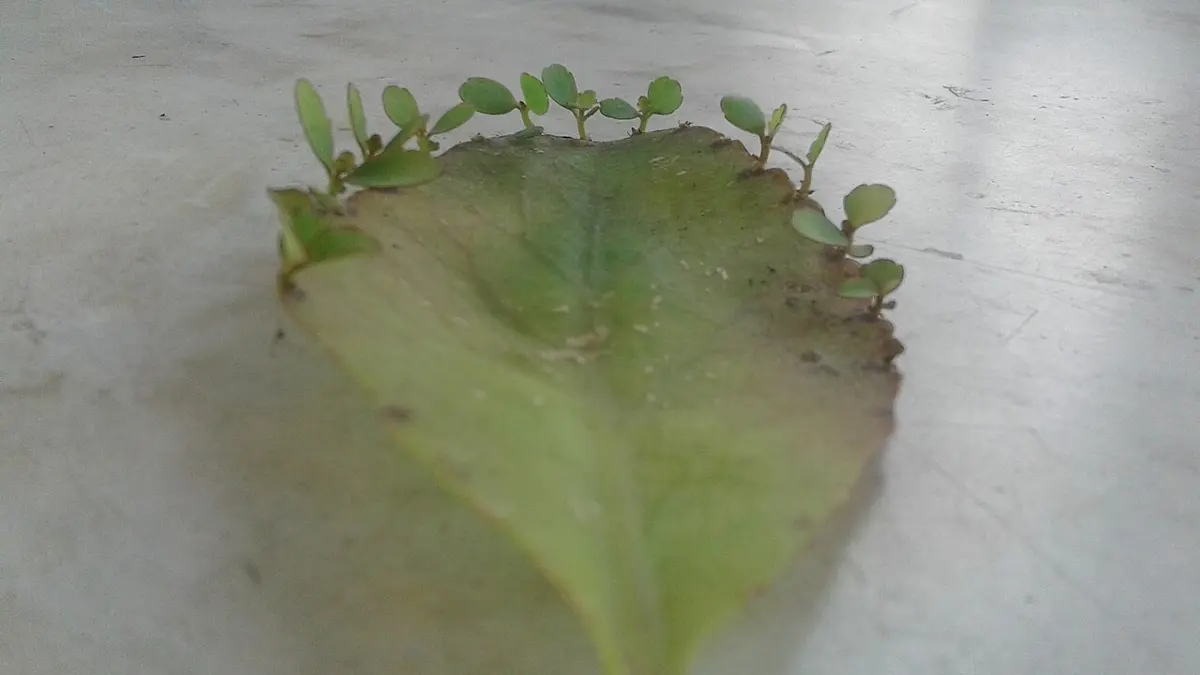
The leaves of some plants can grow new plants. Bryophyllum (pattharchatta, also called kalanchoe), begonia, Sansevieria (snake plant) and crassula (jade plant) all do. Each notch on the edge of a bryophyllum leaf has a tiny bud. On an old leaf, or one that falls on damp soil, the buds grow into baby plants with their own roots and shoots, a whole row of them round the leaf.
Farmers plant pieces of sugarcane stem, not seeds. What must each piece have?
Pick an answer to see why.
Which of these is a rhizome?
Pick an answer to see why.
Artificial vegetative propagation
Gardeners and farmers grow new plants from vegetative parts on purpose, with tools and skill, to get more and better crops and fruit. This is artificial vegetative propagation. The methods are cutting, layering, gootee, grafting and tissue culture.
Why not just sow seeds? A seed is made by two parents, so the plant that grows from it is a mix, and may be quite different from the tree you liked. A mango seed from a sweet tree might give sour fruit. A piece of the tree itself grows into a copy of it. And because the new plant starts from a part that is already grown up, it bears fruit years sooner than a seedling.
Advantages of artificial vegetative propagation
- i.The breed and qualities of the plant can be chosen as we need: we copy a plant that is known to be good.
- ii.The new plants bear fruit sooner.
- iii.Many identical plants can be grown from one parent plant in a short time.
- iv.Plants with no viable seeds (banana, seedless grapes, pineapple) can still be grown.
(a) Cutting
Growing new plants by planting cut pieces of a stem, root or leaf is called cutting. Raspberry, ground raspberry and blackberry can be grown from pieces of root; sugarcane, rose and lemon from pieces of stem. For a stem cutting, choose a twig about a year old, and make sure each piece has at least two nodes: one goes in the soil to make roots, and one stays above to make the shoot. After a few days, roots and a shoot start to grow from the nodes.
(b) Layering
Layering is done on plants with long, soft branches near the bottom of the stem, such as jasmine, grapevine and strawberry. The branch chosen is called the layer. A ring of bark 2–3 cm wide is peeled off it, and that part is bent down into the soil and covered, with the tip still above ground. The soil is kept moist. New roots grow from the peeled, buried part while the branch is still fed by its parent. Then the branch is cut from the parent and planted somewhere else.
(c) Gootee
Gootee (गुटी) is air layering: layering done up in the air, for branches too stiff to bend down. Take a branch at least a year old of litchi, mango, guava, orange or pomelo (bhogate), and peel a ring of bark 2–3 cm wide. Cover the bare part with a ball of moist soil (or moss) mixed with minerals and a rooting hormone, and wrap it tightly in a plastic sheet to keep it moist and free of infection. After a month or two, roots grow into the ball from the peeled part. The branch is then cut off below the ball and planted.
(d) Grafting
Grafting is joining parts of two closely related plants so that they grow as one. It is used to make fruit plants that bear good fruit early.
- The stock (rootstock) is the lower part, with roots: a young plant about a year old, grown from seed, cut off 20–30 cm above the ground. It gives strong roots.
- The scion (or graft) is a twig from a fruit tree of good quality and yield, with a few buds (nodes), with or without a few half-cut leaves.
The cut ends of the two are shaped so that they fit tightly, like a key in a lock, and the living layers under their bark touch, so that water and food can flow from one to the other. The joint is sealed airtight with grafting wax or grafting tape. In a few weeks the wounds heal and the two parts grow into one plant. It soon bears fruit just like the tree the scion came from.
In Nepal, the Nepal Agricultural Research Council (NARC) and many private nurseries prepare thousands of grafted saplings of mango, orange, pear, apple, avocado and other fruits every year. Farmers who plant them get good fruit in a few years, which has helped fruit farming in Nepal grow.
(e) Tissue culture
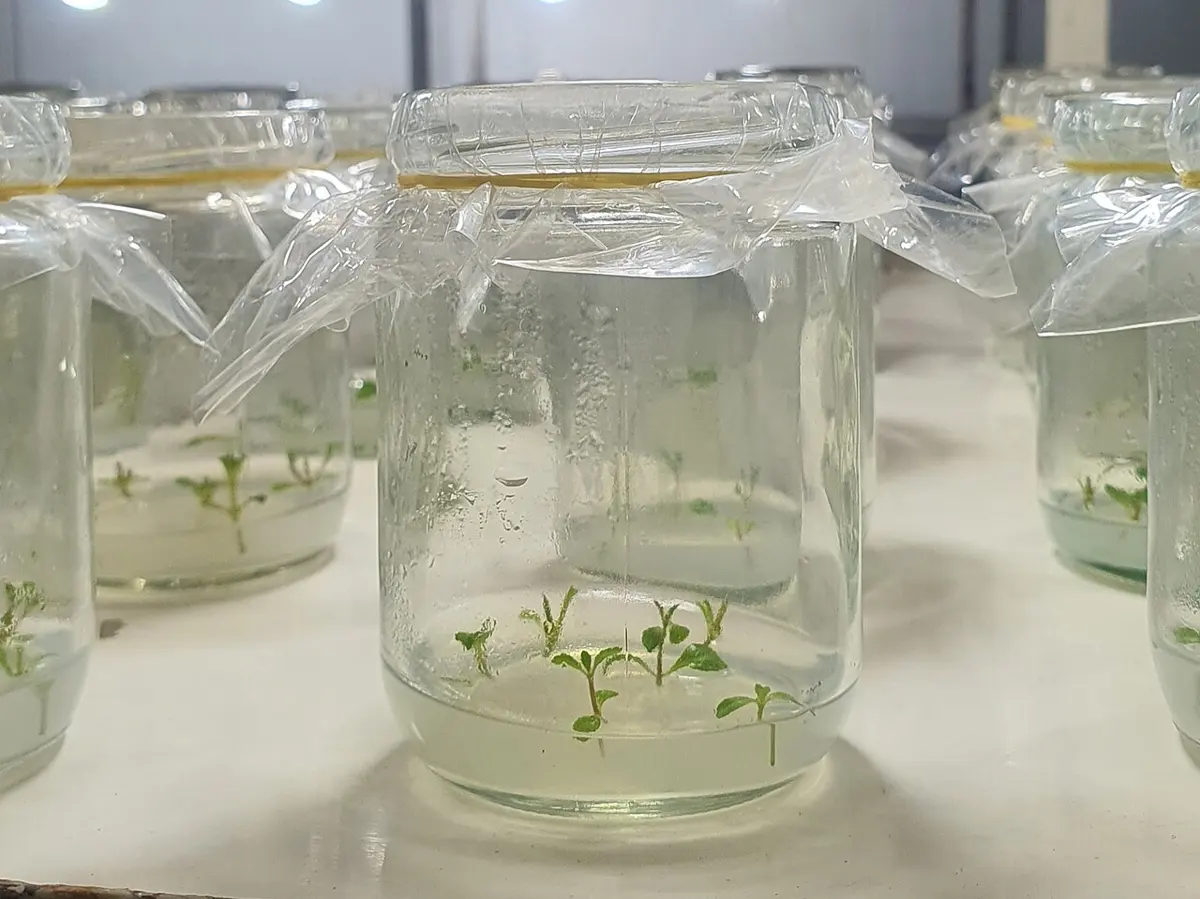
Tissue culture is the most modern way of growing new plants. A tiny piece of the parent plant, a few cells or a bit of tissue from a shoot tip, called the explant, is placed on a jelly of nutrients, the culture medium, in a clean glass jar. (A medium is a mixture of the nutrients that cells or microorganisms need to grow.) Everything is kept germ-free, and the light and temperature are controlled in the lab.
- The explant grows into a small, pale-green lump of cells that are all alike, called a callus.
- Plant hormones added to the medium make the callus form shoots and roots: a tiny plant, a plantlet.
- The plantlets are moved into pots, toughened up in a greenhouse, and planted out.
One small piece of a plant can give hundreds of thousands of identical, disease-free plantlets in a few months. Labs in Nepal grow banana, potato, orchids, strawberries and flowers this way.
Exercise (5.1 Reproduction)
1. Choose the best answer
a. How are new organisms formed in regeneration?
Pick an answer to see why.
b. What should you make sure of when growing plants from cuttings?
Pick an answer to see why.
c. Which of these best gives the meaning of reproduction?
Pick an answer to see why.
d. An old potato has new shoots and leaves growing from its eyes. Which type of vegetative propagation is this?
Pick an answer to see why.
e. Tissue culture grows many plantlets from a small explant in a lab. Which statement is true of this method?
Pick an answer to see why.
2. Differentiate between
Fission and budding
Answer
| Fission | Budding |
|---|---|
| The parent splits into two or more new organisms. | A small bud grows out of the parent. |
| The parent no longer exists afterwards. | The parent is still there after the bud separates. |
| The new organisms are about the same size. | The bud is much smaller than the parent at first. |
| Only in single-celled organisms, e.g. amoeba, Paramecium. | In yeast and simple many-celled animals, e.g. hydra. |
Bulbils and rhizome
Answer
| Bulbils | Rhizome |
|---|---|
| Small, fleshy buds formed above ground, at nodes, at leaf bases or in place of flowers. | A thick stem growing flat under the soil. |
| Each bulbil falls off and grows into one new plant. | Its buds send up new shoots season after season, while it stays in the soil. |
| e.g. agave, githa (air yam), some lilies | e.g. ginger, turmeric |
Natural and artificial vegetative propagation
Answer
| Natural vegetative propagation | Artificial vegetative propagation |
|---|---|
| Happens by itself in nature. | Is done by people, with tools and skill. |
| No choice of the parent plant. | A good parent plant is chosen to copy. |
| From roots, underground stems, aerial stems, bulbils, leaves. | By cutting, layering, gootee, grafting, tissue culture. |
| e.g. ginger, potato, bryophyllum | e.g. grafted mango, rose cuttings |
Layering and grafting
Answer
| Layering | Grafting |
|---|---|
| A branch grows its own roots while still joined to its parent. | Parts of two plants are joined to grow as one. |
| Needs one plant. | Needs two closely related plants (stock and scion). |
| The new plant has its own roots. | The new plant uses the stock’s roots. |
| e.g. jasmine, grapevine | e.g. mango, orange, apple |
3. Give reasons
Asexual reproduction has no male and female.
Answer
Asexual reproduction needs only one parent and no gametes. The new individual grows from part of that one parent (a split cell, a bud, a piece, a spore), so no male gamete and female gamete have to meet, and there is no need for a male parent and a female parent.
Growing new plants from a potato tuber is called vegetative propagation.
Answer
A potato tuber is a swollen underground stem, a vegetative part of the plant, not a flower or seed. New plants grow from the buds in its eyes without any gametes fusing. Reproduction from a vegetative part (root, stem or leaf) is vegetative propagation.
Farmers benefit from grafting.
Answer
A grafted plant bears fruit of the same good quality as the tree the scion came from, and it starts bearing in a few years instead of many, because the scion is already mature. The stock can be chosen for strong roots that resist disease or drought. So farmers get better fruit, sooner, and earn more.
Tissue culture is thought to be the most advanced method of vegetative propagation.
Answer
It uses modern lab methods (germ-free culture media, controlled light and temperature, plant hormones) and needs only a tiny piece of the parent. From that piece it can produce hundreds of thousands of identical, disease-free plantlets of almost any plant in a short time, in any season, which no other method can do.
4. Answer these questions
What is reproduction? Give an example.
Answer
Reproduction is the biological process by which organisms produce new individuals of their own kind. Example: a hen lays eggs that hatch into chicks; a mango seed grows into a mango tree; an amoeba splits into two amoebae.
What are the types of asexual reproduction? Describe one of them briefly.
Answer
Fission, budding, fragmentation, regeneration, sporulation and parthenogenesis.
Budding: a small outgrowth, the bud, forms on the parent’s body. It grows and develops into a complete small organism, then breaks off and lives on its own. Example: yeast, hydra.
(You may describe any one; for example, binary fission: a single-celled organism such as an amoeba divides its nucleus and then its cytoplasm, splitting into two daughter cells.)
Describe budding in hydra, with figures.
Answer
Draw a row of four hydras, as in Figure 5.3.
- A small bump (bud) appears on the side of a hydra’s body, where cells divide rapidly.
- The bud grows longer; its hollow inside is joined to the parent’s.
- A mouth and a ring of small tentacles form at its tip.
- The young hydra pinches off at its base, attaches itself nearby, and lives on its own.
Make a flowchart of the methods of vegetative propagation.
Answer
Vegetative propagation
→ Natural: root; underground stem (sucker, rhizome, corm, bulb, tuber); aerial stem; bulbils; leaf
→ Artificial: cutting; layering; gootee; grafting; tissue culture
(Draw it as the tree in Figure 5.8.)
What kind of reproductive unit is a bulbil? Give an example.
Answer
A bulbil is a small, fleshy bud full of stored food that forms at a node, at the base of a leaf or in place of a flower. It falls off and grows roots and a shoot to become a new plant. It is a unit of natural vegetative propagation. Example: agave (kettuke), githa (air yam), some lilies.
What are the stock and the scion in grafting? Describe grafting and its advantages.
Answer
The stock is the lower part, with roots, usually a year-old seedling cut 20–30 cm above the ground. The scion is a twig with a few buds taken from a tree with good fruit.
Process: the stock and scion are cut so that their ends fit together closely, with their living layers touching. They are joined, tied, and sealed airtight with grafting wax or tape. After a few weeks the cut surfaces heal and the two grow into one plant.
Advantages: the plant bears fruit as good as the scion’s parent; it bears early; the stock can give strong, disease-resistant roots; many good plants can be made from one tree.
What is layering? Draw a figure of layering, with an example.
Answer
Layering is growing roots on a branch while it is still joined to the parent plant. A ring of bark 2–3 cm wide is removed from a low, soft branch (the layer), and that part is bent down and buried in moist soil, the tip left above ground. When roots have grown from the buried part, the branch is cut from the parent and planted. Example: jasmine, grapevine. (Draw the middle panel of Figure 5.13.)
Name the method of asexual reproduction in: yeast, Paramecium, pineapple, banana, planaria, begonia, ginger, onion, sugarcane, Mucor, sweet potato, Spirogyra.
Answer
| Organism | Method |
|---|---|
| Yeast | budding |
| Paramecium | binary fission |
| Pineapple | vegetative: crown, slips (bulbils) and suckers |
| Banana | vegetative: suckers |
| Planaria | regeneration |
| Begonia | vegetative: leaf |
| Ginger | vegetative: rhizome |
| Onion | vegetative: bulb (also bulbils) |
| Sugarcane | vegetative: aerial stem (stem cuttings) |
| Mucor | sporulation (also fragmentation) |
| Sweet potato | vegetative: root |
| Spirogyra | fragmentation |
“Artificial vegetative propagation is more important and useful to everybody than natural.” Justify this, with examples.
Answer
- Farmers get plants that bear good fruit early: grafted mango and orange saplings start fruiting in 3–4 years, against 6–8 or more for a seedling.
- Good qualities are kept: a sweet, large variety of litchi copied by gootee gives the same fruit, which a seed can’t promise.
- Plants without seeds can be grown: banana (from tissue culture or suckers), pineapple, seedless grapes.
- Compared with natural propagation, people choose the best parent plant and the method, so the young are good copies, many are made at once, and they are planted where and when they are wanted, not left to chance.
- Many healthy plants quickly: tissue culture gives thousands of disease-free potato and banana plantlets for farmers.
- Consumers get more and better fruit, the nation needs to import less, and nurseries give jobs.
5.2 Sexual reproduction in plants and animals
Many-celled plants and animals usually reproduce by making gametes: male gametes made by male reproductive organs, and female gametes made by female ones. Reproduction by the fusion of a male gamete and a female gamete of the same species is called sexual reproduction. The fused cell is the zygote, and it grows and develops into a new individual.
- Organisms with only male or only female organs are unisexual. In humans and cows, the male and female organs are in separate individuals. (A maize plant has separate male and female flowers: each flower is unisexual, though the plant has both.)
- Organisms with both male and female organs in the same body are bisexual, or hermaphrodite. A mustard flower has both; so does an earthworm.
Characteristics of sexual reproduction
- a.Male and female gametes are formed, and they fuse to make a zygote.
- b.The organism has male and female reproductive organs, either in the same body or in different bodies.
- c.It keeps the ability to reproduce going from one generation to the next.
- d.The young are better able to adapt to a changing environment.
- e.The young show variation: each one is a new mix of its two parents, unlike its brothers and sisters.
- f.Because of this variation, sexual reproduction makes evolution of living things much more likely.
5.2.1 Sexual reproduction in plants
In flowering plants, the flower is the reproductive part. It has male and female parts. Sexual reproduction in a flowering plant happens in two steps: pollination, then fertilization.
The parts of a flower
| Whorl | Parts | Job |
|---|---|---|
| Calyx | the green sepals | protects the flower in bud |
| Corolla | the colored petals | attracts insects and birds |
| Androecium (male) | the stamens: each an anther on a thin filament | the anther makes pollen grains |
| Gynoecium (female) | the pistil (or carpels): stigma on top, style in the middle, swollen ovary at the base | the ovary holds the ovules, each with an egg cell |
Each stamen ends in one anther, usually with two lobes; inside it are pollen sacs full of powdery pollen grains. When the pollen is ripe, the anther bursts open and the pollen is shed.
Which part of a flower makes the pollen grains?
Pick an answer to see why.
(A) Pollination
The transfer of pollen grains from an anther to a stigma of the same kind of plant is called pollination.
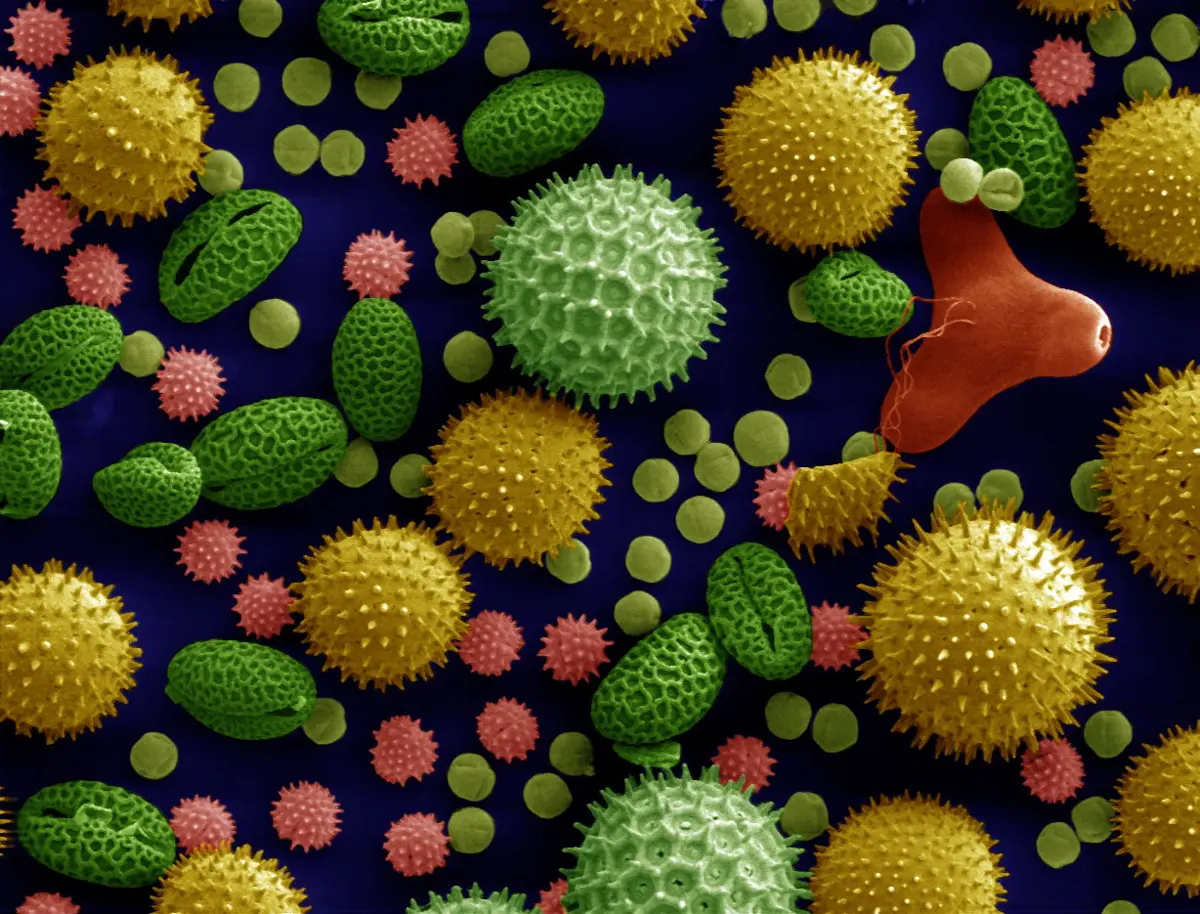
A pollen grain is far too small to see one by one: dust-sized, a few hundredths of a millimeter across. It has a tough wall of two layers. The outer layer is often covered in spikes, ridges or a sticky oil, which help it stick to an insect and to the stigma. Inside, it carries the cells that will make the male gametes. Each kind of plant has pollen of its own shape, so a scientist can tell from a pollen grain which plant it came from.
There are two types of pollination: self-pollination and cross-pollination.
(a) Self-pollination
Self-pollination is the transfer of pollen to a stigma of a flower on the same plant. It has two forms:
- Autogamy: pollen falls on the stigma of the same flower. No helper is needed.
- Geitonogamy: pollen reaches the stigma of another flower on the same plant. This needs a carrier, an insect or the wind, but the genes are still the plant’s own.
Self-pollination is common in small, dull flowers without nectar or scent, which don’t need to attract insects. Rice (paddy), wheat, peas and groundnut usually self-pollinate; in a pea, the flower pollinates itself before it even opens.
Advantages of self-pollination
- a.The good qualities of the parent plant are kept in its young.
- b.It nearly always produces seeds.
- c.It is easy: no pollinator is needed.
Disadvantages of self-pollination
- a.It brings no new characters into the young.
- b.Over many generations of only self-pollination, the plants slowly become weaker and make fewer seeds.
- c.Bad characters in the line can’t be corrected by mixing with other plants.
(b) Cross-pollination
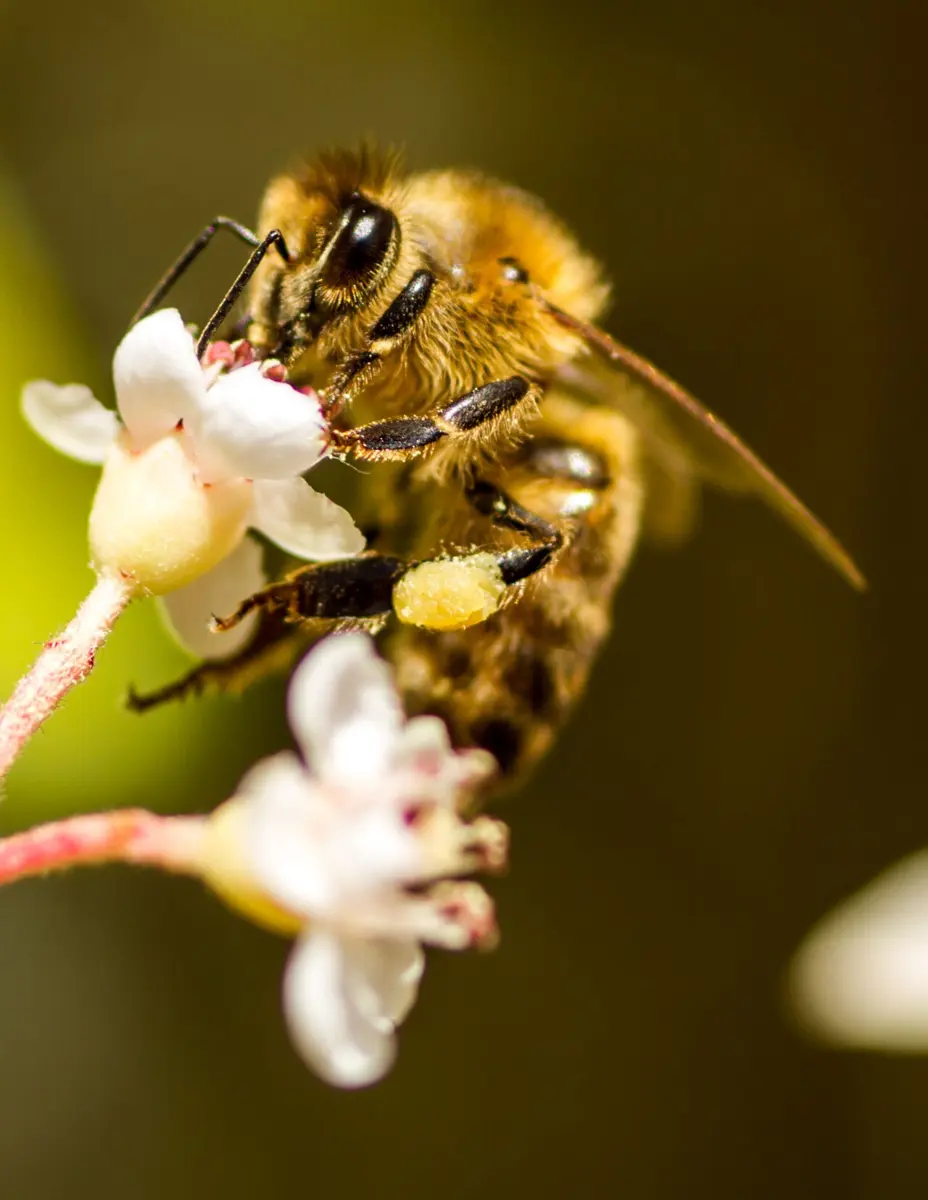
Cross-pollination is the transfer of pollen from a flower of one plant to a flower on a different plant of the same species. It usually happens in colorful, scented flowers with nectar, and in flowers whose anthers and stigma ripen at different times, so that they can’t pollinate themselves. Something has to carry the pollen: a pollinating agent.
| Pollinating agent | Name | The flowers are… | Examples |
|---|---|---|---|
| wind | anemophily | small, dull, no scent; lots of light, dry pollen; feathery stigmas | maize, rice, wheat, grasses (and pine’s cones) |
| water | hydrophily | small; pollen floats on or under the water | Vallisneria, Hydrilla |
| insects | entomophily | bright, scented, with nectar; sticky pollen | mustard, sunflower, pumpkin |
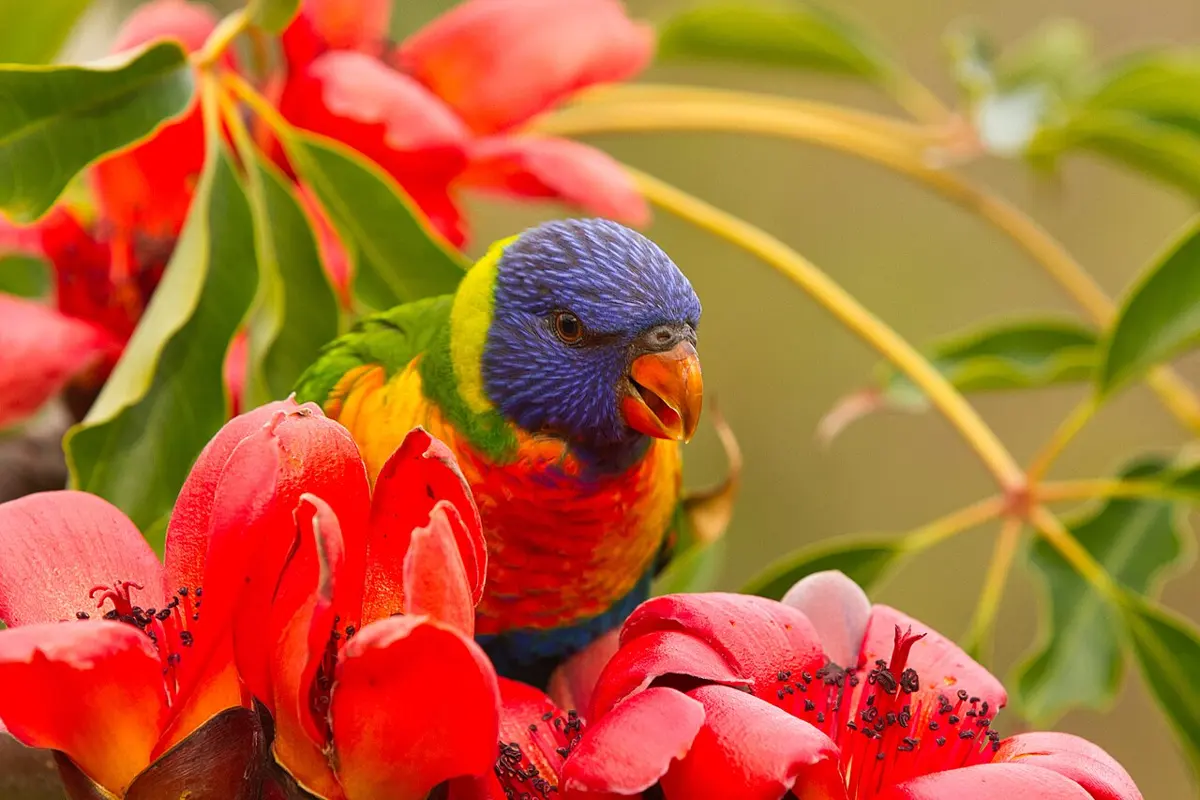
| birds | ornithophily | often red or orange, tube-shaped, with lots of nectar, little scent | coral tree (phaledo), silk cotton (simal), hibiscus |
The birds are small nectar-drinkers: in Nepal, sunbirds and tailorbirds (fisto); in the Americas, hummingbirds. Mango and litchi flowers are visited by flies and bees, and also shed pollen on the wind. Many plants use more than one agent.
Advantages of pollination
- a.Cross-pollination produces new plants with new, often better, combinations of qualities.
- b.Plants from cross-pollination are better able to adapt to their environment.
- c.It produces healthier seeds that germinate better.
Disadvantages of pollination
- a.Cross-pollination depends on pollinating agents; without them, it may not happen at all.
- b.It is hard to keep a plant’s good qualities exactly as they are: the young are mixtures.
- c.The young may also get bad, unwanted characters from the other parent.
A flower is small and green, with no scent and no nectar, and makes huge amounts of light, dry pollen. Its stigmas are long and feathery. How is it pollinated?
Pick an answer to see why.
(B) Fertilization
The fusion of a male gamete with a female gamete of the same species is called fertilization. In flowering plants, it happens inside the ovule, which sits inside the ovary.
A pollen grain that lands on the right stigma takes in water and sugar from the stigma’s sticky fluid, and germinates: it grows a long, thin pollen tube. The tube grows down through the style towards the ovary, like a root growing through soil. On the way, the pollen grain’s contents move into the tube and form two male gametes. The tube enters an ovule through a tiny opening, the micropyle, and releases both male gametes inside it.
- One male gamete fuses with the egg cell (the female gamete). They form the zygote, which grows into the embryo, the baby plant.
- The other male gamete fuses with the two polar nuclei in the large central cell of the ovule (in many plants these have joined into one secondary nucleus). This makes the endosperm nucleus, which grows into the endosperm, the food store of the seed.
Two fusions happen in each ovule, so this is called double fertilization. It is found only in flowering plants. Afterwards, the ovule becomes the seed and the ovary becomes the fruit; the petals, stamens, stigma and style usually wither and fall.
After fertilization, what does the ovary become?
Pick an answer to see why.
5.2.2 Sexual reproduction in animals
In most animals, males and females are separate. When they become adults, they can reproduce. Each has special organs for making gametes: the male has testes, which make sperms, and the female has ovaries, which make eggs or ova (singular: ovum). Sperms and eggs are the male and female gametes. Making gametes in the testes and ovaries is called gametogenesis. (In plants, gametes are made in the anthers and the ovules.)
The two gametes look nothing alike.
- A sperm is tiny and built to swim: an oval head holding the nucleus, with a cap called the acrosome that helps it get into the egg; a middle piece packed with mitochondria, which give it energy; and a long tail that whips to drive it forward.
- An ovum is large, round and still. It has a nucleus (with a nucleolus), a lot of cytoplasm with stored food, and a plasma membrane, surrounded by a clear jelly layer, the zona pellucida, and a ring of small cells, the corona radiata.
A man makes millions of sperms every day; a woman’s ovaries usually release just one ovum about once a month.
Fertilization in animals
After mating (a male and a female coming together so that his sperms reach her eggs), the sperms swim towards the egg. Many sperms may reach it, but only one fertilizes it: as soon as one sperm gets in, the egg’s outer layer changes and shuts all the others out. The nucleus of the sperm fuses with the nucleus of the egg. This is fertilization. The fertilized egg is now a zygote, carrying genes from both parents. The zygote is the first cell of the new body. It divides again and again into an embryo, which grows into a baby. The time a zygote takes to develop into a baby ready to be born or hatched is called the embryonic period (in mammals, the pregnancy or gestation period: about 9 months in humans and cows, about 2 months in dogs).
There are two kinds of fertilization in animals.
- Internal fertilization happens inside the female’s body, after mating. In mammals, the sperm meets the egg in the oviduct (in humans, the fallopian tube). Insects, spiders, reptiles, birds and mammals have internal fertilization.
- External fertilization happens outside the female’s body, in water. The female lays a large number of eggs in water, or on wet plants or stones, and the male releases sperms over them. Most fishes and amphibians (frogs, toads) do this.
| External fertilization | Internal fertilization |
|---|---|
| outside the body, in water | inside the female’s body |
| no mating; eggs and sperms are shed into water | after mating |
| very many eggs (a frog lays thousands) | far fewer eggs |
| eggs and young are unprotected; most are eaten | the egg is protected; more young survive |
| most fishes, frogs, toads | insects, reptiles, birds, mammals |
Which group of animals has external fertilization?
Pick an answer to see why.
Exercise (5.2 Sexual reproduction)
1. Choose the best answer
a. Where does fertilization take place in flowering plants?
Pick an answer to see why.
b. What is pollination by flies called?
Pick an answer to see why.
c. Which statement gives the meaning of cross-pollination?
Pick an answer to see why.
d. In Figure 5.25, which part is marked B?
Pick an answer to see why.
e. Which of these animals has internal fertilization?
Pick an answer to see why.
- f.Read these statements about fertilization:
- i.Usually the ovary becomes the fruit and the ovule becomes the seed after fertilization.
- ii.In some plants, the ovary becomes a fruit without fertilization.
- iii.The first fertilization happens in the stigma, and the second in the ovary.
- iv.Fertilization happens first, and then gametogenesis makes the zygote.
Which are true?
Pick an answer to see why.
g. Which sequence is right for pollination and what follows in a flowering plant?
Pick an answer to see why.
2. Differentiate between
Pollination and fertilization
Answer
| Pollination | Fertilization |
|---|---|
| Transfer of pollen from an anther to a stigma. | Fusion of a male gamete with a female gamete. |
| Happens on the outside of the flower, at the stigma. | Happens inside the ovule. |
| Needs an agent for cross-pollination (wind, insects…). | Needs a pollen tube to carry the male gametes. |
| Comes first. | Follows pollination. |
| Only in seed plants. | In all sexually reproducing organisms. |
Gametes and zygote
Answer
| Gametes | Zygote |
|---|---|
| Reproductive cells: sperm (male) and egg (female). | The cell formed when a male and a female gamete fuse. |
| Formed by gametogenesis in testes, ovaries, anthers, ovules. | Formed by fertilization. |
| Each carries half the set of chromosomes. | Carries a full set, half from each parent. |
| Can’t grow into a new individual alone (except in parthenogenesis). | Grows into the embryo and the new individual. |
Anther and pollen grain
Answer
| Anther | Pollen grain |
|---|---|
| The top part of a stamen, a sac on the filament. | A tiny grain made inside the anther. |
| Many cells; an organ that makes pollen. | A microscopic unit that carries the male gametes. |
| Stays on the flower and bursts open to release pollen. | Is carried to a stigma and grows a pollen tube. |
Autogamy and geitonogamy
Answer
Both are self-pollination: the genes come from one plant.
| Autogamy | Geitonogamy |
|---|---|
| Pollen reaches the stigma of the same flower. | Pollen reaches the stigma of another flower on the same plant. |
| Needs no pollinating agent. | Needs an agent (insect, wind). |
| Only in bisexual flowers. | In bisexual flowers, and in plants with separate male and female flowers (maize). |
| e.g. pea | e.g. maize, cucumber, when pollen moves between flowers of one plant |
External fertilization and internal fertilization
Answer
| External fertilization | Internal fertilization |
|---|---|
| Sperm and egg meet outside the female’s body. | Sperm and egg meet inside the female’s body. |
| Happens in water. | Can happen on land: the gametes never leave the body. |
| Very many eggs are laid. | Few eggs are made. |
| Eggs and young are unprotected, and most die. | The eggs are protected, and more young survive. |
| e.g. frog, most fishes | e.g. birds, mammals, insects, reptiles |
3. Give reasons
Pollinating agents have a great role in pollination.
Answer
Pollen can’t move by itself. For cross-pollination, and for geitonogamy, something must carry it from an anther to a stigma on another flower: wind, water, insects or birds. Without these agents, most flowers would get no pollen, and no fertilization, fruits or seeds would follow.
Both male and female are needed for sexual reproduction.
Answer
Sexual reproduction is the fusion of a male gamete with a female gamete. The male gamete (sperm, or the pollen’s male gamete) is made only by a male organ, and the female gamete (egg) only by a female organ. So both, whether in two separate individuals or in one bisexual organism, are needed to make a zygote.
External fertilization takes place in water, or in very wet places on land.
Answer
In external fertilization the sperms have to swim to the eggs, and the eggs, with no shell, would dry up and die in air. So animals with external fertilization lay their eggs in water (fishes, most frogs), or in very wet places on land, such as damp moss or a foam nest (some frogs), where the sperms can reach them and the eggs stay moist. On dry land it can’t happen.
4. Answer these questions
What is pollination? Give an example.
Answer
Pollination is the transfer of pollen grains from an anther to a stigma of a flower of the same species. Example: a honey bee visiting mustard flowers carries pollen from one flower to another (entomophily); the wind carries pollen from a maize tassel to the silks of a cob (anemophily).
Compare self-pollination and cross-pollination, with diagrams.
Answer
Draw the three routes in Figure 5.19.
| Self-pollination | Cross-pollination |
|---|---|
| Pollen reaches a stigma on the same plant (same flower or another flower of it). | Pollen reaches a stigma on a different plant of the same species. |
| Often no agent is needed. | An agent (wind, water, insect, bird) is always needed. |
| Flowers small, dull, without scent or nectar. | Flowers often bright, scented, with nectar; or with feathery stigmas for wind. |
| Anthers and stigma ripen together. | Anthers and stigma often ripen at different times. |
| No new characters; the line slowly weakens. | New combinations of characters; healthier young. |
| e.g. pea, wheat, rice | e.g. mustard, maize, pumpkin |
What is double fertilization? Describe it briefly.
Answer
In flowering plants, two fusions happen in each ovule; this is double fertilization.
A pollen grain on the stigma grows a pollen tube down the style. Two male gametes form in it. The tube enters the ovule through the micropyle and releases them.
- One male gamete fuses with the egg cell → zygote → embryo.
- The other fuses with the two polar nuclei (secondary nucleus) → endosperm nucleus → endosperm, the food for the embryo.
Then the ovule becomes the seed and the ovary becomes the fruit.
Draw a neat, labeled diagram of an ovum and a sperm.
Answer
Draw them as in Figure 5.22.
Ovum: corona radiata (outer ring of cells), zona pellucida (clear layer), plasma membrane, cytoplasm, nucleus, nucleolus.
Sperm: head (with acrosome and nucleus), neck, middle piece (with mitochondria), tail.
“Four puppies were born at a home.” What type of reproduction is this? Describe the importance of gametes in sexual reproduction.
Answer
This is sexual reproduction, with internal fertilization and live birth (dogs are mammals).
Importance of gametes:
- A male gamete and a female gamete fuse to form the zygote, the first cell of every new individual.
- Each gamete carries half of a parent’s genes, so the young get a new mixture from both parents. That is why the four puppies look different from each other.
- This variation helps a species adapt to changes and makes evolution possible.
- Gametes keep the number of chromosomes the same in every generation: half + half = a full set.
Make a chart showing sexual reproduction in animals.
Answer
Male (testes) → sperm
Female (ovaries) → ovum (egg)
sperm + ovum → fertilization (internal or external) → zygote → cell division → embryo → baby (born or hatched) → grows into an adult → makes gametes again.
(Draw it like Figure 5.23, with arrows.)
What is gametogenesis? Where does it take place in plants and in animals?
Answer
Gametogenesis is the making of gametes (sex cells) in the reproductive organs.
- In animals: sperms are made in the testes, and ova in the ovaries.
- In flowering plants: the male gametes are formed from the pollen made in the anthers (in many plants they form in the pollen tube), and the egg cell is made in the ovule, inside the ovary.
Name the type of fertilization in: human, pigeon, tortoise, butterfly, fish, bat, frog, cow, dragonfly, whale.
Answer
Internal: human, pigeon, tortoise, butterfly, bat, cow, dragonfly, whale.
External: fish (most fishes), frog.
What would happen if there were no sexual reproduction in plants and animals? Explain with an example.
Answer
- Animals that reproduce only sexually (cows, dogs, birds, humans) would have no young at all, and would die out in one generation.
- Plants that make only seeds (wheat, rice, mustard) would vanish; there would be no grains or most fruits to eat.
- Even organisms that can reproduce asexually would all be copies. With no variation, one new disease could wipe out all of them. Example: in the 1840s, Ireland’s potatoes, all grown from tubers and so nearly identical, were destroyed by one disease, and about a million people died in the famine that followed.
- With no variation, living things couldn’t adapt or evolve.
“If there is no pollination, fertilization is nearly impossible.” Justify this.
Answer
In a flowering plant the male gametes are carried in the pollen, and the egg is deep inside the ovule. The only way the male gametes reach the egg is by a pollen grain landing on the stigma and growing a pollen tube down to the ovule. If there is no pollination, no pollen reaches the stigma, no tube grows, and the male and female gametes never meet. So no fertilization, no seeds and (in most plants) no fruits form.
“Internal fertilization is safer than external fertilization.” How?
Answer
- The sperms are put directly inside the female’s body, so they are not lost in water, and many more eggs are fertilized.
- The fertilized egg is protected inside the mother (mammals) or by a shell (birds, reptiles), safe from drying, cold and animals that eat eggs.
- So, although fewer eggs are made, a much larger share of them survive to become adults. In external fertilization most eggs are never fertilized, or are eaten.
How do a flower’s scent, and the anthers and stigma ripening at different times, help pollination?
Answer
- Scent (with color and nectar) attracts insects and birds. As they move from flower to flower to feed, pollen sticks to them and rubs onto the next stigma, so cross-pollination happens.
- If the anthers and stigma of a flower ripen at different times, the flower can’t pollinate itself: when its pollen is ready its stigma isn’t, or the other way round. Its stigma must receive pollen from another flower, so cross-pollination is ensured, and the young get the benefits of variation.
Study Figure 5.26.
- i.Name the parts A, B, C and D.
- ii.What would happen to fertilization if part B were removed?
Answer
- i.A: stigma. B: anther. C: ovary. D: ovule.
- ii.B is the anther, which makes the pollen. Without its own anthers the flower could not pollinate itself, so self-pollination and fertilization by its own pollen would stop. It could still be fertilized if an insect or the wind brought pollen from another flower (cross-pollination). Growers remove anthers on purpose (emasculation) when they want to cross two varieties.
5.3 Seed
After fertilization, the zygote inside the ovule divides again and again and becomes the embryo, a tiny baby plant. When the embryo is complete, the whole fertilized ovule has become a seed. A seed, then, is a fertilized, ripened ovule with an embryo inside it, which can germinate into a new plant when it gets the right conditions. Just as babies are part of the life cycle of animals, seeds are part of the life cycle of flowering plants.
Seeds come in every size and shape: as fine as dust (orchids), small and round (mustard), flat (pumpkin), wrinkled (dry peas), winged (pine), hairy (simal), or huge (coconut).
Dispersal of seeds
Seeds grow inside fruits. A fruit may hold one seed (mango) or many (papaya). When the fruit ripens, the seeds separate from it. If they all fell right under the parent, the seedlings would fight it and each other for light, water and space. So many plants send their seeds away. The carrying of seeds from the parent plant to other places is called dispersal of seeds. It is an adaptation of flowering plants that lets them reach new places and settle there. Seeds are dispersed in five main ways:
- a.by wind
- b.by water
- c.by animals
- d.by gravity
- e.by bursting of pods
(a) Dispersal by wind
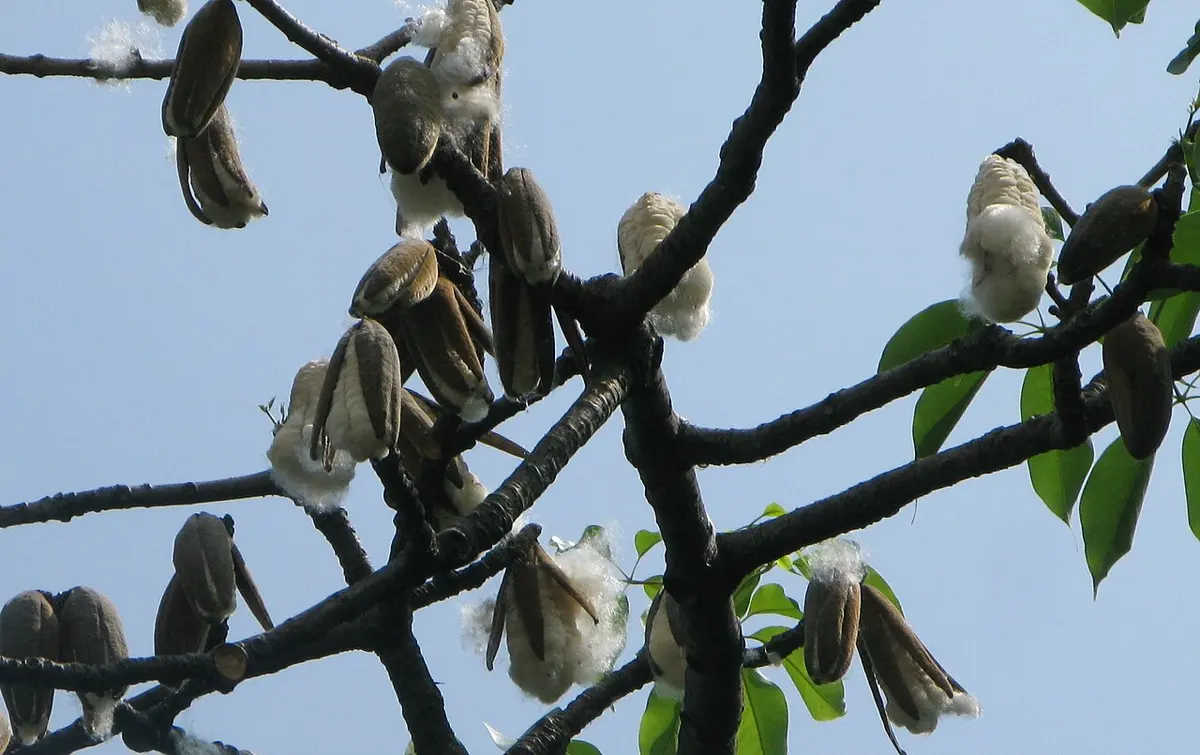
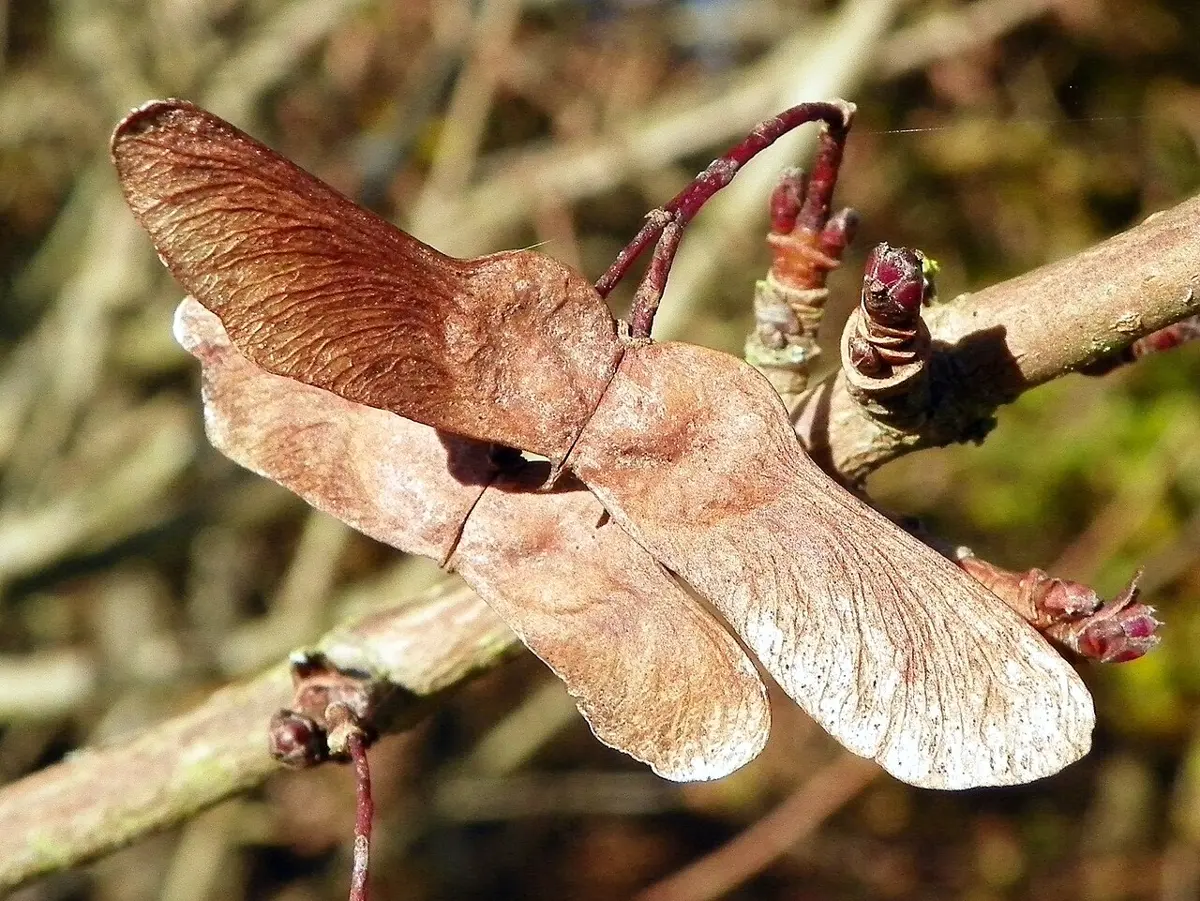
Seeds carried by the wind are small and light, and many have hairs like a parachute, wings, or little air-filled pouches, which lower their density and keep them floating in the air for a long time. When the fruit ripens and opens, the seeds lift off and the wind carries them far away. Simal (red silk cotton), aak (Calotropis), kans grass, dandelion, cotton, maple and pine seeds travel by wind.
(b) Dispersal by water
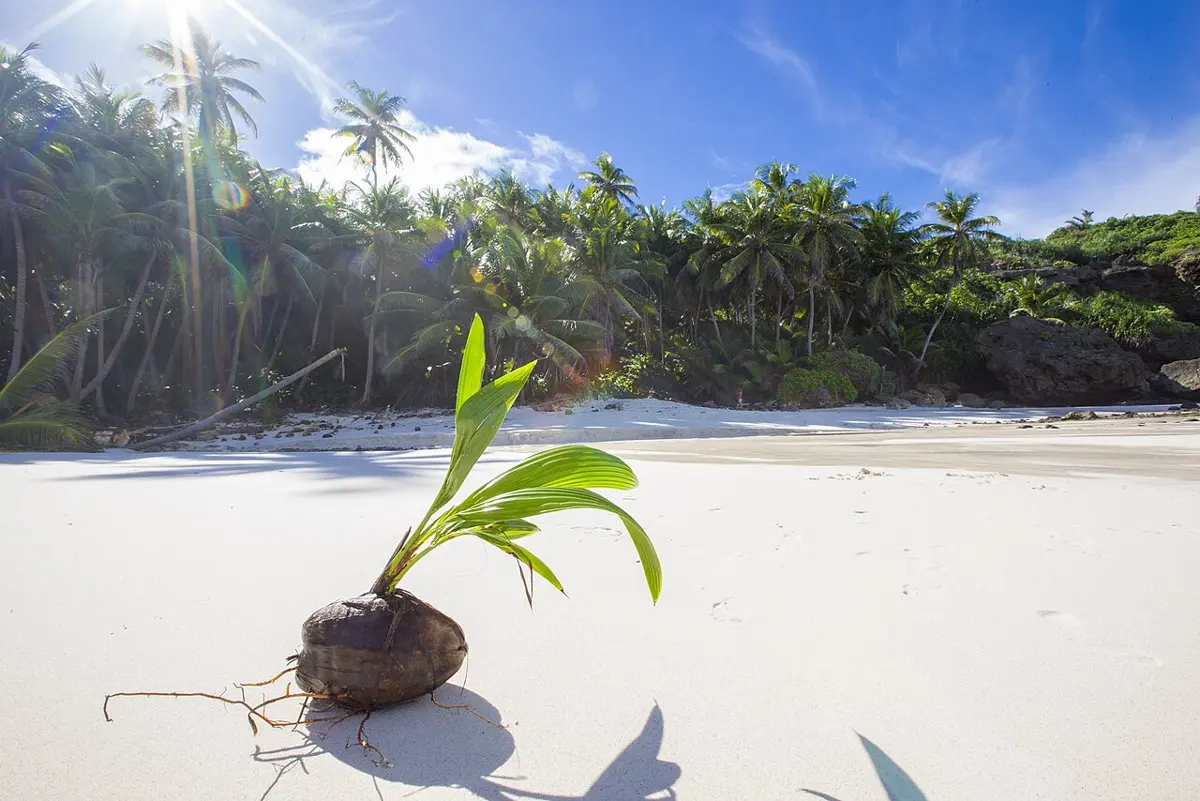
Plants of rivers, ponds, wetlands and seashores (hydrophytes, and plants of river banks) often have seeds or fruits that are waterproof, light and able to float. When they ripen and drop into the water, the current carries them far away. Lotus, water lily, mangroves, coconut and cattail are dispersed by water.
(c) Dispersal by animals
Many fruits are tasty, and are eaten by monkeys, deer, squirrels, rats, rabbits, birds and fruit bats (flying foxes). Animals help in two ways.
- Eaten and passed out. The animal swallows small seeds with the fruit. The seeds have hard coats, so they are not digested, and they pass out in the animal’s droppings (egested) far away, often with a little manure. Jamun, harro, barro, amala, guava, pear, kaphal and ainselu (raspberry) are spread like this. Other animals eat the flesh of a bigger fruit and drop the hard seed somewhere else.
- Hooks and bristles. Some seeds have hooks or spikes that stick to animals’ fur, or to your socks. They fall off later, far from the plant. Kuro (cobbler’s pegs, Bidens) and bhede kuro (cocklebur) are dispersed this way.
People are the biggest seed carriers of all: we have taken the seeds of cereals, pulses, fruits and vegetables all round the world. Maize, potatoes, tomatoes and chillies all came to Nepal from the Americas.
(d) Dispersal by gravity
Some fruits and seeds are big and heavy. When ripe, they simply fall to the ground under the parent plant. The fruit rots, and the seed germinates if conditions are right. Mango, apple and jackfruit fall this way (and are often carried farther by animals that eat them).
(e) Dispersal by bursting of pods
In some plants, the ripe fruit (a pod) dries in the sun and its walls pull unevenly as they dry, until it bursts open with a snap and throws the seeds out around the parent plant. Mustard, okra (ladies’ finger), beans, peas, ipil-ipil, dhaturo (thorn apple), laal gedi (rosary pea) and balsam (Impatiens) are dispersed like this.
Simal seeds are wrapped in light, silky cotton. How does this help them?
Pick an answer to see why.
Structure of a seed
A seed has three main parts: the seed coat, the embryo and the endosperm.
(a) Seed coat
The seed coat is the outer covering of the seed. It has two layers: a thick, tough outer layer, the testa, and a thin inner layer, the tegmen. On it you can see the hilum, a scar where the seed was attached to the fruit, and next to it a tiny hole, the micropyle, through which water enters when the seed is soaked. Litchi and tamarind have hard, shiny seed coats. (A coconut’s hard shell is not its seed coat but part of the fruit wall.) The seed coat protects the seed from injury, drying, insects and germs, and keeps it from germinating during bad conditions.
(b) Embryo
The embryo is the most important part of the seed: it is the baby plant, the part that grows when the seed germinates. It has three parts:
- the radicle, which grows into the root system;
- the plumule, which grows into the shoot system (stem and leaves);
- the cotyledon(s), the seed leaves. They protect the radicle and plumule, and in many seeds they store starch and protein for the young plant. In seeds like bean, they come above the ground and turn green, making food by photosynthesis for a few days: the plant’s first leaves.
A monocot seed (maize, rice) has one cotyledon; a dicot seed (bean, gram, mango) has two; and a gymnosperm (pine) has two or more, in a ring. In a monocot, a protective sheath, the coleoptile, covers the plumule; the first leaf grows out through it.
(c) Endosperm
The endosperm lies just under the seed coat. It stores food (starch and protein) for the embryo until the young plant can make its own food. In monocots such as maize, rice and wheat, the endosperm takes up most of the seed, and the cotyledon only absorbs food from it and passes it to the embryo. Most dicot seeds (castor is an exception) have no endosperm left when they are ripe: the embryo has already moved the food into its two fat cotyledons. That is why a bean is mostly cotyledon, and a grain of rice is mostly endosperm.
Germination of seed
A ripe seed can stay alive without growing for months or years if it is kept dry. This resting state, in which the seed stays unchanged and doesn’t grow, is called dormancy. It lets seeds wait out winter or drought, and lets farmers store seed until the next sowing. Different seeds stay alive for different lengths of time; well-stored seeds of many crops keep for several years.
When a seed gets enough water, air (oxygen) and warmth, it absorbs water and swells; chemical reactions start in its cells, and the embryo wakes up. The radicle comes out first and grows down into the root system. Then the plumule grows up into the shoot system. The growth of an embryo into a young plant, with its own root and shoot, is called germination.
There are two ways the young shoot comes up:
- In bean and gourds, the stem below the cotyledons (the hypocotyl) grows into a hook, pulls the cotyledons above the ground, and they turn green: epigeal germination.
- In maize, gram and pea, the cotyledons stay underground, and only the plumule grows up (in maize, through its coleoptile): hypogeal germination.
The young plant that grows from a germinated seed, until it is ready to plant out, is a seedling. A sprouting seed mobilizes its food: enzymes turn its stored starch and protein into sugars and smaller molecules, and new vitamins are made. That is why sprouted grains and pulses are easy to digest and nutritious.
Factors affecting germination
Germination depends on things inside the seed (a living embryo, enough stored food, dormancy broken) and on its surroundings. The outside factors are water, air, temperature and light.
(a) Water
Seeds are dried well in the sun before they are stored. In a dry seed, almost no chemical activity (metabolism) goes on. When it is soaked, the seed absorbs plenty of water through its micropyle and coat, swells, its dormancy breaks, and its cells become active. The water also softens the seed coat so the radicle can break through. That is why many seeds are soaked for about a day before sowing.
(b) Air
Germinating seeds need oxygen. The growing embryo needs a lot of energy, which its cells get by respiration: they use oxygen in their mitochondria to break down stored food. A dormant seed respires so slowly that it hardly uses any food or oxygen; once it germinates, it needs plenty. A seed buried in waterlogged soil, or kept under water, often fails to germinate or rots, because it can’t get air.
(c) Temperature
Seeds don’t germinate if it is too cold or too hot: their enzymes work only in a range of temperature. Many seeds germinate best at about 16–24 °C; crops of hot places such as maize and rice prefer it warmer, about 25–30 °C. That is why each crop is sown in its own season. A suitable temperature also helps break dormancy. Seeds buried in soil are kept moist, warm (the soil is warmed by the sun) and supplied with air.
(d) Light
Most seeds can germinate in the dark, under the soil. But as soon as the shoot comes up, the seedling needs light to make food by photosynthesis. Some small seeds (lettuce, many weeds and forest trees) do need light to germinate, so they wait in the soil until it is dug or a gap opens in the forest. That is why the seeds dropped on a dark forest floor may wait for years.
Importance of germination of seeds
- a.Germination produces the next generation of plants, so it is needed for the plant’s kind to carry on.
- b.Good germination of seeds on farms means a better harvest, which helps farmers, consumers and the country.
- c.Sprouted seeds are easier to digest and have more of some vitamins, so it is good to sprout grains and pulses before eating them.
- d.Good germination of the seeds of grasses and trees in forests and pastures helps to keep biodiversity.
Exercise (5.3 Seed)
1. Choose the best answer
a. How are the seeds of thatch grass (khar) dispersed?
Pick an answer to see why.
b. What is the main function of a seed?
Pick an answer to see why.
c. Which of these happens during germination?
Pick an answer to see why.
d. In Figure 5.33, which shows a seedling?
Pick an answer to see why.
e. Why are seeds not stored in damp or wet places?
Pick an answer to see why.
f. Which statement about dormancy is correct?
Pick an answer to see why.
g. Seeds of simal, aak, kans and maple have hairs, air sacs or wings. How do these help them to be dispersed?
Pick an answer to see why.
2. Differentiate between
Dispersal of seeds and germination of seeds
Answer
| Dispersal of seeds | Germination of seeds |
|---|---|
| The carrying of seeds away from the parent plant. | The growth of the embryo into a seedling. |
| Happens when the seed is ripe and dormant. | Happens when the seed gets water, air and warmth. |
| By wind, water, animals, gravity or bursting pods. | Inside the seed, by its own growth. |
| Spreads the plant to new places. | Starts the new plant’s life. |
Plumule and radicle
Answer
| Plumule | Radicle |
|---|---|
| The part of the embryo that grows into the shoot system. | The part of the embryo that grows into the root system. |
| Grows upwards, towards light. | Grows downwards, into the soil. |
| Comes out after the radicle. | Comes out first. |
| Bears the first tiny leaves. | Bears root hairs. |
Dispersal of mustard seeds and dispersal of kaphal (myrica) seeds
Answer
| Mustard seeds | Kaphal seeds |
|---|---|
| Dispersed by the bursting of pods. | Dispersed by animals (birds, monkeys, people). |
| The dry pod splits and throws the seeds out. | The juicy fruit is eaten, and the hard seed is passed out or spat out elsewhere. |
| Seeds land near the parent plant. | Seeds can travel far. |
| Seeds are small, round and dry. | Seed is inside a juicy fruit, with a hard stone. |
3. Give reasons
Seeds start to germinate when soaked in water.
Answer
A dry seed is dormant: with almost no water, its cells can’t carry out their chemical reactions. When soaked, it absorbs water through its micropyle and coat; the seed coat softens, enzymes become active, stored food is broken down for energy and growth, and the embryo starts to grow. So water breaks dormancy and starts germination.
Seeds of red silk cotton (simal) are dispersed over long distances.
Answer
Simal seeds are small and light and each is wrapped in fine, silky cotton. The cotton gives a lot of surface for very little weight, so the seed floats in the air and the wind carries it a long way, even several kilometers.
Seeds carry on the plant’s kind from generation to generation.
Answer
A seed holds an embryo, a new plant made by sexual reproduction, with food and a protective coat. It can stay dormant through bad seasons, travel to new places by dispersal, and germinate into a new plant that grows up and makes seeds of its own. So seeds link one generation to the next.
4. Answer these questions
What is a seed? Give examples.
Answer
A seed is a ripened, fertilized ovule, containing an embryo (a baby plant), a food store, and a protective seed coat, that can germinate into a new plant. Examples: rice, maize, gram, bean, mustard, mango seed (the stone), pumpkin seed.
List the methods of seed dispersal, and explain one with a figure and an example.
Answer
By wind, by water, by animals, by gravity, and by bursting of pods.
Wind: seeds that are small and light, with hairs, wings or air pouches, float in the air and are carried far by the wind. Example: simal, whose seeds float on silky cotton; maple, whose winged fruit spins as it falls. (Draw a seed with a tuft of hairs, or a winged maple fruit, with an arrow for the wind.)
What is seed dormancy? How does it help seeds?
Answer
Dormancy is the resting state of a ripe seed, in which it stays alive but does not grow, with its activity almost stopped.
It helps the seed to survive bad conditions (cold winter, dry season) and to wait until there is enough water, air and warmth to germinate and grow; it also gives time for the seed to be dispersed. For people, it means seeds can be stored safely from one season to the next.
Explain the germination of a seed, with a diagram.
Answer
Draw the bean in Figure 5.31.
- The seed absorbs water through its micropyle and swells; the seed coat softens and splits.
- Stored food in the cotyledons is broken down and used for energy (with oxygen) and growth.
- The radicle comes out first and grows down, forming the root and root hairs.
- The hypocotyl grows into a hook and pulls the cotyledons out of the soil (in bean); they turn green.
- The plumule grows up into the stem and the first true leaves. The young plant is now a seedling and starts making its own food.
What is the role of air in germination?
Answer
Air gives the seed oxygen. The cells of the germinating embryo respire, using oxygen in their mitochondria to break down stored food, and the energy released is used to grow. Without enough oxygen (in waterlogged soil, or under water) a seed can’t germinate, and often rots.
Mention the importance of germination of seeds, in points.
Answer
- It produces the next generation, keeping the plant’s kind going.
- Good germination means good crops: more food and income for farmers and the nation.
- Sprouted grains and pulses are easier to digest and more nutritious.
- Germination of the seeds of trees and grasses renews forests and pastures and keeps biodiversity.
Suryanarayan plowed his field well with a tractor and added compost to sow wheat. The next day he sowed the wheat and plowed the field again, which buried all the seeds in the soil. A few days later he found that where the soil was moist, the seedlings were good, but in the dry part of the field, germination was patchy.
- i.Why did he plow the field again after sowing?
- ii.Why did the seeds in the dry part not germinate well?
- iii.What should he do to get good seedlings in every corner of the field?
Answer
- i.To cover the seeds with soil, which keeps them moist and warm, gives them air in the loose soil, and saves them from birds.
- ii.The dry part lacked water. Without enough moisture, the seeds couldn’t absorb water, their dormancy didn’t break, and they did not germinate (or germinated late).
- iii.Irrigate the field evenly (or sow just after rain), soak the seeds for a day before sowing, keep the soil loose and moist but not waterlogged, sow at the right time and depth, and use good seeds.
Name the method of dispersal of: mango, chestnut, maple, gram, cobbler’s pegs (kuro), sesame (til), pumpkin, coconut, pear.
Answer
| Seed | Method |
|---|---|
| Mango | gravity (and animals) |
| Chestnut | the spiny husk splits and the nuts fall (bursting and gravity); squirrels carry them |
| Maple | wind |
| Gram | bursting of pods |
| Cobbler’s pegs (kuro) | animals (hooks stick to fur and clothes) |
| Sesame (til) | bursting of pods (capsules) |
| Pumpkin | animals and people (eaten), and gravity |
| Coconut | water |
| Pear | animals (eaten) |
Study Figure 5.34.
- i.Name the parts A to F.
- ii.What does part A grow into when the seed germinates?
- iii.Do all seeds have part F? What does it do?
Answer
- i.A: plumule. B: radicle. C: testa (outer seed coat). D: tegmen (inner seed coat). E: hilum. F: cotyledon.
- ii.The plumule grows into the shoot system: the stem and leaves.
- iii.Nearly all do: a seed has one cotyledon in monocots (maize) and two in dicots (bean). (The dust-like seeds of orchids are a rare exception: their tiny embryo has none.) The cotyledons store food for the germinating embryo (in dicots) or pass food to it from the endosperm (in monocots), protect the plumule and radicle, and in some seeds come up as the first green leaves.
“Eating sprouted seeds is better than eating dry seeds.” Explain.
Answer
When a seed sprouts, its enzymes break stored starch and protein into simpler sugars and amino acids, which are easier to digest. Some vitamins, such as vitamin C, are made, and others increase. Substances that block the absorption of minerals are reduced. And sprouts are soft, cook quickly, and taste fresh. So sprouted gram, moong or kwati are more nourishing and easier on the stomach than the same seeds dry.
Worksheet: Life Process: asexual reproduction and vegetative propagation (PDF, 4 pages)
Worksheet: Life Process: sexual reproduction in plants and animals (PDF, 4 pages)
Worksheet: Life Process: seeds, their dispersal and germination (PDF, 4 pages)
Practice every question in the book, and keep track of the ones you miss →