
Brain hormones, and how to measure them
Nobel Prize in Physiology or Medicine, 1977: Roger Guillemin, Andrew Schally, and Rosalyn Yalow
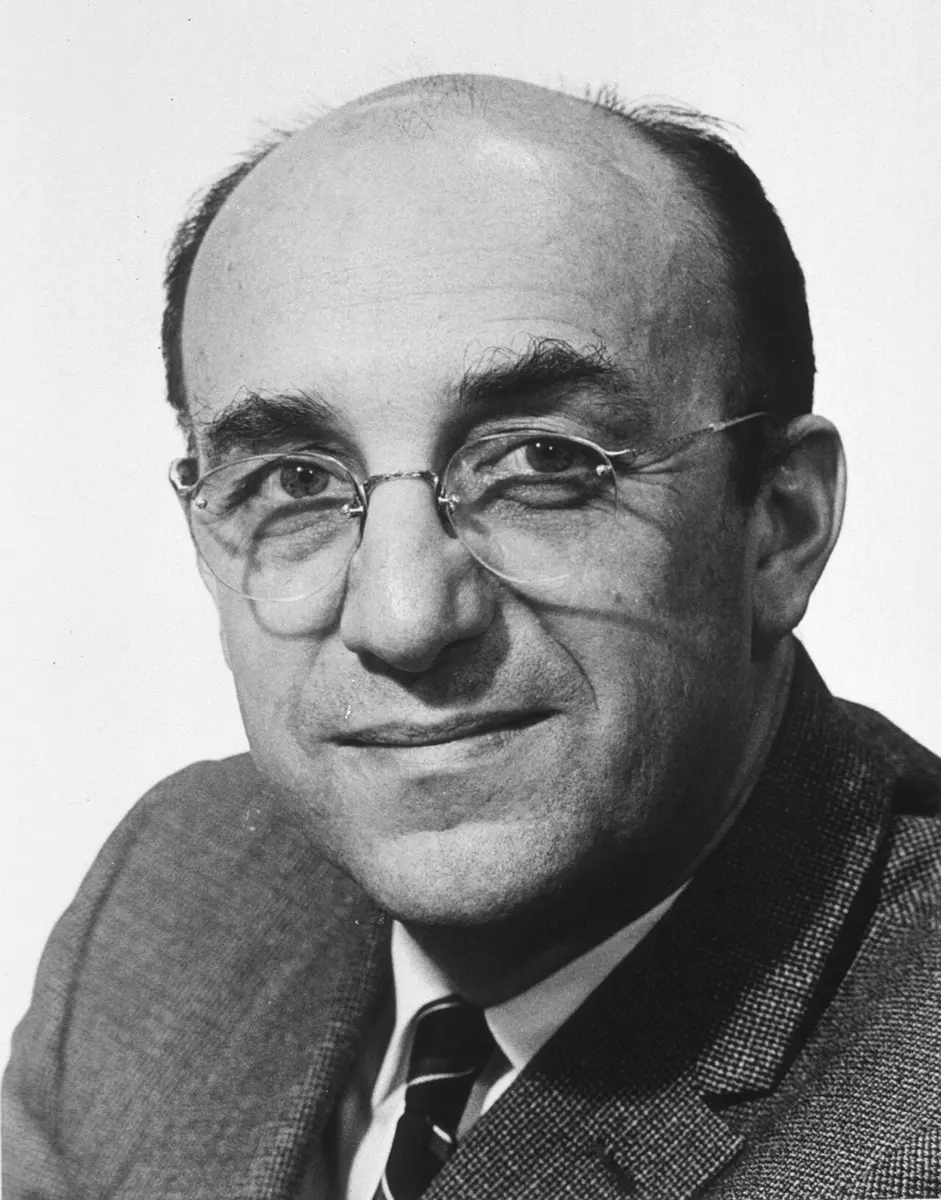
Roger Guillemin
1924–2024, born in Dijon, France
His medical school in Dijon had no laboratory at all. A lecture in Paris made him follow the speaker, Hans Selye, to Montreal to do research.
Photo: Unknown author, Public domain
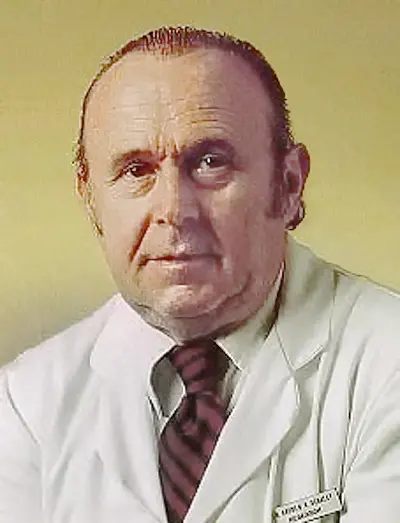
Andrew Schally
1926–2024, born in Wilno, Poland (now Vilnius, Lithuania)
He lived through the Second World War as a child in occupied Eastern Europe, and came to science by way of Scotland, London and Montreal. He did much of the purifying with his own hands.
Photo: US gov, Public domain
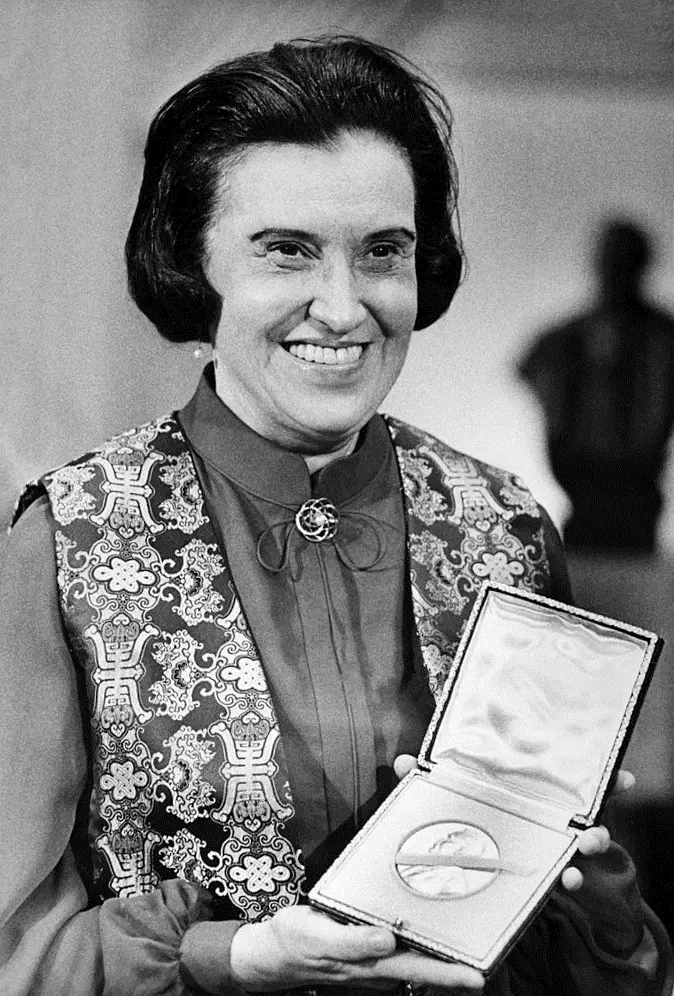
Rosalyn Yalow
1921–2011, born in New York, USA
A physicist, not a doctor. Her parents never finished high school; she became the second woman to win this prize.
Photo: Keystone, Public domain
When a doctor wants to know if your thyroid gland is working properly, a nurse takes a little blood from your arm, and a day later the laboratory sends back a number. That number is the amount of a hormone in your blood, and it is astonishingly small: a few millionths of a gram in a whole liter of blood, or less.
Before the 1960s, no laboratory in the world could measure amounts like that. The 1977 Nobel Prize in Physiology or Medicine was shared between two discoveries that belong together. Roger Guillemin and Andrew Schally found the hormones with which the brain gives orders to the body’s glands. Rosalyn Yalow found a way to measure tiny amounts of hormones in blood, a method that changed medicine.
The problem: messages too small to see
You know that hormones are chemical messengers. A gland releases them into the blood, and the blood carries them to cells far away Grade 9: Endocrine glands. The pituitary gland, the size of a pea at the base of the brain, is called the master gland, because its hormones control the thyroid, the adrenal glands and the sex glands Grade 9: Pituitary gland.
But who controls the master gland? Doctors had long noticed that the mind can change the body’s hormones. Fear, grief and stress can stop a woman’s periods, although nothing is wrong with her ovaries. So somehow the brain must send orders to the pituitary.
Just above the pituitary is a small part of the brain called the hypothalamus. In 1930 it was found that tiny blood vessels run from the hypothalamus down the pituitary’s stalk. From the 1940s, the British scientist Geoffrey Harris argued that the hypothalamus sends chemical messages down these vessels. Nobody could find them.
The second problem was measuring. Many hormones, such as insulin and growth hormone, are peptides or small proteins: chains of building blocks called amino acids. They are in the blood in fantastically small amounts. Some are at about one picogram per milliliter: a million-millionth of a gram in each milliliter. That is like one gram of sugar dissolved in a lake one kilometer long, one kilometer wide and one meter deep.
The old way to measure a hormone was to inject a sample into an animal and see how strongly the animal responded. It was slow and rough, and it needed a lot of material. To measure the stress hormone ACTH in a person this way took about 250 ml of blood, half a bottle of soft drink. You could not do that to a patient every day.
Why did doctors think the brain must control the pituitary?
Pick an answer to see why.
How the brain gives its orders
Here is the chain as we know it now, using the thyroid as the example.
- The hypothalamus releases a tiny hormone into the blood vessels that run down to the pituitary. For the thyroid, this is TRH (thyrotropin-releasing hormone).
- TRH tells the pituitary to release its own hormone, TSH (thyroid-stimulating hormone), into the general blood.
- TSH travels to the thyroid in the neck, which then releases thyroxine, the hormone that sets how fast your cells use food and oxygen.
- When there is enough thyroxine in the blood, it tells the hypothalamus and the pituitary to slow down. This is called negative feedback: like a person filling a bucket who turns the tap down as it gets full.
The hypothalamus has a releasing hormone like this for several of the pituitary’s hormones: one for the hormones that control the ovaries and testes, one for the stress hormone ACTH, one for growth hormone. It also has at least one hormone that says “stop”. Each is a short chain of amino acids. These were what Guillemin and Schally set out to find.
Why it was hard
The amounts were the problem again. The hypothalamus of a sheep or a pig is about the size of a fingertip, and each holds only a tiny trace of each releasing hormone, mixed in with thousands of other chemicals. To collect even a milligram of one, you need the brains of hundreds of thousands of animals, and then you must purify it, step after step, while testing at every step that you still have the active substance.
Many scientists doubted that these hormones existed at all, and by the late 1960s the people paying for the research were losing patience.
What they did, step by step
Guillemin and Schally: a race through millions of brains
The two men began together. In 1957 Schally, fresh from his doctorate in Montreal, joined Guillemin’s laboratory at Baylor University in Houston, USA. Both were sure they would find the first releasing hormone quickly. They didn’t. After about five years they parted, and from 1962 they ran rival teams: Schally at the Veterans Administration Hospital in New Orleans, Guillemin in Houston and later at the Salk Institute in California.
- 1960s, collecting. Guillemin’s team collected the hypothalamus of sheep from slaughterhouses, Schally’s team those of pigs. The Nobel committee said each team used about five million hypothalamus fragments, nearly half a tonne. Other accounts give smaller numbers, but all agree that it took the brains of hundreds of thousands of animals.
- Purifying and testing. At each step the extract was tested on pituitary tissue: did it still make the pituitary release TSH? Fractions that did were purified again. Both teams concentrated on the same hormone, TRH, and the race became fierce.
- 1969, one milligram. Each team ended with about one milligram of pure TRH, less than a single grain of rice weighs. The presentation speech joked: “Rarely have so many gained so little from so much.”
- 1969, the structure. TRH turned out to be tiny: a chain of just three amino acids (glutamic acid, histidine and proline, with their ends slightly changed). Both teams worked out its structure in 1969, and Guillemin’s team made it in the laboratory the same year. Synthetic TRH worked exactly like the natural hormone, in animals and in people.
- 1971, the second hormone. Schally’s team, and shortly afterwards Guillemin’s, found the hormone that controls the ovaries and testes, GnRH (also called LH-RH), a chain of ten amino acids. It tells the pituitary to release the two hormones that make eggs ripen and sperm form.
- 1973, the brake. Guillemin’s team found somatostatin, a chain of fourteen amino acids that tells the pituitary to make less growth hormone. It was the first brain hormone found that says “stop”.
TRH, GnRH and somatostatin are all chains of amino acids. Which of these is also a chain of amino acids?
Pick an answer to see why.
Rosalyn Yalow: a physicist in a hospital
Rosalyn Yalow studied physics in New York and then at the University of Illinois. There, in 1941, she was the only woman among about 400 teachers in the College of Engineering, the first since 1917. She earned a doctorate in nuclear physics in 1945 and became skilled at measuring radioactivity.
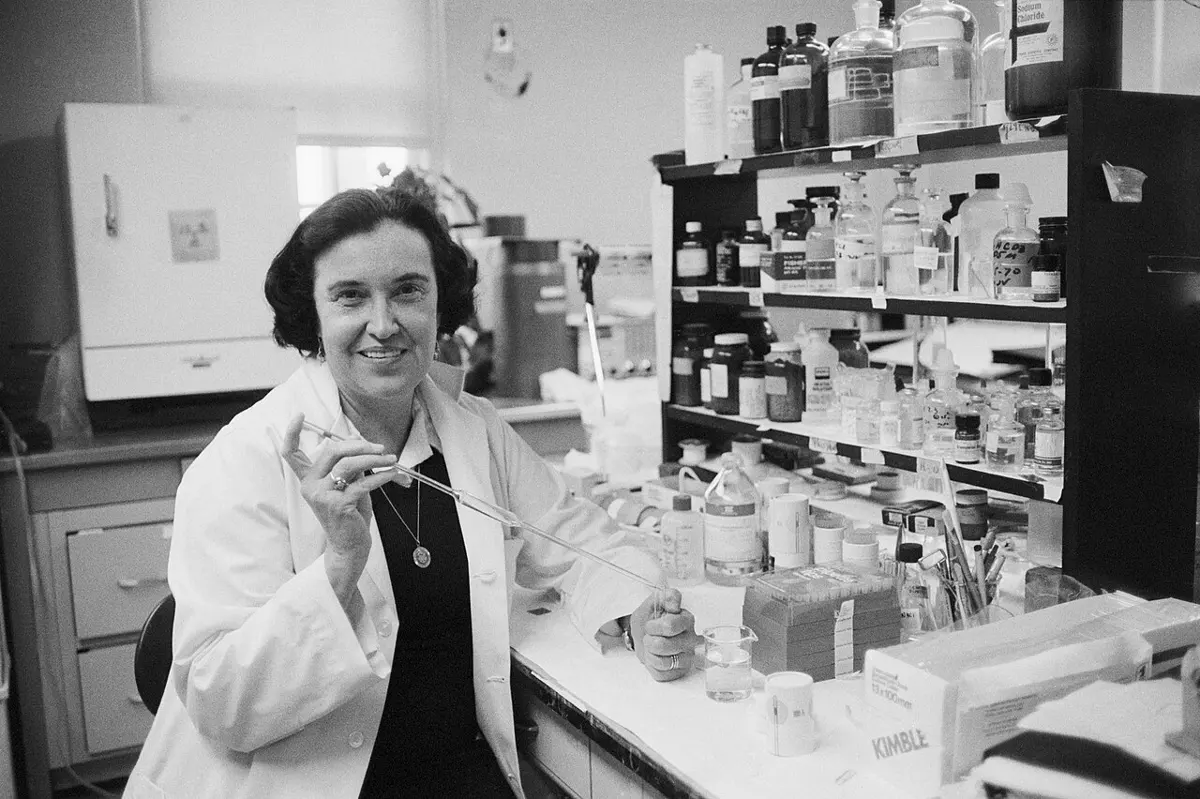
In 1947 she joined the Veterans Administration Hospital in the Bronx, New York, to set up a laboratory using radioactive isotopes in medicine. It started, she said, in a former janitor’s closet. In 1950 a young doctor, Solomon Berson, joined her. They worked together for 22 years.
- Early 1950s, a puzzle. Yalow and Berson gave patients a little insulin labeled with radioactive iodine, so they could follow it in the blood with a radiation counter. In patients who had been treated with insulin before, the insulin stayed in the blood much longer than in others. Something was holding on to it.
- 1955–1956, antibodies. That something was antibodies. Insulin for diabetes then came from the pancreases of cows and pigs, and the patients’ immune systems had made antibodies against it. Experts were sure a molecule as small as insulin could not cause antibodies. Science refused their paper, and the Journal of Clinical Investigation accepted it only after they took the word “antibody” out of the title. It was published in 1956.
- The key observation. In a test tube, the antibodies grabbed the radioactive insulin. But when they added ordinary, non-radioactive insulin, it pushed some of the radioactive insulin off: the two kinds competed for the same places on the antibodies. The more ordinary insulin they added, the less radioactive insulin stayed stuck.
- 1959–1960, a method. They turned this into a way of measuring insulin in human blood: the radioimmunoassay, or RIA (“radio” for the radioactive label, “immuno” for the antibodies, “assay” meaning a measurement). It could measure as little as 10 picograms of insulin, and later less than one picogram of ACTH in a milliliter of blood.
Berson died in 1972. The Nobel Prize is not given after death, so Yalow received it alone. She named her laboratory after him so that his name would stay on her papers.
How it works now
The idea of RIA is a competition, and it is easiest to see with a game of musical chairs.
- Put a fixed number of antibodies in a tube. Each antibody is a “chair” that can hold one hormone molecule.
- Add a fixed amount of radioactive hormone, more than there are chairs. Some of it sits down; the rest is left standing.
- Now add the patient’s blood. Its hormone (not radioactive) competes for the same chairs.
- Separate the hormone sitting on antibodies from the free hormone, and measure the radioactivity of the bound part with a gamma counter.
If the blood has no hormone, the radioactive hormone takes most of the chairs and the bound part is very radioactive. If the blood has a lot of hormone, it takes many of the chairs and the bound part is only weakly radioactive. By comparing with tubes made with known amounts of hormone, the laboratory reads off how much hormone is in the blood.
In a radioimmunoassay, the radioactivity stuck to the antibodies is very low. What does that tell you about the blood sample?
Pick an answer to see why.
The method works for anything an antibody can be made against: not just peptide hormones, but steroid hormones, vitamins, medicines, drugs, viruses. Within a few years RIA was used in thousands of laboratories. Yalow and Berson never patented it. They wanted anyone to be free to use it.
In your life today
- Thyroid tests. Thyroid problems are common, in Nepal too, where goiter was once widespread in the hills Grade 9: Thyroid gland. The first test a doctor orders is usually TSH, measured by an immunoassay: Yalow’s idea of antibodies grabbing a hormone. Today the label is usually a chemical that gives off light or changes color instead of a radioactive one, but the principle is the same. If the thyroid makes too little thyroxine, the pituitary pushes harder and TSH goes up: the feedback chain above, read backwards.
- Pregnancy tests. A home pregnancy test detects hCG, a hormone made in early pregnancy, with antibodies on a paper strip. It is a direct descendant of the immunoassay.
- Diabetes research. With RIA, Yalow and Berson showed that many people with type 2 diabetes have plenty of insulin in their blood: their bodies respond to it poorly Grade 10: Diabetes.
- Medicines from brain hormones. Copies of GnRH, changed to last longer, are used to treat prostate cancer, to stop puberty that starts far too early, and in fertility treatment. Schally himself led the first trials in prostate cancer. Long-lasting copies of somatostatin treat people whose pituitary makes too much growth hormone.
What came next
- More brain hormones. Guillemin’s former student Wylie Vale found the releasing hormone for the stress hormone ACTH in 1981, and Guillemin’s team found the one for growth hormone in 1982. In the 1970s Guillemin’s team also found endorphins, brain chemicals that dull pain, like morphine made by the body itself.
- No more radioactivity. From the 1970s, labels that change color or glow (the method called ELISA is one) gradually replaced radioactive ones in most tests. They avoid radioactive waste and are cheaper, but they rest on Yalow’s competition of hormone and antibody.
- Mind and body. The hypothalamus turned out to link feelings to hormones, as doctors had suspected: long stress raises the stress hormones and can upset sleep, growth and periods. How long-term stress, through these hormones, affects health, from the heart to the immune system, is still being worked out.
In your science books
- Grade 9: endocrine glands, the pituitary gland, the thyroid gland, the pancreas and insulin, nerves and hormones working together, and radioactive elements.
- Grade 10: diabetes.
- Going further: proteins do the work, in “How does a gene make a protein?”
Learn more
- The Nobel Prize’s press release and presentation speech.
- The laureates’ Nobel lectures: Guillemin, Schally and Yalow.
- Rosalyn Yalow’s own story.
The official reason
The prize was given “for their discoveries concerning the peptide hormone production of the brain.”
The prize was given “for the development of radioimmunoassays of peptide hormones.”