
Jumping genes in a cob of maize
Nobel Prize in Physiology or Medicine, 1983: Barbara McClintock
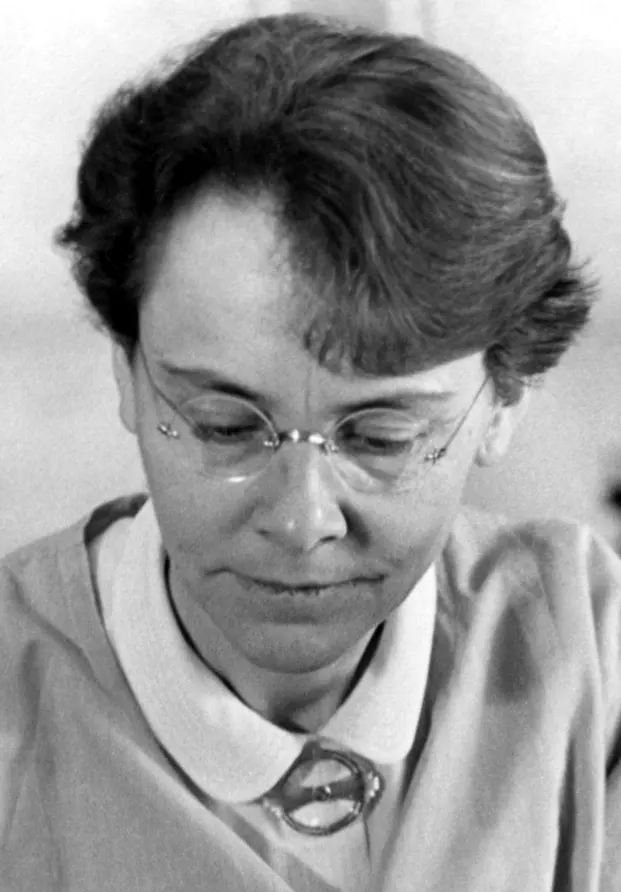
Barbara McClintock
1902–1992, born in the United States
She worked almost alone, with maize plants she grew herself every summer, and a microscope. She won the prize at 81, more than thirty years after her discovery.
Photo: Smithsonian Institution /Science Service; Restored by Adam Cuerden, Public domain
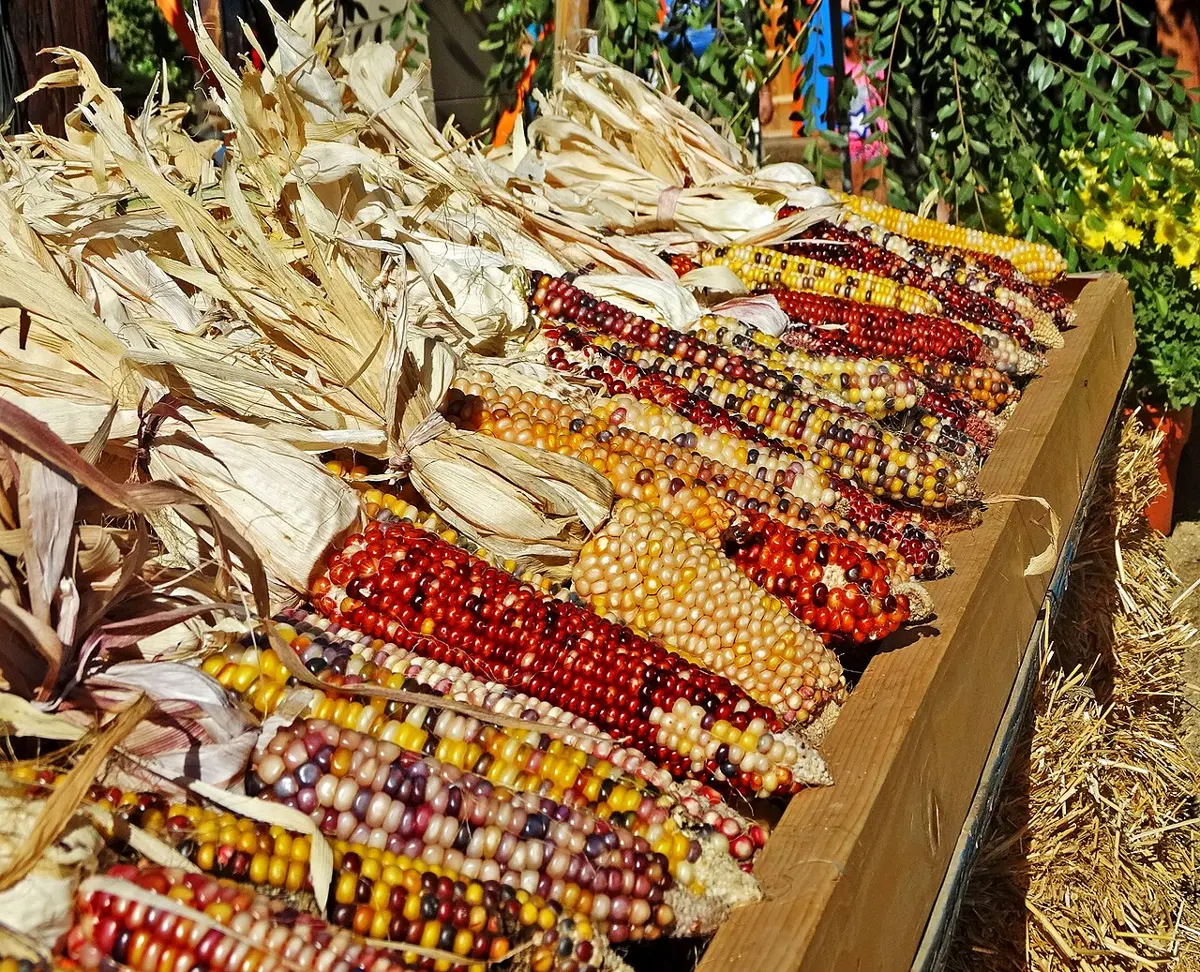
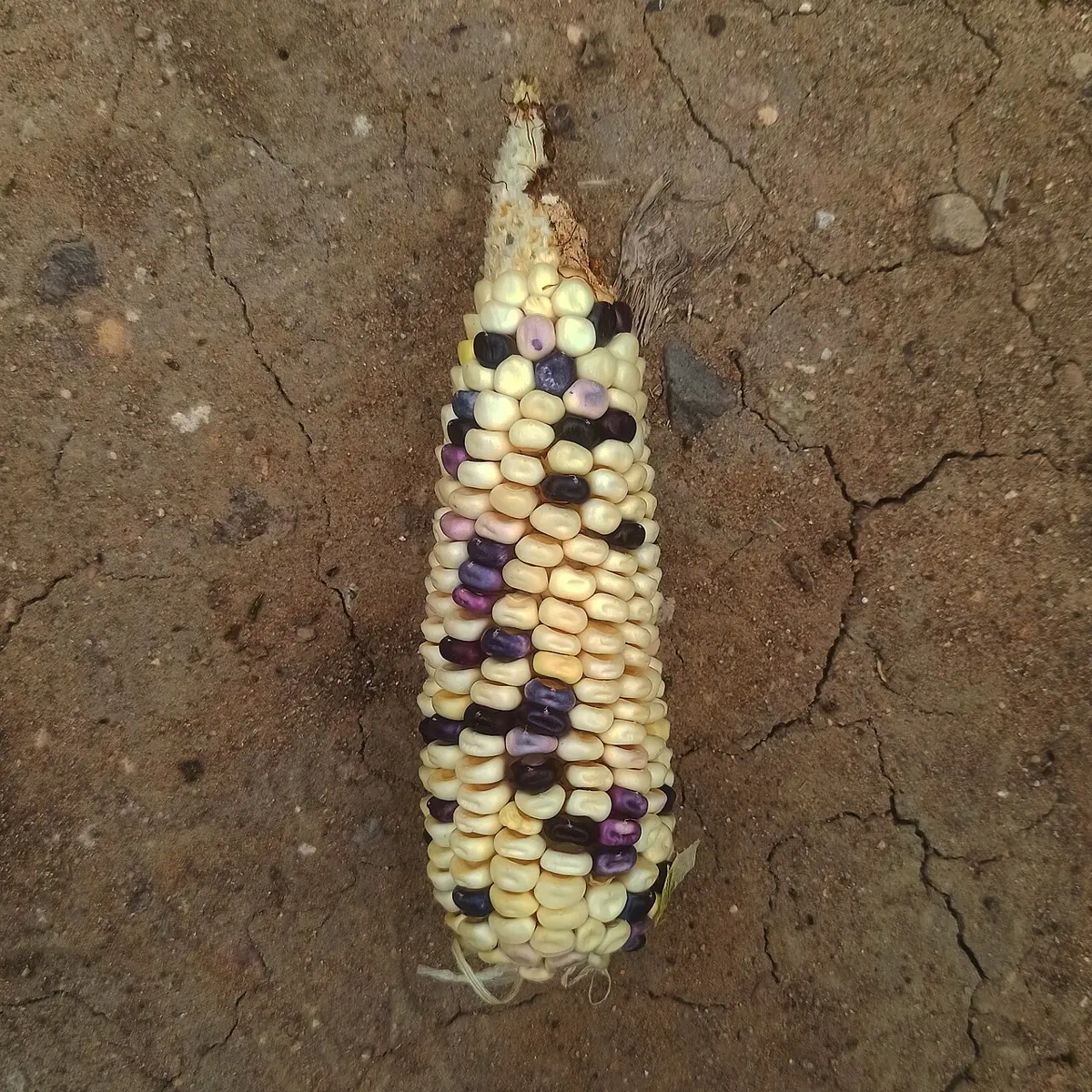
In autumn, in the hills of Nepal, maize cobs hang drying under the eaves of houses, and roasted cobs, poleko makai, are sold at every bus stop. Most cobs are yellow or white. But look at enough of them and you may find a cob with a few purple or red kernels, or kernels that are pale with purple speckles, as if someone had flicked paint at them.
Those speckles puzzled scientists for years. Barbara McClintock worked out what makes them, and in doing so she found something nobody believed at first: genes that move. They jump from one place on a chromosome to another, switching other genes off and on as they go. For this she received the 1983 Nobel Prize in Physiology or Medicine.
The problem: genes were supposed to stay put
By the 1930s, scientists knew that the instructions for a living thing are carried on chromosomes, the thread-like structures in the nucleus of every cell Grade 10: chromosomes. Each instruction is a gene. Genes were pictured like beads on a string: each in its own fixed place, always in the same order. Scientists even drew maps showing where each gene sat.
Genes could change: a change in a gene is a mutation Grade 9: mutation. But mutations were thought to be rare accidents that happen to one gene at a time, at random. Nobody imagined that a piece of a chromosome could pick itself up, move to a new place, and change how the genes around it work.
Spotted maize kernels didn't fit. Different kernels on one cob can be different colors for ordinary reasons. Each kernel is a separate seed, made when a separate grain of pollen reaches it, so kernels on one cob are like brothers and sisters, and Mendel's rules explain why they differ Grade 10: Mendel's laws. But a spotted kernel is different inside one seed. Some of its cells make purple pigment and some don't. Why?
Why can kernels on the same maize cob be different colors, even without any jumping genes?
Pick an answer to see why.
How a kernel gets its color, and its spots
The color of a maize kernel is in a thin outer layer of its food store. The purple comes from a pigment, made by the cells of that layer. Several genes are needed to make it. If one of them is broken, the cell can't make the pigment, and the kernel is pale: yellow or white.
A kernel's outer layer grows from one cell, which divides again and again, by mitosis, into thousands Grade 10: cell division. Each new cell gets a copy of its mother cell's DNA. So if something changes in one cell's DNA, all the cells that come from it carry the same change, and they sit next to each other in a patch.
This gives a way to tell when a change happened, just by looking at the size of the patch (Figure 2). A change early in the kernel's growth gives a big patch; a change late gives a tiny dot.
Why it was hard
McClintock had no way to read DNA. In the 1940s nobody knew yet that genes are made of DNA, and its double-helix shape was discovered only in 1953 Grade 10: DNA. All she had were:
- crosses: pollinating chosen plants by hand and counting what the kernels of the next generation looked like;
- a microscope, to look at the chromosomes themselves;
- time: maize gives only one generation a year where she worked, so each experiment took a whole summer to grow, and a whole winter to study.
And the patterns were complicated: spots of different sizes, numbers and colors, changing from one generation to the next. To make sense of them she had to keep track of thousands of kernels, and hold the whole story in her head.
What McClintock did, step by step
Learning to read maize chromosomes
- 1920s: Cornell University. McClintock studied at Cornell, in New York State, and earned her PhD there in 1927. She found a way to stain maize chromosomes so that all ten kinds could be told apart under the microscope, by their lengths and shapes. Maize became the plant whose chromosomes were best known.
- 1931: chromosomes swap pieces. With a young student, Harriet Creighton, she proved that when egg and pollen cells form, the two chromosomes of a pair swap pieces (crossing over). They saw the swap under the microscope and, at the same time, saw the genes on those pieces swap in the next generation's kernels.
- 1930s: broken chromosomes. At the University of Missouri she studied chromosomes broken by X-rays. She found that broken ends can stick together, then break again at the next division, over and over. Plants with such chromosomes had streaks and patches of different colors.
Finding the genes that move
- 1944: a place that breaks. At Cold Spring Harbor Laboratory, on Long Island near New York City, where she worked from 1942, McClintock grew plants descended from ones with broken chromosomes. In some, one arm of chromosome 9 broke again and again, always at the same spot. She named what was there Ds, for “Dissociation” (breaking apart).
- A second factor. Ds caused breaks only when another factor, somewhere else in the plant's chromosomes, was present too. She called it Ac, for “Activator”.
- 1948: they move. Following Ds through generation after generation, she found it in new places on the chromosomes. Ds could jump, and so could Ac. When Ds landed inside a pigment gene, the gene stopped working, and the kernel was pale. When Ds jumped out again in a growing kernel, the gene worked once more in that cell and in all its daughter cells, making a purple spot (Figure 3).
- Controlling the timing. Ac decided when Ds jumped. With some forms of Ac the jumps came early (big spots), with others late (small dots). McClintock called Ds and Ac controlling elements, because they controlled when and where other genes worked.
- 1950–1951: telling the world. She published her results in 1950 and presented them at a meeting at Cold Spring Harbor in the summer of 1951. Her talk was met, she said later, with “puzzlement and, in some instances, hostility”. Few people understood it.
- Working on. From 1953 she mostly stopped trying to convince others. She kept working, and reported her results in the yearly reports of her institute, which few scientists read.
A pale kernel has many tiny purple dots, but no big patches. What does this tell you?
Pick an answer to see why.
How it works now
In the 1960s and 70s, scientists found jumping pieces of DNA in bacteria, then in yeast, fruit flies and people. Today they are called transposons or transposable elements, and they can be read letter by letter.
- Ac is a stretch of DNA about 4,600 letters long. It carries the gene for an enzyme that cuts Ac out of the chromosome and pastes it in somewhere else, a kind of cut and paste.
- Ds is a damaged copy of Ac. Its own gene for the cutting enzyme is broken, so Ds can't move by itself. It moves only when Ac in the same cell makes the enzyme, which is just what McClintock found.
- Other kinds of jumping genes copy and paste: the cell makes a copy of them, and the copy is put in at a new place, so their numbers grow.
Over millions of years, copies have piled up. About 85% of the DNA of maize, and almost half of human DNA, is made of jumping genes or their remains. Most of these copies are now broken and can never move again, but they are still there, like old words copied into a book.
In your life today
- Germs that resist medicines. Some transposons in bacteria carry genes that protect against antibiotics. Because they can jump onto small rings of DNA that bacteria pass to one another, resistance can spread from one kind of bacterium to another. This is one reason a medicine that once worked can stop working (why antibiotics stop working).
- Mendel's wrinkled peas. In 1990 scientists found why some of Mendel's peas are wrinkled: a jumping gene had landed inside a gene that makes starch.
- White grapes. The first grapevines had dark grapes. White grapes come from vines in which a jumping gene landed next to the gene that makes the dark color, and switched it off.
- A tool for scientists. Scientists use Ac and Ds, and other transposons, on purpose: to switch off genes in plants one at a time and see what each gene does, and to carry new genes into cells.
- Maize in Nepal. Maize is Nepal's second most important cereal after rice. Some speckled and streaked cobs that farmers find are colored by jumping genes, just like McClintock's.
What came next
- Reading Ac. In the early 1980s Nina Fedoroff and her colleagues cut Ac and Ds out of maize DNA and read them, confirming McClintock's picture at the level of DNA.
- Your immune system. Your body makes millions of different antibodies by cutting and joining pieces of a few genes. The enzymes that do the cutting seem to have come, long ago, from a jumping gene that our ancestors' cells tamed.
- An open question. Are jumping genes just “selfish” DNA that copies itself, which cells put up with? Or have they also been useful, as raw material for new genes and new ways of switching genes on and off? Scientists are finding examples of both, and how much they have shaped evolution is still being worked out (shared mistakes in DNA).
In your science books
- Grade 9: mutation and variation and heredity.
- Grade 10: mitosis, meiosis, DNA, chromosomes and Mendel and his peas.
- Going Further (9–12): how a gene makes a protein, crossing over and why antibiotics stop working.
Learn more
- The Nobel Assembly's press release and the presentation speech (nobelprize.org).
- McClintock's Nobel lecture, “The significance of responses of the genome to challenge”, and her banquet speech.
The official reason
The prize was given “for her discovery of mobile genetic elements.”