
Streptomycin: the first cure for TB
Nobel Prize in Physiology or Medicine, 1952: Selman Waksman
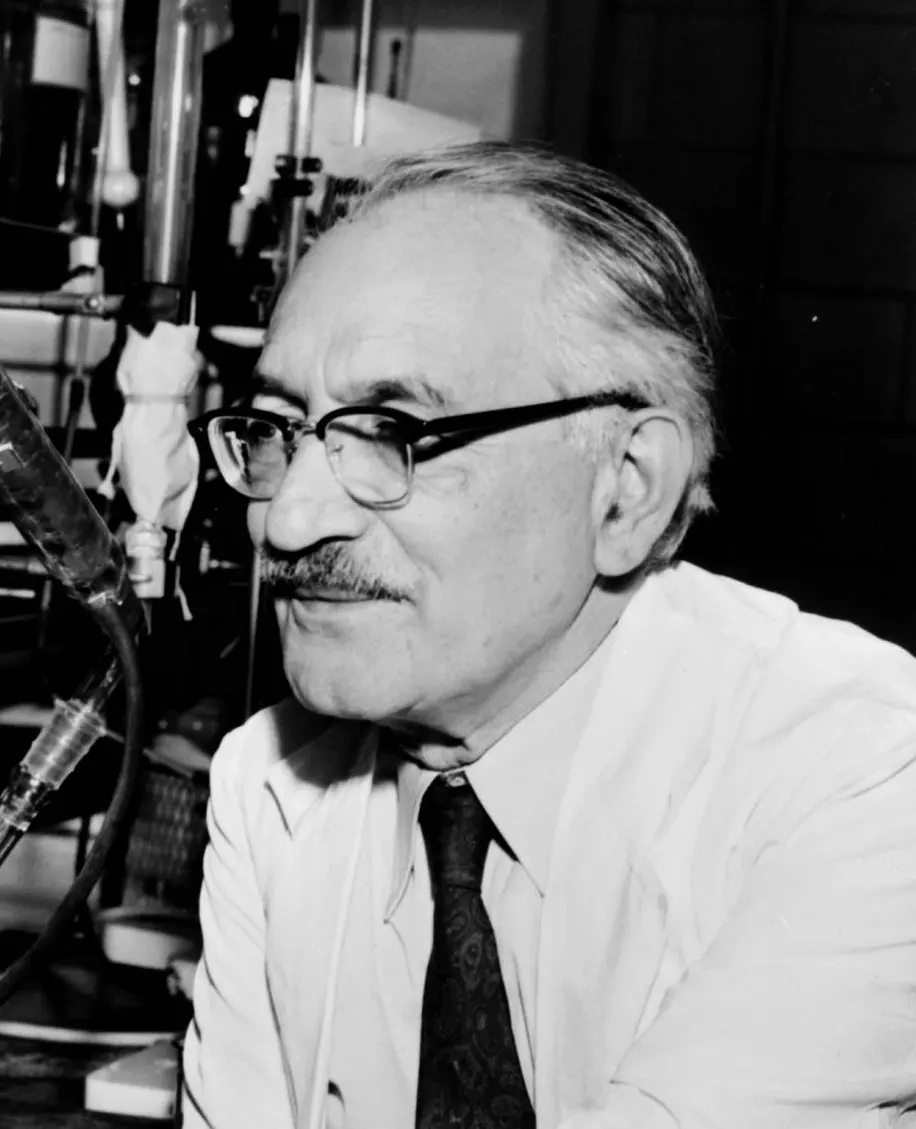
Selman Waksman
1888–1973, born in the Russian Empire (now Ukraine)
A soil scientist, not a doctor, who spent his life studying the tiny living things in earth.
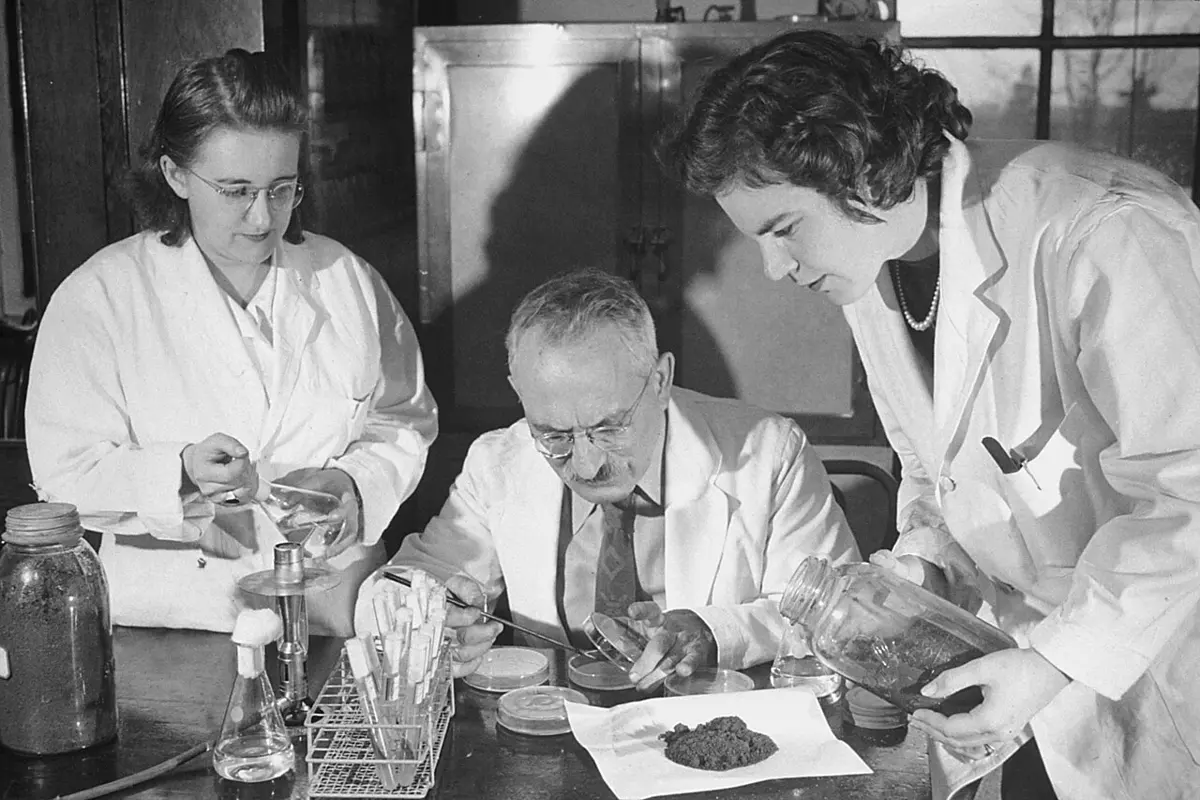
Photo: New York World-Telegram and the Sun staff photographer: Higgins, Roger, photographer., Public domain
Think of the smell of the ground after the first rain of the monsoon. Part of that earthy smell is made by tiny living things in the soil called streptomycetes. They are everywhere: in the fields, in a flower pot, in the dust of the road.
In 1943 one of them gave the world streptomycin, the first medicine that could cure tuberculosis (TB), a disease that had killed people for thousands of years. In 1952 the Nobel Prize in Physiology or Medicine went to Selman Waksman, the soil scientist whose laboratory found it.
The problem: a disease nothing could cure
Tuberculosis is caused by a bacterium, Mycobacterium tuberculosis. It was discovered by the German doctor Robert Koch in 1882. The bacteria usually attack the lungs. A person with TB of the lungs coughs for weeks, loses weight, has a fever and sweats at night. When they cough, they spray tiny droplets with bacteria into the air, and other people breathe them in. That is how TB spreads Grade 8: Negative effects of microorganisms.
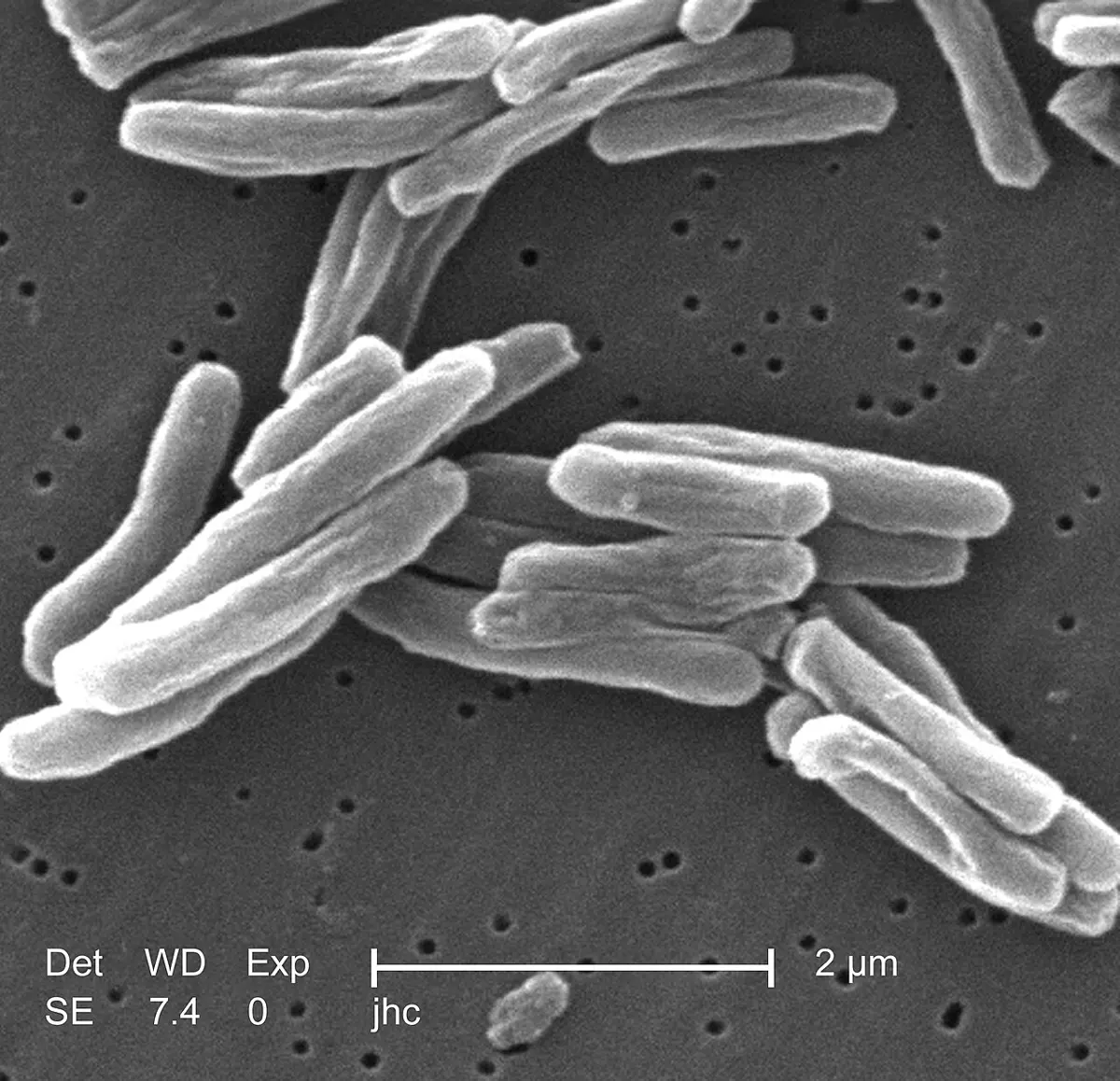
TB can also spread to other parts of the body. Two forms were the most feared. In tuberculous meningitis, the bacteria attack the coverings of the brain. In miliary TB, they spread through the blood to the whole body. Before 1944, almost everyone with these forms died.
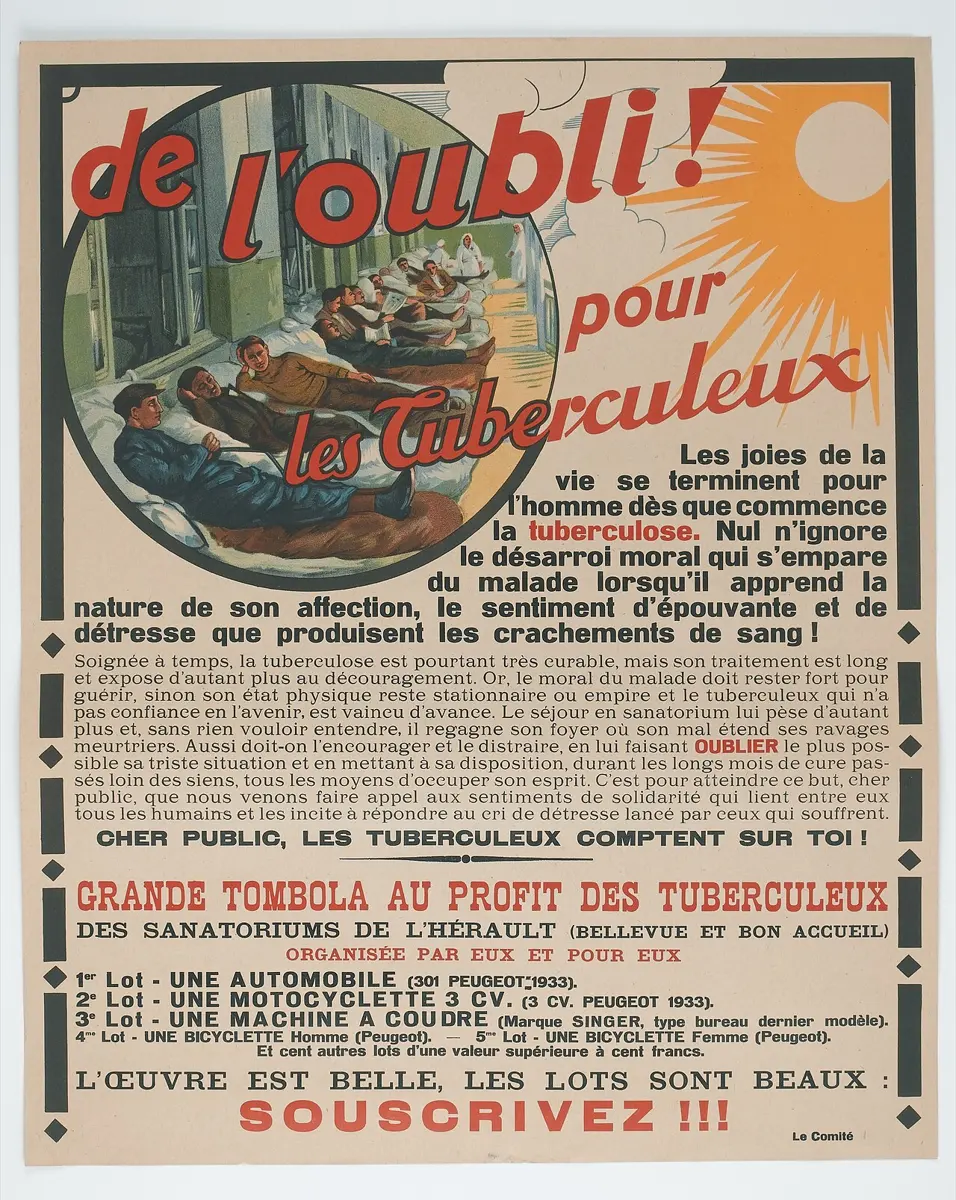
For lung TB, doctors could offer little more than rest. Patients were sent to sanatoriums, hospitals in the hills or the countryside, where they lay in bed in fresh air for months or years. Some got better on their own. Many did not.
Every medicine tried had failed. Even penicillin, the wonder drug of the 1940s, did nothing against TB: the TB bacterium is wrapped in a thick, waxy coat and has defenses of its own, and penicillin can’t harm it (Penicillin).
The idea: microbes at war
Waksman was not a doctor. He was a soil microbiologist: he studied the microbes (microorganisms, living things too small to see) that live in soil. A pinch of garden soil holds millions of them: bacteria, molds, and streptomycetes.
All these microbes compete for the same food and space Grade 9: Competition. Some of them fight their neighbors with chemicals: they give out substances that stop other microbes from growing, or kill them.
TB bacteria end up in the soil, in coughed-up spit, yet they soon disappear from it. In 1932 an American society against tuberculosis asked Waksman to find out why. His answer: other microbes in the soil were probably killing them.
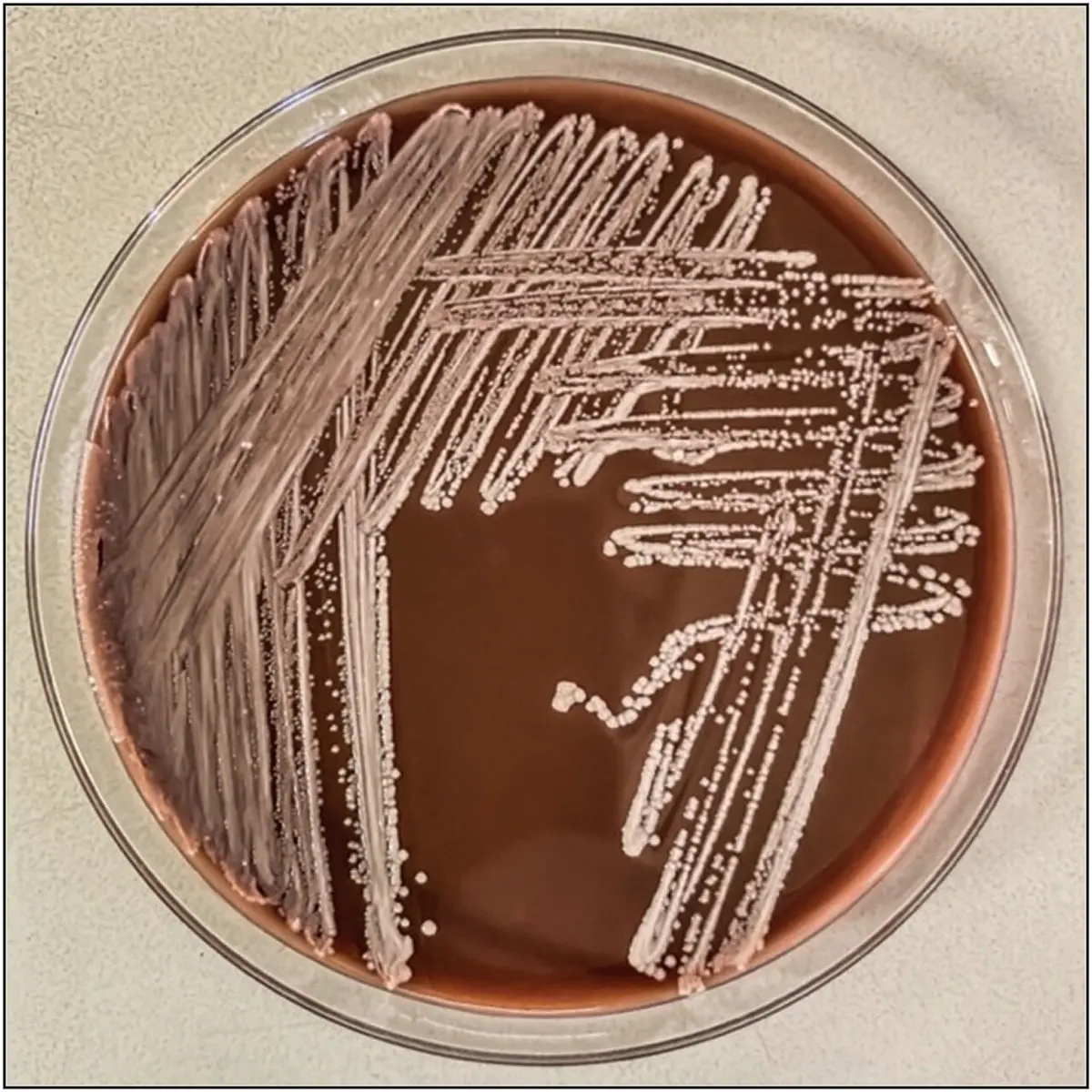
Waksman knew one group of soil microbes especially well, the actinomycetes. These are bacteria, but they grow like a mold, as a mat of fine branching threads, and they make spores to spread Grade 8: Sporulation. The streptomycetes are the commonest of them. In 1915 Waksman and a colleague had found one that they named Actinomyces griseus. Remember that name.
Waksman also gave us a word. He used antibiotic for a substance made by one microbe that kills other microbes or stops them growing. Today we use the word for all such medicines.
Why would a microbe living in soil make a substance that kills other microbes?
Pick an answer to see why.
Why it was hard
- There are so many microbes. Each pinch of soil holds thousands of kinds. There was no way to know which one, if any, made a useful substance, except by testing them one at a time.
- Most germ killers are poisons. A substance that kills bacteria often harms human cells too. A useful medicine must kill the germ and leave the patient alive.
- TB is dangerous to work with. Its bacteria spread through the air, so a scientist growing them in the laboratory risks catching TB.
- TB grows slowly. TB bacteria take weeks to make a colony, so every test was slow.
What they did, step by step
Waksman’s laboratory at Rutgers University (1939–1943)
Waksman was born in 1888 in a village near Kyiv, then in the Russian Empire and now in Ukraine. In 1910 he moved to the United States, studied agriculture at Rutgers University in New Jersey, and stayed there all his working life.
- A plan (1939). Waksman started a big, careful search: grow soil microbes, one kind at a time, and test what each one made against germs.
- A test that could be done thousands of times. His team used simple tests on dishes of jelly. In the cross-streak test, a soil microbe is spread in a line across a dish and given a few days to grow and give out its chemicals. Then different bacteria are streaked across the jelly towards it. If the bacteria stop growing before they reach the line, the microbe makes something that kills them, and the gap shows how strongly.
- Two failures (1940 and 1942). The search found substances that killed bacteria, but they were poisons. Actinomycin (1940) was far too poisonous. Streptothricin (1942) killed many bacteria, even TB bacteria, but it too was poisonous to animals. By the time streptomycin was found, about 10,000 different soil microbes had been tested.
Albert Schatz finds streptomycin (1943)
In June 1943 Albert Schatz, a young student who had just left the army, came back to Waksman’s laboratory to work for his doctorate. He was given the job of looking for new actinomycetes, and he chose to search for one that killed TB bacteria. Because TB was so dangerous, he worked alone in a basement laboratory.
- Within a few months he found two strains that killed bacteria. One came from soil, the other from the throat of a healthy chicken.
- Both turned out to be Actinomyces griseus, the very kind Waksman had found in 1915. (It was soon renamed Streptomyces griseus.) The old strain hadn’t made an antibiotic; these new ones did.
- Their substance, streptomycin, killed TB bacteria. It also killed many bacteria that penicillin can’t touch.
- Elizabeth Bugie, another student, did many of the tests against bacteria. Schatz, Bugie and Waksman reported streptomycin in January 1944.
Testing it at the Mayo Clinic (1944–1946)
Would streptomycin cure a living animal, and then a person, without poisoning them? Two doctors at the Mayo Clinic in the United States, William Feldman and Corwin Hinshaw, tested it.
- Guinea pigs (1944). They gave TB to guinea pigs and treated some of them with the tiny amount of streptomycin there was. The treated animals survived.
- The first patients (from November 1944). They first chose patients for whom there was no hope left. The most surprising results were in people with tuberculous meningitis and miliary TB, who until then had always died. Some of them recovered.
- Making enough. The company Merck had paid for Waksman’s research. It now began to grow the microbe in big tanks. By the late 1940s streptomycin was being made in large amounts.
A fair test (1946–1948)
In Britain, in 1946, streptomycin was scarce and expensive. The Medical Research Council used it for one of the first randomized trials in medicine. Patients with serious TB of both lungs were divided into two groups by chance: one group had bed rest and streptomycin, the other bed rest alone. After six months, deaths in the bed-rest group were nearly four times as common as in the streptomycin group.
How streptomycin works
To live and grow, a cell must keep making proteins. They are built by ribosomes, the cell’s protein factories Grade 8: Ribosomes. A ribosome reads a message copied from a gene and joins amino acids, the building blocks of proteins, in the order the message says.
Streptomycin sticks to the small part of a bacterium’s ribosome. The ribosome then misreads the message and puts wrong amino acids into the chain. The proteins come out faulty, the bacterium can’t make what it needs, and it dies.
Why doesn’t it do the same to you? Bacteria’s ribosomes are smaller than the ones in your cells and a different shape, so streptomycin sticks to theirs much more than to yours. It is not completely harmless, though. In large doses or long treatments it can damage the nerves for hearing and balance in the inner ear, and some patients became deaf. Purer streptomycin and smaller doses made this much rarer, but doctors still watch for it.
Streptomycin stops bacteria making proteins. Why does it harm bacteria much more than your own cells?
Pick an answer to see why.
A new problem: resistance
Within months of the first treatments, doctors saw something worrying. A patient would get better on streptomycin, and then, while still taking it, get worse again. The TB bacteria in them had become resistant: streptomycin no longer killed them.
Why? Try working it out.
A patient with TB took streptomycin alone. At first they got better, then worse again, though they kept taking it. What most likely happened?
Pick an answer to see why.
The drug doesn’t change the bacteria: it picks out the few that could already survive it. The answer was to give two drugs together. A Swedish scientist, Jörgen Lehmann, had found another TB drug, PAS. A bacterium that happens to survive one drug is very unlikely to survive the other as well, so with both drugs together, resistance was much slower to appear (Why two drugs at once).
In your life today
- TB is curable. Today TB is treated with a mix of antibiotics, usually four for the first two months and then two more for four months: six months in all. Streptomycin is no longer one of the main four, but it is still used for some patients whose TB resists the usual drugs.
- But TB is still a big killer. In 2024 about 10.7 million people in the world fell ill with TB and about 1.23 million died of it (WHO). It kills more people than any other single germ. Nepal has many cases too.
- In Nepal, testing and treatment for TB are free at government health facilities. Babies get the BCG vaccine, which protects young children from the worst forms of TB, such as TB meningitis.
- A long cough is a warning. A cough that lasts more than two weeks, especially with fever, weight loss or night sweats, should be checked at a health post. And anyone being treated for TB must take every dose to the end, even after feeling better: stopping early is one of the main ways resistant TB is made.
- Medicines from soil. Streptomycin started a hunt through soil microbes all over the world. Neomycin, in many creams for cuts, came from Waksman’s laboratory in 1948, and tetracycline from another streptomycete. Many of our antibiotics come from these little soil microbes.
What came next
- More TB drugs. Isoniazid came in 1952, the year of Waksman’s prize, and rifampicin in the 1960s. Together they made TB treatment much shorter and surer.
- Resistant TB. Some TB bacteria now resist the two best drugs, isoniazid and rifampicin. This multidrug-resistant TB can still be cured, but the treatment is longer, more expensive and harder on the body.
- New antibiotics from soil. Most soil microbes won’t grow in a laboratory dish. In 2015 scientists grew some inside a small device buried back in soil, and found a new antibiotic, teixobactin.
- The open question. Can we find a better vaccine, one that protects adults and not only young children, and a cure that takes weeks rather than months? Then TB could finally be ended, as the speech at Waksman’s prize hoped.
In your science books
- Grade 8: bacteria, diseases caused by microorganisms, ribosomes, and spores.
- Grade 9: Kingdom Monera, where the bacteria belong, and competition between living things.
- Going further: How does a gene make a protein? (what a ribosome does) and Why do antibiotics stop working?
Learn more
- The prize at nobelprize.org: The Nobel Prize in Physiology or Medicine 1952, with the presentation speech that tells the story.
- Waksman’s own Nobel lecture, on streptomycin and the search for antibiotics.
The official reason
The prize was given “for his discovery of streptomycin, the first antibiotic effective against tuberculosis.”