
At 11:56 on the morning of Saturday, 25 April 2015 (12 Baisakh 2072), the ground under Barpak, a village in Gorkha, lurched. A crack 150 km long tore eastward under the hills at nearly 3 km a second, and for almost a minute the whole of central Nepal shook. In Kathmandu, 80 km away, the first jolt came about a quarter of a minute later and the shaking grew for nearly a minute, and Dharahara, the city’s white tower, fell.
Five months later, on 14 September 2015, two machines in the USA felt a shaking of a very different kind: a squeeze and stretch of space itself, a few thousandths of the width of a proton, from two black holes that had collided 1.3 billion years before. Both were waves carrying energy from a sudden event far away. This unit is about such recent work in physics: earthquakes and the waves they send, the 2015 Gorkha earthquake, gravitational waves, the Higgs boson, and nanotechnology, the science of the very small.
25.1 Earthquake
An earthquake is a sudden shaking of the ground, when energy stored in the rocks below is suddenly let go. The energy travels out as seismic waves, spreading in every direction from the point underground where the earthquake starts.
Most earthquakes start on a fault: a break in the crust where the rock on one side can move against the rock on the other. When two blocks try to move past each other but are held by friction, stress builds up in the rock year after year, bending it like a stick bent between your hands. When the stress becomes greater than the friction, the rocks suddenly slip, the bent rock springs back, and the stored energy is released as an earthquake.
Faults are named by the way the blocks move (Figure 25.2). Where a fault slopes, the block above it is the hanging wall and the block below it the footwall (a miner in a sloping tunnel along the fault would hang a lamp on the one and stand on the other).
Key terms to know
- Focus or hypocenter: the point inside the Earth where the rock first slips and the earthquake begins.
- Epicenter: the point on the Earth’s surface directly above the focus. The shaking is usually strongest near it.
- Foreshocks: smaller tremors that sometimes come before the main shock. They can be recognized only afterwards, once the main shock has come.
- Aftershocks: smaller earthquakes that follow the main shock, as the rock around the slipped fault settles, becoming smaller and less frequent with time.
Causes of earthquakes
Earthquakes can be caused by sudden movements along faults, volcanic eruptions, large landslides, and bomb blasts or underground explosions. By the nature of their source, earthquakes are of two kinds.
- Natural earthquakes are caused by the movement of tectonic plates or by volcanic activity. The Earth’s outer shell, the lithosphere, is broken into large plates that move a few centimeters a year. Where they grind past each other or collide, at plate boundaries, energy builds up in the rock and is released in earthquakes. Nepal sits on such a boundary: the Indian Plate pushes north under the Eurasian Plate at about 2 cm a year, raising the Himalaya.
- Artificial earthquakes are triggered by human activities: blasting during construction, mining, filling large reservoirs behind dams, pumping fluids deep underground, and nuclear or bomb explosions.
Earthquake magnitude
Magnitude measures the energy released at an earthquake’s source. It was first measured on the Richter scale, worked out in 1935 by the American seismologist Charles F. Richter from how far a seismograph’s needle swung. The scale is logarithmic: each increase of one in magnitude means
- waves 10 times taller on a seismograph, and
- about 32 times as much energy released (more exactly ).
So a magnitude 8 earthquake has waves 10 times taller than a magnitude 7 and 100 times taller than a magnitude 6, and it releases about 32 times as much energy as the 7 and about 1000 times as much as the 6.
As more seismograph stations were built, it became clear that Richter’s method worked only for certain distances and wave frequencies, and that it gave too small a number for the biggest earthquakes. New scales were made for particular waves, the body-wave magnitude and the surface-wave magnitude , and finally a scale that works for every earthquake, the moment magnitude , worked out from how large an area of the fault slipped and by how much. For most earthquakes the scales give about the same number, so news reports often still say “Richter”.
Earthquakes below magnitude 3.0 are usually not felt; those above 7.0 can cause severe destruction. The largest ever recorded, the 1960 Valdivia earthquake in Chile, had a moment magnitude of 9.5.
Seismology and seismic waves
Seismology is the study of earthquakes and of the seismic waves that move through and around the Earth. A seismograph records the ground’s shaking; its record is a seismogram.
Seismic waves are elastic waves made by earthquakes or explosions: as they pass, they deform the rock, which springs back, so they carry the earthquake’s energy away from the focus. They are mechanical waves (Unit 6, Types of waves), of two families: body waves, which travel through the inside of the Earth, and surface waves, which travel along its surface.
Body waves
P waves (primary, or pressure, waves) are longitudinal: the rock is pushed and pulled along the direction the wave travels, in compressions and rarefactions, like sound in air. They are the fastest seismic waves, about 6 to 8 km/s in the crust, so they arrive first, and they travel through solids, liquids and gases. They are also called compression waves.
S waves (secondary, or shear, waves) are transverse: the rock is shaken at right angles to the direction of travel, up and down or side to side. They are slower, about 3 to 4.5 km/s, so they arrive second, and they travel only through solids: a liquid has no stiffness against being sheared, so it can’t pass a shear wave on. That S waves never cross the Earth’s outer core is how we know it is liquid.
Surface waves
Surface waves form when body waves reach the Earth’s surface layers. They travel along the surface, more slowly than body waves but with larger swings that last longer, and they do most of the damage in an earthquake. There are two kinds.
- Rayleigh waves, predicted by Lord Rayleigh in 1885, roll along the surface like waves on the sea: each bit of ground goes round an upright ellipse, moving up and down and back and forth along the direction of travel. They are made where P waves and up-and-down S waves meet the surface, and their motion dies away with depth. Of all seismic waves they are usually the slowest, and they carry much of the ground shaking.
- Love waves, described by the British mathematician A. E. H. Love in 1911, shake the ground from side to side, horizontally, at right angles to the direction of travel, with no up-and-down motion. They are made by side-to-side S waves trapped in the surface layers, so they need a solid whose properties change with depth (soft layers over hard rock). They are a little faster than Rayleigh waves and shake the bases of buildings sideways.
The four waves compared:
| Property | P wave (primary) | S wave (secondary) | Rayleigh wave | Love wave |
|---|---|---|---|---|
| Type | longitudinal (compression) | transverse (shear) | surface wave, rolling | surface wave, horizontal transverse |
| Speed | fastest, about 6–8 km/s | about 3–4.5 km/s | slowest | a little faster than Rayleigh |
| Motion of the ground | along the direction of travel | at right angles to the direction of travel | elliptical rolling: up and down and back and forth | side to side, horizontal |
| Travels through | solids, liquids and gases | solids only | along the Earth’s surface (solids only) | along the Earth’s surface (solids only) |
| Arrives | first | second | after P and S waves, last | after P and S waves, before Rayleigh |
| Damage | least | more than P waves | heavy: most of the ground’s heaving | heavy: strong sideways shaking of foundations |
| Felt as | a sharp jolt | stronger shaking, up and down and sideways | the ground rolling, like a boat | the ground jerking sideways |
At a seismograph 300 km from an earthquake, which arrive first?
Pick an answer to see why.
25.2 Gorkha earthquake 2015
On 25 April 2015, at 11:56 Nepal time, an earthquake of moment magnitude 7.8 struck under Barpak in Gorkha district, about 80 km northwest of Kathmandu. It began at a shallow depth, about 8 km by the U.S. Geological Survey’s estimate (other estimates put it nearer 15 km), and a shallow-focus earthquake shakes the surface above it hard.
It ruptured about 150 km of the Main Himalayan Thrust (MHT), the great fault along which the Indian Plate slides under the Eurasian Plate. The rupture spread mostly eastward, under Kathmandu and beyond, and the shaking was felt across Nepal and far into India, Tibet and Bangladesh. The main shock lasted about 50 to 60 seconds, longer and stronger than any of the aftershocks that followed: more than 400 of magnitude 4 or more in the following months, the largest of magnitude 7.3 on 12 May 2015, near Dolakha.
The seismic waves arrived as expected for the Himalaya’s rocks:
- P waves at 5.0–8.0 km/s,
- S waves at 3.0–4.5 km/s,
- surface waves (Love and Rayleigh), slower, about 2.0–3.5 km/s, but with the largest swings at the surface.
Scientists had long feared that an earthquake this size would flatten much of the Kathmandu Valley. The damage there, though terrible, was less than feared. The rupture slipped smoothly, so it sent out less of the quick, jerky shaking that breaks low brick and stone houses than expected, and the valley’s soft lake-bed sediments shook mostly in a slow sway, about once every four to five seconds. That slow sway was hardest on tall structures, which sway slowly themselves, such as the nine-story Dharahara.
Key seismic parameters
- Magnitude: 7.8 (moment magnitude, ).
- Epicenter: Barpak, Gorkha district (28.23° N, 84.73° E).
- Depth of the focus: about 8 km (shallow); estimates range up to 15 km.
- Fault type: a thrust fault, the Main Himalayan Thrust.
- Duration of shaking: 50–60 seconds.
Pattern of energy release and aftershocks
- The earthquake occurred on the Main Himalayan Thrust, the collision zone between the Indian Plate and the Eurasian Plate.
- The rupture spread eastward from Gorkha, under Kathmandu and beyond.
- A strong aftershock of magnitude 7.3 struck on 12 May 2015, near Dolakha.
- More than 400 aftershocks of magnitude 4.0 and above were recorded over the following months.
Effects of the earthquake
- Nearly 9,000 people died, and about 22,000 were injured.
- Hundreds of thousands of homes, and thousands of schools and health posts, were destroyed or damaged, worst in Gorkha, Sindhupalchowk, Nuwakot, Dhading, Rasuwa, Dolakha and the Kathmandu Valley.
- The earthquake set off an avalanche from Pumori onto Everest Base Camp, killing at least 22 people, and an avalanche of ice and rock that buried the village of Langtang.
- Historic landmarks, Dharahara and many temples and monuments in the Durbar Squares of Kathmandu, Patan and Bhaktapur, were damaged or reduced to rubble.
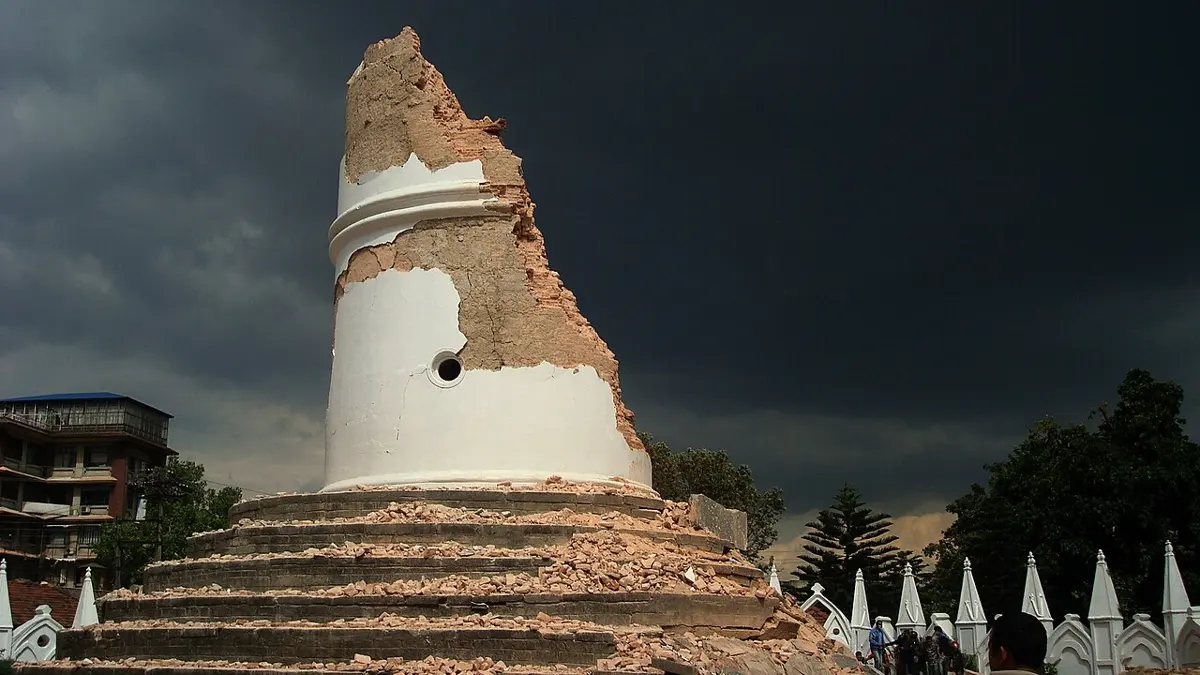
The Gorkha earthquake showed how powerful the tectonic forces under the Himalaya are, and how shallow thrust earthquakes put the whole region at risk. It also showed the resilience of Nepal’s people, and the importance of being prepared: earthquake-resistant buildings, safe schools, drills, and early warning systems. (Going Further, Can you design an earthquake-safe house?, shows how buildings are made to survive.)
25.3 Gravitational waves
Gravitational waves are tiny ripples of space and time themselves, made by some of the most violent events in the universe, such as black holes or neutron stars colliding, or a star exploding. They spread out from their source in all directions at the speed of light, carrying information about what made them.
The idea was first put forward by Albert Einstein in 1916, from his general theory of relativity: space and time together, space-time, are bent by mass, and massive objects accelerating should disturb it so that ripples spread out, like ripples from a stone thrown into water. A passing wave stretches space in one direction and squeezes it in the direction at right angles, back and forth (Grade 11, Gravitational waves).
For almost a century they stayed a prediction, because by the time they reach us they are unbelievably weak. Then, on 14 September 2015, the two detectors of LIGO, the Laser Interferometer Gravitational-Wave Observatory in the USA, detected one for the first time. It came from two black holes, of about 36 and 29 times the Sun’s mass, merging about 1.3 billion light years away. Rainer Weiss, Barry Barish and Kip Thorne won the 2017 Nobel Prize in Physics for the detection.
How LIGO hears a wave
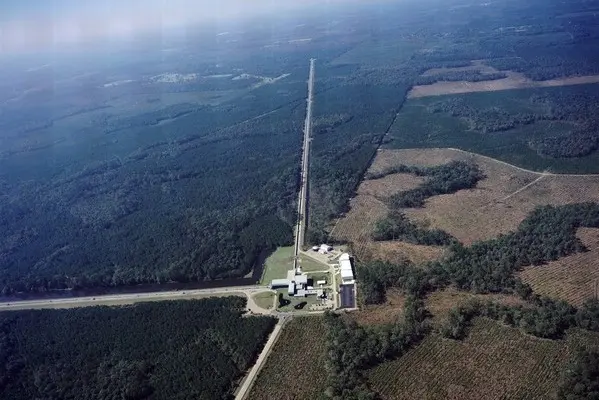
LIGO is a giant interferometer, the same idea as Michelson’s in Interference of Light. A laser beam is split in two, and the halves travel along two arms, each 4 km long, at right angles, bounce off mirrors and come back to be recombined (Figure 25.5). The arms are set so that the two returning waves cancel: no light reaches the detector. A passing gravitational wave stretches one arm while it squeezes the other, so the two light waves no longer arrive exactly out of step, and light flickers onto the detector.
The change is tiny: the first wave changed each 4 km arm by a few times m, a few thousandths of the width of a proton. To be sure a signal is real, LIGO has two detectors 3000 km apart, in Hanford, Washington, and Livingston, Louisiana; a real wave reaches both within 10 milliseconds (the time light takes to cross the distance), while a passing truck shakes only one.
Causes of gravitational waves
Gravitational waves are produced whenever huge masses accelerate. The ones strong enough to detect come from:
- a supernova, an exploding star, if it explodes unevenly;
- two neutron stars orbiting each other;
- two black holes spiraling together and merging.
Because these events are so far from the Earth, the waves that reach us are extremely weak, and only very sensitive detectors such as LIGO can notice them.
Key points to remember
- They are ripples of space-time itself, sent out by violent events far away.
- They spread out in every direction at the speed of light.
- Einstein predicted them in 1916; LIGO first caught one in 2015.
- They give astronomers a new sense, gravitational-wave astronomy, for events that give out little or no light, such as black holes merging.
Types of gravitational waves
Scientists sort the waves they look for into four kinds, by their source and the signal it makes.
- Continuous gravitational waves would come from a single spinning, slightly lopsided object, such as a neutron star with a tiny bump on its surface. They would have a steady frequency and go on for years, so a long search can add up a signal too weak to see at once. None had been detected by 2026: they are expected to be far weaker than the waves from collisions.
- Burst gravitational waves come from short, violent events whose signal can’t be predicted in detail, such as a supernova. Because their shape isn’t known in advance, they are hard to pick out from the detectors’ noise. None had been detected by 2026; a supernova in our own galaxy could be heard.
- Stochastic gravitational waves are a random background “hum” from very many sources all over the universe, too many to tell apart, and perhaps also from the first moments after the Big Bang. In 2023, astronomers timing the steady flashes of pulsars found the first evidence of such a background, with waves years long, probably from pairs of giant black holes in the centers of galaxies.
- Compact binary inspiral gravitational waves come from two compact objects, black holes or neutron stars, spiraling toward each other: two neutron stars (BNS, binary neutron stars), two black holes (BBH) or one of each (NSBH). As they come closer they orbit faster, so the waves’ frequency and strength rise together into a chirp, then stop when the two merge. Each kind of pair gives its own waveform, but they all follow the same pattern. These are the only gravitational waves the detectors had caught by 2026: hundreds of them since 2015.
Together, these four kinds of wave give a new way to explore the most extreme places in the universe.
25.4 Higgs boson
The Higgs boson, nicknamed the “God particle” (after a popular book; most physicists dislike the name), was among the great discoveries of physics in this century. It is the fundamental particle that goes with the Higgs field, an invisible field that fills the whole universe. In the Standard Model of particle physics, the Higgs field is what gives the fundamental particles their mass.
Particles that interact with the Higgs field gain mass: the more strongly a particle interacts with it, the more massive it is. The photon doesn’t interact with it at all, so it has no mass and travels at the speed of light; the electron interacts weakly, so it is light; the top quark interacts strongly, so it is about as heavy as a gold atom. A picture often used: a famous person crossing a room crowded with admirers is slowed by the crowd that gathers round, and is harder to get moving and to stop, as if heavier; someone unknown crosses easily. (Like every picture of quantum physics, it isn’t exact: mass is not a drag that slows a moving particle, but a resistance to changes in its motion.)
The particle was predicted in 1964 by Peter Higgs and others. It was not found until 2012, because it is heavy, about 125 GeV, 133 times the proton’s mass, and lasts less than s before decaying. Scientists at CERN (the European Organization for Nuclear Research) made it in head-on collisions of protons in the Large Hadron Collider (LHC), the biggest and most energetic particle accelerator ever built, a ring 27 km round under the border of Switzerland and France. On 4 July 2012, the two great detectors there, ATLAS and CMS, each announced that they had seen it, by the particles it decays into.
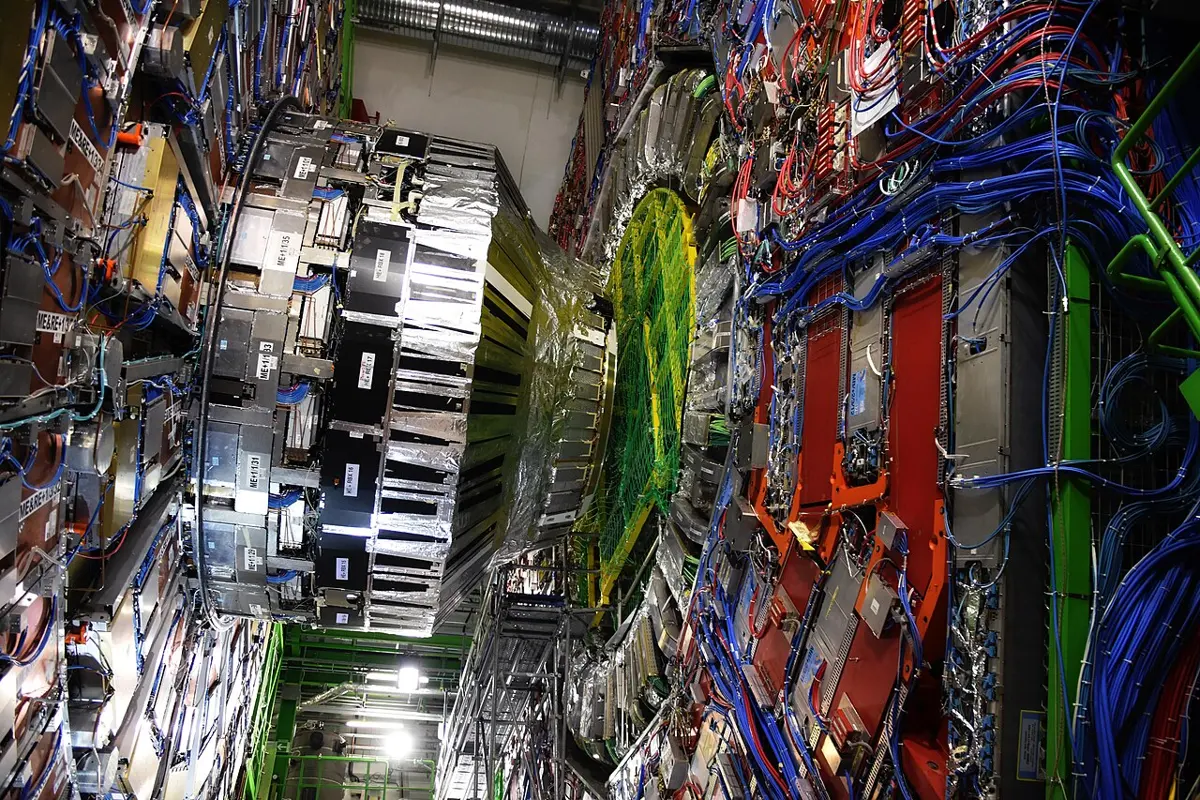
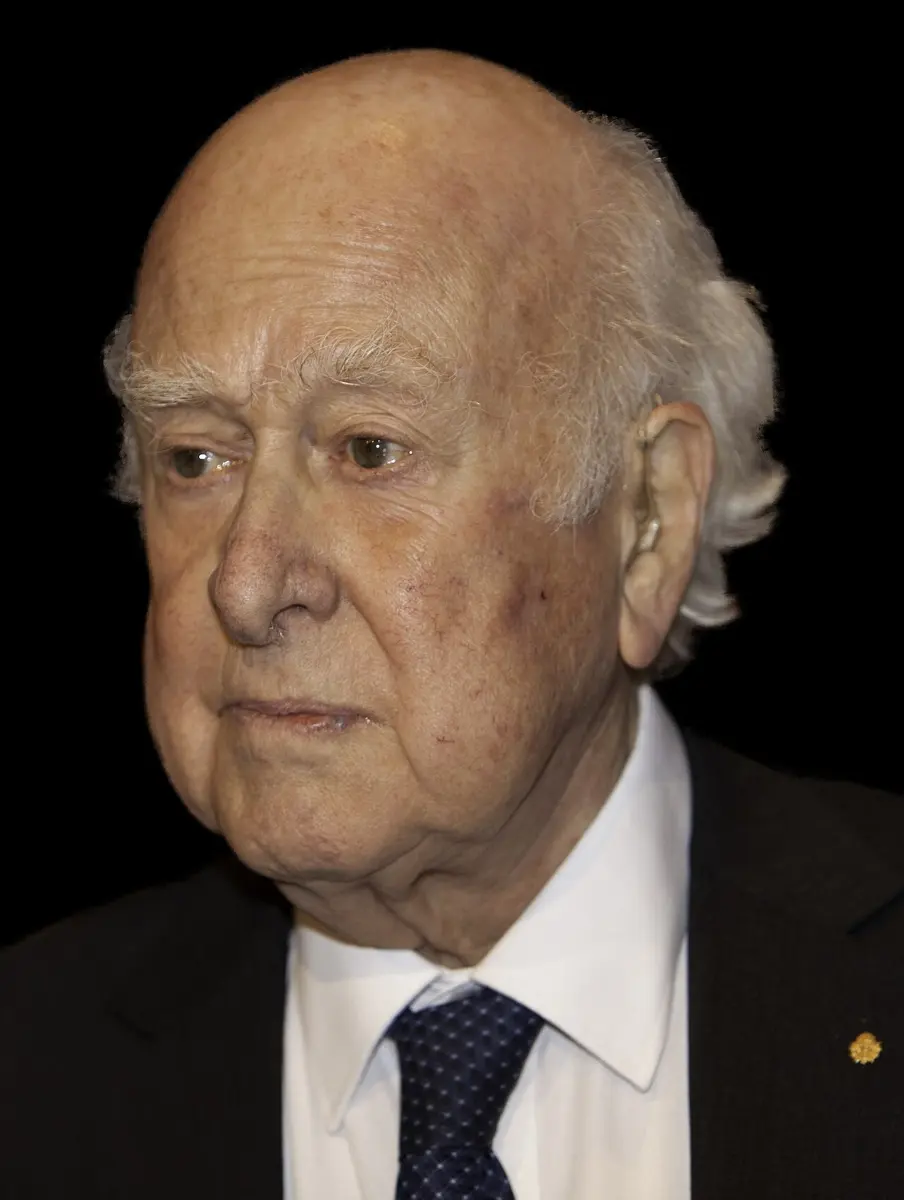
The discovery completed the Standard Model and won the 2013 Nobel Prize in Physics for Peter Higgs and François Englert. Studying the Higgs boson tells scientists why matter has mass and how nature works at its smallest scale, and it opens the door to physics beyond the Standard Model, such as the nature of dark matter and what happened just after the Big Bang. The LHC is still measuring it, to see whether it behaves exactly as the theory says.
25.5 Nanotechnology
Nanotechnology is science and engineering with matter on an extremely small scale, between 1 and 100 nanometers (nm). One nanometer is a billionth of a meter, : a strand of human hair is about 50,000 to 100,000 nm wide, and a row of five to ten atoms is 1 nm long (Figure 25.9). At this scale scientists work with individual atoms and molecules to make new materials, tools and devices.
Nanotechnology lets us build structures and machines thousands of times narrower than a hair, with properties ordinary pieces of the same material don’t have. Two things change at that scale. A tiny particle has a very large surface for its volume, so more of its atoms are at the surface, where reactions happen: nanoparticles make far better catalysts. And for a particle only a few nanometers across, quantum effects change how it absorbs and gives out light: gold nanoparticles are red, and particles of a semiconductor glow in different colors just by their size. This is changing medicine (drugs carried to a tumor, sensitive tests), electronics (smaller, faster chips), energy (better solar cells and batteries), food safety and environmental science.
History of nanotechnology
- 1959: the American physicist Richard Feynman gave a famous lecture, “There’s Plenty of Room at the Bottom”, imagining machines that place atoms and molecules one by one, and writing a whole encyclopedia on the head of a pin. (The word nanotechnology was coined in 1974 by the Japanese engineer Norio Taniguchi.)
- 1981: Gerd Binnig and Heinrich Rohrer, at IBM in Zurich, built the scanning tunneling microscope (STM), which feels a surface with a needle so sharp it ends in a single atom, and shows the individual atoms. It won the 1986 Nobel Prize in Physics. In 1989, IBM scientists used one to move 35 xenon atoms on a nickel surface to spell “IBM”.
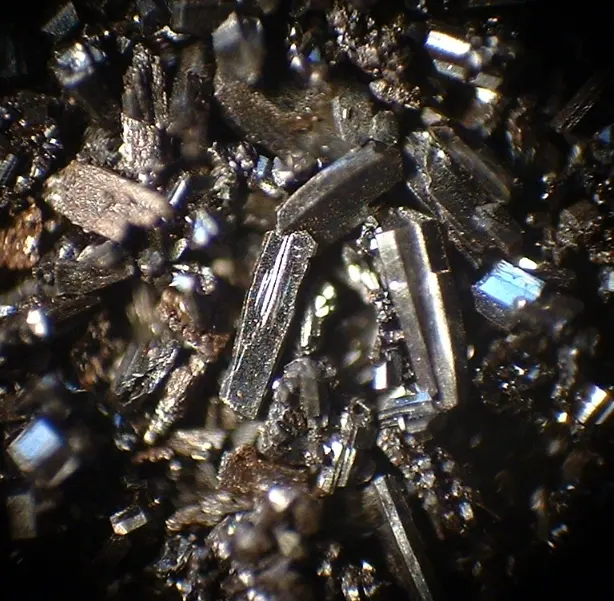
- 1985: Harold Kroto, Robert Curl and Richard Smalley discovered fullerene, , a hollow ball of 60 carbon atoms joined in hexagons and pentagons like a football (Nobel Prize in Chemistry 1996). It opened up new forms of carbon nanomaterials: carbon nanotubes (1991) and graphene, a sheet of carbon one atom thick (Nobel Prize in Physics 2010).
Uses of nanotechnology
- Medicine: nanoparticles carry drugs straight to the cells that need them, especially in cancer treatment, so less of the drug harms healthy cells.
- Diagnosis: faster and more accurate tests for disease. The lines on a rapid test (for pregnancy or COVID-19) are made red by gold nanoparticles.
- Electronics: the transistors in a modern chip are a few tens of nanometers across, so billions fit on a chip, making devices faster, more efficient and smaller.
- Solar panels made more efficient at turning sunlight into electricity.
- Batteries that charge faster and last longer.
- Water purification: nano-filters remove bacteria and harmful substances.
- Textiles: clothes made waterproof, stain-resistant and antibacterial.
- Food packaging that keeps food fresh longer and detects spoiling.
- Construction materials made stronger and lighter.
- Cosmetics: nanoparticles of zinc oxide and titanium dioxide in sunscreens block ultraviolet light while looking clear on the skin, and are used in creams for better absorption.
Like any new technology, it needs care: particles so small can get into the lungs and cells, so the safety of each nanomaterial has to be tested.
Which of these is about 1 nm across?
Pick an answer to see why.
Worked examples
Test yourself
Exercise
Choose the correct option
- Which type of seismic wave travels fastest?
Pick an answer to see why.
- Who predicted the existence of gravitational waves?
Pick an answer to see why.
- What kind of motion does a Love wave produce?
Pick an answer to see why.
- The Higgs boson was confirmed through experiments at:
Pick an answer to see why.
- Which of the following waves can travel through solids, liquids and gases?
Pick an answer to see why.
- What is the speed of gravitational waves?
Pick an answer to see why.
- What does the Higgs field do?
Pick an answer to see why.
- The point within the Earth where an earthquake’s seismic energy is first released is called the:
Pick an answer to see why.
- Which of the earthquake waves is recorded first on a seismograph?
Pick an answer to see why.
- Nanomaterials are materials with at least one dimension measuring less than:
Pick an answer to see why.
Answer these questions
What is seismology? Describe the various types of seismic waves.
Hint
Answer
Describe the key seismic parameters of the Gorkha earthquake. How did it affect different regions, and what made it so destructive?
Answer
Explain the different types of seismic waves. Compare P waves, S waves, Rayleigh waves and Love waves in terms of motion, speed, medium and destructiveness.
Answer
Explain the concept of the Higgs boson. Why is it important in modern physics, and how was it discovered?
Answer
Define nanotechnology. Briefly explain its history, and name any four major fields where nanotechnology is used.
Answer
Printable PDFs
- The unit as a book (A5) 22 pages Answers as an A4 booklet, 6 sheets
- Study notes 3 pages
- Worksheet 4 pages Answer key
- Harder practice questions 2 pages Answer key
Quiz yourself: Earth and Space, Grades 5–12 →
Practice every question in the book, and keep track of the ones you miss →
A companion to your textbook, not a replacement for it: study from the book your school uses, and where the two differ, follow your teacher. Found a mistake? Please tell us.