
Look at your hand. It is made of atoms, the atoms of electrons and nuclei, the nuclei of protons and neutrons, and those of quarks. Look up on a clear night from Nagarkot, and the faint smudges between the stars are other galaxies, each of billions of stars, nearly all of them rushing away from us. Two of the biggest stories in physics of the last hundred years run in opposite directions, one into the smallest things there are, the other out to the edge of everything we can see, and they turn out to meet: to understand how the universe began, you need to know what it is made of.
This unit follows both. First the particles: antimatter, quarks, leptons and the particles that carry forces. Then the universe: the light of galaxies stretched by expanding space, the Big Bang, black holes, and the dark matter and dark energy that make up 95 % of everything, and that nobody has yet identified.
26.1 Particles and antiparticles
The positron is, in effect, a positive electron. It has the same mass as the electron and many of the same properties, but the opposite charge, +e; its other quantum numbers are reversed too. The positron is the antiparticle of the electron.
After the positron was discovered in 1932, physicists expected other particles to have antiparticles too. In 1955 the antiparticle of the proton, the antiproton (), was found, with a negative charge, and soon after the antineutron (). The bar over a symbol marks an antiparticle. Every particle has an antiparticle; a few, such as the photon and the neutral pion (π⁰), are their own antiparticles.
Antiparticles are made in nuclear reactions and in collisions when enough energy is available, and they don’t last long among ordinary matter. A positron on its own is stable, but when it meets an electron the two annihilate: the energy of their vanished mass, plus any kinetic energy they had, becomes gamma rays or other particles (Unit 24, section 24.8). Every particle–antiparticle pair annihilates in the same way.
Every particle, elementary or made of others, belongs to one of two classes: fermions and bosons. Quarks, leptons and the gauge bosons that carry forces all fall into one class or the other (section 26.2).
An antiproton has:
Pick an answer to see why.
26.2 Fundamental particles
All the matter around us is made of elementary, or fundamental, particles: particles that are not made of anything smaller.
Protons, neutrons and electrons were once thought to be fundamental. But in the middle decades of the 20th century, physicists found many other particles that didn’t fit this simple picture. They named them pions, kaons, muons and so on, using up most of the Greek alphabet. They were found in two ways:
- in cosmic rays, particles that arrive at the Earth from space and smash into the atmosphere;
- among the particles made in high-energy collisions in particle accelerators.
More than half a century of painstaking experiments and theory have led to what is now believed to be the complete list of the fundamental particles of nature, the Standard Model. They are of three basic types: quarks, leptons and bosons (the exchange particles that carry forces, and the Higgs boson).
Producing elementary particles
Fundamental particles are not permanent: they can be created and destroyed. Different particles are produced in different ways. Electrons are the easiest: heat a piece of metal enough and electrons boil off its surface (as in an old TV tube or an X-ray tube). Protons come from ionizing hydrogen gas. Besides these, there are three main sources of new particles:
- cosmic rays, which brought the first positrons, muons, pions and kaons;
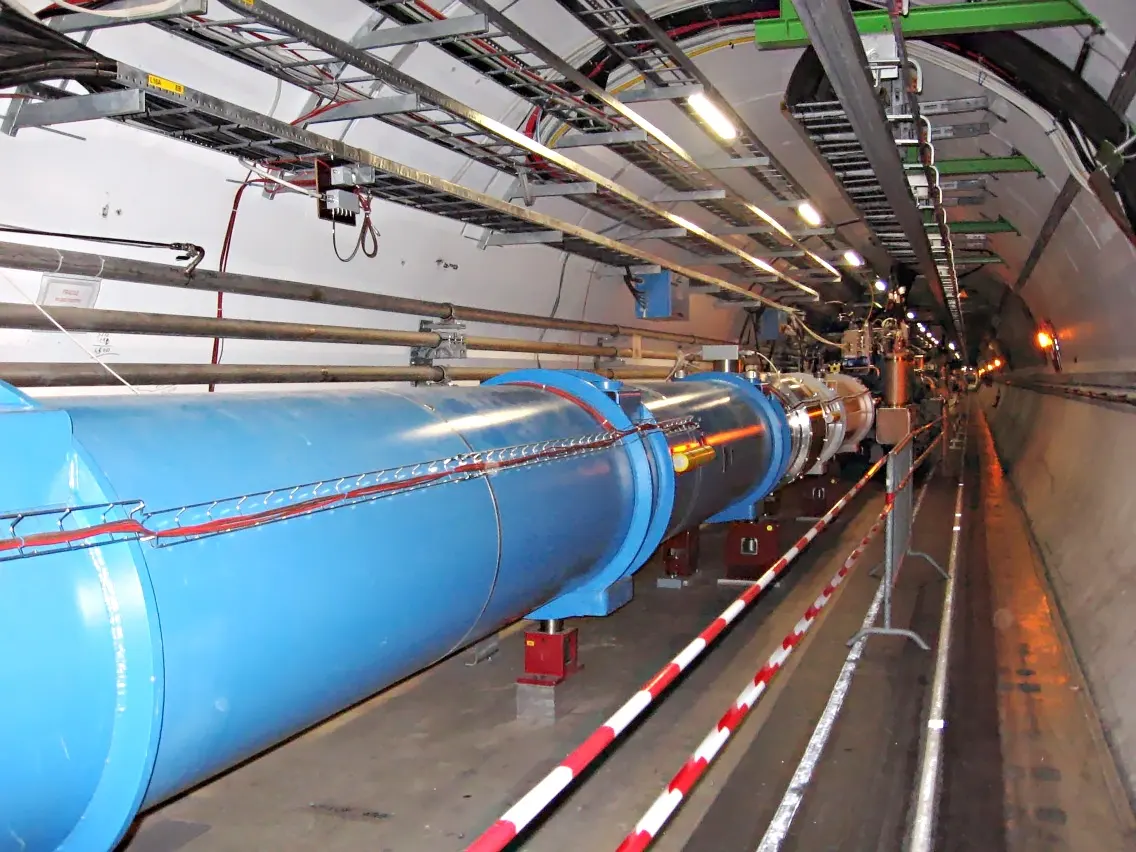
- particle accelerators, such as the Large Hadron Collider at CERN, near Geneva, where protons collide with energies of 13.6 TeV;
- nuclear reactors, which give out huge numbers of antineutrinos from the beta decay of fission fragments.
Fermions and bosons
Every particle, whether elementary or composite (such as the baryons: protons, neutrons and others), is either a fermion or a boson. What decides it is the particle’s spin, an angular momentum each particle has as part of what it is, measured in units of .
Fermions have half-integer spin: ½, 3⁄2, 5⁄2, … They obey the Pauli exclusion principle: no two identical fermions can be in the same quantum state at the same time. That is why electrons in an atom fill up shells one after another instead of all crowding into the lowest level, and why matter takes up space. Fermions obey Fermi–Dirac statistics. They are the particles of matter.
- Examples: leptons (electrons, neutrinos…), quarks (up, down…) and baryons (protons, neutrons…).
Bosons have whole-number (integer) spin: 0, 1, 2, … Any number of identical bosons can share the same state; they are “gregarious”. (A laser works because photons, which are bosons, crowd into the same state.) Bosons obey Bose–Einstein statistics. The fundamental bosons carry the forces.
- Examples: the photon, the gluons, and the W and Z bosons (the force-carrying gauge bosons, spin 1), the Higgs boson (spin 0), and composite particles such as the mesons (pions, kaons…).
Classifying particles
The particles that make up our universe fall into three main groups:
- hadrons: particles made of quarks, which feel the strong nuclear force (they feel the weak force too, and the charged ones the electromagnetic force);
- leptons: particles that don’t feel the strong force; all feel the weak nuclear force, and the charged ones the electromagnetic force too;
- exchange particles: the bosons that carry the forces between other particles.
These are divided further:
- Hadrons are made of quarks, and come in two kinds: baryons (protons, neutrons…), each made of three quarks, and mesons (pions, kaons…), each made of a quark and an antiquark. Every hadron has its antiparticle.
- Leptons, the electron, muon and tau and their neutrinos, contain no quarks. They are fundamental particles themselves. Every lepton has its antiparticle.
Which of these particles is not fundamental?
Pick an answer to see why.
26.3 Quarks
Quarks were first proposed in 1964 by two physicists working independently, Murray Gell-Mann and George Zweig. Gell-Mann took the name from a line in James Joyce’s novel Finnegans Wake: “Three quarks for Muster Mark!”
There are six different types, or flavors, of quark. The up (u), charm (c) and top (t) quarks have an electric charge of ; the down (d), strange (s) and bottom (b) quarks have . The top and bottom quarks are also called truth and beauty.
| Quark flavor | Symbol | Charge Q | Baryon number B |
|---|---|---|---|
| up | u | ||
| down | d | ||
| strange | s | ||
| charm | c | ||
| bottom (beauty) | b | ||
| top (truth) | t |
There is solid experimental evidence for all six flavors (the top quark, the heaviest, was found last, in 1995). Each has an antiquark, with the same mass and opposite charge (and opposite baryon number), written with a bar: has charge , has . Two antiparticles met earlier are the antineutrino of beta-minus decay and the positron of beta-plus decay.
Quarks are never found alone. They are always bound together, by the strong force carried by gluons, into particles called hadrons. Pull two quarks apart and the energy put in makes new quark–antiquark pairs, which join the pieces, so you get new hadrons, never a free quark. Quarks combine to form hadrons in two main ways:
- three quarks form a baryon (three antiquarks form an antibaryon);
- a quark and an antiquark form a meson.
Rarer combinations exist too. Experiments since the 2000s have found tetraquarks (two quarks and two antiquarks) and, since 2015 at CERN’s LHCb detector, pentaquarks (four quarks and an antiquark), all short-lived and very rare.
The proton is a baryon made of two up quarks and one down quark, uud. The neutron is a baryon made of one up and two down quarks, udd.
The charge of the proton is then
and that of the neutron
which are, of course, their measured charges.
Pions are mesons. The positive pion, π⁺, is made of an up quark and a down antiquark, : its charge is .
Baryon number
Besides electric charge, quarks have another property, the baryon number, B. Each quark has and each antiquark . The baryon number of a hadron is the sum of its quarks’:
All baryons, made of three quarks, have B = +1; all antibaryons B = −1; all mesons B = 0; and leptons and bosons B = 0.
Quarks feel all three forces of the Standard Model: the strong, the weak and the electromagnetic. In every reaction, electric charge and baryon number are conserved: their totals are the same before and after.
A particle is made of the quarks . It is:
Pick an answer to see why.
26.4 Leptons
Leptons are particles that don’t feel the strong nuclear force. Unlike quarks, they can exist on their own; they aren’t trapped inside larger particles. There are six:
| Generation | Charged lepton | Charge | Its neutrino | Charge |
|---|---|---|---|---|
| 1 | electron, e⁻ | −e | electron neutrino, | 0 |
| 2 | muon, μ⁻ | −e | muon neutrino, | 0 |
| 3 | tau, τ⁻ | −e | tau neutrino, | 0 |
The muon is about 207 times heavier than the electron, and the tau about 3500 times. There is solid experimental evidence for all six, and each has an antiparticle: the positron e⁺, the antimuon μ⁺, the antitau τ⁺ and three antineutrinos. All leptons feel the weak nuclear force; the charged ones (e⁻, μ⁻, τ⁻ and their antiparticles) also feel the electromagnetic force.
Neutrinos were long thought to have no mass. There is now conclusive evidence that they do, though very little: less than about a millionth of the electron’s mass. Trillions of neutrinos from the Sun pass through your body every second, day and night, and almost none of them ever touch anything.
Leptons (and only leptons) are given another quantum number, the lepton number, one for each family: the electron number, the muon number and the tau number. An electron and its neutrino have electron number +1, a positron and an electron antineutrino −1. In all ordinary reactions, each family’s lepton number is conserved. For example, in the beta decay of a neutron, , the electron (+1) is matched by the antineutrino (−1): electron number 0 before, 0 after.
Which particle is a lepton?
Pick an answer to see why.
26.5 Cosmology
Cosmology is the study of the universe as a whole: how it began, how it has developed, and what will happen to it.
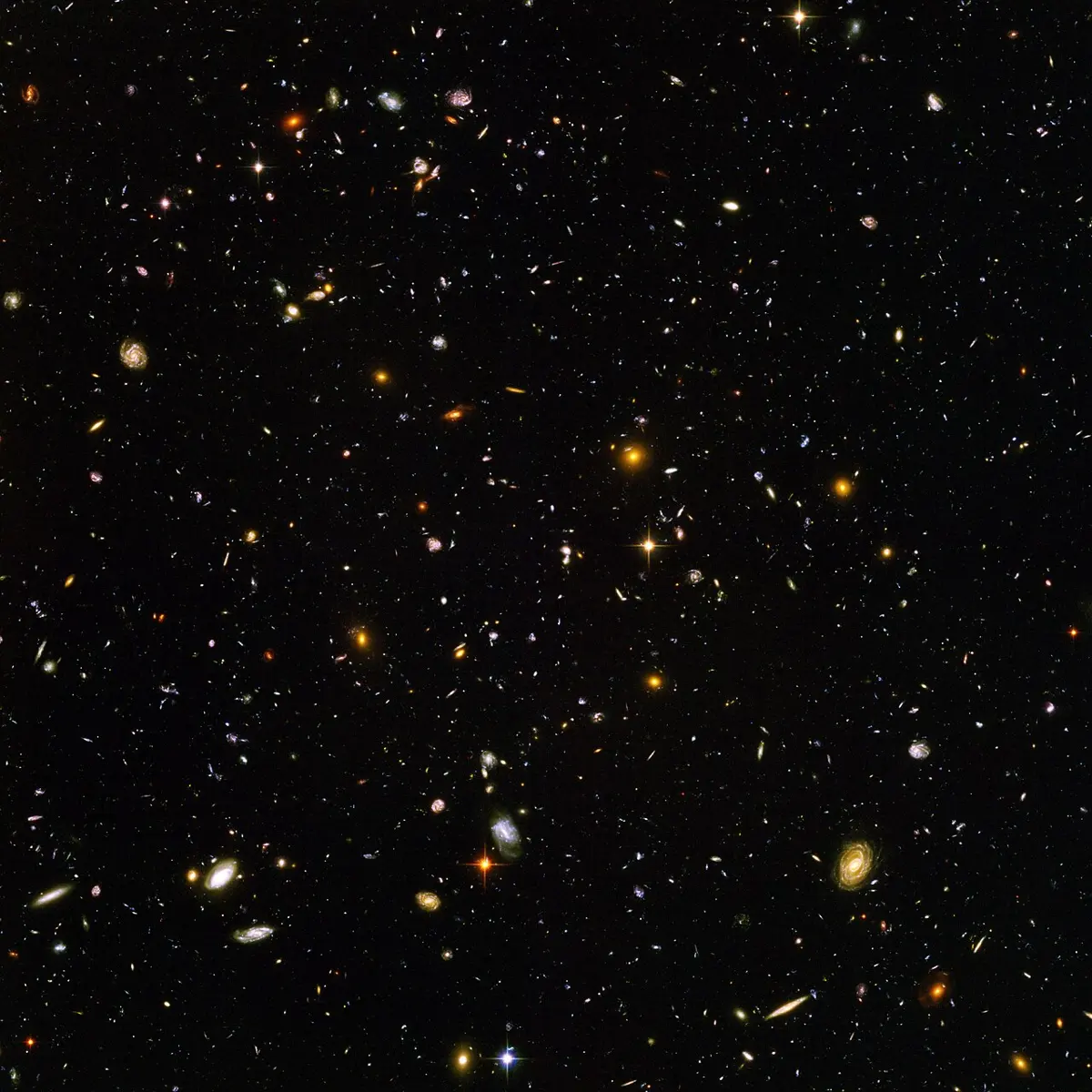
People in every culture have wondered what lies beyond the Earth. The Sun and the stars seem to turn round the Earth every day, and early civilizations, understandably but wrongly, concluded that a still Earth was at the center of everything. Since Copernicus, Kepler, Galileo and Newton, we know that the Earth is a planet going round the Sun, one of hundreds of billions of stars in our galaxy, the Milky Way, which is one of hundreds of billions of galaxies, perhaps more, in the universe we can see.
26.6 Models of the universe
26.6.1 The Newtonian model of the universe
In the Newtonian model, the Earth, the Sun and the planets were tiny parts of an infinitely large, unchanging (static) universe that had always been as it is, and would always stay the same. On the large scale it was much the same everywhere, with stars spread roughly evenly. Newton reasoned that only if all this were true would the stars’ gravitational pulls balance, so that the stars (which were thought not to move) stayed in place.
But there is a big problem with this model. If the universe is infinite and contains an infinite number of stars, the night sky should not be dark: in every direction you look, your line of sight should end on the surface of a star, and the whole sky should glow as bright as the Sun’s surface. This is Olbers’ paradox, named after the 19th-century German astronomer Heinrich Wilhelm Olbers. (A paradox is a statement that seems true and yet leads to a contradiction. “I always lie” is a well-known one.)
So either the reasoning or the Newtonian model had to change. Since the mid to late 1960s, astronomers have accepted the Big Bang model, which solves Olbers’ paradox: the universe has a finite age, 13.8 billion years, so light can only have reached us from stars within a finite distance, and that light is stretched by expansion to longer, dimmer wavelengths.
26.6.2 The Big Bang model
The Big Bang model is the current theory of how the universe began, at one moment in time, 13.8 billion years ago, from a state that was extremely hot and dense. The Hot Big Bang model describes the origin and expansion of the universe, and is supported by a great deal of evidence. Before looking at it more closely, we will look at the evidence that the universe is expanding.
26.7 The expanding universe: redshift
Is the universe as a whole static, or does it change? One of the most important scientific results of the twentieth century was that distant galaxies are moving away from us, and the farther they are, the faster they are moving away.
How do astronomers know how fast a galaxy is moving? From the Doppler shift of the lines in its spectrum (Grade 12). You know how the pitch of a sound changes when its source moves: higher as an ambulance comes towards you, lower as it moves away. The same happens with light. If the source moves towards us, the frequency is higher and the wavelength shorter (a blueshift); if it moves away, the frequency is lower and the wavelength longer, shifted towards the red end of the spectrum (a redshift).
Every element gives out and absorbs light of its own exact wavelengths, the lines of its spectrum (why each element has its own lines). In the light of a distant galaxy the same patterns of lines are seen, but each line is moved to a longer wavelength by the same fraction. That fraction is the redshift, z:
where is the wavelength measured in a laboratory and is how much longer the wavelength observed from the galaxy is. For speeds much less than the speed of light, the redshift gives the speed at which the galaxy is moving away, its recessional speed v:
The fractional change in frequency is about the same size, , with the frequency falling.
26.8 Hubble’s law
In the late 1920s, the American astronomer Edwin Hubble measured the distances to galaxies (from stars of known brightness in them) and set them beside their speeds, found by Vesto Slipher from the Doppler shifts of their spectra. In 1929 he made two key observations:
- He confirmed earlier observations that the light from the great majority of galaxies is redshifted: they are moving away from the Earth.
- In general, the farther away a galaxy is, the greater its redshift, and so the faster it is moving away.
From these he stated what is now called Hubble’s law (or the Hubble–Lemaître law): the recessional speed v of a galaxy is directly proportional to its distance d from the Earth, .
On a graph of recessional speed against distance, the galaxies should lie on a straight line through the origin. Hubble’s own data, from 24 nearby galaxies, were very scattered: they suggested the law was right, but left a large uncertainty in the line’s slope. Modern measurements reach a thousand times farther and fit the line closely.
The Hubble constant
The slope of the graph is the constant of proportionality, the Hubble constant, :
Its SI unit is (m/s) ÷ m = s⁻¹. Cosmologists usually give speeds in km/s and distances in megaparsecs (Mpc, section 26.11), so is usually quoted in km/s per Mpc, which is also a unit of s⁻¹. In 2013 the Planck satellite’s data gave km/s per Mpc, about 2.2 × 10⁻¹⁸ s⁻¹.
A galaxy at a distance d moves away from us at a speed v. A galaxy three times as far away moves away at about:
Pick an answer to see why.
26.9 The expanding universe
Hubble’s law is the key evidence for the Big Bang theory and the model of the expanding universe, the most widely accepted explanation of why the light from nearly all the galaxies we can see is redshifted. In this model, space itself is expanding in all directions: the galaxies are not flying apart through space, but are carried apart as the space between them stretches. So every point in the universe is moving away from every other point, and the farther apart two points are, the faster they move apart. That is exactly why, from the Earth, light from more distant galaxies is more redshifted.
26.10 The cosmological principle
The cosmological principle is the assumption that, on a large enough scale, the universe is homogeneous and isotropic, and the laws of physics are the same everywhere.
- The laws of physics apply across the universe. This is a bold assumption: it means that theories and models tested here on Earth can be applied to everything in the universe, at all times and places. So far, every test has supported it: the spectral lines of hydrogen in a galaxy billions of light years away have exactly the pattern they have in a laboratory.
- Homogeneous means that matter is spread uniformly across the universe. In a large enough volume (hundreds of millions of light years across), the density is the same everywhere, and the same kinds of structures (galaxies, clusters of galaxies) are seen.
- Isotropic means that the universe looks the same in every direction to every observer. It follows that the universe has no center and no edge.
In short, the cosmological principle says that the universe would look much the same wherever you were in it.
26.11 The Big Bang
Hubble’s discovery that the galaxies are moving apart is strong evidence that they were once much closer together. Running the expansion backwards, there must have been a time when the whole universe we can see was extremely hot and dense: that time is the Big Bang, about 13.8 billion years ago.
Right after the Big Bang, the universe was unimaginably hot, about 10³² K, and it cooled rapidly as it expanded:
- One second after the Big Bang, it had cooled to about 10¹⁰ K, and protons, neutrons and electrons had formed.
- In the first few minutes, some protons and neutrons fused to make helium nuclei, leaving the universe about 75 % hydrogen and 25 % helium by mass, as measured today in gas clouds that stars have hardly changed.
- About 380,000 years after the Big Bang, it had cooled to about 3000 K, and electrons joined nuclei to make the first atoms. The universe became transparent, and the light given out then has been traveling ever since.
- That light, stretched by the expansion to microwaves, still fills the universe today, at 2.7 K: the cosmic microwave background. It was found by accident in 1965 by Arno Penzias and Robert Wilson, and it is the strongest evidence for the hot Big Bang.
As the galaxies move apart, the space between them stretches. That is what we mean by the expansion of the universe, and it is the cause of the redshift: the space through which the light travels is expanding, and it stretches the light’s wavelength with it. The farther the light has come, the more the space it crossed has stretched, and the longer its wavelength: the cosmological redshift. It is not quite the same thing as the Doppler redshift of something moving through space, though for nearby galaxies the two give the same answer.
How old is the universe?
All distant objects show a redshift, so they are all moving away from us: the universe as a whole is expanding. Imagine time running backwards from now: the universe would contract, until everything we can see was in the same place. That moment would be the Big Bang. So if we know the Hubble constant, how fast the universe is expanding, we can estimate when it started.
- Take a galaxy now at a distance , moving away at a speed . Suppose it has moved at this same speed since the Big Bang, a time ago, starting from where we are.
- Speed = distance ÷ time, so , and .
- But the slope of Hubble’s graph is . So
The same for every galaxy: the nearer ones are slower in exactly the right proportion, so all of them were together at the same moment. Use the same units for the distance and for the length in the speed: with in km/s per Mpc, turn the km/s into m/s and the Mpc into m.
The estimate assumes that the galaxies have always moved at today’s speeds. In fact gravity slowed the expansion for the first several billion years, and dark energy (section 26.13) has been speeding it up since; the full calculation, with Planck’s of 67.4, gives 13.8 billion years. The oldest stars, about 13 billion years old, are a little younger, as they must be.
Big distance units
Astronomical distances are enormous. Our nearest neighbor, the Moon, is nearly 400 000 000 m away; the Sun 150 000 000 000 m; Pluto, on average, 5 900 000 000 000 m. Standard form helps, but astronomers also use their own units.
- The astronomical unit (AU) is the average radius of the Earth’s orbit round the Sun: 1 AU = 1.50 × 10¹¹ m.
- The light year (ly) is the distance light travels in one year: 3.00 × 10⁸ m/s × 3.16 × 10⁷ s, 1 ly = 9.46 × 10¹⁵ m, about 10¹⁶ m.
- The parsec (pc), from “parallax second”.
Angles in astronomy are tiny, so they are given in seconds of arc: one second (1″) is of a minute of arc (1′), which is of a degree, so of a degree.
As the Earth goes round the Sun, a nearby star seems to shift a little against the much more distant stars behind it, back and forth once a year: its parallax. The parallax angle φ is the angle that the radius of the Earth’s orbit, 1 AU, makes at the star.
A star at a distance of 1 parsec has a parallax angle of 1 second of arc. The smaller the parallax, the farther the star: a star whose parallax is φ seconds of arc is at a distance
and 1 megaparsec (Mpc) = 10⁶ pc = 3.09 × 10²² m.
26.12 Black holes
A black hole is a region of space where matter is packed so densely that nothing, not even light, can escape from its gravity.
We saw in Unit 24 that neutron stars are enormously dense, with small radii. So the gravitational potential at the surface of such a star is enormous too, and so is the escape velocity, the speed something must have to escape its gravity for good (Unit 7). What if a star were so compact that its escape velocity equaled the speed of light? Then no light or other radiation could leave its surface: it would be a black hole.
Black holes in general relativity
The proper way to think about black holes is Einstein’s general theory of relativity (1915). It says that mass curves space-time, and that objects and light rays follow the straightest paths there are in curved space-time, called geodesics. In general relativity we don’t speak of the “force” of gravity pulling on objects; objects move as they do because space-time is curved.
A picture helps. Think of space as a thin stretched rubber sheet. A heavy ball placed on it makes it sag. A marble rolled past the ball curves towards it, and a marble at rest near it rolls in, following the curve of the sheet.
Curved space bends the path of light: starlight passing close to the Sun is bent by 1.75 seconds of arc, as Arthur Eddington’s expedition first measured during the eclipse of 1919. General relativity also predicts that time runs more slowly in a strong gravitational field: a clock 5000 m up in the Himalaya gains on a clock in the Tarai by about 50 billionths of a second a day, and GPS satellites must allow for the same effect.
Near a black hole, space is so curved that no path of light leaving its region can get out: every path bends back in. An object of mass M becomes a black hole if it collapses, under its own gravity, to within a radius called the Schwarzschild radius:
where G is the gravitational constant and c the speed of light. (The same radius comes out of the escape velocity: equals c when . That this simple calculation gives the right answer is a happy accident: the proper reasoning is general relativity’s.)
The sphere of the Schwarzschild radius is the black hole’s event horizon: the surface beyond which no signal can ever reach us, so that we can never learn of events inside it. As a star collapses towards a black hole, the light it gives out is pulled harder and harder by gravity, but we can still see it. Once the matter has passed inside the event horizon, the light it gives out can’t escape. To an observer far away, a clock falling towards the horizon seems to tick more and more slowly, and to stop at the horizon itself; the clock itself notices nothing strange and falls straight through.
General relativity predicts that the matter inside the horizon collapses to a point, at r = 0, of infinite density: a singularity. This prediction is uncertain, because at such densities quantum mechanics must also be used together with gravity, and no one has yet found a theory that unites them.
So a black hole has an event horizon and, in general relativity, a singularity at its center. All that can ever be known about a black hole from outside is its mass, its angular momentum (a black hole can spin) and its electric charge. No details of its structure, or of what kind of matter it was formed from, can be known, because no information can escape.
How can black holes be observed?
We can’t see a black hole directly: no light leaves it, so it would be a black object against a black sky. But it pulls on everything nearby, and on light passing close to it.
- By the stars around it. At the center of our galaxy, stars are seen racing round an unseen object in orbits that take as little as 16 years, at up to 3 % of the speed of light. From their orbits its mass is about 4.3 million times the Sun’s, packed into a region smaller than the Solar System: it can only be a black hole, Sagittarius A*. Reinhard Genzel and Andrea Ghez, who followed those stars for 30 years, shared the 2020 Nobel Prize in Physics with Roger Penrose, who showed that general relativity makes black holes form.
- By the X-rays of a binary star. A black hole can be one of a pair of stars going round their common center of mass, with only its companion visible. Its gravity pulls gas off the companion, which spirals in, is heated to millions of kelvin and gives out X-rays before it passes the event horizon. Such X-rays, together with a large enough mass worked out from the orbit, are evidence for a black hole. The first strong candidate, found in 1971, is Cygnus X-1: a black hole of about 21 times the Sun’s mass, orbiting a blue supergiant star every 5.6 days.
- By its shadow. In 2019 the Event Horizon Telescope, eight radio telescopes on four continents linked into one Earth-sized dish, released the first picture of a black hole’s surroundings: a ring of glowing gas round the dark shadow of the black hole at the center of the galaxy M87, 6.5 billion times the Sun’s mass. In 2022 it pictured Sagittarius A* too.
- By its gravitational waves, when two black holes merge (section 26.14).
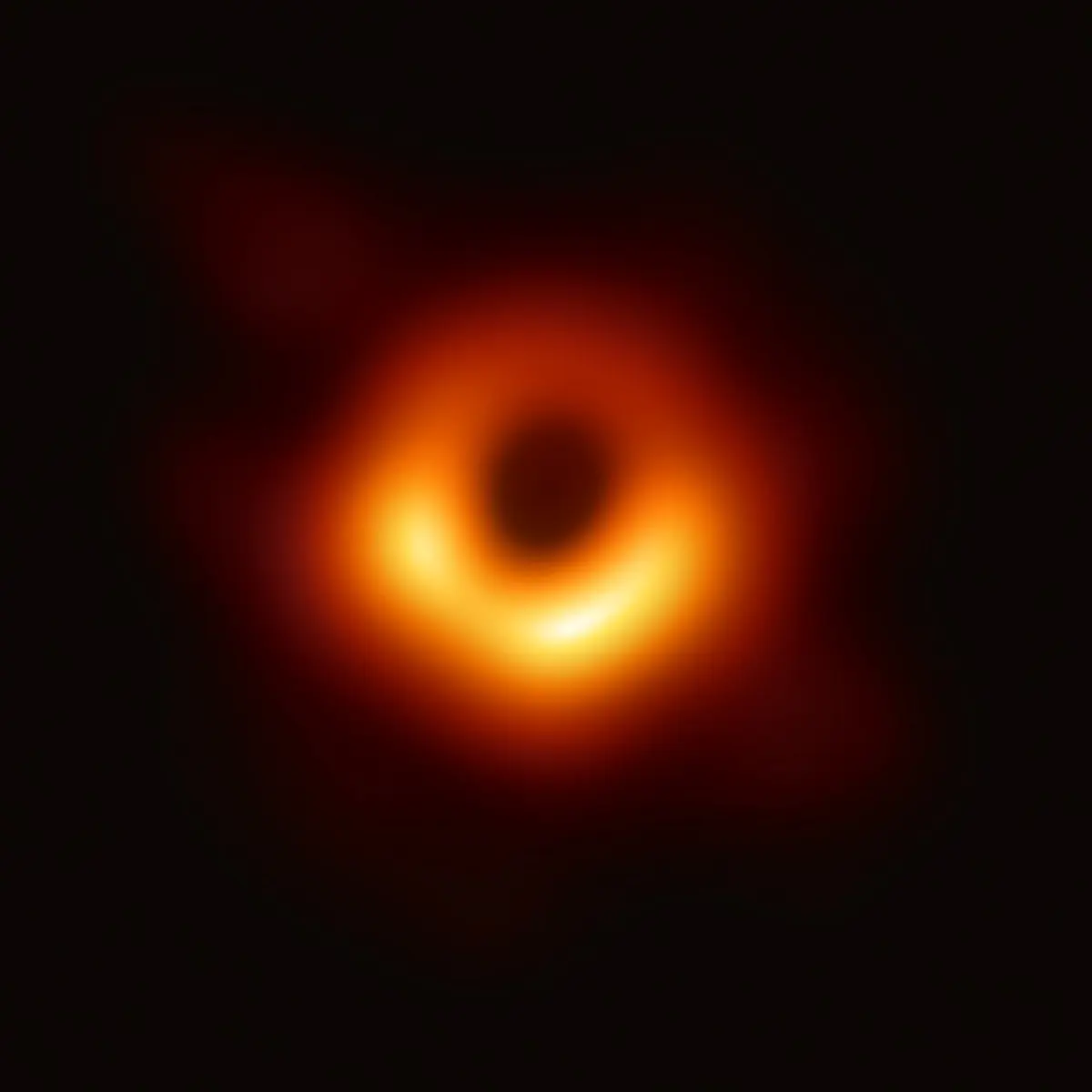
Most large galaxies, our own Milky Way included, are now thought to have a supermassive black hole at their centers, of millions to billions of times the Sun’s mass.
Two black holes have masses of 10 and 20 times the Sun’s mass. The Schwarzschild radius of the heavier one is:
Pick an answer to see why.
26.13 Dark matter and dark energy
Our attempts to measure the universe have turned up two great problems.
- Galaxies spin too fast. The outer stars of nearby galaxies move round their centers too fast to be held in by the gravity of all the matter we can see, the stars, gas and dust. Something else, with mass, must be pulling on them.
- The expansion is speeding up. Distant galaxies are moving away from us at an accelerating rate, rather than slowing down as the attraction of gravity should make them. This was discovered in 1998 from the brightness of exploding stars (supernovae) billions of light years away, and won Saul Perlmutter, Brian Schmidt and Adam Riess the 2011 Nobel Prize in Physics.
Dark matter is the name for the unseen matter that the first problem requires. It has never been detected directly, because it neither gives out nor absorbs light or any other radiation. But it pulls on ordinary matter with its gravity, so from the speed of a star round the edge of a galaxy, the total mass inside its orbit can be worked out, and it is much more than the mass we can see. There is about five times as much dark matter in the universe as ordinary matter (atoms).
Many ideas have been proposed for what dark matter is, including:
- MACHOs, massive astrophysical compact halo objects: old dim stars, small “failed” stars (brown dwarfs), very large planets or black holes, any of which give out too little radiation for us to see. Searches have found far too few of them to account for dark matter.
- WIMPs, weakly interacting massive particles. (“Massive” here means only “with mass”, not that each one is heavy.) There could be huge numbers of particles we don’t know about yet, because they hardly ever interact with ordinary matter. Underground detectors have searched for them for decades, so far without success.
- Neutrinos. They are present in the universe in vast numbers, and they have mass. But their masses are so tiny that, all together, they make up less than about 1 % of the dark matter.
Dark energy is the name for whatever is making the expansion of the universe speed up: a kind of “antigravity” that seems to fill all of space evenly. Its nature is even more mysterious than dark matter’s. One idea is that it is a property of empty space itself, the “cosmological constant” Einstein once put into his equations.
The 5 % universe
From the afterglow of the Big Bang, the Planck satellite measured how the universe’s mass–energy is shared out:
- ordinary matter (atoms): about 5 %;
- dark matter: about 27 %;
- dark energy: about 68 %.
So we know what only about 5 % of the universe is made of; for the other 95 % we have only names. Some cosmologists go further and suggest that our universe may be only one of many, a multiverse, though if so, no knowledge of the others may ever reach us.
How do astronomers know dark matter exists, if it gives out no light?
Pick an answer to see why.
26.14 Gravitational waves
Gravitational waves are ripples in space-time itself, made by some of the most violent events in the universe. Einstein predicted them in 1916 from his general theory of relativity: massive objects accelerating, such as two neutron stars or two black holes orbiting each other, should disturb space-time so that waves of stretching and squeezing spread out in all directions. They travel at the speed of light, carrying information about where they came from, and clues to the nature of gravity itself.
A passing gravitational wave stretches space one way and squeezes it the other, back and forth. Even the strongest that reach the Earth change a length of 4 km by only a few thousandths of the width of a proton, so Einstein himself thought they could never be detected.
On 14 September 2015, the two detectors of LIGO (the Laser Interferometer Gravitational-Wave Observatory) in the USA caught one for the first time. Each detector is an L-shaped instrument with arms 4 km long, along which laser beams measure the arms’ lengths to an astonishing precision. The signal, a rising “chirp” lasting a fifth of a second, came from two black holes, of 36 and 29 times the Sun’s mass, merging 1.3 billion light years away. In that fifth of a second they turned about three Suns’ worth of mass into gravitational waves. Rainer Weiss, Barry Barish and Kip Thorne won the 2017 Nobel Prize in Physics for the detection.
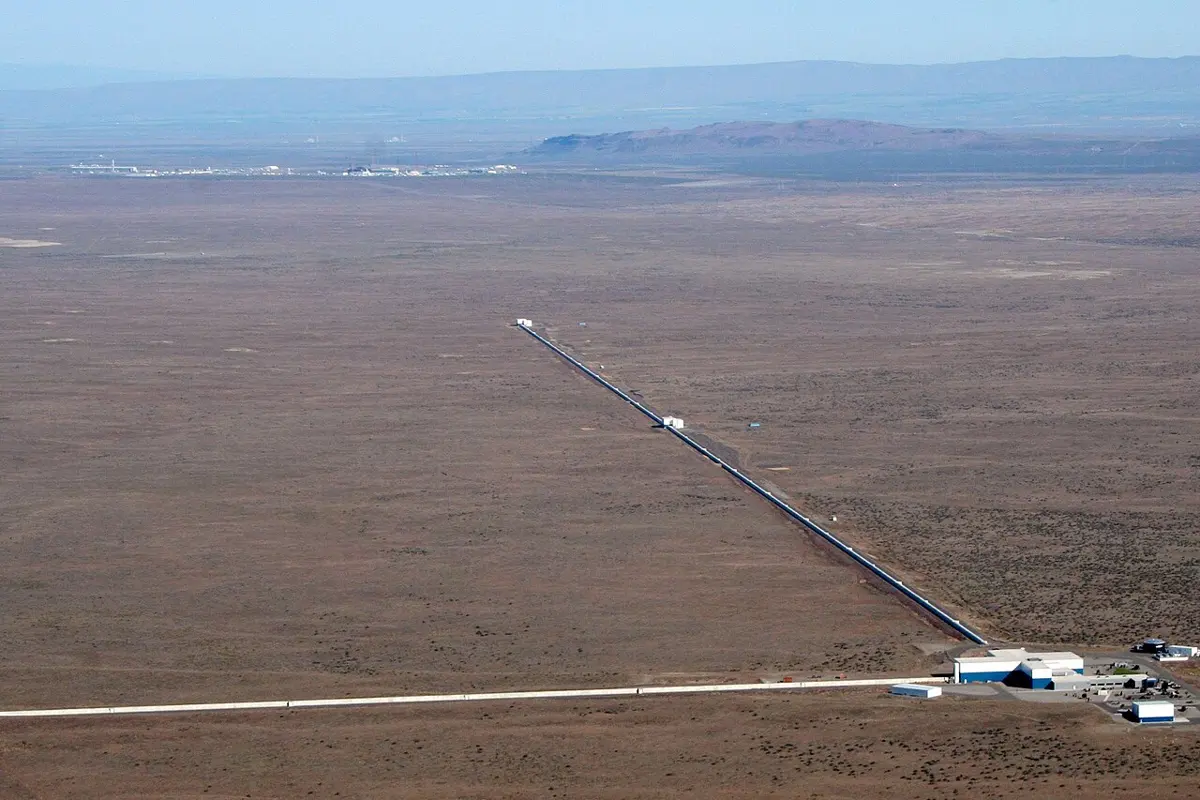
Since then, hundreds of mergers of black holes and of neutron stars have been detected. In 2017, two neutron stars merging were seen both in gravitational waves and in light, by telescopes all over the world. The light showed that heavy elements, such as gold and platinum, had been made in the explosion, and the gravitational waves arrived within two seconds of the gamma rays, after 130 million years of travel, showing that gravity travels at the speed of light.
Exercise
- Which of the following is not a fundamental particle?
Pick an answer to see why.
- Which combination of up (u) and down (d) quarks forms a proton?
Pick an answer to see why.
- Baryons and mesons are particles made of quarks. Which pair shows a possible quark composition for a baryon, and then for a meson?
Pick an answer to see why.
The group of particles known as hadrons is made of quarks. There are two subgroups of hadrons: mesons and baryons.
- a.What is the property that defines a hadron?
- b.State the quark structure of a meson.
- c.State the quark structure of a baryon.
- d.The antiproton is the antiparticle of the proton. State one way in which the proton and the antiproton are similar, and one way in which they are different.
- e.For an antiproton, state (i) its charge and (ii) its quark structure.
Answer
Particles can be leptons, hadrons or exchange particles. Here is a list: electron, proton, neutron, muon, pion.
- a.From the list, name one lepton and one hadron.
- b.State one difference between leptons and hadrons.
- c.State the difference in structure between baryons and mesons.
- d.From the list, name one baryon and one meson.
Answer
The table shows some information about three hadrons.
| Particle | Quark structure | Baryon or meson | Charge |
|---|---|---|---|
| ? | ? | ? | |
| ? | udd | ? | ? |
| kaon, K⁺ | ? | ? | ? |
- a.Copy and complete the table.
- b.Every particle in the table has an antiparticle. Name one baryon and its antibaryon not shown in the table, and give their quark structures.
- c.The electron and the positron are a lepton particle–antiparticle pair. State one property of the positron that is the same as the electron’s, and one that is different.
Answer
- A sodium atom contains 11 electrons, 11 protons and 12 neutrons. Which row gives the correct numbers of hadrons, baryons, mesons and leptons in a sodium atom?
Pick an answer to see why.
What is the charge on each of these particles?
- a.electron
- b.muon neutrino
- c.up quark
- d.positron
- e.down quark
- f.strange quark
Answer
State one similarity and one difference between a particle and its antiparticle (for example, an electron and a positron).
Answer
Why are quarks believed to be fundamental particles?
Answer
Use this list to answer: proton, pion, muon, photon, neutron.
- a.Which particle is a lepton?
- b.Which particles are hadrons?
- c.Which particles are fundamental particles?
- d.Which particle is a meson?
- e.Which particle is an exchange particle?
Answer
A quark is a fundamental particle but a neutron is not. Explain the meaning of this statement.
Answer
A proton and a neutron each contain three quarks, either up or down quarks.
a. Copy and complete the table to show the charge on a proton and a neutron, and the quarks they contain.
| Particle | Charge | Quarks |
|---|---|---|
| proton | ? | ? |
| neutron | ? | ? |
b. Using the information in your table, suggest why some quarks must have a positive charge and some a negative charge.
Answer
The Hubble constant is 2.3 × 10⁻¹⁸ s⁻¹.
a.
- A galaxy is 1.6 × 10⁸ ly from the Earth. Show that its recessional speed, measured from the Earth, is about 3.5 × 10⁶ m/s. (1 ly = 9.46 × 10¹⁵ m)
- A line in the hydrogen spectrum measured in a laboratory on the Earth has a wavelength of 486 nm. Calculate, in nm, the wavelength of the same hydrogen line as observed in the galaxy’s spectrum.
b. Outline how observations of the spectra of distant galaxies provide evidence that the universe is expanding.
Answer
- a.State Hubble’s law.
- b.Explain the principles used by observers on the Earth to find the speeds of distant galaxies.
- c.Describe how observations of distant galaxies provide evidence for (i) the expanding universe and (ii) the Big Bang theory.
Answer
Printable PDFs
- The unit as a book (A5) 23 pages Answers as an A4 booklet, 6 sheets
- Study notes 3 pages
- Worksheet 5 pages Answer key
- Harder practice questions 2 pages Answer key
Quiz yourself: Earth and Space, Grades 5–12 →
Practice every question in the book, and keep track of the ones you miss →
A companion to your textbook, not a replacement for it: study from the book your school uses, and where the two differ, follow your teacher. Found a mistake? Please tell us.