
In February 1896, in Paris, Henri Becquerel wanted sunshine. He meant to leave crystals of a uranium salt on a photographic plate wrapped in thick black paper, out in the sun, to see whether sunlight made them give off rays that could pass through the paper. The sky stayed gray, so he put everything away in a drawer. A few days later he developed the plate anyway, expecting nothing, and found the outlines of the crystals sharp and dark on it. No sunlight, no electricity, no heating: the uranium was sending out something invisible, all by itself, and it never stopped.
That something is radioactivity, and in this unit you will meet its three kinds of radiation, the law that says how fast a radioactive sample dies away, and the numbers that measure it: the half-life, the decay constant, the mean life and the activity. Then three things it does for us: the Geiger–Müller tube that counts it click by click, the carbon clock that dates a 10,000-year-old bone, and the radioisotopes that find and treat disease. Grade 11 Physics, Nuclear Physics, explained what a nucleus is made of and why some are bound more tightly than others; here you will see what happens when one isn’t bound tightly enough.
24.1 Radioactivity
Radioactivity is the natural process in which an unstable nucleus breaks down, or decays, to become more stable, giving out energy as particles or rays. What it gives out is called radiation. Some elements, such as uranium, thorium and radium, do it naturally, and every element has radioactive isotopes.
Radioactivity matters to physics because it opened the inside of the atom: Rutherford found the nucleus by firing alpha particles from radium at gold foil (Grade 11, Rutherford’s experiment). It matters to everyone else because of its uses, in medicine, industry, dating the past and nuclear power, and because of its dangers.
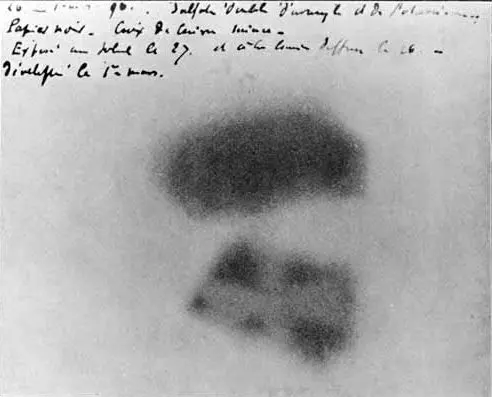
Becquerel had found it by accident, as the opening tells. He showed that the rays came from the uranium in any compound of it (he first used a potassium uranyl sulphate, a double sulphate of potassium and uranium), that they made air conduct electricity, and that their strength didn’t depend on light, heat or chemistry. They were called Becquerel rays, or uranic rays.

What made Becquerel’s plate dark in the drawer?
Pick an answer to see why.
24.2 Natural and artificial radioactivity
Natural radioactivity
Natural radioactivity is the spontaneous decay of unstable nuclei of elements found in nature, giving out alpha (α) particles, beta (β) particles or gamma (γ) rays. Nothing has to start it: it goes on by itself. It is found mostly in heavy elements, such as uranium, thorium and radium, and in a few light ones, such as potassium-40 and carbon-14.
Artificial radioactivity
Artificial (or induced) radioactivity is the radioactivity of nuclei made unstable on purpose, by a nuclear reaction. Stable nuclei are bombarded with particles such as neutrons, protons or alpha particles; the new nuclei formed are unstable, and they decay, giving out radiation. The radioactive isotopes made in this way are called artificial radioisotopes.
It was discovered in 1934 by Irène Joliot-Curie (Marie Curie’s daughter) and her husband Frédéric Joliot-Curie. They fired alpha particles from polonium at aluminium foil, and found that the foil went on giving out radiation after the alpha source was taken away. The alpha particles had made phosphorus-30, which doesn’t exist in nature:
and the phosphorus-30 then decayed, with a half-life of about 2.5 minutes, giving out positrons (positive electrons) and becoming stable silicon-30. They won the 1935 Nobel Prize in Chemistry for it.
Today nuclear reactors and particle accelerators make hundreds of artificial radioisotopes: cobalt-60 for treating cancer, technetium-99m for medical scans, iodine-131 for the thyroid, americium-241 for smoke detectors. Natural and artificial radioactivity together are used in medicine, in radiocarbon dating and in nuclear power.
Which of these is an example of artificial radioactivity?
Pick an answer to see why.
24.3 Radioactive radiations
Radioactive substances give out three kinds of radiation, named by Rutherford with the first three letters of the Greek alphabet in the order of how far they get through matter: alpha (α), beta (β) and gamma (γ).
They can be told apart by passing them through an electric or a magnetic field, in a vacuum, as in Figure 24.3:
- Between charged plates (an electric field), alpha particles, being heavy and positive, bend towards the negative plate; beta particles, light and negative, bend towards the positive plate, much more sharply; gamma rays go straight on, so they have no charge.
- In a magnetic field, alpha and beta particles curve in opposite directions, so their charges are opposite; gamma rays again go straight on: they are neutral, a kind of electromagnetic wave.
The force on a charge moving at across a magnetic field is , and it bends the particle into a circle of radius (Unit 20, an electron beam in a magnetic field). An alpha particle has twice the charge of a beta particle but about 7,300 times its mass, so in the same field its circle is far larger: it hardly bends at all. That is why Rutherford needed a very strong magnet to show, in 1903, that alpha particles are positive.
Cause of radioactivity
A nucleus is held together by the strong nuclear force, an attraction between all its nucleons (protons and neutrons) that acts only over about 10⁻¹⁵ m, between neighbors. Against it pushes the electric repulsion between its protons, which reaches across the whole nucleus. A nucleus is stable only when the two are well balanced, and that needs the right mix of neutrons and protons (Grade 11, Forces in the nucleus).
When the balance is wrong, the nucleus is unstable, and sooner or later it changes into a more stable one by giving out radiation:
- a nucleus that is too big (heavier than lead, with more than 82 protons, where the repulsion of so many protons is hard to hold) gives out an alpha particle and gets smaller;
- a nucleus with too many neutrons for its protons turns a neutron into a proton and gives out a beta particle (an electron);
- a nucleus left with too much energy, in an excited state after an alpha or beta decay, gives the extra energy out as a gamma ray, as an excited atom gives out light.
So the cause of radioactivity is an unstable nucleus: one whose repulsion is too much for its binding, or whose neutrons and protons are out of balance.
Properties of alpha particles
- Alpha particles are helium nuclei, : two protons and two neutrons, a helium atom that has lost its two electrons. So an alpha particle has twice the positive charge of a proton (+2e = +3.2 × 10⁻¹⁹ C) and about four times its mass (6.64 × 10⁻²⁷ kg).
- Their speeds are about 1.4 × 10⁷ to 2.05 × 10⁷ m/s (5–7% of the speed of light), depending on the substance that gives them out. All the alpha particles from one kind of nucleus come out with the same energy, between about 4 and 9 MeV (4.2 to 6.8 MeV for most of the usual sources).
- Although they carry a lot of energy, they are the least penetrating of the three. Being heavy and doubly charged, they lose their energy quickly: a sheet of paper, aluminium about 0.02 mm thick, or the dead outer layer of your skin stops them.
- Their range in air at normal pressure is 3 to 8 cm, depending on their energy.
- They have a very great ionizing power: each produces about a hundred thousand ion pairs (tens of thousands in every centimeter of air) before it stops.
- They make some substances, such as zinc sulphide and barium platinocyanide, glow (fluorescence).
- They are deflected by electric and magnetic fields (only slightly, being heavy).
- They affect a photographic plate.
- They are scattered when they pass through thin metal foils (Rutherford’s experiment).
- They can cause nuclear reactions, and so make artificial radioactivity, as the Joliot-Curies found.
Properties of beta particles
- Beta particles are fast-moving electrons, coming from the nucleus (not from the electron shells): charge −e = −1.6 × 10⁻¹⁹ C, mass 9.11 × 10⁻³¹ kg.
- They come out with every speed from almost zero up to about 99% of the speed of light. Each decay shares its energy between the electron and an antineutrino in a different way, so the electrons have every energy from zero up to a maximum, which for most beta emitters is a few MeV or less. With so little mass, even the fastest carry modest energies.
- They penetrate more than alpha particles: a few millimeters of aluminium stops them, and their range in air is up to several meters.
- They ionize gases, but their ionizing power is much smaller than that of alpha particles: very roughly a hundred ion pairs per centimeter of air.
- They make zinc sulphide and barium platinocyanide glow.
- They are deflected by electric and magnetic fields, much more than alpha particles, and the other way.
- They affect a photographic plate.
- They can cause nuclear reactions, and so produce artificial radioactivity.
Properties of gamma rays
- Gamma rays are electromagnetic waves of very short wavelength (about 10⁻¹¹ m and shorter), like X-rays but usually of higher energy. They travel at the speed of light.
- They are highly penetrating: they pass through several centimeters of iron or lead. Lead and thick concrete only reduce them; each 1.2 cm of lead halves the gamma rays of cobalt-60.
- Their ionizing power is small.
- They make some substances, such as willemite (a zinc mineral), fluoresce.
- They affect a photographic plate.
- They are not deflected by electric or magnetic fields: they have no charge.
- They knock electrons out of the surfaces they fall on (the photoelectric effect).
- They heat the surfaces that absorb them.
- They can cause some nuclear reactions (a gamma ray can break a deuterium nucleus into a proton and a neutron).
- High-energy (hard) gamma rays are used in hospitals for radiotherapy, to kill cancer cells.
| Property | Alpha (α) | Beta (β) | Gamma (γ) |
|---|---|---|---|
| What it is | helium nucleus, | fast electron from the nucleus | electromagnetic wave (photons) |
| Charge | +2e | −e | 0 |
| Mass | about 4 u | about u | 0 (no rest mass) |
| Speed | 5–7% of c | up to about 99% of c | c |
| Ionizing power | greatest | moderate | least |
| Penetrating power | least: stopped by paper | moderate: stopped by a few mm of aluminium | greatest: reduced by cm of lead |
| Range in air | 3–8 cm | up to several meters | very long |
| In electric and magnetic fields | deflected (a little) | deflected (a lot, the other way) | not deflected |
Notice that the order of ionizing power is the exact reverse of penetrating power. That is no accident: each ion a radiation makes costs it some energy. An alpha particle, making tens of thousands of ions per centimeter, spends all its energy in a few centimeters of air; a gamma ray, making very few, keeps going.
An unknown source is placed in front of a Geiger–Müller tube. The count rate drops a lot when a sheet of paper is put in front, drops a little more with 5 mm of aluminium, and drops only slightly further with 1 cm of lead. What does the source give out?
Pick an answer to see why.
24.4 Laws of radioactive decay
Radioactive decay is spontaneous: it happens by itself. The decay of a nucleus is called radioactive disintegration. From their experiments, Rutherford and Soddy gave these laws (1902–1903):
a. Radioactive decay is random and spontaneous, and it is not affected by external conditions such as temperature, pressure, chemical combination or electric and magnetic fields. Heating uranium to 1000 °C or cooling it in liquid nitrogen leaves its rate of decay exactly the same: the energies inside a nucleus are millions of times larger than anything heat or chemistry can supply.
b. In one decay a nucleus gives out either an alpha particle or a beta particle, never both at once, and one atom gives out only one such particle at a time. When it does, it becomes an atom of a different element, by these rules (the displacement laws of Soddy and Fajans):
i. Alpha decay. The nucleus loses two protons and two neutrons. Its mass number goes down by 4 and its atomic number by 2, so it moves two places back in the periodic table:
is the Q value, the energy released, which mostly becomes the alpha particle’s kinetic energy. For example, uranium-238 decays by giving out an alpha particle and becomes thorium-234:
ii. Beta decay. Inside the nucleus a neutron turns into a proton, and an electron (the beta particle, ) is created and thrown out, with an antineutrino (a neutral particle with almost no mass). The nucleus has one proton more and one neutron fewer: goes up by 1, and stays the same. It moves one place forward in the periodic table:
For example, carbon-14 gives out a beta particle and becomes nitrogen-14:
iii. Gamma emission. A gamma ray carries away energy only: and don’t change. It usually follows an alpha or a beta decay at once, as the new nucleus settles from an excited state.
Radium-226 () gives out an alpha particle. The new nucleus is:
Pick an answer to see why.
c. The rate of disintegration at any time is directly proportional to the number of radioactive atoms present at that time. This is the radioactive decay law, or law of radioactive disintegration, and it gives radioactivity its numbers.
The decay equation
Why should the rate be proportional to the number present? Because each nucleus has the same chance of decaying in the next second, whatever has happened before and however many neighbors it has. A thousand nuclei give a thousand chances; twice as many give twice as many decays.
Let a sample start with radioactive atoms at , and let be the number not yet decayed at time . In the short time after that, of them decay. Because is going down, is negative, and the rate of disintegration is , a positive number.
- By the decay law, the rate is proportional to the number present:
- Put in a constant of proportionality , the decay constant (or disintegration constant) of the substance:
The minus sign says that the number of parent atoms goes down as time goes on. - Separate the variables, on one side and on the other:
- Integrate both sides, from (at ) to (at time ):
- The integral of is :
- Take the exponential of both sides:
This is the decay equation: it gives the number of atoms not yet decayed at any time . It is an exponential decrease, the same law that describes a cooling cup of tea or a capacitor discharging. Since is zero only when , a radioactive sample never quite disappears in theory: its graph of against gets ever closer to the time axis without touching it (it is asymptotic to it), Figure 24.4.
From the equation and its graph:
- Radioactive decay is exponential: fast at first, while there are many atoms to decay, then slower and slower.
- The larger the decay constant , the faster the number of atoms falls.
- Whatever the substance, a sample would take infinite time to decay completely, so in that sense all radioactive substances look alike. They are not: some are far more active than others. To compare them we use the half-life or the mean life, below.
A sample of a radioactive substance is heated from 20 °C to 500 °C. Its rate of decay:
Pick an answer to see why.
24.5 Half-life
The half-life of a radioactive substance is the time in which half the atoms of a sample decay; or, the time in which its number of undecayed atoms (or its activity) falls to half.
To find it, put and into the decay equation (24.3):
- Cancel and turn both sides over:
- Take natural logarithms:
- So
The half-life is inversely proportional to the decay constant, and it is a property of the nucleus alone: nothing done to the sample changes it. Half-lives range from far less than a second to far longer than the age of the universe:
| Isotope | Decays by | Half-life |
|---|---|---|
| polonium-214 | α | 0.16 milliseconds |
| radon-222 | α | 3.8 days |
| iodine-131 | β | 8.0 days |
| cobalt-60 | β, γ | 5.3 years |
| radium-226 | α | about 1600 years |
| carbon-14 | β | 5730 years |
| uranium-238 | α | 4.47 billion years |
Take radium, with a half-life of about 1600 years (some older books give 1620). Start with atoms. In 1600 years, half of them, , will each have given out an alpha particle and become radon, and radium atoms are left. In the next 1600 years half of those decay, leaving ; then , and so on. Each half-life takes away half of what is left, not half of what you started with.
Number of atoms left after n half-lives
| Time | Atoms left |
|---|---|
| 0 | |
So after a time , which is half-lives,
This works for any time, not only whole numbers of half-lives ( can be 2.5), and it is the same equation as (24.3): . Use whichever is easier: (24.5) when the time is a whole number of half-lives.
A sample has a half-life of 3 hours. What fraction is left undecayed after 12 hours?
Pick an answer to see why.
24.6 Radioactive decay constant
From equation (24.1), , so
The decay constant of a radioactive substance is the ratio of its instantaneous rate of disintegration to the number of atoms present at that time: the fraction of the atoms that decay per unit time. Its unit is s⁻¹ (or per day, per year). If per second, then about 1% of the atoms present decay in each second; or, for one nucleus, is the probability per second that it decays.
There is a second way to see it. Put in the decay equation:
So the decay constant is the reciprocal of the time in which the number of atoms falls to , about 37%, of its starting value. That time, , is the mean life, next.
24.7 Average life or mean life
Some nuclei of a sample decay in the first second, some last a thousand years; each nucleus’s life is a matter of chance. The mean life (or average life) of a radioactive substance is the average time a nucleus of it exists before it decays:
The mean life is 1/λ
- Of the nuclei present at the start, the number that decay between and is the rate times the time, .
- Each of them lived for a time , so together they lived .
- Add up the lives of all the nuclei, from to , and divide by :
- The integral, by parts, is (the term is zero at both limits, leaving ). So
The mean life is the reciprocal of the decay constant. Using from (24.4):
The mean life is 1.443 times the half-life; the half-life is 0.693 times the mean life.
A substance has a half-life of 6.93 hours. Its mean life is:
Pick an answer to see why.
24.8 Activity of a radioactive substance
The activity (or ) of a radioactive substance is its rate of disintegration: the number of nuclei that decay per second.
The minus sign makes the activity a positive number while is falling. By the decay law (24.1), , so
The activity is the decay constant times the number of radioactive atoms present. At , ; at time , . Dividing, and using (24.3):
The activity falls exponentially at the same rate as the number of atoms, with the same half-life. So we can also write
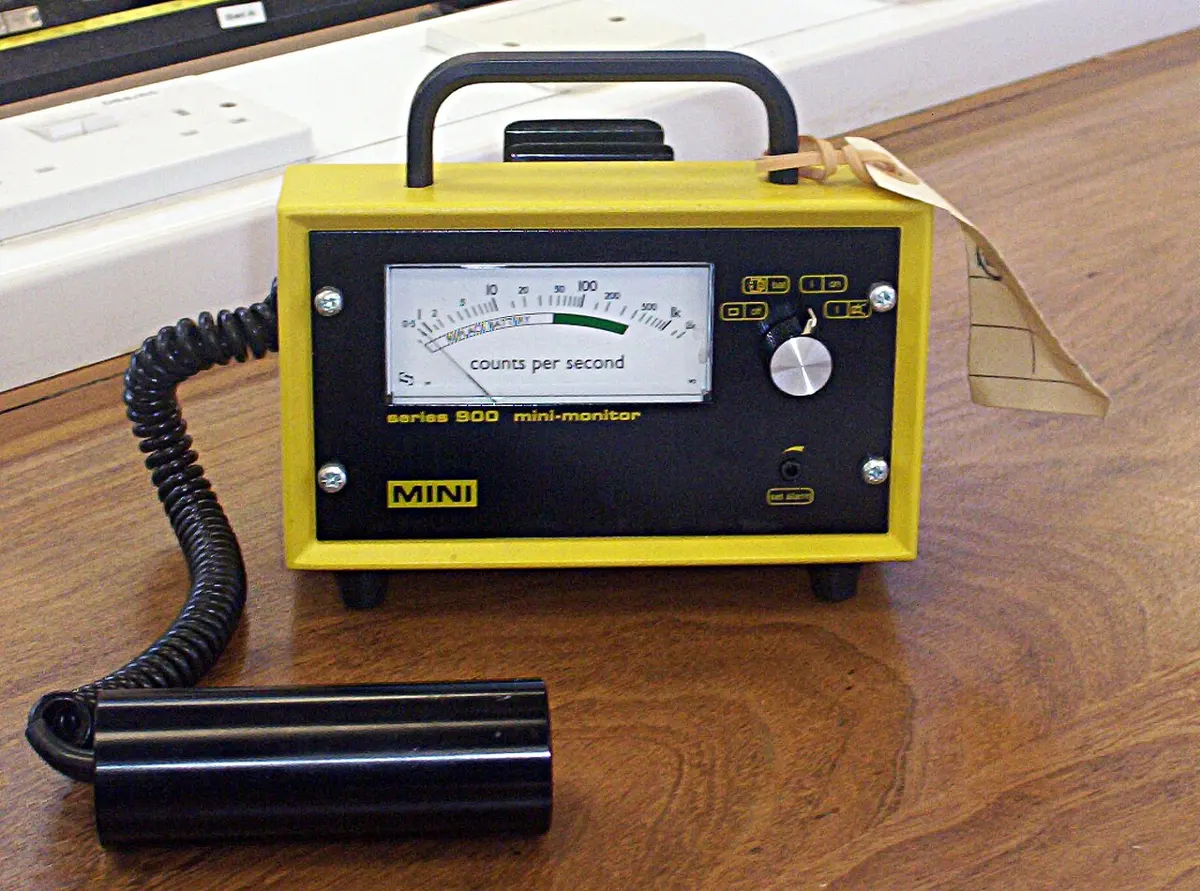
This is why a half-life can be measured with a Geiger–Müller counter: the count rate (counts per second, a fixed fraction of the activity, after the background count is taken away) halves in each half-life, just as the number of atoms does. Every graph in this unit’s exercise is a count rate against time.
24.9 Units of radioactivity
- The becquerel (Bq) is the SI unit of activity: 1 Bq = 1 disintegration per second. It is named after Henri Becquerel.
- The curie (Ci) is the older unit: 1 Ci = 3.7 × 10¹⁰ disintegrations per second. It was chosen to be about the activity of 1 g of radium-226, and named after Marie and Pierre Curie. A curie is a large activity, so smaller units are used:
- 1 millicurie (mCi) = 10⁻³ Ci = 3.7 × 10⁷ disintegrations per second;
- 1 microcurie (µCi) = 10⁻⁶ Ci = 3.7 × 10⁴ disintegrations per second.
- Because the curie is tied to radium, the rutherford (Rd) was proposed in 1946: 1 Rd = 10⁶ disintegrations per second, with
- 1 millirutherford (mRd) = 10³ disintegrations per second;
- 1 microrutherford (µRd) = 1 disintegration per second.
The rutherford is hardly used now; the becquerel replaced both, but the curie is still common in hospitals and industry.
Worked examples
Test yourself
24.10 Detection of radiation: the GM tube
Radiation can’t be seen, heard or felt, so we need instruments to detect it: photographic film, cloud chambers, scintillation counters, semiconductor detectors. The simplest and commonest is the Geiger–Müller counter (GM counter), made by Hans Geiger and Walther Müller in 1928. Each particle of radiation that enters it gives one click.
Construction
The GM tube is shown in Figure 24.6.
- C is a metal cylinder (or a glass tube coated inside with metal), the cathode. It is filled with a gas at low pressure, about 10 cm of mercury: usually argon, with a little halogen or alcohol vapor.
- W is a fine tungsten wire stretched along the middle of the cylinder, the anode.
- The cylinder and the wire are insulated from each other by ebonite plugs E.
- The wire is connected to the positive terminal of a high-voltage supply (about a kilovolt) through a very high resistance R (of the order of megohms); the cylinder is connected to the negative terminal.
- A thin window W′ of mica at one end lets the radiation in; even alpha particles can get through it.
- The voltage across R is passed to an amplifier and a counter.
Working
- With the power on, the wire is positive and the cylinder negative, so there is a strong electric field between them, strongest close to the thin wire.
- An ionizing particle (an alpha or beta particle, or an electron knocked out by a gamma ray) enters through the window and ionizes a few gas atoms, making electrons and positive ions.
- The electrons are accelerated towards the wire. Near the wire the field is so strong that each gains enough energy between collisions to ionize more atoms; the new electrons do the same, and so on. A single electron becomes an avalanche of millions of electrons, which spreads along the whole wire.
- The avalanche reaches the wire and flows through the resistance R, giving a short pulse of voltage across R.
- The pulse is amplified and counted: each one adds 1 to the counter, and often a loudspeaker clicks.
So each ionizing particle that enters gives one count, whatever its energy: the tube counts particles but can’t tell their energies apart.
Plateau of the GM counter
If the source is kept fixed and the count rate (counts per minute) is measured at different applied voltages, the graph is as in Figure 24.7.
- Below a certain voltage, the threshold voltage , the field is too weak for an avalanche big enough to count, so the count rate is zero.
- Above , more and more of the ionizing particles start avalanches big enough to count, and the count rate rises quickly.
- Then every particle that enters gives a counted pulse. Raising the voltage further can’t give more counts than there are particles, so the curve is almost flat: this flat part, from to , is the plateau.
- Beyond the plateau the field is so strong that the tube breaks into continuous discharge, with no particles needed: the count rate shoots up, and the tube can be damaged. This region is always avoided.
Working voltage. On the plateau the count rate hardly depends on the voltage, so it gives the true count of particles. The best working voltage is taken in the middle of the plateau, where small changes in the supply don’t matter:
Why is a GM tube worked on the plateau of its characteristic?
Pick an answer to see why.
24.11 Radiocarbon dating
Finding the age of an archaeological object (a bone, a piece of charcoal, a cloth) or a geological one (a rock) is called dating. It is done by measuring how much of a radioactive isotope is left in it. For things that were once alive, the isotope is carbon-14, with a half-life of 5730 years.
How carbon-14 gets into living things
- Cosmic rays from space hit the upper atmosphere and knock neutrons out of nuclei. These neutrons hit nitrogen-14, the commonest nucleus in the air, and make carbon-14:
- The carbon-14 joins oxygen as carbon dioxide and mixes through the air. Plants take it in during photosynthesis, along with ordinary carbon-12; animals eat the plants. So every living thing contains carbon-14, in the same small proportion as the air: about 1.2 carbon atoms in every million million (10¹²) are carbon-14. While it lives, it keeps taking in new carbon, so the proportion stays the same.
- Carbon-14 is radioactive and decays back to nitrogen:
In living carbon this gives an activity of about 0.23 Bq for every gram of carbon (about 14 decays a minute). - When the plant or animal dies, it stops taking in carbon. Its carbon-12 stays, but its carbon-14 decays away with a half-life of 5730 years, and nothing replaces it. So the less carbon-14 is left, compared with the carbon-12, the longer ago it died.
The age
Let be the number of carbon-14 atoms the sample had when it died, and the number now. Because the carbon-12 doesn’t change, is found from the sample’s carbon-12 and the living ratio; or, more simply, we compare the activity of the sample with the activity of the same mass of carbon from a living thing today.
- By the decay law, , so .
- Activity is proportional to the number of atoms (), so .
- Take logarithms: , and put in :
where years is carbon-14’s half-life, the activity of living carbon and that of the same mass of carbon from the sample. This gives the time since the organism died: its age.
After about ten half-lives (57,000 years) only a thousandth of the carbon-14 is left, too little to measure reliably, so radiocarbon dating works back to about 50,000 years. Older things, and rocks, are dated with longer-lived isotopes: uranium-238 decaying to lead-206 (half-life 4.47 billion years) dates the oldest rocks, and gives the age of the Earth, 4.54 billion years.
Why can’t radiocarbon dating find the age of a stone tool?
Pick an answer to see why.
24.12 Medical uses of radiation
Radiation has vital uses in medicine. Radioisotopes of elements such as carbon, chlorine, sodium, iodine and technetium are made, mostly in nuclear reactors, and used in two ways: to find out what is wrong (diagnosis) and to treat it (therapy).
i. Diagnosis
A small amount of a radioisotope, a tracer, is given to the patient by mouth or injection. It goes where that element goes in the body, and its gamma rays, which pass out of the body, are picked up by a detector or a gamma camera to show where it is and how fast it moves.
- a.Blood circulation: a little sodium-24 in the blood shows where the circulation is blocked or slow.
- b.Brain tumors: tracers collect in the tumor, which shows up as a bright spot. Today this is usually done by PET scans with fluorine-18, which gives out positrons (Grade 11, Annihilation and creation).
- c.The heart’s pumping: tracers in the blood (sodium-24 in early studies, technetium-99m today) show how much blood the heart pumps with each beat.
- d.Kidneys, liver and lungs: how well they work, in health and disease, from how fast a tracer passes through them.
- e.Bone: a bone scan with technetium-99m shows defects in bone metabolism, fractures and cancers that have spread to bone.
- f.Anemia: iron-59 shows how the body takes up iron to make red blood cells.
The most used medical isotope is technetium-99m: its 6-hour half-life is long enough for a scan and short enough to leave the body soon, and it gives out only a gamma ray, easy to detect and gentle on the patient.
ii. Therapy
Here the radiation is used to destroy cells that are harmful, such as cancer cells, which are more easily killed by radiation than healthy cells because they divide more often.
- a.The thyroid: the thyroid gland takes up iodine, so radioactive iodine-131 given as a drink goes straight there, and its beta particles destroy an overactive thyroid or thyroid cancer from the inside.
- b.Cancer: gamma rays from cobalt-60, in a beam aimed at the tumor from several directions, kill the cancer cells while sparing the tissue around. (Today most beams come from machines called linear accelerators, which make high-energy X-rays instead of using a radioactive source.) Small sealed sources, such as gold-198 seeds or iridium-192, can be placed inside or next to a tumor (brachytherapy).
- c.Skin and blood diseases: phosphorus-32, a beta emitter, has been used on skin conditions and to treat some blood disorders.
Gamma rays are also used to sterilize medical equipment (syringes, gloves, bandages) sealed in their packets, killing every germ without heating them.
Health hazards of radiation
The radiation that heals can also harm, for the same reason: it ionizes. When it passes through a living cell it knocks electrons off atoms and breaks molecules, above all the DNA that carries the cell’s instructions.
- A large dose in a short time kills many cells at once. The body can’t replace them fast enough, and the person suffers radiation sickness: vomiting, burns, hair loss, damage to the bone marrow that makes blood, and death after very large doses. These effects come only above a threshold dose, and get worse as the dose grows.
- Smaller doses may damage the DNA of a cell without killing it. If the cell can’t repair it, the damage can lead, years later, to cancer (leukemia, thyroid cancer and others), and damage in the sex cells can cause mutations passed on to children. These effects have no safe threshold: the larger the dose, the higher the chance.
The harm done is measured as the dose in sieverts (Sv). Everyone receives about 2.4 mSv a year on average from natural background radiation (radon gas from the ground, rocks, cosmic rays, the potassium in our food); a chest X-ray gives 0.02 to 0.1 mSv, a CT scan 2 to 10 mSv. A dose of 4 to 5 Sv in a short time would kill about half the people who received it.
Which radiation is most dangerous depends on where the source is.
- Outside the body, alpha particles are harmless: the dead outer layer of skin stops them. Gamma rays and beta particles, which reach the organs, are the danger.
- Inside the body (breathed in, swallowed, or in a wound), alpha emitters are the most dangerous: all their energy is dumped in a tiny volume of living tissue. Radon gas, which seeps from the ground into closed rooms, and its decay products in the lungs are the second biggest cause of lung cancer after smoking.
Protection has three rules, time, distance and shielding:
- spend as little time near a source as possible;
- keep as far away as possible (handle sources with long tongs; gamma radiation from a small source falls as the square of the distance);
- put shielding in between (lead aprons, lead or concrete walls; sources kept in lead containers);
- and in addition, never eat, drink or smoke where radioactive materials are used, and wear a film badge or dosimeter to record the dose received.
The danger of radioactive contamination was seen at Chernobyl (Ukraine, 1986), where a reactor exploded and spread radioactive cesium-137 and iodine-131 over much of Europe, and at Fukushima (Japan, 2011). Thirty-year cesium-137 keeps the land around Chernobyl contaminated for a century or more.
A source that gives out only alpha particles is most dangerous:
Pick an answer to see why.
Exercise
Choose the correct option
- An activity of 1.85 × 10¹² disintegrations per second is equal to:
Pick an answer to see why.
- The half-life of a radioactive substance is 2 months. Of a mass M, the amount left after 1 year is:
Pick an answer to see why.
- A radioactive salt of half-life 2 days has a mass of 10 g. How much of it will be left after 10 days?
Pick an answer to see why.
- If 20% of a radioactive mass decays in 10 days, what percentage of it remains undecayed after 20 days?
Pick an answer to see why.
- Which of these is equal to one rutherford?
Pick an answer to see why.
- What determines the half-life of a radioactive element?
Pick an answer to see why.
- A radioactive element has a half-life of 2.5 hours. In 10 hours, 1 g of it is reduced to:
Pick an answer to see why.
- A source with a half-life of 130 days contains 10²⁰ radioactive atoms at first. What is its activity after 260 days?
Pick an answer to see why.
- The activity of radium decreases by about 1% every 25 years. Find its half-life.
Pick an answer to see why.
- A radioactive source decays to 1% of its initial activity in 100 days. What is its half-life?
Pick an answer to see why.
- The half-life of a radioactive substance is 4.8 min. Find the time needed for its activity to fall to 5%.
Pick an answer to see why.
Answer these questions
- a.What is radioactivity? Write down the laws of radioactive decay.
- b.Define the radioactive decay constant. Find the relation between half-life and decay constant.
- c.The half-life of a radioactive element is 30 days. Calculate its decay constant, and the time needed for 75% of its atoms to disintegrate.
Hint
Answer
- a.State the law of radioactive disintegration. What do you mean by the half-life and the mean life of a radioactive substance? Prove that the half-life of a radioactive substance is 0.693 times its mean life.
- b.What is the half-life of a radioactive substance whose activity falls to of its original value in 7.5 years?
Hint
Answer
- a.Does the neutron–proton ratio of a nucleus increase or decrease in α-decay?
- b.The half-life of a radioactive substance is 30 days. How long does it take for of its original mass to disintegrate?
Hint
Answer
- a.What percentage of a sample of a radioactive substance is left undecayed after five half-lives?
- b.A stream of neutrons has a kinetic energy of 0.0327 eV. If the half-life of the neutron is 700 s, what fraction of the neutrons will decay before they travel a distance of 10 m? (Mass of a neutron = 1.675 × 10⁻²⁷ kg.)
Hint
Answer
The graph shows the count rate against time for a sample containing indium-116.
- a.Use the graph to find the half-life of the isotope.
- b.Calculate its decay constant.
Hint
Answer
The graph shows how the count rate from a radioactive source changes with time.
- a.Describe how the count rate changes with time.
- b.i. Find from the graph how many seconds it takes for the count rate to fall from 60 counts/s to 15 counts/s.
- ii.How many half-lives is this?
- c.Calculate the half-life of the substance.
- d.How long does the count rate take to fall from 10 counts/s to 5 counts/s?
Hint
Answer
Astatine-210 is a radioactive material. Its nucleus is .
a. Complete the table for the nucleus of astatine-210.
| Type of particle | Number of particles | Charge on a particle |
|---|---|---|
| neutron | ||
| positive |
- b.Astatine-210 has a half-life of 8 hours.
- i.The count rate of a sample of astatine-210 is measured over 24 hours. Sketch a line on axes like those below to show how the count rate changes over the 24 hours.
- ii.A sample of astatine-210 has a mass of 0.500 kg. Calculate how long it takes for 0.375 kg of it to decay.
Hint
Answer
- a.Complete this definition of radioactive half-life: the half-life of a radioactive substance is the time taken for …
- b.The graph shows how the count rate from a sample of radioactive material changes with time.
- i.Use the graph to find the half-life of the material.
- ii.Use the graph to find how long it takes for the count rate to fall from 30 counts/s to 10 counts/s.
- iii.Use your answers to (i) and (ii) to find how long it takes for the count rate to fall from 30 counts/s to 5 counts/s.
Hint
Answer
- a.A radioactive nucleus decays by giving out a β-particle. State what a β-particle is, and give its charge.
- b.The graph shows how the count rate from a sample of a radioactive substance varies with time. Use the graph to find the half-life. Show your working on the graph.
- c.After an accident, the soil around a nuclear power station is contaminated by cesium-137, which is radioactive. A sample of the soil has a count rate of 180 counts/min from its cesium-137. Cesium-137 has a half-life of 30 years and decays by β-emission.
- i.Calculate the count rate from the cesium-137 in the sample after 60 years.
- ii.Suggest why people do not want to live near the power station, even after it has closed.
Hint
Answer
Printable PDFs
- The unit as a book (A5) 28 pages Answers as an A4 booklet, 7 sheets
- Study notes 3 pages
- Worksheet 4 pages Answer key
- Harder practice questions 2 pages Answer key
Quiz yourself: Matter, Atoms and Reactions, Grades 5–12 →
Practice every question in the book, and keep track of the ones you miss →
A companion to your textbook, not a replacement for it: study from the book your school uses, and where the two differ, follow your teacher. Found a mistake? Please tell us.