
Spin a coin on its edge on a table. It stays upright as long as it spins fast, wobbles as it slows, and falls flat once it stops. Spin a top, a fan, a potter’s wheel in Bhaktapur, a bicycle wheel: each keeps turning after you let go, some longer than others, and each resists being started and stopped.
Grade 11 described how a body moves along a line and why. This unit does the same for bodies that turn. You will meet the turning versions of mass, force, momentum and kinetic energy, and you will find that the same laws hold, with one new twist: for turning, where the mass sits matters as much as how much there is. That is why a skater spins faster when she pulls her arms in, why a ring rolls down a slope more slowly than a disc of the same mass, and why the Earth has kept spinning for four and a half billion years.
1.1 Introduction
From a spinning top to the rotating Earth, turning is part of everyday life. Three questions to keep in mind as you read:
- Why does a skater spin faster when she pulls her arms in? (Section 1.7)
- How do wheels help vehicles move? (Rolling, after Section 1.4)
- What keeps the Earth spinning, day after day? (Section 1.7)
Rigid bodies
A real body bends, stretches and squashes a little when it is pushed or turned. To study turning simply, we use an ideal model:
A rigid body is a body in which the distance between any two of its particles stays the same, whatever forces or torques act on it. Its particles keep their positions relative to one another throughout the motion.
A steel wheel, a cricket bat and a door are very nearly rigid; a rubber ball being squeezed or a jelly is not. The study of how rigid bodies move under forces and torques is rigid body dynamics. Engineers use it to design vehicles, cranes and machines, and the makers of computer games and animated films use it to make tumbling objects look real.
A rigid body can move in two basic ways:
- Translation (translatory motion): every point of the body moves along parallel paths, by the same displacement in the same time, as a box sliding across a floor or a car driving straight.
- Rotation (rotatory motion) about a fixed axis: every point moves round a circle centered on the axis, as a wheel, a fan or a door does.
Most motions are both at once: a rolling wheel turns about its axle while the axle moves forward.
1.2 Moment of inertia
Newton’s second law, , says that mass sets how hard it is to change a body’s motion along a line: the larger the mass, the smaller the acceleration a given force produces. This mass is called the inertial mass.
Turning has a quantity that plays the same part. The moment of inertia, , measures how hard it is to start a body turning about an axis, or to stop it once it turns. But unlike mass, it depends on two things:
- how much mass the body has, and
- how far that mass is from the axis.
The farther the mass is spread from the axis, the larger the moment of inertia and the harder the body is to spin up or slow down.
Try it with a broom. Hold it in the middle and twist it quickly back and forth about its long axis: easy. Now hold it at one end and swing it back and forth sideways: much harder, though the broom’s mass hasn’t changed. In the second case most of its mass is far from the axis of turning.
For the same reason, a ring is harder to spin than a solid disc of the same mass and radius: all of the ring’s mass is at the rim, while much of the disc’s is near the center. And a heavy car wheel, with much of its mass far out in the tyre and rim, is much harder to spin than a light bicycle wheel.
In short, moment of inertia is the turning equivalent of mass: a body’s resistance to any change in its turning.
Defining it
Think of a body as made of many small particles of masses at perpendicular distances from the axis (Figure 1.2). The moment of inertia of the body about that axis is
Each particle counts by its mass times the square of its distance from the axis. So a particle twice as far out counts four times as much. Its SI unit is the kilogram meter squared, kg m², and it is a scalar.
For a single small mass at a distance from the axis, . A thin ring of mass and radius , turning about its own axis, has all its mass at the same distance , so too. But for a disc, a rod or a sphere, the particles are at all sorts of distances, and is not simply the total mass times the square of some size of the body: we must add up for every particle, or, for a continuous body, integrate (Section 1.3).
Two balls of 1 kg each are fixed on a light rod, one 0.1 m and the other 0.3 m from the axis. Which ball adds more to the moment of inertia, and by how much?
Pick an answer to see why.
The same body, a different axis
A body has a different moment of inertia about each axis, because its particles are at different distances from each one. A solid sphere of mass and radius has about a diameter, but about a tangent (a line touching its surface), three and a half times as much, because about the tangent most of its mass is much farther from the axis. So whenever you give a moment of inertia, say about which axis.
1.2.1 Radius of gyration
It is often useful to say how far from the axis a body’s mass is, “on average”, in one number.
The radius of gyration, , of a body about an axis is the distance from the axis at which the body’s whole mass, placed at one point, would have the same moment of inertia as the body itself.
So if the body has mass ,
Its SI unit is the meter. It depends on the axis, and on how the mass is spread about it, not on how much mass there is: double every particle’s mass and doubles too, so stays the same.
For n equal particles. Let the body be made of particles, each of mass , at distances from the axis. Its total mass is , and
Putting :
So for equal particles, the radius of gyration is the root mean square of their distances from the axis: square the distances, take their mean, then the square root. It is a scalar, and it gives a picture of how far out the mass is: a small means the mass is crowded near the axis, a large that it is spread far out. Engineers use it to judge how stiff a beam or a column is against bending and buckling.
1.3 Moment of inertia of a uniform rod
For a body whose mass is spread continuously, divide it into tiny pieces, each of mass at a perpendicular distance from the axis, and add up for all of them. The sum of infinitely many tiny pieces is an integral:
1.3.1 About an axis through its center, perpendicular to its length
Take a thin uniform rod of mass and length . Put the origin O at its center, with the rod along the x-axis, so the rod runs from to .
- The rod is uniform, so its mass per unit length is .
- A tiny piece of length at a distance from O therefore has mass .
- Its moment of inertia about the axis is
- The rod lies on both sides of O, so we add up (integrate) from to :
- If is its radius of gyration, , so
1.3.2 About an axis through one end, perpendicular to its length
Now put the origin at one end of the rod, so the rod runs from to .
- As before, a piece of length at a distance from O has mass , and
- All the mass is on one side of the axis, so we integrate from 0 to :
- Its radius of gyration: , so
About its end, the rod’s moment of inertia is four times as large as about its center: the same rod, the same mass, but now half of it is much farther from the axis. That is why a cricket bat or a hockey stick is so much harder to swing when held at the very end than when held near its middle.
Moments of inertia of some common bodies
The same kind of integration gives the moments of inertia of other bodies. You will need these results in this unit (you need not derive the ones for discs and spheres yet):
| Body (mass M) | Axis | Moment of inertia | K²/R² |
|---|---|---|---|
| Thin ring or hollow cylinder, radius R | its own axis | 1 | |
| Hollow sphere (thin shell), radius R | a diameter | 2/3 | |
| Solid disc or solid cylinder, radius R | its own axis | 1/2 | |
| Solid sphere, radius R | a diameter | 2/5 | |
| Thin rod, length l | through its center, perpendicular | ||
| Thin rod, length l | through one end, perpendicular |
For the same mass and radius, the order from largest to smallest is: ring > hollow sphere > disc > solid sphere, the same order as how much of each one’s mass lies far from the axis.
A ring, a solid disc and a solid sphere have the same mass and radius. Which has the largest moment of inertia about its axis of symmetry?
Pick an answer to see why.
1.4 Rotational kinetic energy of a rigid body
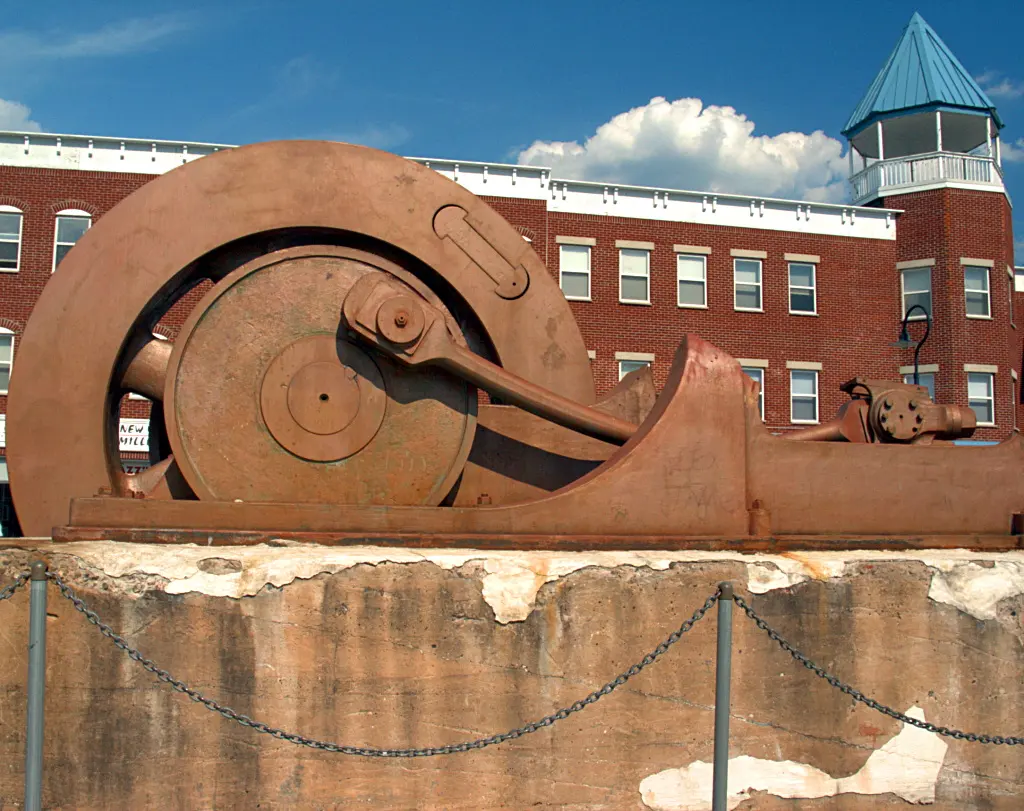
A spinning wheel that stays in one place still has kinetic energy: each of its particles is moving. Let us add their kinetic energies.
Let a rigid body turn with angular velocity about an axis XY. Its particles of masses are at perpendicular distances from the axis and move with speeds round their circles.
- The body is rigid, so every particle turns through the same angle in the same time: all have the same angular velocity .
- A particle at distance moves round its circle with speed (Grade 11, Unit 6), so its kinetic energy is
- The body’s rotational kinetic energy is the sum over all its particles; is the same for all, so it comes outside the sum:
- The sum is the moment of inertia of the body about XY. So
Compare it with : the moment of inertia takes the place of the mass, and the angular velocity the place of the velocity. The greater the moment of inertia, the more kinetic energy a body has at a given angular velocity, and the more work it takes to spin it up from rest.
The formula also gives a meaning to : if rad/s, then , so the moment of inertia is numerically twice the rotational kinetic energy of the body when it turns at 1 rad/s.
Rolling
A wheel rolling along a road both turns and moves forward. This section adds what you need about rolling, which the exercise asks about.
Rolling is the motion of a round body (a wheel, a ball, a cylinder) that turns about its axis while its axis moves forward along a surface. It is pure rolling (rolling without slipping) when the point of the body touching the surface is, at that instant, at rest relative to the surface: the body neither skids nor spins on the spot.
The relation between v and ω. Let a wheel of radius roll without slipping, turning at angular velocity .
- In one full turn, every point of the rim touches the ground once, so the wheel lays its whole rim, , along the ground: its center moves forward .
- One turn takes the period .
- So the center’s speed is
Seen another way: a rim point moves forward with the center at and, at the bottom, backward round the center at . It is at rest only if , the same condition. So pure rolling means ; if the wheel skids, if it spins and slips, as a bus’s wheels do on mud.
Kinetic energy of rolling. A rolling body has both kinds of kinetic energy, of its center’s motion and of its turning:
For a solid cylinder, : its translational energy is and its rotational energy , so of its total energy, two thirds is translational and one third rotational.
Rolling down a slope. A body rolls from rest down a slope, through a height . The energy it gains, , is shared between moving and turning:
The bigger , the more of the energy goes into turning, and the slower the body moves at the bottom. Its acceleration down a slope at θ is . Neither result has or in it: only the shape, through , decides the race.
| Body | K²/R² | Speed after falling h | Order |
|---|---|---|---|
| Solid sphere | 2/5 | first | |
| Solid disc or cylinder | 1/2 | second | |
| Hollow sphere | 2/3 | third | |
| Ring or hollow cylinder | 1 | last |
A body sliding without friction would reach , faster than any of them, because none of its energy goes into turning.
A solid disc and a ring of the same mass and radius roll from rest down the same slope, starting together. Which reaches the bottom first?
Pick an answer to see why.
1.5 Torque and angular acceleration of a rigid body
Torque
To make a door turn, you push it far from its hinges, at right angles to it. Push near the hinge, or along the door towards the hinge, and nothing turns. What makes a body turn is not the force alone but its torque (moment of force), which depends on the force, where it acts, and its direction.
The torque of a force about an axis is the product of the force and the perpendicular distance from the axis to the line of action of the force. If a force acts at a point whose position from the axis is , at an angle θ to ,
As a vector it is the cross product of the position vector and the force:
where is the position vector of the point where the force acts, measured from the axis (or point) about which we take the torque, and is the force. Its size is ; its direction is along the axis, perpendicular to both and , given by the right-hand rule (curl the fingers of your right hand the way the force turns the body; your thumb points along ). The SI unit of torque is the newton meter, N m.
- When (force at right angles to ), and the torque is greatest, .
- When or (force along , towards or away from the axis), the torque is zero.
A spanner 0.25 m long turns a nut. A force of 40 N is applied at its end at 30° to the spanner. The torque on the nut is:
Pick an answer to see why.
Torque and angular acceleration: τ = Iα
Let a torque act on a rigid body that can turn about a fixed axis XY, giving it a uniform angular acceleration . Think of the body as particles of masses at perpendicular distances from the axis.
- The body is rigid, so every particle has the same angular acceleration . But their linear (tangential) accelerations differ, since a particle farther out moves round a bigger circle:
- By Newton’s second law, the tangential force on the th particle is
- This force acts along the tangent, at right angles to , so its torque about the axis is
- The total torque on the body is the sum over all its particles (the internal forces between particles cancel in pairs, so only the outside torque is left):
- The bracket is the moment of inertia , so
This is the turning form of Newton’s second law: torque does for turning what force does for straight-line motion, and moment of inertia plays the part of mass. A given torque gives a body with a large moment of inertia only a small angular acceleration.
When gravity gives a torque, we can treat the body as if all its weight acted at its center of mass: the torque of the weight about an axis is times the perpendicular distance from the axis to the vertical line through the center of mass.
Equations of rotational motion
When the angular acceleration is constant, the turning motion follows equations just like Grade 11’s equations of motion, with θ in place of , ω in place of and α in place of . If a body starts with angular velocity and turns with constant angular acceleration α for a time :
They come the same way: gives the first; the angle turned is the average angular velocity times the time, , which with the first gives the second; and eliminating gives the third.
1.6 Work and power in rotational motion
Work done by a torque
A force does work when it moves its point of action along its own direction. Here is what that gives for turning:
- A steady force acts along the tangent at the rim of a wheel of radius , so its torque about the axle is .
- The wheel turns through a small angle . The point where the force acts moves along the rim by an arc , in the direction of the force.
- The work done is .
- For a steady torque turning the body through an angle θ, adding up the small pieces gives
with θ in radians. It holds when the torque and the angular displacement are about the same axis. Compare : torque takes the place of force, and angle the place of distance.
Work and kinetic energy. In straight-line motion, the work done on a body goes into its kinetic energy. In turning, the work done by a torque goes into rotational kinetic energy. If a body starts from rest and a steady torque spins it up to angular velocity :
using . So all the work done is stored as rotational kinetic energy (the work–energy theorem for turning).
Power in rotational motion
Power is the rate of doing work. In straight-line motion, . In turning, a torque turning a body through a small angle in a time does work , so the power is
The two formulas match: force with torque, velocity with angular velocity. An engine’s power is its torque times its angular velocity, which is why car makers quote both.
1.7 Angular momentum and its conservation
Angular momentum
A moving body has linear momentum, . A turning body has its turning equivalent.
The angular momentum of a particle about a point is the moment of its linear momentum about that point:
where is the particle’s position vector from the point and its momentum. Its size is , and for a particle going round a circle of radius (where is at right angles to ), . Its SI unit is the kilogram meter squared per second, kg m²/s (the same as J s).
For a rigid body turning about a fixed axis, add up the particles. A particle at moves round its circle at , so
Compare : moment of inertia for mass, angular velocity for velocity. The faster a body spins, and the larger its moment of inertia (the more mass it has, and the farther from the axis), the larger its angular momentum.
Angular momentum is a vector. For a turning body it points along the axis, in the direction given by the right-hand rule: curl the fingers of your right hand the way the body turns, and your thumb points along .
Torque changes angular momentum
Newton’s second law says that a force changes linear momentum: . In the same way, torque is the rate of change of angular momentum:
For a rigid body turning about a fixed axis, and , which is Section 1.5’s law again. A torque can change how fast a body spins, or the direction of its axis, or both.
The principle of conservation of angular momentum
If no outside torque acts on a body or a system, its total angular momentum stays constant:
So if the body changes its moment of inertia from to , by moving its mass in or out, its angular velocity changes from to with
This is the principle of conservation of angular momentum: in the absence of an external torque, the total angular momentum of a system remains constant. A smaller moment of inertia means a faster spin, and a larger one a slower spin.
You can try this on a turning chair. Sit with a heavy book or a bottle of water in each hand, arms held out, and have a friend give you a gentle spin, then let go. Pull your hands in to your chest: you spin faster. Stretch them out again: you slow down. In an ideal chair with no friction, you could go on speeding up and slowing down like this for as long as you liked, your angular momentum always the same.
Examples of the conservation of angular momentum
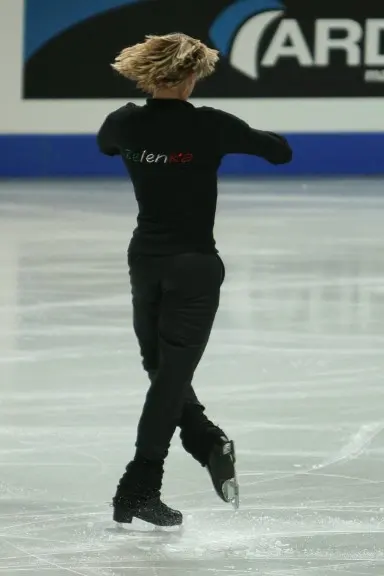
- A skater’s spin. A spinning ice skater pulls her arms (and a leg) in close to her body: her moment of inertia falls, so her angular velocity rises, and she spins faster, up to about five turns a second in a fast spin. To slow down she stretches her arms out again. Throughout, .
- A planet round the Sun. The Sun’s pull on a planet points straight at the Sun, so it gives no torque about the Sun, and the planet’s angular momentum about the Sun, , stays constant. When the planet is nearer the Sun (smaller ), it moves faster along its orbit; when it is farther away, it moves more slowly. The Earth moves at about 30.3 km/s in early January, when it is nearest the Sun, and 29.3 km/s in early July. This is Kepler’s second law.
- A tornado or a whirlpool. Air spiraling in towards the center of a tornado moves to a smaller radius and so goes round faster, like the skater’s arms. Water swirling into a drain speeds up the same way.
- A bicycle wheel. A light wheel, with thin spokes holding a light rim, has a small moment of inertia for its size, so the rider’s pedaling spins it up quickly. Since most of a wheel’s mass is in its rim and tyre, far from the axle, racing cyclists value light rims most of all. The spokes are what make such a light wheel possible: thin wires in tension hold the rim true and strong without the mass of a solid disc.
- Melting ice and the length of the day. When ice near the poles melts, the water spreads over the oceans, much of it nearer the equator and so farther from the Earth’s axis. The Earth’s moment of inertia grows, so its spin slows very slightly and the day gets longer. Since 2000, measurements show, melting ice has been lengthening the day by about 1.3 milliseconds per century, and by 2100 it could be about twice that (Kiani Shahvandi and others, 2024).
- A diver. A diver leaves the board with some angular momentum. Pulling the arms and legs in (a tuck) reduces her moment of inertia and makes her somersault faster; stretching out before entering the water slows the turning so she enters cleanly.
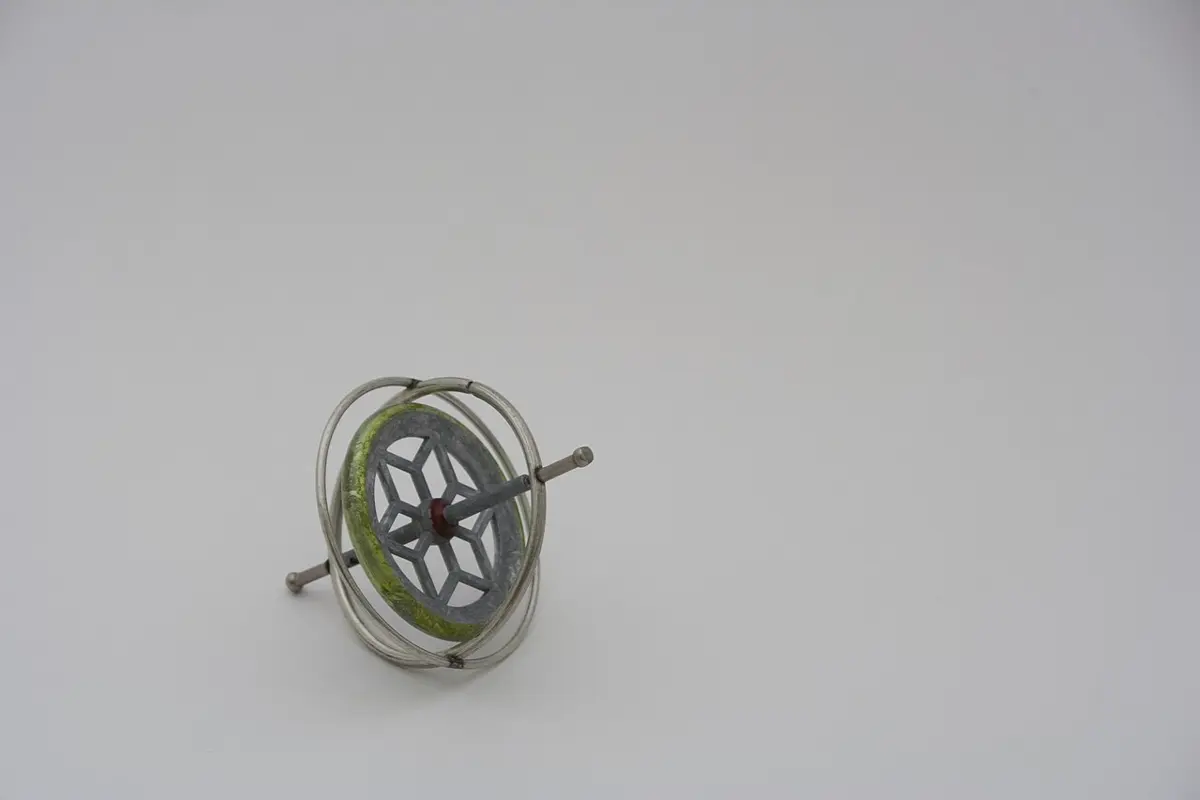
- A gyroscope. A fast-spinning wheel keeps the direction of its axis, because changing it would need a torque to change its angular momentum. That is why a spinning top stands up, a moving bicycle is easier to balance than a still one (partly), and gyroscopes keep spacecraft, drones and ship compasses pointing steadily.
A skater spinning at 2 turns a second pulls her arms in, halving her moment of inertia. If no outside torque acts, her new rate of spin and her kinetic energy are:
Pick an answer to see why.
Linear and rotational motion compared
Every quantity of straight-line motion has a turning partner, and every law has a turning form:
| Linear motion | Rotational motion |
|---|---|
| Displacement, | Angular displacement, θ |
| Velocity, | Angular velocity, ω () |
| Acceleration, | Angular acceleration, α () |
| Inertial mass, | Moment of inertia, |
| Linear momentum, | Angular momentum, |
| Force, | Torque, |
| Work, | Work, |
| Kinetic energy, | Rotational kinetic energy, |
| Power, | Power, |
| Conservation of momentum (no external force) | Conservation of angular momentum (no external torque) |
Exercise
Choose the correct option
- A disc and a ring, both with the same mass and radius, are released together from the top of an inclined plane and roll down it. Which reaches the bottom first?
Pick an answer to see why.
- Two bodies of masses and move in circles of radii and . If they go round their circles in equal times, the ratio of their linear speeds is:
Pick an answer to see why.
- A figure skater pulls in her arms during a spin. What happens to her moment of inertia and angular velocity?
Pick an answer to see why.
- A ring, a solid sphere, a disc and a solid cylinder all have the same mass and radius. Which has the greatest moment of inertia about its axis of symmetry?
Pick an answer to see why.
- Which of these does not affect the moment of inertia of a rotating body?
Pick an answer to see why.
- Why does a diver tuck in her body during a dive to increase her rate of turning?
Pick an answer to see why.
- Two wheels of the same mass and shape but different radii roll without slipping on a level road at the same speed. How do their rotational kinetic energies compare?
Pick an answer to see why.
- What are the parts of the total kinetic energy of a solid cylinder rolling down an incline without slipping?
Pick an answer to see why.
- What can you say about the torque when the angle between and is 90°?
Pick an answer to see why.
- A ring, a solid sphere, a disc and a hollow sphere all have the same mass and radius. Which has the greatest moment of inertia?
Pick an answer to see why.
- Why does a spinning gyroscope stay stable and resist changes in the direction of its axis?
Pick an answer to see why.
- The mass of a rotating object is drawn in so that its radius is halved, its mass unchanged and no outside torque acting. What happens to its angular momentum?
Pick an answer to see why.
- What is the angular velocity of the minute hand of a clock, in rad/s?
Pick an answer to see why.
Answer these questions
While watching a gymnast spin, you might wonder how she controls how fast she turns.
- a.Define moment of inertia and explain how it depends on the distribution of mass.
- b.State the principle of conservation of angular momentum. Explain why a gymnast spins faster when she pulls in her arms.
- c.In a stage show, a dancer of mass 60 kg spins on a frictionless turntable with her arms stretched out. Her moment of inertia is 5 kg m² and her angular velocity 2 rad/s. She then pulls her arms in, reducing her moment of inertia to 2 kg m² in 0.5 s. Find:
- i.her new angular velocity;
- ii.the change in her rotational kinetic energy;
- iii.the average torque an outside agent would need to give her the same speed-up, from 2 rad/s to her new angular velocity in 0.5 s, if she kept her arms out (I = 5 kg m²).
Hint
Answer
The motion of a wheel rolling down an incline without slipping combines rotation and translation.
- a.Define rolling motion and state the condition for pure rolling.
- b.Derive the relation between the linear velocity and the angular velocity of a body in pure rolling.
- c.A uniform rod of length 1.2 m and mass 2.4 kg lies on a smooth horizontal surface. A force of 12 N is applied at one end of the rod, perpendicular to it. Find:
- i.the torque about the rod’s center of mass;
- ii.the angular acceleration of the rod about its center of mass;
- iii.the linear acceleration of its center of mass.
Hint
Answer
A rigid body turns about a fixed axis, and the way its mass is spread affects its rotational inertia.
- a.Define radius of gyration. How is it related to the moment of inertia?
- b.Explain how the moment of inertia differs for bodies such as a ring, a disc and a sphere (any two, with reasons).
- c.A uniform rod of mass 2 kg and length 1 m lies on a smooth inclined plane at 30° to the horizontal. It is hinged at one end to the plane, with the hinge’s axis at right angles to the plane, so the rod can swing round in the plane of the incline. It is held lying across the slope (horizontal), then released, and starts to swing down the slope. Find, just after it is released:
- i.the torque on the rod about the hinge;
- ii.its angular acceleration. (g = 9.8 m/s²)
Hint
Answer
The torque needed to turn a rigid body plays a central part in its dynamics.
- i.Define torque and give its SI unit. Write its vector formula and explain each term.
- ii.State the relation between torque and angular acceleration. What is the rotational analog of Newton’s second law?
- iii.A steady torque of 1000 N m turns a wheel of moment of inertia 200 kg m² about an axis through its center. Find its angular velocity after 3 s, starting from rest.
Answer
A body turns with a constant angular acceleration under a constant torque.
- a.Define angular acceleration. Write the equations of rotational motion for constant angular acceleration.
- b.Distinguish between angular displacement, angular velocity and angular acceleration.
- c.A disc starts from rest and speeds up uniformly to 20 rad/s in 5 s. Find i. its angular acceleration, ii. the angle it turns through in this time.
Answer
Suppose a flywheel turns about its center, with masses attached symmetrically at different distances.
- a.Define center of mass. How does its position affect the stability of a turning body?
- b.Explain rotational kinetic energy. How is it different from translational kinetic energy?
- c.Two masses, 1 kg and 2 kg, are fixed on a light (massless) rod, at 0.2 m and 0.1 m from its center O, as in the figure below. Find the moment of inertia of the system about an axis through O, perpendicular to the rod.
Answer
Long rods turning about different axes behave differently, depending on how their mass is spread.
- a.Why is the moment of inertia called the rotational analog of mass?
- b.Derive the expression for the moment of inertia of a uniform rod about an axis through its center, perpendicular to its length.
- c.A rod of mass 5 kg and length 1 m turns about its center. Find its moment of inertia, and its rotational kinetic energy when it turns at 12 rad/s.
Answer
A uniform rod of length L and mass M is pivoted at its center and can turn freely in a horizontal plane. Two small masses, and , are fixed at equal distances from the center, at its two ends.
- a.Write the expression for the total moment of inertia of the system about the central pivot, naming each term.
- b.How will the moment of inertia change if one mass is moved closer to the center? Explain.
- c.The rod has mass M = 3 kg and length L = 1.2 m; the point masses are kg, each 0.6 m from the center. Find the total moment of inertia about the center.
Answer
A figure skater shows how angular momentum is conserved by changing her body position mid-spin.
- a.Define angular momentum for a rotating body and give its SI unit.
- b.State and explain the principle of conservation of angular momentum. Give one real-life example other than a skater.
- c.A skater of moment of inertia 3 kg m² spins at 4 rad/s. She pulls in her arms, reducing her moment of inertia to 1.5 kg m². Find her new angular velocity. What does this tell us about angular momentum?
Answer
- a.Derive the formula for the work done by a torque in producing an angular displacement.
- b.A steady torque of 8 N m is applied to a wheel. It turns through 5 rad in 2 s. Find the work done and the average power delivered.
Answer
A ballet dancer spins with her arms stretched out, then pulls her arms in and spins faster.
- a.Name and state the physical principle that explains why her angular velocity increases.
- b.Derive the relation between angular momentum and moment of inertia for a rotating body.
- c.Her moment of inertia is 4 kg m² and her angular velocity 2 rad/s. She reduces her moment of inertia to 2 kg m². Find her new angular velocity.
Answer
A uniform rod of length L and mass M can turn in a horizontal plane about an axis through its center, perpendicular to its length. Two small masses and are fixed at distances and from the center.
- a.What is the significance of moment of inertia in rotational motion?
- b.Write the formula for the moment of inertia of the uniform rod about this axis.
- c.State the principle of conservation of angular momentum with a real-life example.
- d.Find the total moment of inertia of the system (rod and masses) about the axis. If the system starts from rest and turns under a steady torque τ, find i. its angular acceleration α, ii. its angular velocity after turning through an angle θ.
Given: M = 6 kg, L = 2 m, kg at m, kg at m, τ = 12 N m, θ = π rad. (Take .)
Answer
A figure skater of moment of inertia spins at angular velocity with her arms stretched out. She then pulls her arms in, reducing her moment of inertia to .
- a.Define angular momentum and state its SI unit.
- b.State the principle of conservation of angular momentum.
- c.Explain why the skater spins faster after pulling her arms in.
- d.Given kg m², rad/s and kg m², find i. her new angular velocity , ii. the change in her rotational kinetic energy ().
Answer
Printable PDFs
- The unit as a book (A5) 21 pages Answers as an A4 booklet, 6 sheets
- Study notes 3 pages
- Worksheet 4 pages Answer key
- Harder practice questions 2 pages Answer key
Quiz yourself: Force, Motion and Machines, Grades 5–12 →
Practice every question in the book, and keep track of the ones you miss →
A companion to your textbook, not a replacement for it: study from the book your school uses, and where the two differ, follow your teacher. Found a mistake? Please tell us.