
Every packet of Ayo noon sold in Nepal must carry a set amount of iodine, every tanker of milk is checked for acid before the dairy takes it, and every batch of tablets is tested to see that each holds the dose printed on the strip. Behind each of these checks is the same simple act: a liquid of known strength is run, drop by drop, from a long glass tube into a flask until a color changes, and the volume used tells how much of something was there.
This is volumetric analysis, measuring amounts by measuring volumes. This unit builds the tools it needs: the equivalent weight of a substance, the many ways of stating how concentrated a solution is (percentage, g/L, molarity, molality, normality, mole fraction, ppm), the standard solutions everything is compared with, the law of equivalence, and finally titration itself, by acids and bases and by oxidizing and reducing agents.
1.1 Introduction to gravimetric analysis, volumetric analysis and equivalent weight
In the laboratory you smell the gas a reaction gives off and notice the color of a solution. Such observations make up qualitative analysis: they tell us what a substance is like, its quality. When we measure the mass or the volume of a substance, we are doing quantitative analysis: it tells us how much there is. The substance being studied, by either kind of analysis, is called the analyte.
Chemical analysis means identifying, separating and measuring the substances in a sample. These days everyone worries about the quality of food, water, air and medicines, and the only way to be sure of them is to find out what they contain and how pure they are.
- Qualitative analysis finds which elements and compounds are present in a sample: it asks “what is it?”
- Quantitative analysis finds how much of each is present: it asks “how much is it?”
Quantitative analysis may use physical methods, which measure a physical property such as density, refractive index or surface tension, or chemical methods, which use a reaction such as precipitation, neutralization or oxidation. The methods used most often are gravimetric analysis, volumetric analysis and instrumental analysis (Figure 1.1).
1.1.1 Gravimetric analysis
In a food factory, and at home too, the amount of water in a food matters: too much and it spoils, too little and its texture is wrong. To find it, a small sample is weighed, dried in an oven until its mass stops changing, and weighed again. The water has evaporated, so the mass lost is the mass of water in the sample. This is a gravimetric method: it depends on measuring a change of mass in a chemical or physical change.
Gravimetric analysis is quantitative analysis in which the amount of the analyte is found by measuring a mass.
Often the analyte is first turned into a solid that does not dissolve, a precipitate, which is filtered off, washed, dried and weighed. The chloride in a sample, for example, is found by adding silver nitrate:
Every 143.5 g of silver chloride weighed holds 35.5 g of chloride, wherever it came from.
1.1.2 Volumetric analysis
Have you ever measured a liquid in a beaker? A beaker’s marks are only a rough guide, good to about 5%. A syringe in a hospital measures a dose of medicine more carefully. In volumetric analysis, volumes are measured with the glassware above, much more accurately still.
Volume is usually measured in liters (L), which is the same as cubic decimeters (dm³), and milliliters (mL), the same as cubic centimeters (cm³). Larger volumes are measured in kiloliters (kL) and megaliters (ML).
Volumetric analysis is a quantitative method that finds the concentration of an analyte (the component of interest) in a solution by measuring the volume of a solution that reacts with it.
It rests on stoichiometry: the amounts of reactants and products in a reaction are fixed by the equation. So the reaction used must be known, and ideally it should be fast, go to completion, and have an end that can be seen clearly.
Applications of volumetric analysis
- a.Testing water: the hardness of water, and pollutants in drinking water, such as arsenic in the tube wells of the Tarai.
- b.Medicines: the amount of the active ingredient in a tablet or syrup.
- c.Food: the acidity of vinegar, fruit juices, milk and wine.
- d.The environment: pollutants such as nitrate and phosphate in rivers.
1.1.3 Equivalent weight
Using moles we can work out the mass of any reactant or product, if we have the balanced equation. But early chemists often didn’t know the formulas of the substances they worked with, so they couldn’t write equations. They found another way to compare substances: by how much of each combines with, or replaces, a fixed amount of a standard element. This amount is the substance’s equivalent weight.
Three standards are used:
- Hydrogen, the lightest element, with the smallest atomic mass (1.008);
- Oxygen, which is very reactive and forms compounds with almost every element;
- Chlorine, which reacts readily with metals and non-metals alike.
The gram equivalent weight of a substance is the mass of it that combines with or displaces 1.008 g of hydrogen, or 8.0 g of oxygen, or 35.5 g of chlorine. (Equivalent weight is just a number; written in grams it is the gram equivalent weight. In practice both are simply called the equivalent weight, or equivalent mass.)
The three amounts are equivalent to each other: 1.008 g of hydrogen combines with 8.0 g of oxygen (in water) and with 35.5 g of chlorine (in hydrogen chloride).
Equivalent weight tells us how much of a substance is worth one “unit” of reacting power in a given reaction. With it, many calculations become simple divisions.
In general, the equivalent weight of an element is
using whichever element it combined with, or displaced.
Which mass of oxygen is equivalent to 1.008 g of hydrogen?
Pick an answer to see why.
1.2 Relationship between equivalent weight, atomic weight and valency
The atomic weight (A) of an element is the mass of one mole of its atoms, in grams per mole (g/mol).
The valency (v) of an element is its combining capacity. One way to find it is to count the hydrogen atoms that combine with one atom of the element: carbon in CH₄ has valency 4, oxygen in H₂O valency 2.
The equivalent weight (E) of an element is the mass of it that combines with or displaces one mole of hydrogen atoms, 1.008 g. Then:
- One atom of the element combines with v atoms of hydrogen (that is what valency means).
- So one mole of its atoms, A grams, combines with v moles of hydrogen atoms, v × 1.008 g.
- The mass that combines with 1 mole of hydrogen atoms, 1.008 g, is therefore A/v.
For magnesium, A = 24 and v = 2: E = 12, as found above. An element with more than one valency has more than one equivalent weight: iron is 56/2 = 28 in iron(II) compounds and 56/3 = 18.7 in iron(III) compounds.
1.3 Equivalent weight of compounds (acid, base, salt, oxidizing and reducing agents)
The equivalent weight of a compound is the mass of it that gives or takes one mole of the “reacting unit” of its reaction: one mole of H⁺ for an acid, one mole of OH⁻ for a base, one mole of charge for a salt, one mole of electrons for an oxidizing or reducing agent.
(The molar mass of a compound is what many books call its molecular weight; for an ionic compound, its formula mass. In grams per mole the numbers are the same.)
where n, called the n-factor or valence factor, is:
- for an acid: the number of replaceable hydrogen atoms in one molecule (its basicity);
- for a base: the number of replaceable hydroxide ions in one formula unit (its acidity);
- for a salt: the total positive charge (or the total negative charge) in one formula unit;
- for an oxidizing agent: the number of electrons one formula unit gains in the reaction;
- for a reducing agent: the number of electrons one formula unit loses in the reaction.
a. Equivalent weight of an acid
An acid has one or more replaceable hydrogen atoms: hydrogens it gives up as H⁺ to a base. Their number in one molecule is the acid’s basicity. The equivalent weight of an acid is the mass of it that contains 1.008 g of replaceable hydrogen:
Sulphuric acid, H₂SO₄, has basicity 2, so its equivalent weight is 98/2 = 49.
Only hydrogens that can leave as H⁺ count. In acetic acid, CH₃COOH, three of the four hydrogens are held by carbon and stay put: only the one on oxygen is replaceable.
| Acid | Molar mass | Basicity | Equivalent weight |
|---|---|---|---|
| HCl, HNO₃ | 36.5, 63 | 1 | 36.5, 63 |
| CH₃COOH | 60 | 1 | 60 |
| H₂SO₄ | 98 | 2 | 49 |
| H₂C₂O₄·2H₂O (oxalic acid crystals) | 126 | 2 | 63 |
| H₃PO₃ | 82 | 2 | 41 |
| H₃PO₄ (fully neutralized) | 98 | 3 | 32.7 |
b. Equivalent weight of a base
The equivalent weight of a base is the mass of it that contains one mole of replaceable hydroxide ions, or that completely neutralizes one gram equivalent of an acid. The number of hydroxide ions in one formula unit of a base is its acidity. Sodium hydroxide, potassium hydroxide and ammonium hydroxide are monoacidic bases (acidity 1).
For example, magnesium hydroxide, Mg(OH)₂, has acidity 2: its equivalent weight is 58/2 = 29.
c. Equivalent weight of a salt
A salt is made of positive ions (cations) and negative ions (anions). The total charge on the cations in one formula unit (equal to the total charge on the anions) is the salt’s ion-exchange capacity, and
For example: NaCl (Na⁺ Cl⁻, charge 1): E = 58.5/1 = 58.5. MgCl₂ (Mg²⁺, charge 2): E = 95/2 = 47.5. Na₂CO₃ (2Na⁺, charge 2): E = 106/2 = 53. Al₂(SO₄)₃ (2Al³⁺, charge 6): E = 342/6 = 57.
d. Equivalent weight of oxidizing and reducing agents
An oxidizing agent gains electrons and a reducing agent loses them. The number of electrons one formula unit gains or loses equals the total change in oxidation number of its atoms, and this number is its n:
Both are the molar mass divided by the total change in oxidation number per formula unit. In the activity’s reaction:
- KMnO₄: E = 158/5 = 31.6;
- anhydrous oxalic acid, H₂C₂O₄ (M = 90): E = 90/2 = 45; the crystals, H₂C₂O₄·2H₂O (M = 126), which are what is weighed in the laboratory: E = 126/2 = 63.
The ionic equation shows the same counts:
The n-factor can also be read from a half-equation, the number of electrons in it per formula unit. Potassium permanganate shows how much it depends on the medium:
| Medium | Half-equation | n | E of KMnO₄ |
|---|---|---|---|
| acidic | 5 | 158/5 = 31.6 | |
| neutral or weakly alkaline | 3 | 158/3 = 52.7 | |
| strongly alkaline | 1 | 158/1 = 158 |
In acid the purple permanganate becomes almost colorless Mn²⁺; in neutral solution a brown solid, MnO₂; in strong alkali green manganate, MnO₄²⁻.
Sodium thiosulphate, a reducing agent, is oxidized by iodine to the tetrathionate ion:
Two thiosulphate ions lose 2 electrons, one each, so n = 1, and the equivalent weight of Na₂S₂O₃ is its molar mass, 158 (or 248 for the crystals, Na₂S₂O₃·5H₂O).
e. Equivalent weight of a radical
A radical here means an ion, a charged group of atoms (SO₄²⁻, CO₃²⁻, NH₄⁺). Its equivalent weight depends on its charge:
The carbonate ion, CO₃²⁻: E = (12 + 3 × 16)/2 = 30. The phosphate ion, PO₄³⁻: E = 95/3 = 31.7.
In the reaction , what is the equivalent weight of H₃PO₄ (M = 98)?
Pick an answer to see why.
1.4 Concentration of a solution and its units
Concentration matters in the kitchen too. If the curry is too salty, the concentration of salt in it is too high, and you add water. Adding water lowers the concentration of salt, but the amount of salt in the pot is the same as before: it is just spread through more water.
The concentration of a solution is the amount of solute in a given amount of solution (or of solvent). A solution with more solute particles in each milliliter is more concentrated.
The amount of solute may be stated as a mass, as moles or as gram equivalents, and the amount of solution as a mass or a volume, so there are many ways to state a concentration. Each suits a different job.
A. Percentage
A bottle of concentrated sulphuric acid labeled 98.3% holds 98.3 g of H₂SO₄ in every 100 g of the liquid; the rest, 1.7 g, is water. A percentage is an amount of solute in 100 parts of solution. It may be by mass or by volume.
i. Percentage by mass (% w/w)
The mass of solute, in grams, in 100 g of solution:
40 g of ethanol mixed with 60 g of water is 40% ethanol by mass. Concentrated acids and bases are sold labeled in % w/w, with their specific gravity (density in g/mL) on the label as well. For a solid, the same percentage is called its percentage purity.
ii. Percentage mass by volume (% w/v)
The mass of solute, in grams, in 100 mL of solution:
Normal saline, the drip that rehydrates patients after illness, surgery or loss of fluid, is 0.9% w/v sodium chloride: 0.9 g of NaCl in every 100 mL. The two percentages are linked by the solution’s density (specific gravity):
iii. Percentage by volume (% v/v)
The volume of solute, in mL, in 100 mL of solution:
A typical beer is about 5% ethanol by volume: 5 mL of ethanol in every 100 mL.
Grams per liter (g/L)
Grams per liter is the mass of solute, in grams, in one liter of solution:
So normal saline, 0.9% w/v, holds 9 g/L of NaCl.
B. Molarity (M)
Molarity is the most used measure of concentration in chemistry: the number of moles of solute in one liter of solution.
Its unit is mol/L (mol/dm³), written M and read “molar”. A solution with 1 mole of solute in 1 liter of solution is a molar solution (1 M). For sodium hydroxide (M = 40 g/mol):
| NaOH in 1 L of solution | Moles | Name |
|---|---|---|
| 40 g | 1 | molar, M |
| 20 g | 0.5 | semimolar, M/2 |
| 4 g | 0.1 | decimolar, M/10 |
| 0.4 g | 0.01 | centimolar, M/100 |
How many grams of glucose (C₆H₁₂O₆, M = 180) are needed to make 250 mL of a 0.2 M solution?
Pick an answer to see why.
C. Molality (m)
Molality is the number of moles of solute in one kilogram of solvent:
Its unit is mol/kg, written m and read “molal”. Dissolve 1 mole of sugar in 2 kg of water, and the molality is 1/2 = 0.5 m.
Molality is the measure to use when a solution is heated or cooled, as in finding boiling and freezing points: it divides by a mass, which doesn’t change with temperature, while molarity divides by a volume, which does.
D. Normality (N)
Normality, also called the equivalent concentration, counts the solute in gram equivalents instead of moles: it is the number of gram equivalents of solute in one liter of solution.
Its unit is gram equivalents per liter, written N and read “normal”. Normality is handy in titrations because, as section 1.6 shows, equal volumes of solutions of equal normality react exactly, whatever the reaction.
A solution with one gram equivalent of solute in 1 liter of solution is a normal solution (1 N). For sodium carbonate, Na₂CO₃ (equivalent weight 106/2 = 53):
| Na₂CO₃ in 1 L of solution | Gram equivalents | Name |
|---|---|---|
| 53 g | 1 | normal, N |
| 26.5 g | 0.5 | seminormal, N/2 |
| 5.3 g | 0.1 | decinormal, N/10 |
E. Mole fraction (χ)
The mole fraction of a component is the number of moles of it divided by the total number of moles of all the components:
For a mixture of two components A and B:
A mole fraction is a ratio of moles to moles, so it has no unit, and like molality it doesn’t change with temperature. It is used most with mixtures of gases and of liquids.
F. Formality (F)
Ionic solids such as sodium chloride are not made of molecules, but of a network of ions, and in water they split into those ions. Formality states their concentration by the formula units put in, counted before they dissociate:
1 mole (58.5 g) of NaCl made up to 1 liter of solution is 1 F, a formal solution, even though it holds 2 moles of ions. Formality is the number of gram formula masses of the solute in a liter of solution. In practice it is the same number as the molarity, and most chemists simply call it molarity.
G. Parts per million (ppm) and parts per billion (ppb)
For many years the United States’ Environmental Protection Agency required a water supplier to act when the lead in tap water reached 15 ppb: 15 micrograms of lead in a liter of water (in 2024 it lowered this to 10 ppb). Concentrations this small are stated in parts per million (ppm) and parts per billion (ppb):
Parts per million is the number of parts of a component in a million parts of the whole mixture; parts per billion, the number in a billion parts. The pollutants in water and air are usually given this way. In water, 1 L weighs about 1 kg, so for a dilute solution:
- 1 ppm = 1 mg/L (1 mg in 1,000,000 mg of water);
- 1 ppb = 1 µg/L.
So Nepal’s limit for lead, 0.01 mg/L, is 0.01 ppm, or 10 ppb.
Relation between normality and molarity
Molarity counts moles in a liter of solution; normality counts gram equivalents in a liter of solution. One mole contains n gram equivalents (because the equivalent weight is the molar mass divided by n), so:
where the n-factor is the basicity of an acid, the acidity of a base, the total positive charge of a salt, or the total change in oxidation number (electrons gained or lost) of an oxidizing or reducing agent. For example, 0.1 M H₂SO₄ is 0.2 N; 0.1 M HCl is 0.1 N; 0.02 M KMnO₄ in acid is 0.1 N.
1.5 Primary and secondary standard substances
To make a solution of known concentration, we weigh a solute and dissolve it to a known volume. This only works if what we weigh is exactly what we think it is. A substance that is very pure, stable and readily soluble can be weighed and used directly: it is a primary standard substance, and the solution made from it is a primary standard solution. Such solutions are used to standardize (find the exact concentration of) other solutions.
A primary standard substance must be:
- a.Highly pure, so that the mass weighed is all the substance, with no impurities to upset the analysis.
- b.Stable: it does not change over time, and does not react with the air (oxygen or carbon dioxide) or with moisture.
- c.Non-hygroscopic: it does not absorb water from the air, which would change its mass while it is being weighed.
- d.Readily soluble, usually in water, so that the solution can be made accurately and the same way every time.
It also helps if it has a large equivalent weight, so that a weighing error of a milligram is a small fraction of the mass weighed, and if it reacts quickly and completely in the titration.

You may have used caustic soda (NaOH) pellets in the laboratory. Leave a few on a Petri dish for an hour and they become wet and sticky: they have absorbed water from the air until they began to dissolve in it (they are deliquescent). They also absorb carbon dioxide from the air, turning partly to sodium carbonate. So a weighed mass of NaOH is never quite NaOH, and sodium hydroxide can’t be a primary standard. (It is also corrosive: it burns the skin, so handle it with a spatula, never with fingers.)
Many substances, like this, can’t be got pure, or change their composition over time: they may be hygroscopic (absorbing moisture), deliquescent (absorbing enough to dissolve) or efflorescent (losing water of crystallization to the air). Their solutions are made only roughly and then standardized. They are secondary standard substances. Examples: NaOH, HCl, H₂SO₄, KMnO₄ and Na₂S₂O₃.
A solution made by dissolving a known mass of a primary standard to a known volume is a primary standard solution. A solution of a secondary standard is a secondary standard solution, and its exact concentration is found by titrating it against a primary standard solution.
Why can’t potassium permanganate be used as a primary standard?
Pick an answer to see why.
1.6 Law of equivalence and normality equation
One gram equivalent of a substance reacts exactly with one gram equivalent of another. This is the law of equivalence: in a complete reaction, the numbers of gram equivalents of all the substances reacting (and formed) are equal. For a reaction
at completion,
gram equivalents of A = gram equivalents of B = gram equivalents of C = gram equivalents of D.
This is what makes equivalents so handy in titrations: the gram equivalents of the titrant (the solution in the burette) used equal the gram equivalents of the analyte (the solution in the flask), whatever the coefficients of the equation.
The number of gram equivalents can be found from a mass or from a solution:
So when solution 1 reacts exactly with solution 2,
the normality equation. Since N = M × n, it can also be written
where M is the molarity and n the n-factor (valence factor) of each.
Theory of dilution
When water is added to a solution, it becomes less concentrated, or dilute: this is dilution. The volume increases and the concentration falls, but the amount of solute, in moles or in gram equivalents, stays the same:
moles before dilution = moles after dilution, so (since moles = molarity × volume in liters)
gram equivalents before = gram equivalents after, so (since gram equivalents = normality × volume in liters)
where M₁ (or N₁) and V₁ are the concentration and volume before dilution, and M₂ (or N₂) and V₂ after.
1.7 Titration and its types: acid–base titration, redox titration
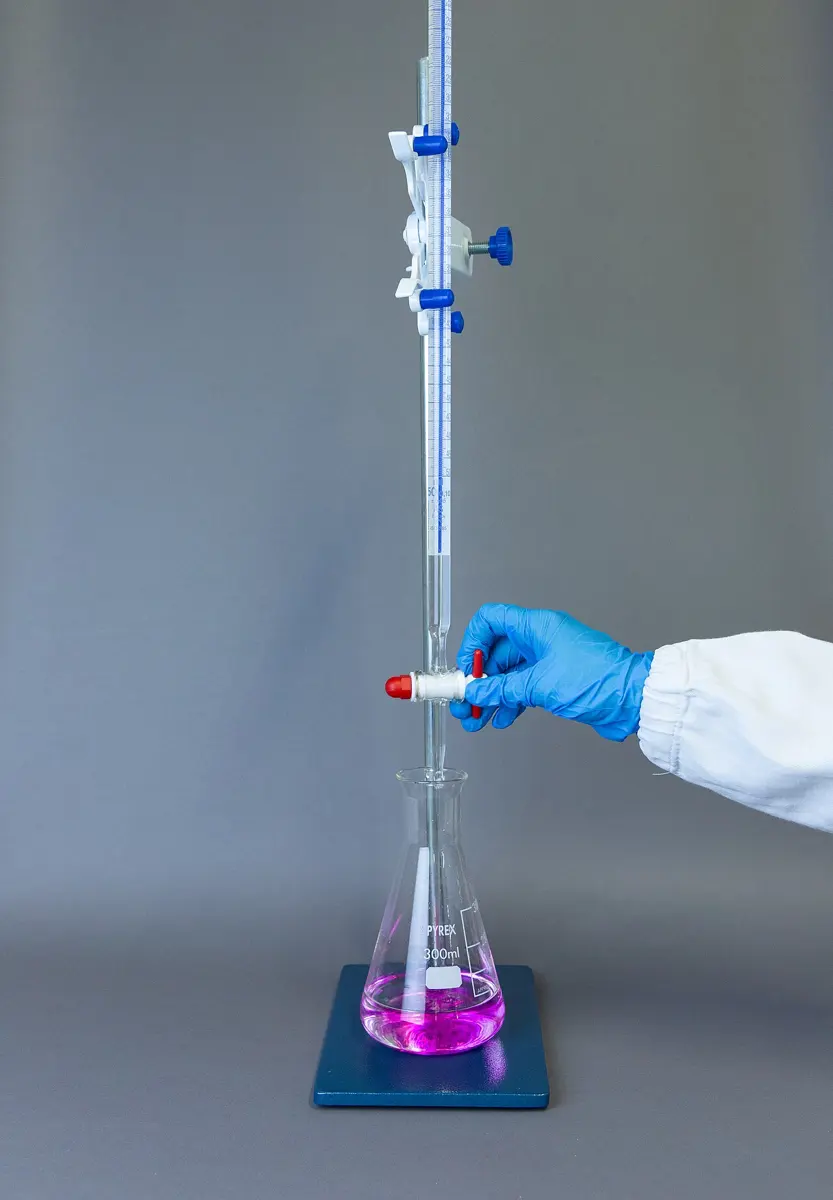
A solution of exactly known concentration is a standard solution. In a titration it is usually put in the burette and is called the titrant. It is added to a measured volume (usually by pipette) of the solution being tested, called the titrand or analyte. The titration is complete when just enough titrant has been added to react with all of the analyte.
To show when that happens, an indicator is usually added to the flask: for an acid–base titration, a substance with clearly different colors in acid and in alkali (how one works, and how to choose it, is in Unit 2). The point at which the indicator changes color sharply, showing that the analyte is used up, is the end point.
Titration is a quantitative method in which the concentration of a solution is found by finding the volume of it that reacts exactly with a standard solution. Titrations are used in medicine-making, environmental testing, food and drink factories and research laboratories, to measure what substances contain.
Doing a titration well
- Rinse the burette with a little of the titrant (not with water, which would dilute it), and the pipette with the analyte. The conical flask may be wet with distilled water: water added there changes the volume, but not the amount of analyte in it.
- Fill the burette, run a little out so the tip has no air bubble, and read it.
- Read the bottom of the meniscus (for a colorless solution) with your eye level with it, to the nearest 0.05 mL (Figure 1.10). For a deeply colored one like KMnO₄, whose bottom can’t be seen, read the top.
- Do a quick rough titration first, then careful ones, adding the titrant drop by drop near the end. Repeat until two readings agree within 0.10 mL, and use their average.
1.7.1 End point and equivalence point
As titrant runs into the flask, at one moment just enough has been added to react completely with the analyte. This is the equivalence point (or stoichiometric point): there, the gram equivalents of titrant added equal the gram equivalents of analyte, as the equation requires.
The end point is the point at which the indicator changes color. The equivalence point is set by the reaction; the end point is what we can actually see. A good indicator makes them almost the same, but they never coincide exactly.
The difference between the end point and the equivalence point is the titration error.
Errors in a titration can come from:
- a.defects in the apparatus or the method (a burette that isn’t clean, so drops cling to its wall; an air bubble in the tip);
- b.changes in conditions such as temperature (solutions expand when warm);
- c.reading the meniscus wrongly (with the eye above or below it);
- d.mistakes in weighing or in diluting;
- e.an indicator whose color change is not at the equivalence point.
They are kept small by using calibrated glassware, a suitable indicator, and repeating the titration until the readings agree.
In a titration of hydrochloric acid with sodium hydroxide using phenolphthalein, which is true?
Pick an answer to see why.
A. Acid–base titration
An acid–base titration finds the concentration of an acid or a base. When the strength of an acid is found with a standard solution of a base, the titration is called alkalimetry; when the strength of a base is found with a standard solution of an acid, it is acidimetry. The end point is shown by an acid–base indicator (a pH indicator).
An acid (HA) and a base (BOH) react, exchanging a proton (H⁺), to make a salt (BA) and water:
In ionic form,
A titration between an acid and a base is an acid–base titration, or neutralization titration.
Acid–base indicators have different colors in acidic and basic solutions. The most used are phenolphthalein, methyl red and methyl orange. Each changes color over its own small range of pH, and its color depends on the pH within that range (Figure 1.11).
Which indicator suits which titration is a question of where the steep jump in pH lies; the reasons come in the next unit, on ionic equilibrium. The widget above already shows the rule: the indicator’s range must fall on the steep part of the curve. For a strong acid with a strong base, any of them will do; for a weak acid with a strong base (acetic acid with NaOH), phenolphthalein; for a strong acid with a weak base (HCl with ammonia), methyl orange or methyl red.
Sodium carbonate against an acid. Na₂CO₃, the usual primary standard for HCl or H₂SO₄, takes up the acid in two stages:
Phenolphthalein loses its pink at the end of the first stage, when the carbonate has only become hydrogencarbonate: half the acid the carbonate needs. Methyl orange changes, yellow to orange-red, only at the end of the second stage, because the dissolved CO₂ leaves the solution acidic, about pH 4. So methyl orange marks the complete reaction, , and is the indicator for standardizing an acid with sodium carbonate.
Sodium carbonate solution is titrated with hydrochloric acid using phenolphthalein. Where does the pink disappear?
Pick an answer to see why.
B. Redox titration
A redox titration uses a reaction between an oxidizing agent and a reducing agent:
It may need a redox indicator, a substance with different colors in its oxidized and reduced forms, which changes color sharply at or near the equivalence point. Some titrants are colored strongly enough to be their own indicator.
Depending on the reagent used, redox titrations are of several kinds.
i. Permanganate titration (permanganometry)
Permanganometry is a redox titration in which potassium permanganate (KMnO₄) is the titrant. KMnO₄ is a strong oxidizing agent, and is used to measure reducing agents such as iron(II) salts, oxalates and hydrogen peroxide, in environmental, industrial and biological samples.
The permanganate ion is a deep purple. In acid it is reduced to the Mn²⁺ ion, which is almost colorless, so each drop added loses its color as it reacts. Once all the reducing agent is used up, the next drop stays, and the solution turns pale pink. KMnO₄ is therefore its own indicator, a self-indicator (or auto-indicator): no other indicator is needed.
With oxalic acid, in dilute sulphuric acid, warmed to about 60 °C (the reaction is slow when cold):
In ionic form,
With an iron(II) salt:
ii. Dichromate titration (dichromatometry)
Dichromatometry is a redox titration in which potassium dichromate (K₂Cr₂O₇) is the oxidizing agent. It is strong, stable, and can be got very pure, so it is a primary standard: its solution can be made by weighing, with no need to standardize it.
When chromium goes from +6 to +3, the color changes from orange to green:
(orange dichromate, green Cr³⁺)
Orange fading into green is hard for the eye to judge exactly, so a redox indicator is added, usually diphenylamine sulphonate, which turns a sharp violet at the end point.
iii. Iodometric titration
Exercise
Choose the correct option
- Which principle is used in gravimetric analysis?
Pick an answer to see why.
- Ferrosoferric oxide (magnetite), Fe₃O₄, is an oxide of iron. What is the equivalent weight of iron in it? (Fe = 56)
Pick an answer to see why.
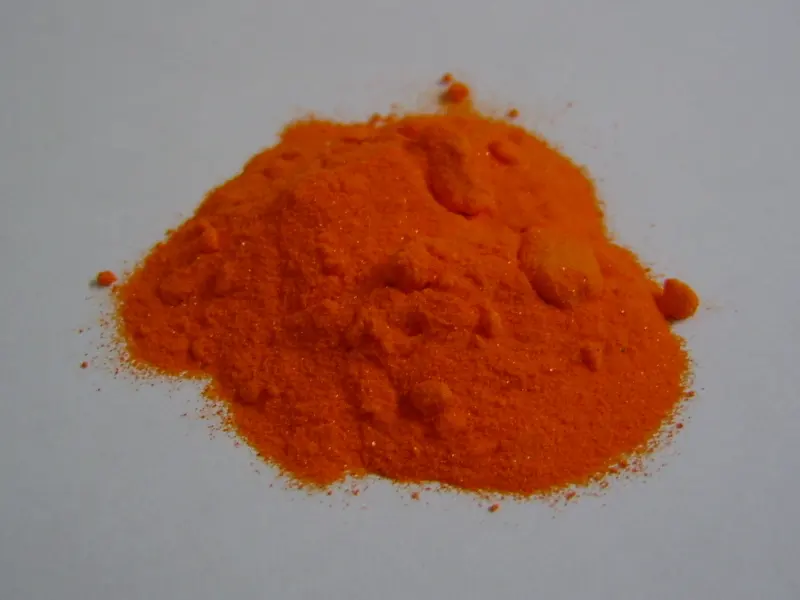
- Potassium dichromate, K₂Cr₂O₇, is an orange-red crystalline compound and a powerful oxidizing agent. If its molar mass is M, what is its equivalent weight in this reaction (not balanced)?
Pick an answer to see why.
- If 1 ppm means one part per million, what does 1 ppb mean?
Pick an answer to see why.
- Which is a primary standard substance used to prepare a standard solution?
Pick an answer to see why.
- Which is NOT a property of a good primary standard?
Pick an answer to see why.
- The law of equivalence states that at the equivalence point of a titration:
Pick an answer to see why.
- 25 mL of decimolar H₂SO₄ reacts completely with 50 mL of NaOH solution. What is the molarity of the NaOH?
Pick an answer to see why.
- In a redox titration of potassium permanganate with oxalic acid, KMnO₄ is:
Pick an answer to see why.
- 0.5 g of Na₂CO₃ (M = 106 g/mol) is dissolved to make 100 mL of solution. What is its molarity?
Pick an answer to see why.
- You must make a 0.25 M solution of NaOH from 20 g of it. What volume of solution can you make?
Pick an answer to see why.
- 25 mL of semimolar HCl is titrated with 0.5 N Na₂CO₃ solution. What volume of the titrant neutralizes one fourth of the acid in the flask?
Pick an answer to see why.
- How many grams of H₂SO₄ are there in 500 mL of a 0.2 M solution?
Pick an answer to see why.
- A solution of 20 g of NaOH in 500 mL is diluted to twice its volume. Compared with the original solution, what is the same?
Pick an answer to see why.
- 0.7 g of an unknown monoprotic acid needs 35 mL of 0.1 M NaOH for complete neutralization. What is the equivalent weight of the acid?
Pick an answer to see why.
- You have 36.5 g of HCl and need to make a 0.5 N solution of it. To what volume must the solution be made up?
Pick an answer to see why.
Answer these questions
Define, and tell the difference between:
- a.molarity and normality
- b.ppm and ppb
- c.molarity and molality
- d.number of moles and number of gram equivalents
- e.a primary and a secondary standard substance
- f.an acid–base titration and a redox titration
Answer
Volumetric and gravimetric analysis are both kinds of quantitative analysis, useful in the laboratory and in industry.
- a.Define volumetric analysis. How is it different from gravimetric analysis?
- b.What are the uses of volumetric analysis?
- c.Give one limitation of volumetric analysis.
Answer
In a gravimetric analysis, 0.500 g of impure barium chloride is dissolved in water and treated with excess sulphuric acid to precipitate barium sulphate. After filtering and drying, the precipitate weighs 0.434 g. (Ba = 137, Cl = 35.5, S = 32, O = 16)
- a.Write the balanced equation for the reaction.
- b.Calculate the percentage of barium chloride in the sample.
- c.Why is excess sulphuric acid used?
Hint
Answer
Match each secondary standard with the property that stops it from being a primary standard.
| Substance | Property |
|---|---|
| HCl | it absorbs CO₂ and moisture from the air |
| I₂ | it is decomposed by sunlight |
| H₂SO₄ | it is a gas |
| NaOH | it absorbs moisture from the air |
| KMnO₄ | it sublimes |
Answer
- a.Define equivalent weight. Write the relationship between equivalent weight, atomic weight and valency.
- b.Calculate the equivalent weights of H₃PO₄, FeSO₄ and K₂Cr₂O₇ in these reactions (K = 39, Cr = 52, Fe = 56, P = 31, S = 32):
and, for FeSO₄ and K₂Cr₂O₇,
Answer
Nitric acid is an important inorganic acid, a strong oxidizing agent with many uses. A bottle of nitric acid is labeled 68% (w/w), specific gravity 1.4 g/mL.
- a.What does 68% (w/w) mean?
- b.Convert this concentration to % w/v.
- c.Calculate the mass of HNO₃ in 1 liter of the solution.
- d.Which of % w/v and % w/w depends on temperature, and why?
Answer
- a.State the law of equivalence. How is it useful in titration?
- b.Use it to calculate the mass of magnesium that reacts exactly with 250 mL of decinormal sulphuric acid. (Mg = 24)
Answer
Mohr’s salt, (NH₄)₂Fe(SO₄)₂·6H₂O, is a double salt widely used in analytical chemistry to make a primary standard solution.
- a.What is a standard solution? Why is it important in volumetric analysis?
- b.Give three properties of Mohr’s salt that make it a primary standard.
- c.Why is it called a double salt?
Answer
The normal range of glucose in blood (fasting) is about 70–100 milligrams per deciliter (mg/dL). A person’s blood contains 80 mg/dL of glucose. Convert this to:
- a.% w/v
- b.g/L
- c.ppm and ppb
- d.molarity (glucose, C₆H₁₂O₆, M = 180)
Answer
Rabin must prepare 500 mL of 0.100 M HCl, but the only HCl solution available is 12.0 M.
- a.Calculate the number of moles in 500 mL of 0.100 M HCl.
- b.What volume of the 12.0 M acid should he use?
- c.What precautions should he take, and why?
Answer
A 0.200 g sample of a mixture of NaCl and NaBr is dissolved in water and titrated with 0.100 M AgNO₃.
- a.Name the type of titration. Why is it called so?
- b.If 25.00 mL of AgNO₃ is needed to reach the end point, what is the percentage of NaCl in the mixture? (Na = 23, Cl = 35.5, Br = 80)
The textbook gives a 0.500 g sample, but the numbers don’t work: 25.00 mL of 0.100 M AgNO₃ (0.00250 mol) can react with at most 0.257 g of salt, even if it were all NaBr. A 0.200 g sample is used here.
Hint
Answer
Potassium permanganate oxidizes oxalic acid in acidic solution.
- a.Write the balanced equation for the reaction.
- b.25 mL of 0.1 M KMnO₄ completely oxidizes 50 mL of oxalic acid solution. Calculate the molarity of the oxalic acid.
Answer
Long answer questions
An industrial chemist needs 100 liters of 0.5 N H₂SO₄ for a manufacturing process, and has a bottle labeled 98% (w/w), density 1.84 g/mL.
- a.What does a 0.5 N concentration of the acid mean?
- b.Calculate the volume of the concentrated acid needed.
- c.Discuss the dangers and the precautions in preparing and handling such concentrated acid in large quantities.
Answer
In biological research, a 2% (w/v) NaCl solution is used to draw water out of cells; it is more concentrated than the cells’ contents (hypertonic), while 0.9% saline is isotonic with them.
- a.What does 2% (w/v) mean?
- b.Calculate the molarity and normality of this solution. (Its density is 1.02 g/mL.)
- c.Why are different units needed for concentration?
Answer
A titration is set up as in Figure 1.9: decimolar (0.1 M) caustic soda in the burette, and 25 mL of 0.2 M oxalic acid solution in the conical flask.
- a.Identify the type of titration, the analyte and the titrant.
- b.Write the equation for the reaction.
- c.Calculate the volume of NaOH needed to react completely with 25 mL of the oxalic acid.
- d.What is the concentration of the salt in the flask when the oxalic acid is half neutralized?
Hint
Answer
100 mL of 0.1 M HCl is mixed with 200 mL of 0.2 M H₂SO₄ to make a mixture of acids.
- a.What does 0.1 M HCl mean?
- b.Find the volume of sulphuric acid from a bottle of 98% (w/v) H₂SO₄ needed to prepare 200 mL of 0.2 M H₂SO₄.
- c.Calculate the normality of the acid mixture.
- d.What happens to the concentration of the mixture when 700 mL of water is added? Calculate the concentration of the diluted solution.
Answer
A solution of KMnO₄ is standardized by titrating it against a known amount of oxalic acid, with a mineral acid present, in warm solution:
- a.Why must a solution be standardized before it is used in a titration?
- b.With KMnO₄ in the burette, what is the color change at the end point?
- c.Why is the flask warmed before the titration?
- d.25.00 mL of KMnO₄ solution is needed to titrate 0.250 g of anhydrous oxalic acid, H₂C₂O₄. What is the molarity of the KMnO₄?
Answer
Potassium permanganate is used to find the concentration of an iron(II) sulphate solution. In acid, KMnO₄ reacts with Fe²⁺ ions:
- a.How many moles of KMnO₄ react with 1 mole of iron(II) sulphate?
- b.Calculate the equivalent weights of KMnO₄ and FeSO₄ in this reaction. (K = 39, Mn = 55, Fe = 56)
- c.What is the indicator in this titration, and why?
- d.A 25.0 mL sample of iron(II) sulphate solution needs 20.0 mL of 0.02 M KMnO₄ for complete reaction. Calculate the concentration of the iron(II) sulphate solution.
Answer
Solve these numerical problems.
- a.A bottle of tile cleaner contains 135 g of HCl and 775 g of water. What is the percentage by mass of HCl?
- b.How many grams of FeSO₄ are there in 1 L of a solution marked 0.35 M FeSO₄?
- c.Calculate the concentration in grams per liter of bench hydrochloric acid of 12 mol/L.
- d.“Concentrated” hydrochloric acid, a common laboratory reagent, is 37.2% HCl by mass, with density 1.19 g/mL. What mass of HCl is in 0.500 L of it?
- e.What volume of 0.01 M KMnO₄ solution contains 5 g of KMnO₄?
- f.1 g of caustic soda is added to 2 liters of X M sulphuric acid, and the solution is then exactly neutral (pH 7). Find X.
- g.What volumes of 12 M and 2 M NaOH solution must be mixed to make 2 liters of 9 M solution?
- h.Calculate the volume of 1 M NaOH needed to neutralize 200 mL of 2 N HCl. What mass of NaCl is formed?
- i.Two liters of molar H₂SO₄ are mixed with one liter of normal NaOH. Calculate the strength of the mixture and the mass of salt formed.
- j.50 mL of 2 N H₂SO₄ is mixed with 30 mL of 3 N NaOH. Is the solution acidic, basic or neutral? Calculate its strength.
- k.Lye is solid sodium hydroxide sold for cleaning. 1.20 g of lye needs 45.0 mL of 0.5 M hydrochloric acid to neutralize it. Calculate the percentage purity of the NaOH.
- l.5.125 g of washing soda crystals are dissolved and made up to 250 mL. 25.0 mL of this solution needs 35.8 mL of 0.05 M sulphuric acid for complete neutralization. Calculate the percentage of sodium carbonate in the crystals.
- m.A person may die if the alcohol in their blood goes above 500 mg per 100 mL. What is the molar concentration of ethanol at this level?
- n.6.615 g of Mohr’s salt, (NH₄)₂Fe(SO₄)₂·nH₂O, are dissolved in dilute acid and made up to 250 mL. 25.0 mL of this solution needs 22.5 mL of 0.015 M potassium permanganate at the end point. Calculate n.
- o.A commercial bleach contains 3.62% NaOCl by mass in water. Calculate i. the mole fraction and ii. the molality of NaOCl in it.
The textbook gives 8.492 g of the salt in n., but the numbers don’t work: they give a molar mass of 503 g/mol and n = 12.2, not a whole number (Mohr’s salt is the hexahydrate, 392 g/mol). With 6.615 g they give n = 6.
Answer
Printable PDFs
- Study notes 3 pages
- Worksheet 4 pages Answer key
Quiz yourself: Matter, Atoms and Reactions, Grades 5–12 →
Practice every question in the book, and keep track of the ones you miss →
A companion to your textbook, not a replacement for it: study from the book your school uses, and where the two differ, follow your teacher. Found a mistake? Please tell us.