
One kilogram of coal, burnt, keeps a 1 kW heater going for about eight hours. One kilogram of uranium-235, split in a reactor, could keep the same heater going for over two thousand years. The difference is not in the fuel’s chemistry but in where the energy is stored: in coal it sits between atoms, in uranium it sits inside the tiny nucleus at the center of each atom.
This unit opens that nucleus. It starts with the experiment that found it, a beam of alpha particles fired at gold leaf, and measures its size from how close an alpha particle can get. Then it asks what holds a nucleus together when every proton in it pushes every other one away, and answers with Einstein’s : a nucleus weighs less than the parts it is made of, and the missing mass is the energy that binds it. One graph, the binding energy per nucleon, then explains why the Sun shines by joining light nuclei and why a power station can run by splitting heavy ones.
24.1 The discovery of the nucleus: Rutherford’s alpha-scattering experiment
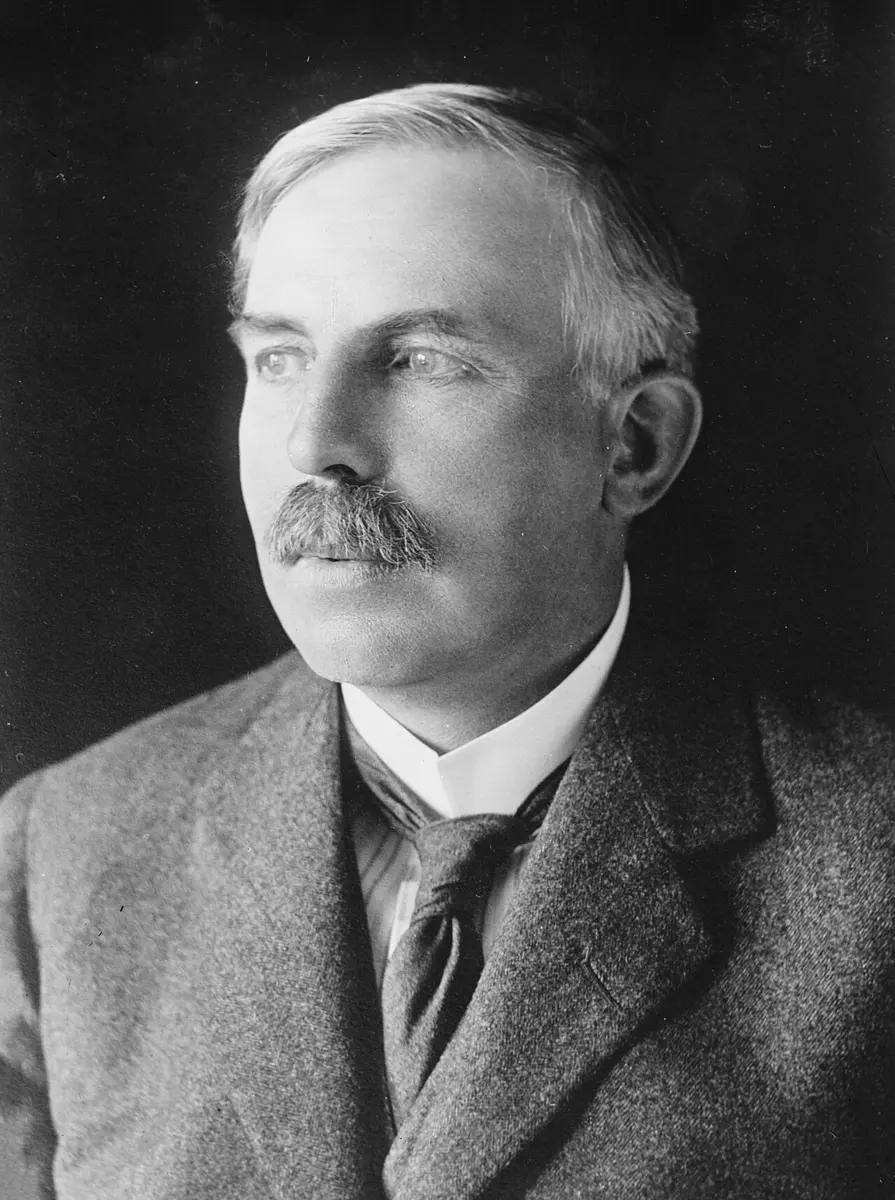
Ernest Rutherford won the 1908 Nobel Prize in Chemistry for his work on radioactivity, and only afterwards made his greatest discovery. Years later he described the moment his assistants told him that an alpha particle could bounce straight back off a sheet of gold:
“It was quite the most incredible event that has ever happened to me in my life. It was almost as incredible as if you fired a 15-inch shell at a piece of tissue paper and it came back and hit you.”
In 1911, from this experiment, he proposed that all the positive charge of an atom, and nearly all its mass, is packed into a tiny region at its center: the nucleus.
The experiment
The experiment was carried out in Rutherford’s laboratory in Manchester by Hans Geiger and Ernest Marsden from 1909 to 1913. Figure 24.2 shows a simplified version of it.
- An alpha particle is a helium nucleus, two protons and two neutrons, with a charge of +2e. It comes out of a radioactive source such as radium at about 5 % of the speed of light.
- The foil was gold because gold can be beaten thinner than any other metal, down to well under a micrometer.
- Each alpha particle hitting the zinc sulphide screen made a faint speck of light, a scintillation. Geiger and Marsden sat in the dark and counted the flashes by eye, at each angle θ from 0° to nearly 180°, often for hours.
Observations
- Most alpha particles went straight through the foil, or were turned through only a degree or two.
- A very few were turned through large angles. About 1 alpha particle in 8000 was turned through more than 90°, coming back off the foil on the same side it went in.
Conclusions: the nuclear model
- The atom is mostly empty space. Most alpha particles passed through a few hundred layers of atoms as if nothing were there.
- The positive charge, and almost all the mass, sits in a tiny nucleus. To turn a fast, heavy alpha particle right round, a single atom must push on it with a huge force, and only a charge packed into a very small region can do that (the push of a point charge grows as 1/r², without limit, as you get closer). One close encounter with one nucleus, not many small nudges, turns it back.
- The nucleus is positive, because it repels the positive alpha particles, and much heavier than an alpha particle, because it is not knocked out of the way itself.
Play the experiment yourself. Each path below is worked out from the push of a gold nucleus on a 7.7 MeV alpha particle.
Why did the alpha particles that bounced back show that the atom’s positive charge is concentrated in a tiny nucleus?
Pick an answer to see why.
Sizes of the atom and the nucleus
Rutherford estimated the size of the gold nucleus from how close an alpha particle can get to it.
Think of an alpha particle aimed head-on at a nucleus. As it approaches, the repulsion slows it down, turning its kinetic energy into electric potential energy . At the distance of closest approach, d, it stops for an instant, and
The electric potential energy of two charges and a distance r apart is (Unit 21)
The alpha particle has charge ; a nucleus of atomic number Z has (for gold, Z = 79). So, at the closest approach,
The alpha particle never touches the nucleus, so the nucleus’s radius must be smaller than d. The distance of closest approach is an upper limit for the nuclear radius.
Later, sharper experiments (fast electrons fired at nuclei, below) showed the radius of a gold nucleus to be about 7 × 10⁻¹⁵ m. Most nuclei have radii of a few times 10⁻¹⁵ m, while most atoms have radii of about 10⁻¹⁰ m. So a nucleus is about 10⁵ times smaller across than its atom.
Doubling the kinetic energy of the alpha particles in a head-on approach to a gold nucleus makes the distance of closest approach:
Pick an answer to see why.
24.2 A simple model of the atom
After Rutherford’s discovery, the nuclear model was quickly accepted. In 1919 Rutherford found that the nucleus of hydrogen comes out of other nuclei when they are struck by alpha particles; he named it the proton. It has a positive charge equal and opposite to the electron’s.
But protons alone could not account for an atom’s mass. A helium nucleus has twice the charge of a hydrogen nucleus but four times its mass. The puzzle was solved in 1932, when James Chadwick discovered the neutron, a particle with no charge and almost the same mass as a proton.
This gives the model of the atom used today:
- Protons and neutrons make up the nucleus.
- Electrons move around the nucleus in a cloud, some closer to the center and some farther from it. They don’t follow fixed paths like planets (see Where is the electron?).
24.3 Some nuclear terminology
Protons and neutrons are together called nucleons, because both are found in nuclei. Three numbers describe what a nucleus is made of:
- the atomic number or proton number, Z: the number of protons;
- the mass number or nucleon number, A: the total number of nucleons (protons + neutrons);
- the neutron number, N: the number of neutrons, so
A nucleus with a particular number of protons and neutrons is called a nuclide. A nuclide is written
where X is the chemical symbol of the element. For example, is an oxygen nucleus with 8 protons and 16 nucleons, so 16 − 8 = 8 neutrons. Since the symbol already fixes Z (every oxygen nucleus has 8 protons), the lower number is often left out: ¹⁶O, or oxygen-16.
The same notation is used for particles, with the lower number giving the charge (in units of e) and the upper the nucleon number:
| Particle | Symbol |
|---|---|
| proton | (or ) |
| neutron | |
| electron | (or β⁻) |
| positron | (or β⁺) |
| photon | , or just γ |
| alpha particle | or |
| neutrino | , or just ν |
| antineutrino | , or just |
The nuclide has:
Pick an answer to see why.
24.4 Isotopes
Isotopes are nuclides of the same element: they have the same number of protons but different numbers of neutrons. Ordinary hydrogen (), deuterium () and tritium () are all isotopes of hydrogen. An isotope can be named by its element and its mass number: carbon-12 is another way of writing .
The chemistry of an atom is decided by its electrons, and a neutral atom has as many electrons as protons. So all the isotopes of an element, with the same Z, have almost identical chemical properties. Their physical properties can differ a great deal: one isotope may be strongly radioactive while another is perfectly stable (carbon-14 decays, carbon-12 doesn’t). Bombarding a material with neutrons, protons, electrons or other particles can make new, radioactive isotopes; that is how the isotopes used in hospitals are made.
Two more words describe nuclides that share a number:
- Isotones have the same neutron number N: , , and all have 8 neutrons.
- Isobars have the same mass number A: , , and all have 16 nucleons.
A way to keep them apart: isotopes share protons, isotones share neutrons, and isobars share A.
Which pair are isotopes?
Pick an answer to see why.
24.5 Atomic mass units
A kilogram suits apples, not protons. For nuclei and particles we use a much smaller unit.
The atomic mass unit (u), also called the unified atomic mass unit, is defined as exactly one twelfth of the mass of an atom of carbon-12.
Its value in kilograms follows from Avogadro’s number. One mole of carbon-12 has a mass of exactly 12 g and contains atoms. So one atom has a mass of
and
On this scale a proton is 1.007 276 u, a neutron 1.008 665 u and an electron 0.000 549 u.
24.6 Nuclear size and density
The size of a nucleus can be measured by firing very fast electrons at it. Electrons are not affected by the strong nuclear force, so they probe where the charge is; and at high enough energy their de Broglie wavelength (Grade 12) is about 10⁻¹⁵ m, small enough to be diffracted by a nucleus. From such experiments, the radius R of a nucleus of mass number A is found to be
where 1 fm (one femtometer, or fermi) = 10⁻¹⁵ m. For hydrogen, A = 1 and R = r₀, so r₀ is roughly the radius of a proton.
The volume of a sphere is . With equation (24.1),
So the volume of a nucleus is proportional to its number of nucleons: each nucleon takes up about the same room, like marbles packed in a bag. The mass of the nucleus is about A u, so its density is
A cancels: all nuclei have about the same density, whatever their size. This is a key fact about nuclear structure: nucleons pack together like drops of a liquid that can’t be squeezed, not like planets round a sun.
A nucleus is small, massive and so extremely dense: about 10¹⁷ kg/m³, some 10¹⁴ times denser than water. A teaspoonful (5 mL) of nuclear matter would have a mass of about 5 × 10⁻⁶ × 2.3 × 10¹⁷ ≈ 10¹² kg, a thousand million tonnes, about the mass of all the water in Phewa Lake twenty times over.
24.7 Einstein’s mass and energy
In 1905, working on special relativity, Albert Einstein showed that mass and energy are two forms of the same thing, linked by
where E is energy in joules, m is mass in kilograms, and c is the speed of light, 3.00 × 10⁸ m/s. Because is so large, 9 × 10¹⁶ m²/s², a tiny mass is worth an enormous energy. The first experiment to show it directly was done in 1932, when John Cockcroft and Ernest Walton split lithium nuclei with fast protons and found that the energy of the fragments matched the mass that had disappeared.
Where the mass goes when a nucleus forms
A helium nucleus contains four nucleons, two protons and two neutrons. Its mass is slightly smaller than the mass of the four nucleons apart:
- mass of a proton = 1.6726 × 10⁻²⁷ kg
- mass of a neutron = 1.6749 × 10⁻²⁷ kg
- mass of two protons and two neutrons = 2 × 1.6726 × 10⁻²⁷ + 2 × 1.6749 × 10⁻²⁷ = 6.6950 × 10⁻²⁷ kg
- measured mass of a helium nucleus = 6.6447 × 10⁻²⁷ kg
- difference = 6.6950 × 10⁻²⁷ − 6.6447 × 10⁻²⁷ = 5.03 × 10⁻²⁹ kg
When the four nucleons come together to form a helium nucleus, this mass is given out as energy:
That is about the energy of seven million chemical bonds, from one helium nucleus. In Einstein’s own words, “very small amounts of mass may be converted into a very large amount of energy and vice versa”.
The reverse is also true. To pull a helium nucleus apart into its four nucleons, work must be done against the strong forces that hold them together, 28.3 MeV of it, and that energy put in reappears as the extra mass of the separate nucleons.
Mass defect and binding energy
A nucleus of Z protons and N neutrons always has less mass than its protons and neutrons apart. The difference is called its mass defect, Δm:
measured in kilograms or in atomic mass units. The energy that corresponds to it is the binding energy of the nucleus:
The binding energy is the energy that would have to be supplied to a nucleus to pull it apart into separate protons and neutrons, and it is the energy given out when the nucleus is formed from them. It is measured in J or, more often, in MeV.
24.7.1 Mass–energy equivalence
The equation can be read two ways.
Mass is a form of energy. When an electron meets its antiparticle, a positron, they destroy each other (annihilation) and their entire mass becomes the energy of two gamma-ray photons (section 24.8).
Energy has mass. Whenever a system gains or loses energy ΔE, its mass changes by Δm, where
A cup of hot tea loses a little mass as it cools; a stretched spring has a little more mass than the same spring slack; a moving ball has a little more energy, and so more inertia, than the same ball at rest. In everyday life the changes are far too small to notice, because is so large:
- A sealed torch that gives out 10 W of light for 10 hours (36 000 s) loses 10 × 36 000 = 0.36 MJ of energy. Its mass falls by kg, nothing compared with the mass of the torch.
- A 1000 kg car that speeds up from rest to 30 m/s gains kJ of kinetic energy, worth kg.
- An unstable nucleus that gives out a 5 MeV gamma-ray photon loses 5 × 1.6 × 10⁻¹³ = 8.0 × 10⁻¹³ J. Its mass falls by kg: about 0.5 % of the mass of a nucleon, far from negligible on a nucleus’s scale.
Electrons in a particle accelerator can be given energies hundreds of times their rest energy, and there the extra inertia is very noticeable: it is why no accelerator can push an electron to the speed of light.
The energy of one atomic mass unit
In nuclear calculations it is handy to know the energy equivalent of 1 u:
and, since 1 eV = 1.602177 × 10⁻¹⁹ J,
So 1 u is equivalent to 931.5 MeV. A mass defect in u, multiplied by 931.5, gives the binding energy in MeV straight away.
Nuclear reactions turn mass into energy and energy into mass, but nothing is lost: in any closed system, the total of the energy and the energy equivalent of the mass is constant. This is the law of conservation of energy, with mass counted as one of the forms of energy.
A system gives out 9.0 × 10¹³ J of energy. Its mass decreases by:
Pick an answer to see why.
24.8 Annihilation and creation
When a particle meets its own antiparticle they destroy each other: annihilation. The positron is the electron’s antiparticle, with the same mass and the opposite charge (Unit 26). When an electron and a positron meet, their whole mass becomes energy, in the form of two gamma-ray photons that fly off in opposite directions (two, not one, so that momentum is conserved).
The smallest energy of the photons, for a pair that meets nearly at rest:
- change in mass: , where kg is the mass of an electron or a positron;
- energy released: , shared by two equal photons;
- energy of each photon: J, or 0.51 MeV.
If the electron and positron were also moving, each photon has even more energy.
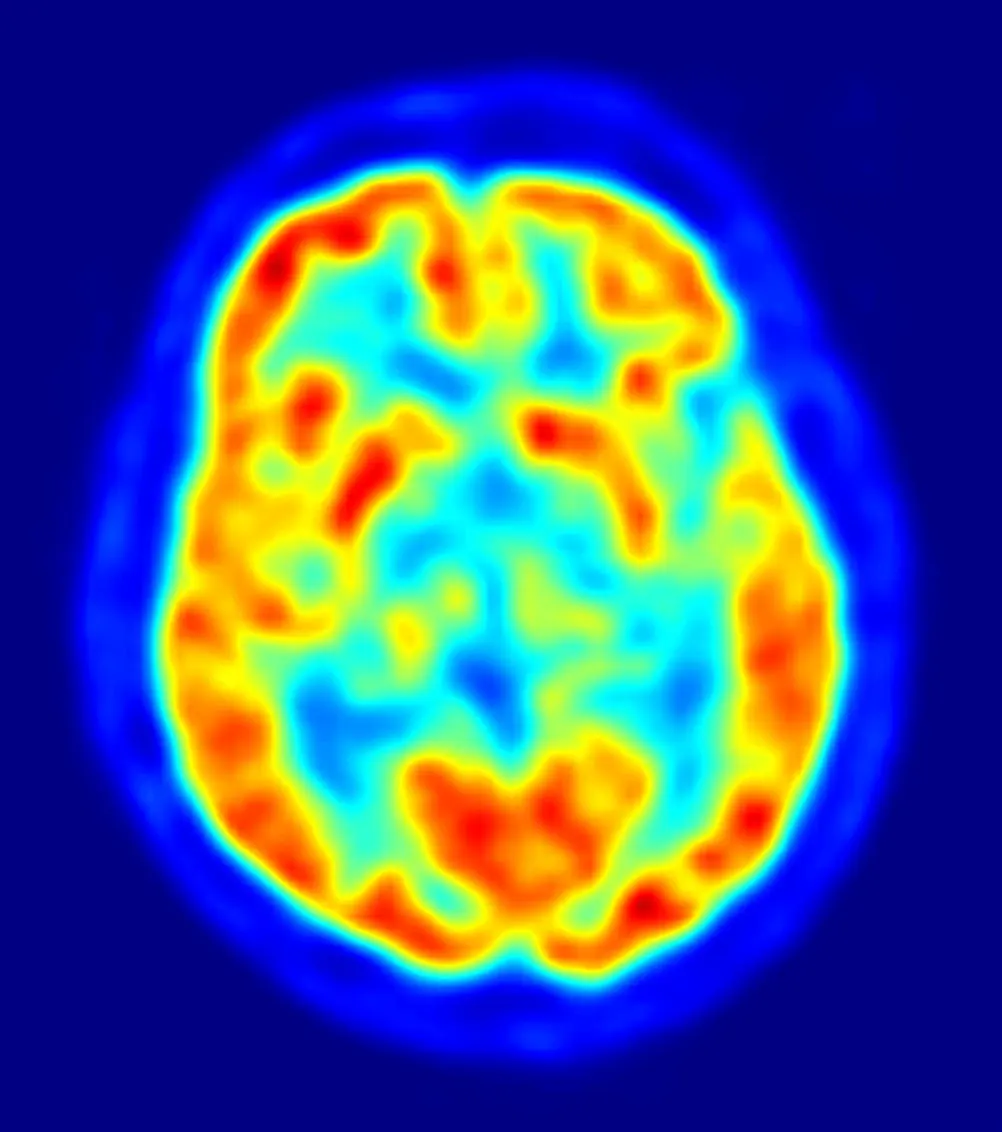
This is not science fiction: hospitals use it. In positron emission tomography (PET), a patient is given a sugar-like substance tagged with a radioactive isotope (often fluorine-18) that gives out positrons. Each positron soon meets an electron in the body and annihilates; a ring of detectors round the patient catches the two 0.51 MeV photons arriving at the same instant from opposite sides, and a computer works out where they came from. The result is a map of where the body uses the most sugar, which shows active parts of the brain, or a tumor.
The opposite of annihilation is pair production: a single photon disappears, and its energy creates a particle and its antiparticle. This happens when a high-energy gamma-ray photon passes close to a heavy nucleus (the nucleus is needed to take up some momentum). To make an electron–positron pair, the photon must supply at least the rest energy of both particles:
Any energy above that becomes the kinetic energy of the pair.
A gamma-ray photon of 0.80 MeV passes close to a lead nucleus. Can it produce an electron–positron pair?
Pick an answer to see why.
24.9 Forces in the nucleus
Apart from hydrogen, every nucleus contains two or more protons, packed together within a few femtometers. Like charges repel, and at that distance the repulsion is enormous. What keeps nuclei from flying apart? Could it be gravity?
Since gravity is far too weak, there must be another force. It is called the strong nuclear force (or strong force), and it is one of the four fundamental forces of nature, with gravity, the electromagnetic force and the weak nuclear force.
- It is attractive between nucleons and acts on protons and neutrons alike; it does not act on electrons.
- It is very strong: within a nucleus, stronger than the electric repulsion between protons.
- It has a very short range, about 10⁻¹⁵ m (1 fm). Beyond a few femtometers it falls almost to nothing. At separations below about 0.5 fm it becomes repulsive, which is why nucleons don’t collapse into each other and why nuclei all have the same density.
Neutrons are the glue. They add strong attraction with no electric repulsion, which is why heavy nuclei need more neutrons than protons: lead-208 has 82 protons and 126 neutrons.
Which statement about the strong nuclear force is correct?
Pick an answer to see why.
24.10 Binding energy
The strong nuclear force acts only between neighboring nucleons, over about 10⁻¹⁵ m, and the very existence of stable nuclei with many protons in them is evidence for it.
To take a nucleus completely apart, work must be done against the strong force to pull every proton and neutron away from the others. This work is the binding energy of the nucleus: the energy needed to separate all its protons and neutrons and move them infinitely far apart.
Run the process backwards and build a nucleus from separate nucleons: as the strong force pulls them together, energy is given out, exactly as much as the binding energy. So energy is needed to take a nucleus apart, and the same energy is released when it is put together, just as energy is needed to pull a ball back up a hill it rolled down.
24.11 Mass defect
Deuterium is the isotope of hydrogen whose nucleus, the deuteron, is one proton bound to one neutron. To separate them, work must be done against the strong force. By , the separated proton and neutron must then have more mass than the deuteron.
Is this really true? Masses can be measured very accurately with a mass spectrometer:
- mass of a deuteron = 2.013 553 u
- mass of a proton = 1.007 276 u
- mass of a neutron = 1.008 665 u
- proton + neutron = 2.015 941 u
The separated nucleons are indeed heavier, by
which is equivalent to 0.002 388 × 931.5 = 2.2 MeV (3.6 × 10⁻¹³ J). So at least 2.2 MeV is needed to break a deuteron into a proton and a neutron; and when a proton and a neutron join to form a deuteron, 2.2 MeV is given out, usually as a gamma-ray photon. Both have been measured, and agree with the masses.
The difference 0.002 388 u is the mass defect of the deuteron, and 2.2 MeV is its binding energy:
- The mass defect of a nucleus is the difference between the total mass of its separated nucleons and the mass of the nucleus. In other words, the mass of a nucleus is less than the total mass of its protons and neutrons.
- The binding energy of a nucleus is the minimum energy needed to separate it completely into its protons and neutrons. It is the mass defect × c².
24.11.1 Calculating a binding energy
For a nuclide with N = A − Z neutrons and nuclear mass ,
With masses in u, the binding energy in MeV is Δm × 931.5.
A uranium-235 nucleus has 92 protons and 143 neutrons. To split it into all its nucleons takes far more than 2.2 MeV: there are many more nucleons, and many more neighbors holding each one.
24.11.2 The binding energy per nucleon
Bigger nuclei have bigger binding energies, simply because they have more nucleons. To compare how tightly different nuclei are held, divide by the number of nucleons:
For deuterium it is 2.2 MeV ÷ 2 = 1.1 MeV; for uranium-235, 7.6 MeV. The binding energy per nucleon is the average energy needed to remove one nucleon from the nucleus. The greater it is, the more tightly bound the nucleus, and the more stable it is.
The shape of this graph explains radioactive decay, fission and fusion. From it you can see that:
- The binding energy per nucleon of ordinary hydrogen, , is zero: its nucleus is a single proton, with nothing to bind.
- The curve rises sharply for small A: for nuclei up to A ≈ 56, the binding energy per nucleon increases as A increases.
- It has peaks at , and , which are unusually stable compared with their neighbors. All three are made of whole alpha particles (2, 3 and 4 of them), and helium-4 is so tightly bound that heavy nuclei often throw out an alpha particle when they decay.
- The highest binding energy per nucleon, about 8.8 MeV, is round iron-56 and nickel-62: these are the most tightly bound nuclei in nature.
- Beyond the peak, the curve falls gently: for A above about 60, the binding energy per nucleon decreases as A increases, to 7.6 MeV at uranium. In large nuclei every proton repels every other proton, near or far, while the strong force only holds neighbors, so the repulsion gradually wins.
- Most nuclei have a binding energy per nucleon between 7 and 9 MeV, nearly the same. That is the short range of the strong force at work: a nucleon is held only by its immediate neighbors, not by all the nucleons in the nucleus. Once a nucleus is big enough (roughly A > 20), each nucleon inside has about the same number of neighbors, so it takes about the same energy to remove, whatever the size of the nucleus.
What the graph says about energy:
- Fusion. When two light nuclei (left of the peak) join to make a heavier one, the product is higher up the curve: it has a larger binding energy per nucleon, and more total binding energy than the nuclei that formed it. The difference is given out. Fusion is how the Sun and the other stars produce their energy; thanks to it, there is life on Earth.
- Fission. When a heavy nucleus (far right) splits into two middle-sized ones, the fragments are also higher up the curve, and again the difference in binding energy is given out. All nuclear power stations work this way.
- Radioactive decay. In a spontaneous decay, such as a heavy nucleus giving out an alpha particle, the total binding energy of the daughter nucleus and the alpha particle is greater than that of the parent nucleus. The difference appears as the kinetic energy of the products.
Both fusion and fission move nuclei towards the peak. Nuclei at the peak can give out energy neither way: iron is the ash of the nuclear fire.
Why do both fusion of light nuclei and fission of heavy nuclei give out energy?
Pick an answer to see why.
24.12 Nuclear reactions
Some nuclei can give out energy by fission or fusion. Almost all nuclear reactions that happen naturally produce nuclei that are more stable, with a higher binding energy per nucleon than the original nuclei. The mass of the products is then less than the mass of the original nuclei, and the difference in mass corresponds to the energy released. To increase their binding energy per nucleon, light nuclei tend to fuse, and heavy nuclei tend to undergo radioactive decay or fission.
Conservation laws in nuclear reactions
Besides momentum and energy, every nuclear reaction obeys these conservation laws:
- Charge (proton number). The total charge cannot change. Any change in the charge of a nucleus is exactly balanced by an opposite change elsewhere: if a nucleus loses +2e of charge, a particle of charge +2e (an alpha particle) must be given out. In nuclide symbols, the lower numbers add up to the same total on both sides.
- Nucleon number (mass number). The total number of nucleons stays the same: the upper numbers add up to the same total on both sides.
- Mass–energy. The total of the mass (as energy, mc²) and all other energy stays the same.
For example, in : the upper numbers give 1 + 235 = 236 = 141 + 92 + 3, and the lower numbers 0 + 92 = 92 = 56 + 36 + 0.
24.13 Nuclear fission
Nuclear fission is the splitting of a heavy, unstable nucleus into two fragments of comparable mass, usually with a few neutrons.
On the binding energy curve, a heavy nucleus is far to the right. Split it into two nuclei near the middle, and the binding energy per nucleon increases: the energy difference is given out, mostly as the kinetic energy of the fission fragments. Any nucleus with A above about 120 would release energy by splitting, though in practice only a few, uranium and plutonium above all, can be made to split easily.
For fission and fusion alike, the energy released is
where is the total binding energy of the original nucleus or nuclei and that of the products. Since binding energies correspond to mass defects, and the numbers of protons and neutrons don’t change, the increase in the total mass defect is exactly the decrease in the total mass. So the energy released corresponds to the mass the reaction turns into energy:
where is the total mass of the original nucleus or nuclei and the total mass of the products. Energy is released when .
Fission usually begins with a free neutron striking a heavy nucleus. A neutron has no charge, so it is not repelled and can drift right into a nucleus even when moving slowly. When uranium-235 absorbs a neutron, it becomes uranium-236 for a moment, a nucleus so disturbed that it wobbles, stretches into a dumbbell and splits almost at once. One possible result:
Where does the energy of one fission go? About 205 MeV in all (nuclear-data tables differ by a few MeV), shared like this:
| Where the energy goes | About |
|---|---|
| kinetic energy of the two fragments, which heats the fuel as they crash into the atoms around them | 168 MeV |
| kinetic energy of the 2 or 3 neutrons | 5 MeV |
| gamma rays given out at the moment of splitting | 7 MeV |
| beta particles and gamma rays the fragments give out later, as they decay | 15 MeV |
| antineutrinos, which pass out of any reactor and are lost | 10 MeV |
More than four-fifths of it is the fragments’ kinetic energy. These are averages over the many ways uranium-235 splits. The 173 MeV worked out above is for one split, into barium-141 and krypton-92, and counts only the moment of splitting; the fragments’ later decays, and the antineutrinos they send out, add some 25 MeV more.
The chain reaction
Each fission is set off by one neutron, and gives out two or three more. If at least one of these goes on to split another uranium-235 nucleus, the fissions keep going by themselves: a chain reaction. The fission is induced: it starts when a neutron strikes a uranium-235 nucleus.
What happens depends on the average number of neutrons from each fission that go on to cause another fission, the multiplication factor k. The rest escape from the fuel or are absorbed without causing fission.
- k < 1: each generation has fewer fissions than the last, and the chain dies out (subcritical).
- k = 1: each fission leads to exactly one more; the rate stays steady (critical). A nuclear reactor runs here, controlled by rods that absorb spare neutrons.
- k > 1: the number of fissions grows by a factor k every generation (supercritical). A generation takes only about 10 nanoseconds in a bomb, so with k = 2 the whole energy is released in less than a microsecond.
A chain reaction can thus be made to go slowly and steadily, as in a nuclear reactor, or explosively, as in a bomb. Either way the energy released is enormous, far greater than in any chemical reaction: the fission of 1 kg of uranium-235 gives about 8 × 10¹³ J, as much as burning about 3000 tonnes of coal.
In a nuclear reactor working steadily, the multiplication factor k is:
Pick an answer to see why.
24.14 Nuclear fusion
Nuclear fusion is the building up of nuclei by bringing protons and neutrons together, or by joining small nuclei into larger ones.
Joining small nuclei gives out energy, because the total binding energy of the fused nucleus is larger than the total binding energy of the nuclei that formed it. The difference is given out as the kinetic energy of the products.
The catch is getting the nuclei to touch. The strong force only reaches about 10⁻¹⁵ m, so two nuclei must come within a few femtometers of each other. But all nuclei are positive, and at that distance their electric repulsion is enormous. At ordinary temperatures nuclei never get close enough to fuse. At very high temperatures they move fast enough to get close despite the repulsion, and the strong force pulls them together. That is why fusion is also called a thermonuclear reaction.
The conditions are right in the cores of stars. In the Sun’s core the temperature is about 1.5 × 10⁷ K and the density about 1.5 × 10⁵ kg/m³ (150 times the density of water); the enormous density makes the number of fusions per second high.
The proton–proton chain
Fusion in stars happens in chains of reactions. In the Sun, most of the energy comes from the proton–proton chain:
First, two protons fuse to form a deuteron, a positron and a neutrino:
This step gives out 0.42 MeV, and the positron soon annihilates with an electron, adding 1.02 MeV more: 1.44 MeV in all. One of the protons has turned into a neutron, through the weak nuclear force, which is why this step is very slow: an average proton in the Sun waits about ten billion years for it.
Next, the deuteron fuses with another proton, forming helium-3 and a gamma-ray photon, and giving out 5.5 MeV:
Last, two helium-3 nuclei (each made by the first two steps) fuse to form helium-4 and two protons, giving out 12.9 MeV:
The two protons given back can start the cycle again. The first two steps happen twice for each third step, so overall
and the total energy is 2 × 1.44 + 2 × 5.5 + 12.9 = 26.7 MeV. This chain, also called hydrogen burning, is one of the main ways helium is made in stars. In the Sun it happens about 9 × 10³⁷ times every second.
Why does fusion need temperatures of millions of kelvin?
Pick an answer to see why.
Exercise
Choose the correct option
- In the early 20th century, experiments were carried out to measure the scattering of alpha particles after striking thin gold foil. Which of the following could not be concluded from the results of these experiments?
Pick an answer to see why.
- Two alpha particles with the same kinetic energy are moving towards, and are then deflected by, a gold nucleus. Which diagram above could show the paths of the two alpha particles?
Pick an answer to see why.
- In an experiment to investigate the nature of the atom, a very thin gold film was bombarded with α-particles. What pattern of deflection of the α-particles was observed?
Pick an answer to see why.
- The numbers of protons, neutrons and nucleons in three nuclei are: X, 15 protons, 16 neutrons, 31 nucleons; Y, 15 protons, 17 neutrons, 32 nucleons; Z, 16 protons, 16 neutrons, 32 nucleons. Which nuclei are isotopes of the same element?
Pick an answer to see why.
- Which one of the graphs of binding energy per nucleon against nucleon number above is correct?
Pick an answer to see why.
- From the graph above, which of the four nuclei is the most stable?
Pick an answer to see why.
- The mass defect of a carbon-12 nucleus is 0.0990 u. What is its average binding energy per nucleon?
Pick an answer to see why.
Answer these questions
The most common isotope of calcium is . Its nuclear mass is 39.9516 u.
The textbook gives 39.9626 u, which is the mass of the whole atom, with its 20 electrons; the nucleus alone is 39.9516 u, so the book’s numbers don’t fit with bare protons and neutrons.
- a.Calculate the mass defect of this nucleus.
- b.Calculate its binding energy in MeV.
(Mass of a proton = 1.00728 u; mass of a neutron = 1.00867 u.)
Hint
Answer
- a.Show that the mass defect of a helium nucleus (alpha particle) is 0.03039 u.
- b.Calculate its binding energy per nucleon in MeV.
(Mass of a helium nucleus = 4.00151 u; proton = 1.00728 u; neutron = 1.00867 u.)
Answer
- a.Write down an equation to show how helium is formed from hydrogen by fusion.
- b.Explain the conditions needed for the reaction to occur.
Answer
Calculate the mass of material that is converted into 5.0 × 10¹³ J of energy.
Answer
A typical alpha decay is the decay of radon-220:
- a.Give the values of A and Z for both X and α.
- b.Calculate the energy released, in MeV and in J, by one nucleus of radon. (Atomic masses: radon-220, 220.011 394 u; polonium-216, 216.001 915 u; helium-4, 4.002 603 u.)
The textbook gives no masses for part b, so the book’s numbers don’t work as asked; the atomic masses here are from the tables (the electrons balance, 86 on each side).
Hint
Answer
In this reaction, a proton and a deuterium nucleus fuse to form a helium nucleus, releasing energy:
- a.Write down the isotope of helium formed, in isotope notation.
- b.Calculate the energy given out by this reaction. (Mass of proton = 1.00728 u; deuterium nucleus = 2.01355 u; helium nucleus = 3.01493 u.)
Answer
Beryllium-7 decays by electron capture to lithium: its nucleus captures one of the atom’s own inner electrons.
Calculate the energy change in this event. (Mass of beryllium-7 nucleus = 7.014 727 u; lithium-7 nucleus = 7.014 356 u; electron = 0.000 549 u; the neutrino’s mass is negligible.)
Answer
a. Beryllium-9 has a proton number of 4. Its nuclear mass is 9.00999 u.
- Calculate the number of neutrons beryllium-9 has.
- Calculate the mass defect of the beryllium-9 nucleus.
b. Beryllium-8 has a nuclear mass of 8.00311 u.
- Calculate the mass defect of a beryllium-8 nucleus.
- Show that the energy equivalent to the mass defect of a beryllium-8 nucleus is about 56.5 MeV.
- Calculate its binding energy per nucleon.
c. The binding energy of each helium-4 nucleus, worked out from its mass defect, is 28.31 MeV. Two alpha particles fuse to form beryllium-8: .
- Calculate the total binding energy of the two alpha particles.
- Calculate the energy change as the reaction proceeds.
(Mass of proton = 1.00728 u; neutron = 1.00867 u.)
The textbook gives 9.01218 u and 8.00531 u, which are the masses of the whole atoms, with their 4 electrons each; with bare protons and neutrons those numbers don’t work out right (they give 54.48 MeV for beryllium-8, and a reaction in c that needs 2 MeV, ten times too much). The nuclei alone are 9.00999 u and 8.00311 u.
Hint
Answer
Use these nuclear masses: proton 1.00728 u; neutron 1.00867 u; deuterium 2.01355 u; tritium 3.01550 u; helium-3 3.01493 u; helium-4 4.00151 u.
The textbook gives the proton as 1.00782 u, close to the mass of a whole hydrogen atom, and only three reactions, which add up to about 39 MeV, so the book’s numbers don’t fit; with the proton’s own mass, 1.00728 u, and the fourth reaction in part d, they do.
a. Two deuterium nuclei fuse: .
- Show that the change in mass in this reaction is about 3.5 × 10⁻³ u.
- Determine the energy in MeV that is given out.
b. Deuterium and tritium fuse to give a helium-4 nucleus and a neutron: .
- Show that the change in mass in this reaction is about 1.9 × 10⁻² u.
- Determine the energy in MeV that is given out.
c. Deuterium and helium-3 react to form helium-4 and a proton: .
- Show that the change in mass is about 0.02 u.
- Determine the energy in MeV.
d. Two deuterium nuclei can also fuse the other way: . Together, these four reactions turn six deuterium nuclei into two helium-4 nuclei, two protons and two neutrons.
- Show that the total energy released by the four reactions is about 43 MeV.
- This set of reactions happens 6.0 × 10²³ times. Calculate the total energy released in J.
- Calculate the total mass that has been turned into energy.
Answer
In a certain fission reaction of uranium-235, the mass change is 3.1 × 10⁻²⁸ kg for each nucleus.
- Determine the energy equivalent to this mass change.
- Calculate how many nuclei would be needed to give 1.0 J. Give your answer to an appropriate number of significant figures.
Answer
A nucleus written in isotope notation is . It has a mass M. The mass of a proton is and the mass of a neutron is .
- Write an expression for the mass defect Δm of the nucleus.
- Write an expression for its binding energy per nucleon, E.
Answer
a. Uranium-235 has the nuclide notation . Use these data to calculate its binding energy per nucleon: mass of uranium-235 nucleus = 234.993 u; proton = 1.00728 u; neutron = 1.00867 u.
The textbook gives 235.044 u, which is the mass of the whole atom, with its 92 electrons; with bare protons and neutrons that number gives 7.39 MeV per nucleon instead of uranium’s 7.6, so the book’s numbers don’t fit. The nucleus alone is 234.993 u.
b. Figure 24.12 shows how the binding energy per nucleon varies with the nucleon number A.
- State where uranium-235 and its fission fragments are on the graph. (No values are needed.)
- Explain why fission releases energy.
Answer
The figure above shows the binding energy per nucleon against the number of nucleons.
- a.Use the figure to find the binding energy per nucleon of: 1. U-235; 2. Sr-90; 3. Xe-144.
- b.Use these values to calculate the energy released in the reaction
Hint
Answer
When a nucleus of uranium-235 undergoes fission, it mostly splits into two fragments. The fragments can be a range of different elements; the most common have nucleon numbers of about 95 and 137.
a. One such reaction gives
Find the proton number and the nucleon number of the isotope of element X.
b. The nuclear masses are: uranium-236, 235.995 061 u; barium-144, 143.892 211 u; X, 88.898 071 u; neutron, 1.008 67 u.
- Calculate the change in mass in the reaction .
- Show that the energy given out is about 170 MeV.
c. A nuclear power station has an output power of 1500 MW and is about 40 % efficient.
- Show that the fissionable material used is less than 5 kg a day, assuming that 1 kg of the uranium fuel gives 6.8 × 10¹³ J.
- If the fuel contains 5 % of fissionable material, find the total amount of fuel needed each day.
Hint
Answer
The mass defect of a uranium-235 nucleus is 1.9151 u.
The textbook gives 1.864557 u, which comes from the mass of the whole atom, with its 92 electrons, so the book’s numbers don’t fit uranium’s 7.6 MeV per nucleon; the nucleus’s own mass defect is 1.9151 u, as in question 36.
- a.Calculate the binding energy, in joules, of a uranium-235 nucleus. (1 MeV = 1.60 × 10⁻¹³ J)
- b.Calculate the average binding energy per nucleon of uranium-235, in MeV.
Answer
This equation shows a nuclear reaction between two deuterium () nuclei, forming helium-3:
- a.State what type of nuclear reaction this is.
- b.The binding energy per nucleon is 0 for a neutron, about 1.11 MeV for a nucleus and about 2.58 MeV for a nucleus. Use these values to estimate the energy released.
Answer
The Sun radiates about 4 × 10²⁶ W and has a mass of 1.99 × 10³⁰ kg. Astronomers estimate that it can convert only the innermost 10 % of its hydrogen into helium; 73 % of the Sun’s mass is hydrogen. Estimate how long the Sun can continue to shine at its present power.
Hint
Answer
One of the fusion reactions in a star much more massive than the Sun is the fusion of a calcium nucleus with a helium-4 nucleus to form titanium:
The binding energies per nucleon are: calcium-40, 8.551 MeV; helium-4, 7.073 MeV; titanium-44, 8.533 MeV. Find the energy released in this fusion reaction.
Answer
Printable PDFs
- The unit as a book (A5) 25 pages Answers as an A4 booklet, 7 sheets
- Study notes 3 pages
- Worksheet 5 pages Answer key
- Harder practice questions 2 pages Answer key
Quiz yourself: Matter, Atoms and Reactions, Grades 5–12 →
Practice every question in the book, and keep track of the ones you miss →
A companion to your textbook, not a replacement for it: study from the book your school uses, and where the two differ, follow your teacher. Found a mistake? Please tell us.