
Draw an atom. Almost everyone draws the same thing: a dot in the middle and a few electrons running round it on neat circles, like planets round the Sun. Your Grade 9 book draws it that way, and so does nearly every science logo you have seen.
It is a useful picture. But nobody has ever seen an electron go round a circle, and since 1926 scientists have known that it doesn’t. An electron in an atom has no path at all. So where is it? This topic follows the scientists who asked that question, from Rutherford’s tiny nucleus to the fuzzy clouds of today, and shows how those clouds give the periodic table its shape.
Rutherford’s atom and its big problem
You met the nucleus in Grade 9 Grade 9: Structure of an atom. In 1911 Ernest Rutherford showed that an atom’s positive charge and nearly all its mass are packed into a tiny nucleus, about 100,000 times smaller across than the atom. The electrons are somewhere in the huge empty space around it.
The obvious picture was a tiny solar system: the electrons held in orbit by the pull of the positive nucleus, as the planets are held by the Sun’s gravity. But there was a serious problem with it.
An electron going round a circle is always changing direction, so it is always accelerating. Physicists already knew, from Maxwell’s theory of light and from every radio transmitter, that an accelerating charge gives out electromagnetic waves. So an orbiting electron should give out light all the time, lose energy, and spiral into the nucleus. Worked out with the physics of the time, a hydrogen atom should collapse in about 10⁻¹¹ s, a hundred-billionth of a second.
Atoms obviously don’t collapse: you are made of them, and they have lasted billions of years. And there was a second puzzle. A spiraling electron would give out a smooth smear of colors, a continuous spectrum. But hot hydrogen gives out only a few sharp colors (What Are Stars Made Of?). The ordinary laws of physics, which work so well for planets and cricket balls, were failing inside the atom.
Why did physicists in 1911 expect an orbiting electron to fall into the nucleus?
Pick an answer to see why.
Bohr’s staircase
In 1913 a 27-year-old Danish physicist, Niels Bohr, made a bold guess. He didn’t explain why the electron doesn’t spiral in; he simply said that it doesn’t, as long as it stays in one of a few allowed orbits. In an allowed orbit it gives out no light at all. It gives out light only when it jumps from one allowed orbit to a lower one, and then it gives out exactly one photon carrying the difference in energy.
These allowed orbits are the shells of your Grade 9 book, numbered n = 1, 2, 3… (K, L, M…) Grade 9: Shells and their energy. For hydrogen, Bohr’s rules gave each orbit a radius and an energy:
The energy is negative because the electron is held by the nucleus: you would have to give it 13.6 eV to pull it right out of the atom from level 1, to 0 eV. (1 electronvolt, eV, is 1.60 × 10⁻¹⁹ J.) The smallest orbit, 0.0529 nm, is called the Bohr radius.
Bohr’s rules did what nothing before them had done. The drops between his levels gave exactly the colors of hydrogen’s spectral lines, which had been measured for decades without anyone knowing why they were where they were.
But Bohr’s model was a patch, not an explanation, and it soon ran into trouble:
- It gave no reason why only these orbits were allowed, or why an electron in one doesn’t give out light.
- It worked for hydrogen, with one electron, but failed for helium, with just two.
- It made the hydrogen atom flat, a circle in a plane, but a real hydrogen atom behaves the same in every direction, as a round atom would.
- It couldn’t say why some lines are brighter than others, or explain how atoms join to make molecules.
Electrons are waves too
The answer started with a question turned round. Einstein had proposed in 1905, and experiments had since confirmed, that light, which everyone thought was a wave, also comes as particles, photons (Is Light a Wave or a Stream of Particles?). In 1924 a French student, Louis de Broglie, asked: if waves can act like particles, can particles act like waves?
He proposed that every moving particle has a wavelength, which depends on its momentum (mass × velocity):
where h is Planck’s constant, 6.63 × 10⁻³⁴ J s. Because h is so tiny, the wavelength is tiny unless the mass is tiny too. For a cricket ball it is far too small ever to notice. For an electron it is about the size of an atom.
Think of a wave running round and round a ring. After each lap it meets itself. If a whole number of waves fits round the ring, each lap lies exactly on top of the last, crest on crest: the wave is steady. If not, each lap arrives out of step, crests fall on troughs, and over many laps the wave cancels itself out. So only orbits that hold a whole number of waves can last. In de Broglie’s picture, orbit n holds n waves, and that is why only Bohr’s orbits are allowed.
A steady wave that stays in one place is a standing wave, like the vibration of a guitar string or a madal’s skin. A string fixed at both ends can only vibrate in a few ways, the ones in which a whole number of half-waves fits between its ends; that is why it plays a note and its overtones, not any pitch at all. An electron held by a nucleus is like that: only certain standing waves fit, and each has its own energy. The staircase of energy levels comes from the waves.
The evidence: electrons that make stripes
A wave can be tested: waves diffract and interfere, making patterns of stripes. If electrons are waves, a beam of them should make stripes too.
Today electron waves are used every day. An electron microscope uses a beam of electrons in place of light. Their wavelength is many thousands of times shorter than light’s, so it can show details far too small for any light microscope, down to single atoms. And in 1989 a team at Hitachi in Japan filmed electrons building up an interference pattern one at a time (Wave or particle?), just as photons do.
An electron and a proton move at the same speed. Which has the longer de Broglie wavelength?
Pick an answer to see why.
No path at all
De Broglie’s ring is still a circle in a flat plane, and the real atom is not. In 1926 the Austrian physicist Erwin Schrödinger found the equation that the electron’s wave obeys, in three dimensions. Solving it for hydrogen gave the same energy levels as Bohr, but no orbits. The electron’s wave fills the whole space around the nucleus, in shapes like the overtones of a drum or a bell, round and round the nucleus in three dimensions.
But what is the wave? An electron is always found in one place: it makes one dot on a screen, never a smear. In 1926 the German physicist Max Born gave the answer that is still used: the wave tells you where the electron is likely to be found. Where the wave is strong, the electron is often found; where it is weak, rarely; where it is zero, never. The wave doesn’t tell you where the electron is, only the probability of finding it in each place.
A year later Werner Heisenberg showed that an electron simply doesn’t have an exact place and an exact velocity at the same time. This is his uncertainty principle: the more exactly the position of a particle is fixed, the less exactly its momentum can be, and the other way round:
Here Δx is the spread in its position and Δp the spread in its momentum (Δp = mΔv).
What the cloud shows
So scientists don’t draw an electron’s path. They draw where it is likely to be: a cloud of dots, each dot one place where the electron might be found if you looked. Where the dots crowd together the electron is often found; where they thin out, rarely. The region of space described by one standing wave of the electron is called an orbital. You met the word in Grade 10 as a “room” in a subshell Grade 10: Shells, subshells and orbitals; now you can see what the room looks like.
Look at the 1s cloud, hydrogen as it normally is. It is round, thickest near the nucleus, and fades away with no edge. There is no distance beyond which the electron can never be, only places where it is very rarely found. To draw an orbital, chemists draw the surface that holds most of the dots: 90% of the time, hydrogen’s electron is within 0.14 nm of the nucleus, and 99% of the time within 0.22 nm.
The most likely distance of hydrogen’s 1s electron from the nucleus is exactly 0.0529 nm: Bohr’s radius. Bohr’s orbit was not nonsense. It was the right distance, drawn as a sharp line when it should have been a cloud.
Normal and excited
Hydrogen has only one electron, so how can the widget show six clouds? They are the places that one electron can be, not several electrons at once. Normally it is in 1s, the lowest level. This is the atom’s ground state, and nearly every hydrogen atom around you is in it.
Give the atom energy, by heating it, shining light on it or passing a spark through the gas, and the electron can take in just enough to move up to a higher level: 2s or 2p in the L shell, 3s, 3p or 3d in the M shell, and so on. The atom is then excited. It doesn’t stay that way. Usually within a few billionths of a second the electron drops back, in one step or several, and gives out each drop’s energy as a photon. These are Bohr’s jumps on his staircase, now seen with clouds instead of circles. A glowing tube of hydrogen is billions of atoms being excited and dropping back, over and over, and its colors are the sizes of their drops.
Every atom has the same set of orbitals, filled or empty. In a bigger atom the electrons fill them from the bottom up, as you will see below, and the atom is excited when one of its electrons is lifted into an empty orbital higher up.
The electron of a hydrogen atom is found in a 3d orbital. What does that tell you?
Pick an answer to see why.
Now try 2s and 3s in the widget. They are round too, but layered: a small cloud inside a bigger one, with thin empty shells between them where the electron is never found. These are the nodes of the standing wave, like the still points on your rope. The 2s orbital has one such shell, at 0.106 nm; 3s has two. The 2p orbital has a different kind of node: a flat plane through the nucleus. In every case, a higher level means more nodes and a bigger cloud.
In the 1s cloud of a hydrogen atom, a region far from the nucleus has very few dots. What does that mean?
Pick an answer to see why.
Shapes and sizes: s, p and d
Schrödinger’s equation gives each level n its own set of orbitals, in a few shapes. They are named by letters you met in Grade 10:
- An s orbital is round, the same in every direction. Every shell has one.
- A p orbital has two lobes on opposite sides of the nucleus, with a flat node between them. From the L shell on, each shell has three, at right angles to each other, along the x, y and z directions.
- A d orbital has four lobes, or (in one of them) two lobes and a ring. From the M shell on, each shell has five.
- An f orbital has still more lobes. From the N shell on, each shell has seven.
The size of an orbital is set mostly by its shell: the higher n, the bigger it is, roughly in proportion to n², as in Bohr’s orbits. In hydrogen, a 3s electron is on average exactly 9 times (3²) as far from the nucleus as a 1s electron.
Spin: every electron is a tiny magnet
One more fact explains the numbers in your Grade 10 table. Every electron behaves like a tiny magnet, with a north and a south pole. This is called its spin. The name comes from an early picture: a little ball of charge spinning like a top, since a spinning charge makes a magnet. That picture is wrong. No one has ever measured a size for the electron, and to make a magnet as strong as an electron’s, a spinning ball that small would have to turn faster than light. Spin is simply something an electron has, like its charge. It never speeds up, slows down or stops.
The strange part is how this magnet can point. A bar magnet can point any way. An electron’s magnet, measured along any direction you choose, is only ever found pointing one of two ways: along that direction or against it. These are called spin up and spin down, and there is nothing in between.
This was seen in 1922, before anyone had thought of spin. Otto Stern and Walther Gerlach sent a beam of silver atoms between the poles of a magnet shaped to push a tiny magnet up or down. A silver atom’s electrons are all in pairs, one up and one down, whose magnets cancel, except one. If that electron’s magnet could point any way, the beam would have spread into a smear. Instead it split cleanly in two. Stern and Gerlach thought it proved something else; the real reason, spin, was proposed in 1925 by two young Dutch physicists, George Uhlenbeck and Samuel Goudsmit.
Spin is what lets the shells fill as they do. In 1925 Wolfgang Pauli found the rule that every atom obeys: no two electrons in an atom can be in the same state. An electron’s state is its orbital and its spin, so each orbital can hold two electrons, one spin up and one spin down, and no more. That gives the numbers you know:
| Subshell | Orbitals | Most electrons |
|---|---|---|
| s | 1 | 2 |
| p | 3 | 6 |
| d | 5 | 10 |
| f | 7 | 14 |
Shell by shell, that is 2, 8 and 18, the 2n² of your books: K has one orbital (2 electrons), L four (8), M nine (18). Without spin, every orbital would hold just one electron, every shell half as many, and the periodic table would look nothing like it does.
Spin also explains why helium joins with nothing. Its two electrons fill 1s, one up and one down. The shell is full, with no room to take in or share another electron, so helium forms no ordinary compounds.
How many orbitals are in the L shell (n = 2), and how many electrons can it hold?
Pick an answer to see why.
How the clouds build the periodic table
In an atom with many electrons, the electrons fill the orbitals from the lowest energy up, two to an orbital (the Aufbau principle, from Grade 10: The order of filling). The clouds explain two things that Grade 10 states as rules.
Why s comes before p, and 4s before 3d. In hydrogen, all the orbitals of one shell have the same energy. In bigger atoms they don’t. An outer electron is pulled by the nucleus but pushed away by all the electrons between it and the nucleus, which shield it from part of the pull. Now look again at the 3s cloud in the widget: it has small inner layers that reach in close to the nucleus, inside the inner shells, where the electron feels the nucleus almost fully. A 3p cloud reaches in less, and a 3d cloud hardly at all. So in a bigger atom 3s is held most tightly (lowest in energy), then 3p, then 3d. The 3d is pushed up so far that, in potassium and calcium, 4s, with its inner layers reaching in, is lower still. That is why the 19th electron goes into 4s.
Why the table has its shape. Each block of the periodic table is a subshell being filled. The s subshell holds 2 electrons, so the s block is 2 columns wide; p holds 6, so the p block is 6 wide; d is 10 wide, and f is 14. The width of the table is the number of electrons that its orbitals can hold.
So the lengths of the periods are 2, 8, 8, 18, 18, 32 and 32. Period 1 fills only 1s (2). Periods 2 and 3 fill s and p (2 + 6 = 8); the 3d is too high to fill in period 3. Periods 4 and 5 add a d subshell (2 + 10 + 6 = 18), and periods 6 and 7 add an f subshell as well (2 + 14 + 10 + 6 = 32).
The outer electrons decide
Chemists write a configuration shortly by naming the noble gas that has the same inner electrons. Sodium, 1s² 2s² 2p⁶ 3s¹, is written [Ne] 3s¹: the neon core plus one electron in 3s. Potassium is [Ar] 4s¹ and rubidium [Kr] 5s¹.
Written this way, the pattern of the periodic table is plain. Every element in group 1 is a noble-gas core with one s electron outside it. Every halogen is a core plus s² p⁵, one electron short of filling its p subshell. Every noble gas has its outer s and p full. Elements in a group behave alike because their outermost electrons, the ones that meet other atoms, are arranged alike. Their inner electrons, held tightly inside, take no part in reactions.
The clearest evidence is the ionization energy: the energy needed to pull one electron off each atom of an element, measured for a mole of atoms. It measures how tightly an atom holds its outermost electron, and it can be measured very accurately from the atom’s spectrum.
The graph has three patterns, and the clouds explain each one:
- It rises across each period. Each step adds one proton to the nucleus, and the new electron goes into the same shell, which shields it only a little. The outer electrons feel a stronger pull, and they are held more tightly. (This is also why atoms get smaller across a period, as you learned in Grade 10.)
- It drops sharply at each alkali metal. The next electron must start a new shell, much farther out, shielded by all the full shells inside. Lithium, sodium, potassium and rubidium are the lowest points.
- Down a group it falls. Each step down adds a shell, so the outer electron is farther out and better shielded.
And look closely at period 2. Boron is a little lower than beryllium, and oxygen a little lower than nitrogen. Bohr’s shells can’t explain that, but the subshells can: boron’s outer electron is the first in 2p, which is higher than 2s; oxygen’s fourth 2p electron has to share an orbital with another, and the two repel. These small dips are evidence that subshells and orbitals are real.
Why does the first ionization energy drop from neon (2,081 kJ/mol) to sodium (496 kJ/mol)?
Pick an answer to see why.
How do we know? Seeing atoms
Everything so far came from spectra and from calculation. Can anyone actually see an atom, or the cloud of its electrons?
Not with light. Light’s wavelength (400–700 nm) is thousands of times bigger than an atom, so no light microscope can ever show one. The way in came from the electron’s strangest property. Because an electron is a wave, its cloud has no sharp edge, and it can sometimes cross a gap it has not got the energy to jump, as if it passed through a wall. This is called tunneling.
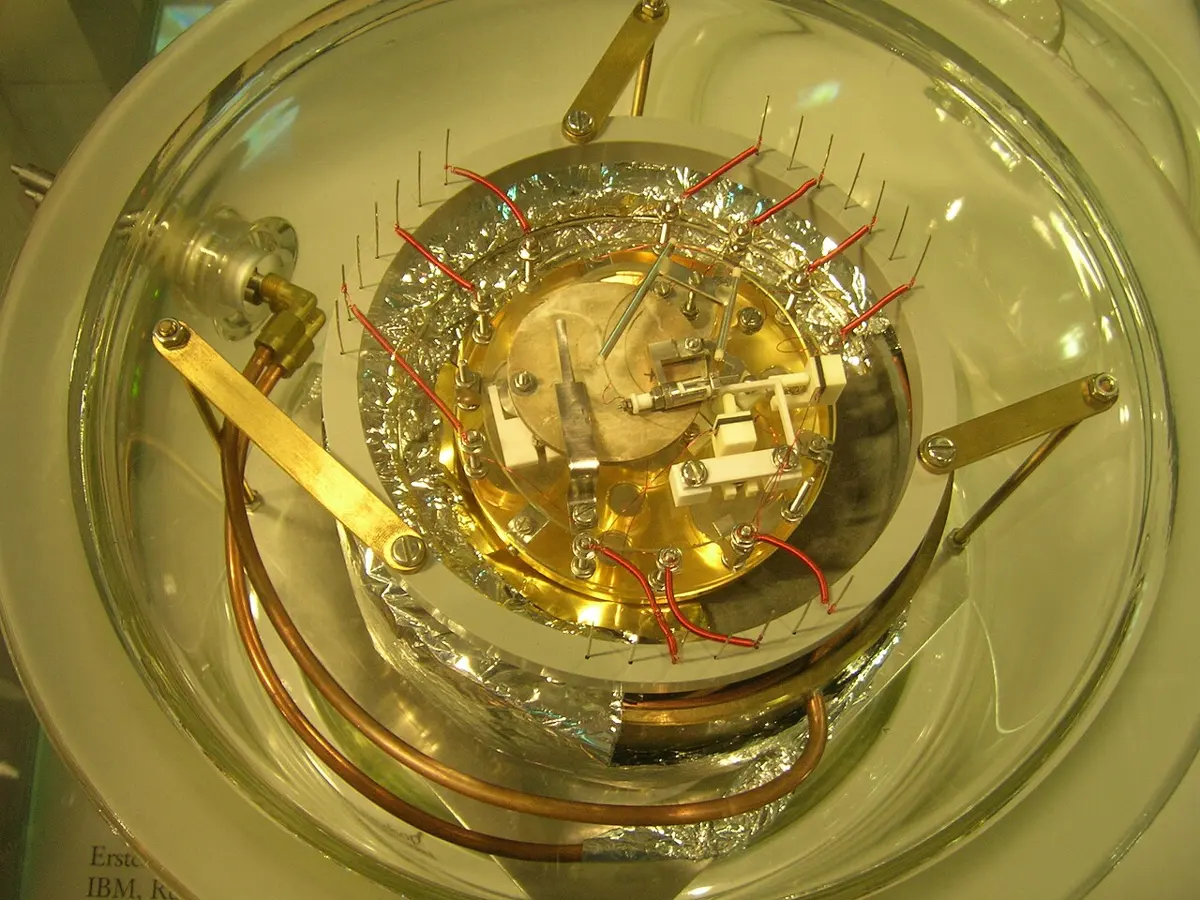
In 1981, at IBM’s laboratory in Zurich, Gerd Binnig and Heinrich Rohrer built the scanning tunneling microscope (STM). A metal needle, so sharp that it ends in a single atom, is brought to within about a nanometer of a surface, without touching it. A small voltage is applied, and electrons tunnel across the gap. The current is extremely sensitive to the gap: it changes about ten times for every 0.1 nm, less than the width of an atom. The needle is moved across the surface row by row, and moved up and down to keep the current steady. A computer turns the needle’s ups and downs into a picture: a map of the electron clouds of the surface atoms. Binnig and Rohrer won the Nobel Prize for it in 1986.
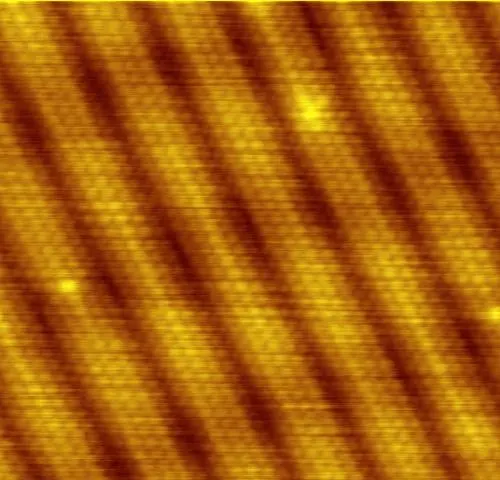
STMs can even move atoms. In 1989 IBM scientists in California pushed 35 xenon atoms into place, one by one, to spell “IBM”. In 1993 the same team put 48 iron atoms in a ring on a copper surface. Inside the ring, the STM showed circular ripples: the standing waves of the copper’s electrons, trapped in the ring, like the rope’s loops in two dimensions.
And orbitals themselves have now been photographed. In 2005 a team at IBM in Zurich used an STM to show the shapes of single orbitals of molecules lying on a thin insulating layer. In 2013 a team at the AMOLF institute in Amsterdam, with Aneta Stodolna as the first author of their paper, took the first pictures of the wave of the electron in a hydrogen atom. They placed hydrogen atoms in an electric field, used lasers to lift the electron into a large, high level and then free it; the electrons flew onto a screen, magnified by an electric lens more than 20,000 times, and built up a picture of rings, dot by dot. The rings are the nodes of the electron’s standing wave, exactly where Schrödinger’s equation, written 87 years earlier, said they would be.
Why can a scanning tunneling microscope see single atoms when no light microscope can?
Pick an answer to see why.
Questions
Which of these did Bohr’s model of the atom explain correctly?
Pick an answer to see why.
An element’s atoms have the outer electrons [Kr] 5s² 4d¹⁰ 5p⁵. Which element is it most like?
Pick an answer to see why.
What was wrong with the idea of the atom as a tiny solar system? Give two pieces of evidence against it.
Answer
In a solar-system atom, the electron would move in a circle and so would always be accelerating. An accelerating charge gives out electromagnetic waves, so the electron would keep losing energy and spiral into the nucleus.
- Atoms are stable: they don’t collapse, although by this model a hydrogen atom should collapse in about 10⁻¹¹ s.
- A spiraling electron would give out a smooth range of colors, a continuous spectrum, but hot hydrogen gives only a few sharp lines at fixed wavelengths.
Use de Broglie’s idea to explain why an electron in an atom can have only certain energies.
Answer
De Broglie said that the electron is also a wave, with a wavelength λ = h ÷ mv. An electron held by a nucleus is like a wave going round and round the nucleus. For the wave to be steady, it must join up with itself after each lap, so a whole number of wavelengths must fit round. If not, each lap is out of step and the wave cancels itself. So only certain standing waves are possible (like the few ways a string fixed at both ends can vibrate), and each has its own energy. That is why only certain energy levels exist. (In three dimensions, Schrödinger’s equation gives the same result: only certain standing waves, the orbitals, fit around the nucleus.)
An electron is accelerated through a voltage so that it moves at 4.4 × 10⁶ m/s. (Mass of an electron 9.11 × 10⁻³¹ kg, h = 6.63 × 10⁻³⁴ J s.)
- i.Find its de Broglie wavelength.
- ii.The atoms in a crystal of nickel are in rows about 0.2 nm apart. Would a beam of these electrons be diffracted by the crystal? Explain.
Answer
- i.λ = h ÷ mv = 6.63 × 10⁻³⁴ ÷ (9.11 × 10⁻³¹ × 4.4 × 10⁶) = 1.65 × 10⁻¹⁰ m = 0.165 nm.
- ii.Yes. Waves are diffracted strongly by gaps or rows of about their own wavelength. The electrons’ wavelength, 0.165 nm, is close to the spacing of the rows, 0.2 nm, so the crystal acts like a set of slits and the electrons come off strongly at some angles and hardly at all at others. (These are about the electrons Davisson and Germer used, with 54 eV of energy.)
A student says, “The electron in a hydrogen atom moves round the nucleus so fast that it looks like a cloud, just as a fan’s blades look like a disc.” What is wrong with this? Explain what the cloud really shows.
Answer
The fan’s blur comes from blades moving fast along a fixed path. An electron in an atom has no path: by the uncertainty principle, it can’t have an exact position and an exact velocity at the same time, and before it is measured it doesn’t have an exact position at all. The cloud is not a blur of motion. Each dot shows a place where the electron might be found if its position were measured; where the dots are crowded, it is likely to be found, and where they are thin, it rarely is. The cloud is a map of probability, from the strength of the electron’s wave at each place.
Here are the first three ionization energies of an element X, in kJ/mol: 738, 1,451, 7,733.
- i.Between which two is the biggest jump?
- ii.How many outer electrons does X have? Explain.
- iii.Which group of the periodic table is X in? Name an element it could be (it is in period 3).
- iv.Predict the formula of its chloride.
Answer
- i.Between the second (1,451) and the third (7,733): the third is more than five times the second.
- ii.Two. The first two electrons come off fairly easily; the third needs far more energy. So the third must come from a shell closer to the nucleus, which is full and much less shielded. X has two electrons in its outer shell.
- iii.Group 2. In period 3 it is magnesium ([Ne] 3s²), whose ionization energies these are.
- iv.X loses its two outer electrons to make X²⁺; chlorine gains one to make Cl⁻. Two chloride ions balance one X²⁺: XCl₂ (magnesium chloride, MgCl₂).
Using the idea of electron shielding, explain why (i) fluorine holds its outer electrons more tightly than lithium, though both are in period 2, and (ii) cesium is the most reactive metal in group 1 (leaving out radioactive francium).
Answer
- i.Lithium (3 protons) and fluorine (9 protons) both have their outer electrons in shell 2, shielded by the same two 1s electrons. Fluorine’s outer electrons feel a pull from about 7 protons’ worth of charge (9 minus the 2 that shield), lithium’s from about 1 (3 minus 2). So fluorine’s outer electrons are pulled much more strongly, are closer in, and are harder to remove (1,681 against 520 kJ/mol).
- ii.All group 1 metals react by losing their one outer s electron. Down the group, each element has one more shell, so the outer electron is farther from the nucleus and shielded by more full shells. Cesium’s (6s¹) is the farthest out of the stable group 1 metals and the most loosely held, so it is lost most easily and cesium reacts most violently, exploding in water.
Explain why the periodic table has 18 columns, and why period 3 has only 8 elements although shell 3 can hold 18 electrons.
Answer
Each column is one more electron in the subshell being filled. In periods 4 and 5, three kinds of subshell are filled: an s (1 orbital, 2 electrons), a d (5 orbitals, 10 electrons) and a p (3 orbitals, 6 electrons), each orbital holding two electrons with opposite spins. 2 + 10 + 6 = 18 columns. (The f subshell, 14 more, is printed in the separate rows below.)
In period 3, only 3s and 3p are filled (2 + 6 = 8 electrons). The 3d orbitals are higher in energy than 4s, because a 3d cloud hardly reaches in past the inner electrons and is well shielded, while 4s has inner parts that reach close to the nucleus. So after argon the next electrons go into 4s (potassium, calcium), starting period 4, and 3d fills only after that, from scandium.
Stern and Gerlach’s beam of silver atoms split into two. (i) What would a beam of zinc atoms do, if every one of zinc’s 30 electrons is in a pair? (ii) Use spin to explain why an orbital can hold two electrons but not three.
Answer
- i.In each pair, one electron is spin up and the other spin down, so their tiny magnets cancel. A zinc atom then has no magnet left over, the magnet neither pushes it up nor down, and the beam goes straight through: one spot, not two.
- ii.No two electrons in an atom can be in the same state (Pauli’s rule), and an electron’s state is its orbital and its spin. Spin has only two values, up and down, so one orbital can take one electron of each: two. A third would have to share both the orbital and the spin of one already there, which the rule forbids.
Where to go next
- Why does salt melt at 801 °C but ice at 0 °C? The outer electrons decide how atoms join: given away in salt, shared in water. How strongly they join decides what melts and boils.
- What happens inside a nucleus when it decays? The other end of the atom: the tiny nucleus at the center of the cloud, and the energy locked inside it.
- What are stars made of? The jumps between the electron’s levels give each element its own colors, and let us read what the stars are made of.