
Open a bottle of soda and it hisses; leave the cap screwed on and it can sit in a shop in Thamel for months without losing a bubble. Inside the closed bottle nothing seems to happen. Yet carbon dioxide is leaving the drink and dissolving back into it all the time, at exactly the same rate. Chemists call that equilibrium: a balance kept by two-way traffic, not by everything stopping.
Many chemical reactions end in the same kind of balance, with some reactants left over however long you wait. This unit shows why, and how to describe the balance with one number, the equilibrium constant. Then comes Le Chatelier’s principle, which tells you which way a balance moves when you push it: by adding a chemical, heating it, or squeezing it. That is how a pressure cooker cooks dal faster, why ice melts under a wire, and how factories make the ammonia in the urea that Nepal’s farmers spread on their fields.
8.1 Reversible and irreversible reactions
When the arrow between reactants and products points both ways, ⇌, the products can turn back into the reactants. When it points one way, →, they can’t, under those conditions:
Reversible reactions
A reversible reaction is one in which the products, once formed, react together to give back the reactants under the same conditions. It is really two reactions going on at once: the forward reaction (left to right) and the backward reaction (right to left), shown by the double arrow ⇌.
Blue copper sulphate crystals are the easiest example to see. Heat them and they lose their water of crystallization, turning into a white powder; add a few drops of water to the white powder and it turns blue again, getting warm as it does:
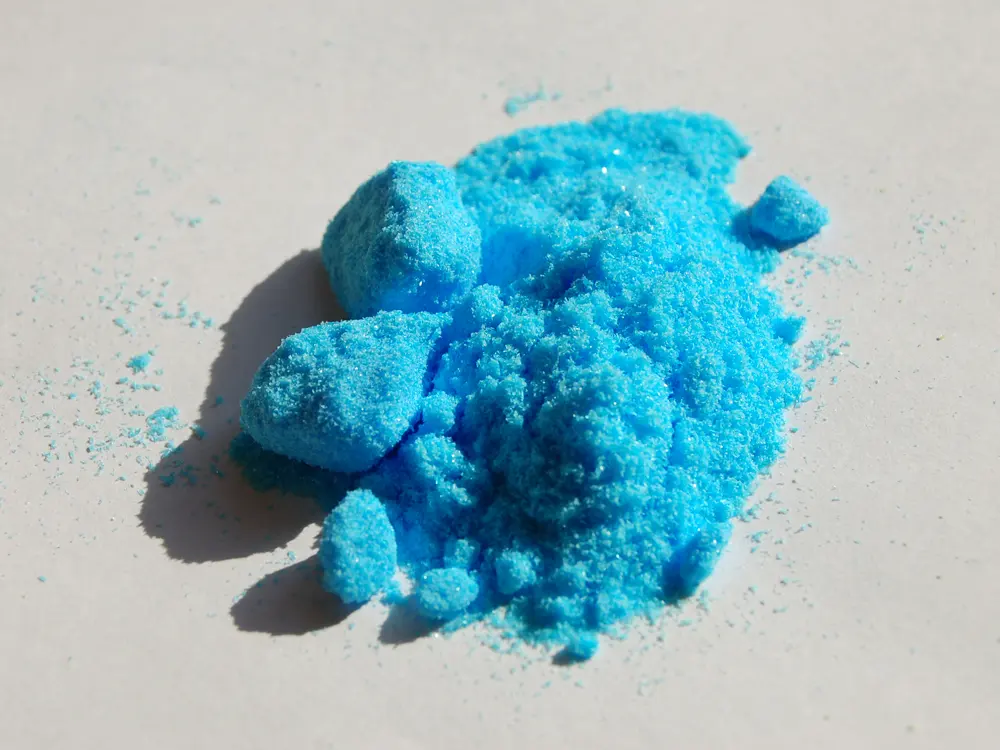
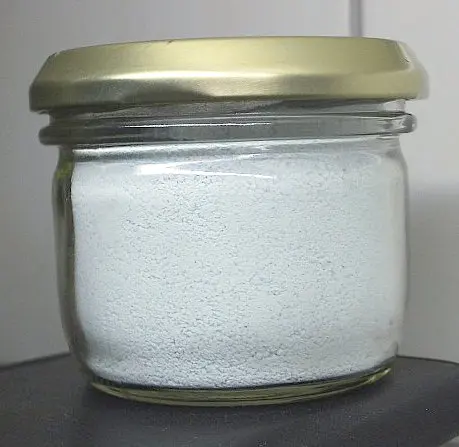
Other reversible reactions:
Irreversible reactions
An irreversible reaction is one that goes in one direction only: the reactants turn into products, and the products don’t react to give back the reactants under those conditions. It goes on until at least one reactant is used up. For example:
In the third, white silver chloride falls out of the solution as a precipitate (the ↓); in the last, magnesium burns with a dazzling white flame. Burning is the everyday example: no one has ever turned the smoke and ash of a burnt piece of paper back into paper.
Strictly, every reaction can go backwards a little: “irreversible” means that the backward reaction is so slight that it can’t be measured, or that a product escapes (as a gas from an open vessel, or as a precipitate) and so can’t react back. Most processes in nature, like burning, rusting and the rotting of leaves, are irreversible in practice.
Which of these reactions is irreversible?
Pick an answer to see why.
8.2 Chemical equilibrium
Now take a reversible reaction between two gases, A₂ and B₂, which make AB in a closed vessel (made-up gases: a model, to show what any such reaction does):
At the start there is no AB at all (Figure 8.4, A). Only the forward reaction can happen, and it is fastest now, because the reactants are at their highest concentration. As AB is formed, the A₂ and B₂ are used up, so the forward reaction slows down; and now that there is some AB, its molecules sometimes collide and split back into A₂ and B₂, so the backward reaction starts and speeds up (B). Soon the two rates become equal (C). From then on, every second, as many AB molecules are made as are split. The amounts of A₂, B₂ and AB stop changing: the mixture has reached chemical equilibrium.
Chemical equilibrium is the state of a reversible reaction in which the rate of the forward reaction equals the rate of the backward reaction, so that the concentrations of the reactants and products stay constant. For hydrogen and iodine,
at equilibrium hydrogen iodide is formed exactly as fast as it splits up.
Because both reactions keep going at equilibrium, it is called a dynamic equilibrium (dynamic: moving). A book lying on a table is in static equilibrium: nothing moves at all. A chemical equilibrium only looks static, like a crowd in a temple courtyard on a festival day: if as many people walk in through the gate each minute as walk out, the crowd stays the same size, though nobody in it stands still.
Characteristics of chemical equilibrium
- a.It is reached only in a closed system, where nothing can get in or out. If a product escapes (a gas from an open vessel), the backward reaction can’t happen, and there is no equilibrium.
- b.It is dynamic: the forward and backward reactions go on all the time.
- c.The rates of the forward and backward reactions are equal.
- d.The concentrations of the reactants and products stay constant, and so do the color, pressure and density of the mixture, at a given temperature.
- e.It can be reached from either side: start with hydrogen and iodine, or with hydrogen iodide alone, and the same mixture is reached at the same temperature.
- f.A catalyst doesn’t change it: it only makes the equilibrium reached sooner (Section 8.5).
A reversible reaction has reached equilibrium in a closed flask. Which statement is true?
Pick an answer to see why.
8.3 Equilibrium in physical processes
Equilibrium is not only for chemical reactions. When a substance changes its state, or phase (solid, liquid, gas), or dissolves, and the change is reversible in a closed system, the two opposite processes reach equal rates too. That is a physical equilibrium: nothing new is made, and the substance’s chemical composition stays the same on both sides. There are five kinds.
a. Solid–liquid equilibrium
Put ice and water together in a thermos flask at 0 °C (273 K) and normal air pressure. The flask lets almost no heat in or out, and the amounts of ice and water stay the same for hours. Yet at the surface of the ice, molecules keep breaking free into the water, and water molecules keep sticking onto the ice: melting and freezing go on at the same rate.
Solid–liquid equilibrium is the equilibrium between the solid and liquid states of a substance at its melting point (freezing point), where melting and freezing go on at equal rates. At 1 atm, ice and water can stay together only at 0 °C: a little warmer and all the ice melts, a little colder and all the water freezes. That is why a glass of ice water is always at 0 °C, and why melting ice is used to mark 0 on a thermometer.
b. Liquid–vapor equilibrium
Put some water in a vessel and close it. The water level drops a little at first, as water evaporates. But the vapor molecules above it keep hitting the surface and some stick, turning back into liquid. The more vapor there is, the faster it condenses, until condensation is as fast as evaporation. From then on the water level and the amount of vapor stay constant.
Liquid–vapor equilibrium is the equilibrium between a liquid and its vapor in a closed vessel, where evaporation and condensation go on at equal rates. It is reached at any temperature, not only at the boiling point: the warmer the liquid, the more vapor there is at equilibrium.
c. Solid–vapor equilibrium
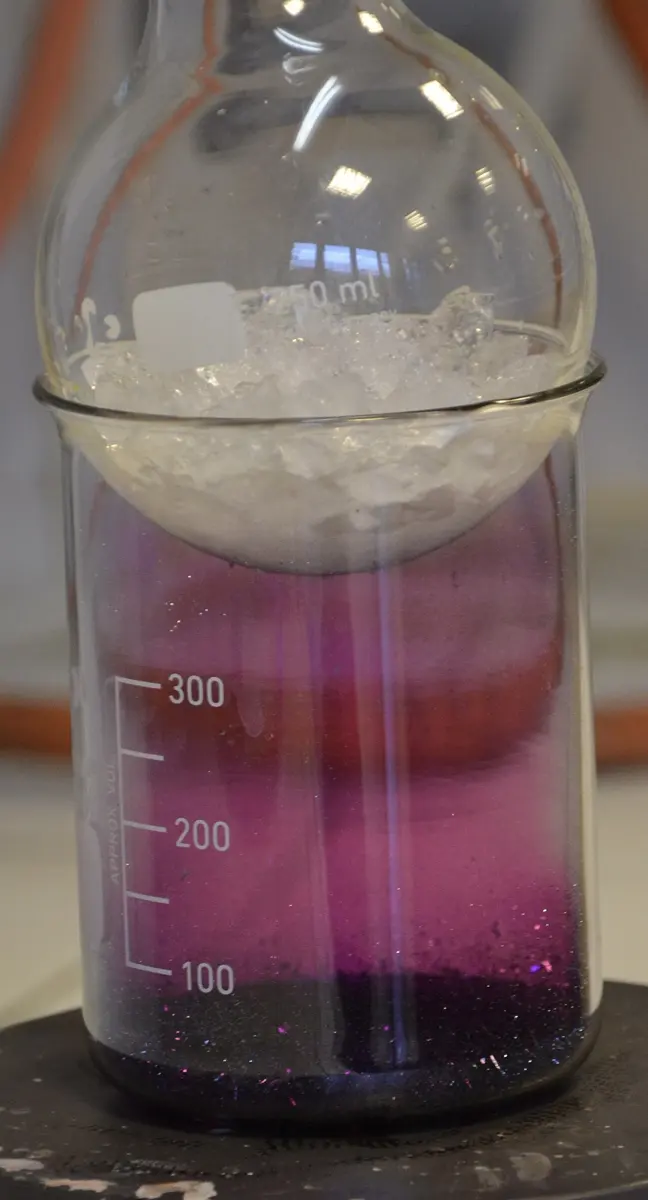
Some solids turn straight into vapor when warmed, without melting first: sublimation. Iodine is one. Put a few crystals of iodine in a closed flask and warm it gently, and the flask fills with violet vapor. After a while the color stops getting deeper: as many iodine molecules leave the crystals each second as land back on the cold glass and the crystals as solid (deposition).
Solid–vapor equilibrium is the equilibrium between a solid and its vapor in a closed vessel, where sublimation and deposition go on at equal rates. Camphor (कपूर) and naphthalene balls do the same, which is why a closed cupboard with naphthalene in it smells of it.
d. Solid–solution equilibrium
Stir sugar into a glass of water, a spoon at a time. At first each spoonful dissolves. Then a spoonful stays at the bottom however long you stir: the solution is saturated, holding as much sugar as it can at that temperature. Sugar molecules still leave the crystals, but just as many come out of the solution and join the crystals.
Solid–solution equilibrium is the equilibrium between undissolved solute and its saturated solution at a given temperature, where dissolving and crystallizing (deposition) go on at equal rates.
e. Gas–solution equilibrium
Soda water and other fizzy drinks are made by forcing carbon dioxide into the drink under pressure and sealing the bottle. Inside it, CO₂ molecules keep escaping from the drink into the gas above it and dissolving back, at equal rates.
Gas–solution equilibrium is the equilibrium between a gas and its solution in a liquid in a closed vessel, where dissolving and escaping go on at equal rates. The amount of gas that dissolves rises with the pressure of the gas above the liquid (Henry’s law). When you open the bottle, the CO₂ escapes into the air and the pressure above the drink falls to that of the air; the drink now holds far more CO₂ than the new balance allows, so the extra comes out as bubbles, with a hiss.
A sealed jar contains some water and air at 25 °C. Which statement about it is true once equilibrium is reached?
Pick an answer to see why.
8.4 Law of mass action
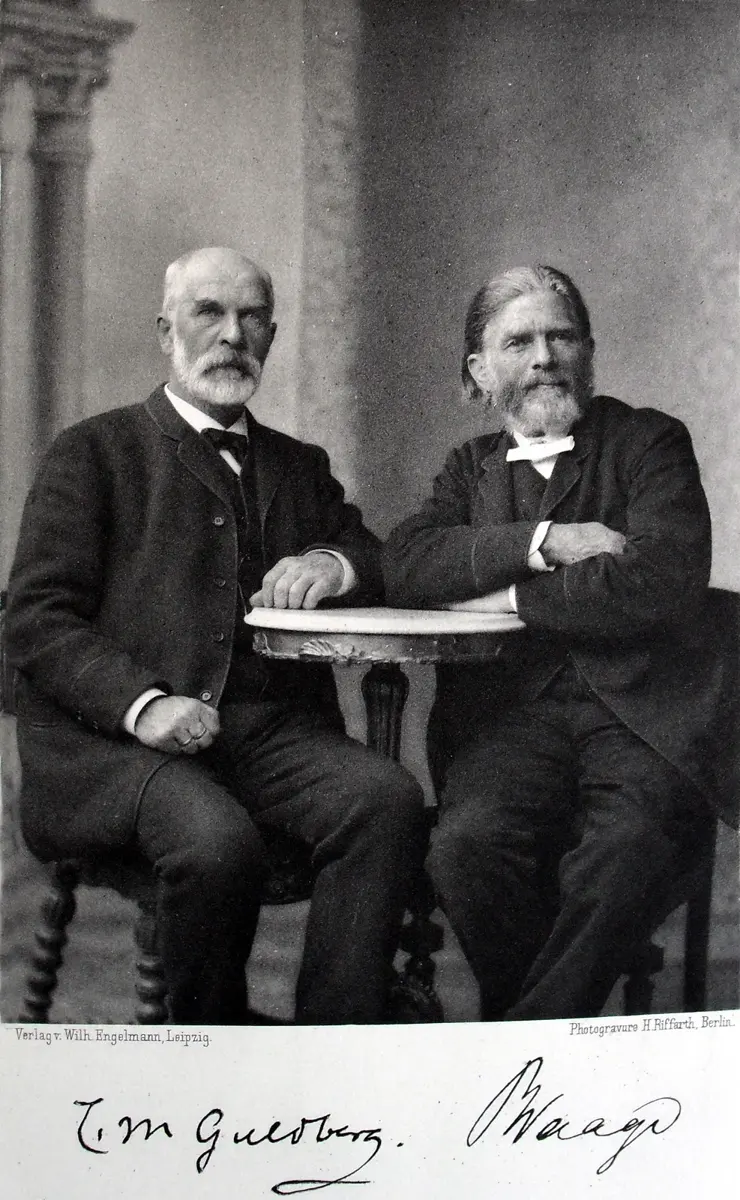
Think of a busy road: the more vehicles there are on it, the more often two of them bump. Molecules are the same. For hydrogen and sulphur reacting to make hydrogen sulphide, , crowd more hydrogen into the same space and its molecules meet sulphur more often, so the forward reaction goes faster. The rate of a reaction rises with the concentrations of the reacting substances. Guldberg and Waage put that into numbers.
The law
For a reaction
the law of mass action gives the rate as
where is the rate of the reaction, [A] and [B] are the molar concentrations of A and B (in mol/L; square brackets always mean a concentration in mol/L), and are their coefficients in the balanced equation (the stoichiometric coefficients), and is a constant, the rate constant (or velocity constant), which depends on the reaction and the temperature.
Law of mass action: the rate of a chemical reaction is directly proportional to the product of the molar concentrations (active masses) of the reactants, each raised to the power of its coefficient in the balanced equation.
The equilibrium constant in terms of concentration,
Take a reversible reaction at equilibrium:
- By the law of mass action, the rate of the forward reaction is , so
2. and the rate of the backward reaction is , so
where and are the rate constants of the forward and backward reactions.
3. At equilibrium the two rates are equal, :
4. Put both constants on one side:
5. and are constants, so their ratio is a constant too. Call it :
is the equilibrium constant; the subscript c means it is written with concentrations. In words: at equilibrium, the product of the concentrations of the products, each raised to the power of its coefficient, divided by the product of the concentrations of the reactants, each raised to the power of its coefficient, is a constant at a given temperature. The concentrations in it are those at equilibrium, not those you started with.
Pure solids and pure liquids have an active mass of 1, so they don’t appear in the expression. For ,
The unit of is (mol/L) raised to the power Δn, where Δn = (moles of products) − (moles of reactants) in the expression. For , Δn = 2 − 4 = −2, so is in (mol/L)⁻², that is, L² mol⁻². When Δn = 0, as for hydrogen iodide, has no unit.
The equilibrium constant in terms of partial pressure,
For a reaction of gases it is often easier to measure pressures than concentrations. In a mixture of gases, each gas pushes on the walls as if it were there alone: that push is its partial pressure . From the ideal gas equation,
where is the partial pressure of the gas, the volume (in L), the number of moles of the gas, the temperature (in K) and the universal gas constant. But is the number of moles per liter, the molar concentration , so
At a fixed temperature and are constant, so : a gas’s partial pressure is proportional to its concentration. So for
the concentrations in (iii) can be replaced by partial pressures, which gives another constant:
where , , and are the partial pressures of A, B, C and D at equilibrium. Only gases appear in ; solids, liquids and dissolved substances are left out. Its unit is (pressure unit)^Δn, for example atm⁻² for ammonia.
Relation between and
For the reaction of gases , at equilibrium,
- From the ideal gas equation, as above, each gas’s partial pressure is (iii), so
2. Put these into (ii):
3. Gather the factors together:
4. The first fraction is , by (i), and :
5. So
where Δn = (moles of gaseous products) − (moles of gaseous reactants) in the balanced equation.
With pressures in atm and concentrations in mol/L, = 0.0821 L atm/(mol K).
For example, for , Δn = 2 − (1 + 3) = −2, so
and . So there are three cases:
| Δn | Relation | Example |
|---|---|---|
| Δn = 0 | : 2 − 2 = 0 | |
| Δn > 0 | : 2 − 1 = +1 | |
| Δn < 0 | : 2 − 3 = −1 |
(“Greater” and “less” here compare the numbers, with = 0.0821: is greater than 1 at every temperature above about 12 K, so is greater than 1 when Δn is positive, and less than 1 when it is negative.)
For , which is true?
Pick an answer to see why.
Characteristics of the equilibrium constant
- a.Its value is found by experiment, and it depends on the temperature. Every reaction has its own K at each temperature (K for ammonia is about 3.6 × 10⁸ L² mol⁻² at 25 °C but only 6.0 × 10⁻² at 500 °C). Temperature is the only condition that changes it.
- b.It doesn’t depend on the starting concentrations of the reactants or products: whatever you start with, the equilibrium concentrations adjust to give the same K (the widget above).
- c.A catalyst doesn’t change it: a catalyst speeds up the forward and backward reactions by the same factor, so stays the same.
- d.The equilibrium constant of the backward reaction is the reciprocal of that of the forward reaction: for , at 425 °C.
- e.Its value depends on how the equation is written: multiply the equation by 2 and K is squared; halve it, and K becomes its square root. So always give the equation with the K.
- f.It measures how far the reaction goes before it stops, not how fast it goes (below).
Importance of the equilibrium constant
The size of K tells you whether there is more product or more reactant at equilibrium:
- K ≫ 1 (say 10³ or more): the equilibrium mixture is mostly products; the reaction goes almost to completion, and the equilibrium is said to lie to the right. For , K is about 10³³ at 25 °C.
- K ≪ 1 (say 10⁻³ or less): the mixture is mostly reactants; the forward reaction hardly happens, and the equilibrium lies to the left. For , K is about 4 × 10⁻³¹ at 25 °C: the nitrogen and oxygen of the air don’t react, luckily for us.
- K near 1: a mixture with substantial amounts of both.
At 25 °C, K for is about 10⁵⁷. What does that tell you?
Pick an answer to see why.
8.5 Le Chatelier’s principle
A beaker of water stands in a closed room. At equilibrium the water evaporates and the vapor above it condenses back at the same rate. Now switch on a fan beside it: the moving air carries the vapor away, the balance is upset, and evaporation speeds ahead of condensation to make up for the vapor taken away. That is a disturbed equilibrium, adjusting.
Disturbing an equilibrium means changing a condition so that the rate of the forward reaction or of the backward reaction changes, and the two are no longer equal. There are three main ways:
- a.by changing the concentration of a reactant or product;
- b.by changing the temperature;
- c.by changing the pressure (for reactions of gases).
The reaction then runs faster one way than the other until a new equilibrium is reached. Which way it goes was first stated in general by the French chemist Henry Le Chatelier.
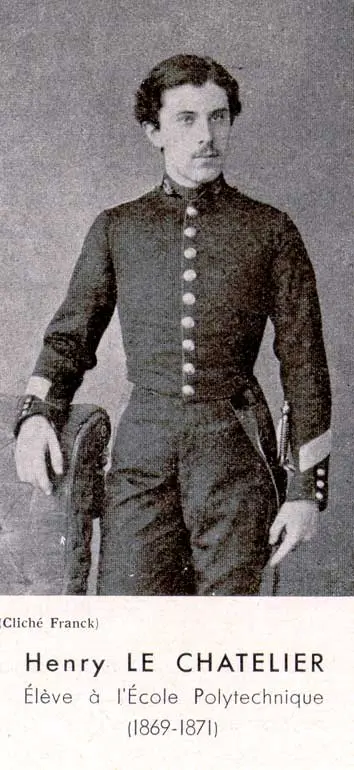
Le Chatelier’s principle: when a system at equilibrium is subjected to a change in concentration, temperature or pressure, the equilibrium shifts in the direction that tends to undo (minimize) the effect of the change.
The equilibrium can never undo the change completely; it only partly cancels it, and settles at a new equilibrium.
a. Effect of a change in concentration
A man in a leaky boat on Phewa Lake bails water out as fast as it comes in. If more water starts coming in, he bails faster. An equilibrium does the same: add a reactant, and the reaction uses some of it up by making more product; add a product, and the reaction uses some of it up by making more reactant.
For :
Removing a substance has the opposite effect: remove a product, and the equilibrium shifts right to make more of it (that is how lime kilns and ammonia plants get more product); remove a reactant, and it shifts left. In short:
- increasing the concentration of a reactant (or removing a product) shifts the equilibrium to the right, favoring the products;
- increasing the concentration of a product (or removing a reactant) shifts it to the left, favoring the reactants.
The value of K doesn’t change: the concentrations rearrange themselves until their ratio is K again.
b. Effect of a change in temperature
Heat behaves like a reactant or a product. In an exothermic reaction heat is given out, so it is written on the right, as a product; in an endothermic reaction it is taken in, so it is written on the left, as a reactant. Then treat heat like any other substance:
- Raising the temperature (adding heat) shifts the equilibrium in the direction that takes in heat, the endothermic direction.
- Lowering the temperature shifts it in the direction that gives out heat, the exothermic direction.
For the exothermic making of ammonia,
For the endothermic splitting of dinitrogen tetroxide into nitrogen dioxide, cooling shifts the equilibrium left and heating shifts it right:
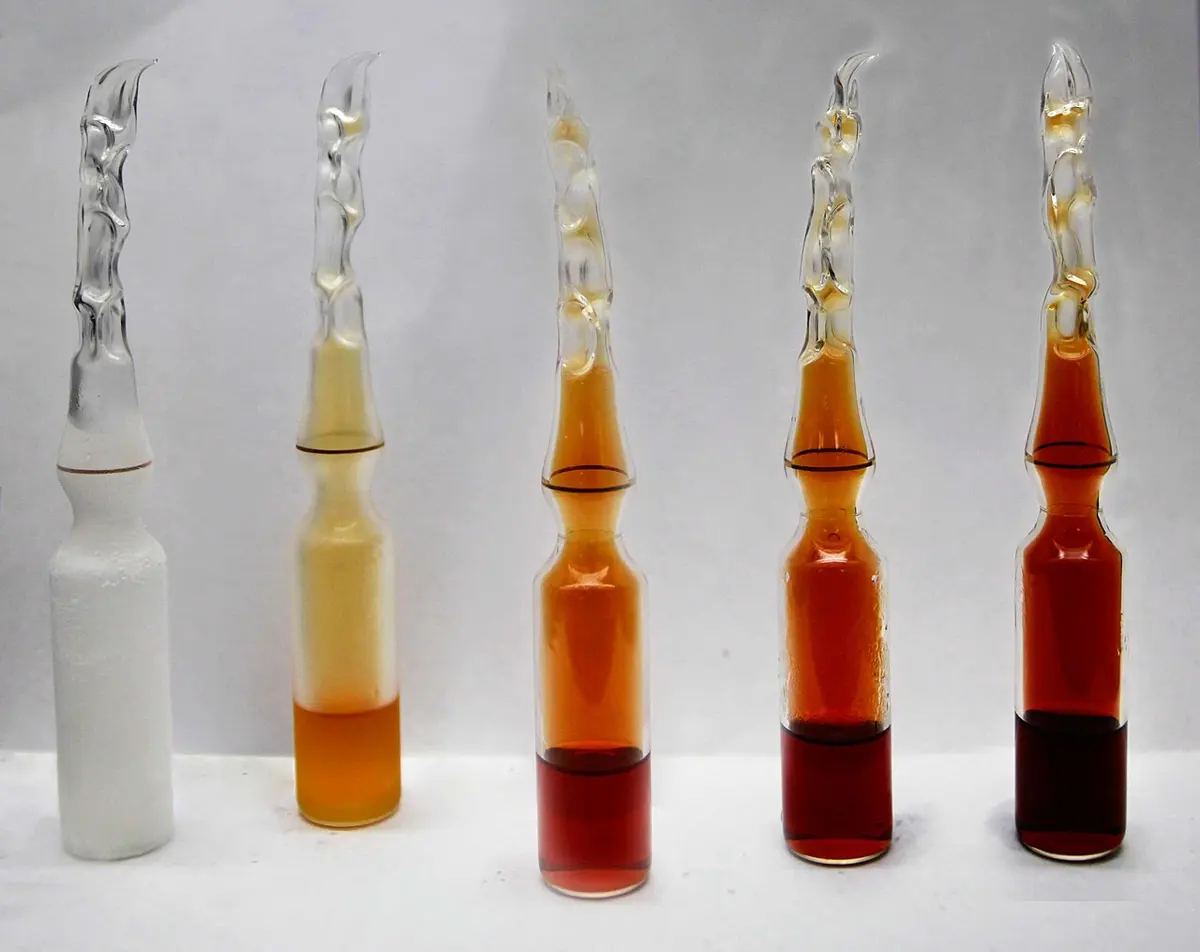
So Le Chatelier’s principle says: an increase in temperature favors the endothermic reaction, and a decrease in temperature favors the exothermic reaction.
Temperature is different from the other changes in one way: it changes the value of K itself. For an exothermic reaction, K gets smaller as the temperature rises; for an endothermic one, it gets larger.
c. Effect of a change in pressure
Squeeze a balloon and it changes shape so that its volume gets smaller and its pressure rises to match the push. A mixture of gases at equilibrium can do something cleverer: it can lower its own pressure by changing the number of gas molecules, because the pressure of a gas depends on how many molecules are hitting the walls.
- Increasing the pressure (by squeezing the mixture into a smaller volume) shifts the equilibrium towards the side with fewer moles of gas (smaller volume of gas), which lowers the pressure again.
- Decreasing the pressure shifts it towards the side with more moles of gas.
- If both sides have the same number of moles of gas (Δn = 0), a change of pressure has no effect on the position of equilibrium.
Changes of pressure have hardly any effect on solids and liquids, which are almost incompressible, so count only the gas molecules. For , with 1 mole of gas on the left and 2 on the right:
As with concentration, a change of pressure doesn’t change K: the partial pressures rearrange until their ratio is K again.
Adding a catalyst or an inert gas
An inert gas (one that doesn’t react, like argon, or nitrogen in a reaction that doesn’t use it) can be added in two ways:
- at constant volume: the total pressure rises, but each reacting gas still has the same amount in the same volume, so its concentration and partial pressure don’t change. No shift.
- at constant pressure: the vessel must get bigger, so the reacting gases are spread out and their partial pressures fall, as if the pressure had been lowered. The equilibrium shifts towards the side with more moles of gas (no shift if Δn = 0).
For , ΔH = −198 kJ, which change gives more SO₃ at equilibrium?
Pick an answer to see why.
Applications of Le Chatelier’s principle to physical equilibria
Look at Figure 8.22. Melting, evaporation and sublimation all take in heat (endothermic), so they increase as the temperature rises. Freezing, condensation and deposition all give out heat (exothermic), so they increase as the temperature falls.
a. Melting of ice
Ice takes in heat as it melts, so raising the temperature shifts the equilibrium right: more ice melts. And there is a pressure effect too. Ice is one of very few solids that is less dense than its liquid (that is why it floats): 1 g of ice takes up 1.09 mL, but 1 g of water only 1.00 mL. So squeezing ice and water shifts the equilibrium towards the liquid, the side with the smaller volume: pressure melts ice, and lowers its melting point a little (by about 0.0075 °C for every atmosphere).
b. Vaporization of water
Raising the temperature favors evaporation, so there is more vapor at equilibrium. Raising the pressure shifts the equilibrium towards the side of smaller volume, the liquid: more pressure means more water and less vapor, so the water must be hotter before it can boil.
Applications of Le Chatelier’s principle to chemical equilibria
a. Synthesis of ammonia by Haber’s process
1 volume of nitrogen and 3 volumes of hydrogen give 2 volumes of ammonia.
- Effect of temperature. The forward reaction is exothermic and the backward one endothermic. By Le Chatelier’s principle, lowering the temperature shifts the equilibrium to the right, the direction that gives out heat. So a low temperature favors ammonia.
- Effect of pressure. 4 volumes of gas (1 of N₂ and 3 of H₂) give 2 volumes of NH₃, so the reaction goes with a decrease in volume. Raising the pressure shifts the equilibrium to the right, where the volume is smaller. So a high pressure favors ammonia.
- Effect of concentration. Adding more nitrogen or hydrogen shifts the equilibrium to the right, and so does removing the ammonia. So high concentrations of N₂ and H₂ (and taking the ammonia away) favor ammonia.
In short, the yield of ammonia is greatest at low temperature, high pressure and high concentrations of N₂ and H₂.
But a factory needs ammonia fast, not only a lot of it at equilibrium. At low temperatures the reaction is far too slow, even with a catalyst, and very high pressures need costly, thick-walled steel plant and a great deal of energy to squeeze the gas. So real plants compromise: about 400–450 °C, about 200 atm, an iron catalyst, and the ammonia cooled to a liquid and drained off, with the unreacted gas sent round again. Each pass turns only about 15% of the gas into ammonia, but nothing is wasted.
b. Formation of nitric oxide
1 volume of nitrogen and 1 volume of oxygen give 2 volumes of nitric oxide.
- Effect of temperature. The forward reaction is endothermic and the backward one exothermic. Raising the temperature shifts the equilibrium to the right, taking in heat: a high temperature favors nitric oxide. (It is why car engines, which burn fuel in air at over 2000 °C, give out nitric oxide, a cause of smog.)
- Effect of pressure. 2 volumes of gas give 2 volumes of gas: Δn = 0, so pressure has no effect on this equilibrium.
- Effect of concentration. More nitrogen or oxygen shifts the equilibrium forward: high concentrations of N₂ and O₂ favor nitric oxide.
Exercise
A. Multiple choice questions
- For which of the following systems is the law of mass action used to write an equilibrium constant?
Pick an answer to see why.
- Which statement is not true of the equilibrium constant?
Pick an answer to see why.
- Which kind of reaction goes only in the forward direction?
Pick an answer to see why.
- What happens when a system reaches equilibrium?
Pick an answer to see why.
- For + heat, which conditions give the most ammonia at equilibrium?
Pick an answer to see why.
- Which is correct for the equilibrium ?
Pick an answer to see why.
- For the reaction , ΔH < 0, which conditions favor the product?
Pick an answer to see why.
- When pressure is applied to the equilibrium ice ⇌ water, what happens?
Pick an answer to see why.
- What is a system called when the rate of its forward reaction equals the rate of its backward reaction?
Pick an answer to see why.
- Which is the correct relation between and ?
Pick an answer to see why.
- Which of the following shows an equilibrium that strongly favors the products?
Pick an answer to see why.
- For , what is the unit of ?
Pick an answer to see why.
- Consider the equilibrium . What is the effect of decreasing the pressure on the position of equilibrium and on the value of ?
Pick an answer to see why.
B. Short answer questions
Define, with an example:
- a.reversible reaction
- b.irreversible reaction
- c.liquid–vapor equilibrium
- d.solid–liquid equilibrium
- e.gas–solution equilibrium
Answer
Give reasons:
- a.Soda water fizzes when the bottle is opened.
- b.The active mass of a solid is taken as one.
- c.A chemical equilibrium is a dynamic equilibrium.
- d.An increase in temperature shifts the equilibrium of an exothermic reaction backward.
- e.An increase in temperature shifts the equilibrium of an endothermic reaction forward.
Answer
The equilibrium constant of a reaction at equilibrium is
- a.Define equilibrium constant, and write any three of its characteristics.
- b.Write the chemical equation, and find the relation between and for this reaction.
Answer
Differentiate between:
- a.reversible and irreversible reactions
- b.static and dynamic equilibrium
- c.physical and chemical equilibrium
- d.solid–vapor and liquid–vapor equilibrium
Answer
What is a reversible reaction? Give an example of a reversible reaction of gases in which
- i.
- ii.
Answer
Derive the relation between and for an equilibrium reaction.
Answer
Give an example of:
- i.liquid–vapor equilibrium
- ii.solid–solution equilibrium
- iii.gas–solution equilibrium
- iv.solid–liquid equilibrium
- v.solid–vapor equilibrium
Answer
What is meant by the equilibrium state? “The equilibrium state is dynamic rather than static.” Justify the statement.
Answer
State the law of mass action. Derive an expression for the equilibrium constant in terms of molar concentration.
Answer
State the law of mass action. Derive an expression for the equilibrium constant in terms of partial pressure.
Answer
State and explain Le Chatelier’s principle, with one example.
Answer
What is the effect of pressure on melting ice? Justify your answer by Le Chatelier’s principle.
Answer
Define equilibrium constant. What does it tell you when
- i.
- ii.
Answer
State Le Chatelier’s principle. Use it to predict the conditions that favor the forward reaction in
Answer
C. Long answer questions
A physical equilibrium between solid and liquid is: ice ⇌ water, − heat (heat is taken in as ice melts).
- a.Why is this equilibrium called a physical equilibrium?
- b.Write the expression for its equilibrium constant.
- c.Name the process that goes to the right and the one that goes to the left.
- d.What happens to the forward process when the temperature is lowered? Why?
- e.What is this process used for?
Answer
The graph shows the rates of the forward and backward reactions of a reversible reaction against time.
- a.What is the difference between the rates of the forward and backward reactions at time zero? Give the reason.
- b.At what time do the two rates become equal?
- c.What happens to the rates at 25 minutes? Why?
Answer
Consider the reversible reaction − heat.
- a.Is the reaction exothermic or endothermic? Why?
- b.Write the equilibrium constant in terms of concentration and of pressure, and the relation between them.
- c.What is the effect of a change in temperature on this equilibrium?
- d.How can the amount of NO be increased by changing the pressure? Why?
Answer
+ heat
- a.How does the position of equilibrium shift in each case? Explain.
- i.An inert gas is added at constant volume.
- ii.A catalyst is added.
- iii.The pressure is increased.
- b.Write the expression for of the forward and backward reactions. How are they related?
Answer
- a.Write the equilibrium constant of each reaction in terms of concentration and of partial pressure, and the relation between them.
- i.
- ii.
- iii., all gases
- b.Which of these reactions gives more product at high pressure? Why?
Answer
One reaction for the burning of a hydrocarbon is
- a.Write the expressions for and , and the relation between them.
- b.Explain the effect on this equilibrium of increasing the concentration of the reactants, and of increasing the pressure.
- c.What is this reaction used for?
- d.What happens to the value of of the forward reaction when the pressure is decreased?
Answer
Nitrogen dioxide, a gas, forms dinitrogen tetroxide in an equilibrium.
- a.Write the balanced equation.
- b.Write the expressions for and .
- c.What is the relation between them?
- d.How does an increase in pressure affect the nitrogen dioxide at equilibrium?
Answer
The following equilibrium is set up at high temperatures:
How is the NO at equilibrium affected by each of these changes?
- a.increasing [N₂]
- b.decreasing [H₂]
- c.compressing the reaction mixture
- d.decreasing the volume of the reaction container
Answer
Printable PDFs
- Study notes 2 pages
- Worksheet 4 pages Answer key
- Harder practice questions 3 pages Answer key
Quiz yourself: Matter, Atoms and Reactions, Grades 5–12 →
Practice every question in the book, and keep track of the ones you miss →
A companion to your textbook, not a replacement for it: study from the book your school uses, and where the two differ, follow your teacher. Found a mistake? Please tell us.