
Dip a pencil into a glass of water and look at it from the side: it seems to snap at the water’s surface. Look at an air bubble rising in a fish tank: it shines like a little silver ball. Hold a hand lens over a page: the letters swell up. After a shower of rain in the evening, a rainbow stands over the hills.
Four different sights, one cause: light changes speed when it passes from one material into another, and that makes it change direction. This unit follows that one idea a long way: to optical fibers that carry the internet into Nepal, to the sparkle of a diamond, to the colors hidden in sunlight, to lenses, and finally to the most important lens you own, the one inside your eye, and what to do when it doesn’t focus.
Denser and rarer media
Light from the things you look at travels through air, water, glass and other transparent media (a medium is any material light travels through; media is the plural). Light doesn’t travel at the same speed in all of them.
| Medium | Speed of light (m/s) | Medium | Speed of light (m/s) |
|---|---|---|---|
| air | 3.00 × 10⁸ | kerosene oil | 2.08 × 10⁸ |
| water | 2.25 × 10⁸ | glass | 2.00 × 10⁸ |
| alcohol | 2.21 × 10⁸ | diamond | 1.24 × 10⁸ |
Light is fastest in air and slowest in diamond. Comparing any two media:
- the one in which light is slower is the optically denser medium;
- the one in which light is faster is the optically rarer medium.
So glass is denser than air, and air is rarer than glass. Water is denser than air but rarer than glass. “Denser” and “rarer” only mean something for a pair of media.
Light travels at 2.25 × 10⁸ m/s in water and 2.00 × 10⁸ m/s in glass. Which statement is right?
Pick an answer to see why.
Refraction of light
Activity 10.1: a beam of light into and out of water
Light travels at 3 × 10⁸ m/s in air and 2.25 × 10⁸ m/s in water. Going from air into water it slows down, and bends towards the normal. So water is the denser medium. Coming out of water into air it speeds up, and bends away from the normal: air is the rarer medium.
The bending of light, or the change in its direction, as it passes from one medium into another is called refraction of light. The cause of refraction is the change in the speed of light. The bigger the change in speed, the more the light bends. (Light going in straight along the normal, square to the surface, changes speed but doesn’t bend at all.)
Light isn’t the only wave that refracts. Sound and water waves bend in the same way when their speed changes, as you will see later in this unit.
Play with it: Refraction: shine a torch from air into water, glass or diamond, and back out, at any angle.
Activity 10.2: refraction through a glass slab
Here are the names for everything in Figure 10.2:
- Normal: an imaginary line square (at 90°) to the boundary between two media, at the point where the light meets it. NN′ and N₁N₁′ are normals.
- Incident ray: the ray AO arriving from the source of light.
- Angle of incidence (i): the angle ∠AON between the incident ray and the normal.
- Refracted ray: the ray OB, which bends at the boundary and travels on in the second medium.
- Angle of refraction (r): the angle ∠BON′ between the refracted ray and the normal.
- Emergent ray: the ray BC that comes out of the slab into the first medium again.
- Angle of emergence (e): the angle ∠CBN₁′ between the emergent ray and the normal N₁N₁′.
- Lateral shift: the perpendicular distance CD between the emergent ray and the incident ray produced (extended straight on, the dashed line).
At the face PQ, light goes from air (rarer) into glass (denser), so it bends towards the normal: r < i. At the face RS it goes from glass into air and bends away from the normal by exactly the same amount, because the two faces are parallel. So the light leaves going the same way it came, i = e, but shifted sideways by CD. The lateral shift is there because the light took a “detour” through the glass at a steeper angle.
If you change the angle of incidence, the angle of refraction changes with it: a bigger i gives a bigger r. The angle of refraction depends on two things: the angle of incidence, and the materials. The laws of refraction (next) tell you exactly what r will be.
Play with it: Refraction Through a Slab: change the slab’s thickness and material and watch the shift.
Light passes from air through a rectangular glass slab and back into air. Which is true?
Pick an answer to see why.
Laws of refraction of light
Activity 10.3: refraction through a semicircular glass slab
The light that leaves the semicircular slab travels along a radius of the curved face, so it meets that face square on and doesn’t bend there. That is why this shape is used: only the flat face bends the light, and you can measure r exactly.
The two laws
- When light passes from one medium into another, the incident ray, the normal and the refracted ray all lie in the same plane at the point of incidence. (On paper: the refracted ray is never bent up out of the paper, or down into it.)
- For a given pair of media, the ratio of the sine of the angle of incidence to the sine of the angle of refraction is constant. This constant is called the refractive index of the pair of media, written μ (the Greek letter “mu”; some books use n):
The second law is called Snell’s law, after the Dutch mathematician Willebrord Snellius.
For light going from air (or a vacuum) into a medium, this constant is equal to the ratio of the speed of light in air, c, to its speed in the medium, v:
This is the refractive index of the medium (strictly, “with respect to air”). Because it is one speed divided by another, it has no unit.
| Medium | Refractive index | Speed of light (m/s) | Medium | Refractive index | Speed of light (m/s) |
|---|---|---|---|---|---|
| water | 1.33 | 2.25 × 10⁸ | glycerine | 1.47 | 2.04 × 10⁸ |
| alcohol | 1.36 | 2.21 × 10⁸ | glass | 1.50 | 2.00 × 10⁸ |
| kerosene oil | 1.44 | 2.08 × 10⁸ | diamond | 2.42 | 1.24 × 10⁸ |
As the refractive index goes up, the speed of light goes down. A medium with a higher refractive index is optically denser, and bends light more. (Air’s refractive index is 1.0003, which we take as 1.) The refractive index is only “constant” for one color of light: violet light is bent a little more than red, as you will see under dispersion. The values in tables are for yellow light.

Worked examples
Light goes from air into four materials at the same angle of incidence. In which does it bend the most?
Pick an answer to see why.
Consequences of refraction of light
Activity 10.4: the coin that comes back
Light from the coin O passes from water (denser) into air (rarer), so it bends away from the normal at the surface. Your brain assumes light always travels in straight lines, so it traces the light straight back and “sees” the coin at I, higher up, where the light seems to come from. The coin is seen because of refraction at the water’s surface.
Refraction from water to air, every day
A pencil dipped into water at a slant looks bent at the surface, and its tip looks closer to the surface than it is. A swimming pool, a tank or a river looks shallower than it really is. All of these are the coin again.
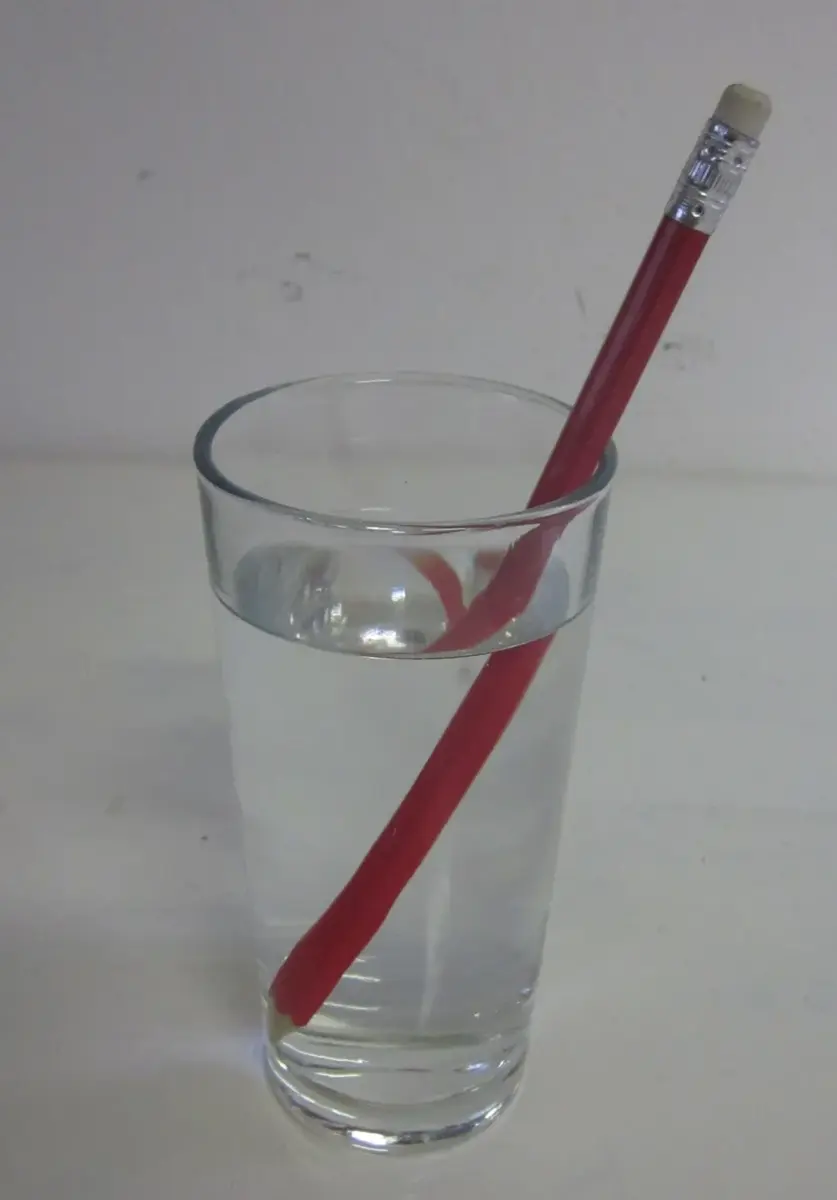
The depth an object seems to be at is its apparent depth; its true depth is its real depth. Looking straight down into the water,
Refraction in the atmosphere
The air around the Earth isn’t the same all the way up. Near the ground it is denser; higher up it thins out. So light coming in from space passes through layer after layer of air with a slowly changing refractive index, and bends a little at every layer.
Twinkling stars. The layers of air are never still: warm and cool pockets of air keep moving about. So the light from a star is bent now a little this way, now a little that way. A star is so far away that it is just a point of light, and this wobbling makes its brightness and position flicker: it twinkles. Planets are much closer and look like tiny discs, not points. Each point of the disc twinkles on its own, but they average out, so planets shine steadily. If you see a bright “star” that doesn’t twinkle, it is probably Venus, Jupiter or Mars.
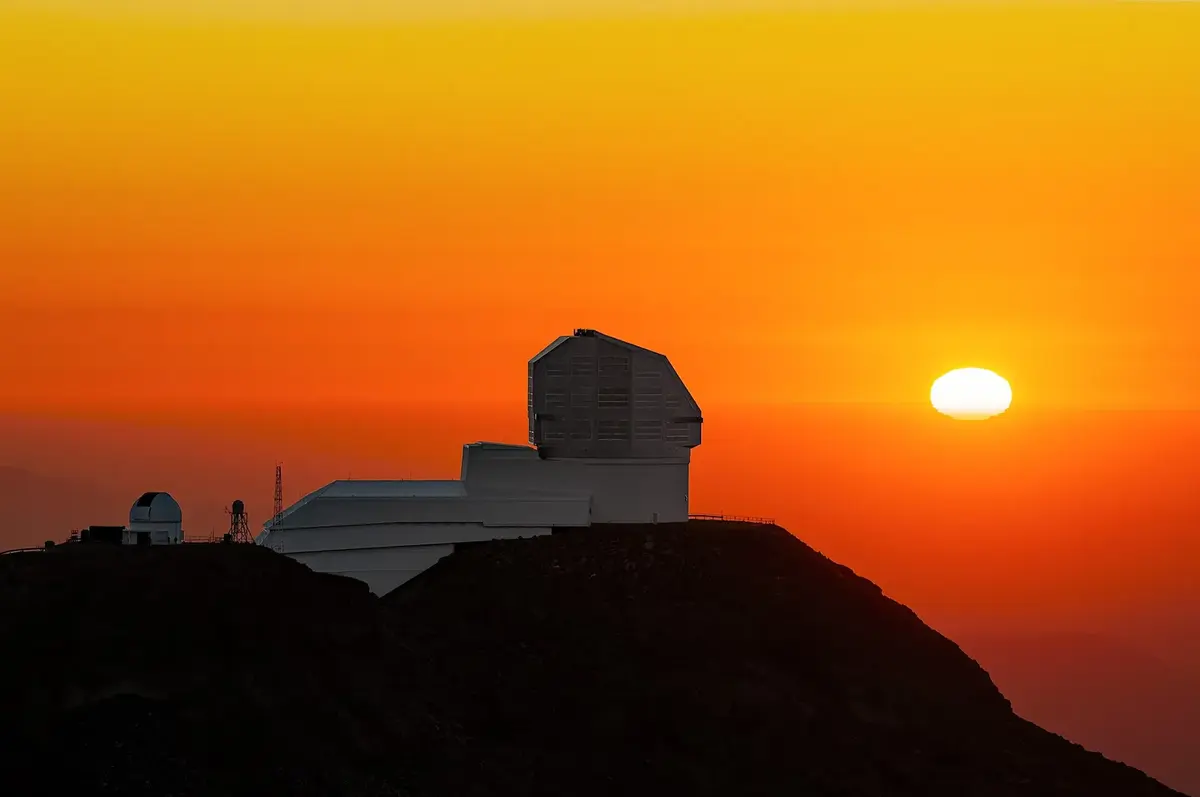
The early sunrise. Light from the Sun, still below the horizon, comes into the atmosphere from rarer to denser air and bends towards the normal, down round the curve of the Earth, just as the coin’s light bent up over the rim of the cup. So the Sun can be seen about 2 minutes before it actually rises, and about 2 minutes after it has actually set. Every day in Nepal is about 4 minutes longer than it would be without air.
Why do planets shine steadily while stars twinkle?
Pick an answer to see why.
Total internal reflection of light
When light goes from water into air, it bends away from the normal, so the angle of refraction is bigger than the angle of incidence: r > i. As you make i bigger, r gets bigger too, and faster. What is the biggest r can be?
Look at a coin in a glass of water from lower and lower down, and at one moment you see it along the water surface itself: the light from it is skimming out along the surface, at 90° to the normal. 90° is the biggest possible angle of refraction. The angle of incidence in the water at that moment has a name: the critical angle.
Activity 10.5: finding the critical angle
The critical angle is the angle of incidence in the denser medium for which the angle of refraction in the rarer medium is 90°. Its value depends on the two media. Against air:
| Medium | Critical angle | Medium | Critical angle |
|---|---|---|---|
| water | 49° | glycerine | 43° |
| alcohol | 47° | glass | 42° |
| kerosene oil | 44° | diamond | 24° |
The higher the refractive index, the smaller the critical angle. In fact you can work it out from Snell’s law: going out into air at r = 90° (sin 90° = 1), the critical angle c obeys
Total internal reflection
If the angle of incidence is bigger than the critical angle, the light can’t get out at all. It is reflected back into the same medium, obeying the laws of reflection. This is total internal reflection: internal because the light stays inside the denser medium, and total because all of it is reflected. Normally, when light meets a boundary, part of it is reflected and the rest refracted. Here nothing gets through, which makes it a better mirror than any silvered mirror.
Two conditions are needed:
- The light must be traveling from a denser medium into a rarer medium.
- The angle of incidence must be greater than the critical angle.
Activity 10.6: trapping light
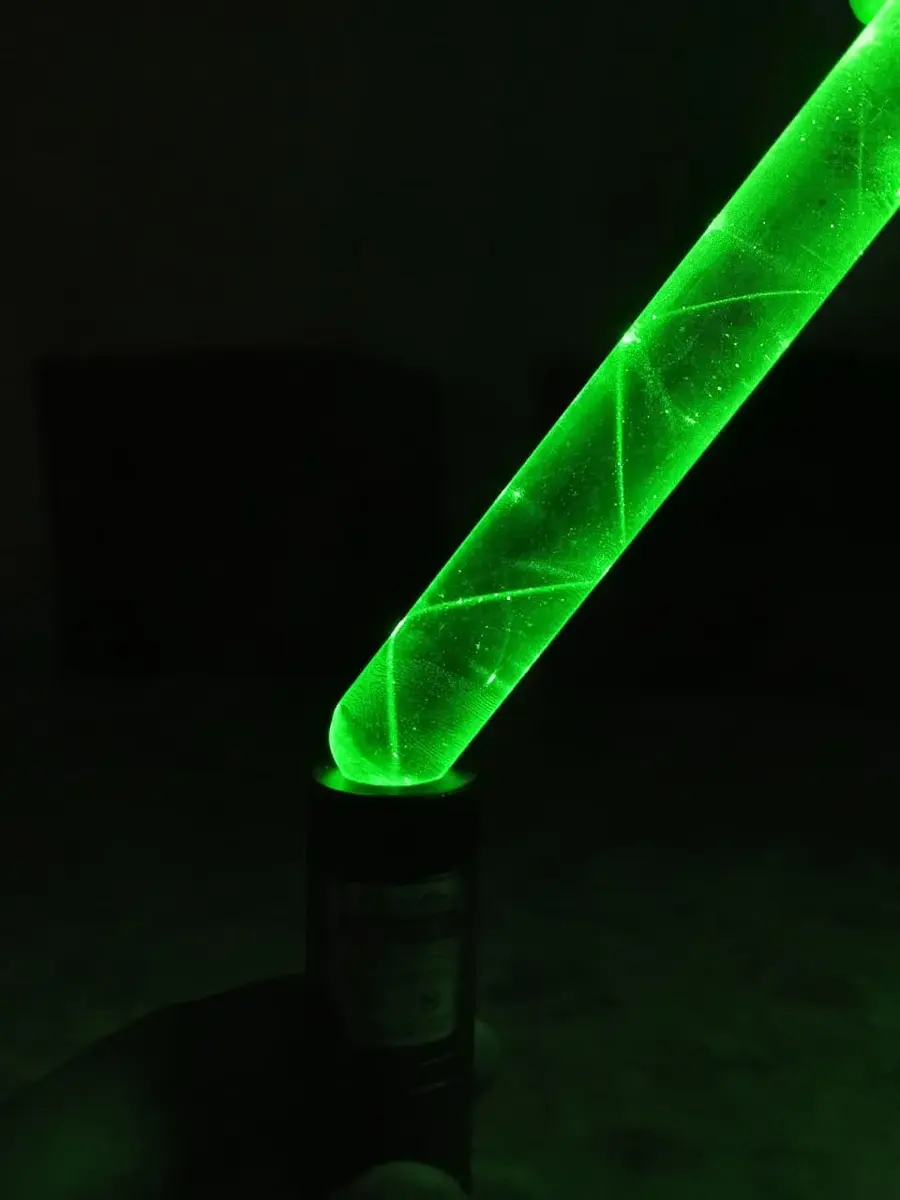
The same trick works on the light from a torch shone into a bent glass rod. At Science Playground you can try it on the Total Internal Reflection exhibit.
Total internal reflection in prisms
A prism is a solid with two triangular faces and three rectangular faces. An equilateral prism has triangles with three equal angles of 60°; a right-angled isosceles prism has angles of 90°, 45° and 45°.
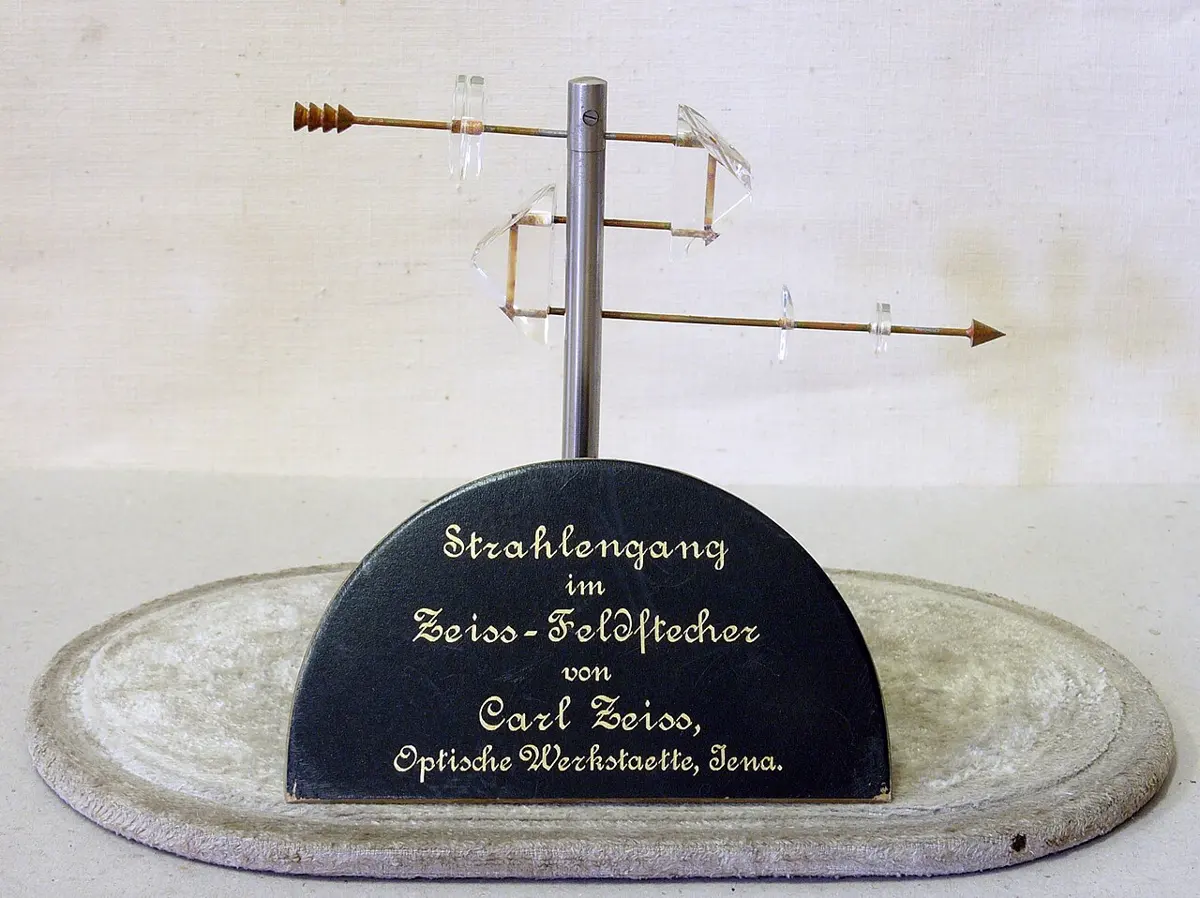
In Figure 10.12a, the ray enters one face of an equilateral prism square on, so it doesn’t bend. Inside, it meets the base at 60°. That is more than glass’s critical angle of 42°, so it is totally reflected, and leaves through the third face, again square on. In the right-angled prisms, the light meets a face at 45°, also more than 42°: so a right-angled prism turns light through 90° (once) or 180° (twice). That is why prisms, not mirrors, are used in periscopes, binoculars and single-lens reflex (SLR) cameras. In each half of a pair of binoculars, light is turned round twice by each of two prisms (Figure 10.12c): this folds a long telescope into a short case and turns its upside-down image the right way up. Total internal reflection loses no light, while even a good mirror absorbs a few per cent, and a mirror’s silver back slowly tarnishes; a glass mirror also makes a faint second image from its front surface.
Tree: W. Heubach (d. 1923) in O. Schmeil, Lehrbuch der Botanik (1911), No restrictions, via Wikimedia Commons
Light inside glass (critical angle 42°) meets the glass–air surface at 30°. What happens?
Pick an answer to see why.
Which of these can never give total internal reflection?
Pick an answer to see why.
Where total internal reflection shows up
The sparkle of a diamond
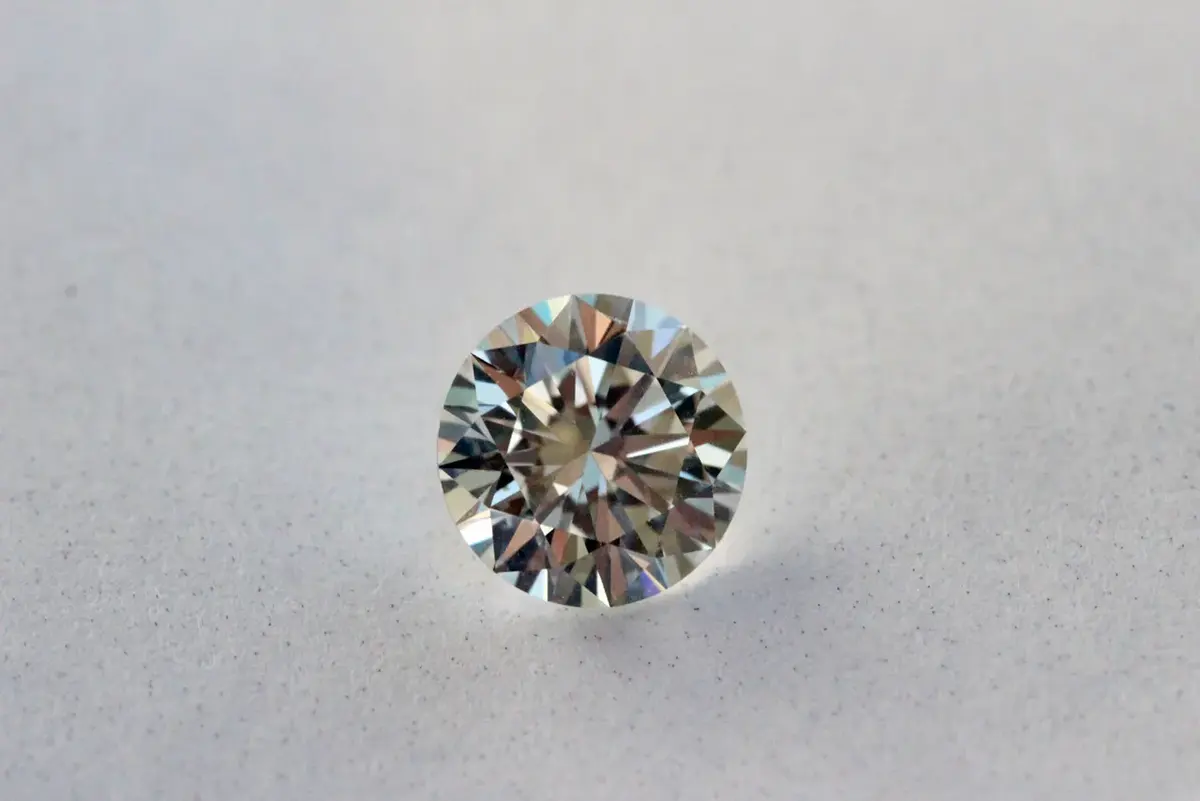
Diamond has a very high refractive index (2.42), so its critical angle is very small: only 24°. Light that gets into a diamond meets its faces inside at more than 24° almost every time, so it is totally reflected again and again. Diamond cutters shape a diamond with many faces (a “brilliant cut” has 57 or 58) at angles chosen so that light entering the top is reflected round inside and comes back out of the top, towards your eyes. That is why a diamond sparkles. A piece of glass cut to the same shape doesn’t: its critical angle is 42°, so much of the light meets the back faces at less than 42° and passes straight out of the back.
Shining surfaces
An air bubble in water shines like silver, and so does an empty test tube dipped at a slant into a beaker of water. Light in the water meets the surface of the air bubble, or the glass wall with air behind it, at more than the critical angle and is totally reflected. Seen from outside, the surface looks like a mirror.
Mirage
On a hot sunny day, look along a long straight road, such as the East-West Highway across the Terai in Jestha: far ahead, the road seems to be covered with a pool of water, with the trees and vehicles reflected upside down in it. When you get there, the road is dry. This illusion is a mirage.
Tree: W. Heubach (d. 1923) in O. Schmeil, Lehrbuch der Botanik (1911), No restrictions, via Wikimedia Commons
The hot road heats the air just above it, so the air is hottest (and rarest) near the road and gets cooler (and denser) higher up. Light from the top of a tree heading down towards the road passes from cooler, denser layers into hotter, rarer ones, and bends a little more away from the normal at each one. Finally, close to the road, its angle of incidence becomes greater than the critical angle for that layer: it is totally reflected and starts traveling upwards, into the eye of the observer. The eye sees an inverted image of the tree, apparently below the road, just like a reflection in a pool. Because the hot air near the road keeps moving, the image shimmers like the surface of water.

A question to consider: sound bends too
Sound travels faster in warm air than in cool air (about 331 m/s at 0 °C, and 0.6 m/s faster for every degree warmer). So sound refracts as it passes between warm and cool layers of air, just as light does.
By day, the air near the ground is warm and the air higher up is cooler. Sound going up passes into slower air, bends towards the normal, and so curves upwards, away from the ground: a listener some distance away can hardly hear it. At night the ground cools quickly, and the air just above it becomes cooler than the air higher up. Now sound going up passes into faster air, bends away from the normal, and at some layer is totally reflected back down. So at night a listener far from the source hears it clearly.
Which of these does NOT depend on total internal reflection?
Pick an answer to see why.
Optical fibers
Activity 10.7: inside an internet cable
If your home has “fiber internet”, the provider has brought a cable up to the house. At its end, the outer cover is removed to expose a thin fiber, and a connector joins it to the router. Inside that cable, information travels as flashes of light through a thread of glass. Sending light through a thin, clear medium like glass is called fiber optics, and the thread is an optical fiber.
The fiber has a core of very pure, transparent glass, wrapped in a cladding made of glass with a slightly lower refractive index than the core. That makes the core the denser medium, so light inside it that meets the cladding at more than the critical angle is totally reflected. Light is sent into the fiber at a small slant, so that it always meets the cladding at more than the critical angle. It bounces along by total internal reflection, whether the fiber is straight or bent, and comes out at the far end. A plastic coating outside protects the fiber. A cable holds many fibers in a bundle.
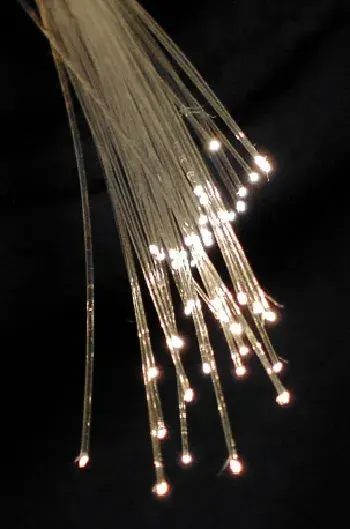
Optical fibers were first used in medicine, to see inside the body. Today they also light up decorations and lamps, but their biggest use is in communication.
In telecommunication
Telephone calls, television and internet data are turned into flashes of light and sent along optical fibers by total internal reflection. Compared with copper wires, fibers carry far more information, far faster, over far longer distances, without electrical interference and without being easy to tap. One fiber can carry thousands of telephone calls at once. A home connection of 1 gigabit per second (1 Gbps; internet speeds are measured in bits, not bytes) is easy for a fiber; the fibers under the oceans each carry many terabits (millions of megabits) per second. That is what lets you watch high-definition videos and upload and download big files.
In Nepal, optical fiber cables have been laid along the East-West Highway, the Mid-Hill (Pushpalal) Highway and many other roads, and connect to the rest of the world through India and, since 2018, also through China (via Rasuwagadhi). Fiber cables are buried in the ground, hung on poles, and laid across the bottom of the oceans, joining the whole world into one network. Nepal has no coast, so its internet reaches the undersea cables through its neighbors.
In medicine: endoscopy and keyhole surgery
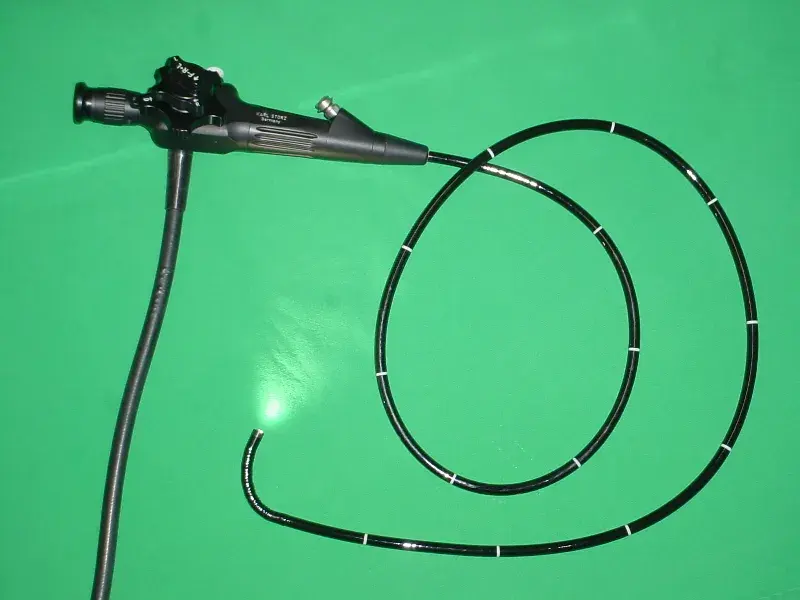
Endoscopy is a way of looking inside the body without surgery. An endoscope is a long, thin, flexible tube containing optical fibers and a camera. To look for an ulcer in the stomach, for example, a doctor passes it through the patient’s mouth, down the esophagus (food pipe) into the stomach and the small intestine.
An endoscope has two bundles of fibers side by side. One carries light into the body to light up the organ; the other carries the light reflected from the organ back to a camera or eyepiece, so the doctor sees the inside of the body on a screen. (In the bundle that carries the picture, the fibers keep their order from one end to the other, so each fiber carries one dot of the picture.) A colonoscopy uses the same kind of instrument passed through the rectum to examine the colon (large intestine).
Keyhole surgery, or laparoscopic surgery, is an operation done through small cuts in the skin. A laparoscope, with fibers and a camera, goes in through one small cut to light up and show the organs on a monitor, and the surgeon works with thin instruments through other small cuts. It is used to remove diseased organs such as the gall bladder or appendix, to take small pieces of tissue for testing (biopsy), and to remove gallstones and kidney stones. Patients recover much faster than after a big open operation.
Why is the cladding of an optical fiber made of glass with a lower refractive index than the core?
Pick an answer to see why.
Dispersion of light
A gas stove burns with a blue flame. The street lamps of many cities glow yellow-orange: they are sodium vapor lamps. Each makes light of one color. Sunlight looks white, but it is really a mixture of seven colors: red, orange, yellow, green, blue, indigo and violet. We don’t see them separately, only their mixture. Passing sunlight through the right medium separates them.
Activity 10.8: splitting white light with a prism
The splitting of white light into its seven colors (red, orange, yellow, green, blue, indigo and violet) when it passes through a prism or a similar transparent object is called the dispersion of light. The band of colors is called the visible spectrum. Each color is light of a different wavelength:
| Color | Wavelength (m) | Wavelength (nm) |
|---|---|---|
| red | 6.2 × 10⁻⁷ to 7.8 × 10⁻⁷ | 620 to 780 |
| orange | 5.9 × 10⁻⁷ to 6.2 × 10⁻⁷ | 590 to 620 |
| yellow | 5.8 × 10⁻⁷ to 5.9 × 10⁻⁷ | 580 to 590 |
| green | 5.0 × 10⁻⁷ to 5.8 × 10⁻⁷ | 500 to 580 |
| blue | 4.6 × 10⁻⁷ to 5.0 × 10⁻⁷ | 460 to 500 |
| indigo | 4.4 × 10⁻⁷ to 4.6 × 10⁻⁷ | 440 to 460 |
| violet | 3.8 × 10⁻⁷ to 4.4 × 10⁻⁷ | 380 to 440 |
(1 nm, one nanometer, is a billionth of a meter, 10⁻⁹ m. A red light wave is about a hundredth of the thickness of a hair.) The colors in the spectrum, in order from violet to red, are remembered by the word VIBGYOR.
Why does white light split?
All colors of light travel at the same speed in a vacuum (and almost the same in air). But inside glass or water, the speed of light depends on its wavelength: red, with the longest wavelength, is the fastest, and violet, with the shortest, is the slowest. So glass has a slightly different refractive index for each color, about 1.51 for red and 1.53 for violet in ordinary glass.
White light entering a prism is refracted twice, going in and coming out, and each time each color bends by a different amount. The colors separate inside the prism, and separate more as they come out, all bent towards the prism’s base. Red, the fastest, is deviated least and lands at the top of the screen; violet, the slowest, is deviated most and lands at the bottom.
Play with it: Dispersion: send white light through prisms of water, glass and diamond. At Science Playground, the Spectroscope splits the light of different lamps.
Activity 10.9: Newton’s disc
A disc painted with the seven colors of light in the right proportion is called Newton’s disc. When it spins fast, each spot of your retina receives all seven colors one after another, faster than your eye can tell them apart (your eye keeps an image for about a tenth of a second). The colors add up, and the disc looks white.
The colors can also be joined back together with a second prism. Put an identical prism upside down next to the first. The colors spread out by the first prism are bent back by the second, and come out as white light, traveling parallel to the light that went in.
In a glass prism, which color of light is slowest and bent the most?
Pick an answer to see why.
Rainbow
A rainbow is a circular arc of colors seen in the sky when the Sun is behind you and there are drops of water in the air in front of you: rain, the spray of a waterfall, or a garden hose. It forms because of the dispersion of light by the water droplets, each of which acts like a tiny prism.
Sunlight enters a drop at A and is refracted, and the colors start to separate inside the drop. They are reflected from the back of the drop (red, bent least, at B; violet, bent most, at C) and are refracted again as they come out of the front, separating further. Each color comes out at its own angle to the sunlight: red at about 42°, violet at about 40°.
Your eye gets red light only from drops that lie at 42° from the line running from the Sun through your head (and on beyond, down into the ground). All such drops lie on a circle around that line, so the rainbow is a circle, always of the same size. Violet comes from drops at 40°, on a slightly smaller circle inside, so red is on the outside and violet on the inside. The ground cuts off the lower part of the circle, so from the ground you see an arc, at most a half circle (when the Sun is just setting). From an airplane or a mountaintop, with drops below you too, a rainbow can be a full circle. The center of the circle is the point directly opposite the Sun, which is below the horizon whenever the Sun is up; so a rainbow can only be seen when the Sun is lower than 42° in the sky: in the morning or late afternoon, never at noon in summer.

Play with it: Rainbow in a Raindrop: drag a sunbeam up and down a raindrop and see the light pile up at 42°.
You see a rainbow in the evening. Where is the Sun?
Pick an answer to see why.
Lens
A pair of spectacles has two pieces of glass (or plastic) with curved surfaces: lenses. So does a hand lens. Light passing through such curved surfaces is refracted so that the rays either converge (come together) at a point, or diverge (spread out) as if from a point.
Activity 10.10: a lens from a plastic bottle
Water held between two curved surfaces bends light, and objects look larger through it. A lens is like two slices cut from glass spheres (or one slice and one flat face). Lenses and curved mirrors are close relatives: slice a cap off a glass ball and you have a convex lens; silver the inside of a hollow one and you have a concave mirror. So a lens is a piece of transparent material bounded by two surfaces, at least one of which is curved (part of a sphere).
Types of lenses
There are two main kinds of lens:
- A convex lens is thicker in the middle than at its edges. It brings light rays together, so it is also called a converging lens. Convex lenses are used in spectacles, cameras, microscopes, projectors, and the hand lens. There is a natural convex lens in each of your eyes.
- A concave lens is thinner in the middle than at its edges. It spreads light rays apart, so it is also called a diverging lens.
Terms used for lenses
- Center of curvature (C): the center of the sphere that a curved surface of the lens is part of. A lens with two curved surfaces has two centers of curvature, C₁ and C₂.
- Radius of curvature (R): the radius of that sphere: the distance from the center of curvature to the surface of the lens.
- Optical center (O): the center of the lens, where the principal axis passes through it. A ray through O goes straight on.
- Principal axis: the straight line through the optical center and the two centers of curvature. It divides the lens into two equal halves.
Activity 10.11: converging and diverging
Principal focus and focal length
A convex lens can be thought of as a stack of prisms. In the upper half, the prisms have their bases down (towards the middle); in the lower half, up. A prism always bends light towards its base, so every part of the lens bends light towards the principal axis. Near the edges, the faces of the lens are more steeply tilted, so those “prisms” bend the light more; near the middle they bend it less, and a ray along the principal axis isn’t bent at all. This is just right: rays traveling parallel to the principal axis all meet at one point on the axis after the lens. That point is the principal focus of the convex lens, F.
A concave lens is a stack of prisms with their bases outwards, so it bends light away from the axis, again more near the edges. Rays parallel to the axis spread out after the lens and never meet; but traced backwards they all seem to come from one point on the axis in front of the lens: the principal focus of the concave lens.
So the principal focus is the point on the principal axis where rays traveling parallel to the principal axis meet (convex lens) or seem to come from (concave lens) after passing through the lens. A lens has a principal focus on each side, F₁ and F₂, at equal distances. The focal length (f) is the distance from the optical center O to the principal focus F.
Which lens is a converging lens?
Pick an answer to see why.
Images formed by lenses
Activity 10.12: the rules for drawing rays
Take the convex and concave lenses whose focal lengths you found, shine a laser beam through each as in the drawings below, and watch where it goes. Three rays are easy to predict, and two of them are enough to find any image.
- A ray passing through the optical center goes straight on, without bending.
- A ray traveling parallel to the principal axis passes through the focus F₂ on the other side after a convex lens. After a concave lens, it spreads out as if it came from the focus F₁ on the same side.
- A ray passing through the focus F₁ of a convex lens comes out parallel to the principal axis. (For a concave lens: a ray heading towards F₂ on the far side comes out parallel.)
Activity 10.13: the image of a candle
Where the image forms, and what it is like, depends on where the object is. Step through every case here:
| Position of the object | Position of the image | Nature and size of the image | Used in |
|---|---|---|---|
| at infinity (very far) | at F₂ | real, inverted, highly diminished (a point) | objective lens of a telescope; a hand lens burning paper in sunlight |
| beyond 2F₁ | between F₂ and 2F₂ | real, inverted, diminished | camera; the eye |
| at 2F₁ | at 2F₂ | real, inverted, same size | erecting lens of a terrestrial telescope; photocopier at 100% |
| between F₁ and 2F₁ | beyond 2F₂ | real, inverted, magnified | projector |
| at F₁ | at infinity | real, inverted, highly magnified | a torch or spotlight sending light far |
| between F₁ and O | on the same side as the object | virtual, upright, magnified | magnifying glass (hand lens) |
As the object comes closer to a convex lens (from far away up to F), its image moves farther away and grows bigger. Moving the object away does the opposite.
Play with it: Convex Lens: drag the object and watch its image grow, shrink and flip, continuously. See it at Science Playground in the Single Lens Camera.
The image formed by a concave lens
Light through a concave lens always spreads out after it, so the rays never really meet. Traced backwards, they seem to come from a point on the same side as the object, between F₁ and O. So, wherever the object is, a concave lens forms an image that is virtual, upright (erect) and diminished, between the focus and the lens. The peephole in a door uses this: it shows the whole doorstep as a small upright picture, and gives a wide view.
Play with it: Concave Lens.
An object is 15 cm from a convex lens of focal length 10 cm. What is its image like?
Pick an answer to see why.
Which lens forms a virtual, upright, diminished image, wherever the object is placed?
Pick an answer to see why.
Power of a lens
Activity 10.14: strong and weak lenses
A lens with greater curvature (a thick lens) bends light more than one with smaller curvature (a thin lens). A thick convex lens brings parallel rays together close to the lens: its focal length is short, and its ability to converge light is high. Likewise, a concave lens with a short focal length spreads light out strongly. The ability of a lens to converge or diverge light is called its power. Power depends on focal length: the shorter the focal length, the greater the power. The power of a lens is defined as the reciprocal of its focal length in meters:
The SI unit of power is the diopter (D): 1 D is the power of a lens with a focal length of 1 m. A convex lens has a positive focal length and a positive power; a concave lens has a negative focal length and a negative power.
The curvature of a glass lens is fixed; it can’t change by itself. But the lens in your eye can change its curvature, and so its power, as you look from far to near. That is the next section.
Lens A has a power of −2 D and lens B a power of +5 D. Which is right?
Pick an answer to see why.
The human eye
The human eye is an optical instrument that forms images of objects naturally, by refracting light through convex lenses. Two clear fluids inside it keep it round: the watery aqueous humor at the front and the jelly-like vitreous humor filling the big space behind the lens.
Eye: traced from Gray’s Anatomy (1918), Fig. 869, H. V. Carter, public domain
a. Cornea. The clear, curved window at the front of the eye that lets light in. Light passes through the air, the cornea, the aqueous humor, the lens and the vitreous humor on its way to the retina, and the cornea bends it the most, more than the eye lens. So the cornea is really the eye’s main lens: about two-thirds of the eye’s focusing power. (Its job is easy because the light goes from air into it; the lens, sitting in fluid, bends light less.)
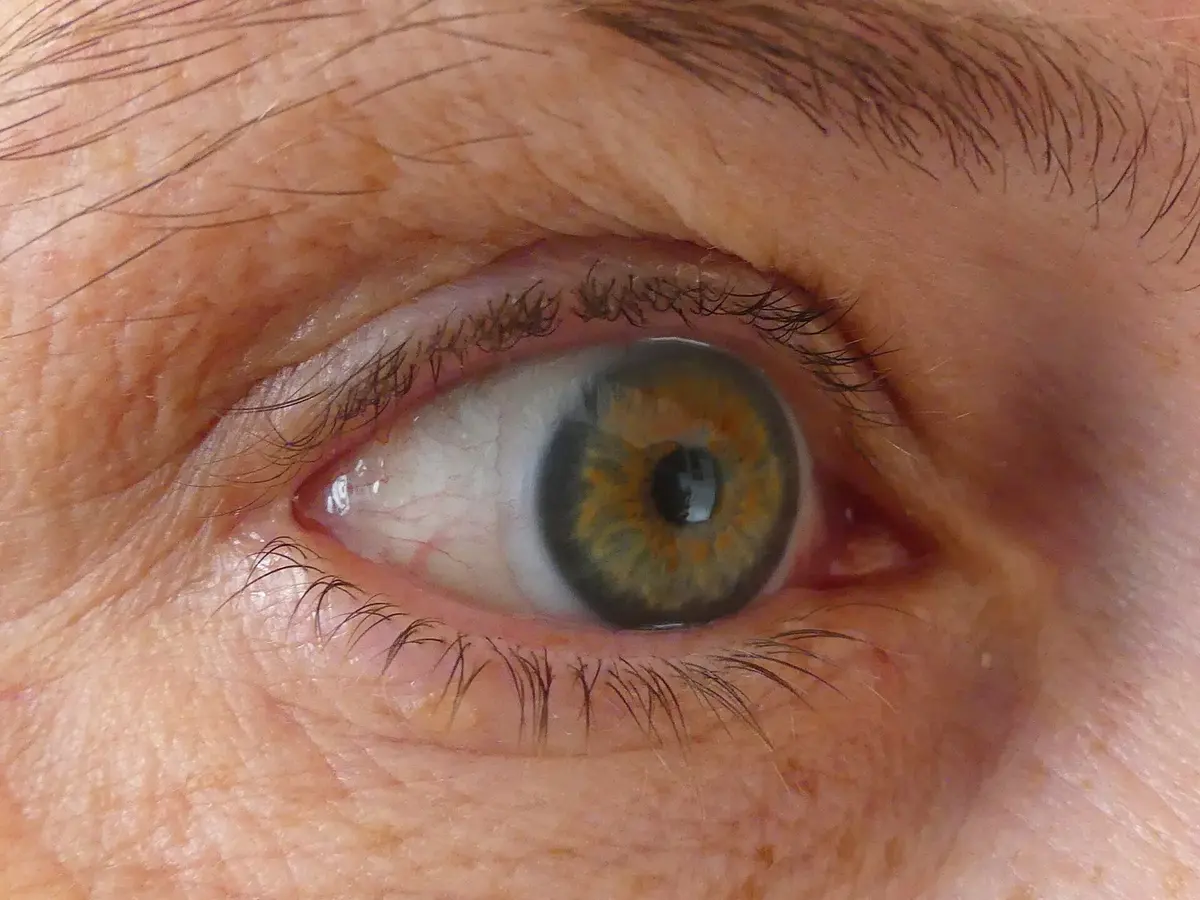
b. Pupil and iris. The pupil is the dark round hole in the middle of the eye through which light enters. Around it is the iris, the colored part (brown, in most Nepali eyes), a ring of muscle that changes the size of the pupil. In bright light, the ring-shaped muscle of the iris (the sphincter) contracts and the pupil becomes small; in dim light, other muscles running outwards like spokes (the dilators) contract and pull it wide open. So about the right amount of light enters the eye, in bright sunshine or in a dark room.
c. Eye lens. A clear, flexible convex lens made of proteins called crystallins. It refracts the light from the cornea a little more, to bring it to a sharp focus on the retina.
d. Ciliary muscles. A ring of muscle around the lens, joined to it by thin threads called suspensory ligaments. As the ciliary muscles contract and relax, the lens becomes fatter or thinner: its curvature, and so its focal length, changes. This keeps the image sharp on the retina.
e. Retina. The light-sensitive layer lining the back of the eye, where the image forms. It has two kinds of light-sensitive cells:
- Rod cells (about 120 million in each eye) are very sensitive. They tell bright from dark and let you see in dim light, but not in color.
- Cone cells (about 6 million) need brighter light. They let you see colors and fine detail. They are packed most tightly in a small spot straight behind the lens, the fovea (yellow spot), where your vision is sharpest.
Both kinds turn light into electrical signals.
f. Optic nerve. A bundle of nerve fibers that leaves the back of the eye and carries the signals from the retina to the brain. Where it leaves there are no rods or cones at all: this is the blind spot.
The image on the retina is formed by convex lenses, so it is real and upside down (and smaller than the object). The brain turns it the right way up, and we see the world upright. For a sharp image, the light must always be focused exactly on the retina, whether it comes from something near or something far.
Which part of the eye does most of the bending of light?
Pick an answer to see why.
Accommodation of the eye
When you look at something far away, the ciliary muscles relax. The lens is pulled thin by the suspensory ligaments: its curvature is small and its focal length is long, just right for the nearly parallel rays from a distant object to be focused on the retina. When you look at something near, the ciliary muscles contract, the ligaments slacken, and the lens bulges into a thicker, more curved shape with a shorter focal length. Now it bends the spreading rays from the near object more strongly, and they too are focused on the retina.
Eye: traced from Gray’s Anatomy (1918), Fig. 869, H. V. Carter, public domain
This adjusting of the focal length of the eye lens to the distance of the object, by the relaxing and contracting of the ciliary muscles, is called the accommodation of the eye.
Far point and near point
The far point is the farthest point at which the eye can see clearly. For a normal eye it is at infinity: with its ciliary muscles fully relaxed, the lens at its thinnest, and its focal length at the longest, the eye focuses the very distant stars.
Bring something closer and closer, and the ciliary muscles contract more and more, until they can contract no further. Any closer and the image becomes blurred. The near point is the nearest point at which the eye can see clearly; the lens is then at its thickest, with its shortest focal length. For a normal adult eye it is about 25 cm away. This distance is also called the least distance of distinct vision.
So a normal eye sees clearly from 25 cm to infinity. The near point depends on age and on the health of the eye; people with defects of vision have different near and far points.
Sanjay looks up from his phone to the mountains on the horizon. What happens in his eyes?
Pick an answer to see why.
Defects of vision
If you have to hold a book much closer than usual, or much farther away, before the letters become sharp, your eye has a problem focusing. To see an object clearly, the light from it must be focused exactly on the retina. When near or distant objects look blurred because the eye can’t form a sharp image of them on the retina, the eye has a defect of vision. The two common defects are short-sightedness (myopia) and long-sightedness (hypermetropia).
Short-sightedness (myopia)
A short-sighted person sees near objects clearly, but distant objects look blurred. Light from far away is focused in front of the retina, and has spread out again by the time it reaches it. There are two main causes:
- The eyeball is too long, so the retina is too far from the lens. This is the most common cause.
- The eye’s lenses are too strongly curved (too powerful), so the focal length is too short: the lens is thinnest when the ciliary muscles are fully relaxed, and even then it isn’t thin enough. Sometimes the cornea is too curved, rather than the lens.
The far point of a short-sighted eye is not at infinity but at some finite distance: the eye sees clearly only up to that point.
Eye: traced from Gray’s Anatomy (1918), Fig. 869, H. V. Carter, public domain
Correction. If the parallel rays from a distant object were spread out a little before they entered the eye, they would be focused farther back, on the retina. A concave (diverging) lens of suitable focal length does this. Its focal length is chosen so that parallel rays leaving it seem to come from the defective eye’s far point: then the eye sees them clearly. So the focal length of the lens equals the distance of the far point (with a minus sign, as it is a concave lens).
Long-sightedness (hypermetropia)
A long-sighted person sees distant objects clearly, but near objects look blurred. Light from near objects would be focused behind the retina. There are two main causes:
- The eyeball is too short, so the retina is too close to the lens.
- The lens can’t become thick enough, because the ciliary muscles have weakened or the lens has stiffened, so its focal length stays too long. This happens to almost everyone in old age. Strictly, the loss of focusing with age has its own name, presbyopia; it blurs near things just as long sight does, and is corrected the same way, with convex reading glasses.
The near point of a long-sighted eye is farther than 25 cm.
Eye: traced from Gray’s Anatomy (1918), Fig. 869, H. V. Carter, public domain
Correction. If the rays from a near object were brought together a little before they entered the eye, the eye could focus them. A convex (converging) lens of suitable focal length does this. Its focal length is chosen so that light from an object at 25 cm seems, after the lens, to come from the defective eye’s near point: then the eye can focus it on the retina.
A student sees the whiteboard clearly from the first bench but not from the last bench. Which lens does she need?
Pick an answer to see why.
Other ways to correct defects of vision
a. Contact lenses
A contact lens is a thin lens worn directly on the cornea to correct vision. It floats on the thin film of tears over the cornea and covers the iris and pupil, and refracts the light by just the amount needed before it reaches the eye lens. Contact lenses are useful when someone doesn’t want to wear glasses, for example while playing sports.
Glasses and contact lenses both have advantages:
- Glasses are easy to use, and good-quality lenses are available in many sizes and powers. But high-power lenses are thick and heavy, and things look distorted when you look sideways through the edge of the lens.
- Contact lenses move with the eye, so the view is clear in every direction, including to the sides, and no frame gets in the way. Because they sit right on the eye, they can be thinner than the matching glasses.
- But contact lenses need much more care. They must be cleaned and disinfected before reuse and stored in the right solution; you must wash your hands before putting them in or taking them out, and never sleep with them in. Careless use can infect or damage the cornea.
b. Laser eye surgery
Eye: traced from Gray’s Anatomy (1918), Fig. 869, H. V. Carter, public domain
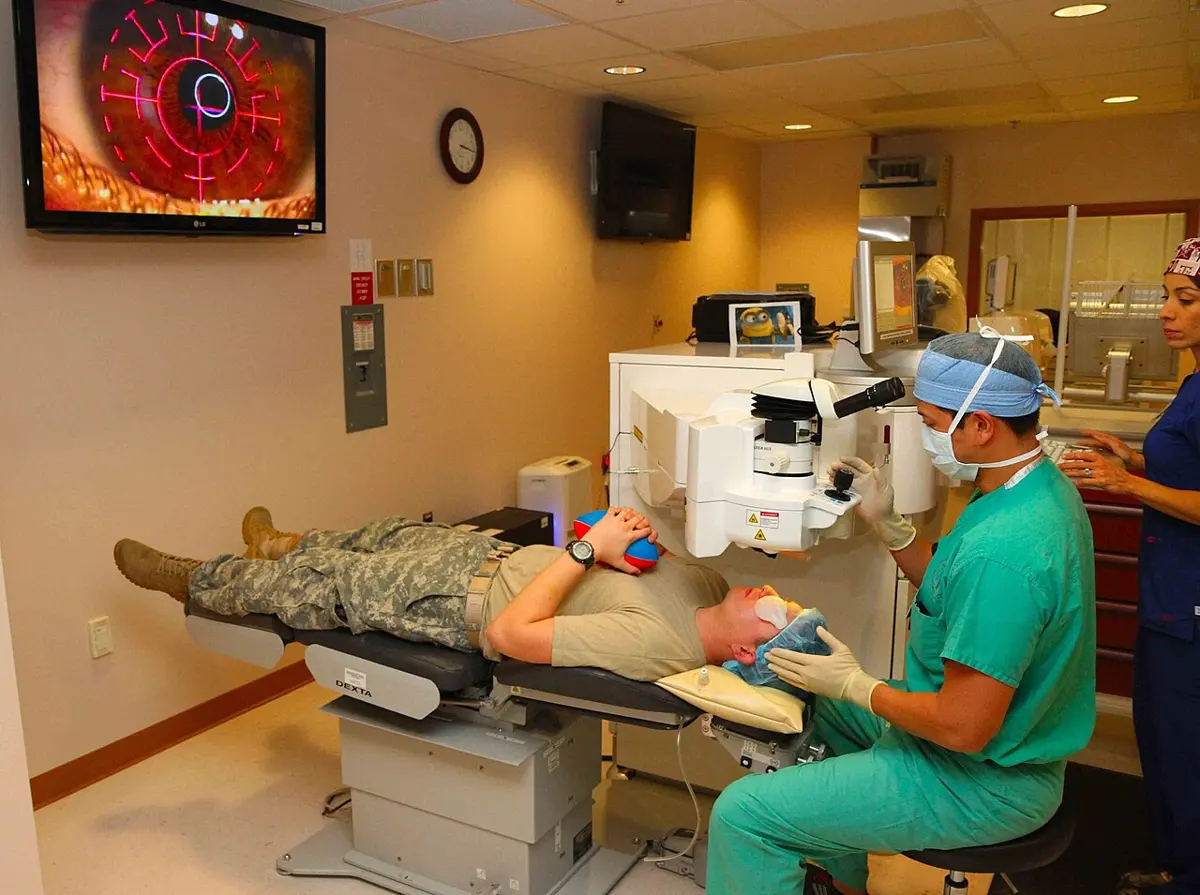
In Figure 10.37, the cornea of a short-sighted eye is made a little flatter by a laser aimed at its middle. The flatter cornea bends light a little less, and the image moves back onto the retina. For long sight, the laser works on the edges of the cornea instead, so the middle bulges a little more and bends light more. Reshaping the cornea with a special ultraviolet laser, the excimer laser, to correct defects of vision is called laser eye surgery. It works on the outer layers of the cornea.
The most popular method is LASIK (laser-assisted in situ keratomileusis). A very thin flap is cut in the front of the cornea and folded back; the laser reshapes the cornea underneath, removing a layer thinner than a hair; then the flap is laid back in place, where it heals by itself.
Draw it: Short-sightedness (myopia) and its correction, Long-sightedness (hypermetropia) and its correction
Other problems of the eye
Besides defects of vision, there are other problems of the eye.
a. Cataract
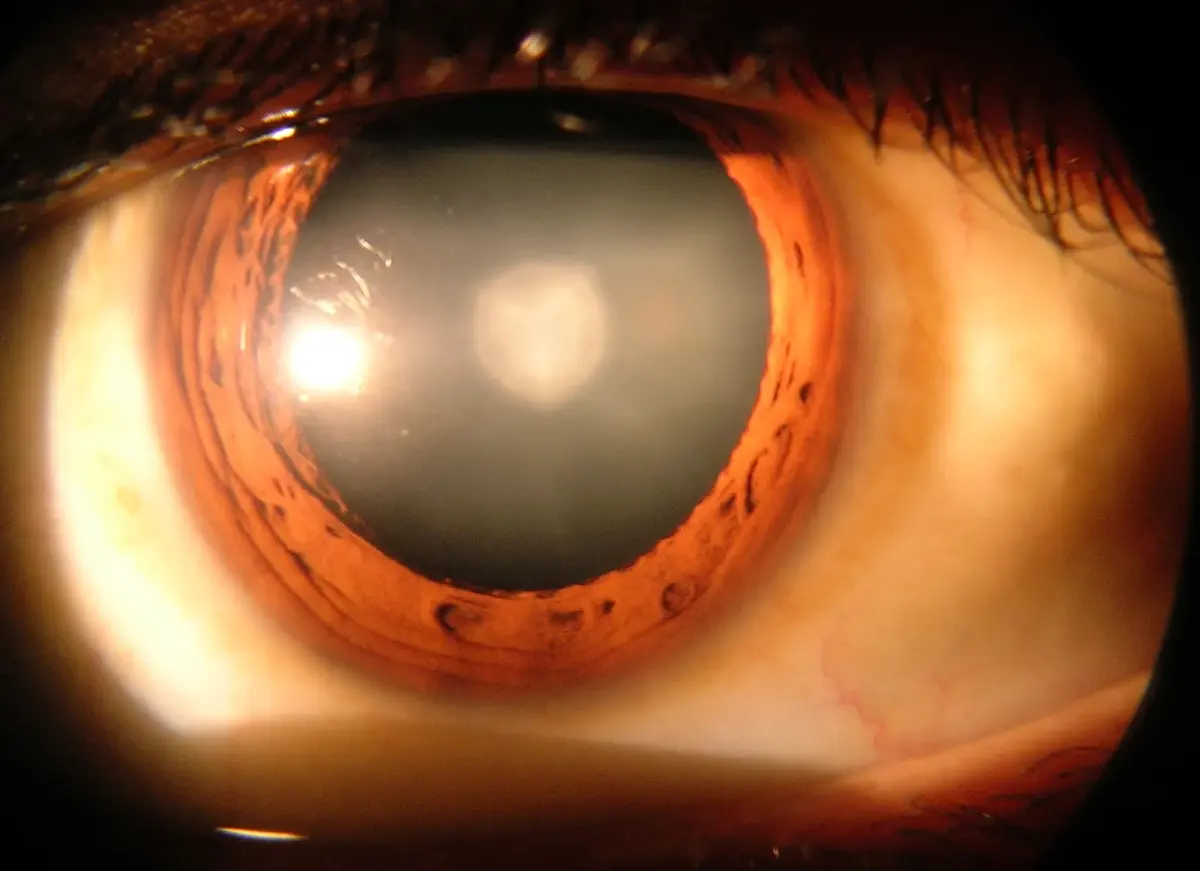
As people grow older, the crystallin proteins of the eye lens can clump together, and the lens becomes cloudy. Light from objects can no longer pass cleanly to the retina, and everything looks blurred, faded and dazzling. As the cloudiness grows, the lens loses its transparency, and in the end the person becomes completely blind. The gray or milky patch then seen in the pupil, caused by the cloudy lens, is a cataract. Cataracts are mostly seen in elderly people; ultraviolet light from the sun, smoking and diabetes make them more likely, and earlier. Wearing sunglasses and a hat in strong sun helps protect your eyes.
Eye: traced from Gray’s Anatomy (1918), Fig. 869, H. V. Carter, public domain
Cataracts are treated by surgery. A tiny cut is made at the edge of the cornea; the cloudy lens is broken into small pieces by ultrasound and sucked out through a fine tube; and in its place a small artificial lens, an intraocular lens (IOL) made of silicone or acrylic, is put in. The operation takes about 15 minutes, and many patients can see well the next day.

b. Color blindness
The color we see depends on the light that reaches our eyes and on the cells in the retina that detect color. A blue object reflects mostly blue light; that light is absorbed by the blue-sensitive cone cells in the retina, and the message “blue” goes to the brain. The retina has millions of cone cells of three kinds: red-sensitive, green-sensitive and blue-sensitive. The brain works out every color from how strongly each kind responds. If some cone cells don’t work properly, we can’t tell certain colors apart.
The inability to distinguish colors because of a defect in the cone cells of the retina is called color blindness. The most common kind is red–green color blindness: red and green look alike. Its main cause is heredity (it is passed on in families); color blindness can also follow damage to the cone cells from disease or harmful rays. Because the genes for the red and green cones are on the X chromosome, it is much more common in boys and men: roughly 1 man in 12 to 1 in 25, but only about 1 woman in 200.
At Science Playground you can take the Color Vision Test.
c. Night blindness
The rod cells of the retina let us see in dim light: even in a nearly dark room, you can make out where the furniture is. Sometimes, because of disease, injury, poor nutrition or other reasons, the rod cells don’t work properly, and things in dim places can’t be seen at all. Night blindness (nyctalopia) is difficulty in seeing at night or in dim light. It is a problem of the retina.
The rod cells contain a light-sensitive pigment, rhodopsin, made from a protein and vitamin A. Without enough vitamin A in the body, too little rhodopsin is made. So a lack of vitamin A is one of the main causes of night blindness. It can also be inherited.
d. Injuries to the cornea
The cornea does most of the eye’s focusing. Its refractive index is 1.376 and its power about +43 D, about two-thirds of the eye’s total. So the cornea must be protected from scratches and injuries. It can be scratched when dust or sand gets into the eye and is rubbed, or injured by stones, pieces of metal and accidents. Long use of contact lenses, or using them without proper cleaning, can infect it. Bacterial, viral or fungal infections of the cornea cause diseases and problems with vision:
- an infection can cause a corneal ulcer (keratitis), an open sore on the cornea; if it isn’t treated quickly, it can make a person blind;
- corneal edema, the build-up of fluid between the layers of the cornea, makes it cloudy and vision blurred;
- in keratoconus, the cornea gradually becomes cone-shaped; it causes short sight at first, and later loss of vision.
Most problems of the cornea can be cured by proper treatment; if the cornea can’t be healed, it can be replaced.
Corneal transplantation
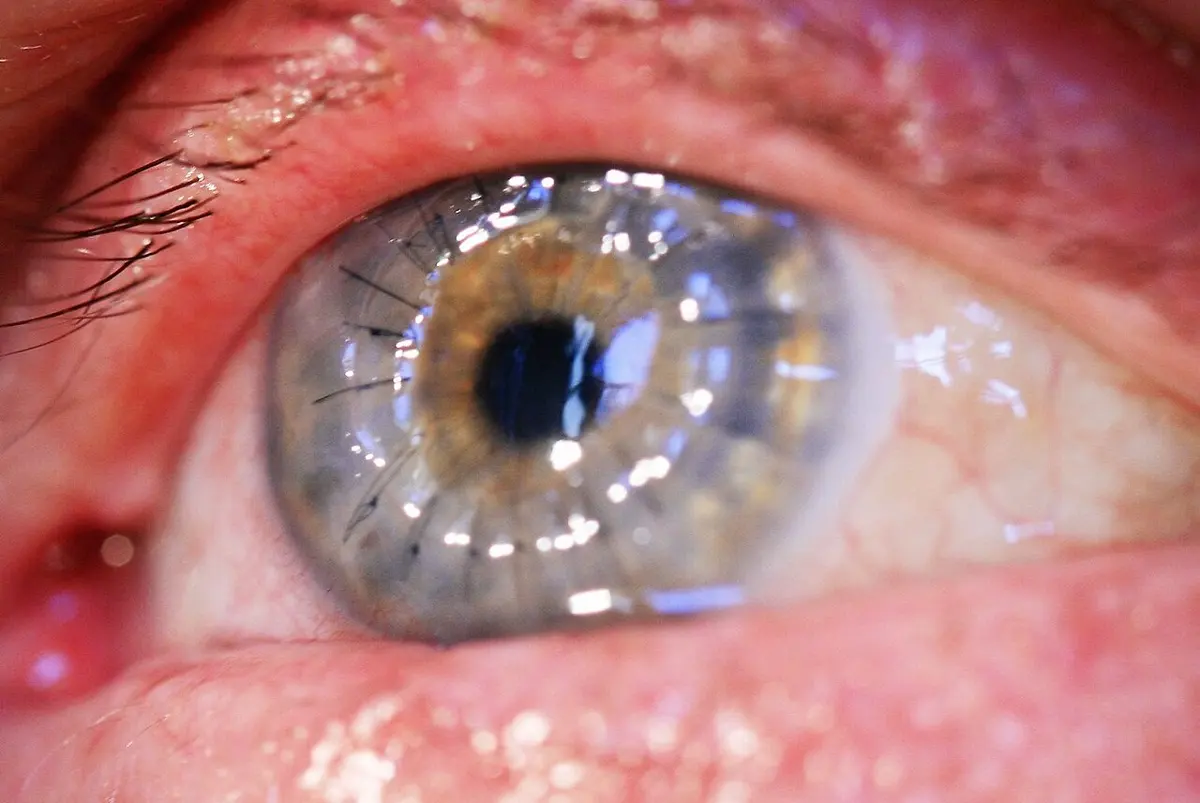
In Nepal, after cataract, damage to the cornea is the second leading cause of blindness. Replacing a damaged cornea with a healthy one by surgery is called corneal transplantation. It can help people born with a cloudy cornea, and people whose corneas were damaged by infections or injuries that weren’t treated in time.
The healthy corneas come from people who have pledged to donate their eyes after death. After a donor dies, the eyelids are closed to protect the corneas from drying and from sunlight, and doctors remove the cornea (not the whole eye) as soon as possible, within a few hours, and store it safely; the sooner, the better its quality. In Nepal, the Nepal Eye Bank, set up at the Tilganga Institute of Ophthalmology, collects, stores and distributes donated corneas. One donor can give sight to two people.
Project work
Exercise
1. Choose the correct option
a. Which of these rules applies during the refraction of light?
Pick an answer to see why.
b. Light in medium 1 meets the boundary at 15° to the normal and goes on in medium 2 at 30°. Which statement is correct?
Pick an answer to see why.
c. In the drawing of light through a glass slab above, which names belong to the numbers 1–4?
Pick an answer to see why.
d. Which result is obtained from observing refraction through a glass slab?
Pick an answer to see why.
e. What is the critical angle of glass?
Pick an answer to see why.
f. Among endoscopes, spectacles, mirages, dispersion of light, rainbows, optical fibers and hand lenses, in which does total internal reflection of light take place?
Pick an answer to see why.
g. The speeds of green, violet and red light in a prism are , and . Which is correct?
Pick an answer to see why.
h. An object AB stands on the principal axis between a convex lens and its focus. What is its image like?
Pick an answer to see why.
i. Which statement about the images formed by concave and convex lenses is correct?
Pick an answer to see why.
j. Which is a correct understanding of eye problems and their causes?
Pick an answer to see why.
2. Differentiate between
Reflection of light and total internal reflection of light
Answer
Concave lens and convex lens
Answer
Near point of the eye and far point of the eye
Answer
Short-sightedness and long-sightedness
Answer
Color blindness and night blindness
Answer
3. Give reasons
Between glass and water, glass is considered the denser medium and water the rarer medium.
Answer
A coin placed in a glass of water appears to rise a little.
Answer
Letters on a paper look slightly raised when seen through a glass slab placed on them.
Answer
Stars twinkle.
Answer
The Sun appears on the horizon about two minutes before the actual sunrise.
Answer
A diamond shines, but a piece of glass cut to the same shape does not.
Answer
Sunlight is refracted (and split into colors) when it is passed through a prism.
Answer
A convex lens converges light rays.
Answer
A concave lens diverges light rays.
Answer
A lack of vitamin A in the body is one of the main causes of night blindness.
Answer
Color blindness occurs when the cone cells of the retina stop functioning.
Answer
4. Answer these questions
What is refraction of light?
Answer
Write the laws of refraction of light.
Answer
What change is seen in the shape of a pencil that is half dipped in water at a slant? Explain with a ray diagram, and name the process.
Answer
Light passes from water into air. At the water–air surface, the angle of incidence is 40.5° and the angle of refraction 60°. Draw a ray diagram, and explain why an object outside looks farther away (higher) than it really is to an observer under the water.
Answer
What is a critical angle?
Answer
What is total internal reflection of light?
Answer
Write two conditions necessary for total internal reflection of light.
Answer
Data can now be sent very fast through fiber internet. What is the role of total internal reflection in fiber internet?
Answer
In endoscopy, colonoscopy and keyhole surgery, how is total internal reflection used to send light to the internal organs and see them?
Answer
What is dispersion of light?
Answer
Give the reason for the dispersion of light.
Answer
Draw ray diagrams showing:
- i.refraction of light through a glass slab;
- ii.dispersion of light through a prism.
Answer
A person wonders why a rainbow always looks like a semicircle and is always the same size. Explain, including where the Sun is, where the water drops are, and the dispersion of light.
Answer
Define these terms related to lenses:
- i.center of curvature
- ii.optical center
- iii.principal axis
- iv.focus
Answer
What is meant by the power of a lens?
Answer
The powers of two convex lenses are +2 D and +4 D.
- i.Which is thicker? Give a reason.
- ii.Calculate the focal length of each lens.
Answer
When is the image formed by a convex lens real and the same size as the object? Show the ray diagram.
Answer
A man on the bank throws a spear at a fish he sees in the water. Will it hit the fish? Explain using the real depth of the fish.
Answer
Light can be made to zigzag along inside a curved glass tube, following its bends. What process is this? Name two devices that work on it.
Answer
Complete these ray diagrams:
- i.light from air at A meeting water at O;
- ii.light in water meeting the surface at 48.8°;
- iii.light falling square on to the short face of a 30°–60°–90° glass prism;
- iv.light P falling square on to the long face (at Q) of a right-angled isosceles prism ABC;
- v.red light falling on an equilateral prism;
- vi.an object beyond 2F in front of a convex lens.
Answer
Here are three uses of lenses: a hand lens burning paper in sunlight, a magnifying glass, and a door peephole. Write the facts about each, with ray diagrams.
Answer
White light is dispersed by a triangular prism onto a screen, with the color X lowest and Y highest.
- a.Which colors are X and Y?
- b.Why is Y bent less than X as the light comes out of the prism?
Answer
How can light dispersed by a prism be turned back into white light?
Answer
Two lenses have focal lengths of 20 cm and −20 cm. What kind of lens is each? Which forms a virtual, magnified image of an object placed 16 cm away? Explain with a scale ray diagram.
Answer
Write the functions of these parts of the eye:
- i.ciliary muscle
- ii.cornea
- iii.lens
- iv.iris
- v.pupil
- vi.retina
Answer
Write two problems that may be caused by an injury to the cornea.
Answer
A student sitting in a classroom shifts his eyes from the letters on the whiteboard to a distant object seen out of the window. Explain the role of the ciliary muscles in the change of thickness of the eye lens.
Answer
In a person’s eye, light from a nearby object (at the normal near point, 25 cm) forms an image behind the retina. Name the defect of vision, give two causes, and explain its correction.
Answer
A student can’t read the letters on the whiteboard from the last bench, but reads them clearly from the first bench.
- i.What defect of vision does he have?
- ii.Draw a ray diagram of it.
- iii.Write two reasons for it.
- iv.Explain, with a ray diagram, the role of the lens that corrects it.
Answer
Explain, with a ray diagram, the role of the lens used to correct long-sightedness.
Answer
A student concludes that “the defect of vision is greater for a person wearing spectacles with thick lenses than for one wearing thin lenses.” Is this correct? Give reasons.
Answer
Compare the use of spectacles and contact lenses to correct defects of vision.
Answer
Explain the laser surgery method used to solve eyesight problems.
Answer
What is a cataract? What is the role of the intraocular lens developed by Nepal’s eye surgeon Dr Sanduk Ruit in the treatment of cataracts?
Answer
5. Solve these problems
The speeds of light in air and glass are 3 × 10⁸ m/s and 2 × 10⁸ m/s. Calculate the refractive index of glass with respect to air.
Answer
The refractive index of diamond is 2.42. If the speed of light in air is 3 × 10⁸ m/s, calculate the speed of light in diamond.
Answer
A ray of light falls on a plastic block at 45° to the normal, and the angle of refraction is 33°. Calculate the refractive index of the plastic.
Answer
Calculate the power of a lens of focal length 25 cm.
Answer
The lenses of a student’s spectacles have a power of −6 D. Calculate their focal length, and say what kind of lens they are.
Answer
Worksheet: Wave: refraction and total internal reflection (PDF, 4 pages)
Worksheet: Wave: dispersion, lenses and power (PDF, 4 pages)
Quiz yourself: Energy, Heat, Light and Sound, Grades 5–10 →
Practice every question in the book, and keep track of the ones you miss →
A companion to your textbook, not a replacement for it: study from the book your school uses, and where the two differ, follow your teacher. Found a mistake? Please tell us.