
In the radiotherapy room of a cancer hospital, a patient lies very still on a table while a heavy machine turns slowly around them. Inside its head is a small metal cylinder of cobalt-60, a few centimeters long. It has no battery and no plug, yet day and night, for years, it sends out invisible rays strong enough to destroy a tumor deep inside the body. When the machine is “off”, the cobalt is not switched off at all: it is simply rolled back inside a thick shield of heavy metal, because nothing can stop it from giving out its rays.
The cobalt-60 is radioactive: the nuclei of its atoms are unstable, and each one, sooner or later, breaks down by itself and throws out radiation. This unit is about that radiation: the three kinds that come out of nuclei, how they differ, what we use them for, how they can harm us, and how people who work with them keep themselves and everyone else safe.
12.1 Introduction of nuclear radiation
Every atom has a tiny nucleus of protons and neutrons, held together by the strong nuclear force, with electrons around it. In most atoms around you, in the oxygen you breathe and the iron in a bicycle, the nucleus is stable: it will stay exactly as it is forever. But some nuclei have too many neutrons, too few, or are simply too big, and they are unstable. An unstable nucleus sooner or later changes into a more stable one by throwing out a particle or a burst of energy.
Radioactivity is the breaking down of unstable nuclei by themselves, giving out radiation. The radiation that comes out is called nuclear radiation (or radioactive radiation), because it comes from the nucleus. A substance whose nuclei do this is a radioactive substance, and an isotope with unstable nuclei is a radioisotope: uranium-238, radium-226, carbon-14 and cobalt-60 are examples. The nucleus that is left after the change is called the daughter nucleus, and the one that broke down the parent.
Radioactivity has three features that set it apart from everything in chemistry:
- It happens by itself. Nothing has to start it, and nothing can stop it.
- Nothing outside the nucleus changes it. Heating a radioactive substance, cooling it, squeezing it, or combining it into a compound makes no difference to how fast it gives out radiation. Chemical reactions only move electrons around; the nucleus doesn’t notice.
- The element changes. When a nucleus throws out a charged particle, its number of protons changes, so it becomes a different element. Dalton thought atoms of one element could never turn into another; radioactivity shows that they can.
Some radioactive substances are found in nature, such as uranium and thorium in rocks, radon gas seeping out of the ground, and potassium-40 in every banana and in your own body. This is natural radioactivity. Others are made by people, in nuclear reactors or particle accelerators, such as cobalt-60 and technetium-99m for hospitals and americium-241 for smoke detectors: artificial radioactivity.
A sample of radium is heated strongly in a flame and then mixed into a compound. What happens to the rate at which it gives out radiation?
Pick an answer to see why.
Types of nuclear radiations
Unstable nuclei give out three kinds of radiation: alpha (α), beta (β) and gamma (γ). A nucleus is written : is the element’s symbol, its atomic number (the number of protons) and its mass number (protons + neutrons), as in Unit 6. Carbon-14, with 6 protons and 8 neutrons, is .
Alpha (α) radiation
An alpha particle is a cluster of 2 protons and 2 neutrons, stuck tightly together. That is exactly the nucleus of a helium atom, so an alpha particle is written or . Its charge is +2 (two protons, no electrons) and its mass number 4. Alpha particles come mostly from very heavy nuclei, such as uranium, radium and polonium, which are too big to be stable.
When a nucleus gives out an alpha particle, it loses 2 protons and 2 neutrons, so:
- its atomic number goes down by 2 (it becomes the element two places earlier in the periodic table);
- its mass number goes down by 4.
Radium-226 (88 protons) gives out an alpha particle and becomes radon, with mass number 226 − 4 = 222 and 88 − 2 = 86 protons:
Check both sides: the mass numbers add up the same (226 = 222 + 4), and so do the atomic numbers (88 = 86 + 2). Every nuclear equation balances like this.
Beta (β) radiation
A beta particle is a fast electron, with a charge of −1 and almost no mass. It is written or : mass number 0, because an electron’s mass is less than a two-thousandth of a proton’s, and “atomic number” −1 for its charge.
But a nucleus has no electrons in it. Where does the beta particle come from? In a nucleus with too many neutrons, one neutron turns into a proton and an electron. The proton stays in the nucleus; the electron is made at that moment and shot out at very high speed. (A tiny, almost massless particle with no charge, an antineutrino, flies out with it, and shares the energy.) So when a nucleus gives out a beta particle:
- its atomic number goes up by 1 (one more proton: the next element in the periodic table);
- its mass number stays the same (one neutron fewer, one proton more).
Carbon-14 (6 protons, 8 neutrons) gives out a beta particle and becomes nitrogen-14 (7 protons, 7 neutrons):
Mass numbers: 14 = 14 + 0. Atomic numbers: 6 = 7 + (−1). Both balance.
Gamma (γ) radiation
Gamma rays are not particles of matter at all. They are electromagnetic waves, like light, radio waves and X-rays, but with far more energy and a far shorter wavelength (usually shorter than about a hundredth of a nanometer). They have no charge and no mass, and they travel at the speed of light, 3 × 10⁸ m/s.
A nucleus often has some energy left over after it has given out an alpha or beta particle: it is excited, like a ball resting on a shelf instead of on the floor. It settles down by giving out that extra energy as a gamma ray. Nothing in the nucleus changes but its energy, so neither the atomic number nor the mass number changes. Cobalt-60, for example, gives out a beta particle and becomes nickel-60, which is left excited (marked with a star) and at once gives out gamma rays:
It is these gamma rays, not the beta particles (which are stopped inside the cobalt’s steel capsule), that a cobalt machine aims at a tumor.
| Radiation | What leaves the nucleus | Atomic number, Z | Mass number, A |
|---|---|---|---|
| alpha, | 2 protons + 2 neutrons | goes down by 2 | goes down by 4 |
| beta, | an electron (a neutron became a proton) | goes up by 1 | stays the same |
| gamma, γ | energy only | stays the same | stays the same |
Writing nuclear equations
To complete a nuclear equation, use two rules: the mass numbers on the two sides add up to the same total, and so do the atomic numbers. Find the missing and first, then look up the element whose atomic number is .
A nucleus gives out one alpha particle and then two beta particles. What happens overall to its atomic number?
Pick an answer to see why.
Characteristics of alpha, beta and gamma radiations
The three radiations differ in four ways that matter: their charge, their mass, how far they penetrate (pass through) matter, and how strongly they ionize it.
Charge
Alpha particles have a charge of +2 (the charge of two protons, 2 × 1.6 × 10⁻¹⁹ C), beta particles −1 (the charge of an electron, −1.6 × 10⁻¹⁹ C), and gamma rays none.
The way to show this is to send the radiation through an electric or a magnetic field. A charged particle moving across a field is pushed sideways; an uncharged one goes straight on.
- Between two charged plates, alpha particles bend towards the negative plate (opposites attract), beta particles towards the positive plate, and gamma rays pass straight between them.
- In a magnetic field, alpha and beta particles curve in opposite directions, because their charges are opposite; gamma rays go straight.
Look at Figure 12.2 closely. Two things in it may surprise you.
The beta particles spread out. All the alpha particles from one kind of nucleus come out at the same speed, so they form one sharp beam. Beta particles come out at every speed from almost zero up to a top speed, because each one shares its energy with an antineutrino in a different way. Faster ones bend less and slower ones more, so the beta beam spreads into a fan.
The alpha beam hardly bends in the magnet. An alpha particle has twice the charge of a beta particle, but it is about 7,300 times heavier. A heavy particle is hard to turn: in a magnetic field strong enough to bend the beta particles into tight curves, the alpha particles’ path curves about 35 to 150 times less (depending on the beta’s speed). Rutherford needed a very strong magnet to bend alpha particles at all; he managed it in 1903, and the direction of the bend proved they are positive. Between charged plates the difference is smaller, so there the alpha beam does bend visibly, though still less than even the fastest beta particles.
Mass
An alpha particle’s mass is 6.64 × 10⁻²⁷ kg, about 4 u (4 times a proton’s; 1 u, the atomic mass unit, is about 1.66 × 10⁻²⁷ kg). A beta particle’s is 9.11 × 10⁻³¹ kg, about of a proton’s, so an alpha particle is about 7,300 times heavier. Gamma rays have no mass.
Their speeds differ too. An alpha particle leaves its nucleus at about 1.5 × 10⁷ m/s, around 5% of the speed of light: fast, but slow next to the others. Beta particles come out at up to 99% of the speed of light, and gamma rays travel at the speed of light, 3 × 10⁸ m/s.
Penetrating power
The penetrating power of a radiation is how far it can travel through matter before it is stopped.
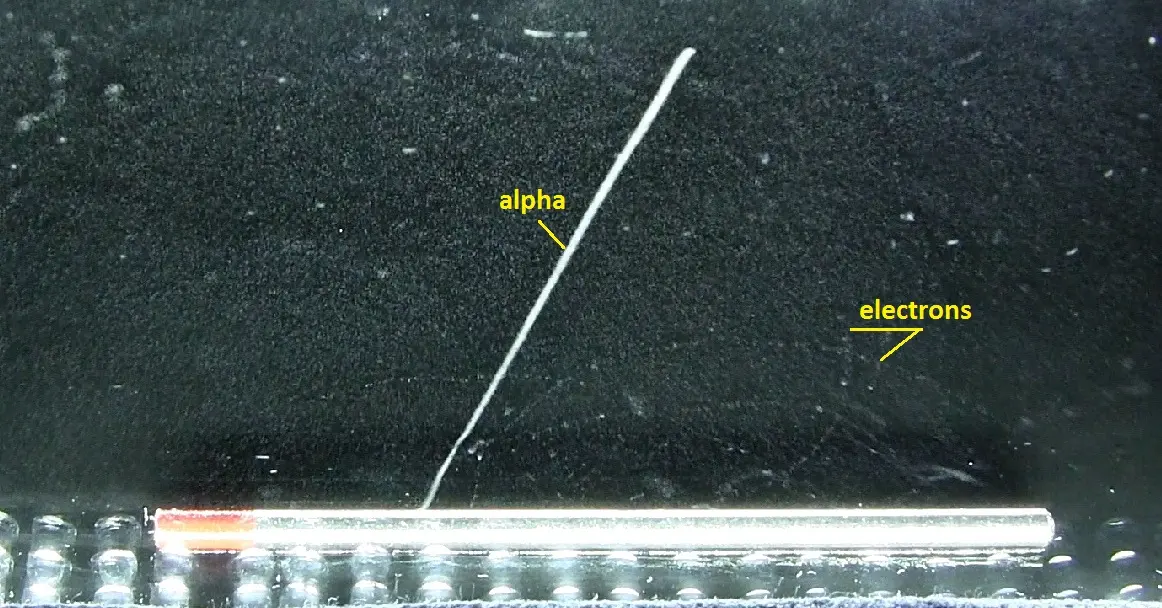
- Alpha particles have the least penetrating power. They travel only about 3 to 7 cm in air, and a sheet of paper, or the dead outer layer of your skin, stops them completely.
- Beta particles penetrate more: up to a few meters of air, and through paper, cloth and thin plastic. A few millimeters of aluminium stops them.
- Gamma rays penetrate most. They pass through paper, aluminium, the human body and walls, and even lead only reduces them: each 1.2 cm of lead (or about 6.6 cm of concrete) cuts the gamma rays of cobalt-60 to half. No thickness stops every last gamma ray, but enough lead or concrete makes them too few to matter.
Ionizing power
As alpha, beta and gamma radiation pass through air, they knock electrons off the atoms they meet, leaving the atoms as positive ions. This is ionization, and the ionizing power of a radiation is how many ions it makes along each centimeter of its path.
- Alpha particles ionize most strongly: tens of thousands of ion pairs in each centimeter of air. Big, slow and doubly charged, an alpha particle tugs hard on every electron it passes.
- Beta particles ionize less: about a hundred ion pairs a centimeter, very roughly. They are small, fast and singly charged.
- Gamma rays ionize least: having no charge, they only rarely hit an electron, making a few ions over a long path.
Notice that the order is exactly the opposite of penetrating power, and that is no accident. Every ion a particle makes costs it a little of its energy. An alpha particle, making so many ions, uses up all its energy in a few centimeters of air and stops. A gamma ray, making very few, keeps its energy and goes a long way. The more strongly a radiation ionizes, the less it penetrates.
The three compared
| Property | Alpha (α) | Beta (β) | Gamma (γ) |
|---|---|---|---|
| What it is | helium nucleus, 2 protons + 2 neutrons | fast electron from the nucleus | electromagnetic wave |
| Symbol | or | or | γ |
| Charge | +2 | −1 | 0 |
| Mass | about 4 u | about u | 0 |
| Speed | about 5% of the speed of light | up to 99% of the speed of light | speed of light, 3 × 10⁸ m/s |
| Penetrating power | least: a few cm of air; stopped by paper | more: a few m of air; stopped by a few mm of aluminium | most: reduced by thick lead or concrete |
| Ionizing power | most | less | least |
| In an electric field | bends towards the − plate | bends towards the + plate, more | not bent |
| In a magnetic field | bends a little | bends the other way, much more | not bent |
| Effect on the nucleus | Z − 2, A − 4 | Z + 1, A the same | no change |
Which radiation has the greatest ionizing power?
Pick an answer to see why.
Uses of nuclear radiations
Radiation that can harm living cells can also be put to work: to kill cancer cells or germs, to see inside the body or a steel pipe, to measure, and to date. In every use, the kind of radiation is chosen for its penetrating power and ionizing power.
In medicine
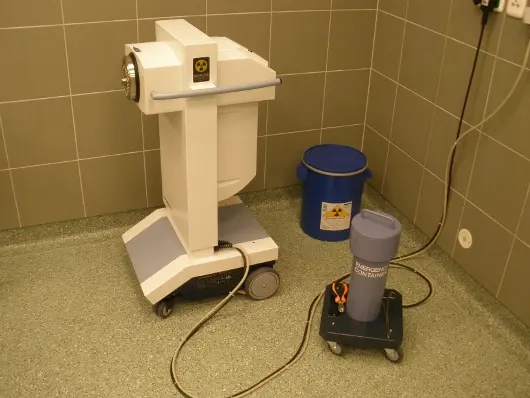
Treating cancer (radiotherapy). Gamma rays aimed at a tumor ionize the atoms in its cells and damage their DNA, so that the cancer cells die. In a cobalt-60 machine, the source is behind thick shielding, and the beam comes out through an opening onto the tumor. The machine turns around the patient, so that the beam always passes through the tumor but through each part of the healthy body around it for only a short time. Radiotherapy in Nepal began with cobalt-60 machines: at Bir Hospital in Kathmandu in 1991, Bhaktapur Cancer Hospital in 1998 and B. P. Koirala Memorial Cancer Hospital in Bharatpur in 1999. In brachytherapy, a small radioactive source, often iridium-192, is placed for a few minutes inside the body, right next to the tumor, through a thin tube, and then pulled back into its shielded safe.
Seeing inside the body (nuclear medicine). A patient is given a tiny amount of a radioactive substance, a tracer, that collects in the organ to be studied. Gamma rays from it pass out through the body to a gamma camera, which builds a picture of where the tracer has gone: a bone that is healing or has cancer, a kidney that isn’t working, the blood flowing through the heart. The commonest tracer is technetium-99m, which gives out gamma rays and almost no particles to harm the cells and loses half its activity in only 6 hours, so very little is left in the body after a day. Gamma rays are used because they get out of the body; an alpha or beta source inside would be stopped in the body, harming the cells around it without reaching the camera. Bir Hospital in Kathmandu, for example, has a nuclear medicine unit that scans patients’ thyroid glands with technetium-99m.
Treating an overactive thyroid. The thyroid gland in the neck collects iodine. A patient swallows a capsule of iodine-131, which gathers in the thyroid, and its beta particles, which travel only about 2 mm in the body at most, destroy the overactive gland from inside while hardly touching anything else.
Sterilizing. Syringes, surgical gloves, bandages and stitches are sealed in their packets and then exposed to strong gamma rays from cobalt-60. The rays pass through the packaging and kill every germ inside, without heating anything, so plastic items that would melt in boiling water can be sterilized, and they stay germ-free until the packet is opened.
In industry
Measuring thickness. In a factory making paper, plastic sheet or aluminium foil, a beta source sits on one side of the moving sheet and a detector on the other. If the sheet comes out too thick, fewer beta particles get through; the counter notices and the rollers are pressed closer together. Beta is chosen because a thin sheet absorbs part of it: alpha would be stopped completely by any sheet, and gamma would pass through almost unchanged, whatever the thickness. For thick steel sheet, gamma rays are used instead.
Checking welds and castings (gamma radiography). A gamma source on one side of a welded steel pipe, and a photographic film on the other, give a picture like an X-ray: a crack or air bubble inside the metal lets more rays through and shows up dark. Gamma is used because only gamma gets through thick metal.
Finding leaks. A little radioactive tracer that gives out gamma rays is added to the liquid in a buried pipe. Where the pipe leaks, the tracer soaks into the ground, and a detector carried along the surface finds the spot without digging up the whole pipe.
Smoke detectors. Many smoke detectors contain a tiny amount of americium-241, an alpha source. Its alpha particles ionize the air between two metal plates, and the ions carry a small current between them. When smoke gets in, the ions stick to the smoke particles, the current drops, and the alarm sounds. Alpha is used because it ionizes air strongly, and because it is stopped by a few centimeters of air and by the detector’s plastic case, so it is safe on a ceiling.
In agriculture and food
- Keeping food longer. Strong gamma rays kill the bacteria, molds and insects in grain, spices and fruit, and stop potatoes and onions sprouting. The food does not become radioactive, just as you don’t become radioactive after an X-ray.
- Controlling insect pests. Male insects are raised in millions, made sterile with gamma rays and released; females that mate with them lay eggs that don’t hatch, and the pest dies out over a few generations. This sterile insect technique drove the screwworm fly, a pest of cattle, out of the United States, Mexico and Central America for decades.
- New crop varieties. Seeds exposed to gamma rays get random changes in their DNA; plant breeders grow thousands of them and keep the rare plants that are better, with higher yields, shorter stems or resistance to disease. Thousands of crop varieties grown around the world, including rice, wheat and barley, were bred this way.
In finding ages
The carbon in every living thing contains a fixed small share of radioactive carbon-14. When the plant or animal dies, it takes in no more, and the carbon-14 it has slowly decays. Measuring how much is left tells how long ago it died, up to about 50,000 years: this is carbon dating, which you will meet in Grade 10 Optional Science. Rocks are dated the same way with uranium and lead, which is how we know the Earth is about 4.5 billion years old.
A factory makes aluminium foil 0.1 mm thick and wants a gauge to keep it even. Which source should the gauge use?
Pick an answer to see why.
Health hazards of nuclear radiations
The very thing that makes nuclear radiation useful, its power to ionize, is what makes it dangerous. When radiation passes through the body, it ionizes the atoms in the cells. That can break the molecules of a cell, above all its DNA, the instructions the cell follows. A cell with damaged DNA may repair itself, may die, or may survive with its DNA changed, and then it may one day grow out of control as a cancer.
The dose. How much harm radiation does depends on the energy it leaves in the body and on the kind of radiation. Both are put together in one number, the dose, measured in sieverts (Sv). A sievert is a very large dose, so everyday doses are given in millisieverts (1 mSv = 0.001 Sv) or microsieverts (1 µSv = 0.001 mSv).
| Dose | What it is |
|---|---|
| about 0.02 to 0.1 mSv | a chest X-ray (one view or two) |
| about 2.4 mSv a year | the world’s average natural background radiation, from rocks, radon, space, food and our own bodies |
| about 8 mSv | a CT scan of the abdomen |
| 1 mSv a year | the limit for the public from man-made sources (not counting medical care) |
| 20 mSv a year (on average) | the limit for people who work with radiation |
| 100 mSv | the lowest dose at which a rise in cancer has been seen |
| 1,000 mSv (1 Sv) in a short time | radiation sickness |
| about 4,000 to 5,000 mSv (4 to 5 Sv) in a short time | kills about half of those who receive it, without medical treatment, within two months |
The harm falls into two kinds.
- Short-term effects, after a large dose received in a short time, over about 1 Sv. Radiation sickness: vomiting, tiredness, a drop in white blood cells and so infections, hair falling out, and burns on the skin. Very large doses damage the bone marrow and the gut so badly that the person dies within weeks. Workers at the Chernobyl power station in 1986 suffered this.
- Long-term effects, which can follow even smaller doses, years later. Cancer, especially leukemia (cancer of the blood) and thyroid, lung and bone cancer. Cataracts in the eyes. The more the dose, the higher the chance; at the low doses of everyday life the extra chance is too small to measure, but it is assumed never to be quite zero, so doses are always kept as low as reasonably possible.
Radiation can also change the DNA in sperm and egg cells. Such a change, a mutation, could be passed to children. In animals given large doses this has been seen; in people it has not been clearly seen, even among the children of the survivors of the atomic bombs of 1945, but the risk is assumed to exist, which is why the reproductive organs are shielded during X-rays.
Which radiation is most dangerous when its source is inside the body?
Pick an answer to see why.
Methods of safely handling and storing nuclear materials
People who work with radioactive materials (in hospitals, factories, laboratories and power stations) keep their doses low by three simple rules: time, distance and shielding.
Time. The dose is in proportion to the time spent near a source: half the time, half the dose. Work is planned so that it is done quickly, and nobody stays near a source longer than they must.
Distance. Alpha and beta particles are stopped by a little air. Gamma rays from a small source spread out in all directions, so their strength falls with the square of the distance: twice as far away, a quarter of the dose; three times as far, a ninth. Sources are never touched by hand, but picked up with long tongs or handled by remote control.
Shielding. A barrier between the source and the person absorbs the radiation: paper or the source’s own case for alpha, a few millimeters of aluminium or plastic for beta, and thick lead or concrete for gamma. That is why the rooms where cobalt-60 machines work have concrete walls more than a meter thick.
Handling radioactive materials safely
- Handle sources only with tongs, gloves or remote-controlled arms, never with bare hands, and keep them pointed away from people.
- Wear a lab coat and gloves, and a dosimeter (a small badge that records the dose received), checked regularly.
- Never eat, drink or put on make-up where radioactive materials are used; wash hands carefully afterwards, and check them with a detector.
- Work behind shields: lead bricks, lead-glass windows, or thick concrete walls for strong gamma sources.
- Keep the time near a source short and the distance as large as possible.
- In a school laboratory, sources are small, sealed and kept by the teacher; students watch from a distance and never handle them.
Storing radioactive materials safely
- Keep sources in thick lead containers (or concrete, for strong ones), in a locked room or safe, away from where people sit or work.
- Label every container with the radiation warning sign, the black or magenta trefoil on yellow ☢, with what is inside and when.
- Keep a written record of every source: where it is, who has it, how strong it is. A source must never get lost, sold as scrap or thrown away with ordinary rubbish.
- Radioactive waste is stored until it is harmless. Many sources lose their activity quickly: technetium-99m halves every 6 hours, so after two days only 1/256 of it is left, and its waste is simply kept shielded until then. Long-lived waste, such as used fuel from nuclear power stations, stays dangerous for thousands of years; it is sealed in steel and concrete, and some countries are building stores for it deep underground in stable rock.
- In Nepal, the Radioactive Substances (Use and Regulation) Act, in force since July 2020 (2077 BS), says that no one may work with nuclear or radioactive materials without a license, and provides for a regulatory body to grant them. Until that body is set up, government offices share the work (as of 2026, among them the Nuclear Materials Management Division of the Ministry of Education, Science and Technology).
Exercise
1. Choose the correct option
a. An alpha particle is the same as:
Pick an answer to see why.
b. When a nucleus gives out a beta particle, its:
Pick an answer to see why.
c. Between two oppositely charged plates, beta particles bend:
Pick an answer to see why.
d. The source in a household smoke detector gives out:
Pick an answer to see why.
e. The SI unit used for the dose of radiation a person receives is the:
Pick an answer to see why.
2. Give reasons
Alpha particles have the least penetrating power, though they have the greatest ionizing power.
Hint
Answer
In a magnetic field, an alpha beam bends much less than a beta beam.
Hint
Answer
Gamma rays, not alpha particles, are used to treat a tumor deep inside the body.
Hint
Answer
3. Differentiate between
Alpha particles and beta particles
Hint
Answer
Beta particles and gamma rays
Hint
Answer
Penetrating power and ionizing power
Hint
Answer
4. Answer the following questions
What is radioactivity? Write two of its features.
Hint
Answer
Write the equations for (i) the alpha decay of uranium-238 (; element 90 is thorium, Th) and (ii) the beta decay of iodine-131 (; element 54 is xenon, Xe).
Hint
Answer
How can you show by experiment that alpha particles are positive, beta particles negative and gamma rays uncharged? Draw a labeled diagram.
Hint
Answer
Write two uses each of alpha, beta and gamma radiation, giving the reason in each case.
Hint
Answer
What are the health hazards of nuclear radiation?
Hint
Answer
Describe the methods of safely handling and storing radioactive materials.
Hint
Answer
Think: A student says, “Lead stops gamma rays, so a 1 cm lead apron makes a gamma source completely safe.” What is wrong with this, and what does 1 cm of lead really do to cobalt-60’s gamma rays?
Hint
Answer
5. Numerical problems
Phosphorus-32 () gives out a beta particle. What does it become? (Element 16 is sulphur, S.)
Hint
Answer
Neptunium-237 () decays through a chain of alpha and beta decays to bismuth-209 (). How many alpha and how many beta particles are given out?
Hint
Answer
A radiographer stands 1 m from a gamma source, where the dose rate is 36 µSv per hour. She steps back to 3 m. Find the new dose rate, and the dose she receives in 2 hours there.
Hint
Answer
A worker in a hospital’s nuclear medicine department receives 2 µSv per hour on average at work. She works 8 hours a day for 250 days a year. Find her yearly dose in millisieverts, and compare it with the limit of 20 mSv a year for radiation workers.
Hint
Answer
Printable PDFs
- The unit as a book (A5) 22 pages Answers as an A4 booklet, 6 sheets
- Study notes 3 pages
- Worksheet 5 pages Answer key
- Harder practice questions 3 pages Answer key
Practice every question in the book, and keep track of the ones you miss →
Found a mistake? Please tell us.