
Buy a packet of chips in Kathmandu and carry it up to Namche Bazaar, at 3,440 m. By the time you get there, the packet is tight and round, like a little pillow, even though nobody has opened it. Nothing has been added to it. The same air is inside, and the packet hasn’t been heated. So why has it grown?
Up at Namche, the air outside presses on the packet much less than the air in Kathmandu does. The air inside pushes the packet’s walls outward until its own pressure matches the weaker push from outside, and to do that it has to spread into a bigger space. Gases behave like this everywhere, in a football, a pressure cooker, a diver’s bubbles and your own lungs, and they follow a few simple rules: the gas laws. This unit is about those rules, and about why moving molecules make gases obey them.

Describing a gas
A solid has its own shape and a liquid its own volume, but a gas has neither: it fills whatever container it is in. To describe a fixed amount of gas, we measure three things.
Volume (V) is the space the gas fills, which is the volume of its container. It is measured in cubic centimeters (cm³), liters (L) or cubic meters (m³): 1 L = 1,000 cm³ = 1 dm³, and 1 m³ = 1,000 L.
Pressure (P) is the force with which the gas pushes on each unit area of its container’s walls. Its SI unit is the pascal (Pa), 1 N/m². Chemists also use the atmosphere (atm), the average pressure of the air at sea level, and the millimeter of mercury (mmHg), the height of a column of mercury that the pressure can hold up in a barometer:
Temperature (T) tells how fast the gas’s molecules are moving on average. In every gas law it must be in kelvin (K): , where is the temperature in °C.
The three quantities are linked. Change one, and at least one of the others changes too. The trick, first found more than 350 years ago, is to hold one of them fixed and watch how the other two change.
7.1 Boyle’s law and Charles’s law
Boyle’s law
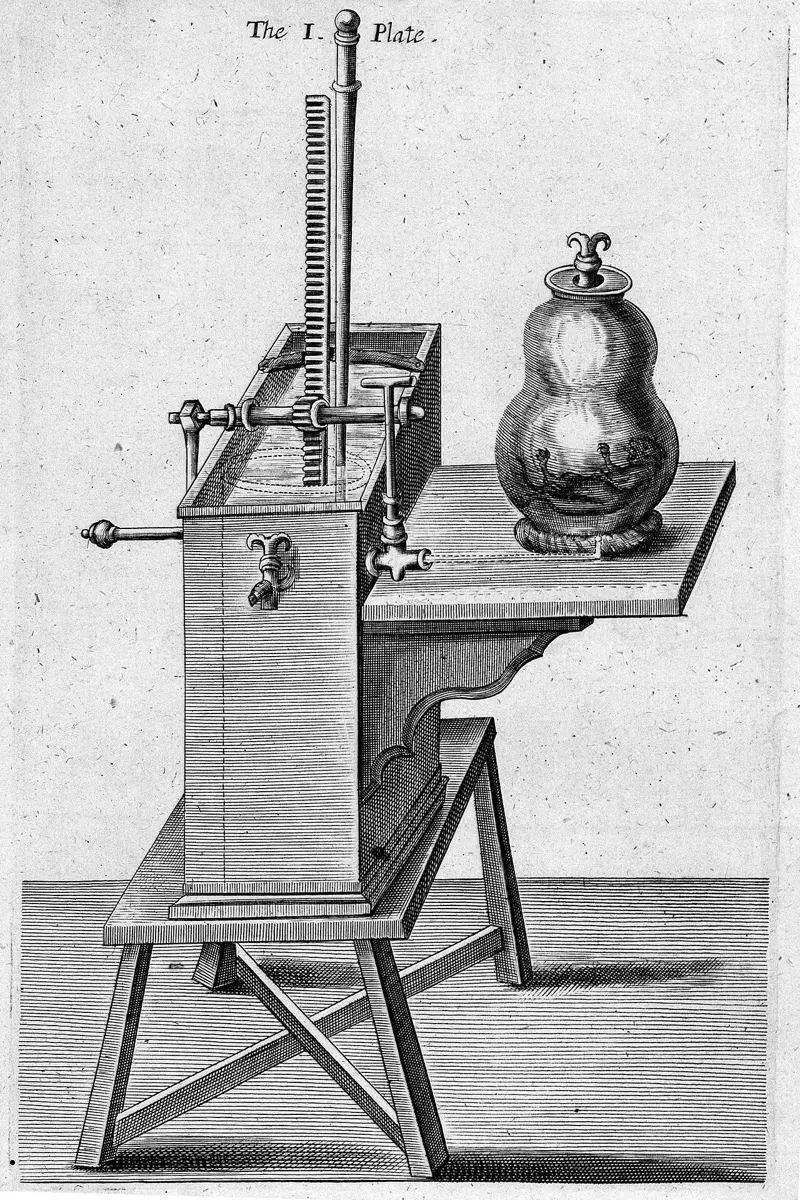
Put your finger over the nozzle of a syringe full of air and push the plunger. The air squeezes into a smaller space, and the harder you push, the smaller it gets. Let go, and the plunger springs back. Robert Boyle measured exactly how the volume of a trapped gas depends on the pressure on it, and in 1662 published what we now call Boyle’s law:
Boyle’s law: the volume of a fixed mass of a gas is inversely proportional to its pressure, provided its temperature stays the same.
“Inversely proportional” means that if the pressure becomes two times bigger, the volume becomes two times smaller; three times the pressure, a third of the volume. In symbols,
where is a constant for that amount of gas at that temperature. So for any two states of the same gas at the same temperature,
Here are the pressure and volume before the change, and after it. Any unit will do, as long as both pressures are in the same unit and both volumes in the same unit.
Plot pressure against volume and you get a curve: as the pressure goes up, the volume goes down, quickly at first and then more and more slowly. It never reaches zero volume, however hard you squeeze. Plot pressure against 1 ÷ volume instead and the same readings fall on a straight line through the origin. A straight line through the origin is the sign of direct proportion: is directly proportional to , which is just another way of saying Boyle’s law.
Why Boyle’s law happens
The pressure of a gas comes from its molecules hitting the walls of the container (you will see why in 7.4). Squeeze the same molecules into half the space, at the same temperature, and they move just as fast as before, but each one now crosses the box in half the time, so it reaches a wall twice as often. Twice as many hits on each square centimeter every second means twice the pressure.
A gas is squeezed at a steady temperature until its pressure is four times what it was. What happens to its volume?
Pick an answer to see why.
Boyle’s law around us
Breathing. To breathe in, your diaphragm moves down and your ribs move out, so your chest and lungs get bigger. The air in your lungs now has more room, so its pressure falls a little below the air outside, and air flows in. To breathe out, the chest gets smaller, the pressure inside rises above the air outside, and air is pushed out.
A syringe and a bicycle pump. Pulling a syringe’s plunger back makes more space, the pressure inside falls, and the liquid is pushed in by the air outside. Pushing a pump’s handle down squeezes the air into a smaller volume until its pressure is higher than the tyre’s, and then it pushes past the valve into the tyre.
Ears on a flight or a bus ride. On a flight from Kathmandu to Lukla, or a long climb by bus, the air pressure outside falls. The air trapped in your middle ear pushes outward on the eardrum until it escapes down the tube to your throat, and your ears “pop”. Swallowing or yawning opens that tube and helps.
A diver’s bubbles. A bubble breathed out by a diver deep in the sea grows as it rises, because the pressure of the water above it gets less and less. A diver coming up must keep breathing out: air held in the lungs would expand and could tear them.
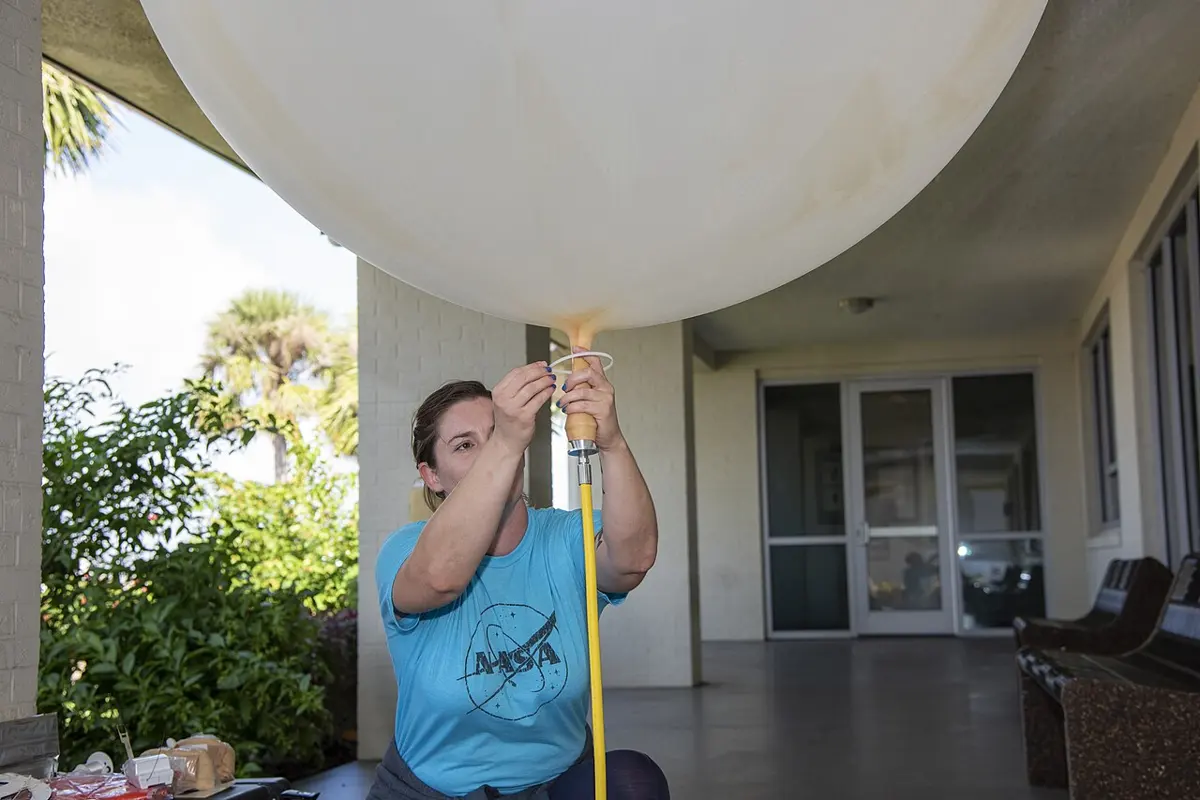
Weather balloons. A balloon carrying weather instruments is let go only partly filled. As it rises, the air pressure around it falls and the gas inside spreads out, so by about 30 km up the balloon is several times wider. It finally bursts, and the instruments come down by parachute.
Charles’s law
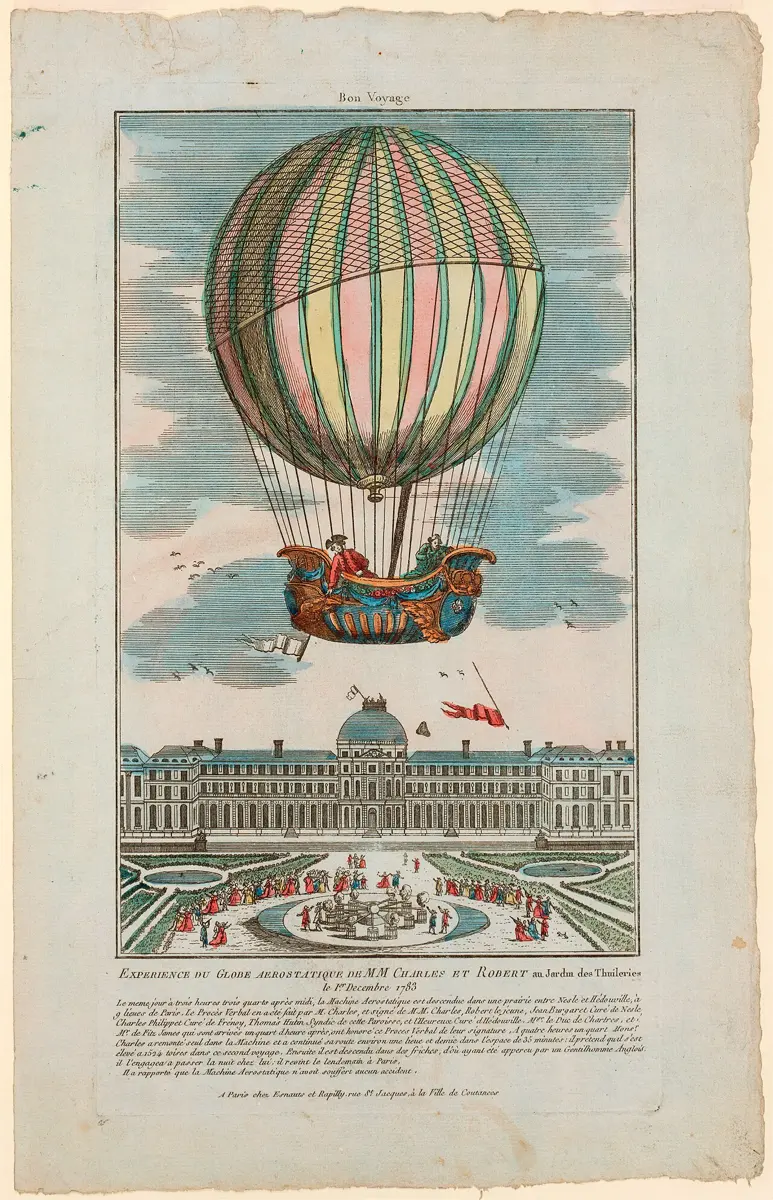
Put a dented table tennis ball into hot water and the dent pops out: the air inside expands when it is warmed. Leave a football in the sun and it gets harder; in the cold of a winter morning it feels softer. Gases expand when heated and contract when cooled, much more than solids and liquids do. The French scientist Jacques Charles studied this around 1787, and Joseph Louis Gay-Lussac measured it carefully and published it in 1802.
They found that every gas expands by the same fraction for each degree it is warmed, as long as its pressure is kept the same: about of its volume at 0 °C for every 1 °C rise. So a gas that fills 273 cm³ at 0 °C fills 274 cm³ at 1 °C, 373 cm³ at 100 °C, and would shrink to 173 cm³ at −100 °C.
Run that rule backward and something remarkable happens. At −273 °C, the gas would have lost 273 parts in 273 of its volume: its volume would be zero. No gas actually gets there, because every real gas turns liquid first, but the line on the graph points to −273 °C (more exactly −273.15 °C) as the coldest any temperature could ever be: absolute zero. The kelvin scale starts from it, so that 0 K = −273 °C. On the kelvin scale, the rule becomes very simple:
Charles’s law: the volume of a fixed mass of a gas is directly proportional to its absolute temperature, provided its pressure stays the same.
Here and must be in kelvin. Double the kelvin temperature, and the volume doubles.
A balloon holds 2 L of air at 0 °C. At the same pressure, at what temperature would it hold 4 L?
Pick an answer to see why.
Charles’s law around us
Hot air balloons. Heating the air inside the balloon’s envelope makes it expand. Since the envelope is open at the bottom, some of the air is pushed out, so the warm air left inside is lighter than the same volume of cool air outside, and the balloon rises.
Tyres and footballs. A tyre pumped hard in the cool of the morning becomes harder still after a long drive in the afternoon sun, as the warmed air inside tries to expand. Its rubber stops it expanding much, so its pressure rises instead (you will see this in 7.2). That’s why tyre pressures are best checked when the tyres are cold.
Puffed rice and popcorn. The water inside a grain of rice or maize turns to steam when it is heated, and hot steam takes up a huge volume; the grain bursts open. (Here the gas is being made as well as heated, so it’s more than Charles’s law alone.)
7.2 Combined gas equation
In real life, pressure and temperature often change together. A gas going up a mountain meets lower pressure and colder air. We can combine Boyle’s law and Charles’s law into one equation.
Take a fixed mass of gas from a first state to a second state in two steps, one law at a time.
In the first step, keep the temperature at and change the pressure from to . Call the new volume . By Boyle’s law,
In the second step, keep the pressure at and change the temperature from to . The volume goes from to . By Charles’s law,
Both (i) and (ii) give the same , so
Rearranging (multiply both sides by and divide both by ) gives the combined gas equation:
In other words, for a fixed mass of any gas, stays the same, however its pressure, volume and temperature change. Boyle’s and Charles’s laws are both inside it: keep fixed and it becomes ; keep fixed and it becomes . Keep fixed, and it gives a third law, : in a closed, rigid container, the pressure is proportional to the absolute temperature. This is sometimes called the pressure law, or Gay-Lussac’s law.
7.3 STP
The volume of a gas means nothing on its own: 100 cm³ of hydrogen at a high pressure holds more hydrogen than 100 cm³ at a low pressure, and 100 cm³ at 0 °C more than at 100 °C. To compare amounts of gas fairly, chemists quote volumes at one agreed temperature and pressure, called standard temperature and pressure (STP):
Standard temperature: 0 °C, which is 273 K.
Standard pressure: 1 atm, which is 760 mmHg, 76 cmHg or 101,325 Pa.
To change a volume to STP, use the combined gas equation with 273 K and 760 mmHg (or 101.3 kPa, or 1 atm) as the second state. At STP, one mole of any gas occupies about 22.4 L, its molar volume. A liter of hydrogen and a liter of carbon dioxide at STP contain the same number of molecules, even though the carbon dioxide is 22 times heavier.
Which of these is standard temperature and pressure, as used in this book?
Pick an answer to see why.
7.4 Kinetic theory of gases
Boyle’s and Charles’s laws describe what gases do, but not why. The kinetic theory of gases explains them by picturing a gas as a crowd of tiny particles in constant motion (“kinetic” comes from the Greek word for moving). Daniel Bernoulli first suggested it in 1738, and James Clerk Maxwell and Ludwig Boltzmann worked it out in the 1860s and 1870s. Its assumptions (postulates) are:
- A gas is made of a very large number of tiny particles, its molecules (or atoms, in a gas like helium). All the molecules of one gas are alike.
- The molecules are so small, and so far apart, that their own volume is negligible compared with the volume of the container. A gas is mostly empty space.
- The molecules move all the time, in straight lines, in every direction at random, until they hit another molecule or a wall.
- Their collisions with each other and with the walls are perfectly elastic: no kinetic energy is lost, so the molecules never slow down and stop.
- There are no forces of attraction or repulsion between the molecules, except at the moment they collide.
- A collision lasts a negligibly short time compared with the time between collisions.
- The pressure of a gas is caused by its molecules hitting the walls of the container.
- The average kinetic energy of the molecules is directly proportional to the absolute temperature of the gas.
From these assumptions, the gas laws follow.
Boyle’s law. At a fixed temperature, the molecules keep the same average speed. Halve the volume, and the same molecules, at the same speed, hit each part of the walls twice as often. The pressure doubles.
Charles’s law. Heat the gas and its molecules move faster (assumption 8), hitting the walls more often and harder. If the pressure is to stay the same, the gas must spread into a bigger space, so that the hits on each square centimeter are fewer again. The higher the temperature, the bigger the volume.
The pressure law. In a closed, rigid container, faster molecules have nowhere to spread to, so the walls take more and harder hits, and the pressure rises.
Diffusion. Molecules moving at random in straight lines spread through any space open to them, which is why the smell of food cooking soon reaches the next room (see 7.6).
According to the kinetic theory of gases, what happens to the molecules of a gas when its temperature is raised?
Pick an answer to see why.
7.5 Real and ideal gases
An ideal gas is a gas that obeys the gas laws, = constant, exactly, at every temperature and every pressure. It would be a gas whose molecules behave exactly as the kinetic theory assumes: with no volume of their own and no attraction for each other.
No such gas exists. Every gas we know is a real gas, and real gases follow the gas laws closely only at low pressure and high temperature. At high pressure or low temperature they stray from them, for two reasons, both of them assumptions of the kinetic theory that aren’t quite true.
The molecules do have a volume. At ordinary pressures, the molecules fill only about a thousandth of the space, and their own size doesn’t matter. Squeeze a gas to hundreds of atmospheres and the molecules are packed so close that they fill a real part of it. The gas can’t be squeezed as much as Boyle’s law says, so comes out more than for an ideal gas.
The molecules do attract each other. The attraction is weak, but when molecules are close together and moving slowly (at high pressure and low temperature), it pulls them toward one another. A molecule about to hit the wall is tugged back by its neighbors, so it hits more gently, and the gas can be squeezed more than Boyle’s law says; comes out less.
In everyday conditions, around 1 atm and room temperature, gases such as hydrogen, helium, nitrogen and oxygen behave almost exactly like an ideal gas: the gas laws are right to better than 1%. Gases whose molecules attract each other more strongly, such as carbon dioxide, ammonia and sulphur dioxide, stray more, and they are also the gases that are easiest to turn into liquids.
| Ideal gas | Real gas |
|---|---|
| Obeys the gas laws exactly at all temperatures and pressures. | Obeys them closely only at low pressure and high temperature. |
| Its molecules have no volume. | Its molecules have a small volume of their own. |
| No attraction between its molecules. | Weak attraction between its molecules. |
| Could never be turned into a liquid. | Turns into a liquid when cooled enough and squeezed. |
| Doesn’t exist; a model. | Every gas there is: hydrogen, oxygen, carbon dioxide… |
7.6 Graham’s law of diffusion
Open a bottle of perfume in one corner of a room and soon it can be smelled in the other. Its molecules spread through the air by themselves, without being blown. This spreading of the particles of a gas from where there are more of them to where there are fewer, by their own random motion, is called diffusion. Gases also effuse: they leak out, molecule by molecule, through a tiny hole, as helium slowly escapes through the rubber of a party balloon.
Do all gases spread equally fast? In the 1830s and 1840s the Scottish chemist Thomas Graham timed many gases diffusing and effusing, and found that light gases spread much faster than heavy ones:
Graham’s law of diffusion: at the same temperature and pressure, the rate of diffusion of a gas is inversely proportional to the square root of its density.
At the same temperature and pressure, the density of a gas is proportional to its molar mass (the same volume holds the same number of molecules), so the law can also be written
The rate is how much gas diffuses in a given time. If the same volume of each gas is timed, the time taken is longer for the slower gas, so the times go the other way: .
Why the square root? At the same temperature, the molecules of every gas have the same average kinetic energy, . A molecule 16 times heavier must then move = 4 times more slowly, and the gas spreads 4 times more slowly.
Which of these gases diffuses fastest at the same temperature and pressure?
Pick an answer to see why.
Applications of Graham’s law
Smells spread, and some faster than others. The smell of food cooking, a perfume or a gas leak reaches us by diffusion through the air. The cooking gas in an LPG cylinder has no smell of its own, so a strong-smelling compound (ethyl mercaptan) is added to it in tiny amounts, to warn of a leak. LPG is heavier than air (propane is about one and a half times as dense, butane about twice), so it spreads slowly and collects near the floor: open the doors and windows, and never switch on a light or a fan near a leak.
Helium balloons go flat sooner. A party balloon filled with helium (M = 4) goes soft within about a day, while one blown up with air (M about 29) lasts much longer. The small, fast helium atoms escape through the rubber about times faster than air does, and more easily still because they are so small.
Finding molar masses. Timing how fast an unknown gas diffuses or effuses, beside a gas whose molar mass is known, gives the unknown gas’s molar mass, as in the example above.
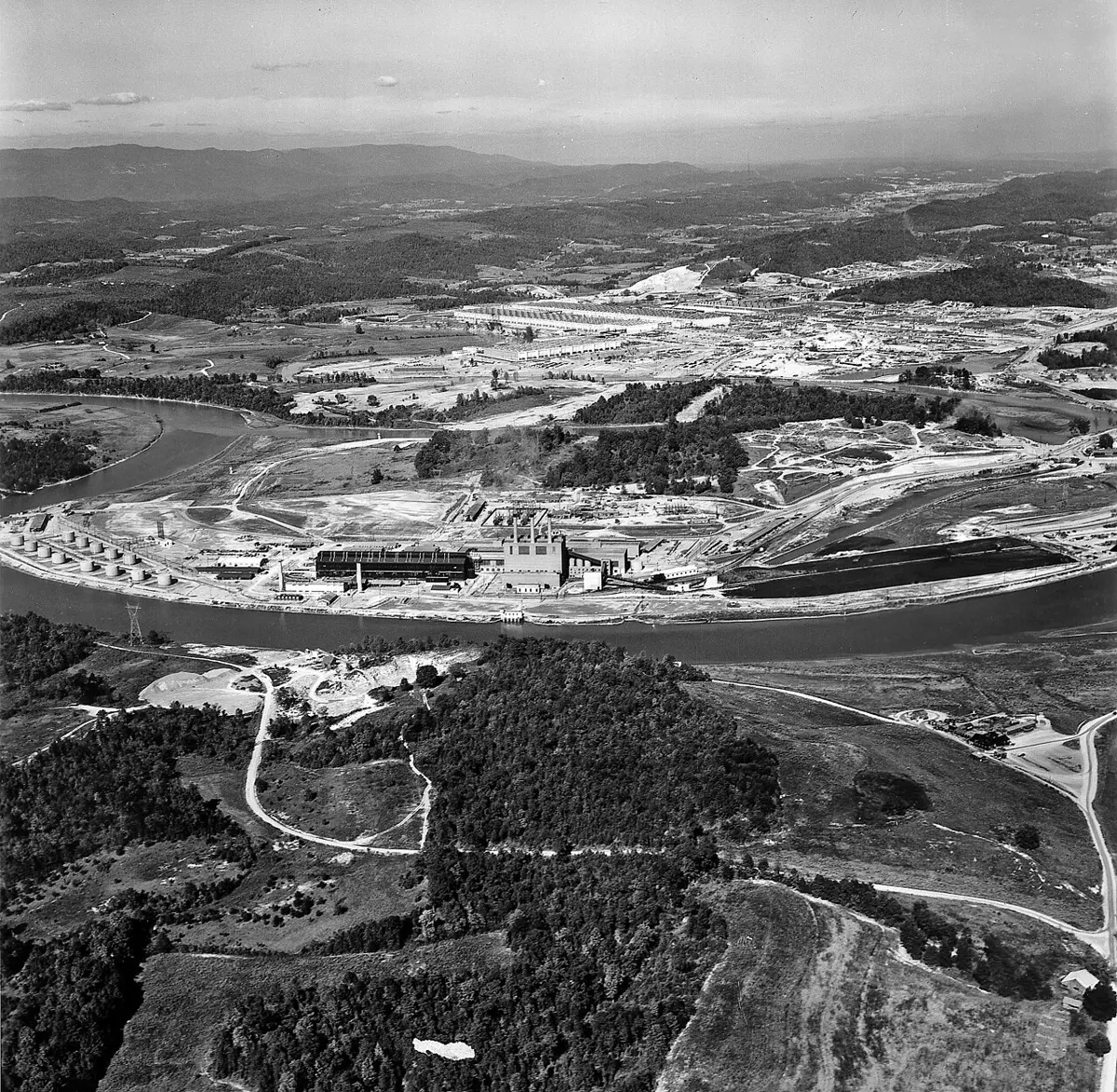
Separating isotopes. Natural uranium is mostly uranium-238, with only 0.7% of the uranium-235 that nuclear power stations need. Turned into the gas uranium hexafluoride (UF₆), the two isotopes differ in molar mass only a little, 349 against 352 g/mol, so the lighter one diffuses through a porous wall only = 1.0043 times faster. Pumping the gas through thousands of such walls, one after another, slowly built up the uranium-235. This was the main way uranium was enriched from the 1940s; the last such plants closed in the 2010s, and fast-spinning centrifuges are used instead.
Exercise
1. Choose the correct option
a. A graph of the pressure of a fixed mass of gas against 1 ÷ its volume, at constant temperature, is:
Pick an answer to see why.
b. At constant pressure, a gas is heated from 100 K to 200 K. Its volume:
Pick an answer to see why.
c. Which equation is the combined gas equation?
Pick an answer to see why.
d. Absolute zero is:
Pick an answer to see why.
e. Which is an assumption of the kinetic theory of gases?
Pick an answer to see why.
f. A real gas behaves most like an ideal gas at:
Pick an answer to see why.
g. Under the same conditions, the rate of diffusion of hydrogen (M = 2) compared with that of oxygen (M = 32) is:
Pick an answer to see why.
h. Standard pressure, as used in this book, is:
Pick an answer to see why.
2. Give reasons
A balloon blown up indoors shrinks when it is taken out on a cold winter night.
Hint
Answer
Temperatures in the gas laws must be written in kelvin, not in degrees Celsius.
Hint
Answer
A weather balloon is filled only partly before it is launched.
Hint
Answer
Ammonia spreads through a room faster than hydrogen chloride gas.
Hint
Answer
Air in a car’s tyres is checked when the tyres are cold.
Hint
Answer
3. Differentiate between
Boyle’s law and Charles’s law
Hint
Answer
Real gas and ideal gas
Hint
Answer
Diffusion and effusion
Hint
Answer
4. Answer the following questions
State Boyle’s law. Explain it using the kinetic theory of gases.
Hint
Answer
State Charles’s law. How does it lead to the idea of absolute zero?
Hint
Answer
Derive the combined gas equation from Boyle’s law and Charles’s law.
Hint
Answer
What is STP? Why is it needed?
Hint
Answer
Write any four assumptions of the kinetic theory of gases.
Hint
Answer
Why do real gases stray from the gas laws at high pressure and low temperature?
Hint
Answer
State Graham’s law of diffusion, and write two of its uses.
Hint
Answer
5. Numerical problems
A gas occupies 600 cm³ at 760 mmHg. What will its volume be at 380 mmHg, at the same temperature?
Hint
Answer
A balloon holds 2.0 L of air at sea level, where the pressure is 101 kPa. It is carried to the top of Mount Everest, where the pressure is 33.7 kPa. Find its volume there, taking the temperature to be the same.
Hint
Answer
250 cm³ of a gas at 7 °C is heated to 147 °C at constant pressure. Find its new volume.
Hint
Answer
At what temperature will 100 cm³ of a gas at 0 °C occupy 150 cm³, the pressure staying the same?
Hint
Answer
2.0 L of a gas is at 27 °C and 1 atm. Find its volume at 127 °C and 2 atm.
Hint
Answer
A glass bottle is sealed with air inside at 27 °C and 1 atm. To what pressure does the air rise if the bottle is heated to 127 °C? (Take the bottle’s volume to stay the same.)
Hint
Answer
500 cm³ of a gas is collected at 27 °C and 700 mmHg. Find its volume at STP.
Hint
Answer
Compare the rates of diffusion of methane (CH₄, M = 16) and sulphur dioxide (SO₂, M = 64).
Hint
Answer
50 cm³ of oxygen (M = 32) diffuses through a small hole in 40 s. How long will 50 cm³ of carbon dioxide (M = 44) take under the same conditions?
Hint
Answer
A gas diffuses through a porous plug at half the rate of methane (M = 16). Find its molar mass.
Hint
Answer
A weather balloon holds 5.0 m³ of hydrogen at the ground, where the pressure is 100 kPa and the temperature 27 °C. It rises to 30 km, where the pressure is 1.2 kPa and the temperature −46 °C. What would the hydrogen’s volume be there, if the balloon’s rubber didn’t hold it back? Is it surprising that such balloons burst?
Hint
Answer
Think: A student says, “If I heat a gas from 20 °C to 40 °C at constant pressure, its volume doubles.” Explain the mistake and find the real change in volume.
Hint
Answer
Printable PDFs
- The unit as a book (A5) 24 pages Answers as an A4 booklet, 6 sheets
- Study notes 2 pages
- Worksheet 5 pages Answer key
- Harder practice questions 2 pages Answer key
Practice every question in the book, and keep track of the ones you miss →
Found a mistake? Please tell us.