
Twenty thousand years ago, people were already living in South Asia, and their world looked very different. The sea was about 120 m lower than it is today, so Sri Lanka was joined to India by dry land. Ice more than 3 km thick covered most of Canada and northern Europe. Himalayan glaciers reached farther down their valleys, the summer monsoon was weaker, and the world as a whole was about 5 to 6 °C colder than it was before factories began. That was the coldest part of the last ice age.
Nobody burned coal in an ice age, and nobody stopped burning it to end one. So what changed the climate then? And what sets a planet’s temperature in the first place? This topic starts with a simple model of the whole Earth, energy in and energy out, then uses it to sort the causes of climate change by how long they take: a year or two for a volcano, a hundred thousand years for an ice age, a hundred million for the air itself.
Energy in, energy out
You know from Grade 10 that the Sun warms the Earth, that the warm Earth gives off infrared, and that greenhouse gases hold some of that infrared back Grade 10: The Earth as a natural greenhouse. You also met the natural causes of climate change there: changes in the Sun, in how much sunlight the Earth reflects, and volcanoes Grade 10: Causes of climate change. Here we put numbers on them, so that you can work out what each one does.
Start with a bucket. Put a bucket with a small hole in its bottom under a tap. At first the water level rises. But the deeper the water, the harder it pushes out through the hole, so the faster it leaks. Soon the water leaks out as fast as it pours in, and the level stops rising. It stays there for as long as nothing changes. Turn the tap up, and the level rises to a new, higher place, then stops again.
The Earth works the same way, with energy instead of water.
- Energy in is the sunlight the Earth absorbs: the tap.
- Energy out is the infrared the Earth gives off to space: the hole. The warmer the Earth, the more infrared it gives off, just as deeper water leaks faster.
- The temperature is the water level. It rises while more energy comes in than goes out, and falls while more goes out than comes in. It settles where energy out equals energy in.
This is the Earth’s energy balance, the simplest model of a planet’s climate. Everything that changes the climate does it by changing one of three things: how much sunlight arrives, how much of it is reflected, or how easily the infrared gets out.
How much sunlight comes in
Above the air, sunlight carries about 1361 W onto every square meter facing the Sun. Measured by satellites since 1978, this number is called the total solar irradiance (it was once called the solar constant, but it isn’t quite constant).
The Earth doesn’t get 1361 W on every square meter, though. Sunlight arrives in parallel rays, so the Earth catches exactly as much as a flat disc as wide as itself would: the disc that makes its shadow. That disc has an area of πR², where R is the Earth’s radius. But the Earth is a ball, it turns, and its whole surface, 4πR², shares that sunlight between day and night, equator and poles. So on average, each square meter of the Earth gets a quarter: 1361 ÷ 4 = 340 W/m².
About 30% of that is reflected straight back to space, mostly by clouds, and by snow, ice and bright desert. The share reflected is the Earth’s albedo, about 0.30. The rest, about 240 W/m², is absorbed and warms the Earth.
How much infrared goes out
Everything gives off infrared, and the hotter it is, the more. The Austrian physicists Josef Stefan (who found it from measurements in 1879) and Ludwig Boltzmann (who showed why, in 1884) worked out how much. A surface at temperature T, in kelvin, gives off
watts on every square meter, where σ, the Stefan–Boltzmann constant, is 5.67 × 10⁻⁸ W/(m² K⁴). This is the Stefan–Boltzmann law. The fourth power matters: double the temperature in kelvin and the infrared goes up 2⁴ = 16 times. That is why the balance is so steady. A slightly warmer Earth gives off quite a lot more infrared, which cools it back.
Remember that temperature in kelvin is the temperature in °C plus 273: 15 °C is 288 K.
So the Earth’s surface gives off about 390 W/m², but only about 240 W/m² gets out to space, the same as the sunlight absorbed. That 39% held back is what keeps the Earth 33 °C warmer than the frozen 255 K planet.
The widget’s temperature settles within a few years, because only the top 100 m or so of the sea warms quickly. The deep ocean holds far more heat and takes centuries to catch up, so the real Earth goes on warming for a long time after a lasting change.
In the bucket model, what does taping over part of the hole stand for?
Pick an answer to see why.
Small changes in the balance
Because energy out goes as T⁴, a small change in the energy coming in changes the temperature in proportion. For a change ΔF in the energy absorbed, out of F = 240 W/m², the temperature T = 288 K changes by about
if nothing else changes. A change in the balance like ΔF is called a climate forcing, measured in W/m².
The simple model leaves out something important. When the Earth warms or cools, other things change with it: snow and ice melt or spread, the air holds more or less water vapor, and clouds change. Each of these changes the balance again, and most of them make the first change bigger. These are feedbacks, and they are the subject of the topic Can One Change Set Off Many More?. With them, the Earth’s real response to a lasting forcing is about two or three times what the simple model gives.
Causes that work over years
Now we can sort the causes of climate change by how long they take. The Grade 10 book lists them; the clearest way to understand them is by their time scales.
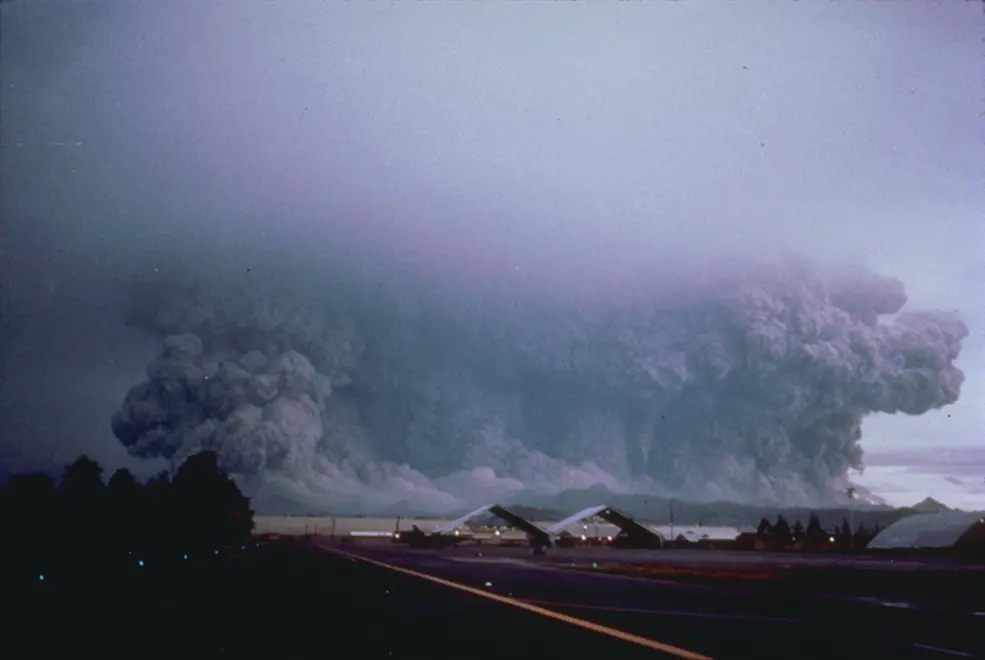
Volcanoes. A big eruption like Pinatubo puts a veil of sulphur droplets into the stratosphere, above the rain that would wash them out in days. They reflect sunlight and cool the Earth for one to three years. The carbon dioxide a volcano gives out warms the Earth, but today’s volcanoes give out less than 1% of the carbon dioxide that people do, so over years and decades their cooling matters more.
Ocean swings. Every two to seven years, the winds over the tropical Pacific weaken, and a huge pool of warm water spreads east across the ocean’s surface. This is El Niño; its opposite, with stronger winds and cooler water, is La Niña. Nothing is added to the Earth’s energy: heat is only moved, from deep water to the surface and back. But the surface is what we measure, and what warms the air, so in an El Niño year the world is about 0.1 to 0.2 °C warmer, and in a La Niña year cooler. El Niño years also often bring a weaker monsoon to South Asia. Part of the reason 2024 was the hottest year on record (as of 2025) was a strong El Niño, on top of the long rise from greenhouse gases.
Which of these cools the Earth for a year or two, then stops?
Pick an answer to see why.
Causes that work over centuries
The Sun. The Sun’s output rises and falls a little over its 11-year sunspot cycle, by about 0.1%, as you worked out: less than 0.1 °C at the Earth. There are slower changes too. Between about 1645 and 1715, hardly any sunspots were seen, a time called the Maunder Minimum, when the Sun was probably a little dimmer than usual.
It fell in the middle of the Little Ice Age, roughly 1300 to 1850, when winters in Europe were often bitter, glaciers in the Alps advanced over farms, and London’s River Thames sometimes froze hard enough for fairs on the ice. The cooling was a few tenths of a degree, mostly in the Northern Hemisphere. Today, climate scientists think it was caused mostly by a run of big volcanic eruptions, with some help from the quieter Sun.
People. Since about 1850, people have burned coal, oil and gas and cut down forests, and raised the carbon dioxide in the air from about 280 parts per million (ppm) to over 420 ppm (as of 2025). That has added a forcing of about 2 W/m² from carbon dioxide alone, more with methane and the other gases, and the world has warmed by about 1.3 °C (as of 2025). Satellites show that the Sun has not got brighter since 1978, so it can’t be the cause. What this means for the climate you will grow up in is the topic What Will the Climate Be Like When You Are Grown Up?.
The ice ages: causes that work over a hundred thousand years
For the last 2.6 million years, the Earth has been in an age of ice ages. Again and again, huge ice sheets have grown over North America and northern Europe, and then melted. How do we know, and what drives them?
Reading the ice
Snow falling on Antarctica never melts. Year after year it is buried, squeezed into ice, and the air between the snowflakes is trapped as tiny bubbles. At Dome C, high on the Antarctic ice sheet, scientists of the European project EPICA drilled down 3.2 km, through ice that took about 800,000 years to pile up, and brought it up in pieces.
Two things in that ice tell the story. The air in the bubbles is a sample of the old air itself, so its carbon dioxide can be measured directly. And the water in the ice holds a record of the temperature: in colder times, less of the heavy kind of hydrogen atom (deuterium) in the water makes it all the way to Antarctica in the snow. So the ice gives both the temperature and the carbon dioxide, year by year, for 800,000 years.
Look at the shape of the red line. The Earth spends most of its time in long, cold ice ages, interrupted by short warm times, called interglacials, of ten or twenty thousand years each. We are in one now: the last ice age ended about 11,700 years ago. Ice ages ended about 11,700, 130,000, 240,000, 335,000 and 425,000 years ago, roughly every 100,000 years. (Antarctica’s temperature swings more than the world’s: about 10 °C there, about 5 or 6 °C for the world as a whole.)
Three slow changes in the orbit
Long ago, astronomers worked out that the Earth’s orbit and axis change slowly, because of the pulls of the Moon and the other planets, mostly Jupiter and Venus. There are three changes, now called the Milankovitch cycles:
- a.Stretch (eccentricity). The Earth’s orbit changes from almost a circle to a slightly stretched ellipse and back, about every 100,000 years, and on a longer cycle of 405,000 years. Today it is nearly round (eccentricity 0.017), and at its most, in the last million years, 0.057. Even then it is nearly a circle, with the Sun a little off center.
- b.Tilt (obliquity). The Earth’s axis is tilted 23.4° from upright today. The tilt swings between about 22.1° and 24.5° every 41,000 years. More tilt means hotter summers and colder winters, most of all near the poles.
- c.Wobble (precession). The axis wobbles round like a spinning top’s, once in about 26,000 years. Combined with the slow turning of the orbit itself, this moves the time of year when the Earth is closest to the Sun all the way round the calendar about every 23,000 years. Today the Earth is closest to the Sun in early January, in the northern winter. In about 11,000 years it will be closest in July.
But here is the puzzle. Add up the sunlight over the whole year and the whole Earth, and these changes hardly alter it at all: even the most stretched orbit gives less than 0.2% more in the year. The tilt and the wobble don’t change the year’s total at all. They only move the sunshine around, between the seasons, and between the poles and the equator. How can moving sunlight around start and end ice ages?
What the orbit does: cool summers in the far north
The answer is in the summers, far to the north. Almost all the land near the Arctic is in the Northern Hemisphere: Canada, Alaska, Siberia, Scandinavia. Snow falls on it every winter. Whether an ice sheet grows depends on whether that snow survives the summer. If summers are cool, some of the snow doesn’t melt; next winter more falls on top, and year after year it builds up into an ice sheet. If summers are warm, it all melts.
When the tilt is small, and the Earth is farthest from the Sun in the northern summer, and the orbit is stretched enough to make that matter, summers in the far north are cool. The average July sunshine at 65° north (the latitude of central Alaska) changes by about 100 W/m² over these cycles: between about 390 and 500 W/m² in the last 800,000 years. Pick “Summer sun” in the widget: the big warmings that ended each ice age came while it was rising strongly.
Carbon dioxide and ice make the change bigger
Moving sunlight around doesn’t, by itself, cool the whole Earth by 5 °C. The orbit starts the change; two things inside the climate make it much bigger.
- a.Ice reflects sunlight. As ice sheets spread, they reflect sunlight that dark land and sea would have absorbed. The Earth absorbs less, and cools more.
- b.Carbon dioxide follows. Pick “CO₂” in the widget. In the ice ages it fell to about 180–200 ppm; in the warm times it rose to about 250–300 ppm. Colder seas dissolve more carbon dioxide, and changes in the winds and currents round Antarctica stored more of it in the deep ocean. Less carbon dioxide means a weaker greenhouse effect, which cools the Earth more.
Each change makes the next bigger. This is how a small push from the orbit turns into an ice age, and why the ice ages are so sensitive to the orbit.
What an ice age does
| Peak of the last ice age, about 20,000 years ago | Before factories | |
|---|---|---|
| world’s average temperature | about 5–6 °C colder | about 14 °C |
| carbon dioxide | about 190 ppm | about 280 ppm |
| ice sheets | over North America and northern Europe, up to 3–4 km thick, as well as Antarctica and Greenland | only Antarctica and Greenland |
| sea level | about 120 m lower | today’s |
| rain | drier in most places; the South Asian monsoon weaker | today’s monsoon |
| plants and animals | forests shrank, grassland and tundra spread; mammoths in Europe and Siberia | today’s forests and grassland |
Causes that work over millions of years
Go further back, and the climate has changed by far more. Around 50 million years ago, forests grew near the North Pole and crocodile relatives lived in the Arctic; the world was 10 °C or more warmer than today, and there was little or no permanent ice anywhere. More than 600 million years ago there were times when ice seems to have reached nearly to the equator: Snowball Earth.
Over millions of years the biggest cause is what the air is made of, above all its carbon dioxide, which is set by two slow processes:
- Volcanoes add carbon dioxide, from deep inside the Earth, a little every year.
- Rain takes it away. Carbon dioxide dissolves in rain to make a weak acid, which slowly breaks down rocks like granite and basalt, turning their minerals into clay. Rivers carry the calcium it frees to the sea, where sea creatures build it into shells of calcium carbonate, which pile up as limestone: the carbon is locked away. You met this kind of weathering in What Does Water Do to Rock?. (Dissolving limestone itself doesn’t count: when its calcium carbonate is made again in the sea, the carbon dioxide comes back out.)
This works as a very slow thermostat. If the Earth gets warmer, there is more rain and the rock dissolves faster, which takes carbon dioxide out of the air faster and cools it again. If it gets colder, the rock dissolves more slowly and the volcanoes’ carbon dioxide builds up. It takes hundreds of thousands of years to act, far too slowly to help with the change today. How the carbon moves between the air, the sea, the rocks and living things is the topic Where Does the Carbon Go?, and how living things changed the air is How Did Life Change the Air?.
Other slow changes join in. Continents move, a few centimeters a year, changing the ocean currents that carry heat to the poles. About 34 million years ago, as the carbon dioxide fell and Antarctica became surrounded by ocean, a great ice sheet grew on it for the first time. And the Sun itself was about 25–30% dimmer when the Earth was young. With so much less sunlight, the Earth should have frozen, yet rocks show there was liquid water: a much stronger greenhouse effect, from far more carbon dioxide and other gases, must have kept it warm.
Questions
Which of these does not change the total sunlight reaching the top of the Earth’s air in a year?
Pick an answer to see why.
In the ice-core record, carbon dioxide was about 180–200 ppm in the ice ages and about 250–300 ppm in the warm times. Today it is over 420 ppm. What does this tell you?
Pick an answer to see why.
Use the energy-balance model to explain why the Earth’s temperature doesn’t keep rising, even though sunlight pours onto it all the time.
Answer
The Earth gives off infrared, and the amount rises steeply with its temperature (σT⁴). If the Earth absorbs more energy than it gives off, it warms; as it warms, it gives off more infrared, until energy out equals energy in. Then its temperature stays steady. It would only change if something changed the energy in (the Sun, or the share reflected) or how easily the infrared gets out (greenhouse gases).
Mars is about 1.52 times as far from the Sun as the Earth, and reflects about 25% of the sunlight that reaches it. a. Work out the sunlight above Mars’s air. b. Work out the temperature at which Mars would be in balance. c. Mars’s average surface temperature is about −60 °C. What does this suggest about its greenhouse effect?
Hint
Sunlight falls off as 1 ÷ distance²: divide 1361 W/m² by 1.52². Then ÷ 4, take off the 25% reflected, and use σT⁴ = energy in.
Answer
- a.1361 W/m² ÷ 1.52² = 1361 ÷ 2.31 = 589 W/m².
- b.Absorbed: 589 ÷ 4 × (1 − 0.25) = 110 W/m². Then T⁴ = 110 ÷ (5.67 × 10⁻⁸) = 1.94 × 10⁹, so T = 210 K, which is −63 °C.
- c.The real temperature, about −60 °C, is only a few degrees above that, so Mars has only a very weak greenhouse effect. Its air is mostly carbon dioxide, but it is so thin (less than 1% of the Earth’s air pressure) that it holds back little infrared.
Sort these causes of climate change by the time over which they act, shortest first, and say for each whether it changes the sunlight arriving, the share reflected, or how easily infrared escapes: a. carbon dioxide from burning fossil fuels, b. the wobble of the Earth’s axis, c. a big volcanic eruption, d. carbon dioxide taken from the air by the weathering of new mountains.
Answer
- c.A big volcanic eruption, one to three years: its droplets increase the share of sunlight reflected.
- a.Carbon dioxide from fossil fuels, decades to centuries: it makes it harder for infrared to escape.
- b.The wobble, about 23,000 years: it changes the sunlight arriving at each latitude in each season (not the year’s total).
- d.Weathering of mountains, millions of years: it removes carbon dioxide, so infrared escapes more easily.
Explain how small changes in the Earth’s orbit, which hardly change the total sunlight the Earth receives in a year, can start and end ice ages.
Answer
The orbit’s changes move sunshine between the seasons and latitudes. What decides whether an ice sheet grows is whether the winter’s snow survives the summer on the large land areas near the Arctic, in Canada, Siberia and Scandinavia. When the tilt is small and the northern summer comes when the Earth is far from the Sun, summers there are cool, the snow builds up year after year, and ice sheets grow. Then two feedbacks make the change much bigger: the ice reflects more sunlight, and the oceans take more carbon dioxide out of the air, weakening the greenhouse effect. When the summer sunshine rises strongly again, the ice melts, less sunlight is reflected, carbon dioxide comes back out of the oceans, and the ice age ends.
Use the widget 800,000 years of ice ages. a. How many years ago was the coldest point of the last ice age, and how much colder was Antarctica than in recent times? b. What was the carbon dioxide then? c. Find the warm time just before ours. Was it warmer or colder than today in Antarctica?
Answer
- a.The coldest stretch was from about 30,000 to 18,000 years ago; the lowest point is about 26,000 years ago, about 10 °C colder in Antarctica than in recent times.
- b.About 185 ppm, near the lowest in the record.
- c.About 128,000 years ago, Antarctica was about 3 °C warmer than in recent times. At that time the northern summer sunshine was especially strong, and the sea was several meters higher than today.
A friend says: “The climate has always changed naturally, so today’s warming must be natural too.” Use what you have learned to answer them.
Answer
It’s true that the climate has always changed, but every natural change had a cause, and we can check each one now. The orbit changes over tens of thousands of years, far too slowly for a warming of 1.3 °C in 150 years, and over the last 10,000 years it has been slowly weakening the northern summer sunshine, which on its own would cool the Earth a little. Satellites show the Sun hasn’t got brighter since 1978. Volcanoes cool the Earth for a year or two, and today’s volcanoes give out less than 1% of people’s carbon dioxide. El Niño only moves heat around for a year or two. What has changed is the carbon dioxide, from 280 to over 420 ppm, far beyond anything in 800,000 years, from burning fossil fuels. Past climate changes actually show how strongly the Earth responds when its energy balance is changed: that is a reason to take today’s change seriously, not to ignore it.
Where to go next
- Can One Change Set Off Many More? Melting ice and rising carbon dioxide made the ice ages bigger. How feedback loops make a small change grow, or keep the climate steady.
- Where Does the Carbon Go? Following carbon through the air, the sea, the rocks and living things, and where our carbon dioxide ends up.
- What Will the Climate Be Like When You Are Grown Up? Temperature records, Himalayan glaciers, and what climate models forecast for Nepal.