
Walk along a maize terrace in late summer and look closely. Near the wall, one plant stands taller than your father, with two fat cobs. A few steps away, another plant is shorter than you, thin and pale, with one small cob. The same farmer sowed them, on the same day, in the same field.
So why are they so different? Was one seed better than the other? Or did one plant get more of something: more water, more sunlight, more manure, more room? Farmers have argued about this for thousands of years: is it the seed or the soil? In this topic you will find that the answer is both, and you will learn how scientists use evidence to tell which one matters, and when.
How a plant grows
You know from Grade 8 how a plant starts: a seed takes in water, gets air and warmth, and its embryo wakes up and germinates Grade 8: Factors affecting germination. That is only the first few days. After that, the seedling has to grow for weeks or months, into a plant that can flower and make seeds of its own.
To grow, a plant needs two things:
- Food, which it makes itself. You learned in Grade 6 that a green plant makes food by photosynthesis: in sunlight, its leaves join carbon dioxide from the air with water from the soil, to make sugar. The green chlorophyll in its chloroplasts catches the light Grade 8: Plastids. Almost everything a plant is made of was built from that sugar.
- Nutrients from the soil: nitrogen, phosphorus, potassium and the other elements a plant needs in small amounts, which you will meet in Grade 9 Grade 9: Necessary nutrients for plants.
With them, the plant makes new cells at the tips of its shoots and roots, and the cells grow bigger. That is growth: a lasting increase in the size and mass of a living thing.
How to measure growth
You can measure a plant’s growth in several ways:
- a.its height, with a ruler;
- b.the number of leaves, or the size of the biggest leaf;
- c.its mass, on a scale;
- d.for a crop, the yield: how much grain or fruit it gives.
Height is the easiest, but it can fool you, as you will see. Mass is the best measure of how much a plant has really grown. Scientists often dry the plant in an oven first and weigh its dry mass, because the amount of water in a plant changes from hour to hour.
Two kinds of cause
Everything that affects how a plant grows belongs to one of two groups.
- Environmental factors are the plant’s surroundings: how much light, water, nutrients, space and warmth it gets. The soil.
- Genetic factors are what the plant inherited from its parents, in its seed: what kind of plant it is (a species, like maize or grass) and which variety of that kind (a tall local maize or a short new one). The seed. For animals, the same thing is a breed: a Jersey cow or a local cow.
You will learn in Grade 10 how characters are passed on from parents, in genes Grade 10: Heredity and Mendelism. Here you don’t need to know how genes work: only that the seed carries something from the parents that decides what kind of plant it can become.
Which of these is a genetic factor in the growth of a rice plant?
Pick an answer to see why.
What the surroundings give
Light
Every year at Dashain, families sow barley or maize in a dark room on the first day, Ghatasthapana. By the tenth day the shoots of jamara are a hand long, and they are yellow, not green. Why?
A shoot grown in the dark has no light to make chlorophyll with, so it stays pale yellow. And it grows tall and thin, fast, as if it is stretching to find light. A seedling growing under a stone or deep in the soil does just that: it pushes up quickly until it reaches the light, and only then opens its leaves and turns green. Growing tall, thin and pale in the dark is called etiolation.
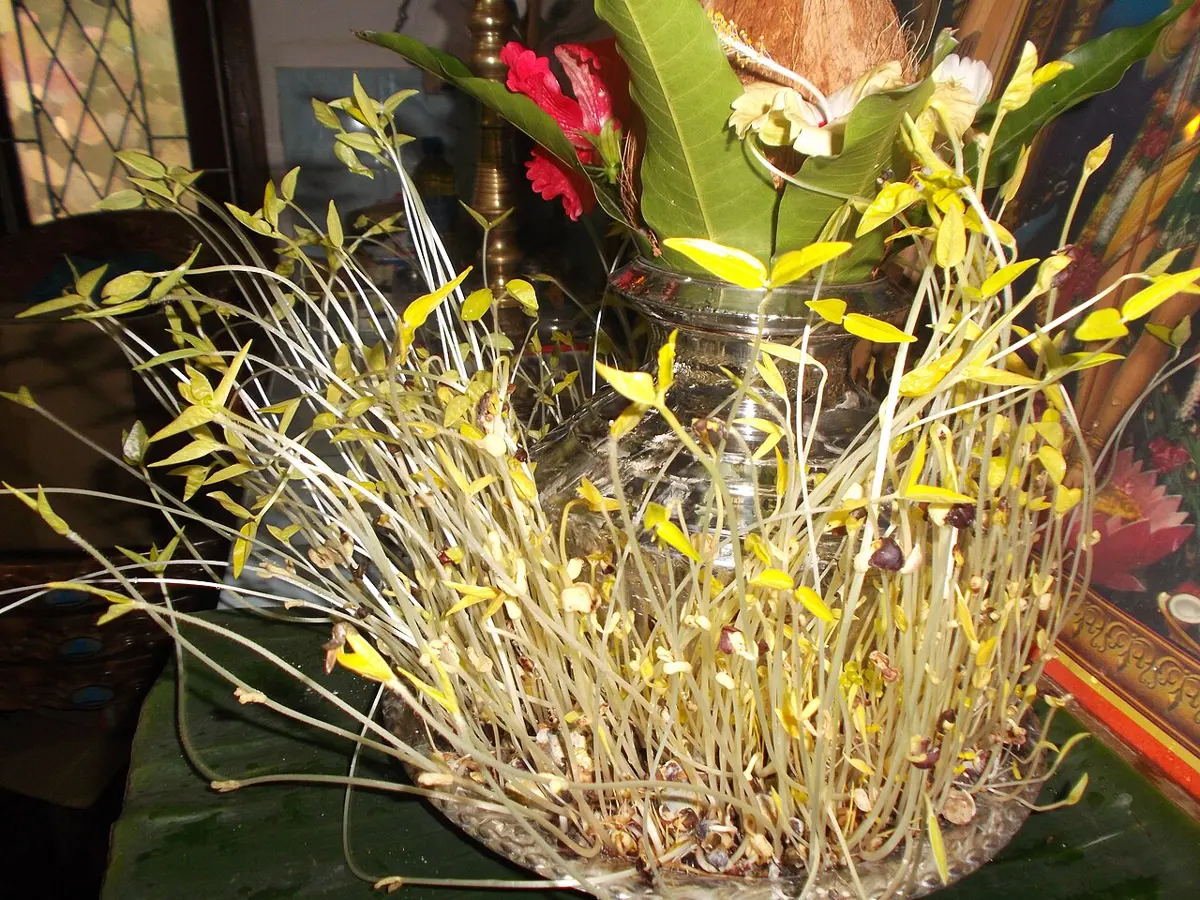
So is the dark-grown seedling growing better, because it is taller? No. It is living on the food stored in its seed, and it can’t make any more without light. Weigh the two after drying, and the one in the light is heavier: it has built more. Leave the dark one in the dark, and it dies when its seed’s food runs out. This is why height alone can fool you.
Jamara grown in a dark room is yellow because…
Pick an answer to see why.
Water
In a dry spell, the leaves of maize roll up and droop. A plant short of water closes the tiny pores in its leaves to save water. But those are the pores that let carbon dioxide in, so with them closed, photosynthesis slows down, and the plant makes less food. Short of water for long, it grows less, flowers late, and gives less grain. That is why a late or weak monsoon means a smaller rice harvest. And water can be too much: you saw in Grade 8 that seeds under water rot for lack of air, and the roots of most crops (not rice) suffer the same in waterlogged soil.
Nutrients from the soil
In Grade 9 you will meet Harka Bahadur, whose maize grew unevenly until he tested his soil and gave each part of his field the fertilizer it lacked Grade 9: Harka Bahadur’s maize. A plant short of nitrogen stays small and its lower leaves turn yellow; short of phosphorus, its roots stay weak. Fertilizer or compost puts back what the soil lacks, and the plant grows more. But only up to a point, as you will see below.
Space
Sow mustard seeds thickly in one corner of a bed, and you get a crowd of thin, spindly seedlings. That is why farmers thin out radish and mustard seedlings, and transplant rice seedlings in rows, a hand’s width or more apart. Plants packed close together compete: their leaves shade each other, and their roots share the same water and nutrients. Each one gets less, so each one grows less.
Two cups of the same soil, kept side by side on a windowsill and watered the same. One has 5 mustard plants, the other 50. After three weeks, which is most likely?
Pick an answer to see why.
The shortest stave
A farmer’s maize is short of water. She spreads more urea. Will it help? Probably not much. A plant can only grow as fast as its scarcest need allows. If it is short of water, extra nitrogen won’t make it grow; it is held back by the water. The need in shortest supply is the limiting factor. Scientists in the 1800s called this the law of the minimum. It is often drawn as a barrel made of wooden staves: water poured in only rises to the top of the shortest stave, however tall the others are.
Real plants don’t follow the barrel exactly: a plant short of one thing can sometimes make up a little with another. But the lesson is true and useful. If you want a plant to grow more, first find what it is most short of. A farmer who spreads fertilizer on a field that is really short of water wastes her money.
A field of wheat has plenty of water and sunlight, but its soil is very short of nitrogen. What will help it grow most?
Pick an answer to see why.
What the seed carries
Now turn it round. Put different seeds in the same surroundings. Do they grow the same?
Different kinds of plant
On the edge of the same field you may see two grasses side by side. Dubo, the grass offered at puja, creeps along the ground and its upright shoots rarely stand more than a hand or two high. Napier grass, grown for fodder, stands 2 to 4 meters tall, much taller than a person. Same soil, same rain, same sun. They grow so differently because they are different species: each inherited its way of growing from its parents.
Different varieties
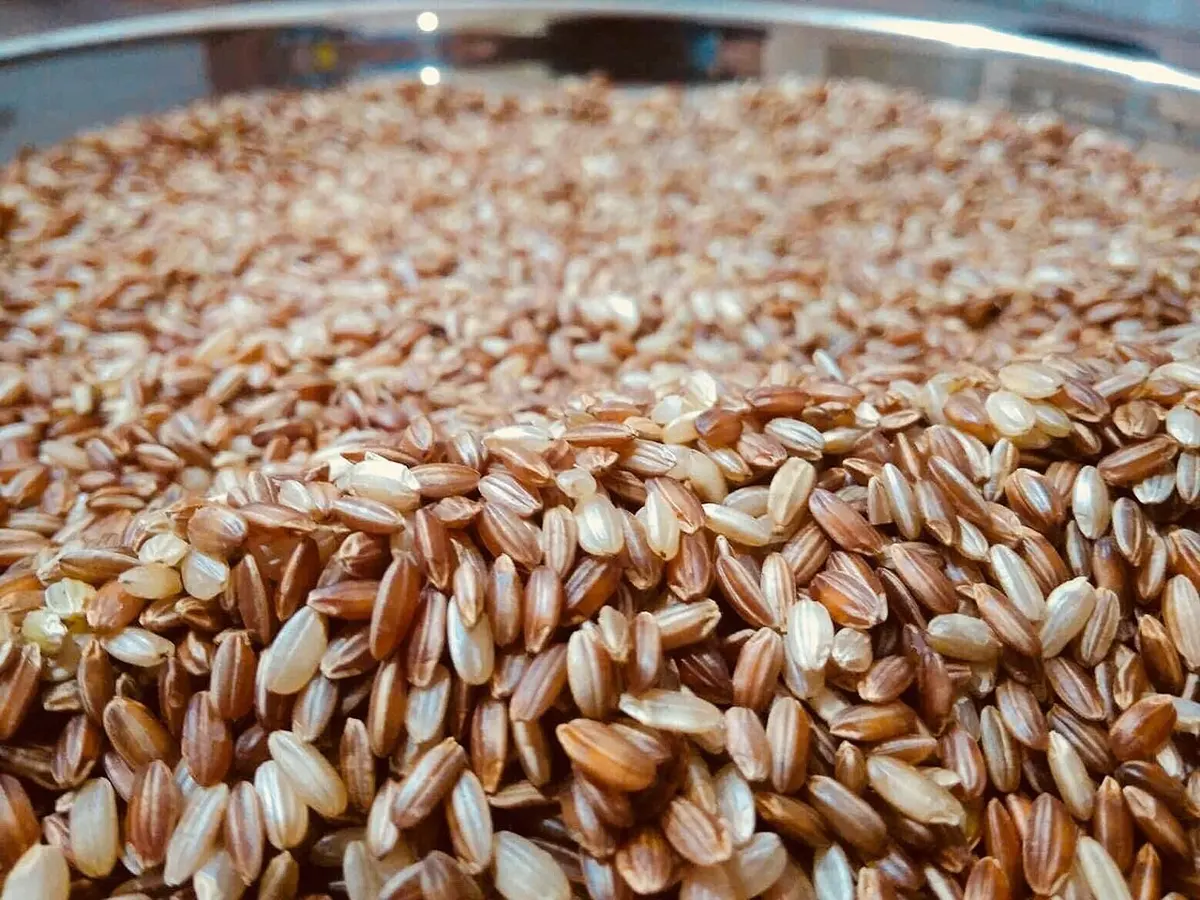
Within one kind of crop, there are many varieties, each bred from parents chosen for certain qualities. Rice in Nepal grows from the hot Terai at about 60 m above sea level up to the cold valleys of Jumla. There, a red rice called Jumli Marshi is grown up to about 3,050 m, said to be the highest rice fields in the world. Most rice varieties would hardly grow in Jumla’s cold. Jumli Marshi has inherited the ability to grow in it.
Different breeds
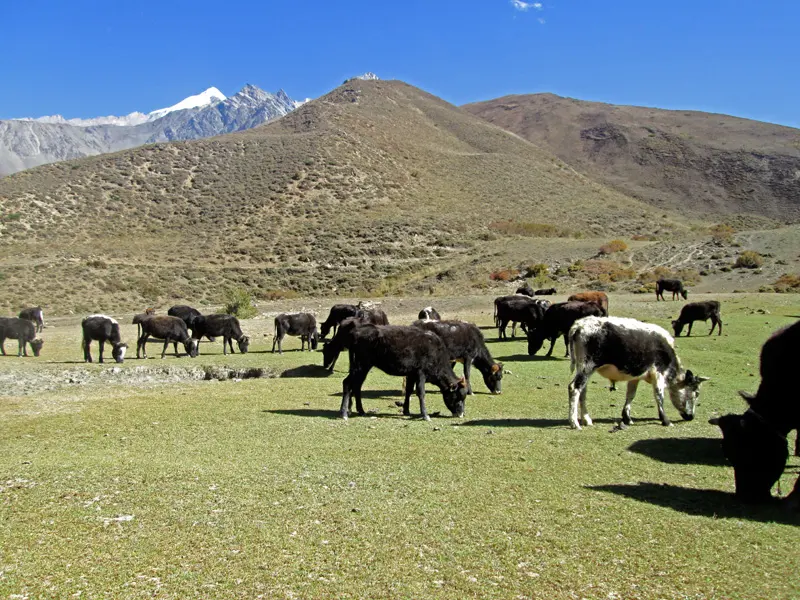
Animals are the same. High in Mustang and Manang lives the Lulu, a dwarf cow. A grown Lulu cow is under 90 cm tall at the shoulder and weighs about 70–150 kg. A grown Holstein Friesian cow, the black-and-white dairy breed, stands about 1.5 m tall and weighs about 700 kg, around five times as much as a big Lulu. Even fed well, a Lulu calf won’t grow into a Holstein-sized cow. Its size is in its genes.
Copies with the same genes
There is a neat way to do the opposite: keep the genes the same and change the surroundings. You learned in Grade 8 that a potato tuber, a sugarcane cutting or a grafted branch grows into a plant just like its parent Grade 8: Vegetative propagation. Those plants have exactly the same genes as the parent, and as each other. So if you plant pieces of one potato in a sunny bed and a shady one, any difference in how they grow comes from the surroundings.
A farmer grows two varieties of maize, A and B, side by side in the same field, with the same water and fertilizer. Variety B grows much taller. What does this suggest?
Pick an answer to see why.
Seed and soil together
So which matters more, the seed or the soil? The real answer is that they work together. The genes set what a plant or animal can become. The surroundings decide how much of that it actually reaches.
A broiler chick has the genes to reach 4 kg in eight weeks, but only if it gets rich feed, water and warmth. Let it peck for scraps in a yard, and it grows far less. A Lulu calf given the best feed in the world still grows into a small cow. Good genes need good surroundings to show what they can do, and good surroundings can only bring out what the genes allow.
Sometimes one variety is better in one place and another variety is better somewhere else. Which seed is “best” depends on the field.
This is the clearest kind of evidence that genes and surroundings work together. You can’t say “fertilizer increases yield”, because it depends on the variety. You can’t say “the short variety is better”, because with no fertilizer, the two are close. The effect of one factor depends on the other.
Short rice and wheat, together with fertilizer and irrigation, about doubled Asia’s harvests of grain between 1970 and 1995. That change was called the Green Revolution. It had costs too: farmers came to depend on bought seed and fertilizer, and many old local varieties stopped being grown.
Animals and people too
Fish in a pond show the same thing. Fish farmers in Chitwan know that if they put too many young carp in a pond, each fish ends up small: there is only so much food and oxygen in the water to go round. The same young fish, fewer to a pond, grow much bigger.
And people. Tall parents tend to have tall children: height is partly in the genes. But food and health matter enormously. In 2016 a team of scientists collected the heights of more than 18 million people around the world. Women in South Korea born in 1996 grew up about 20 cm taller than women born there in 1896. Genes don’t change in a hundred years; food, clean water and health care did.
In Nepal, as in many countries, many young children grow less tall than they could, because of too little good food and too much illness, especially in the first two years. This is getting better, thanks to better food, health care and clean water, not to any change in genes.
Over 100 years, the average height of adults in a country rose by 10 cm. The best explanation is…
Pick an answer to see why.
Finding out with evidence
How do scientists find out whether something affects growth? They do a fair test:
- a.change one factor only (the one you are testing), such as fertilizer;
- b.keep everything else the same: the seed, the soil, the pot, the water, the light, the days;
- c.use many plants for each, not one, because no two plants grow exactly alike;
- d.measure each plant, and work out the average.
Why many plants? One plant might be small because its seed was damaged, or a snail ate a leaf. With ten plants, the odd one makes little difference to the average.
Claim, evidence, reasoning
When a scientist explains something, she gives three things:
- a claim: what she thinks is true (“Compost made the mustard grow more”);
- the evidence: the measurements that support it (“The plants with compost were 15 cm tall on average, those without 10 cm”);
- the reasoning: why the evidence supports the claim (“Both trays had the same seed, water, light and days, so the only difference was the compost. Compost adds nutrients, which plants need to grow”).
Try to give all three whenever you explain something in science.
Questions
Which pair of plants would best show the effect of genes on growth?
Pick an answer to see why.
A tomato plant is short of water and short of nitrogen, but water is much shorter. The farmer adds plenty of nitrogen fertilizer and nothing else. What happens?
Pick an answer to see why.
Explain why two maize plants from the same packet of seed, in the same field, can grow to very different sizes. Give at least three possible reasons.
Answer
Seeds from one packet are of the same variety, so the difference is most likely in their surroundings, even within one field. Possible reasons:
- one gets more water: it is lower on the slope or near the irrigation channel, where the soil stays wetter;
- one gets more nutrients: manure was spread unevenly, or the soil in one spot is richer;
- one gets more light: the other is shaded by a wall, a tree or its neighbors;
- one has more space: the other is crowded by other maize plants or weeds;
- one was damaged by pests or disease, or by being trampled.
Also, seeds are not all exactly alike: even in one variety, seeds differ a little in size and in their genes, and a small or damaged seed gives a weaker start.
Bean seedlings grown in a dark cupboard are taller than seedlings grown in sunlight. A student says, “So beans grow better in the dark.” Explain why she is wrong, and say how she could show it.
Answer
In the dark, the seedlings can’t make chlorophyll or food by photosynthesis. They stretch tall and thin, living on the food stored in the seed, looking for light. They are taller, but thin, pale and weak, and they die when the seed’s food runs out. Growth means an increase in mass, not just in height. She could weigh the seedlings (best after drying them in a warm oven, with an adult) or count and measure their leaves: the seedlings in the light are heavier, with more and bigger green leaves.
Here are made-up results from a trial of two wheat varieties, with and without fertilizer, four plots of each.
| No fertilizer | With fertilizer | |
|---|---|---|
| Variety X | 2.0 t/ha | 2.6 t/ha |
| Variety Y | 2.1 t/ha | 4.0 t/ha |
- a.Which variety gained more from fertilizer? Give the numbers.
- b.A farmer can’t afford fertilizer. Which variety would you advise, and why?
- c.Write an explanation, with a claim, evidence and reasoning, of how genes and surroundings both affect the wheat’s yield.
Answer
- a.Variety Y: it rose by 4.0 − 2.1 = 1.9 t/ha, against 2.6 − 2.0 = 0.6 t/ha for X. (As percentages: Y rose 90 %, X 30 %.)
- b.Without fertilizer, the two give almost the same yield (2.0 and 2.1 t/ha), so either will do; Y is very slightly better. Other things might decide it: seed price, taste, or how well each resists disease and drought.
- c.Claim: the wheat’s yield depends on both its variety (genes) and the fertilizer (surroundings), and the effect of fertilizer depends on the variety. Evidence: with fertilizer, both varieties gave more (surroundings matter); with fertilizer, Y gave 4.0 t/ha against X’s 2.6 (genes matter); fertilizer raised Y’s yield by 1.9 t/ha but X’s by only 0.6. Reasoning: the plots differed only in variety and fertilizer, with four plots of each, so these differences come from those two factors. Fertilizer supplies nutrients, but each variety inherited a different ability to turn extra nutrients into grain.
A fish farmer has two ponds of the same size, depth and water. She puts 500 young carp in pond A and 2,000 in pond B, and gives each pond the same amount of feed. After six months, the average carp in pond A weighs 800 g and in pond B 300 g (made-up numbers). Explain the difference. Was it caused by genes or by the environment? How do you know?
Answer
The fish in pond B are much smaller because there are four times as many fish sharing the same feed, the same natural food in the water and the same oxygen, so each fish gets about a quarter as much. With less food each, they grew less. It was caused by the environment (crowding and food), not by genes: the young carp came from the same stock, and the ponds were the same in everything except the number of fish. Only the number of fish was changed, so it must explain the difference.
Design a fair test to find out whether a new variety of mustard grows better than a local one in your area. Say what you would change, what you would keep the same, what you would measure, and how many plants you would use.
Answer
- Change: only the variety: new and local.
- Keep the same: the soil (from one place, mixed), the pots or beds, the amount and timing of water, the fertilizer or compost, the light (pots side by side, swapped round every few days so neither is always in the shade), the sowing date and the number of seeds per pot.
- Use many plants: for example 10 pots of each variety, with 3 plants per pot after thinning.
- Measure: the height and number of leaves every week, and at the end the mass of the leaves (what a farmer sells), or the mass of seed if grown to harvest.
- Compare the averages. If the new variety’s average is clearly bigger, and the plants of each variety vary less than the two averages differ, it grows better, in these conditions. It might be worth testing again in a dry year or without fertilizer, because the best variety can depend on the conditions.
Lulu cattle are small, and give much less milk than Holstein cows. A farmer in Mustang wonders whether to swap her Lulu cows for Holsteins. What should she think about?
Answer
A Holstein has the genes to grow big and give much more milk, but only in the right surroundings: plenty of rich fodder and water, and a mild climate. Mustang is cold and high, with thin grass and long winters. A Holstein there would not get the food it needs to reach its size and milk, and may fall ill in the cold. The Lulu has inherited the ability to live on poor grazing in the cold, and it needs much less food. The best breed depends on the surroundings: genes and environment together decide how an animal grows. (Some farmers cross local cattle with other breeds for a mix of both.)
Where to go next
- How Did Farmers Make Our Crops? How farmers and scientists choose parent plants to breed varieties like IR8, Jumli Marshi and Sukkha Dhan, over thousands of years.
- Why Do You Look Like Your Parents, but Not Exactly? What genes are, and how they pass from parents to their young, so that each young one is a little different.
- What Happens to the Dal Bhat You Eat? Inside your body, the food you eat becomes energy and new cells: how you grow.