
The farm census of 2021/22 found 4.13 million farms in Nepal, about three for every five households the census of 2021 had counted the year before. Most families still keep some land, a buffalo or a few goats, and most people who work spend at least part of their year in a field. Yet farming, with forests and fishing, makes only about a quarter of what the country produces. The rest of the economy, with far fewer hands, makes three quarters.
That gap is the subject of this chapter. It begins with how much a farm worker produces, then goes down to the plot itself, out along the road to market, back to the laws about who may own land, to where farmers borrow, and last to the question the government has put to itself for decades: whether farming in Nepal can become a business, and whether it should.
Many hands, a small share
Chapter 28 counted the hands two ways. The census of 2021 asked everyone aged 10 and over whether they had done any work in the past year, on the family’s own land included, and 8.59 million of the 14.98 million who said yes had worked mainly in farming, forests or fishing. That is 57%. In the same year, 2020/21, those activities made 25.8% of the value Nepal added to everything it produced.
Divide each side’s output by its workers and the gap becomes a number. Each person who worked mainly on a farm produced about Rs. 112,000 of value in that year. Each person who worked at anything else produced about Rs. 431,000, nearly four times as much. The government’s farming strategy of 2015, working from figures of a few years before, had found the same gap: about one to four.
The division works because both sides count the same thing. The national accounts include the rice, maize and milk a family grows and eats itself, valued as if it had been sold, and the census counts the people who grew it. The Labour Force Survey of 2017/18 counted only work for pay or profit and found just 1.52 million people in farming. Set the whole farm output against that smaller number and farm workers would seem to out-produce everyone, only because the food was counted and most of the people who grew it were not.
Why so little each? Part of the answer is that many farm hands aren’t needed for much of the year. On a family plot, a fifth person working beside four others may add almost nothing to the harvest, the hidden unemployment, अदृश्य बेरोजगारी, of Chapter 24. Part is what the farms grow and how. Most of Nepal’s farming is निर्वाहमुखी खेती, farming to feed the household: of the 4.13 million farms, 69% grew only for their own table, another 25% mainly for it with some to sell, and only about 6% mainly or only for sale. Food grains, which are cheap by weight, are the main crop on most farms. The work is done mostly by hand and by animals, and few farms have the money for machines, better seed or storage. And the land each family works is small, often watered only by the sky, and often far from a road.
Small plots, the sky and the road
The average farm in the census was 0.54 hectares, a square about 73 meters on each side. Chapter 23 showed how unequally that land is shared, with more than four farms in five under a hectare. What the averages hide is that a farm isn’t one piece. The census counted 11.4 million separate parcels on the 4 million farms that had land, nearly three each. A family may have a terrace above the house, a strip by the river and a field in the next village, each divided again when the land is inherited.
Small, scattered plots cost more to work. A tractor needs room to turn, a canal has to reach each piece, and walking between fields takes hours a week. The census counted about 58,500 tractors, one for every 71 farms, and about 118,000 power tillers, the two-wheeled machines that can work a terrace too narrow for a tractor. The household survey of 2022/23 found the average landholding of a farming household had fallen from 1.1 hectares in 1995/96 to 0.4, while the share of farms renting in land had risen from about 5% to 18%.
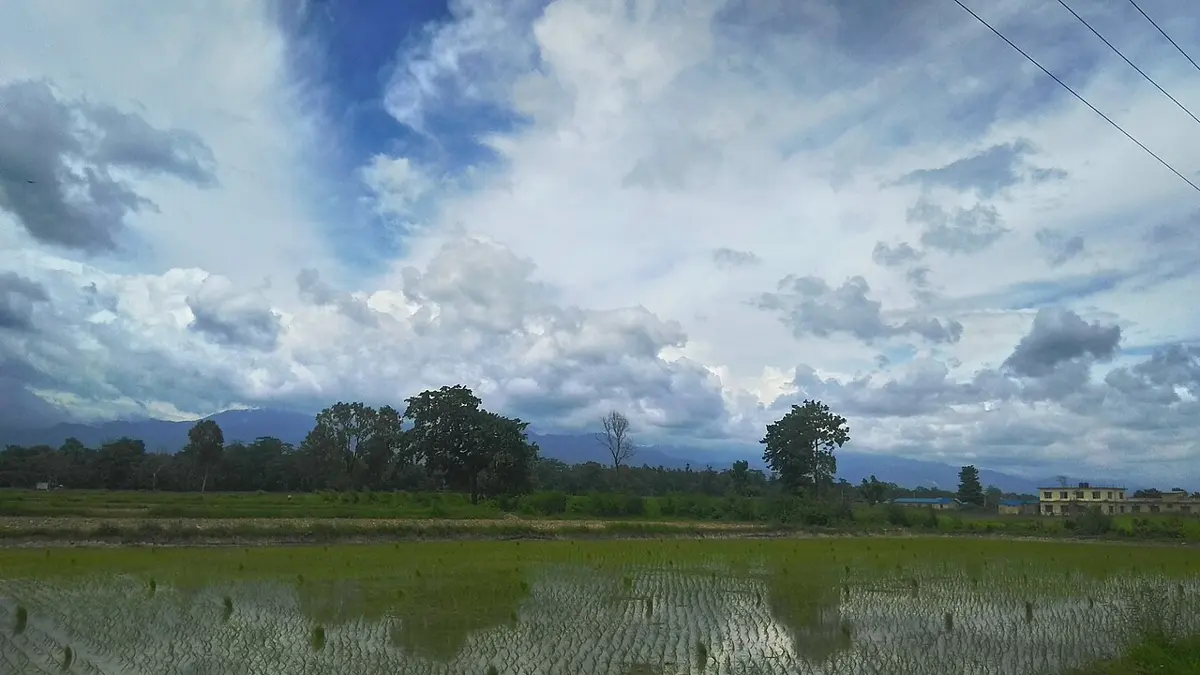
Then there is water. Paddy is planted when the monsoon comes, and a late or weak monsoon means a poor year. How much of Nepal’s farmland is irrigated depends on what is divided by what. The farm census found 1.21 million hectares with some irrigation: 67% of the arable land (the land that can be plowed and sown), or 54.5% of all the land farms hold. The household survey, asking families, found 49.4% of their land irrigated. Much of it has water only in the wet months, when the rain would have come anyway. The government’s farming strategy of 2015 put year-round irrigation at 18% in 2010 and set itself 80% as the target for 2035. Much of the canal network was built and is still run by farmers themselves, as Chapter 26 told.
The third thing is the road. A farmer can grow more than his family eats only if someone will buy it, and a buyer has to reach him. In 1995/96 only a quarter of households were within half an hour of a paved road; by 2022/23, 80% were. A road matters most for what sells for more than grain but spoils if it waits, such as vegetables, fruit and milk. Geography, for the Curious has what grows where, and why.
From field to market
Follow a kilogram of tomatoes from a farm in Bhaktapur to a kitchen in the Kathmandu Valley. A survey of tomato growers in Suryabinayak and Madhyapur Thimi in 2022 traced the route most of them used: from the grower to a local collector, then to a wholesaler, a shop and the household or hotel that ate them. The grower got about Rs. 40. By the survey’s figures the wholesaler paid about Rs. 50, the shop about Rs. 65, and the final buyer about Rs. 75.
The grower got 53% of what the buyer paid. The other Rs. 35 was split nearly evenly: about Rs. 16 went on the costs of moving and selling them, such as transport, damage on the way and taxes, and about Rs. 19 was the traders’ margin, what was left for their time, their risk and their profit. A middleman, बिचौलिया, is easy to blame, and markets often do treat farmers badly. But much of what a middleman does is work someone has to do: gathering small amounts from many farms, carrying them before they spoil, and finding buyers every morning. The question is whether each step is paid more than its work is worth, and that depends on whether anyone could take the trader’s place.
Farm markets have features that tilt the bargain against the grower. Vegetables can’t wait: a tomato picked today must be sold within days, so a farmer far from a cold store has to take what is offered. Many growers sell to few buyers in each village, and the buyers know the city’s prices while the grower often doesn’t. Harvests arrive all at once, so prices fall just when farmers have most to sell, as Chapter 8 showed with tomatoes dumped by the roadside. And crops are sold ungraded and in small lots, which makes each sale costly.
The Kalimati market in Kathmandu, run by a government board, publishes its wholesale prices for each kind of tomato every day, so that anyone can check, and a grower with a phone can see that list before a collector arrives. Collection centers where a village sells together, cold rooms near farms, and farmers’ groups that grade and pack their own produce all work on the same weak points: they let the grower wait, compare and bargain. Business Ideas for Nepal follows one of them, a small cold store run on sunlight.
Who owns the land, and who lends
For most of Nepal’s history, much of the land belonged to the state, to temples, or to those the state rewarded, and the people who farmed it paid a large share of the crop as rent. Nepal’s History, for the Curious tells how raikar, birta, jagir and guthi land worked, and how the Lands Act of 2021 BS (1964) tried to change it, with what result, in its chapter on the Panchayat.
That Act, भूमि सम्बन्धी ऐन, २०२१, is still the law, amended many times. Its aims were to move idle wealth and surplus people off the land into other parts of the economy, to share land more fairly, and to raise the living of those who actually farm. It does this in three ways. It sets a ceiling, हदबन्दी, on how much land one family may own. As Section 7 now reads, lower than in 1964, the limit is 10 bigha in the Tarai and the Inner Madhesh, about 6.8 hectares; 25 ropani in the Kathmandu Valley, about 1.3 hectares; and 70 ropani in the other hills, about 3.6 hectares, with a little more allowed for the house. Land above the limit is to be taken by the government and given out. It protects the tenant farmer, the मोही, whose right to keep farming a field can’t be bought or sold. And Section 33 says no landlord may take more than half the main yearly crop as rent.
Ceilings are easy to write and hard to enforce. Land can be split among relatives on paper, and some of what the state should have taken never was. The law has also bent toward investment. The eighth amendment, of 2076 BS, added Section 12क: an industry already running on more land than the ceiling, bought without permission, could keep it, once, by paying a fee for each bigha or ropani, so long as the land stayed in that use and wasn’t sold or handed on. The same amendment added Section 52ख, promising land, once, to landless squatters, भूमिहीन सुकुम्बासी, which they may not sell for ten years, after a seventh amendment of 2075 BS had promised land to landless Dalits.
The Constitution of 2015 takes a side. Article 42(4) gives every farmer the right, as the law provides, to access land for farming. Article 51(ङ), among the state’s policies on farming and land, asks for an end to two owners for one field, for “scientific” land reform in farmers’ interest, for discouraging owners who don’t farm their land, for joining scattered plots, चक्लाबन्दी, to raise output, for making farming modern and commercial, and for fair prices and a way to market. Those policies guide governments, but Article 55 says no court can be asked whether they have been carried out.
Farming needs money before it pays: seed and fertilizer in spring, a harvest in autumn. Where a farmer borrows matters as much as whether he can. Lenders are usually sorted into two kinds. The organized or formal sources, औपचारिक वा सङ्गठित स्रोत, are banks and finance companies, microfinance lenders, cooperatives and government schemes, regulated and recorded. The unorganized or informal ones, अनौपचारिक वा असङ्गठित स्रोत, are relatives, friends, traders and the village moneylender, the साहुमहाजन. The household survey of 2022/23 asked every household, farming or not, where each loan came from. Relatives gave 42.5% of loans, banks and finance companies 22.4%, cooperatives 18.3% and moneylenders 11.4%. In Madhesh moneylenders gave 30.4%. In 1995/96 moneylenders had given nearly 40% of the country’s loans and relatives about 41%. So banks and cooperatives have taken much of the moneylender’s place, while relatives still give the largest share, about as much as then.
Banks prefer lending against a building in town to lending against a harvest that a flood can wash away, so Nepal Rastra Bank has long told them how much to lend to farming. Under its directive for 2082, commercial banks were to raise their farm lending step by step to 15% of their loans by the end of Asar 2085. In March 2026 it changed course: from the end of Poush 2083 (mid-January 2027), at least 10% to agriculture, with a further 20% shared among tourism, small and medium firms, energy, information technology and exporters using Nepali raw materials, any farm lending above 10% counting toward the 20%. A different count, the central bank’s table of loans by sector, put loans to agriculture, forests and fishing at about 6% of all loans by commercial and development banks and finance companies in mid-October 2026, down from about 7% in mid-July 2024. The two counts use different definitions, so one doesn’t measure whether the other was met. Cooperatives are the lender closest to many villages, and Chapter 15 told how some of the savings-and-credit ones failed.
A business, or a way of life?
Nepal’s plans have promised for decades to modernize farming. Modernizing, आधुनिकीकरण, means better seed, fertilizer used well, machines, irrigation all year advice from people who know the crop, and insurance against a lost harvest. Commercializing, व्यवसायीकरण, means growing to sell: choosing crops by what pays, keeping accounts, grading, packing and reaching buyers. The two go together, since a farm that sells can pay for machines and a farm with machines produces more than it eats.
The government’s present guide is the Agriculture Development Strategy, a twenty-year plan for 2015 to 2035, drawn up for the agriculture ministry with farmers’ groups, traders, donors and others. Its aim is farming that feeds the country from its own fields, lasts, can compete, includes everyone, and drives growth. It works through four parts: governance, productivity, profitable commercialization and competitiveness. Besides the 80% of year-round irrigation, its targets for 2035 include a small surplus of food grains instead of the 5% deficit it started from, and more than double the output of each farm worker, from about $800 a year to about $1,800.
Its main supporting project was the Prime Minister Agriculture Modernization Project, begun in 2073/74 (2016/17) for ten years and renamed the National Agriculture Modernization Program in the budget for 2082/83. It picked crops in three groups, staples for food, crops to replace imports and crops to export, and grouped farms into areas of four sizes: pockets, blocks, zones and superzones, each to specialize in one crop with help for seed, machines, irrigation, storage and processing. Its own completion report, of Jestha 2083, says it was projected to cost Rs. 130 billion, received Rs. 56.5 billion over ten years and spent 64.3% of that. It set up more than 11,000 specialized production areas, distributed over 63,000 machines and built over 18,000 small irrigation schemes. By its own measure, yields in its areas ended about 58% above the national average. It also lists what went wrong: COVID, much less money than planned, frequent changes of policy and of offices, staff on short contracts, and unclear rules for grants.
Whether the rest of farming should go the same way is a real argument. One side says the small farm is the problem: too small to use a machine, to borrow against or to sell enough to live on. Join plots, lease land to those who want to farm it, grow what pays, and let the rest of the people find work in towns. Its supporters point to the countries that are now rich, where a small share of workers grows the food for everyone.
The other side says the small farm is also Nepal’s safety net. A family with a field doesn’t go hungry when a factory closes or a job abroad ends, and with 69% of farms growing only for themselves, that is no small thing. Pushing them out faster than towns can give them work moves poverty, it doesn’t end it. Commercial farming also carries risks a family plot doesn’t: one crop, one market, and a price that can collapse when everyone harvests at once. Both sides agree on more than they seem to. Roads, water, seed, cold stores and fair markets help the family that eats its crop as much as the one that sells it.
Meanwhile people are deciding for themselves. Young men and women leave for the Gulf and Malaysia, and the program’s report itself notes farmland lying fallow, बाँझो, for want of hands. Land on steep slopes need not grow grain at all, and Uses of Nepal’s Slopes gathers ways other mountain countries have used land like it.
Nepal’s farms produce little per worker for reasons that can each be named: plots too small and too scattered for machines, water that comes only with the monsoon, roads that only lately reached the hills, markets that favor whoever can wait, and credit that goes more easily to a house in town than to a field. None of these is fixed by nature, and each has been made better in some places. What hasn’t been settled is how far to go, how fast, and who should bear the cost while farming becomes, for some, a business, and stays, for many, a way to eat.
Found a mistake? Please tell us.