
In September 1941 the German army closed a ring around Leningrad. For nearly two and a half years the city was cut off, and in the first winter almost no food got in. Hundreds of thousands of people died, most of them of hunger. In the middle of the city stood a building full of food: an institute holding seeds of some 187,000 kinds of crop plants, gathered from all over the world, with a cellar full of potatoes. Its scientists went hungry beside it, in rooms with no heat, the windows boarded up, lit by kerosene lamps. They kept watch day and night, checked the tins of seed every week, and tied them into bundles when the rats got in. Seeds don’t live forever, so from the spring of 1942 they planted batches out in fields at the city’s edge, under German shellfire, to grow fresh ones. They didn’t eat the collection. At least nine of the scientists starved, among them the keepers of the rice, the oats and the peanuts, and by the institute’s own count more than thirty of its people died that first winter.
What they were guarding wasn’t a store of dinners. It was a map. The man who gathered the seeds, Nikolai Vavilov, had been trying to find out where the world’s food plants first came from, and why each grows where it does. Those are this chapter’s questions too, and the second one is the easier place to start.
What a crop needs
Every crop is a wild plant that people changed, and it still carries the habits of the place it came from. Rice comes from warm, wet ground and still wants its roots standing in water. Nepal’s school books put it simply: rice likes an average temperature around 27 °C and more than 1,500 mm of rain, or water brought to it, and a field that holds about 10 cm of standing water. Wheat is a crop of cooler air, around 15 °C, and makes do with 500 to 750 mm. Maize wants warmth, about 1,000 mm of rain and no frost. Finger millet, कोदो, asks least of all: it will grow on thin, stony soil with as little as 250 mm.
So a crop grows where four things suit it: warmth, water, soil, and in a country like Nepal, height, which mostly stands in for warmth. Air cools by about 5 °C for every 1,000 m you climb on Nepal’s slopes, so walking uphill is like walking toward the poles, only much faster. Every 1,000 m takes something off the menu and lets something else on.
You can read the result off any hillside. On the warm, flat Terai, with its deep, mixed soils and its rivers, rice is king: about four-fifths of Nepal’s rice is grown there. Wheat follows it on the same fields in winter, when the Terai is about as warm as wheat likes and the winter rain helps. In the hills, rice keeps to the valley floors and the terraces that can be flooded, and maize takes the slopes: three-quarters of Nepal’s maize grows in the hills, with millet on the drier, poorer ground beside it. The potato is the most adaptable of all, a winter vegetable on the plains and a summer staple high in the mountains.
The limits are higher than you might guess. Nepal’s own kinds of rice come from every zone from the Terai, at about 70 m above the sea, up to the high hills at about 3,050 m. Millet goes up to about 3,600 m, and buckwheat, फापर, to about 4,500 m. At Lo Manthang in Upper Mustang, at 3,700 m and behind the mountains that catch the rain, there is time for one crop a year: naked barley, wheat, buckwheat, mustard or potatoes.
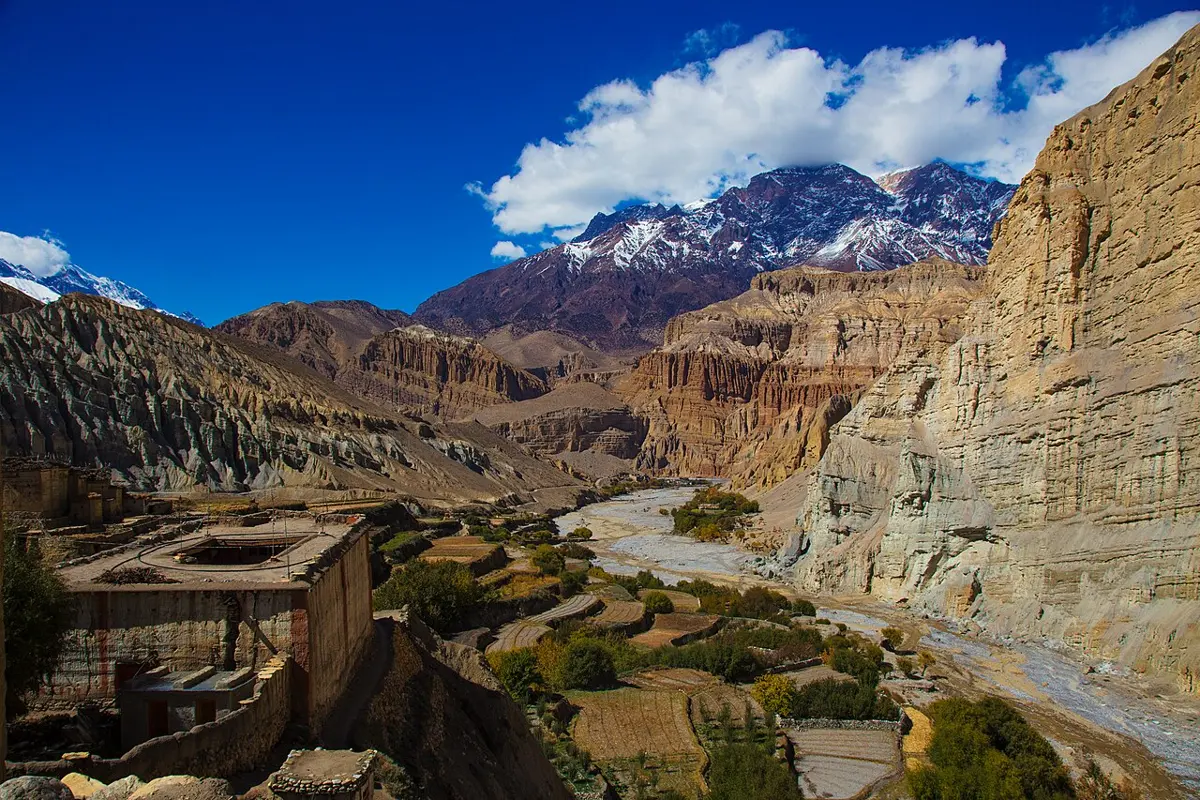
Above that, the land is left to animals that can turn grass into milk and wool, the yaks and herds that move up and down with the seasons. And everywhere, as von Thünen saw, the climate only says what can grow. What farmers do grow depends on what pays, and that depends on how far the market is.
Where crops began
Vavilov spent his life on the other question. Born in 1887, he became a botanist with one aim, to end famine, and he thought the way to do it was to collect every useful variety of every crop. Starting with Iran in 1916, he led more than a hundred collecting trips to some fifty countries. He brought the seeds back to Leningrad, where his institute grew and studied them.
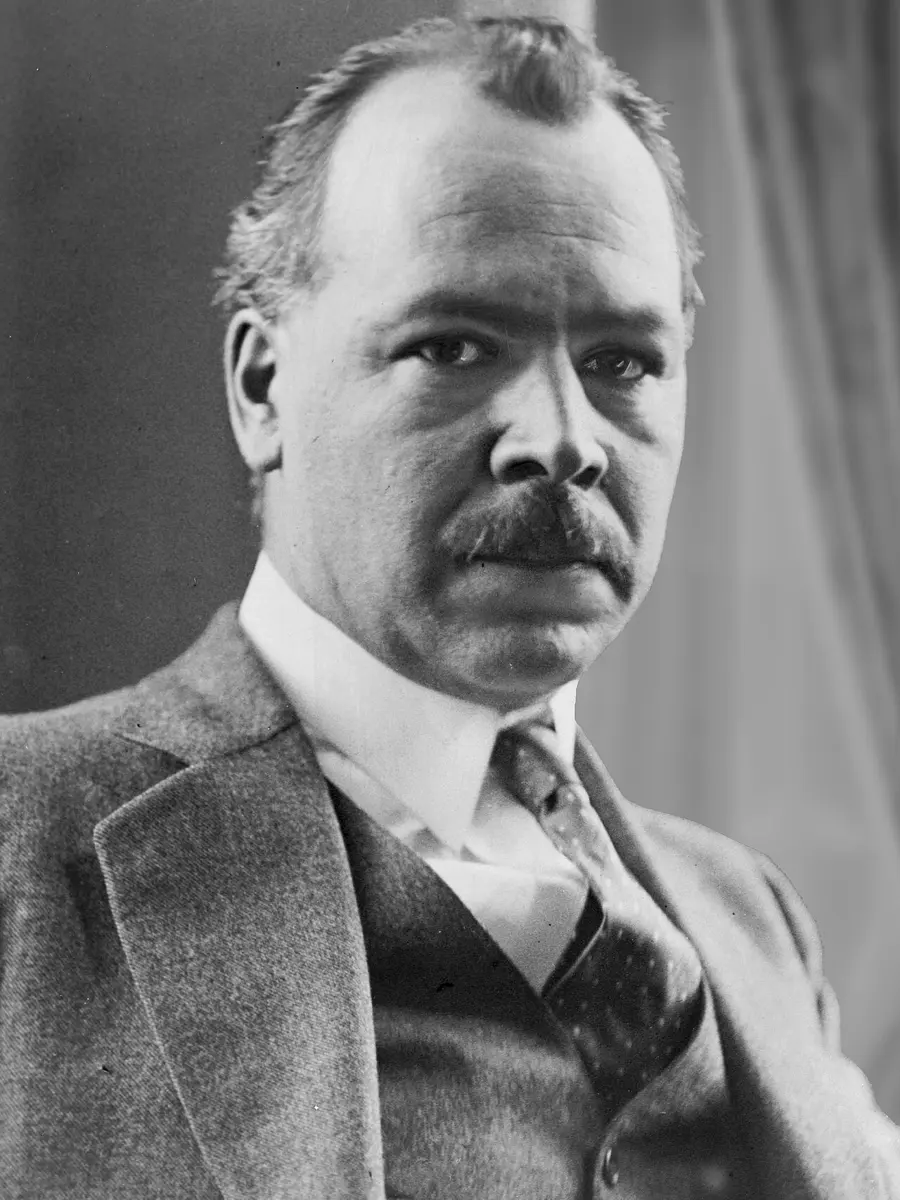
Out of all that collecting came an idea. Where a crop has the most varieties, he reasoned, is where it has been grown longest, so the place of greatest variety should be the place it began. He kept revising his list as the seeds came in, and by the mid-1930s he had eight great centers of origin: China, India and its eastern neighbors, Central Asia with northwest India and Afghanistan, the Near East, the Mediterranean, the highlands of Ethiopia, southern Mexico with Central America, and the Andes. Nepal falls in the gap between three of them.
The idea has held up well in outline, and less well in its rule. Farming did begin in a handful of separate places. Today’s count, from archaeology and from the genes of crops and their wild relatives, is at least 11 regions of the Old and New Worlds, starting between 12,000 and 11,000 years ago, at the end of the last ice age. But later scholars found that the place where a crop is most varied today isn’t always the place where it began.
Nepal’s own plate is a good test. Wheat and barley came from Southwest Asia. Finger millet came from Africa: it was first grown in the highlands of Ethiopia and Eritrea and reached India by sea. Buckwheat’s wild relatives grow in southwest China and the Himalaya, which makes it one of the few staples that is close to local. Maize and the potato came from the Americas, only a few centuries ago, and how they reached Nepal is a story in itself.
Rice is the hard one. Everyone agrees that Asian rice comes from a wild rice that grows from China to India, and that people were gathering and tending wild rice in both the Yangtze valley and the Ganges valley very early. They disagree about what happened next. One view says rice was truly domesticated only once, in China, and every kind grown today descends from that. Another says the two great kinds, the short, sticky japonica of East Asia and the long-grained indica of South Asia, were domesticated separately, in China and in India. A third, from a careful study of rice genomes in 2017, takes something from both: indica and japonica did come from different wild populations, but the changes that make wild rice a crop, such as grains that stay on the stalk instead of falling, happened once, in japonica in China, and reached the wild rice of India when the two crossed. The argument is not over.
Vavilov never saw the answers. In August 1940, while collecting seeds in western Ukraine, he was arrested by the Soviet secret police. A rival, Trofim Lysenko, had won Stalin’s favor by attacking genetics, Vavilov’s science, as false and harmful, and Vavilov had gone on defending it. He was questioned some four hundred times, and in July 1941 he was sentenced to death; the next year the sentence was changed to twenty years in prison. He died in the prison at Saratov in January 1943, aged 55. The prison doctor wrote down pneumonia and a failing heart, and noted how thin he was. Most who have written his story say he starved, the man who had spent his life trying to end hunger. In 1955 his conviction was overturned, and in 1968 the institute he built was renamed after him. The seeds his staff died guarding are there still.
Nepal’s farms
Most of Nepal’s farming is still the kind its school books call निर्वाहमुखी, subsistence farming: a family grows food mainly to eat, on a small piece of land, with its own hands and its animals’ manure, and sells what’s left. The other kind, व्यवसायमुखी, commercial farming, grows for the market, with bought seed, fertilizer, machines and loans, often one crop over a large area. The line between them runs through many households, which eat their rice and sell their ginger.
That is why Nepal’s farm workers are so hard to count. In the 2021 census, of everyone aged 10 or over who had done any work at all in the past year, however briefly, 57% worked in farming, forestry or fishing. The International Labour Organization’s estimate for the same year is 25%. Both are right, because they ask different questions. The census counted anyone who had worked on a farm at any time in the year, growing the family’s own food included. The international count takes people who work for pay or profit at the time they are asked, so it leaves out the household that farms only for its own kitchen and the many who farm for a season and do other work the rest of the year. It is the blind spot that also hides much of what women do. Either way, farming makes only about a fifth of the value of everything Nepal produces, so a great many people are working on farms that pay little.
Rice is the biggest crop by far. In the year to mid-July 2025 Nepal harvested a record 5.95 million tonnes of paddy, about 4.2 tonnes from each hectare. Maize comes next among the grains, at about 3.2 million tonnes, then wheat at about 2 million. Potatoes, heavy with water, weigh in at 3.5 million. Farmers also grow crops mainly to sell, the cash crops: sugarcane, tea, tobacco, jute, cotton and coffee on the school books’ list, and a growing number of others, from cardamom in Taplejung to kiwis in Ilam, each picked by the government from 2007 as one district’s specialty.
Animals are part of nearly every farm. Oxen pull the plow, cows and buffaloes give milk, and their dung feeds the fields, which in turn feed them. In the ministry’s count for 2016/17 Nepal had about 7.3 million cattle, 5.2 million buffaloes and 11.2 million goats, and the country now produces about 2.8 million tonnes of milk a year. Fish have changed most of all. Fishing in rivers has long been the work of particular communities, such as the Majhi, Bote and Danuwar. Fish farming in ponds has grown from about 1,400 tonnes in 1980 to about 100,000 tonnes now, several times what the rivers give.
Even so, Nepal doesn’t feed itself. In 2022 food made up about 18% of everything the country bought from abroad.
Steps on the hills
In the hills, where the ground is never flat, people made it flat. A terrace is a step cut into a slope, its edge held by a wall of stones or a bank of earth, and a hillside of them looks like a staircase for giants. On a slope, rain runs off and takes the soil with it. On a level step it soaks in. And rice, which wants standing water, can only grow on ground that holds water level, so wherever a hill farmer can bring a stream, the steps become flooded खेत, rice fields. Higher up and farther from water, the dry terraces and slopes, पाखो, grow maize and millet.
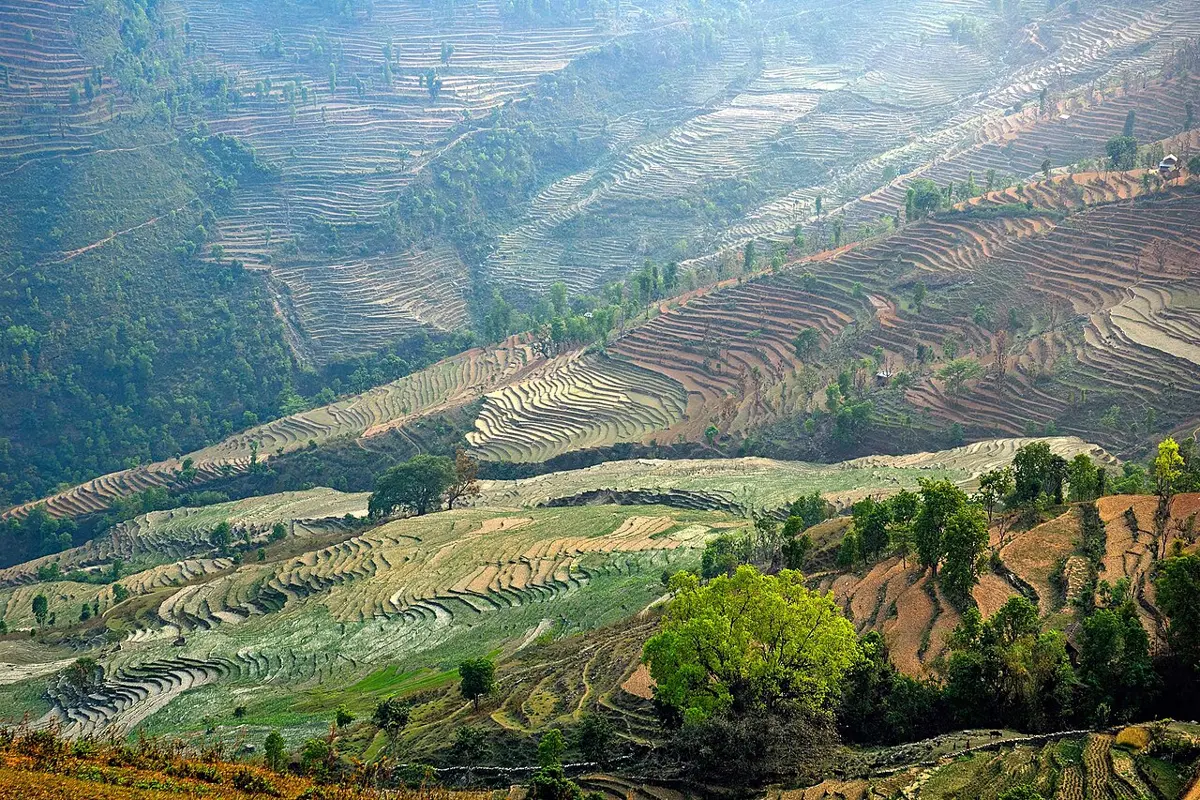
Terraces were once blamed for the hills’ landslides. The evidence turned that around: they are a vast piece of soil conservation, and slopes with more people living on them often had fewer slides, because there were more hands to mend a wall after the rain. That story is told in What the Land Gives. What holds a slope up, and what brings one down, is in Slopes.
The new wheat
In the middle of the twentieth century, an American plant breeder named Norman Borlaug was breeding wheat in Mexico, and his program did so well that by 1956 Mexico grew all the wheat it needed. Then it ran into a strange problem. As farmers used more fertilizer, the plants grew such heavy heads of grain that they fell over, and the harvest could rise no further. Borlaug crossed his wheats with Norin 10, a very short wheat from Japan, and got plants with short, stiff stems that could carry a heavy head and stand up. Fed with fertilizer and water, they gave far more grain.
The new wheats were tried in India and Pakistan from 1963. In 1965 the two countries brought in 250 and 350 tonnes of seed from Mexico for testing on farms, and in 1966 India brought in 18,000 tonnes. India’s wheat harvest went from 12.3 million tonnes in 1964–65 to 20 million in 1970. It came to be called the Green Revolution, and in 1970 Borlaug was given the Nobel Peace Prize. In his lecture he called it “a temporary success in man’s war against hunger”, which had bought the world “a breathing space”. Rice had its own new varieties soon after, bred in the Philippines.
Nepal’s story looks different on the graph.
The new seeds did arrive. Wheat became one of Nepal’s main crops: in 1961 Nepal grew about fifteen times as much rice as wheat, and now it grows about three times as much. But for twenty years and more, the harvest from each hectare barely moved. Nepal planted much more wheat, on many more fields, and only from about 1990 did each field start giving more. The same long wait shows in rice and maize. The new varieties needed fertilizer, reliable water and roads to bring them, and in a country of small, steep, rain-fed fields, those came slowly.
Across the world, the gains were enormous. Between 1960 and 2000, wheat yields in the poorer countries rose by about 200%, and rice yields roughly doubled. Without the new crops, food would have cost far more, and some 20 to 25 million more hectares would have had to be farmed to grow the same food.
The criticisms are real too. The new crops drank water and fertilizer, and where both were cheap because governments paid for them, farmers used too much: water was wasted, soils wore out, and chemicals ran into rivers. Farmers with good land and water gained first and most, and those on dry, poor or remote land, as in much of Nepal’s hills, were often left behind. Fields of a single new variety pushed out old ones, and with them some of the vegetables and fish that poor families had gathered from the rice fields, so in places people had more calories but a poorer diet. Some say the new seeds caused these problems. Others, including some of the scientists who studied them most closely, say the seeds weren’t the problem: the subsidies and the policies around them were.
And the old varieties pushed aside by the new ones are exactly the kind of seed that Vavilov went looking for. Every new wheat or rice is bred from old ones, and the old ones carry the resistance to a disease, a drought or a cold night that the next breeder will need. That is why the world keeps seed banks now, and why the scientists in Leningrad wouldn’t eat theirs.
Found a mistake? Please tell us.