
In the year to mid-July 1994, Nepal sold the world 3.33 million square meters of hand-knotted woolen carpet. Laid edge to edge, that would have carpeted a square more than 1.8 kilometers on a side. It earned about $190 million, and it was half of everything the country sold abroad. In the year to mid-July 2026, the carpets came to 367,454 square meters, about a ninth as much, worth Rs. 10.38 billion out of Rs. 315 billion of exports.
Some of the trouble was in the carpets themselves, and more of it was everything around them: the buyers, the rules of world trade, the rupee, the roads and the power. That is the story of making things in Nepal, and this chapter follows it, from the first mill to the roads and wires every business runs on, and on to the one export that can’t be put on a truck.
What counts as industry
To an economist, industry is the part of the economy that turns one thing into another: grain into flour, clay into bricks, cotton into shirts, water falling down a hill into electricity. Construction counts, and so do mines. How big a slice of Nepal’s output that is, against farming and services, is in Making and working.
Nepal’s law sorts industries in two ways. The Industrial Enterprises Act of 2020 (२०७६) sorts them first by size, by their fixed capital: the buildings, machines, tools, vehicles and furniture a business owns, the things that last. A micro enterprise, लघु उद्यम, has at most Rs. 20 lakh of it, not counting land and buildings, at most nine workers counting the owner, who must run it, sales under Rs. 1 crore a year, and engines of at most 20 kilowatts. A cottage industry, घरेलु उद्योग, is one built on traditional skills, local materials or local art, using at most 50 kilowatts; the Act lists which trades count. Beyond those, a small industry has fixed capital of up to Rs. 15 crore, a medium one up to Rs. 50 crore, and a large one more than that. The law treats the sizes differently: a micro enterprise pays no registration fee.
Then the Act sorts them by what they make or do: energy, manufacturing, farm and forest products, mining, infrastructure, tourism, information and communication, and services. So under Nepal’s law a hotel is an industry, and so is a hydropower plant.
Industry matters beyond its size: it makes at home what would otherwise be bought abroad, gives work off the farm, and can sell to the world. The fullest count of who actually does this work is the National Economic Census of 2018, which tried to visit every business with a fixed place in the country. It found 923,356 of them, employing 3.2 million people. About 104,000 were manufacturers, one in nine, employing 511,000 people. Most were small. Clothing makers and grain mills were the commonest, and brick and tile works employed the most people, then clothing, grain, furniture, jewelry and metal workshops: the trades that serve a town. Half of all the businesses weren’t registered with any government office, and more than half kept no accounts.
The work clusters, and the census shows where. Kathmandu district had the most manufacturers, and the most people working in them; next, by workers, came Morang and Sunsari in the east, where the first mill went up. Why factories gather in the Valley and along the southern border is in Where the work goes.
Why it had more
The first modern factory was the jute mill at Biratnagar, set up in 1936 by traders from Nepal and India beside the jute fields, as in Making and Trading. Its workers’ strike of 1947, one of the first blows against the Rana government, is in From India.
For twenty years after 1950 there was little private money and less know-how, so the state stepped in. The first five-year plan, of 1956, meant to keep transport, telephones, hydropower and irrigation for the government and to run big factories of its own: cement, sugar, cigarettes, textiles, iron and steel. An industrial policy the next year made promoting industry the government’s job for the first time.
Most of the state’s factories were new, not taken from private owners. Foreign governments, China and the Soviet Union above all, wanted to build them, and Nepal took the help. Birgunj’s sugar mill was built in 1964 with Soviet aid, among the cane fields of Parsa. Nepal had 8 public enterprises in the late 1950s and 63 by 1990, counting banks and utilities as well as factories. The government also took over a few private works that were about to close, among them units in jute, cement and tea, to save the jobs. And it built industrial estates, the first at Balaju in 1960, told in Estates and zones.
Then came the boom, and it wasn’t the state’s. In the early 1990s private workshops in the Kathmandu Valley were weaving carpets for Germany, and private factories were sewing shirts for the United States. Manufacturing grew to about 9% of everything Nepal produced, the most it has ever been in the World Bank’s figures.
The state’s factories, meanwhile, were losing money. A paper in Nepal Rastra Bank’s journal blamed political interference, too little freedom and too little accountability for their managers, loose finances and goals that pulled against each other: a factory asked to make a profit, to keep prices low and to give jobs to the minister’s voters can rarely do all three. From 1992 the government changed course. It opened the economy, and its plan now was to sell its enterprises, not to set up more. By about 2002 it had sold or handed over 17, and 43 remained.
Privatizing a factory doesn’t make it profitable. The cabinet decided to sell the Birgunj sugar mill in February 2000; the sale failed, and the mill shut on 23 February 2003. In 2025 the government was drawing up a plan to revive seven of its idle factories, among them two cement works, a cigarette factory and a rubber factory, and a former head of the board that oversees them named, to a newspaper, the same cause the paper had named twenty years earlier: political interference.
The boom ended too, and the line in the figure falls from the late 1990s to about 5% today. The World Bank calls that premature deindustrialization: moving from farming to services without the long age of factories that today’s rich countries passed through. In Nepal the Bank’s list of reasons is long.
The first is distance. Nepal has no coast, so almost everything from overseas, wool, machines, fuel, crosses India to reach it, and almost everything sold overseas goes back the same way. A factory by the sea doesn’t pay for that trip. Mountains raise the cost inside the country too. Then the power: from 2007 to 2018 factories lived with scheduled power cuts, load-shedding, and one study the Bank cites found that Nepal’s GDP would have been about 7% higher in 2008–2016 without them. The cuts were scheduled away in May 2018, yet in the Bank’s 2023 survey of firms 76% still had regular outages. There was the armed conflict of 1996 to 2006, and the years of unsteady governments that followed, each of which made investors wait. And there are the cartels in trucking and transport, which the Bank says raise costs and keep newcomers out.
The last reason is the money from abroad. Remittances raise what families spend, which pushes up prices and the rupee’s real value, and that makes Nepal’s goods dearer to foreign buyers. Since 1994 the rupee’s real value has risen by about 35%. Whether that has cost Nepal its factories, the Dutch disease, or whether the roads and the power would have held them back anyway is still argued; the case is in Leaving.
What would help? The Bank’s list starts with more competition in transport and the other trades that face no foreign rivals, better transport for trade, better standards and testing, since Nepali goods have been turned away abroad for failing them, and lower duties on the materials factories bring in.
Carpets and shirts
The carpet trade began with refugees. Tibetans who came to Nepal in the early 1960s brought their weaving with them, and by the government’s trade center’s account the first commercial shipment, a sample, went to Zurich in 1962.
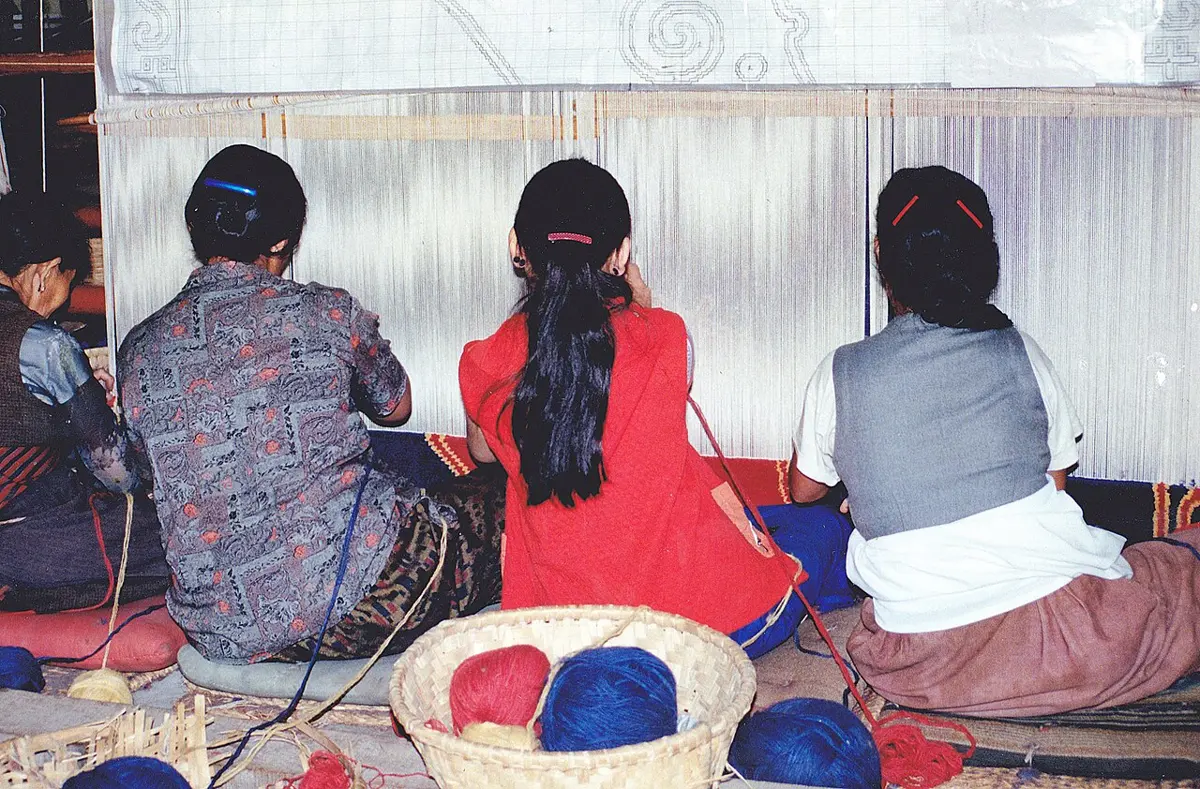
For twenty years it grew slowly, then very fast, and above all for one market: Germany took 80% of Nepal’s carpets in 1993/94. Carpets were 4.7% of Nepal’s exports in 1972/73 and half of them by 1990/91. In 1994/95 the carpet works employed 56,227 people, about a quarter of everyone in manufacturing.
Then it went wrong, faster than it had gone right. In 1994/95 sales fell by about a third, orders were canceled, and workshops closed with their stock unsold. By 2001/02 Nepal sold 1.69 million square meters, half as much as at the peak, for $86 million. A study of the industry written in 2003 asked the people in the trade why. The German buyers said Nepal’s carpets couldn’t compete on price, that makers had used poorer wool to keep up, and that fashion had moved on. Weavers across the border had learned the Tibetan style and made it cheaper. Too many newcomers with money and no experience had made too much carpet of too little quality. And the trade had been hit, just as production peaked, by reports of children at the looms and by a scare over the dyes. The carpet makers’ own association put poor quality first.
Shirts were a different kind of boom, built on a rule. For decades the rich countries limited how much clothing each poor country could sell them, under a deal called the Multi-Fibre Arrangement. Each country got a quota. The big exporters, India and Pakistan among them, came up against theirs, so some of the orders spilled over to countries like Nepal, whose quotas had room. Factories sewing shirts and trousers sprang up around Kathmandu, nearly all of them selling to countries other than India. At the height, around 1999/2000, garments gave about 50,000 people direct work, 12% of everyone in manufacturing, and were over 40% of what Nepal sold to countries other than India.
The rule had a closing date. In 1995 the World Trade Organization’s Agreement on Textiles and Clothing replaced the Arrangement, and it laid down a ten-year plan: the quotas would go in stages, and on 1 January 2005 the last would end. Everyone knew the date. When it came, buyers could order as much as they liked from the cheapest and quickest factories in the world, and those factories weren’t in Nepal.
The figure shows something the story usually leaves out: the fall began well before 2005. By 2004 American orders were already down by two-fifths from 2000. In May 2000 the United States opened its market wider to clothing from Africa south of the Sahara and from the Caribbean, and Nepal’s garment makers blamed that within a year; then came the attacks of September 2001 and quotas lifted on more kinds of clothing, stage by stage. We found no study that measures how much each cost. The end of the quotas finished the job. The trade center counted about 212 garment factories at work in 2001 and about 30 in July 2006, by an industry group’s count. Garments sold to countries other than India fell from Rs. 11.6 billion in 2002/03 to Rs. 3.9 billion in 2006/07.
They didn’t vanish. In the year to mid-July 2026 Nepal sold Rs. 9.3 billion of garments, slightly more than the year before. But neither is the half of all exports carpets once were.
The two booms teach different things. The carpet trade was Nepal’s own: a skill, a style and buyers who wanted it, the kind of advantage in Why Countries Trade. It shrank when the quality and the trust slipped. The garment trade was borrowed: it lived on a gap in other countries’ quotas, and when the gap closed, so did the factories.
Roads, flights, wires
Nobody sells a carpet without a road to the border, a power line to the light over the loom, and a telephone to the buyer. These are infrastructure, पूर्वाधार: the things every other business runs on. Most are slow to build, costly and shared by everyone, so governments build or regulate most of them.
Roads come first, because most of Nepal’s goods and people travel by road. In mid-March 2026 the Department of Roads, which builds the national highways and main roads, looked after 36,806 kilometers of them: 20,456 paved, 7,602 gravel and 8,748 earth. The provinces and municipalities had built another 68,100 kilometers, most of it earth and gravel, making about 104,900 in all. More than 6.2 million vehicles were registered by March 2025, and more than five million of those were motorcycles. How far the roads now reach, the hours a village is from one, and who is still far are in Distance in hours.
Length isn’t quality. In 2019 a world survey of business people ranked Nepal’s roads 120th out of 141 countries and its air transport 131st. An earth road that washes out each monsoon connects a village for half the year.
Railways are only beginning again. A passenger line runs 52 kilometers from Jaynagar in India through Janakpur to Bhangaha, and the first stretch of an electric line along the plains, from Bardibas toward Nijgadh, has its track bed laid. In the mountains the airplane does a road’s work: 35 airports were in operation in 2025, many of them strips on hillsides, as in Runways on the hillside. And a flight past the mountains is itself something Nepal sells; you can take one in Mountain Flights.
Power is the great change of the last ten years. By mid-March 2026, 99.1% of Nepalis had access to electricity, by the Ministry of Finance’s count, and the country sells electricity to India in the wet months, the story in Water, Forests and Minerals. Counted by households, 94 in a hundred had it in 2022/23, and who is still left out is in Wires.
Phones went where wires couldn’t, and so did television: by 2026, 82% of households had digital television. By mid-March 2026, 19,239 kilometers of optical fiber had been laid, and at the end of September there were about 30 million mobile subscriptions, 102 for every 100 Nepalis, by the Nepal Telecommunications Authority’s count. Those count SIM cards, and some people have two. Still, a phone reaches where a road doesn’t: a farmer can check a price in town before carrying his crop there, and a worker can be paid from abroad. Earning a foreign wage from a laptop at home is in Work from Nepal for the World.
The export that stays put
A carpet travels to its buyer. A view of Machhapuchhre can’t. The buyer has to come to it, and when a German trekker pays for a room in Ghandruk, Nepal has sold something abroad as surely as if it had shipped a carpet to Germany, and earned foreign currency for it. In economics, what foreign visitors spend in a country counts as that country’s export. Why tourism is the most geographical of industries, and the visitors year by year, are in An industry of places.
How big an export? In the year to mid-July 2019, by Nepal Rastra Bank’s count, Nepal earned Rs. 75 billion, about $668 million, from foreign visitors. That was two-thirds as much as all its exports of goods brought in, though only about 2% of GDP. In calendar 2025 the earnings were Rs. 87.4 billion. Visitors stayed 16 days on average and spent about $33 a day, by the Ministry of Finance’s figures. Six in ten came for a holiday, one in seven on pilgrimage and one in seven to trek or climb.
Tourism is bigger than those earnings, because Nepalis travel in their own country too, and because a hotel buys vegetables, a trekking agency hires porters, and a porter buys rice. The World Travel and Tourism Council, an association of tourism businesses, counts Nepalis’ own travel too, and by its count travel and tourism were 6.6% of Nepal’s GDP in 2023. It reckons they supported 1.19 million jobs, counting those that depend on tourists’ spending at second hand, and that Nepalis traveling at home did 71.5% of the spending. So “tourism’s share of GDP” can mean 2% or nearly 7%, depending on whether you count only the foreign money or everything that moves.
The bars show the catch. An export that stays put can’t be sent elsewhere when trouble comes. After the earthquake of April 2015, earnings fell by more than a quarter in a year. In the year to mid-July 2021, the first full year of the pandemic, they were $62 million, less than a tenth of two years earlier. The years of the conflict, the early 2000s, show falls as deep as the earthquake’s, more than once. A carpet maker who loses a buyer in Germany can look for one in America. A hotel in Pokhara whose guests stop coming has nowhere to send its rooms.
And the visitors depend on things Nepal can’t control: wages abroad, a war on the route, flights, a frightening headline.
The other risk is to the product itself. A trail crowded with litter or a valley full of concrete is worth less to the next visitor, and the people who live there pay the cost. That is what sustainable tourism means: earning from a place without using it up, so that the forests, the temples and the mountains are still worth the trip in fifty years, and the money reaches the villages along the trail and not only the cities. The government’s own list of what would help is short: better roads, airports and services where visitors go, new places to visit beyond the famous few, and more kinds of things to do.
The carpet trade shows what Nepal can make when it has a skill the world wants. The garment trade shows how fast a borrowed advantage goes. The roads and wires decide what anything costs to move, and tourism sells what can’t be moved at all. For ideas that fit Nepal as it is, its roads and its mountains, see Business Ideas for Nepal.
Found a mistake? Please tell us.