
In 1866 a group of men who owed the government their labor sent it a complaint. During the war with Tibet, they said, they had carried arms and military equipment. This year they had been ordered to carry timber for the building of a palace.
Nobody paid them for either job. Carrying for the state was the price of the land they farmed, and the state, by then, meant the Ranas. Ten years earlier the men had carried for a war. Now they were carrying for a house.
That complaint holds most of what life was like for ordinary people in the century of Rana rule, from 1846 to 1951. Nearly everyone farmed. The land, in theory, belonged to the state, and the family who farmed a field paid for it twice: with part of the crop, and with days of unpaid work whenever the government called. Much of what they paid went to people who didn’t farm at all, to priests, soldiers, officials and nobles, and above all to the Rana family itself. A family that fell into debt could lose more than its field. Until 1925, about one person in a hundred in Nepal was a slave. Meanwhile, in Kathmandu, the Ranas built palaces in the European style, lit by electricity, in a country where hardly anyone could read. Mahesh Chandra Regmi, the historian who spent his life reading the old land and tax papers, called his book on the peasants and landlords of the 1800s Thatched Huts and Stucco Palaces, and the title says it in four words.
Who owned the land
In law, all land was the state’s, and land the state kept for itself was called रैकर (raikar). A family could farm raikar land, pass it to its children and pay the tax on it, but it held only the right to use it. The land itself stayed the state’s.
The state could also give its rights away, and this is where everyone else comes in. Land granted to a person, usually free of tax, was बिर्ता (birta). The word comes from a Sanskrit one meaning a living, and that was the idea: priests, soldiers, nobles and members of the royal family were to live off it, while someone else did the farming. Under the Ranas, most new birta went to the Ranas themselves, their relatives and their favorites, and a grant that had once come with duties became more a privilege than an obligation. Land whose income was given to an official or a soldier as his pay, for as long as he held the post, was जागिर (jagir). Land given to a temple or a charity was गुठी (guthi), and its income paid for the worship, the festival or the rest house it was given for. Guthi was the one kind of land the state almost never took back, so some families gave land to a temple partly to keep it safe.
The farmer on the ground often couldn’t tell the difference. Whoever stood above him, the state, a birta owner, a jagir holder or a guthi, he paid. A common rule for rice fields was अधिया (adhiya): half the paddy to the landlord, half for the farmer. Under another rule, कुत (kut), the farmer owed a fixed amount whatever the harvest, and there was no limit to how high it could be raised. Half the crop was the most a tenant paid under adhiya, and the least he paid under kut, where the rent in rice came on average to about three-quarters of the crop.
How much land had been given away? The first count was made just after the Ranas fell. Of all the farmland it recorded, half was raikar and more than a third, 36 percent, was birta. Jagir and the lands that owed labor made up about 8 percent, kipat 4 and guthi 2. More than a third of the country’s farmland, in other words, belonged to people who paid little or no tax on it, and much of that was in a few hands.
There was one more kind of land, and it worked on a different idea altogether. Among the Limbu of the eastern hills, between the Arun and the Mechi rivers, a man’s right to his fields came from belonging to his people and their ground, the land they had held before the Gorkha conquest. This was किपट (kipat). Rai, Tamang, Sunuwar, Danuwar and other peoples held land in the same way in other parts of the hills. The Limbu headmen, the सुब्बा (subba), collected a tax on each household and could call out unpaid labor, and the title itself could be had for land: a headman’s younger son became a subba by handing fields over to the king, and those fields became raikar.
The state never liked an arrangement it didn’t control. When the Gorkha army took the east in the 1770s, it had promised the Limbu their lands (Chapter 18), and later rulers confirmed the promise. But settlers from other parts of the hills were encouraged to come in, and in disputes the government generally sided with them. Limbu families sold or mortgaged fields to the newcomers, and in May 1886 a new law said that any kipat sold to someone who wasn’t Limbu became raikar for good. It was partly undone early in the 1900s, but by then the newcomers had a better method: they lent money and took the use of kipat fields as the interest, until the loan was paid back, which it often wasn’t. By the end of Rana rule only about a third of the farmland in Limbu country was still kipat. A Limbu writer today puts it more bluntly: the Gorkhalis, he says, “could not follow through” on the promise of 1774, and land the Limbu had kept unfarmed inside their kipat was “forcibly declared” forest.
Down in the Tarai the problem was the opposite: too much land and too few people to farm it. Its forests were thick, and its fever, malaria, killed newcomers, so hill people kept away; Chitwan was known as the Valley of Death. The Tharu, who had lived there for centuries, survived the fever better, and for a long time their labor was what the Tarai ran on. The Ranas made Tharu headmen their local managers, and from 1861 the government appointed a जिमिदार (jimidar) in each village to collect the tax, find settlers and bring land under cultivation. If the village’s tax fell short, the jimidar had to pay it himself or give up his village. In Kailali one Tharu family held the post for three generations. To fill the plains the government also invited farmers from India, offering a family that moved across free land, a plot for a house and the wood to build it. Over the century the newcomers, from India and from the hills, grew in number and wealth, and in the central and eastern Tarai many leading Tharu families slid under them, some becoming their agents. In Chitwan the Tharu were left more to themselves, in a valley kept as forest because the Ranas hunted there. They sold mustard seed at the markets at Hetauda and Bhikna Thori to pay the land tax and to buy cloth, kerosene and salt.
Work without wages
The second payment was work. Every grown man, unless a royal order excused him, could be called on to work for the state without pay. This was झारा (jhara), and it built and fed the country: porters for the army, workers for the gunpowder mills, forts, bridges and canals, wild elephants caught, firewood and fodder for the palace. Two other words, बेठ (beth) and बेगार (begar), are used for it too, and historians don’t agree on exactly how they differed. To a man called away from his own crops, sometimes for months, bringing his own tools, and beaten if he didn’t work hard enough, the names mattered little.
Where the work was regular, the state tied it to the land. Villages along the main routes carried the government’s mail and loads in relays, the हुलाकी (hulaki) porters; others supplied fuel or worked in the powder mills. Their land became रकम (rakam), and its holders typically worked six days every month, 72 days a year. Rules made in 1854 said a man could refuse, but then he had to give up his fields, and few could. Along the busiest roads, officials and travelers demanded so much carrying that some villages emptied.
As the army came to buy its guns abroad, and machines took over the powder mills around 1888, much of this work had nothing left to do. But a free supply of labor is hard to give up. Labor owed to the state went more and more to Rana households, and mail carriers who were no longer needed carried the baggage on the king’s and the prime minister’s tours and hunts. Only in 1913 did the government begin paying its mail carriers, and then it charged their villages’ land an extra tax to cover the wages.
The hunts were the largest jobs of all. A Rana prime minister’s winter shoot in the Tarai, laid on for British guests, was organized like a small war. For the visit of the British king George V to Chitwan in 1911, the prime minister’s camp held twelve thousand followers, and more than six hundred elephants were brought together. The party shot 37 tigers, 18 rhinoceroses and 4 bears. When the Ranas came to hunt in Chitwan, the Tharu were called out to work.
Getting anywhere was slow, and for most people it was on foot. There was no road from the plains into the Kathmandu Valley. Anyone coming in from India needed a pass, a राहदानी (rāhadānī). Indian pilgrims were let in for the festival of Shivaratri and had to leave within a week of it. When the Ranas began buying motor cars, the cars were taken apart and carried. Teams of porters from the villages of Makwanpur, 32, 64 or 96 men on long bamboo poles, walked each one from Bhimphedi over the hills to Thankot, a week or more, for a few annas. In the 1920s a ropeway began swinging goods over the hills from Dhorsing, near Bhimphedi, and in 1927 a small railway began running from the border at Raxaul to Amlekhganj, but cars were still carried into Kathmandu until a road was finished in the 1950s.
Slaves
Below the tenant and the porter there was one more step down. Nepal had slaves, people who belonged to someone and could be sold, given away or handed down. People became slaves by being born to slave parents, by being sold by families too poor to keep them, by selling themselves in a famine, or as a punishment under the law. Debt led to something close to it. A family that couldn’t repay a loan could pledge a son, or a man himself, to work in the lender’s house until the money was paid back, and since it seldom could be, the bond often lasted a lifetime. The law of 1854 tried to stop bonded servants being turned into slaves, banned taking a child under sixteen as one, and forbade selling a child under eleven away from its mother, and Jung Bahadur forbade free people to sell themselves or their children. The papers show the rules broken all the same: children sold and pledged after 1854, and in a famine of 1892 an eighteen-year-old woman named Karto, about to die of hunger, giving herself to a household as its slave. Which castes could be enslaved and which couldn’t was laid down by the law of 1854, the story of Chapter 23. Most owners were high-caste households. Slaves fetched water and firewood, cut grass, worked the fields, washed and carried, through all eight watches of the day and night, as the documents put it. Women slaves were worth more than men: the law of 1854 priced a grown man at 100 rupees and a woman at 120.
Slavery in Nepal is sometimes called mild, because many slaves lived inside a family for generations, and a few rose to real power in a noble house. One paper shows what that closeness could mean. In 1887 Rajakumari, the wife of a काजी (kaji), one of the high officers of the state, living in Kathmandu, gave a deed of freedom to two slaves who had come to her as part of her dowry, a woman named Indravadan and her son Ujire. But the freedom was to begin only when Rajakumari died. Until then, the deed has them promise, they would serve her day and night, and if they left her, even if a husband of theirs or anyone else talked them into it, she could make them slaves again. They agreed in writing that they would have no right to appeal.
The end began in public. On 28 November 1924, the prime minister, Chandra Shumsher, called the officials and officers of the state to the parade ground of Tundikhel in Kathmandu, with the young king Tribhuvan present, and had a long appeal read out. Nepal, it said, so proud of its own independence, still kept some of its own people “in vile bondage”. The government had counted about 51,000 slaves, held by 15,719 owners, a little under one percent of the people. The appeal argued from money: raising a slave child to sixteen cost about 410 rupees, and the child then sold for 120. It argued from work: a slave, it said, labors looking over his shoulder, a free man looking forward to his wages. And it told the story of one slave mother. Her master had already sold one daughter and four sons, and then sold the baby still at her breast. She came all the way to Kathmandu to petition the prime minister. The master answered that this was the custom in the hills, and the law didn’t forbid it, though the law of 1854 did. The prime minister gave her the money to buy her children back, as the law allowed a slave’s relatives to do. We know her only through the speech, which names neither her nor her village.
On 13 April 1925, the first day of the year 1982 by Nepal’s calendar, slavery was abolished by law. Owners were paid for each slave by age and sex, from 15 rupees for a baby boy to 100 for a woman in her prime, and the freed were offered land to clear. When the work was done, by the figures published in 1926, nearly 52,000 slaves had been freed with payment to their owners and more than 4,600 by owners who asked for none; with those who had died or run away in the meantime, it accounted for almost 60,000 people, at a cost of about 3.7 million rupees. Some of the freed were settled in the Tarai forest where the new railway ended, a place later named Amlekhganj, from अमलेख (amalekh), a release from slavery. About sixty households lived there. It was malarial, and the freed found it hard to be accepted by people who still looked down on them. Many found work and homes only on the edges of village life.
Why did Chandra Shumsher do it? He said it was right, and his speech argued it at length. He had already ended sati, the burning of widows on their husbands’ funeral fires, in 1920, after Jung Bahadur had limited it and Bir Shumsher had required the prime minister’s permission. But the timing had other reasons too. In 1923 Britain had signed a treaty recognizing Nepal as fully independent, and in 1924 the League of Nations, the world body of the day, set up a commission on slavery, so a state that wanted to be seen as modern could no longer keep slaves. And freed people could clear and farm the Tarai, which the government badly wanted farmed. They can all be true at once.
Palaces, schools and a newspaper
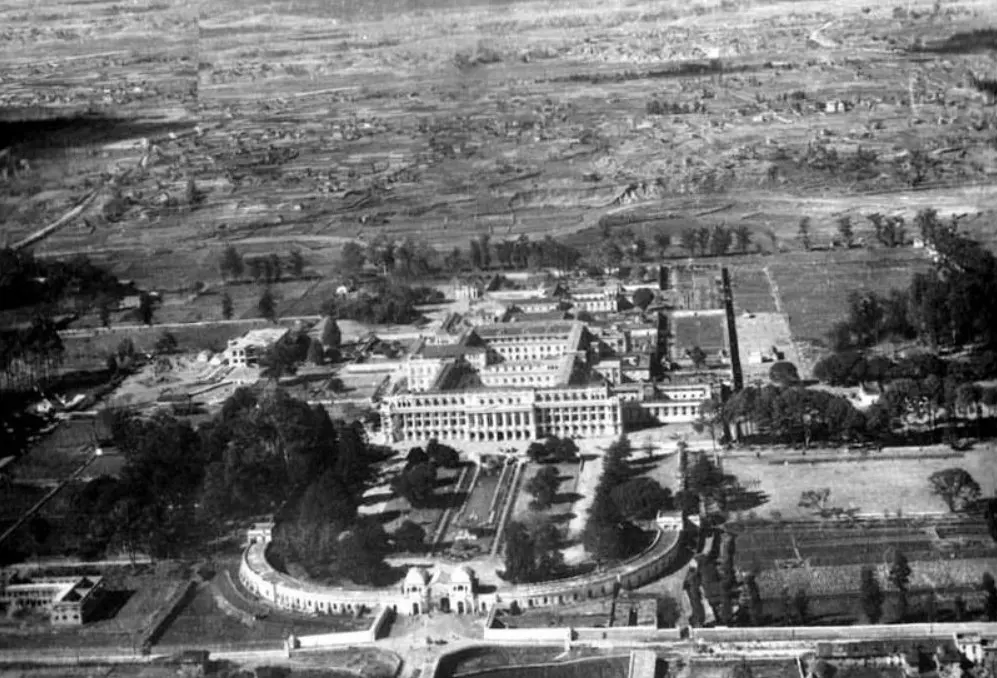
For the Ranas themselves, life could hardly have been more different. In Kathmandu they built palace after palace in the style of Europe, white plaster and long rows of columns. The largest, Singha Durbar, built for Chandra Shumsher in the first years of the 1900s, was big enough for most of his sons to live in it with their wives and children. Its great hall was hung with huge mirrors and chandeliers of crystal, and an English visitor wondered how they had all been brought over the passes. His own answer was that with enough people to carry, almost anything could be brought in. When the British commander-in-chief in India, Lord Kitchener, visited in 1906, he wrote of “marble palaces, lighted by electricity”. There was little line between the state’s money and the prime minister’s: from Jung Bahadur on, the treasury was his to use.
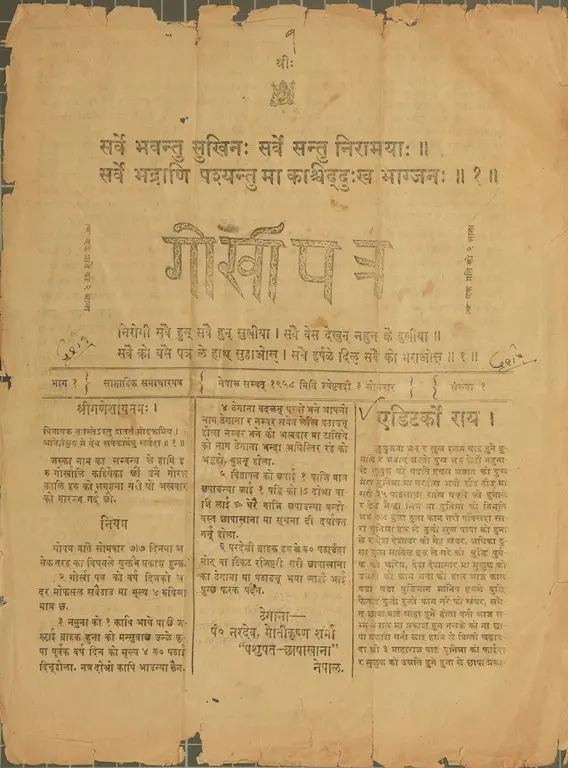
Learning was kept almost as close. In 1854 Jung Bahadur hired an English tutor to teach his own children in his palace, and the classes became Durbar School, for Rana sons. Other children were let in only later. In 1901 a new prime minister, Dev Shumsher, tried to change things quickly. He started the Gorkhapatra, a government weekly that first came out in May 1901 and is still published today. He planned primary schools teaching in Nepali, opened thirty, and freed hundreds of slaves at his own installation. Within months his brothers removed him, and a third of his schools soon closed. The new prime minister, Chandra Shumsher, opened a college in Kathmandu in 1918, Tri-Chandra. By the time Rana rule ended, all of Nepal had about three hundred primary and middle schools, eleven high schools and two colleges. About one person in twenty could read.
Women’s lives ran through all of this, though the papers rarely look at them directly. The state called out its unpaid labor household by household from the able-bodied, and widows were generally excused, along with the old, the young and the disabled. Among slaves, women’s work wasn’t the only thing taken from them: the law didn’t punish the men of a household for having sex with a slave woman, and gave her almost no protection from abuse. A slave woman whose master kept her as a wife and had children by her could no longer be sold, and her children were born free.
Slave women went with a bride as part of her dowry, as Indravadan did. Dev Shumsher’s order of 1901 was to free the slave women of Kaski and Lamjung, the prime minister’s own estates, until the owners’ uproar made him give it up. Until 1920 a widow could still be burned with her husband. Schooling reached women last of all. A girls’ high school opened in Kathmandu only in the years before the Second World War, and when Rana rule ended, fewer than one woman in a hundred could read.
Under the Ranas, then, Nepal was a country of farmers who paid twice, in grain and in work, to people above them, from the village landlord to the prime minister. Land given away as birta and jagir kept a small class rich and loyal, kipat held out in the east while it was chipped away, and the Tarai filled with settlers while its first people lost ground. Slavery lasted until 1925, and its end came from above, for reasons that were moral and practical at once. The palaces, the electric light, the first schools and the newspaper were real changes, but they reached few people beyond Kathmandu. That gap, between the huts and the palaces, is part of why people began to ask why one family should rule (Chapter 26). First, though, many men from those huts were going much further from home, to work and fight in Britain’s wars, the story of Chapter 25.
The Grade 9 सामाजिक book covers the same years in राणा शासनको आर्थिक र सामाजिक प्रभाव.
Found a mistake? Please tell us.