More than the printed sheet
The businesses elsewhere, in full
ColdHubs (Nigeria). Nnaemeka Ikegwuonu started ColdHubs in 2015 and tried the first room in rural Imo State. Each hub is a walk-in room of insulated panels with solar panels and batteries, cooled with propane (R290), a refrigerant that does little harm to the climate. It stays at about 5 °C and holds about 3 tonnes, some 150 crates of 20 kg. Farmers and traders don’t buy the room; they pay about 100 naira a crate a day, and produce that would last two days lasts up to 21. Women from the community run the hubs. In 2020–21 a study put seven hubs in markets in north-east Nigeria: each cost about US$40,000 to build and US$150 a month to run; the traders who used them sold nearly 70% more, and each hub made about US$8,000 a year after running costs, so paying back the building cost with interest would take about ten years. By 2024 ColdHubs ran 58 rooms and 10 refrigerated trucks for over 11,100 farmers, retailers and wholesalers.
Ecozen (India). Devendra Gupta, Prateek Singhal and Vivek Pandey started Ecozen in 2010 with solar irrigation pumps, and have since put in more than 100,000. Its cold room, Ecofrost, came later: a room for 5–6 tonnes with 4–5 kW of solar panels on the roof and a “thermal battery” that stores cold, keeping it at 4–10 °C for up to 30 hours without sun. In 2018 one cost about £15,000, with an Indian farm subsidy and bank loans to help; 100 rooms served about 1,000 farmers, and Ecozen said they could raise farmers’ profits by up to 40%. Farmers don’t have to own one: in Muzaffarpur, Bihar, a solar company, Oorja, owns a room at a market gate and charges by how much is stored (2021). In 2023 Ecozen raised US$25 million to grow into South-East Asia and Africa.
Why so many of Nepal’s cold stores stand empty
A Kathmandu Post report (2023) found that hundreds of cold stores had been built, often with grants from all three levels of government, but without studies of whether they would pay, and only a few were doing well. Ram Janaki Cold Store in Biratnagar, for 5,000 tonnes, was underused, and its operator said that even with half its electricity paid by the province, “We don’t make enough to even pay the energy bill.” A Rs 9 million store in Diktel, Khotang stood unused for want of local produce. In Jaljala, Parbat, a 15-tonne store that cost Rs 4 million was used for one year; some oranges rotted, the rest changed taste, and technicians couldn’t fix it. In Kushma a 10-tonne store couldn’t keep its temperature without steady power.
The lessons: build small, for the produce that is really there; choose a crop whose price rises enough after harvest; plan who repairs it; and don’t depend on the grid or on a subsidy for running costs.
The money, worked through
Step 1: what a room earns from one crop. Dharan’s market cold store charged Rs 20 a kilo to keep pears for two and a half months (2021). A room the size of a ColdHub, about 3 tonnes, filled once with pears: 3,000 kg × Rs 20 = Rs 60,000.
Step 2: is it worth it to the farmer? 100 kg of pears sold at harvest for Rs 15–20 a kilo bring Rs 1,500–2,000. Stored and sold at festival time for Rs 70–80 wholesale, they bring Rs 7,000–8,000, less Rs 2,000 for storage: Rs 5,000–6,000. The farmer is about Rs 3,000–4,500 better off, as long as few pears spoil. That’s why it pays to store a crop whose price rises a lot.
Step 3: what the room costs. Gandaki Province offered up to Rs 15 lakh as half the equipment cost of PEEDA’s solar store in Dolakha (2019), so the equipment came to about Rs 30 lakh. In Nigeria, a hub cost about US$40,000 to build and US$150 a month to run (2020–21).
Step 4: how long it takes to pay back. With one pear season a year, Rs 30 lakh ÷ Rs 60,000 = 50 years. Filled four times a year with different crops at the same rate, Rs 2.4 lakh a year, it is still 12.5 years, and that is before paying a manager, repairs and new batteries. The Nigerian hubs, used every day, needed about ten years. So a room must be full most of the year with several crops, and the building cost shared, by a grant or a cooperative.
How full a room in Nepal would stay: no reliable figure. Find out before you build, by recording for a year what one collection centre’s farmers harvest each month and what each crop sells for.
Other places in Nepal it could fit
The eastern hills’ pears. Taplejung, Dhankuta, Tehrathum, Sankhuwasabha and Khotang all grow pears; Dhankuta alone sold 3,571 tonnes worth Rs 70 million in 2021, and only a few farmers stored any (Kathmandu Post).
Karnali’s apples. Karnali Province grows more than 31,000 tonnes of apples a year, and its farmers say they don’t get a fair price for want of storage, packing and markets (Kantipur, 2026). In Jumla the Chandannath Cooperative buys apples straight from orchards by quality and stores them, aiming to send 300,000 kg to market (2026).
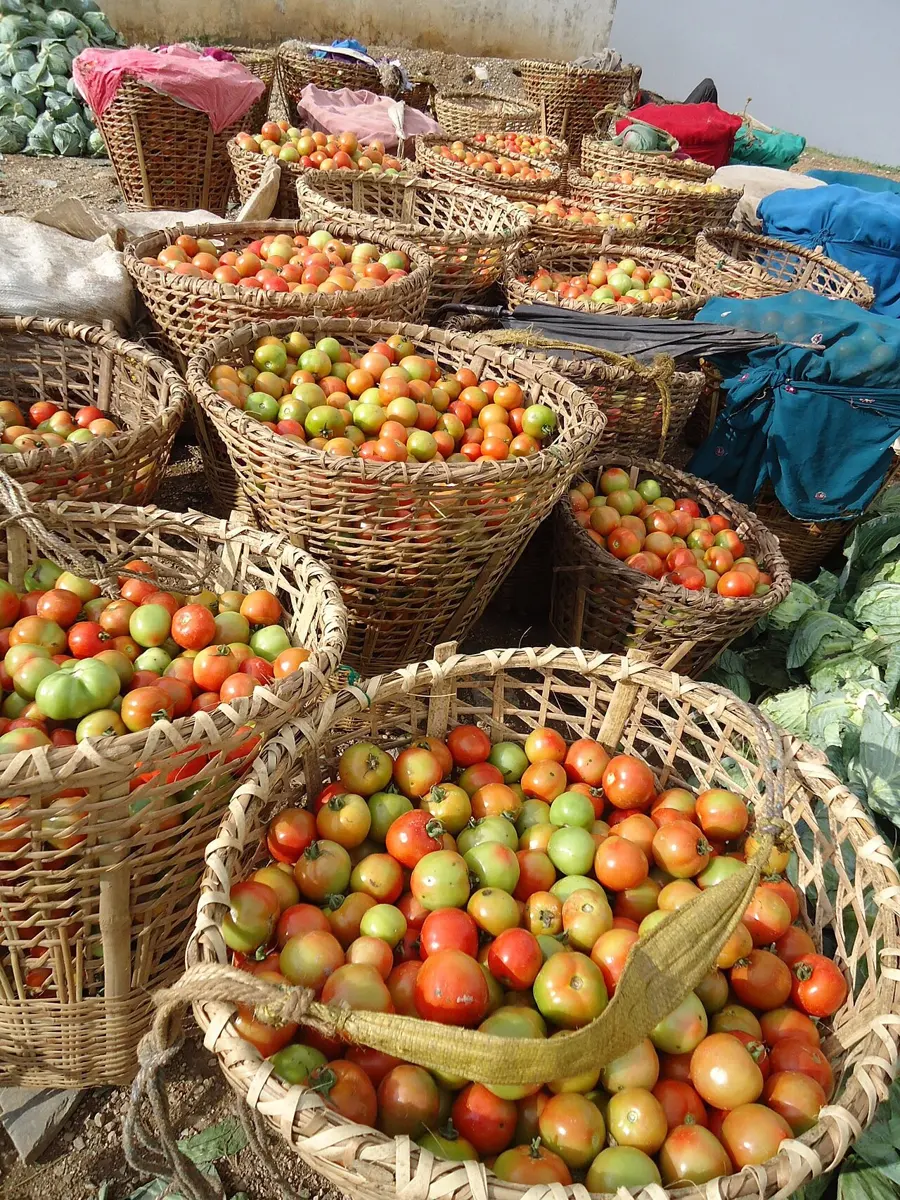
The Tarai’s vegetables. In 2021/22, 94% of the tomatoes and 99% of the onions at Kalimati came from India (Kalimati market board). Stored Nepali produce can take some of that place, if it is cheap enough. Where big stores already stand idle, as in Koshi, renting space and running it well may be the first step.
Questions people ask
- How long do vegetables keep in a cold room?
- In ColdHubs’ rooms at about 5 °C, produce that lasts two days outside keeps up to 21 days; in the Nigerian study it stayed fresh 7–11 days. Pears in Dharan kept for two and a half months at 4–6 °C.
- Why solar, if there is a power line?
- Power cuts spoil what is stored: Kushma’s 10-tonne store couldn’t keep its temperature without steady power. And bills add up: a Biratnagar store couldn’t pay its electricity bill even with half of it paid by the province (Kathmandu Post, 2023). Solar has no bill, but batteries and coolers still need repairs.
- Could a group of farmers own one together?
- Yes: villages in Dolakha store their produce together at PEEDA’s collection centre. But owning together isn’t enough by itself: the East Nawalparasi store, paid for by 350 returnees, has been shut for three years. Someone must run it as a business.
- Can I start without building anything?
- Yes: rent space in an existing store for one harvest and charge farmers per crate (the sheet’s small test). Many stores, such as Ram Janaki in Biratnagar, have more space than produce.
Related
Sources for this part
The sheet’s own sources are listed on it, above.