
Nepal’s rivers could, by the usual reckoning, turn out about 83,000 megawatts of electricity, and about 42,000 of that could be built at a cost worth paying. By mid-July 2026 the country had built 4,120. So about nine-tenths of what the rivers are said to offer is still running past the turbines, as it has since before anyone counted it.
Nepal’s school books call water, forests and minerals the sectors of potential, सम्भावनाका क्षेत्र: the places where the country could grow rich. The word is true and it is also a little dangerous. A river is worth only what it costs to catch its water, turn it into something, carry that to someone, and get paid, all before the money borrowed to do it runs out. Every step costs money and time, and the word “potential” leaves all of them out. This chapter is about those steps, for each of the three: what the water, the forests and the rocks earn now, why it isn’t more, and how the country shares what they do earn. Where the rivers, the trees and the rocks themselves are, and how they got there, is the subject of Geography, for the Curious, in What the land gives and What the rock holds.
Water: too little, then too much
Not long ago the problem was the opposite of potential. For most of the decade to 2016 Nepal couldn’t make the electricity it needed, and the lights went out by timetable, a practice everyone called load shedding. In the worst winters homes went without power for more than half the day, and a study for the World Bank later put the cost at more than 6% of everything the country produced. The cuts ended for homes in the winter of 2016/17 and for factories in May 2018, when the state power company, the Nepal Electricity Authority, finished a run of new power stations and lines and stopped losing so much power on the way, and as more could be bought from India. Geography’s Wires tells how the wires then spread to nearly every home.
Today the trouble is the calendar. Almost all of Nepal’s electricity comes from rivers, and almost all of its rivers are fed by the monsoon. In the wet months they run high and every turbine spins; in winter they shrink, and the power they make falls to less than half. Demand doesn’t follow. People still cook, factories still run, and in winter the evenings are long and cold. So in the year to mid-July 2026 Nepal did something that would have sounded absurd in 2016: it sold electricity abroad for most of the year, and bought it back in winter.
The pattern is plain in the bars. From Shrawan to Kartik, the monsoon and just after, Nepal sold more than 500 million units a month. In Poush the sales fell to a trickle and the buying began, and from Magh to Chaitra Nepal bought about a quarter of a billion units a month from India. About four-fifths of the year’s buying fell in those four months, Poush to Chaitra. Over the whole year the country sold 3,965 million units and bought 1,171, earning about Rs. 29 billion and paying out about Rs. 11 billion. Nine years earlier, in 2016/17, it had sold almost nothing and bought more than 2,000 million units.
The answer to the winter gap is to keep some of the monsoon for later, in a reservoir: a high dam that holds a lake of water through the dry months. Nepal has very few. Most of its power stations take the river as it comes, with at most a small pond behind the dam, enough to run harder for a few hours each evening. Of the state’s own large power stations, only those at Kulekhani save water from the monsoon for the dry season.
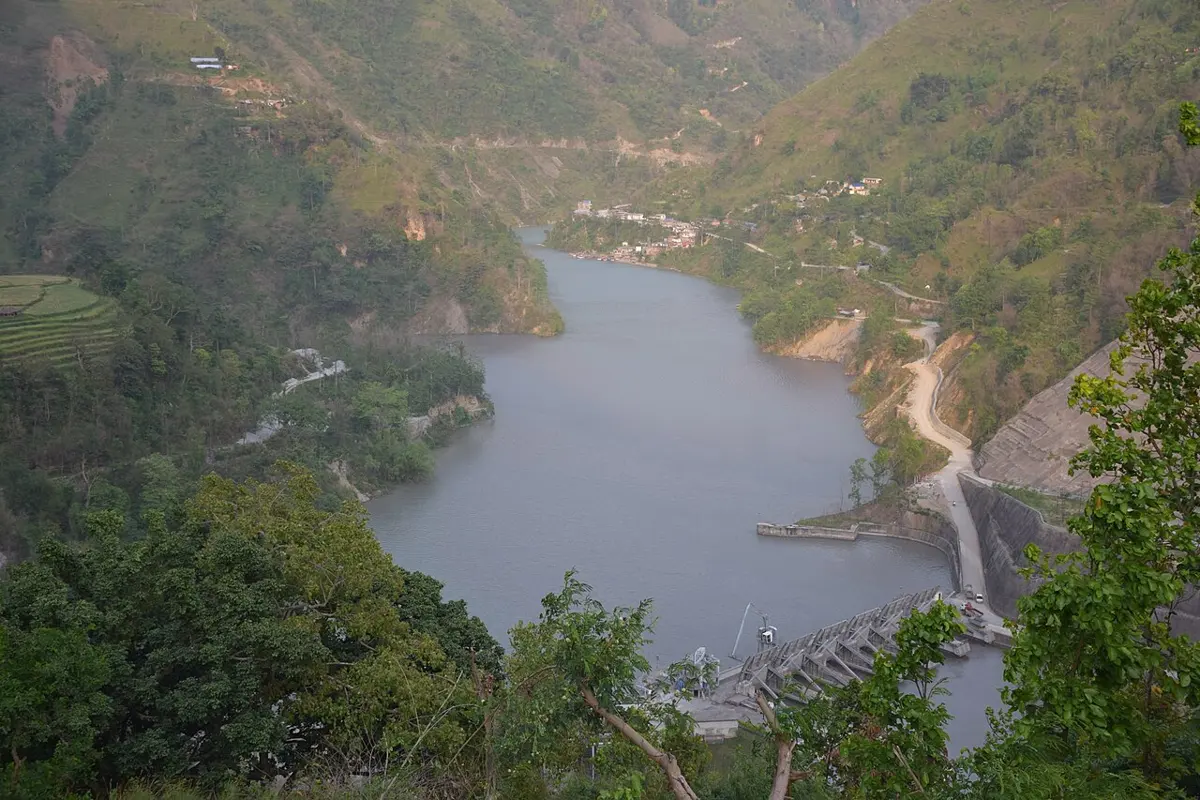
If the rivers are there and the buyers are there, why not simply build more? Upper Tamakoshi, in Dolakha, shows what “simply” means. Its company, set up by the Electricity Authority in 2007, built a station of 456 megawatts on a river that drops 822 meters between where the water is taken and where it spins the turbines. The main contracts were signed by 2013, with the work due to finish in 2016. Then the earthquake of April 2015 struck, and landslides buried most of the last road to the site. In the months after it, fuel and materials stopped arriving from India at the southern border. The design of the main tunnel had to be changed, and one of the contractors managed its part badly. The station opened in July 2021, more than five years late, and its cost had risen from Rs. 35 billion to Rs. 49 billion, before counting the interest paid on the borrowed money while it waited. All of it was raised inside Nepal: loans from the workers’ provident fund and other public bodies, and shares sold to the public and to the people of Dolakha.
Every one of those delays was ordinary. Roads, earthquakes, borders, designs and contractors are what building in the hills is made of, and each year of waiting adds interest to a loan on which nothing is being earned. This is the first thing the word “potential” hides: the river is free, but the years between deciding and earning are not. In mid-July 2026, 213 more projects with 6,472 megawatts between them were being built, and a reservoir station of 140 megawatts at Tanahu was about four-fifths done.
Electricity that can’t be stored has to be used the moment it is made, so a country with more than it needs either finds a buyer or lets the water spill past the turbines unused. Nepal’s buyer is India, which surrounds it on three sides and has an enormous, growing demand. Since November 2021 Nepal has sold power on India’s power exchange, where the price is set by bidding, and it now has longer deals too, with Indian states such as Haryana and Bihar. By 2026 power stations with 1,200 megawatts between them were approved to sell across the border.
The newest step goes further. Under an agreement signed by the Electricity Authority, an Indian state-owned power trader and Bangladesh’s power board, Nepal sells 40 megawatts to Bangladesh, carried across India on Indian wires. Steady deliveries began in June 2025, for the monsoon months, and in the year to mid-July 2026 Bangladesh bought 148 million units. It’s small, but it gives Nepal a second buyer. The Electricity Authority counts on India’s promise to buy 10,000 megawatts from Nepal over ten years, and Nepal hopes to export 15,000 megawatts by 2035.
There is a risk in leaning on one neighbor. The wires, the markets and the route to Bangladesh all run through India, and a buyer with no rival has the stronger hand. The Electricity Authority itself warns that unless more power is used at home and more is sold abroad, some of what the new stations make will have to be thrown away. So the cheapest buyer to reach is the one at home. Nepal still burns imported petrol and diesel in its cars and trucks, and cooks on firewood and imported gas. Every electric stove or bus that replaces them turns a wet-season surplus into a cut in imports, and the sales of petrol and diesel did fall, by 6 to 9%, in the first eight months of the year to mid-July 2026. Electricity still made up only about an eighth of the energy Nepalis used that year; firewood was nearly half. Other renewable sources, which don’t run out as petrol does, help at the edges: about 457,000 homes have biogas plants that turn dung into cooking gas, more than 1.6 million improved stoves burn less wood, and solar panels added about 63 megawatts in the year to mid-July 2025.
Power is only one use of a river, and not the oldest. A canal that waters a field in the dry season can let a farmer grow two or three crops instead of one. By March 2026 about 1.6 million hectares had some irrigation: 45% of the land that can be farmed, and 63% of the land that could be irrigated at all. Fifty years ago the share was about a tenth. The canals that would water whole districts all year are the slow, large ones. Bheri-Babai carries water from the Bheri river into the Babai, Nepal’s first such move of water from one river basin to another, to irrigate about 51,000 hectares in Bardiya and Banke the whole year round and make 46.8 megawatts on the way. It was 70% done in 2026, and not due to finish until 2030/31. Many smaller canals were built and are still run by farmers themselves, which is the story of Shared Things.
Drinking water shows a similar gap between reaching and finishing. By the water supply ministry’s count, 97% of Nepalis had at least basic drinking water in 2026. Only 29% had water of what the ministry counts as a high or medium level, the safe kind, and only about 3% were linked to sewers whose waste was treated before it reached a river. Kathmandu waited decades for water brought from the Melamchi river, a story told in Geography’s Water under the floor.
Rivers bring fun too, and that earns money. Visitors come from abroad to raft Nepal’s white water, and a rafting trip sells the same falling water a power station sells, in a different form.
Forests: worth more than the timber
By the forest ministry’s count in 2024, forests cover about 46% of Nepal’s land, counting shrubland, up from about 40% in the 1990s. They are worth far more than their wood, and most of what they are worth never passes through a till. The firewood that supplies nearly half the energy the country uses is mostly gathered, not bought. The leaves and grass fed to buffaloes, the water a forested hill holds and lets out slowly through the dry season, the soil its roots keep from washing down onto the fields below: none of it is counted as income, though a village would notice at once if it were gone. The national accounts don’t even show forestry by itself. They lump it with farming and fishing, which together make up about a quarter of what Nepal produces.
What is sold is mostly timber. In the year to mid-July 2025 the forests gave about 40 million cubic feet of logs, from the hardwoods of the Terai, such as sal (साल) and sissoo (सिसौ), and the pines and other softwoods of the hills. On top of that come the forest products that aren’t timber, above all herbs: hundreds of kinds of plants are gathered for medicine. And people pay to walk among the trees: national parks such as Chitwan earn entry fees from their visitors. All together, the government’s income from its forests that year, from timber, firewood, herbs, park fees and fines, came to about Rs. 3.4 billion.
There is a newer way to earn from a forest: being paid to leave it standing. A tree takes carbon dioxide from the air as it grows, and when it is cut and burned the carbon goes back, warming the planet, one of the costs nobody pays. Under a program for the Terai Arc, a belt of forests along the southern plains, Nepal kept about 1.9 million tonnes of carbon dioxide out of the air and, for the first time, was paid for it: US$9.4 million, into its Forest Development Fund. More such sales have been agreed.
Fifty years ago the worry was the opposite. A World Bank report of 1979 found that farm and forest goods, mainly rice and timber, had made up more than four-fifths of Nepal’s exports since the early 1960s, that wood and other traditional fuels supplied about nine-tenths of all the energy the country used, and that the average family spent eleven days a month gathering it. It warned that the forests people could reach would largely disappear, as Geography’s The hills that were going to be bare tells.
The reasons for cutting were economic ones. Wood was the only fuel most people had. Land for crops was short in the hills, so families cleared slopes and, once malaria was stamped out, moved down to the Terai: about 400,000 people moved for good in the 1960s alone, most of them settling wherever they could, and forest became farmland. Timber was one of the few things Nepal could sell, and much of the Terai’s forest was cut under the control of officials and traders, not by poor farmers. And when the state took over the forests in 1957, many villages stopped looking after woods that were no longer theirs, the tragedy told in Shared Things.
The cost of cutting fell partly on others, the classic sign of a cost nobody pays. Bare slopes lose their soil, springs below them dry up, and the silt washed down raises the riverbeds in the Terai until they flood. The forests didn’t vanish, as the report feared, partly because they were handed back to the villages, a story Geography tells in The forests come back.
Today the cutting is more often for roads, power lines and dams. By mid-July 2025 development projects had been allowed to fell about 384,000 trees on about 21,800 hectares of forest. The law makes them pay for it. Under the Forest Act 2076, a project that uses national forest must pay into a fund for as much private land as it takes, for trees planted on it, and for five new trees for every one it cuts, all tended for five years; a government project pays for planting an area as large as the one it uses. The rule puts at least part of the cost back in the price, as an economist would want, though making each project keep it is another matter.
Minerals: found but not dug
The rocks are where the gap between potential and earning is widest. Nepal’s Department of Mines and Geology has found minerals in more than a thousand places, 64 kinds in all, from iron and zinc to limestone, magnesite, gems and natural gas. Yet mining and quarrying together make up less than half of one percent of what the country produces.
The department’s own words explain the gap. It calls a find an economic deposit only when digging it would be both possible and profitable, and many finds are not: they are too small or too poor to pay, or only signs that the mineral is there. Being there is the easy part. A mine needs a deposit large enough and rich enough to pay back years of digging, a road to carry the ore out, power to run it, and a price for the metal that stays high for long enough. Nepal’s metals mostly fail one test or another: the deposits are small, they lie in steep country far from roads, and the price of the metal can fall before the mine pays for itself. Geography’s What the rock holds follows the iron at Dhaubadi, the zinc at Ganesh Himal and the gas at Dailekh, all found and all still waiting, and Minerals of Nepal has a page for each mineral.
What Nepal does dig is mostly what it can sell close to home: stone, sand and gravel for building, and limestone for cement. In the year to mid-July 2026 the mines licensed by the department produced 14 minerals, but limestone, nearly 10 million tonnes of it, paid almost all of the department’s royalties. A cement works can sit beside its quarry and sell to builders a few hours away. A metal mine high in the hills has to carry its ore down long roads to a distant buyer.
Minerals differ from water and forests in one plain way: they don’t grow back. A forest cut with care regrows and a river refills every monsoon, but a tonne of limestone dug is gone for good. Economists call the first two renewable and the third non-renewable, and the difference changes the sum. Money from a mine is partly the country selling something it can never have again, so it is best spent on things that last, such as roads, schools and skills, rather than on this year’s bills.
Who gets what the land earns
The government charges a fee, called a royalty, for using what belongs to the whole country: a river’s fall, a forest’s wood, a quarry’s stone, a mountain’s summit. In the year to mid-July 2025 the royalties came to about Rs. 8.2 billion. Electricity paid the most, about Rs. 3.9 billion, then forests, about Rs. 1.7 billion, mines about Rs. 1.6 billion, and mountaineering about Rs. 1 billion.
Who should get that money? The people near a dam or a quarry bear its dust, trucks and drowned fields, while the electricity and cement go to the cities. So the Constitution of 2015 says the benefits of natural resources must be shared fairly, with a part going to the areas and communities a project affects. The Intergovernmental Fiscal Arrangement Act 2074 does the sums: the royalties are pooled and split, half to the federal government, a quarter to the province affected and a quarter to the local governments affected, in proportion to how much each is affected. The split is worked out on the advice of the National Natural Resources and Fiscal Commission, and can be changed every five years. It’s a small sum beside the national budget, but it is money that stays near the dam or the quarry.
Managing all three resources comes down to a few questions that run through this book. Who owns the thing, and who looks after it day to day? Does its price include the harm it does to others? Is it used up faster than it grows back? And is the money it brings spent on what will still be there when the resource is gone? Nepal has answered some of these better than others: the forests by handing them to villages, the rivers by building and selling, the rocks hardly at all yet.
So “potential” is a real word, but a promise only of what could be, if someone pays to catch it. Nepal’s rivers now give it more power than it can use in the monsoon and too little in winter, and the next steps are reservoirs, wires and finding ways to use more of the power at home. Its forests have come back and are worth far more standing than their timber sells for, most of it never counted. Its rocks hold much more than it digs, because a find isn’t a mine until it pays. And what the three do earn is shared, by law, with the places that bear the cost of earning it.
Found a mistake? Please tell us.