
Anshu wants a fridge for her tea shop, so that she can sell cold drinks in the hot months too. She asks her bank for a loan of Rs. 1 lakh. The bank looks at her accounts, decides she will pay it back, and the next morning her balance is Rs. 1 lakh higher. Where did that lakh come from? The obvious answer is someone else’s savings, but nobody’s balance went down. The bank typed a number into Anshu’s account and wrote down beside it that she owes the bank Rs. 1 lakh. That morning there was a lakh more money in Nepal than the night before. (Anshu and her fridge are made up, like her shop.)
That is the plain answer to where most money comes from. Today’s money is mostly numbers in banks’ books, and this chapter is about how the numbers get there. Banks make most of a country’s money when they lend, and the money disappears again when the loans are repaid. That is a great deal of power to leave with private firms, so most of this chapter is about what keeps it in check: the banks’ own caution, their fear of a run, a central bank behind them all, and what happens where nobody is watching.
Where most money comes from
In mid-October 2026 Nepal’s broad money came to about Rs. 9,199 billion. Notes and coins in people’s hands were Rs. 807 billion of it, less than one rupee in ten. The rest was deposits. The Bank of England, explaining the same thing about Britain in 2014, put it bluntly: “Whenever a bank makes a loan, it simultaneously creates a matching deposit in the borrower’s bank account, thereby creating new money.” Economists have called bank deposits “fountain pen money”, made at the stroke of a banker’s pen.
Nepal’s Grade 9 book tells the story in the other order, starting from a deposit. Someone puts Rs. 10 lakh into a bank. The bank must keep a share back, say 10%, and lends the other Rs. 9 lakh. The borrower spends it, and whoever is paid puts it into a bank, so it turns up as a new deposit of Rs. 9 lakh. That bank keeps 10% and lends Rs. 8 lakh 10 thousand, and so on down the chain, each loan becoming someone’s deposit and each deposit a little smaller than the last.
The chain can never pass a ceiling: the first deposit divided by the share held back. At 10%, Rs. 10 lakh can grow to at most Rs. 100 lakh in accounts, of which Rs. 90 lakh is new money that the loans made. One divided by the share, here 10, is called the money multiplier, or the credit multiplier. Hold back 20% and it falls to 5; hold back 4%, Nepal’s actual rule in 2026, and it rises to 25.
The chain shows well that a loan becomes a deposit. The Bank of England called it “a useful way of introducing money and banking”, but “not an accurate description of how money is created in reality”. Banks don’t wait for deposits and lend a fixed share of them. They decide first how much to lend, to whom and at what rate, and the deposits appear as they lend. That doesn’t mean they can lend without limit, and the Bank of England was plain that they can’t. In its account the limits are whether a loan will be repaid and earn more than it costs, the rules on how much of the owners’ own money a bank must hold against its loans, and the interest rate the central bank sets, which decides what lending is worth. A bank must still keep whatever reserves the rules ask, but it can borrow them, at the central bank’s price, and reserve rules, the article added, play little part in how most rich countries’ central banks work today; Britain had none. Every repayment works the chain backwards. When Anshu pays off her loan, her balance and her debt both shrink, and that money is gone.
Nepal in 2026 showed this plainly. Its banks had to keep 4% of their deposits at the central bank. In the three months to mid-October the commercial banks’ balances there rose by more than three-quarters, from Rs. 359 billion to Rs. 638 billion, far beyond what the rule asked. If reserves were what held lending back, the banks had plenty. Yet lending to firms and households grew only 8.3% in a year, and the multiplier as Nepal Rastra Bank measures it (broad money divided by the money the central bank itself issues, notes and banks’ balances with it) fell from 7.28 to 5.78. The real multiplier is far below the chain’s 25 because people keep some money as notes, which never come back as a deposit, and banks keep more than they must. In 2026 they had money to lend, and too few people wanted to borrow it.
Since money is mostly deposits, it is counted in layers, from the most spendable outward. Narrow money, M1, is notes and coins with the public plus current deposits, which can be spent by cheque or card at once: Rs. 1,409 billion in mid-October 2026. Nepal Rastra Bank adds saving and call deposits to make M1+, Rs. 6,265 billion. Broad money, M2, adds fixed deposits too, which can be had only by waiting or paying a penalty: the Rs. 9,199 billion, 13.7% more than a year before.
Who lends, and where
A banking system does three jobs at once. It gathers many people’s small savings and lends them in larger sums to people who will put them to work. It moves payments, by cheque, card and phone. And it lets savers take their money out whenever they like while borrowers keep theirs for years, which is the harder trick, and the one that can go wrong.
Nepal Rastra Bank licenses four classes of institution. In mid-October 2026 there were 103 of them, plus one infrastructure development bank in no class, with 11,301 branches between them. The 20 commercial banks, class A, do nearly everything a bank can: take every kind of deposit, lend to anyone, deal in foreign money and handle importers’ payments abroad. Nepal’s first opened in 1937. The 17 development banks, class B, began as lenders to one part of the economy that ordinary banks neglected. The state set up the Nepal Industrial Development Corporation for industry in 2016 BS (1959/60) and the Agricultural Development Bank for farming in 2024 BS (1967/68), which became a commercial bank in 2063 BS (2006/07). Today’s development banks do much of what commercial banks do, on a smaller scale and within narrower limits set by the central bank. The 16 finance companies, class C, the first of them from 2049 BS (1992/93), lend largely for vehicles, machines and household goods paid for in installments. The 50 microfinance institutions, class D, lend small sums, often without collateral, to people the other banks pass over, who join a group, save together and stand guarantee for each other, so that the group’s eyes do the job a land deed does at a bank. The idea is best known from Bangladesh, where Muhammad Yunus and the bank he founded shared the 2006 Nobel Peace Prize “for their efforts to create economic and social development from below”.
Besides taking deposits and lending, a commercial bank works as its customers’ agent, collecting their dividends and interest, paying their bills and sending their money on, for a fee. And it sells services: guarantees that a customer will pay, letters of credit for importers, foreign currency, lockers for jewelry and papers, and cards.
Around the banks stand institutions that hold people’s money in other ways: insurance companies, the Employees Provident Fund, the Citizen Investment Trust, the Social Security Fund, mutual funds, and the cooperatives that come at the end of this chapter. Nepal’s books call them non-bank financial institutions. And a deposit moves on paper as well as by phone, as cheques, drafts, promissory notes, bills of exchange and certificates of deposit, papers that carry a right to money and can be handed on. Money, for the Curious, Chapters 11 and 12, explains them and the four classes from a saver’s side.
The branches are not spread evenly. They go where the deposits and the borrowers are.
Bagmati, with Kathmandu, had 28 commercial bank branches for every 100,000 people; Madhesh had under 10, about one for every 10,700 people against one for every 3,600 in Bagmati. Development banks lean the same way, with 328 branches in Bagmati and 21 in Karnali. Microfinance fills part of the gap. It had more branches than the commercial banks in five of the seven provinces, all but Bagmati and Gandaki, and it is spread far more evenly.
A run, and the bank behind the banks
That harder trick, short-term deposits paying for long-term loans, is what makes a bank useful and what makes it fragile. In 1983 two American economists, Douglas Diamond and Philip Dybvig, showed why in a simple model. Savers don’t know when they will need their money, and long projects lose most of their value if stopped halfway. A bank solves both: it promises each saver the money on demand and lends to the projects, because on any day only a few savers come. But the promise holds only while most people believe it. A rumor that the bank is in trouble, true or not, makes it sensible for each depositor to get there first. The bank must call in loans and sell what it owns in a hurry, at a loss, and the run makes the rumor true.
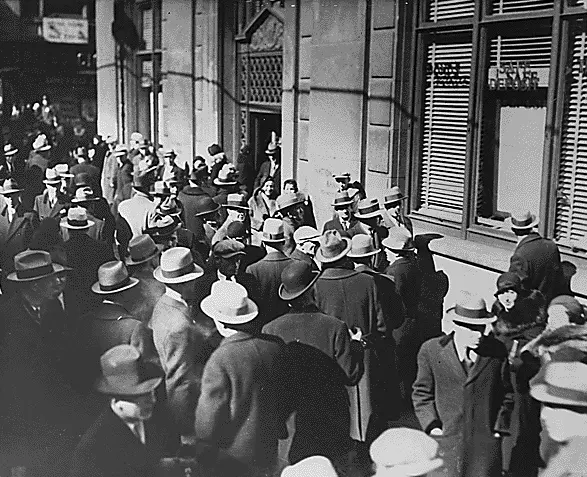
The same year Ben Bernanke, later head of America’s central bank, showed what runs had done in the 1930s. The number of American banks halved in three years. When a bank fails, its knowledge of its borrowers goes with it, firms and farmers can’t borrow, and that, more than any shortage of money, made the depression so deep and long. The three shared the economics prize in 2022. Runs haven’t ended. In March 2023 a Californian bank, nearly all of whose deposits were above the insured limit, lost more than $40 billion in a single day, its depositors warning one another online, and expected about $100 billion more to go the next day. It was closed that day.
Countries answer in three ways. A deposit guarantee pays small savers back whatever happens, so they have no reason to run; Nepal’s covers up to Rs. 5 lakh a person in each bank. A lender of last resort lends to a sound bank caught short of cash. And rules make banks hold enough of their owners’ money to take losses: in mid-October 2026 Nepal’s banks had capital of 12.3% of their loans and other assets, each weighted by its risk, while 5.8% of their loans were not being repaid.
The lender of last resort is Nepal Rastra Bank, set up on 26 April 1956 (Baisakh 14, 2013 BS). Nepal’s books give it seven jobs. It issues the notes and coins. It is the bankers’ bank, holding the cash reserves the banks must keep with it. It is the lender of last resort. It controls the supply of money. It is the government’s bank, keeping its accounts and managing its borrowing. It runs the clearing, where the banks settle what they owe one another each day. And it holds the country’s reserves of foreign money and precious metals. It also licenses and inspects the banks.
Controlling money is done mostly through interest rates. The central bank sets a corridor. At its floor, 2.75% in 2026, it takes the banks’ spare money as deposits, so no bank need lend to another for less. At its ceiling, 5.75%, it lends overnight to any bank short of cash, so none need pay more. In the middle is its policy rate, 4.25%. Each day it buys or sells government bonds, takes deposits or makes short loans, so that the rate the banks charge one another stays near the policy rate. These are open market operations. The banks’ 4% cash reserve ratio is a second lever, and a third is the statutory liquidity ratio, the share of their deposits they must hold in cash and government bonds.
When the central bank lowers its rates and adds money, its policy is loose, or expansionary: loans get cheaper, borrowing and spending rise, and so in time do prices. Raising them is tight, or contractionary, and cools things down. Nepal’s policy for 2083/84, announced in Asar 2083, stayed “cautiously flexible”, aiming at inflation of about 5.5%, foreign reserves enough for at least seven months of imports and growth of 7%. Beneath all its targets sits one more, the rupee’s fixed rate to India’s, which Chapter 33 explains.
In 2026 the trouble was too much money, not too little. Remittances, tourists and public spending kept pouring rupees into the banks faster than people borrowed. By mid-October the central bank was holding about Rs. 1,066 billion of the banks’ spare money in deposit auctions and its own bonds, the rate between banks had sunk to the 2.75% floor, and commercial banks’ average lending rate had fallen from 7.50% a year earlier to 6.31%. Loans were cheap, and credit still grew slowly. Cheap money can’t make people borrow, a limit of monetary policy that Chapter 17 returns to.
Markets for money
Money is lent in two kinds of market. In the money market it is lent for days or months: banks lend spare cash to one another overnight, and the government borrows for three months to a year by selling treasury bills. In the three months to mid-October 2026 banks lent one another Rs. 580 billion, and money was so plentiful that the government could borrow for 91 days at about 1%.
In the capital market money goes for years, as bonds, which are loans that can be sold on, and as shares, which are pieces of a company. Nepal’s is regulated by the Securities Board of Nepal, set up in 1993, and its shares change hands on the Nepal Stock Exchange, NEPSE, whose trading floor opened in 1994. In mid-October 2026 its 305 listed companies were worth Rs. 4,534 billion, more than two-thirds of a year’s GDP. Over half of that value was banks, finance companies and insurers, so in Nepal the banks are both the main lenders and the main thing people buy shares in. Money, for the Curious, Chapter 23, explains how a share is bought.
Outside the walls
Everything so far has a license and an inspector behind it, and its small depositors a guarantee too. Nepal’s savings and credit cooperatives, सहकारी, had none of them, and from about 2022 that difference showed.
A savings and credit cooperative is owned by its members, who pool their savings and lend to one another. Many do a great deal of good, reaching places no branch reaches. Nepal had about 32,000 cooperatives of every kind by March 2026. In June 2023 more than 14,000 of them held about Rs. 478 billion of savings, about a twelfth of what the banks held, and some 10,000 others also did financial business. None was licensed or inspected by Nepal Rastra Bank. The International Monetary Fund counted as many as 761 bodies that could be a cooperative’s regulator, warned of large gaps in the data and weak governance, and saw a risk that trouble would spread to other cooperatives and to the smallest banks.
Many had put members’ savings into land, buying plots to sell on. In 2022 the government halted the dividing of land into plots for sale, land stopped selling, and cooperatives that had promised high interest had no cash to pay it or to return savings. In some, the people running them had taken the money. Offices shut, and members took to the streets. A special committee of parliament looked at 40 cooperatives and found them owing Rs. 87.89 billion, Rs. 71.30 billion of it members’ deposits. By November 2026, of about 76,000 depositors in the 23 cooperatives the federal government had declared troubled, about 11,000 had got some money back. A law of 2025 set up a National Cooperative Regulatory Authority and required savings and credit cooperatives to join the deposit guarantee, and an ordinance of April 2026 added a license from the Authority, renewed each year; by then none had joined the guarantee. Money, for the Curious, Chapter 12, tells the saver’s side.
It is a study in what a regulator is for. A license keeps out people unfit to hold others’ money. Inspection finds a bad loan before it becomes a locked office. Rules on capital and cash make owners lose first and keep enough on hand for ordinary withdrawals. A guarantee stops a rumor turning into a run. The cooperatives lacked all four.
Further outside still is hundi, हुन्डी. A worker in Qatar hands riyals to an agent there, and a partner of the agent pays his family in rupees in Nepal. Nothing crosses the border at that moment; the two agents settle up later, as the international body that sets rules against money laundering describes such systems, “through trade, cash, and net settlement over a long period of time”, often with no transfer between the two ends at all. Running one without a license is an offense under Nepal’s foreign exchange law. The region’s review of Nepal in 2023 found that most workers’ money comes through banks and licensed remittance firms, but that hundi is common both ways, especially in villages beyond the banks’ reach, and that an estimated “large portion” of remittances flows through it. How large nobody knows, since hundi keeps no records anyone can count. The riyals or dollars earned abroad never pass through Nepal’s banks. And the review found the same channel carrying money out of Nepal, to dodge the limits on sending money abroad and to hide it from tax.
So money is mostly made by banks, one loan at a time, and unmade as loans are repaid. Whether a bank lends depends less on the share it must keep than on whether lending pays, and that is what Nepal Rastra Bank steers with its corridor of interest rates, loosening when the economy needs more and tightening when prices run ahead. The whole system rests on a promise that depositors can have their money whenever they ask, which holds only while people believe it, so it is wrapped in licenses, inspections, capital rules, a deposit guarantee and a lender of last resort. Nepal’s cooperatives showed what happens to savings without them. The next chapter follows what happens when money grows faster than the goods it buys.
Found a mistake? Please tell us.