
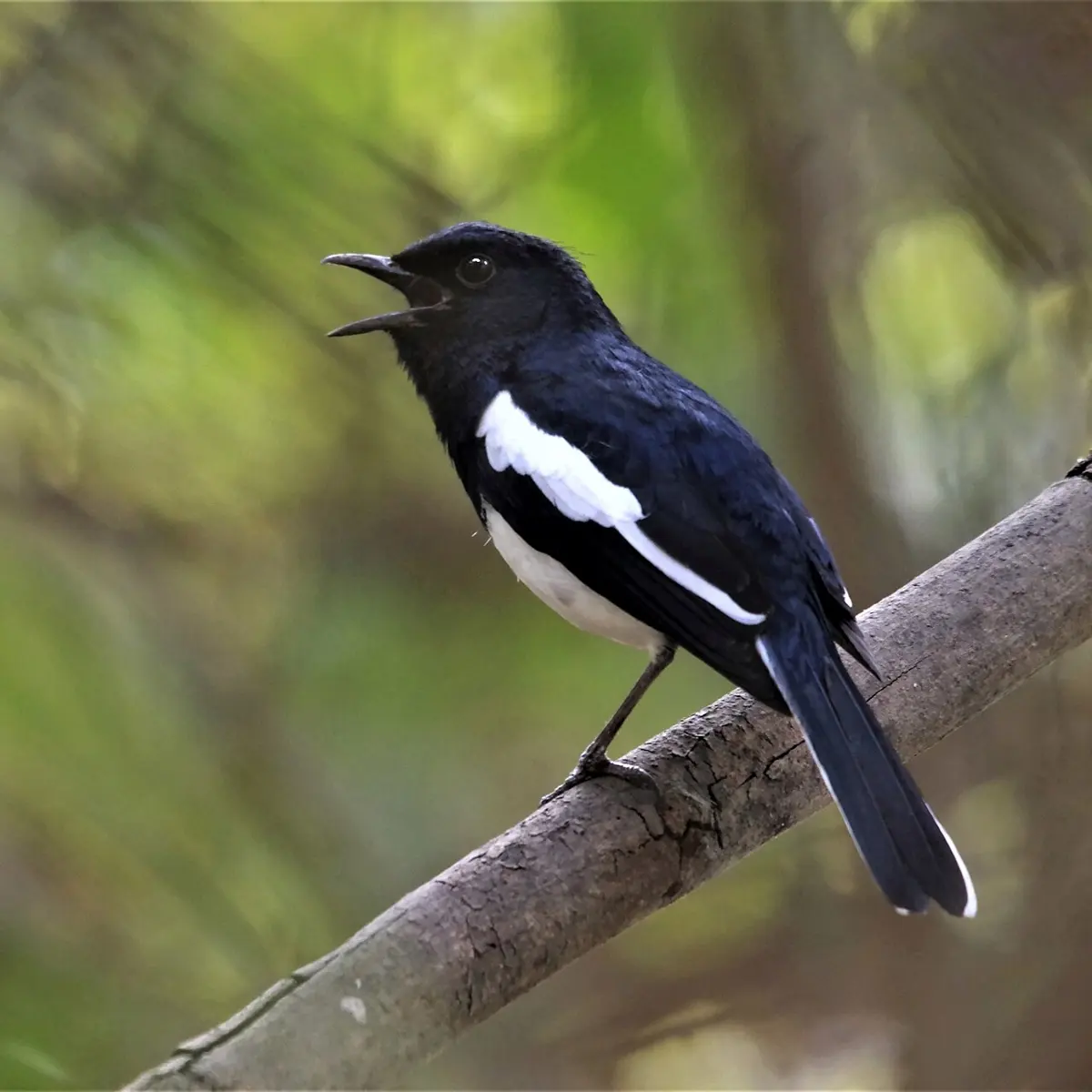
It is March in the hills. Whole hillsides of lali guras have turned red. At dawn a magpie-robin sits on a roof and sings, loud and sweet, again and again. High above the forest, a male danphe struts in front of a brown female, his feathers flashing green, purple and copper. Down in the Terai, a little yellow bird hangs upside down under a half-built nest of woven grass, flapping his wings and calling.
The bird is not singing for you, and the rhododendron is not red for you. Each of these things does one job: it raises the chance of having young that live. In this topic you will find out how songs, colors, nests, herds, nectar, scent and nutshells do that job, and how scientists test it with evidence, not just guesses.
The chance of having young
You know from Grade 8 that living things reproduce to keep their kind going Grade 8: Importance of reproduction, and from Grade 9 that most living things have far more young than ever grow up Grade 9: Enormous fertility. A pair of sparrows may raise a dozen chicks in its life, but only a few of them will ever have chicks of their own. A rhododendron tree makes thousands of flowers every spring, and only a handful of new trees grow from them.
Having young that survive is hard. It is like a path with several gates, and the young are lost if any gate stays shut.
| An animal (a bird) | A flowering plant | |
|---|---|---|
| Gate 1 | find a partner and mate | get pollen from another plant of its kind |
| Gate 2 | lay eggs or give birth | form seeds |
| Gate 3 | keep the young warm, fed and safe until they can look after themselves | get the seeds to a good place to grow |
Scientists call getting through all the gates successful reproduction: having young that live long enough to have young of their own. No animal or plant can make it certain. But many behaviors and body parts make it more likely. A behavior is anything an animal does: singing, building, guarding, dancing. In this topic, each one you meet helps at one of the gates.
Because nothing here is certain, scientists talk about probability: how likely something is, as a fraction or a percentage. If 30 nests out of 100 raise at least one chick, the probability that a nest raises a chick is 30 out of 100, or 30 %.
Why do animals and plants have these useful traits at all? Not because they plan. A bird doesn’t think “I will sing to have more chicks.” But birds that sang well had more young, and their young inherited the way of singing. Over many generations, the traits that let animals and plants through the gates became common. This is natural selection, which you met in Grade 9 Grade 9: Natural selection.
Which of these best describes successful reproduction?
Pick an answer to see why.
Songs and bright feathers
Why birds sing
Listen at dawn in spring and you will hear birds singing everywhere. Most of the singers are males, and most of the singing happens in the breeding season, when birds pair up and nest. That is already a clue: song has something to do with breeding.
A male’s song does two jobs.
- It claims a territory: an area with food and nest sites that the male defends. The song says to other males, “This place is taken. Keep out.”
- It attracts a female. A female listening to several males can choose among them. A male that sings more, louder or with more different songs is often a male in good health, with a good territory.
How do scientists know song keeps rivals out? In the 1970s the British scientist John Krebs tested it with great tits in a wood near Oxford. He caught the pairs that held territories and took them away. Into some of the empty territories he put loudspeakers that played great tit song. Others got a loudspeaker playing a plain note on a tin whistle, and others were left silent. New males soon moved into the empty territories, but they moved into the ones with the song last. The song alone was enough to keep newcomers away for a while.
That was a fair test: everything was the same in the three kinds of territory except the sound, so the difference had to come from the sound. The tin whistle was there to show that it wasn’t just any noise that kept birds away.
What about females? Around 1980, Krebs and his team tried another test on great tits. They gently caught a male’s mate, kept her in a cage for a while, then let her go. While she was away, the male sang about six times as much as before. When she came back, his singing dropped back to normal almost at once. Two of the males found new partners while their mates were away, and then they too sang less. A male without a mate sings to get one.
Why the male danphe shines
The danphe (Himalayan monal) is Nepal’s national bird. You saw it in Grade 10 as an example of the class Aves Grade 10: Aves. It lives on high slopes, from about 2,100 to 4,500 m. People call him the bird of nine colors: a shining green head and crest, a copper neck, a purple-blue back, a white patch low on his back, and a rusty tail. The female is mottled brown.
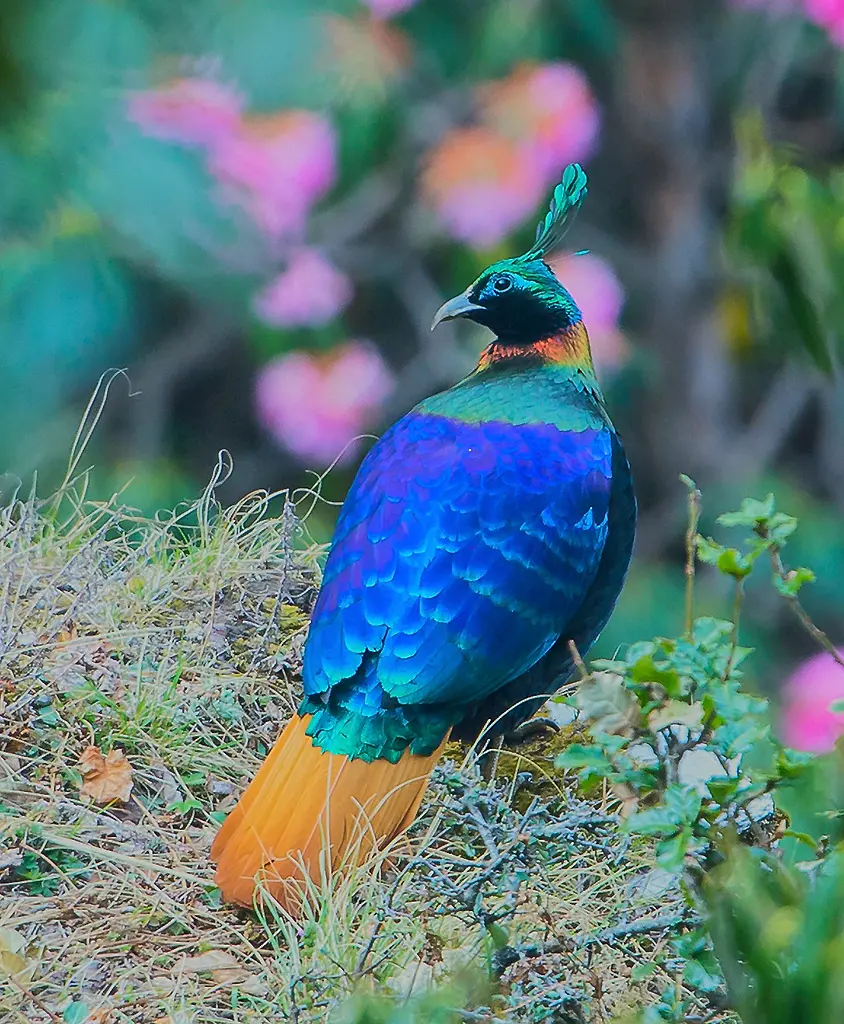
In spring the male displays to a female. He fans his tail and holds it high, bobs his shoulders and walks round her in half-circles, showing his colors and the white patch on his back. The female watches, and chooses.
Why is the female brown? Because she does a different job. She alone sits on the eggs, three to five of them, for about four weeks, on the ground. A shining bird on a nest would be easy for a fox or an eagle to find. Brown feathers match the dead leaves and rocks around her. Her color helps at gate 3 (keeping the young safe); his colors help at gate 1 (finding a mate).
Bright colors have a cost. A shining male is easier for predators to see too. So a trait can help at one gate and hurt survival at the same time. A trait spreads when its gain is bigger than its cost.
An experiment with tails
Is it really the colors and feathers that females choose? Or do the best males just happen to be the most colorful? A famous experiment tested this.
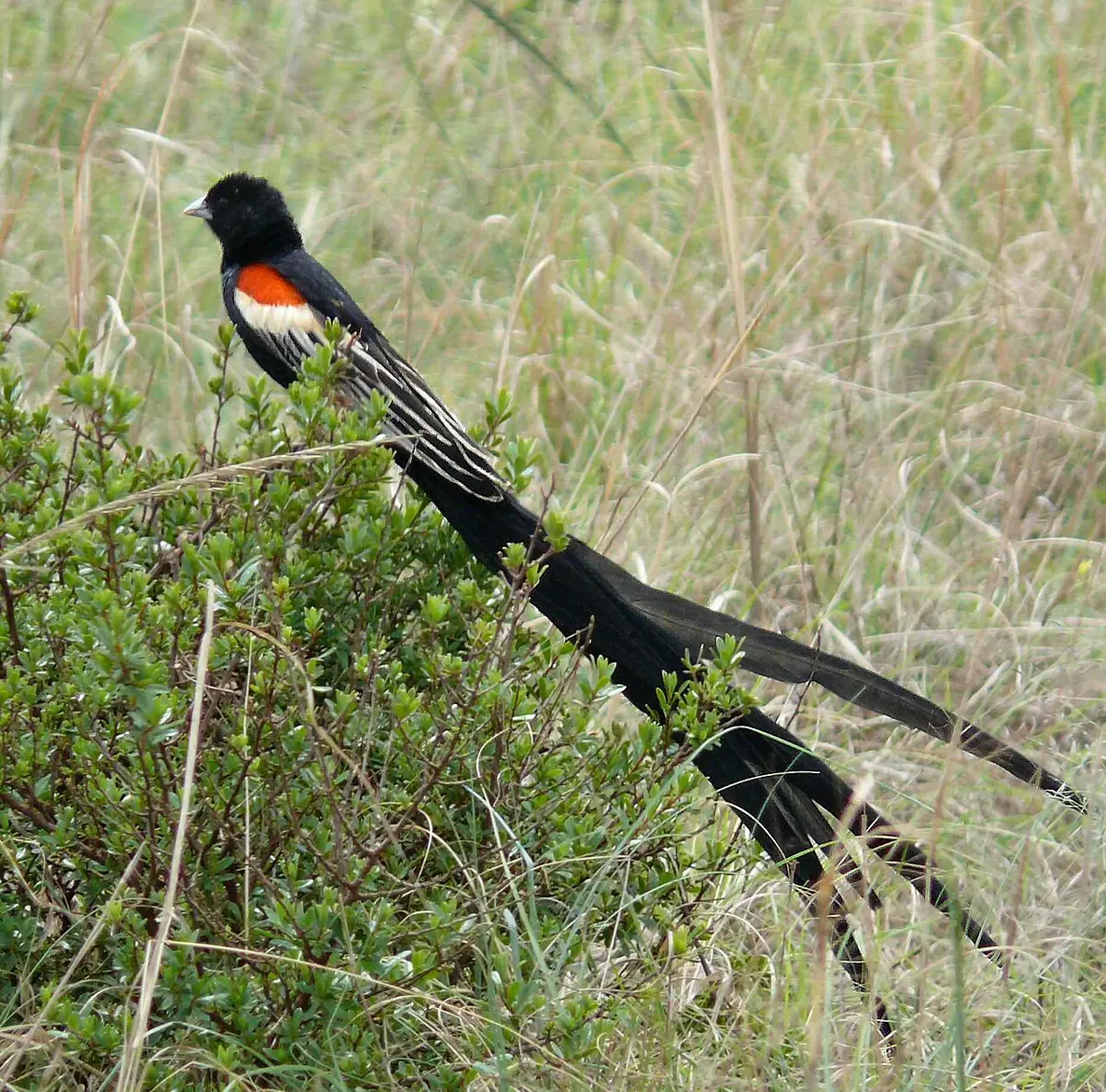
The long-tailed widowbird of the grasslands of Kenya and southern Africa is a black bird a little bigger than a sparrow, with red shoulders. In the breeding season the male grows a tail about half a meter long, more than twice as long as his body. In 1982 the Swedish scientist Malte Andersson caught 36 males in Kenya and put them into groups of four, matched so that each male in a group had a similar territory and a similar tail. In each group:
- a.one male had his tail cut short, to about 14 cm;
- b.the cut-off feathers were glued onto a second male’s tail, making it 20–30 cm longer;
- c.a third male had his tail cut and glued back on, so it looked normal;
- d.a fourth male was caught and let go, untouched.
Then Andersson counted how many females built their nests in each male’s territory. The males with lengthened tails got the most new nests, and the males with shortened tails the fewest. The shortened males still displayed and defended their territories just as much, so the difference wasn’t because they had stopped trying. The females were choosing the long tails.
Why does the female danphe have brown feathers while the male shines?
Pick an answer to see why.
Nests, herds and parents
Getting a mate is only the first gate. The eggs and young are small, helpless and tasty, and many animals have behaviors that protect them.
A nest you can’t get into
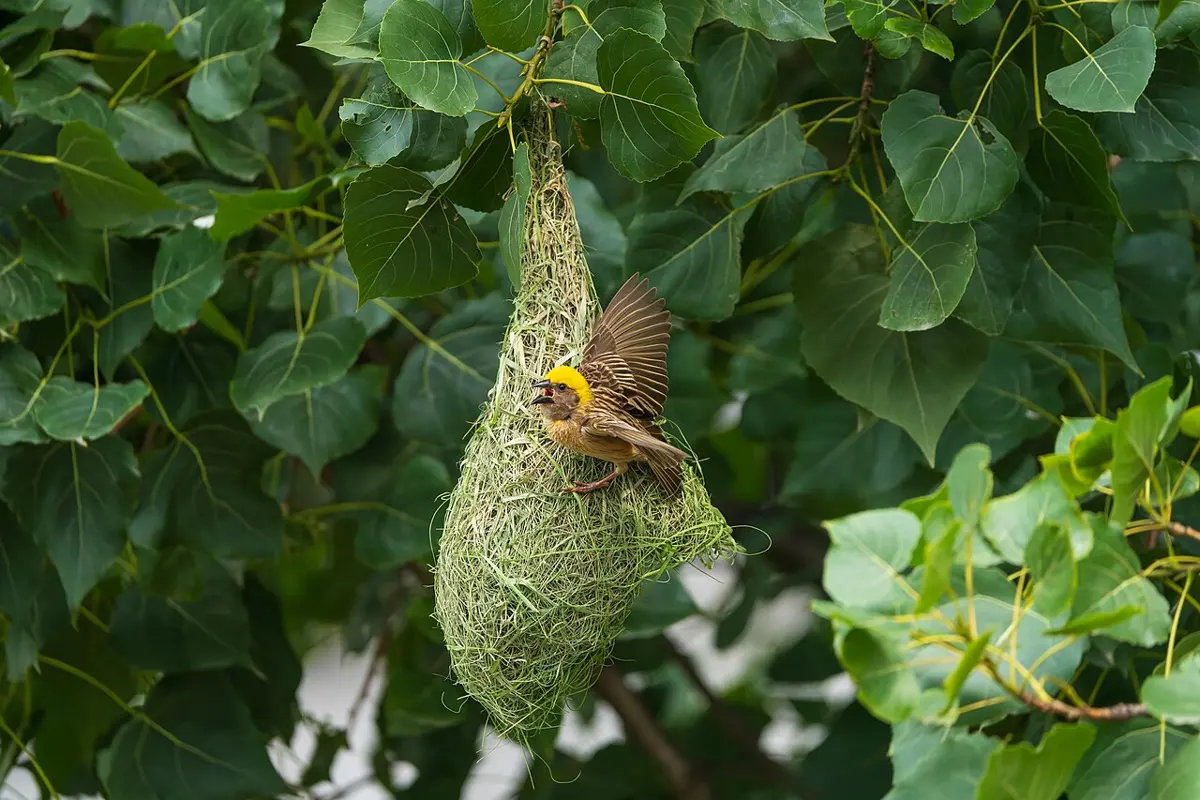
The baya weaver lives in the Terai and in the Kathmandu Valley. The male builds a hanging nest of woven grass and palm-leaf strips, often over water or from a thorny tree or a palm. He knots and weaves each strip with his beak; one nest can take him up to 500 trips with strips, over about 18 days.
He doesn’t finish it straight away. When the nest is half-built, a round hood called the helmet stage, he hangs under it, flaps his wings and calls to females. A female flies in, looks the nest over, pulls at the strips and tests it. If she likes the nest and the place, she accepts it, and him. Only then does he finish the nest by weaving the long entrance tube. If no female accepts a nest, he often abandons it and starts another.
The shape keeps the eggs safe in several ways at once:
- It hangs from a thin, swinging strand, out of reach of most climbing snakes and rats, and often over water.
- The way in is a tube that opens at the bottom. A crow can’t simply reach in from above; it would have to hang upside down and climb up the tube.
- The eggs sit in a separate chamber to one side, above a ledge, so they don’t roll out when the nest swings in the wind.
- The roof is thick, and the nests often face away from the monsoon rain.
So when a female chooses a good nest, she is choosing safety for her eggs. Nest building helps at gate 1 (the nest attracts a mate) and gate 3 (it protects the young).
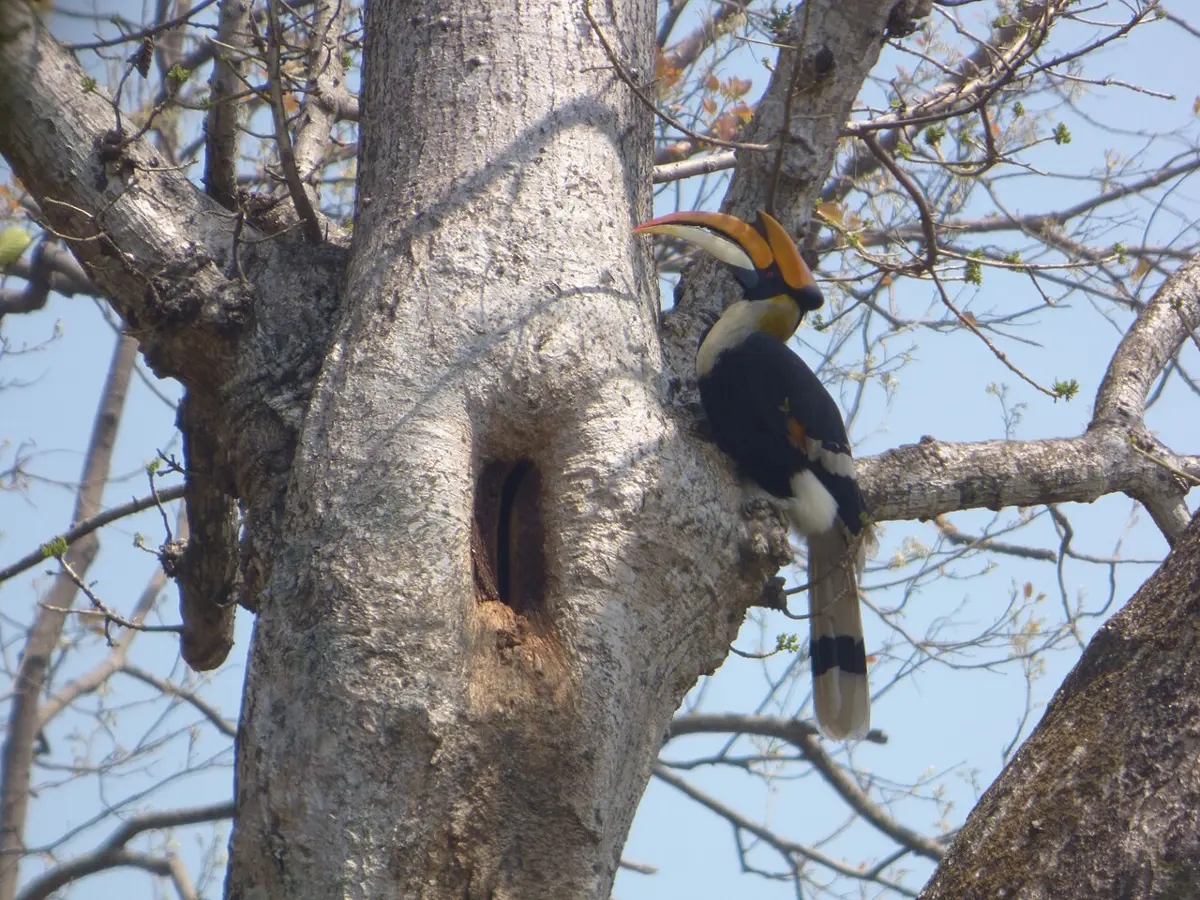
Other nests protect young from cold. Small chicks can’t keep themselves warm, and a chick that gets cold stops growing. Many birds line their nests with soft feathers, hair or moss, the way you put a blanket over a sleeping baby.
Safety in numbers
Many grazing animals, like chital (spotted deer) and blackbuck, live in herds. Wild elephants in Chitwan and Bardiya move in family herds, and when danger comes, the adults stand round the calves. A herd protects young in two ways:
- More eyes. With many animals looking up from time to time, someone usually spots a leopard or tiger early, and the whole herd runs.
- Less chance it’s you. A leopard that attacks a herd usually catches one animal. The bigger the herd, the smaller the chance that the one it catches is your calf.
The second idea is a simple calculation. If a leopard catches one animal at random from a herd of 20, each animal has a chance of 1 in 20 of being the one.
Real attacks are not quite random. Leopards and tigers often pick the young, the old, the sick, or an animal at the edge of the herd. That is why the mothers keep their young in the middle, and why herds bunch together when a predator is near.
A fawn in a herd of 50 is safer than a fawn alone. Which reason is not correct?
Pick an answer to see why.
Why flowers are bright, sweet and full of nectar
A plant can’t walk to find a partner. In Grade 8 you learned how pollen gets from one flower to another: by wind, water, insects or birds, and which kind of flower uses which Grade 8: Pollination. You also learned that colorful flowers get their color from chromoplasts Grade 8: Plastids. Here we go further: why a flower’s color, scent and nectar are made for a particular visitor, and how scientists know they matter.
Colors for the eyes that see them
A flower’s color is an advertisement, so it only works if the visitor can see it.
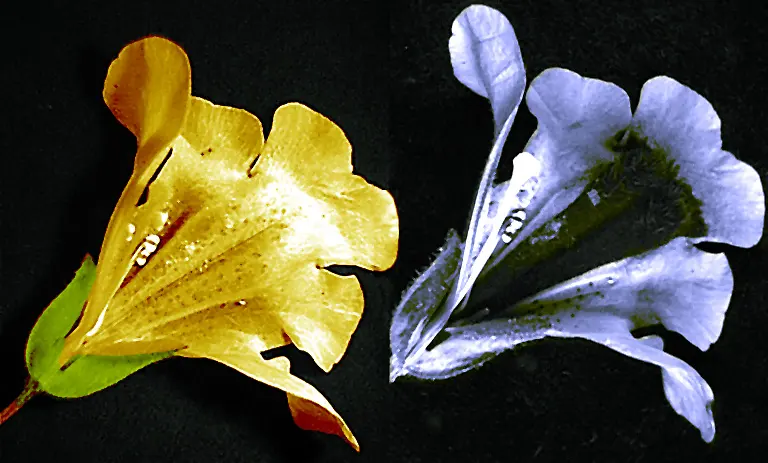
- Bees see blue, violet, yellow and white well, and also ultraviolet light, which we can’t see at all. But bees see red poorly. Many bee flowers have ultraviolet patterns, nectar guides, that point like arrows to the nectar in the middle. To us the petals look plain.
- Birds see red very well. Most birds have a weak sense of smell. So flowers that birds pollinate are often bright red or orange, with plenty of nectar, and almost no scent.
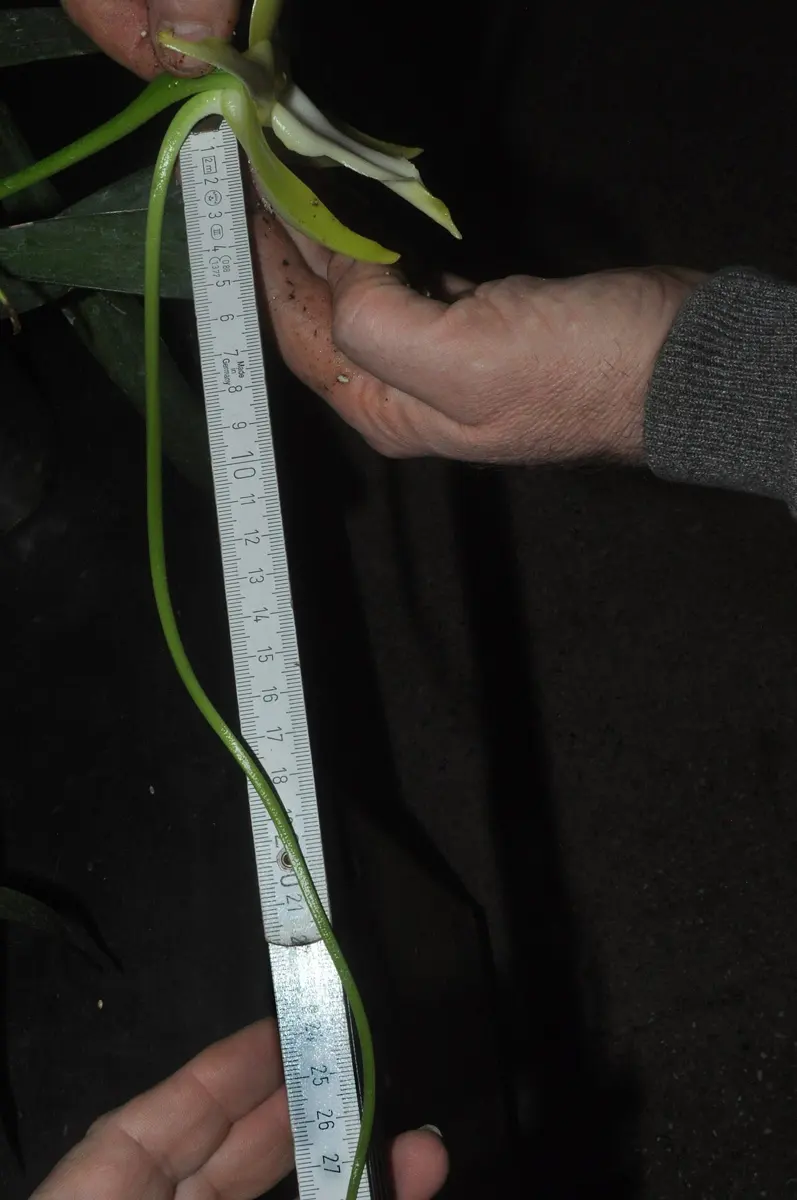
- Moths fly at night, when colors can’t be seen. Moth flowers are often white, which shows up in dim light, and they smell strongest at night.
Now you can answer the question in the title. Flowers smell sweet to bring insects, and the strongest scents of all come at night, for moths. The raat ki rani (night-blooming jasmine) by many Nepali houses smells sweetest after dark, when moths are flying. And our national flower, the lali guras, has almost no scent, because birds, which come to it for nectar, hardly use their noses.
Nectar: the reward
Color and scent are the advertisement; nectar is the payment. It is sugary water, made in small glands at the base of the flower. While a bee or a sunbird drinks it, pollen rubs onto its body, and some of it rubs off on the next flower’s stigma. The visitor gets food; the plant gets its pollen carried. You met the best-known nectar drinker in Grade 10: the honey bee, which turns nectar into honey and pollinates crops as it goes Grade 10: Uses of honey bees.
The nectar is usually placed deep in the flower, so that the visitor has to push past the anthers and stigma to reach it. A flower that put its nectar on the outside would feed visitors without getting pollinated.
Testing it: what if the visitors are kept out?
How do we know that a flower really needs its visitors? Ask the plant, with an experiment. Put a cage of wire mesh around some flowers. If the holes are big enough for bees to get through but too small for birds, the caged flowers can be visited by insects but not by birds. Cover other flowers with a fine net bag that keeps every visitor out. Leave the rest open. Then count how many flowers in each group become fruits. The share of flowers that become fruits is called the fruit set.
In 2017, Chinese botanists did exactly this with 15 kinds of rhododendron in the mountains of Yunnan, China, at the eastern end of the Himalaya. Sunbirds, bulbuls, warblers and other birds visited nine of them.
The result of the bags was the same for every kind: no flowers kept away from all visitors made fruit at all. These rhododendrons need visitors to carry their pollen. And for most of the kinds that birds visited, keeping out the birds cut the fruit set a lot, while for the kinds where no bird was seen, the cage made little difference to the fruit set.
Lali guras flowers are red and full of nectar, but have almost no scent. Which visitors are they mostly built for?
Pick an answer to see why.
Animals that plant seeds
After pollination, a plant still has gate 3: getting its seeds to a place where they can grow. In Grade 8 you met the ways seeds travel, by wind, water, animals, gravity and bursting pods Grade 8: Dispersal of seeds. Animals do more than carry them. Some put them in exactly the right place to grow.
Hard shells and forgetful gardeners
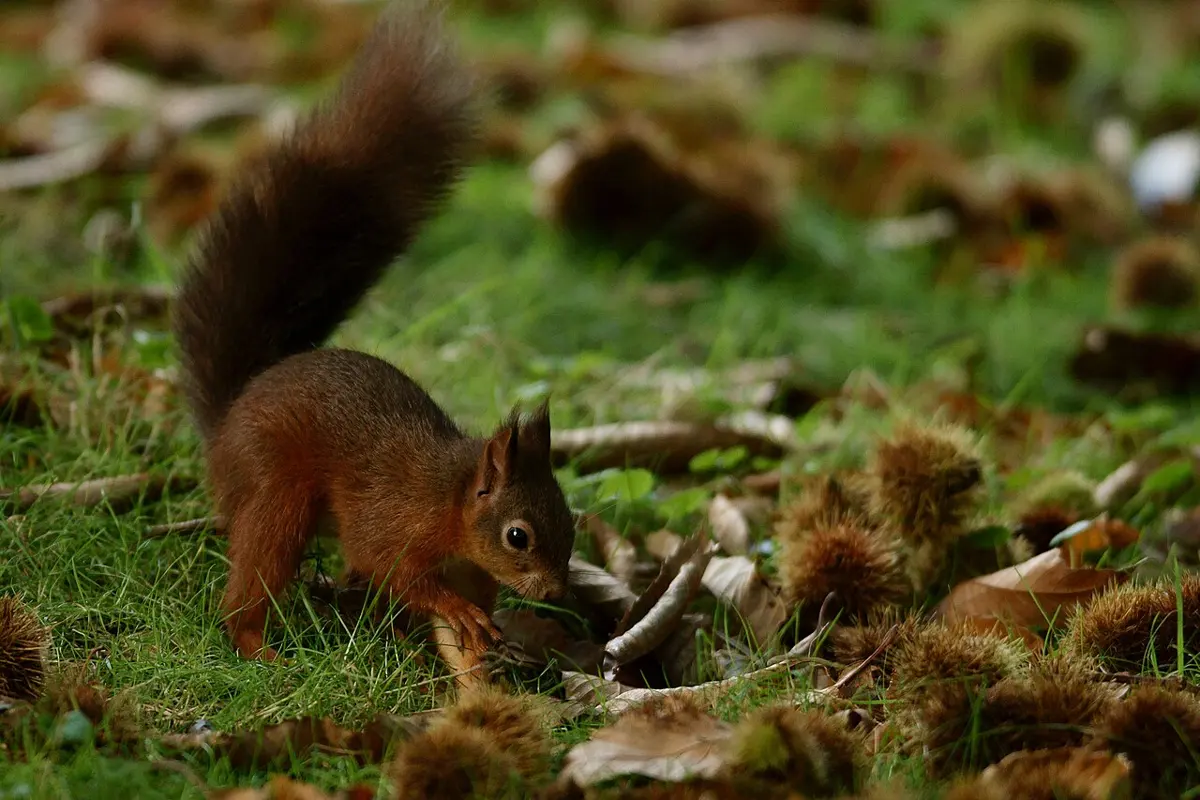
A walnut has a hard shell. A squirrel can’t eat it on the spot quickly, and in autumn there are more nuts than it can eat anyway. So it buries them, one here, one there, to dig up in winter. The hard shell keeps the nut from rotting in the ground or being eaten by insects for months. Squirrels find many of their nuts again, but not all. A nut that is never dug up is already planted, under the soil, away from its parent tree, and in spring it can grow.
Jays do the same with acorns in Nepal’s oak forests: one jay can hide thousands of acorns in an autumn, and the forgotten ones grow into oaks. The hard shell and the animal’s habit work together: the shell makes the nut worth storing, and storing plants it.
A rhino that grows trees
In Chitwan, the one-horned rhino eats the fallen fruit of the bhellar tree (Trewia nudiflora). The seeds pass through its gut unharmed. Rhinos like to drop their dung on the same big piles, called latrines, often out in the open grassland. So bhellar seeds are carried away from their parent trees and left in a heap of manure, with open sky above, where seedlings can grow. Scientists studying rhinos in Chitwan in the 1980s found bhellar seedlings growing out of rhino dung piles, and the rhino is thought to be the main way this tree spreads across the floodplain. This is an animal creating the conditions for seeds to germinate and grow, which you studied in Grade 8 Grade 8: Germination of seed.
Why might a hard nutshell help a tree, even though it makes the nut harder to eat?
Pick an answer to see why.
Making an argument from evidence
Scientists don’t just say “the song attracts females”. They make an argument: a claim, backed by evidence, joined up by reasoning. You can do the same.
- Claim: one sentence that answers the question.
- Evidence: the observations or data that support it, with numbers where there are any.
- Reasoning: why the evidence supports the claim, including why other explanations are ruled out.
Questions
In Krebs’s great tit experiment, why did some empty territories get a loudspeaker playing a tin whistle?
Pick an answer to see why.
A flower is white, has a long narrow tube with nectar at the bottom, and smells strongest at night. Which animal most likely pollinates it?
Pick an answer to see why.
Out of 120 flowers bagged so that no visitor could reach them, none made fruit. Out of 120 open flowers on the same plants, 90 made fruit. What was the fruit set of the open flowers?
Pick an answer to see why.
A male danphe and a female danphe look very different. For each, name a feature and say which gate to young it helps with, and how.
Answer
The male’s shining colors, crest and white back patch, shown off in his display, help at gate 1, finding a mate: a female chooses among displaying males. The female’s brown, mottled feathers help at gate 3, keeping the young safe: she sits alone on the eggs on the ground for about four weeks, and her color hides her and the nest from predators.
Explain three ways in which the shape of a baya weaver’s nest makes it more likely that the eggs and chicks survive.
Answer
- It hangs from a thin, swinging strand, often over water or from a thorny tree, so snakes, rats and lizards find it hard to reach.
- The entrance is a long tube that opens at the bottom, so a crow can’t reach in from above.
- The eggs lie in a separate chamber beside the tube, above a ledge, so they don’t fall out when the nest swings, and the thick woven roof keeps off rain and sun.
A blackbuck herd has 16 animals. A wolf attacks and catches one, at random.
- i.What is the chance that a particular fawn is caught? Give it as a fraction and a percentage.
- ii.The herd splits into two herds of 8, and the wolf attacks one of them. Now what is the chance for a fawn in that herd?
- iii.Give one reason, apart from this calculation, why staying in a large herd is safer.
Answer
- i.1 in 16 = 1/16 = 0.0625 = 6.25 % (about 6 %).
- ii.1 in 8 = 1/8 = 12.5 %, twice as likely as before.
- iii.Any one of: more animals are watching, so the wolf is usually spotted earlier and the herd can run; the adults can keep the young in the middle, away from the edge where predators usually strike.
Use the rhododendron experiment to explain why a flower that is bagged so that no animals can reach it makes no fruit, even though it has pollen of its own.
Answer
For a fruit to form, pollen must reach the stigma and the flower must be fertilized (Grade 8). In these rhododendrons the pollen is carried from flower to flower by animals: birds and insects. In a bag, no animal can reach the flower, so no pollen arrives on its stigma, no fertilization happens, and no fruit forms. The flowers’ own pollen doesn’t pollinate them on its own, so they depend on their visitors.
Lali guras is red, has a lot of nectar and almost no scent. Raat ki rani is pale, with a strong sweet smell at night. Make an argument (claim, evidence, reasoning) about which of the two is built for night-flying moths.
Answer
Claim: Raat ki rani is built for moths that fly at night; lali guras is not.
Evidence: Raat ki rani’s flowers are pale and smell strongest at night. Lali guras is red and has almost no scent.
Reasoning: At night colors can hardly be seen, so a night flower must be found another way: pale flowers show up best in dim light, and moths find flowers by smell. A scent that is strongest after dark is only useful to visitors that come after dark. Lali guras’s bright red, which birds see well, and its lack of scent fit day-flying birds, which find flowers by sight and hardly use smell.
A student says: “Squirrels are bad for walnut trees, because they eat the nuts.” Use what you know to argue that squirrels can also help walnut trees reproduce.
Answer
Squirrels do eat many nuts. But in autumn they bury nuts one by one, to eat later, often far from the tree. They find many again, but not all. Every nut that is forgotten is already planted under the soil, away from its parent, where a seedling won’t have to compete with the parent for light. The hard shell keeps the nut from rotting until spring. So squirrels carry and plant walnut seeds the tree couldn’t spread on its own: the tree loses some nuts, but gains seedlings in new places.
Design an experiment to test the claim: “Pumpkin flowers need insects to make pumpkins.” Say what you would do, what you would keep the same, and what result would support the claim.
Hint
A pumpkin has separate male and female flowers; only female flowers, with a tiny pumpkin under the petals, can become pumpkins.
Answer
- Find several female pumpkin flower buds, on the same plants, the evening before they open.
- Cover half of them with a small bag of fine net or thin cloth, tied loosely round the stalk, so no insect can reach them. Leave the other half open. Choose which ones get bags by tossing a coin, so the bagged ones aren’t all the healthiest or the sunniest.
- Keep everything else the same: the same plants, the same days, the same watering.
- After the flowers close, take the bags off (so they don’t shade the fruit) and mark which flowers were bagged. A week later, count how many of each group have started to grow into pumpkins.
If the open flowers grow into pumpkins and the bagged ones wither and drop off, the claim is supported. For a stronger test, bag a third group and pollinate them yourself, with pollen from a male flower on a small brush, before bagging them again: if these grow, it shows the bag itself didn’t harm the flowers, only the missing pollen did.
Where to go next
- Why Do Two Plants From the Same Field Grow So Differently? A plant’s genes and its surroundings both decide how well it grows: seeds from the same parent, in different soil, light and water.
- Why Do You Look Like Your Parents, but Not Exactly? The young of a danphe or a pumpkin are a mix of their two parents. How genes are passed on, and why sexual reproduction makes each young one different.
- How Do Snow Leopards Come to Fit the Mountains? How natural selection, the process that spread the songs, tails and flowers in this topic, shapes a whole animal to its home.