
Monoclonal antibodies: one key, for ever
Nobel Prize in Physiology or Medicine, 1984: Niels K. Jerne, Georges J. F. Köhler, and César Milstein
-
Niels K. Jerne
1911–1994, born in the United Kingdom
Born in London to Danish parents and raised in the Netherlands, he studied physics before medicine. He published his first great idea about the immune system at the age of 44.

Georges J. F. Köhler
1946–1995, born in Germany
He came to Cambridge as a young researcher in 1974. Within a year he and Milstein had made the first hybridoma. He died at the age of 48.
Photo: Willy Pragher, CC BY 3.0 de
-
César Milstein
1927–2002, born in Argentina
The son of a poor immigrant family, he and his wife Celia hitch-hiked round Europe for their honeymoon. He spent most of his working life in Cambridge, England.
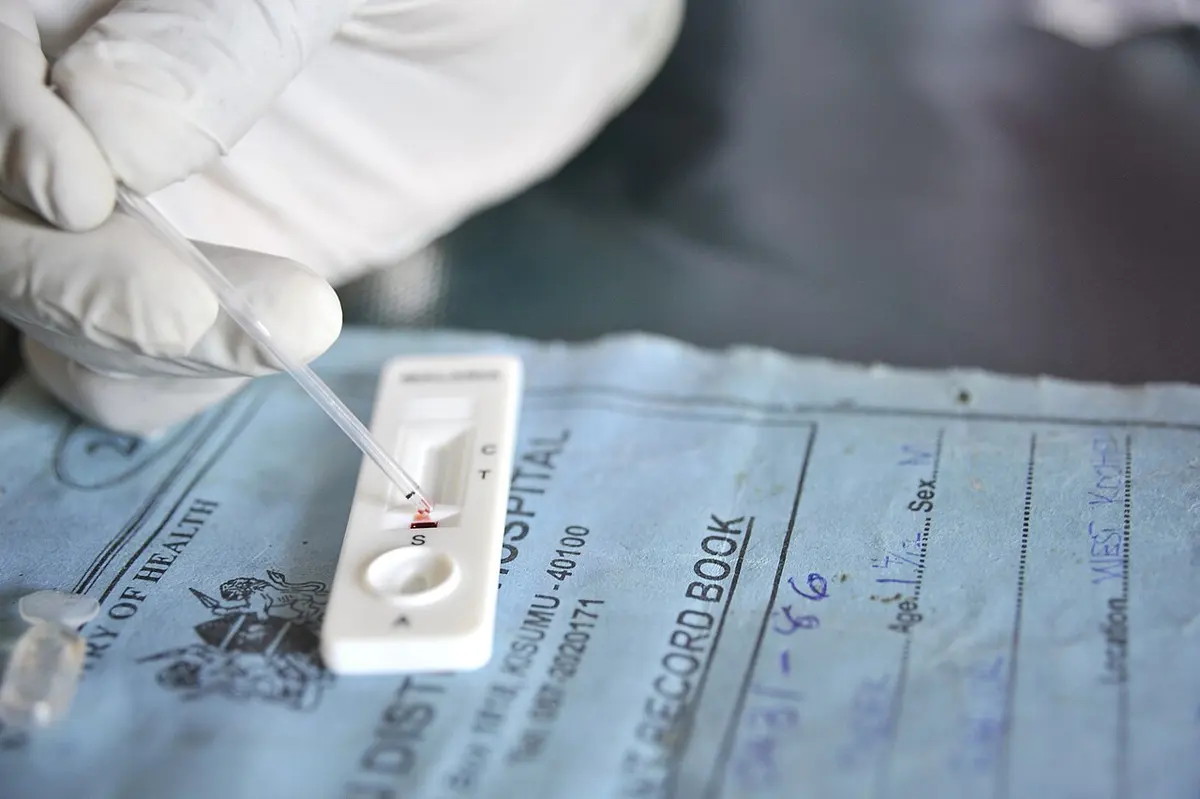
At a health post in the Terai, a girl with a fever has her finger pricked. A drop of blood goes onto a small plastic strip. About fifteen minutes later, one or two red lines appear, and the health worker knows whether she has malaria. A pregnancy test and a rapid COVID-19 test work the same way.
Inside each strip are antibodies: molecules that your own body makes to grab germs. But the antibodies in the strip didn't come from a person. They were made by cells in a factory, cells that make one exact kind of antibody, the same every time, for ever. They are called monoclonal antibodies.
In 1984 the Nobel Prize in Physiology or Medicine went to three scientists. Niels Jerne explained how the body can make the right antibody for germs it has never met. Georges Köhler and César Milstein found how to make cells that produce one chosen antibody, in any amount.
The problem: the body's best defense couldn't be bottled
When a germ gets into your body, some of your white blood cells Grade 10: white blood cells called B cells make antibodies against it. An antibody is a protein shaped like the letter Y. The two tips of the Y grip one small part of the germ, like a key fitting a lock. A germ covered in antibodies can't get into your cells, and other white blood cells find it and destroy it. Anything that antibodies grip is called an antigen.
Antibodies are very useful outside the body too. A doctor can use them to find a germ in a blood sample, or to measure a hormone. For a hundred years the only way to get them was from blood. You inject an animal, often a horse, rabbit or goat, with the antigen, wait for it to make antibodies, and take some of its blood. The liquid part of the blood, with the antibodies in it, is called an antiserum. The antivenom that saves people bitten by snakes in Nepal is made this way, from horses.
But an antiserum has two big problems.
- It is a mixture. A germ has many different spots on its surface, and the animal makes a different antibody for each one. An antiserum holds many kinds of antibody, some strong, some weak, some that also stick to things they shouldn't.
- It runs out. When the animal's blood is used up, you must start again with another animal, and the new mixture is never quite the same. A test made with one batch may give different results from a test made with the next.
What scientists wanted was a single kind of antibody, gripping a single chosen spot, that could be made in any amount and would always be the same.
How the body makes the right antibody
Before you can make one antibody, it helps to know how the body makes so many. Your body can make antibodies against almost anything: germs it has never met, even chemicals made in a laboratory last week. How?
In the 1940s many scientists believed the answer was instruction: the antigen enters a cell and acts as a mold, and a new antibody is folded around it to fit, like clay pressed round a key.
Niels Jerne: the answer is already there
- 1955: selection, not instruction. Jerne, then working at the Danish State Serum Institute in Copenhagen, turned the idea round. Your body, he said, has already made a huge variety of antibodies, before any germ arrives. When a germ comes, it simply picks out the antibodies that happen to fit it, and the body then makes many more of those. It is like a shoe shop with every size already on the shelves: you pick the pair that fits, and the factory makes more of that pair.
- 1957: one cell, one antibody. The Australian scientist Macfarlane Burnet took the idea further. Each B cell, he said, makes only one kind of antibody. When a germ meets a B cell whose antibody fits, that cell multiplies into a family of identical cells, a clone, all making the same antibody. This is clonal selection, and experiments soon showed it is right. (Burnet won a share of the 1960 Nobel Prize, for other work on the immune system.)
- 1971: learning in the thymus. Jerne's second idea was about how young white blood cells are trained in the thymus, a small organ in the chest, so that they attack germs but not the body's own cells.
- 1974: a network. His third idea was that antibodies are themselves antigens: other antibodies can grip them, and those can be gripped by still others. So the immune system is a huge network of antibodies and cells, each holding the others in balance, like a busy market where every trader watches the others. A germ upsets the balance, and the response is the system finding a new balance.
Jerne liked to compare the immune system with a language. His Nobel lecture was called “The Generative Grammar of the Immune System”: with a limited set of parts, it can build an almost endless number of antibodies, as a language builds endless sentences from a limited set of words.
According to Jerne and Burnet, what happens when a new germ enters your body?
Pick an answer to see why.
Why it was hard
Burnet's idea pointed to a perfect source of single antibodies. One B cell and its clone make only one antibody. So if you could take one B cell and grow it in a dish, it would make a single, pure antibody.
The trouble was that B cells taken out of the body die within a few days. They can't be grown in a dish.
There was one kind of antibody-making cell that never dies: a cancer called myeloma, in which one B cell multiplies out of control. Myeloma cells from mice could be grown in dishes for ever, and each myeloma made one antibody, in large amounts. But nobody could choose what a myeloma's antibody gripped. Usually nobody even knew. They were perfect factories making a product nobody wanted.
What they did, step by step
Köhler and Milstein: a cell that never dies and makes the right antibody
- The 1960s–70s: fusing cancer cells. César Milstein, an Argentine biochemist, worked at the Laboratory of Molecular Biology in Cambridge, England. He studied how antibodies are built. With Richard Cotton, he had fused two myeloma cells into one cell. The joined cell, a hybrid, kept growing, and it made the antibodies of both parents.
- 1974: a visitor from Basel. Milstein gave a talk in Basel, Switzerland. In the audience was Georges Köhler, a young German researcher who had been trying, without success, to keep normal antibody-making cells alive in dishes. In April 1974 Köhler came to Cambridge to work with Milstein.
- The idea. Instead of fusing two myeloma cells, why not fuse a myeloma cell with a normal B cell from an animal that had been given an antigen? The hybrid might take the long life from the myeloma and the chosen antibody from the B cell.
- 1975: it worked. They injected a mouse with sheep red blood cells, took B cells from its spleen, and fused them with myeloma cells. They grew the cells in a special food in which only the hybrids could live. Some hybrids made antibodies that gripped sheep red blood cells, and they kept growing, and kept making them.
- 7 August 1975: the paper. They published the method in the journal Nature. The last sentence suggested, rather modestly, that such cells “could be valuable for medical and industrial use”.
- A scare. Soon after, the method stopped working, and for months no fusion would succeed. A new member of the team, Giovanni Galfré, found the reason: one of their stock solutions had become contaminated with something poisonous. With that fixed, the method became reliable.
The hybrid cells were later named hybridomas: hybrid + myeloma. All the cells grown from a single hybridoma are a clone, so their antibody is called monoclonal: from one clone.
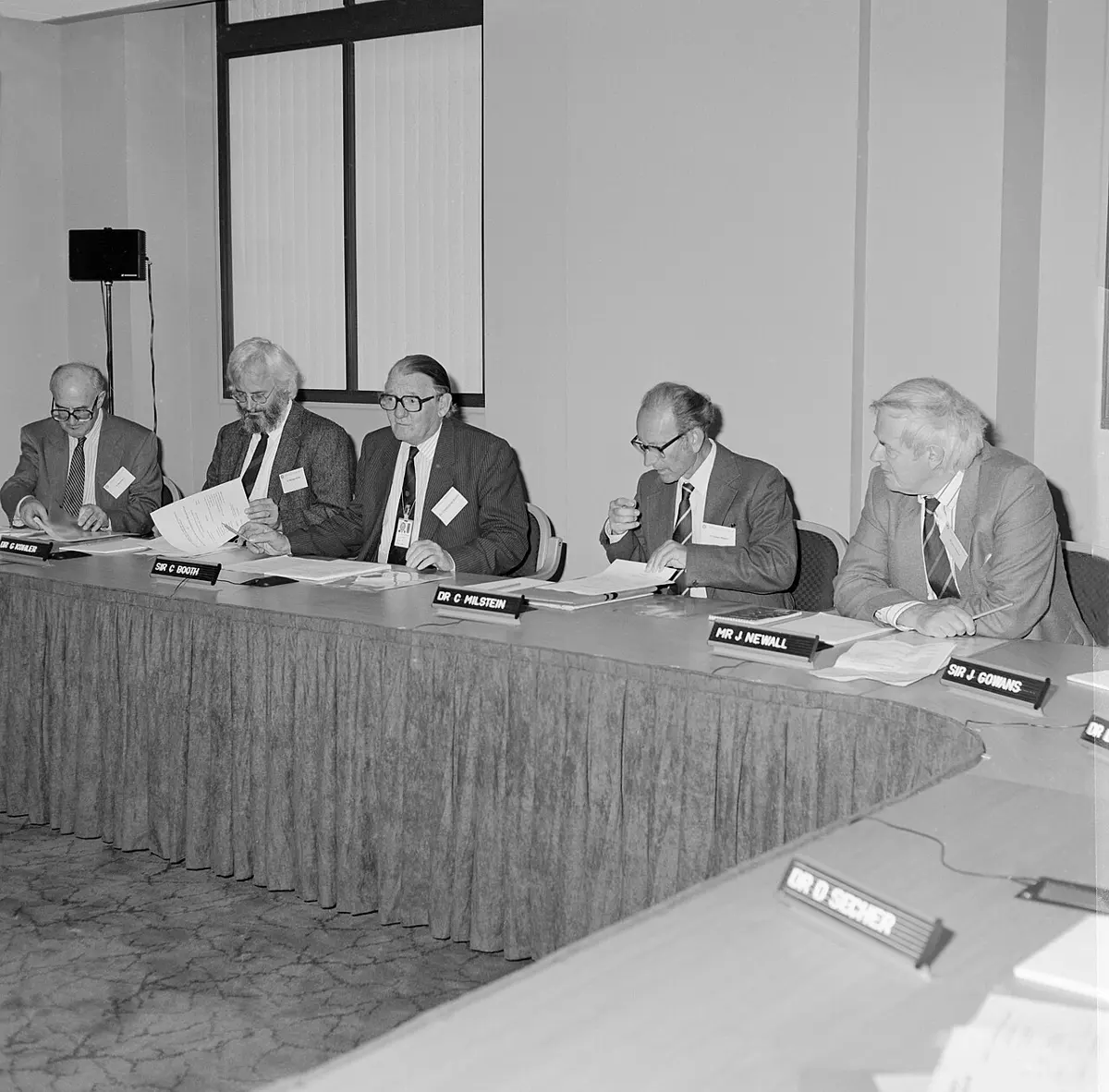
The method was never patented. Some people praise that as a gift to the world; others call it a costly mistake for Britain. Either way, Milstein sent his myeloma cells to laboratories that asked for them, and within a few years scientists everywhere were making monoclonal antibodies.
In a hybridoma, what does each parent cell give?
Pick an answer to see why.
How it works now
The method is much the same as in 1975 (Figure 2). Making a new monoclonal antibody takes a few months. After that, its hybridoma can be frozen, sent anywhere in the world and grown again whenever more antibody is needed.
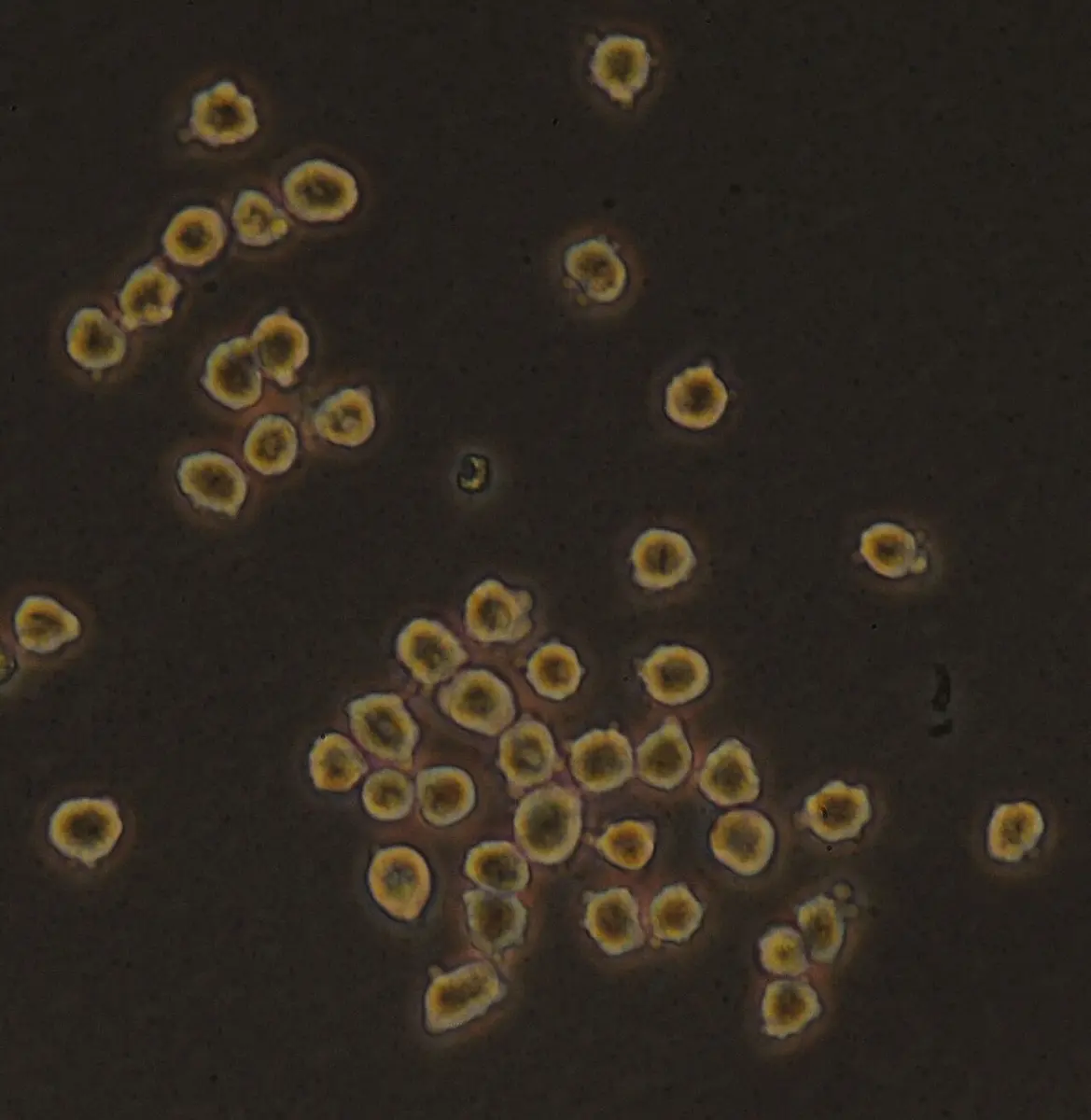
Two later steps made monoclonal antibodies into medicines:
- Making them human. A mouse antibody given to a person as medicine is itself treated as a germ: the body attacks it. From the late 1980s scientists, led by Gregory Winter in the same Cambridge laboratory, learned to replace most of the mouse parts with human ones, and later to find fully human antibodies without using mice at all. Winter shared the Nobel Prize in Chemistry in 2018.
- Factories of cells. Medicines are now made in huge steel tanks of cells, thousands of liters at a time.
In your life today
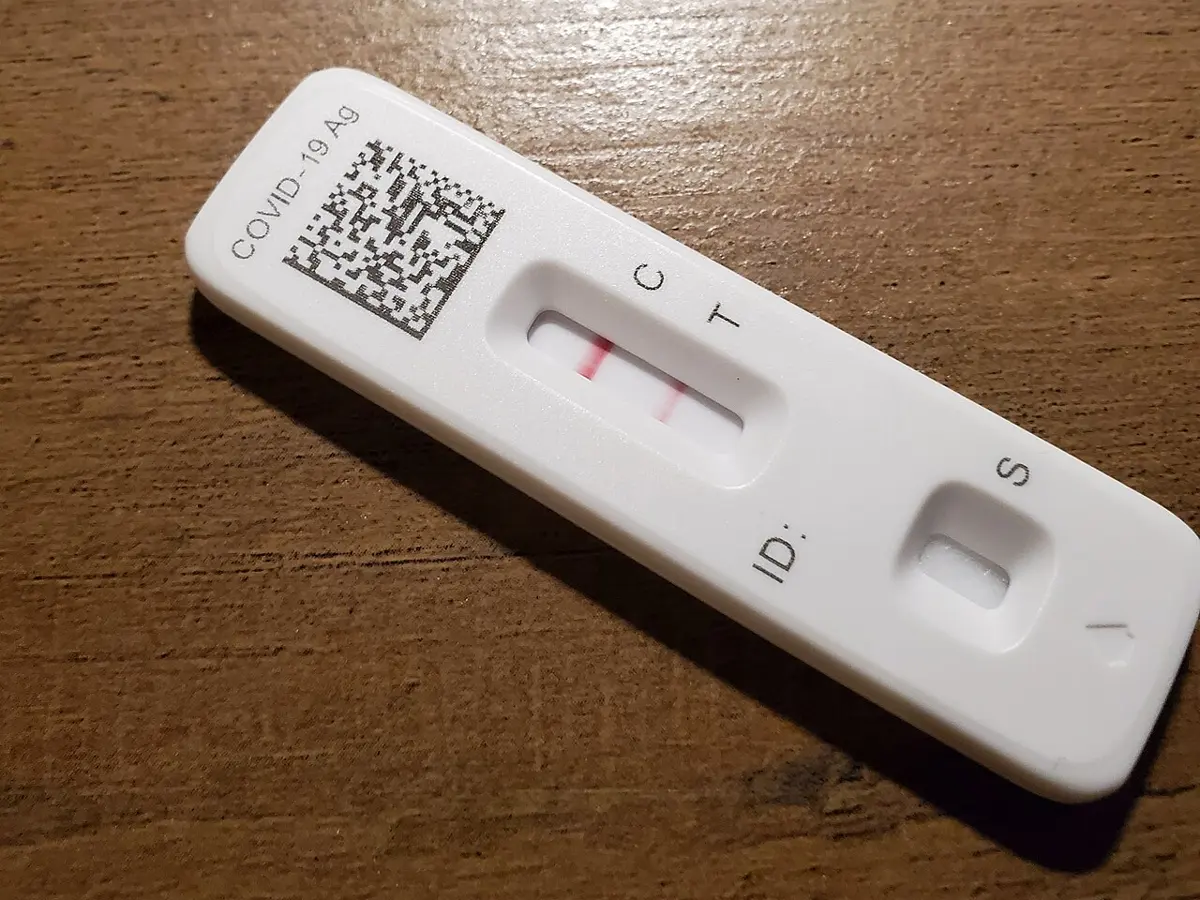
- Rapid tests. Malaria tests in Nepal's health posts, home pregnancy tests and rapid COVID-19 tests all use monoclonal antibodies on a strip of paper (Figure 4). Because every antibody is the same, every strip behaves the same.
- Blood groups. Before a blood transfusion, your blood group must be tested Grade 10: testing a blood group. Most testing liquids, anti-A and anti-B, are now monoclonal antibodies.
- Medicines. The first monoclonal antibody medicine was approved in 1986, to stop the body rejecting a transplanted kidney. By 2021 more than a hundred had been approved, for cancers, arthritis, asthma, and infections. Some breast cancers, for example, are treated with an antibody that grips a protein on the cancer cells.
- Research. Scientists use monoclonal antibodies to find, measure and purify one particular protein out of thousands.
In a rapid test, a red line appears at C but not at T. What does it mean?
Pick an answer to see why.
What came next
- Antibodies as medicines are now among the best-selling medicines in the world. But they are expensive to make, and many patients in poorer countries, including Nepal, can't get them. Milstein himself cared about this: he worked for years to help scientists in poorer countries, including his own Argentina.
- Jerne's network. Antibodies that grip other antibodies are real, as he predicted, but how much the network matters is still argued about, and the vaccines it suggested have not come into everyday use.
- Faster ways. New methods find antibodies without hybridomas: from libraries of antibody genes, or straight from the B cells of a person who has recovered from a disease. During the COVID-19 pandemic, antibodies against the virus were found this way within months.
- An open question. Could antibodies be made so cheap that they are used like ordinary medicines everywhere, for snake bites, rabies or malaria? Scientists are now testing monoclonal antibodies that could protect a person from malaria for months with one injection.
In your science books
- Grade 9: blood and the human glands.
- Grade 10: white blood cells, blood groups and why the blood group must match; cell division.
- Going Further (9–12): proteins do the work.
Learn more
- The Nobel Assembly’s press release, the presentation speech and the speed read (nobelprize.org).
- The Nobel lectures: Jerne, Köhler and Milstein.
The official reason
The prize was given “for theories concerning the specificity in development and control of the immune system and the discovery of the principle for production of monoclonal antibodies.”