
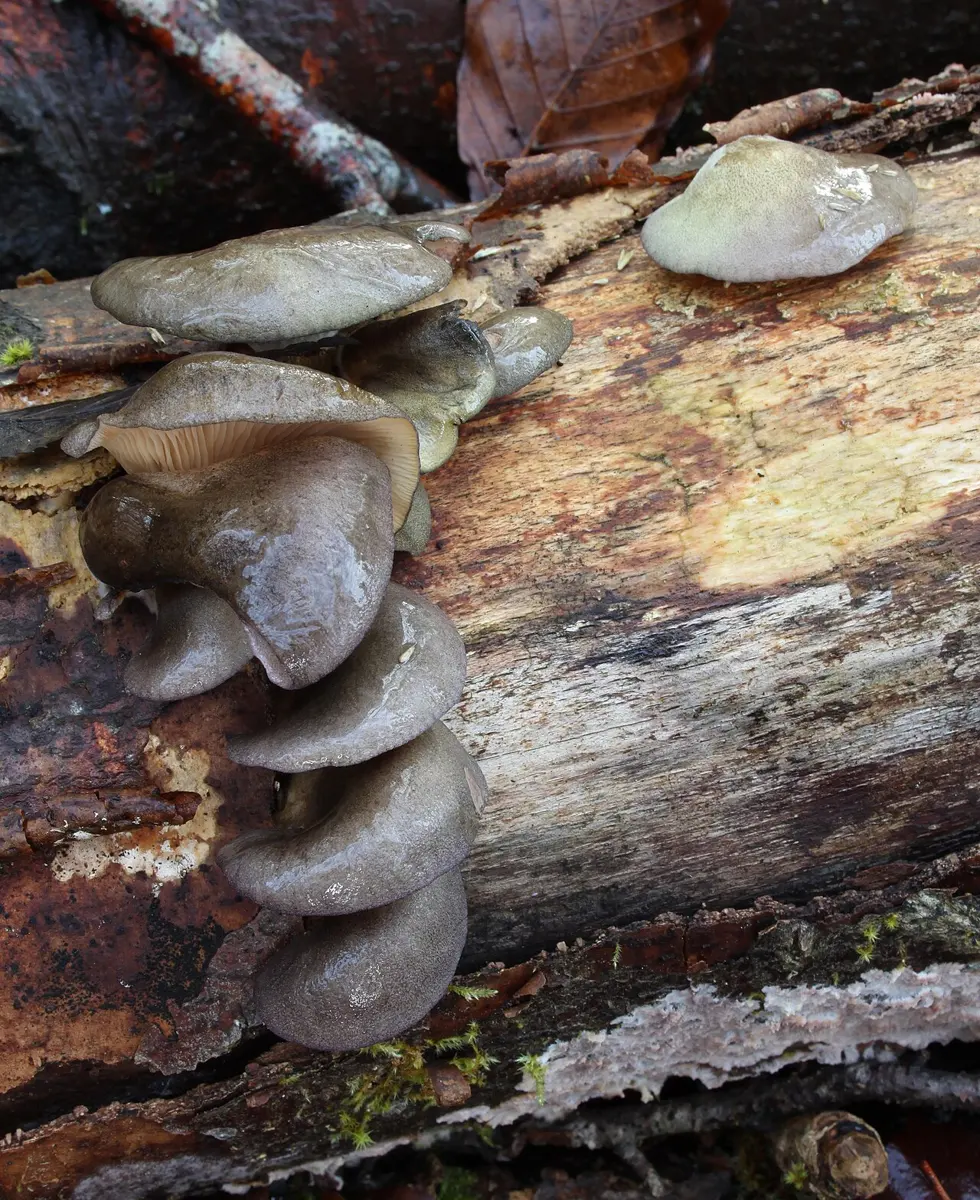
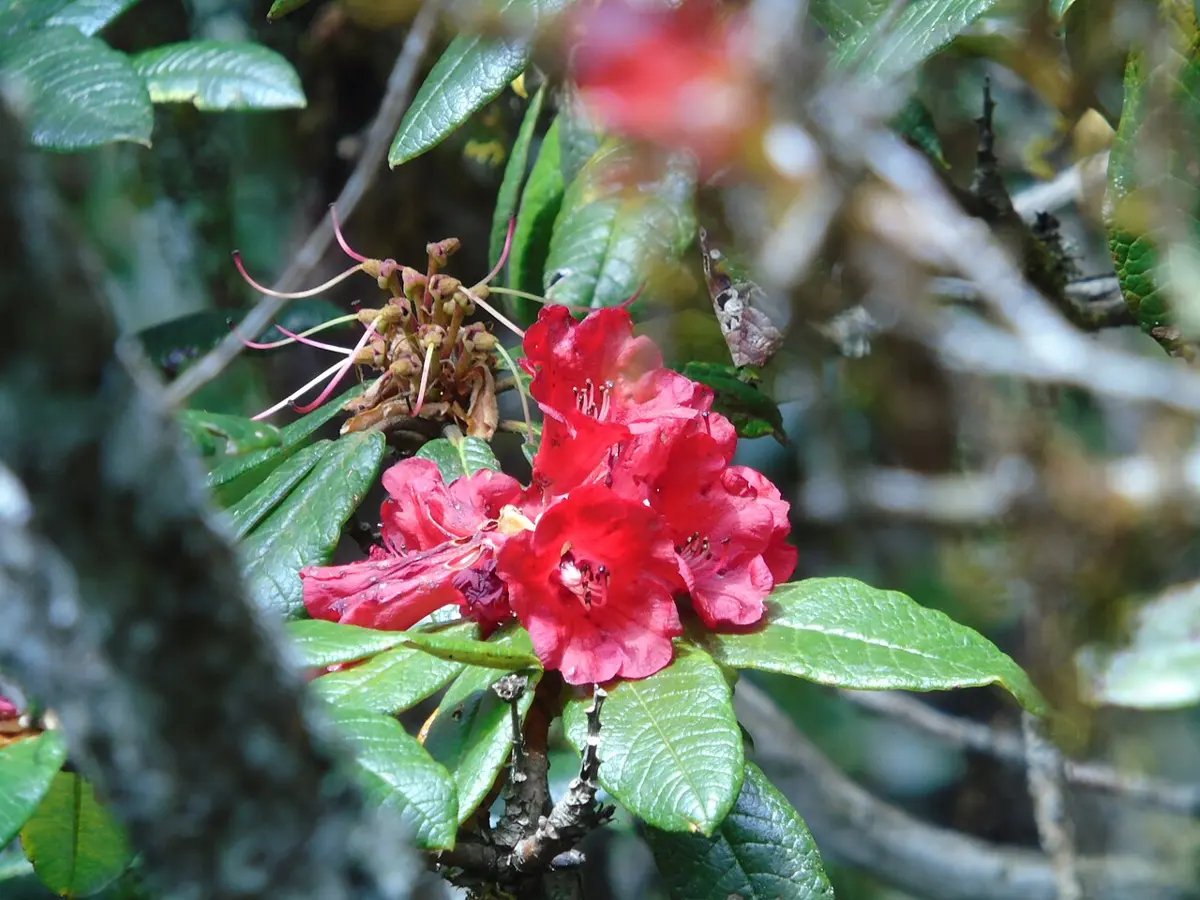
Pick up a bunch of kanye chyau, oyster mushrooms, at the vegetable market, and a sprig of lali gurans, Nepal’s red rhododendron. Which of the two is more closely related to you?
Most people would say: neither, or perhaps the mushroom and the rhododendron are related to each other, as “plants”. A mushroom doesn’t move, grows out of the ground and was once classed with the plants. But the answer is surprising. The mushroom is more closely related to you than it is to the rhododendron. You and the mushroom shared an ancestor long after both your lines had split from the plants’.
Nobody could have learned that from bones: a mushroom has none. Fossils of soft, single-celled ancestors more than a billion years old are rare and hard to read. The answer came from a record that every living thing carries in every cell: its DNA. This topic shows how DNA is read as evidence, and how it agrees with the evidence from fossils and bodies.
What bones and rocks already told us
In Grade 9 you met five kinds of evidence that living things have evolved from common ancestors Grade 9: Evidences of organic evolution. Each line of evidence does a different job:
| Evidence | What it shows | What it can’t do |
|---|---|---|
| Fossils | which living things lived when: the order in which groups appeared, and how long ago | soft bodies and microbes rarely fossilize; many gaps |
| Homologous organs | the same bones in an arm, a wing and a flipper: a body plan inherited from one ancestor | only works for living things with parts to compare |
| Vestigial organs | leftover parts, like the tail bones, that only make sense if an ancestor used them | the same |
| Connecting links | animals with features of two groups, like Archaeopteryx: what an in-between form looked like | rare finds |
| Embryos | early embryos of fish, birds and humans are alike: a shared way of building a body | only for animals with similar development |
Embryos tell us one more thing. The features you share with your most distant relatives tend to appear earliest as you develop in the womb: the notochord, the rod the backbone forms around, appears in the third week; the buds of the arms and legs at the end of the fourth; hair starts to form only in the third month. Your body is built in roughly the order its features were gained in evolution.
All five lines say the same thing: the more features two living things share, the more recently their ancestors split. But all five need bodies to compare. They can tell a bat from a bird, but not how a mushroom is related to a rhododendron, or a bacterium to you. For that, scientists needed something that every living thing has.
Which kind of evidence tells us when a group of animals first appeared?
Pick an answer to see why.
One language for all life
Every living thing you have ever seen, and every one under a microscope, keeps its instructions in DNA, written with the same four letters, A, T, G and C Grade 10: DNA. They all read it the same way. In topic 17 you met the genetic code: each three-letter codon means one amino acid (the code). GGG means glycine in you, in a mushroom, in a rhododendron and in the bacteria in curd. They all build their proteins from the same 20 amino acids, on ribosomes made in the same way.
Why should that show that they are related? Think about languages. In Nepali, one, two, three is ek, dui, tin. In Hindi it is ek, do, tin; in Bengali ek, dui, tin; in Sanskrit eka, dvi, tri. Nothing about the number three needs the sound “tin”. The words match because these languages all came down from one ancestor language, changing a little along each line. Newar, spoken in Bhaktapur, says chhi, ni, swa: it comes from a different family of languages.
The genetic code is like those words. As far as anyone knows, nothing in chemistry forces GGG to mean glycine: other codes would work. Scientists have even changed it: in Cambridge, in 2019, they made a bacterium whose genes use only 61 of the 64 codons, and in 2021 they gave the three freed codons new meanings, amino acids that living things don’t use. The bacteria live. So when every living thing uses the same code, the simplest explanation is that they all inherited it from one ancestor, the last universal common ancestor of all life, which lived more than 3,500 million years ago. This shared descent from one ancestor is called common ancestry.
Why is the shared genetic code good evidence that all living things are related?
Pick an answer to see why.
Reading the differences
Every time a cell copies its DNA, a letter is very occasionally copied wrong: a mutation Grade 9: Mutation. A change that does no harm can be passed on, and over thousands of generations it can spread to a whole species. So a gene changes slowly, one letter at a time.
Now picture two species splitting from one ancestor. At first their genes are identical. Then each line collects its own changes, separately. The longer ago they split, the more changes there have been time for, so the more differences between their genes and proteins, the longer ago they shared an ancestor. Comparing sequences turns DNA into a family record.
To compare two sequences, scientists first line them up so that matching parts sit one above the other: a sequence alignment. Then they count the places where the letters differ.
A good molecule to compare is cytochrome c, a small protein in your mitochondria that passes electrons along during respiration (how food becomes energy). Almost every animal, plant and fungus has it, because it is needed to respire with oxygen. In humans it is a chain of 104 amino acids, written below with one letter for each amino acid, as scientists write them (G for glycine, K for lysine, and so on).
Now compare cytochrome c across all of life yourself.
Notice two things. First, some places are the same in all of them: like the C, C and H at places 14, 17 and 18, which hold the iron-containing heme that carries the electron. A change there would wreck the protein, so a living thing with such a mutation doesn’t survive to pass it on. Second, the order of the differences follows the fossil record: chimpanzee 0, monkey 1, dog 11, chicken 13, tuna 21, fruit fly 24.
But look at the oldest points in Figure 27.3. The mushroom differs from us at 39 places and the rhododendron at only 34, yet the rhododendron’s line split from ours earlier. Is this protein saying we are closer to the rhododendron?
No: it is saying that it can’t tell. Over more than a billion years, the places that can change have changed again and again, some of them several times, and the count stops growing. The mushroom and the rhododendron also differ from each other at 37 places, so the three are about equally far apart in this one small protein. A short sequence is like a clock that has gone round so many times that you can’t tell 3 o’clock from 15 o’clock. To settle old questions, scientists need many genes, or a different kind of evidence. We will come back to the mushroom.
Human and horse cytochrome c differ at 12 places, human and chicken at 13, human and yeast at 39. What does this suggest?
Pick an answer to see why.
From differences to a family tree
How do you turn a table of differences into a family tree, a phylogenetic tree? One of the simplest ways, used since the 1960s, goes like this:
- Find the two with the fewest differences. Join them: they share the most recent ancestor.
- Treat the pair as one group. Its difference from each of the others is the average of its members’ differences.
- Repeat with the new, smaller table, until everything is joined.
The best test is our own family. Which ape is our closest relative? For a long time, many experts grouped chimpanzees, gorillas and orangutans together as “the great apes”, with humans set apart. With their long arms and hair all over, they look more like each other than like us. DNA settled it.
The tree you built says that chimpanzees and bonobos are our closest living relatives, then gorillas, orangutans and gibbons, and that the rhesus monkey’s line split off first. That is also the order of the times worked out from fossils and DNA together: our line split from the chimpanzees’ about 6–7 million years ago, from the gorillas’ about 9, the orangutans’ about 16 and the gibbons’ about 20.
A single gene gives only a small sample. Since 2005 scientists have compared whole genomes: of the human and chimpanzee DNA letters that can be lined up, about 1.2% differ, roughly 35 million single letters out of 3 billion. The genomes give the same tree as your gene did. They also show something no single gene could: in about 30% of the genome, a gorilla is closer to the human or to the chimpanzee than those two are to each other, because the three lines split within a few million years of each other, and some old versions of genes were sorted into the lines by chance. That is why scientists trust trees built from thousands of genes, not one.
DNA keeps a finer record than proteins
So far we have mostly compared proteins. DNA holds even more information. You know from topic 17 that most amino acids have several codons, which usually differ in the third letter (Kinds of change). A mutation that turns CAT into CAC still codes histidine: a silent change. The protein stays exactly the same, but the change is recorded in the DNA, and passed on.
So between close relatives, whose proteins may be identical, the DNA can still show differences. Here is the gene for β-globin, the hemoglobin protein you met in topic 17, compared letter by letter.
Shared mistakes
Imagine two students hand in homework with exactly the same unusual mistake: the same wrong number, in the same place, with the same spelling error. You would suspect that one copied from the other, or both from a third. Getting the right answer is no evidence of copying; sharing a rare mistake is.
DNA has its own rare mistakes. Sometimes a whole stretch of letters is added to a gene, an insertion, or a stretch is lost. Insertions of the same length at exactly the same place are very unlikely to happen twice by chance. So when two groups share one, they almost certainly inherited it from one ancestor.
This is how the mushroom question was settled. In 1993 Sandra Baldauf and Jeffrey Palmer compared 25 proteins of animals, fungi and plants, and found exactly such a mark in a protein called EF-1α, which every cell with a nucleus uses to build proteins.
Animals and fungi share the block; plants, and the much more distant microbes, don’t have it. The simplest explanation is that the block was added once, in an ancestor of animals and fungi only, after its line had split from the plants’. Since then, studies of hundreds of genes have agreed. Animals and fungi form one branch of life, called the opisthokonts (Greek for “rear pole”, after the single tail at the back of a swimming cell: a human sperm, or a spore of the simplest fungi). The plants are on another.
Once you know, other clues fit. Fungi store sugar as glycogen, as your liver does, not as starch, as plants do. Their cell walls are made of chitin, the material of an insect’s hard skin, not of cellulose. A mushroom is a very distant cousin of yours that took up a quiet life in the soil.
Two groups of animals both have the same 9-letter stretch inserted at the same place in a gene, which no other animals have. What is the best explanation?
Pick an answer to see why.
When the lines of evidence agree
Fossils are dated rocks dug out by paleontologists. Anatomy is bones and organs compared by anatomists. Embryos are watched by developmental biologists. DNA sequences are read by machines and compared by computers. These are different people using different methods on different material, and none of them had to agree.
Yet they give the same tree. The features that bodies share are nested: every animal with hair has a backbone, but not every animal with a backbone has hair. Fossils show those features appearing in the same order as the branches. And the differences in DNA and proteins grow in the same order again.
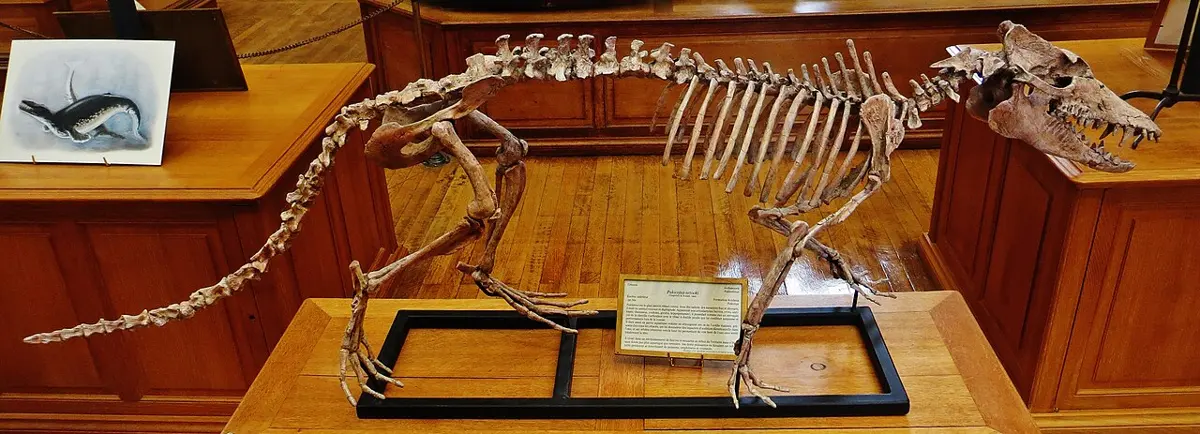
When independent lines of evidence agree like this, scientists can be very confident. And a good explanation can do more than agree: it can predict. Here is one prediction that came true.
Questions
Human and chimpanzee cytochrome c are identical. What does this show?
Pick an answer to see why.
Which of these is the strongest evidence that two species share a recent common ancestor?
Pick an answer to see why.
Here are the differences between the β-globin genes (444 letters each) of four animals, counted from real sequences:
| rhesus monkey | mouse | chicken | |
|---|---|---|---|
| human | 18 | 79 | 116 |
| rhesus monkey | 75 | 116 | |
| mouse | 127 |
Build the family tree, step by step, by joining the closest pair and averaging. Draw it, and say whether it agrees with what you know from fossils and anatomy.
Hint
Start with the smallest number. Then work out the difference between that pair and each of the others, as averages.
Answer
Step 1: the smallest is 18: join the human and rhesus monkey.
Step 2: mouse to that group: (79 + 75) ÷ 2 = 77. Chicken to the group: (116 + 116) ÷ 2 = 116. Mouse to chicken: 127. The smallest is 77: the mouse joins.
Step 3: chicken to the group of three: (116 + 116 + 127) ÷ 3 = 119.7. The chicken joins last.
The tree: ((human, rhesus monkey), mouse), chicken. It agrees: humans and monkeys are both primates; the mouse is another mammal (hair, milk); the chicken, a bird, belongs to the branch that split from the mammals’ line about 320 million years ago, as the fossils show.
A student says: “Comparing DNA has made fossils unnecessary.” Explain why scientists still need both.
Answer
DNA shows how closely living things are related, but on its own it can’t give dates: the number of differences has to be turned into time using fossils of known age, and genes change at different speeds in different lines. Fossils show what extinct animals looked like, which no living DNA can (for example, whales that walked on land), and they test the predictions that DNA makes, as the whale ankle bones did. DNA, in turn, can compare living things that have no bones and left few fossils, like fungi and microbes. Each line of evidence fills the other’s gaps, and when they agree, the conclusion is much stronger.
The protein cytochrome c says that a mushroom differs from us at 39 places and a rhododendron at 34. Explain why this does not show that we are more closely related to the rhododendron, and what evidence shows that fungi are our closer relatives.
Answer
Over more than a billion years, the places in cytochrome c that can change have changed many times, sometimes twice at the same place, so the count of differences stops growing and no longer measures time: the mushroom and the rhododendron also differ from each other at 37, so all three are roughly equally far apart in this protein. Better evidence comes from many genes at once, which put animals and fungi together, and from a shared rare change: animals and fungi carry the same 12-amino-acid insertion in the protein EF-1α, which plants lack. It most likely arose once, in a common ancestor of animals and fungi only. Other features fit: fungi store glycogen, as animals do, and make chitin.
Explain why a silent change in a gene can still be passed on and used as evidence, although it does not change the protein.
Answer
A silent change alters a letter of the DNA (often the third letter of a codon) but the new codon codes for the same amino acid, so the protein, and the body, are unaffected. Because it does no harm, natural selection doesn’t remove it, and it is copied into every cell and passed to the next generation like any other letter. So silent changes build up steadily over time, and two lines that split long ago differ in many of them. That makes them useful for comparing close relatives, like humans and chimpanzees, whose proteins are often identical.
Write a short paragraph, as if for a friend who has not studied this topic, explaining how scientists know that humans and dogs share an ancestor. Use at least three different lines of evidence.
Answer
A good answer uses evidence of different kinds, for example: Humans and dogs have the same bones in the same order in their front limbs (homologous organs), both have hair and feed their young on milk, and their early embryos look alike: all signs of a body plan inherited from one ancestor. Fossils show that animals with hair and milk, the mammals, first appeared about 205 million years ago, and that the groups that include dogs and humans branched apart later, around 90 million years ago. Their DNA tells the same story: the same genetic code, and proteins that are very alike; human and dog cytochrome c differ at only 11 of 104 places, against 21 for a tuna and 39 for yeast. Different scientists, using different methods, all reach the same family tree.
Where to go next
- How Does a Gene Make a Protein? How the code you compared here is read: from DNA to RNA to a chain of amino acids.
- Why Aren’t You Exactly Like Your Brother or Sister? Where new variation in genes comes from: the shuffling of chromosomes, and the mutations that build up into the differences in this topic.
- How Do New Species Begin, and End? How one species splits into two, the moment a branch of the tree is born.
- Why Do Antibiotics Stop Working? Evolution fast enough to watch, in bacteria.