
Chemistry on a computer
Nobel Prize in Chemistry, 1998: Walter Kohn and John A. Pople
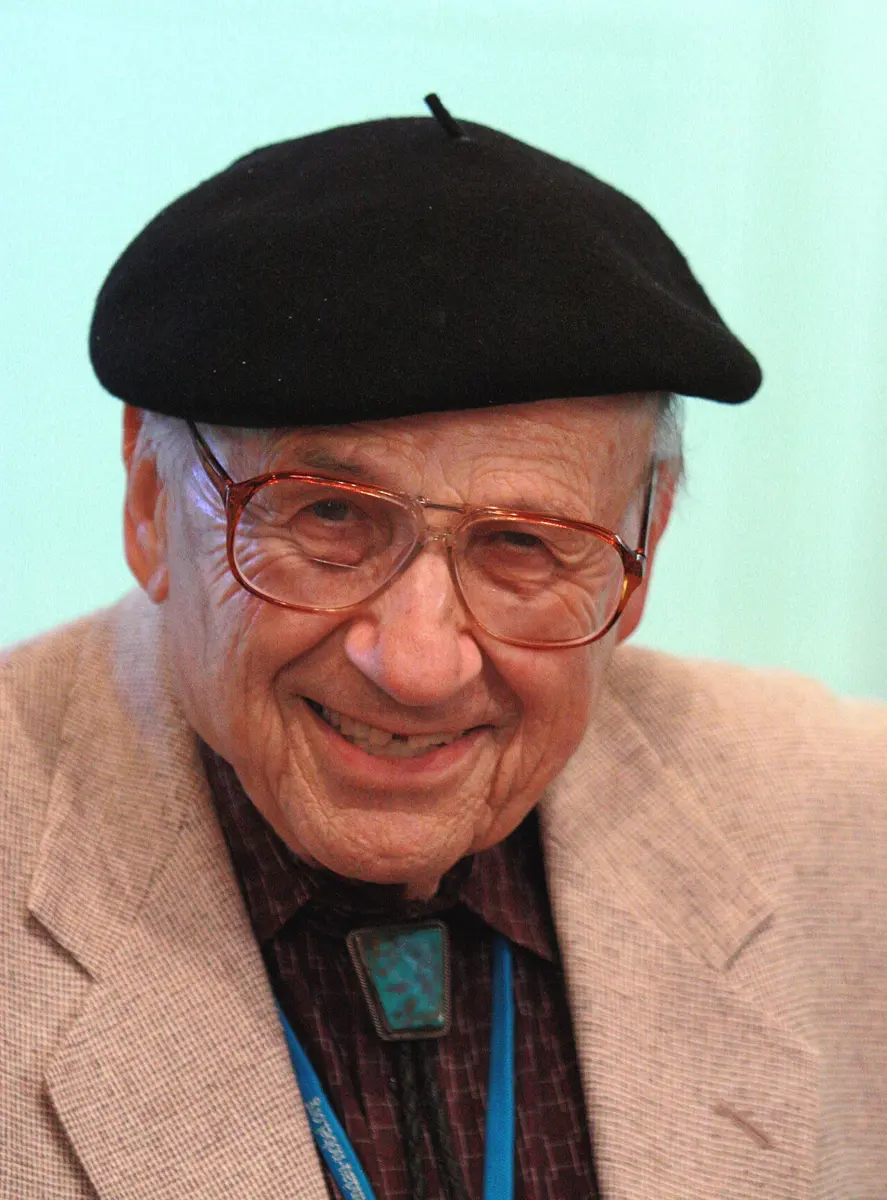
Walter Kohn
1923–2016, born in Austria
A Jewish boy in Vienna who escaped to England at 16, just before the Second World War; his parents were murdered in the Holocaust. A physicist, he last went to a chemistry class at 17.
-
John A. Pople
1925–2004, born in England
His father ran a clothes shop in a small seaside town. At twelve he found a calculus book in a wastepaper basket and read it from cover to cover.
Before a company makes a new medicine, it may try thousands of possible molecules. Making and testing each one in a laboratory takes weeks. Today, chemists often try them on a computer first: the computer works out the shape of each molecule, how its electrons are spread, and whether it will fit the protein it is meant to block. Only the most promising ones are made.
For most of the 20th century this was impossible. In 1998 the Nobel Prize in Chemistry went to two scientists who made it possible: Walter Kohn, a physicist, who found a clever shortcut, and John Pople, who turned the theory into a computer program that any chemist could use.
What decides a molecule’s shape?
You have learned that an atom has a small nucleus with electrons around it in shells Grade 9: Structure of an atom, and that in a covalent bond two atoms share a pair of electrons Grade 9: Covalent bond. In a water molecule, H₂O, the oxygen atom shares one pair with each hydrogen atom Grade 9: Formation of a water molecule.
But a water molecule is not a straight line, H–O–H. It is bent, with an angle of about 104.5° between the two bonds. That bend is why water molecules have a slightly negative end and a slightly positive end, why they cling together, and why water boils at 100 °C and not far below zero, like other small molecules (Molecules with charged ends). Almost everything about a substance follows from where its electrons are.
The rules were known in 1926
In the 1920s physicists discovered the rules that electrons obey: quantum mechanics. In 1926 Erwin Schrödinger wrote down the equation that, in principle, tells you exactly where the electrons in any atom or molecule are likely to be, and how much energy they have. Solve it, and you know the molecule’s shape, its color, its bonds, and how it reacts.
In 1929 the physicist Paul Dirac wrote that the laws needed for “the whole of chemistry” were now completely known. “The difficulty,” he added, “lies only in the fact that application of these laws leads to equations that are too complex to be solved.”
Which of these does the arrangement of a molecule’s electrons decide?
Pick an answer to see why.
Why it was so hard
The trouble is that every electron pushes on every other electron. You can’t work out where one electron is without knowing where all the others are, and they are all moving.
Here is a way to see how bad this gets, the kind of count Kohn himself used in his Nobel lecture. Divide the space around a small molecule into a rough grid, just 10 points along each side: 10 × 10 × 10 = 1,000 points.
- To describe one electron, you need a number for each point: how likely the electron is to be there. That is 1,000 numbers.
- For two electrons, you need a number for every pair of points (electron 1 here and electron 2 there): 1,000 × 1,000 = a million numbers.
- For the 10 electrons of a water molecule, you need 1,000 multiplied by itself 10 times: 10³⁰ numbers, a one followed by thirty zeros. No computer could ever store them.
Every extra electron multiplies the work by another thousand. Physicists call this the exponential wall. For a medicine molecule with hundreds of electrons, the exact equation is hopeless.
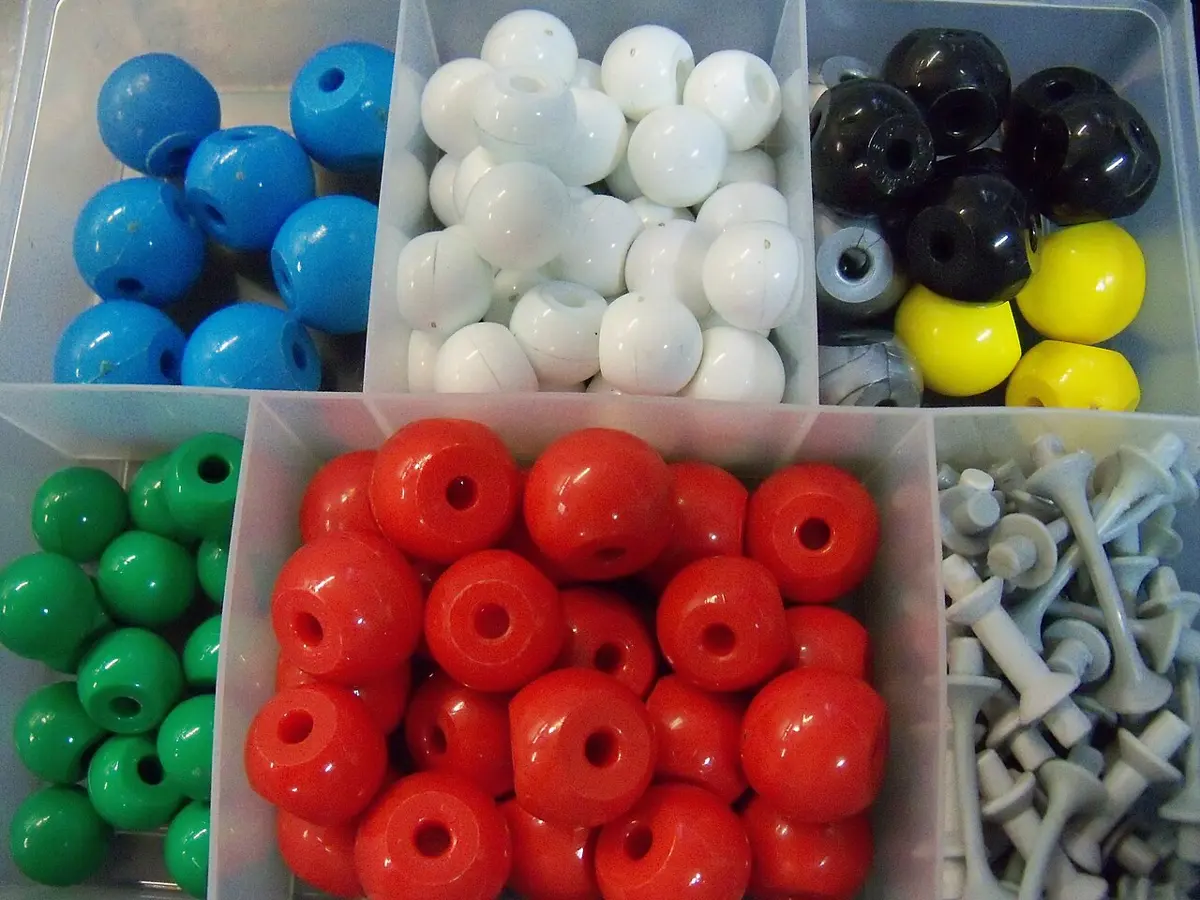
So in the 1950s quantum chemistry could handle only the simplest molecules, and chemists mostly relied on experiments, models made of balls and sticks, and rules of thumb.
What they did, step by step
Kohn: forget the electrons, keep the cloud (1964–65)
Walter Kohn was a physicist at the University of California, San Diego, who studied the electrons in metals and alloys.
- 1963, an idea in Paris. On a visit to the École Normale Supérieure in Paris, Kohn began to wonder: do we really need to know where every electron is? Perhaps it is enough to know the electron density: how much electron there is, on average, at each point in space. Think of it as a cloud, thick where electrons are often found and thin where they rarely go. It needs only one number per point, 1,000 numbers on our grid, however many electrons there are.
- A three-line proof. Kohn found a short argument showing that the cloud alone completely decides everything else: the energy, and so the shape and the bonds. The result seemed so remarkable that he did not trust it. With a young American physicist in the same office, Pierre Hohenberg, he searched the books to see if anyone had found it before. No one had. They published it in 1964.
- 1965, a recipe. Knowing that the cloud decides everything is not the same as knowing how. Back in San Diego, Kohn and Lu Jeu Sham found a practical recipe: replace the real electrons, which all push on each other, by imaginary electrons that move independently but give exactly the same cloud. These are easy to calculate. All the hard part, the way real electrons dodge each other, is packed into one correction term.
- Decades of guessing. Nobody knows that correction term exactly. Kohn and Sham gave a first, rough version. Over the next thirty years many scientists found better and better approximations for it, until by the 1990s the method was accurate enough for chemists. It is called density-functional theory, or DFT.
Pople: a tool for every chemist (1950s–1990s)
John Pople was a mathematician who became a chemist. At Cambridge University in the early 1950s he made his first models of molecules with hand calculators. He wanted a whole “chemistry on paper”: to be able to work out the properties of any molecule from the laws of physics alone.
- 1964, computers. Pople moved to the Carnegie Institute of Technology (now Carnegie Mellon University) in Pittsburgh, USA. Fast computers were arriving, and he learned to write programs for them, in a dingy basement where his group’s computer stood.
- Pieces that are quick to add up. The shape of an electron’s cloud around an atom is hard to compute. Following an idea of the British chemist Frank Boys, Pople built each cloud out of many simple bell-shaped pieces called Gaussian functions (named after the mathematician Gauss). A computer can combine them very quickly.
- 1970, GAUSSIAN. His group published a program called GAUSSIAN-70. A chemist typed in the atoms of a molecule and a rough guess of their positions; the program worked out the energy, moved the atoms to lower the energy, and repeated this until it found the shape with the lowest energy: the real shape of the molecule.
- A model chemistry. Pople insisted that a method is useful only if you know how much to trust it. So each method in his program was tested on many molecules whose properties had already been measured, and he arranged the methods as a ladder: rough and fast at the bottom, accurate and slow at the top. A chemist could choose the step that suited the problem.
- Early 1990s, joining the two. Pople added Kohn’s density-functional theory to the program. Now even quite large molecules could be calculated accurately.

A computer program finds the shape of a molecule by searching for…
Pick an answer to see why.
In your life today
- Medicines. Drug companies use these methods to study how a possible medicine fits into the protein it should block, and how enzymes work, before anything is made in a laboratory.
- New materials. Density-functional theory is used to search for better materials for batteries, solar cells, LEDs and catalysts, by calculating thousands of possible crystals and making only the best.
- The air we breathe. Calculations helped chemists understand the reactions in which chlorine from CFCs destroys ozone high in the atmosphere (the 1995 prize).
- Molecules in space. Radio telescopes pick up signals from molecules in huge clouds between the stars. Many of these molecules can’t be made on Earth, but a computer can work out which signals each would give, so astronomers can tell what the clouds contain.
In 2014 the journal Nature listed the 100 most cited scientific papers of all time. Several of them are about density-functional theory, and one is in the top ten: a sign of how many scientists use it every day.
What came next
- Bigger and bigger. Today’s computers can calculate molecules with thousands of atoms, and DFT is used in physics, chemistry, geology (to study rocks deep inside the Earth) and biology.

- Learning from calculations. Programs that learn from millions of quantum calculations can now guess a molecule’s energy in a fraction of the time. The 2024 Nobel Prize in Chemistry went to computer methods that predict the shapes of proteins (the 2024 prize).
- The missing piece. The exact form of Kohn and Sham’s correction term is still unknown. Today’s versions work well for most molecules but go wrong for some, such as certain metals and molecules whose bonds are breaking. Finding a better one is an open problem that many scientists are working on now.
In your science books
- Grade 9: the structure of an atom, the covalent bond, with water and methane.
- Grade 10: shells, subshells and orbitals.
- Going further: why molecules pull on each other, and catalysts.
Learn more
- The Nobel Prize’s press release for 1998, with a computed electron cloud of an amino acid.
- The Nobel lectures: Kohn, Electronic structure of matter: wave functions and density functionals, and Pople, Quantum chemical models.
- Their own life stories: Kohn and Pople (nobelprize.org).
The official reason
The prize was given “for his development of the density-functional theory.”
The prize was given “for his development of computational methods in quantum chemistry.”