
Walk along the bund of a paddy field in Shrawan, a month after planting, and the field is loud. Frogs call from the water, dragonflies dart over the young rice, a white egret steps slowly through the mud, and somewhere in the grass of the bund a rat-snake is hunting. Now imagine that, one year, almost all the frogs are caught and sold. What happens next? The insects the frogs used to eat have one enemy fewer, so there are more of them, and more of them feed on the rice. The snakes and egrets that ate the frogs go hungry, or turn to other food. A change in one kind of animal spreads, step by step, through everything that lives in the field.
The study of these links, between living things and between living things and their surroundings, is ecology. In this unit you will look at how ecologists describe the living world, what happens to the others when one population grows or shrinks, how bacteria and fungi break down every dead leaf and body and give its materials back, and why wetlands, from a Terai lake to a paddy field, are among the richest ecosystems on Earth.
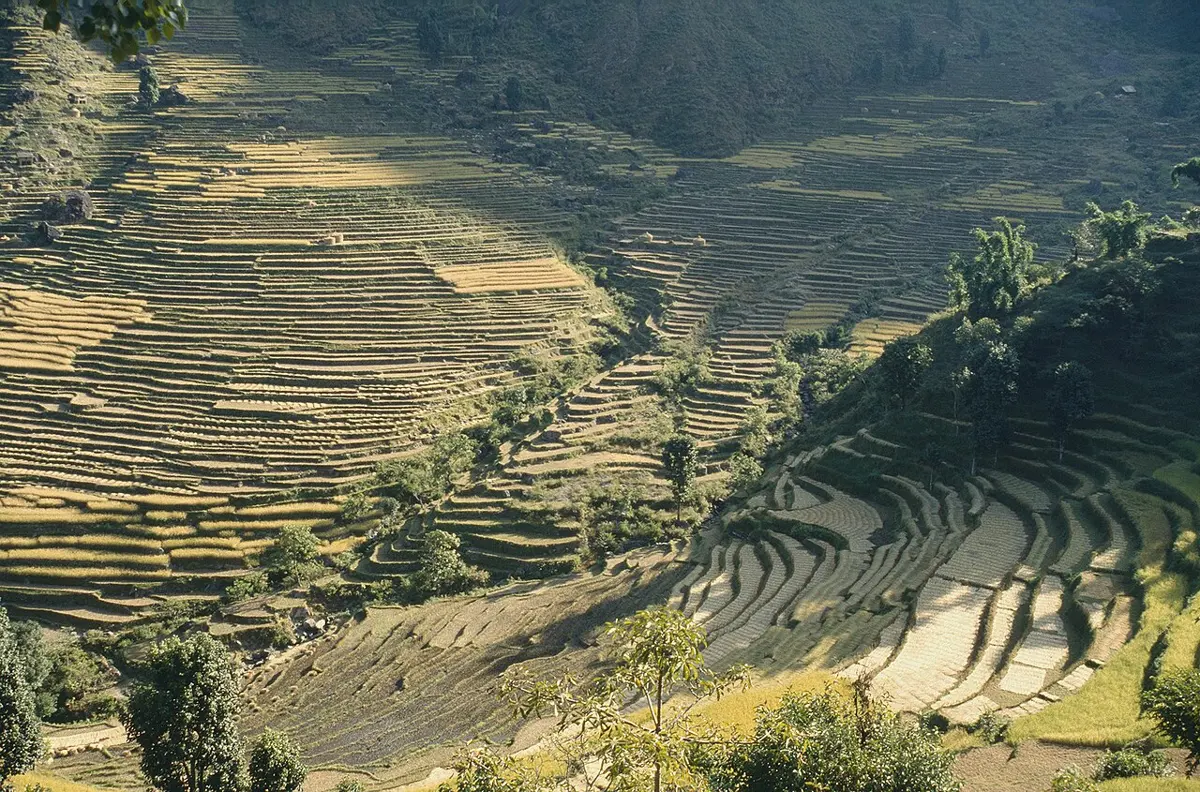
4.1 Ecology and ecosystem
What ecology is
Ecology is the branch of biology that studies how living things interact with each other and with their environment, the non-living surroundings in which they live. The word was made in 1866 by the German biologist Ernst Haeckel, from two Greek words: oikos, a house or a home, and logos, study. Ecology is the study of living things “at home”.
An ecologist asks questions such as these. Why do rhododendrons grow on the hills of Ilam but not in the Terai? How many tigers can the grasslands of Chitwan feed? What eats the planthoppers in a rice field, and what happens if a farmer sprays them? Why does a fallen sal leaf vanish in a year while a pine needle lasts much longer? The answers always involve links: between one living thing and another, and between living things and light, water, temperature and soil.
From an organism to the biosphere
Ecologists look at life at several levels, each one built from the one before it. Think of the frogs of a paddy field.
- Organism (individual). One frog: a single living thing.
- Population. All the frogs of one species living in the same field at the same time. A population is a group of organisms of the same species that live in the same area at the same time and can breed with each other. Every population has a size, a density (how many in each unit of area or volume, such as 12 frogs in every 100 m² of field), a birth rate and a death rate.
- Community. The frogs together with the rice, the weeds, the algae, the insects, the spiders, the snakes, the egrets, the fish and the microbes of the field. A community is all the populations of different species that live in the same area and interact with each other.
- Ecosystem. The community together with the water, the mud, the air, the sunlight and the temperature of the field. An ecosystem is a community of living things together with its non-living (abiotic) environment, the two acting on each other as one working system. The word was first used by the English ecologist Arthur Tansley in 1935.
- Biosphere. All the ecosystems of the Earth together: the thin layer of land, water and air, from the deep sea floor to a few kilometers up in the sky, in which life is found.
Two more words help to describe where an organism lives and what it does there. Its habitat is the place where it lives: the paddy water for a tadpole, the bark of a tree for a lichen. Its niche is its whole way of life in the ecosystem: what it eats, what eats it, when it is active, where it shelters and breeds. A habitat is a frog’s address; its niche is its job. Two species can share a habitat, but if they have exactly the same niche, they compete for the same things, and one usually pushes the other out.
All the one-horned rhinoceroses in Chitwan National Park make up:
Pick an answer to see why.
The ecosystem as a working system
An ecosystem has a structure, the parts it is made of, and functions, the work those parts do together.
Structure. Its abiotic components are the non-living parts: light, temperature, water, air, soil and the minerals in it, and the inorganic substances (water, carbon dioxide, nitrogen, phosphates) and organic substances (the remains of dead things) that pass between living and non-living. Its biotic components are the living parts, grouped by how they get their food: producers, which make it by photosynthesis; consumers, which eat other living things; and decomposers, which feed on dead matter and break it down.
Functions. Two kinds of work go on all the time in every ecosystem.
- Energy flows through it in one direction: sunlight is caught by the producers, passed along food chains as food, and finally lost as heat. It is never used again.
- Materials cycle round and round: the carbon, nitrogen, water and minerals of a living body are passed on when it is eaten, and given back to the soil, water and air when it dies and decays. The same atoms are used again and again.
An ecosystem also controls itself. Its numbers of plants, plant-eaters and hunters rise and fall, but each change sets off others that pull it back, so over the years the whole stays roughly in balance. That is the subject of 4.2.
Kinds of ecosystem, with examples
Ecosystems are as big or as small as we choose to study. A rotting log, a pond, the whole of the Chitwan valley and the Pacific Ocean are all ecosystems. They can be sorted in two ways.
By where they are. Terrestrial (land) ecosystems: forests (the sal forests of the Terai, the oak and rhododendron forests of the hills), grasslands (the phantas of Shuklaphanta, the high pastures of the Himalaya), deserts and the cold, rocky land above the tree line. Aquatic (water) ecosystems: freshwater ones such as ponds, lakes, rivers and wetlands, and marine ones, the seas and oceans, which cover about 71% of the Earth.
By how they came about. Natural ecosystems develop and keep going by themselves: a forest, a lake, a river. Artificial (human-made) ecosystems are made and kept going by people: a paddy field, a maize field, a fish pond, a garden, an aquarium. An artificial ecosystem has fewer species, and it needs people’s work to keep it going: weeding, watering, fertilizers, pest control. Left alone, a paddy field fills with weeds and grasses, then shrubs, and in time, in the hills, a forest.
| Example | Producers | Consumers | Decomposers | Main abiotic factors |
|---|---|---|---|---|
| Sal forest (Terai) | sal, other trees, shrubs, grasses | deer, wild boar, termites, birds, leopards, tigers | fungi and bacteria in the leaf litter and soil | monsoon rain, heat, deep soil |
| Pond | algae, phytoplankton, hydrilla, lotus | zooplankton, snails, fish, frogs, herons | bacteria and fungi in the mud | still water, dissolved oxygen, light |
| Paddy field | rice, weeds, algae | planthoppers, grasshoppers, rats, spiders, frogs, snakes, egrets | bacteria and fungi in the mud | standing water, warmth, fertilizer |
| Alpine meadow (Himalaya) | grasses, sedges, small flowering herbs | yaks, pikas, blue sheep, snow leopards | slow-working fungi and bacteria | cold, thin soil, strong sunlight, snow |
Which of these is an artificial ecosystem?
Pick an answer to see why.
4.2 Effects of increase and decrease in population of one species on others
What makes a population change
The size of a population changes in four ways. Births and immigration (animals moving in) add to it; deaths and emigration (animals moving out) take away from it. If births and immigration together are more than deaths and emigration, it grows; if fewer, it shrinks.
What decides those numbers is, above all, the rest of the ecosystem: how much food there is, how many predators hunt it, diseases and parasites, competitors for the same food or space, and abiotic factors such as rain, floods, drought, cold and fire. And every one of these is itself changing. So when one population changes, it changes things for all the populations linked to it, and those changes spread on. Food chains and food webs show which way.
Changes along a food chain
Take a food chain of a paddy field:
Each arrow means “is eaten by”. Each living thing is food for the one after it and an eater of the one before it. Now suppose the number of frogs falls sharply. Follow it both ways along the chain.
- Up the chain (the frog’s eaters). Snakes have less food. Fewer young snakes survive, so the snakes decrease too, and then the hawks that eat snakes have less food.
- Down the chain (the frog’s food). Fewer grasshoppers are eaten, so the grasshoppers increase. More grasshoppers eat more rice, so the rice crop decreases.
An increase works the same way with the signs turned round. More frogs mean more food for snakes (more snakes, then more hawks), and more grasshoppers eaten (fewer grasshoppers, so more rice). So a simple rule follows every link:
- If a population increases, its eaters increase and its food decreases.
- If a population decreases, its eaters decrease and its food increases.
Then each of those changes passes on along the next link by the same rule. Notice that a change two steps away comes out the same way round as the first: fewer frogs, more grasshoppers, less rice; fewer frogs, fewer snakes, fewer hawks... and also, by the snakes, more rats. A predator at the top can, through the steps below it, help the plants at the bottom. Ecologists call a chain of effects like this a trophic cascade (from trophe, food), since it tumbles down the feeding levels like water down a set of steps.
In the chain grass → deer → tiger, the number of tigers increases. What happens to the grass?
Pick an answer to see why.
Changes in a food web
A real field is not one chain but a web of many chains joined together. In a web, an animal usually has several foods and several enemies, and that changes how a loss spreads.
- A web softens the blow. If the frogs disappear, a snake can still eat rats, and an egret can still eat grasshoppers and fish. So the snakes and egrets decrease less than they would in a single chain, though they now press harder on their other foods.
- Effects can pull both ways. An egret eats frogs and grasshoppers. With fewer frogs it has less of one food, but there are more grasshoppers to eat. Whether egrets end up more or fewer depends on which effect is bigger, and only counting them can tell.
- Some species matter far more than their numbers. A species whose loss changes the whole ecosystem, much more than its share of the living things there, is called a keystone species, after the stone at the top of an arch that holds the others in place. Big predators, such as tigers and leopards, are often keystone species, and so are some plants and helpers, such as figs, whose fruit feeds many birds and monkeys when little else is fruiting.
The more links a web has, the more ways each animal has to get its food, and the better it can take a loss. That is why an ecosystem with many species (great biodiversity) is usually more stable than one with few, and why a field of one crop, with few species, suffers pest outbreaks more easily than a forest.
Real cases of one population changing others
Spiders, insecticides and the brown planthopper. The brown planthopper is a tiny brown insect that sucks the sap at the base of rice plants. A field full of them dries and browns in patches, called hopperburn. In the 1970s and 1980s farmers in Asia sprayed more and more insecticide against it, yet outbreaks grew worse. The spray killed the planthoppers’ enemies, wolf spiders, small bugs and wasps, even more surely than the planthoppers themselves, and the planthoppers, which breed very fast, came back first, with no enemies to hold them down. This bounce-back of a pest after spraying is called resurgence. In 1986 Indonesia banned 57 insecticide products for use on rice and trained farmers to spare the spiders and spray only when the pests really outnumbered their enemies. For the next fifteen years planthopper outbreaks there stayed small and local, until heavy spraying came back in the 2000s and so did the outbreaks.
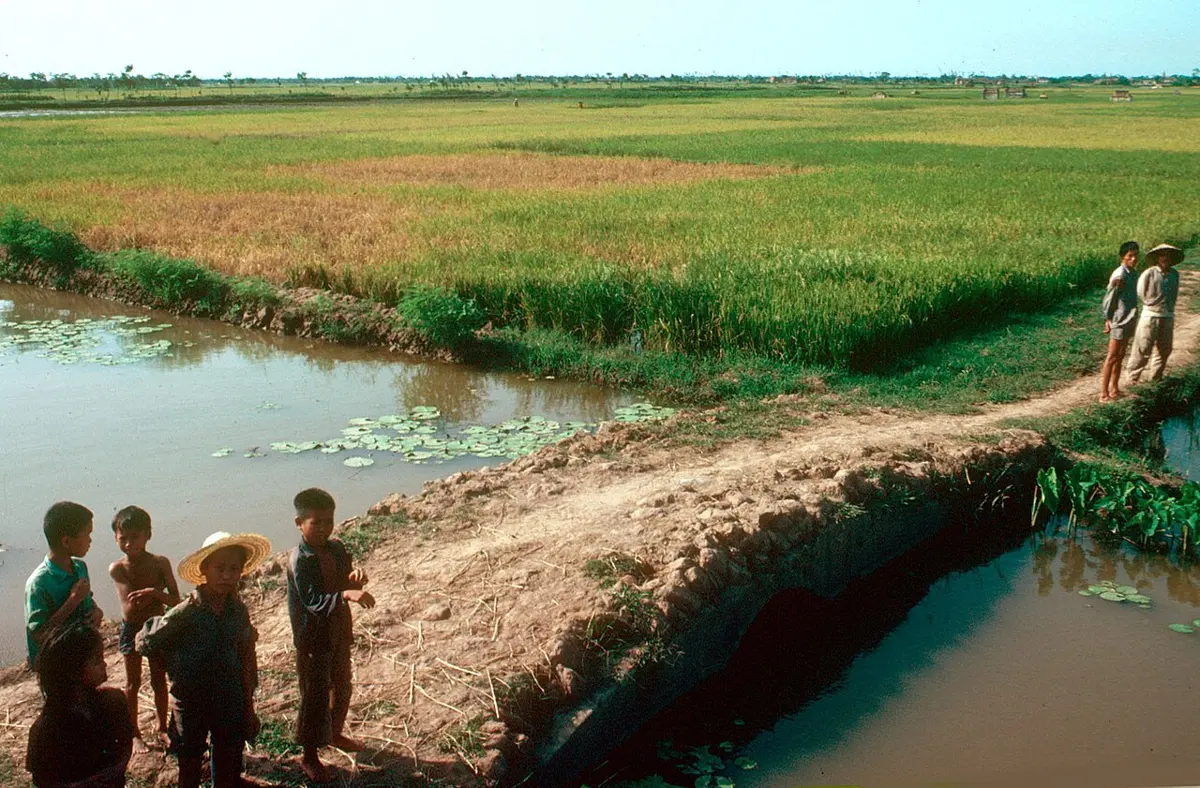
Frogs in the paddy fields of India. For years India exported millions of frogs’ legs a year to Europe and America, most of them from frogs caught in paddy fields. In 1987 India banned the trade, among other reasons because people feared that with the frogs gone, crop pests and mosquitoes would multiply; Bangladesh banned it in 1989. How much the frogs’ loss raised the pests was never measured well, but the reasoning is the rule above: fewer predators, more of what they eat.
The sparrows of China. In 1958 China’s government began a campaign against four “pests”, among them the tree sparrow, which ate grain in the fields. People banged pots and drums until the frightened birds fell from the sky exhausted, and destroyed their nests and eggs, and the sparrows nearly vanished from many places. But sparrows also feed their young on insects. With the sparrows gone, insect pests, locusts among them, spread through the crops, adding to the failed harvests of the years that followed. In 1960 the sparrow was taken off the list, and bedbugs were put in its place.
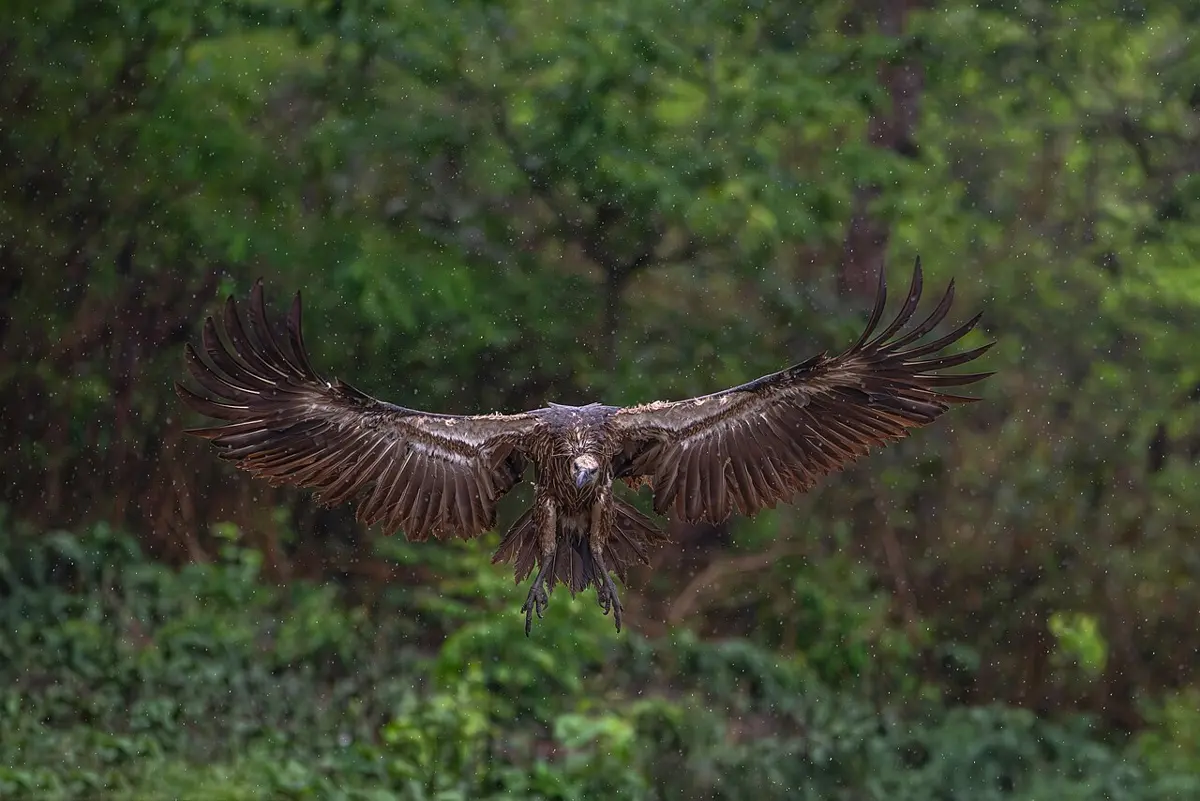
Vultures across South Asia. In the 1990s and 2000s the vultures of Nepal, India and Pakistan almost disappeared, killed by diclofenac, a painkiller given to cattle, which harms a vulture’s kidneys when it eats a treated carcass. Vultures are scavengers: they eat dead animals. With them gone, carcasses lay rotting for longer, and stray dogs, which ate them instead, multiplied, and with them dog bites and rabies. In 2024 two economists estimated that in India the loss of the vultures led to about half a million more human deaths between 2000 and 2005, through rotting carcasses spreading germs into water and through rabies. Nepal banned diclofenac for animals in 2006, and since then its vultures have slowly begun to recover Grade 10: Nepal’s success stories.
An increase: Nepal’s tigers. Nepal’s wild tigers rose from 121 in 2009 to 429 in the count of 2026, a conservation success. More tigers eat more deer and wild boar, which helps the grasslands and forests; but young tigers looking for space of their own also wander out of the parks, and attacks on cattle and on people have risen in the villages around them.
An increase: a plant with no enemies. Mikania micrantha, a fast-growing climbing weed from Central and South America, has spread over many of Chitwan’s grasslands and forest edges, smothering the grasses and shrubs that rhinos and deer eat. In its home, insects and fungi that feed on it keep it in check; here nothing does. A species brought to a new place where it spreads out of control is an invasive species. Water hyacinth in Phewa Lake, which you met in Grade 9 Science, is another.
Spraying an insecticide on a rice field to kill brown planthoppers can make the planthoppers more numerous a few weeks later. Why?
Pick an answer to see why.
People and the balance of an ecosystem
Most of the big changes to populations in Nepal today come from people: cutting forests and draining wetlands (fewer homes for wild animals), hunting and poaching (fewer predators or prey), pesticides (fewer insects and their enemies), bringing in new species (invasive weeds and fish), and pollution. Knowing how populations are linked lets us foresee the harm before it is done. It is also why conservation protects whole ecosystems, a forest with its prey and predators, and not only the one animal people care most about.
4.3 Bacterial and fungal decomposition of organic matter
Every year the trees of a sal forest drop tonnes of leaves on each hectare, and animals die and leave their bodies and their dung. Yet the forest floor is not buried meters deep. Something breaks it all down and gives its materials back to the soil. That breaking down is decomposition.
Decomposition is the process by which the complex organic matter of dead plants, dead animals and their wastes is broken down into simpler substances, and at the end into inorganic ones (carbon dioxide, water and mineral salts such as nitrates and phosphates), mainly by bacteria and fungi. The dead matter they feed on is called detritus.
Who does the work
The true decomposers are bacteria and fungi. They are saprotrophs (saprophytes): they live on dead matter and feed by extracellular digestion. A saprotroph can’t swallow food. Instead it releases enzymes out of its cells and onto the dead matter, the enzymes break the large molecules there into small soluble ones, and the decomposer absorbs those through its cell wall. What it doesn’t use, and the waste it gives out, stays in the soil.
They are helped by detritivores, small animals that eat detritus: earthworms, termites, millipedes, woodlice, springtails, mites and the larvae of many flies and beetles. Detritivores swallow dead matter and digest part of it inside their bodies. Their main help is to cut it up: every bite makes more surface for the bacteria and fungi to work on, and their droppings are a rich food for the microbes.
The steps of decomposition
Follow one fallen leaf. Decomposition goes on in steps, which overlap: while one part of the leaf is still whole, another is already being eaten by fungi.
- Fragmentation. Detritivores such as termites, millipedes and earthworms chew and tear the leaf into small pieces. Rain, frost and sunlight crack it too.
- Leaching. Rainwater soaking through the litter dissolves the soluble substances in the dead leaf (sugars, some mineral salts) and carries them down into the soil, where some of them settle as salts.
- Catabolism. Bacteria and fungi release enzymes onto the pieces and break the large molecules into small ones, which they absorb: starch and cellulose into sugars, proteins into amino acids and then ammonia, fats into fatty acids and glycerol. The decomposers use these for their own growth and energy, and respire much of the carbon away as carbon dioxide.
- Humification. What is left is a dark brown or black, crumbly, jelly-like substance with no trace of the leaf’s shape: humus. It is made of the parts that resist decomposers, such as lignin and the leftovers of the microbes’ own bodies. Humus holds water like a sponge, holds minerals so that rain doesn’t wash them away, and makes soil crumbly, so that air and roots can get into it.
- Mineralization. Over years, microbes break down even the humus, very slowly, releasing inorganic substances: carbon dioxide, water, and mineral salts such as ammonium, nitrates, phosphates, potassium and sulphates. These are taken up again by the roots of plants.
So the materials of the leaf go back to the soil and air, ready for a new plant to use. Without decomposition, the carbon, nitrogen and phosphorus of the world would sooner or later all be locked up in dead bodies, and life would stop.
Peepal leaf: traced from a nature print of 1858 (public domain)
Earthworm: Pearson Scott Foresman, Public domain, via Wikimedia Commons
Root tip: New Student's Reference Work (1914), public domain
In which step of decomposition are soluble substances in dead matter washed down into the soil by water?
Pick an answer to see why.
Bacterial decomposition
Bacteria are single cells about a thousandth of a millimeter long, but they are everywhere and they multiply fast: in good conditions some divide every 20 minutes. A single gram of fertile soil holds hundreds of millions of them.
- They feed on soft, rich dead matter: the proteins, sugars and fats of dead animals, dung, urine and soft leaves. So they are the main decomposers of animal bodies and wastes, and in water and wet mud.
- Some work with oxygen (aerobic bacteria, such as Bacillus and Pseudomonas) and some without it (anaerobic bacteria, such as Clostridium), so bacteria decompose things even in airless places, such as waterlogged mud, the inside of a dung heap, or the stomach of a cow.
- They play special parts in the cycle of nitrogen. When bacteria break down the proteins of a dead body or of dung, the nitrogen is released as ammonia (ammonification). Other bacteria in the soil (Nitrosomonas, then Nitrobacter) turn the ammonia into nitrites and then nitrates (nitrification), the form most plants take up. You will follow the whole nitrogen cycle in Grade 10.
- A group of thread-like soil bacteria called actinomycetes (such as Streptomyces) break down tougher matter, and give soil its smell.
Fungal decomposition
A fungus that decomposes, a mold on bread or a mushroom on a log, is mostly hidden: a mass of fine branching threads called hyphae, together a mycelium, which grow through the dead matter. What we see (the mushroom, the gray fur of a mold) is only the part that makes spores.
- The hyphae push into the dead matter, even into wood, and release enzymes at their growing tips, then absorb the food they free. So fungi can reach deep inside a fallen branch or a thick leaf, where bacteria can’t get.
- Fungi are the main decomposers of the toughest parts of plants: cellulose and, above all, lignin, the substance that makes wood hard. Hardly anything but certain fungi, such as the white-rot fungi that leave rotten wood pale and soft, can break lignin down. Without fungi, fallen trees would hardly rot at all.
- Most fungi need oxygen, but they can work where it is drier, cooler or more acid than most bacteria like: in the leaf litter of a pine forest, on old wood, or on bread and fruit in a kitchen.
- Examples: molds such as Rhizopus (black bread mold), Mucor, Penicillium and Aspergillus; mushrooms such as Agaricus; and bracket fungi on dead trees.
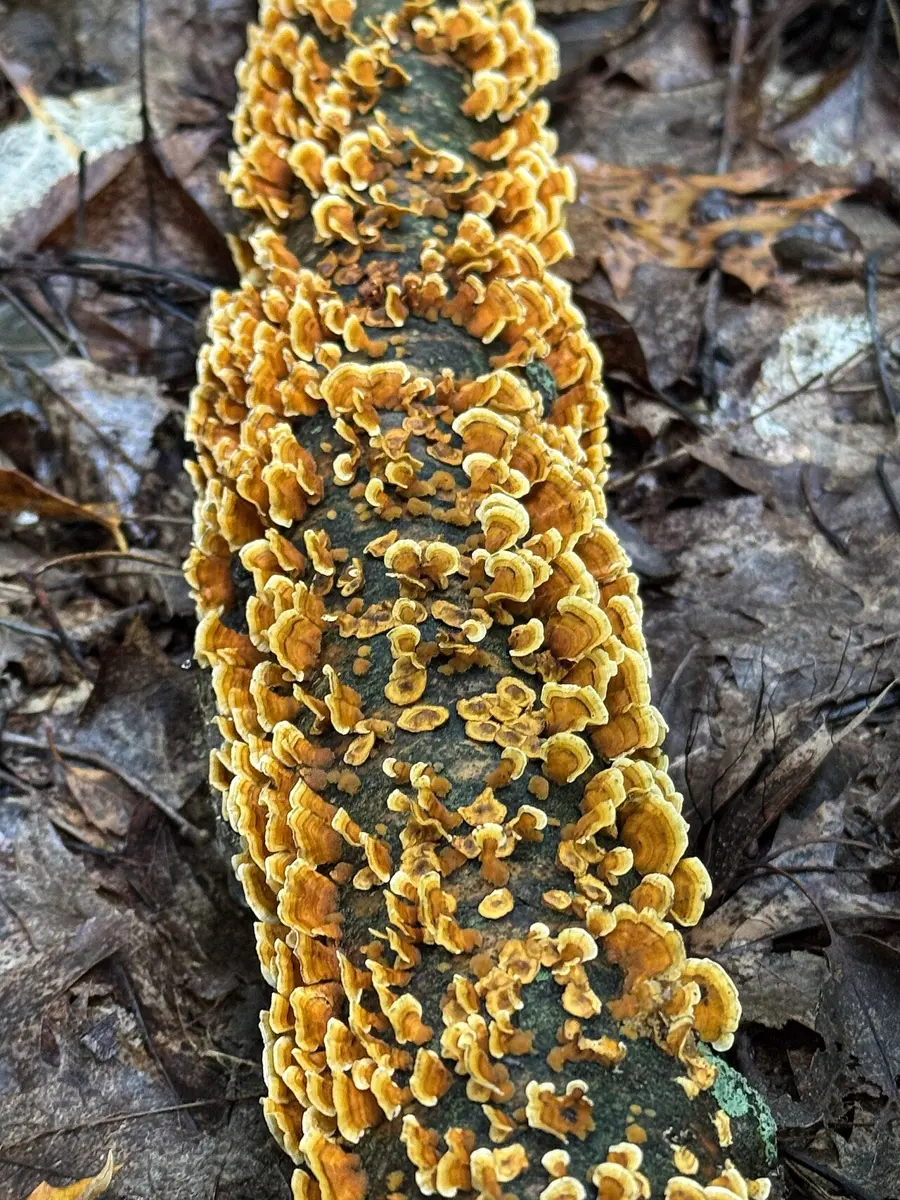
Bacteria and fungi are not rivals so much as a team. In a fallen leaf, fungi often come first, opening up its tough tissues with their hyphae; bacteria then multiply on the softer, richer parts that the fungi expose, and both are eaten in turn by tiny animals in the soil.
A fallen pine branch in a dry forest is slowly turning soft and pale. Which decomposers are most likely doing this, and why?
Pick an answer to see why.
What decides how fast things decay
- Temperature. Decomposers’ enzymes work faster when it is warm, up to about 35 °C. A leaf that rots in months in the Terai monsoon may lie for years on a cold Himalayan slope; food in a refrigerator keeps for days.
- Moisture. Bacteria and fungi need water. Dry matter hardly decays: that is why dried meat (sukuti), dried fish and dried vegetables keep for months.
- Oxygen. With plenty of air, decomposition is fast and complete. Where there is little or none, as in waterlogged mud, it is slow and incomplete, so dead plants pile up as peat.
- The kind of dead matter. Soft leaves rich in nitrogen and sugars (a bean leaf, grass, dung) rot fast. Tough matter rich in lignin, wax or resin (sal leaves, pine needles, wood, the chitin of insect shells) rots slowly.
- pH. Most bacteria prefer soil that is neither strongly acid nor alkaline; in acid soils, such as under pines, fungi do most of the work, and more slowly.
Aerobic and anaerobic decomposition
| Aerobic decomposition | Anaerobic decomposition | |
|---|---|---|
| Oxygen | needs oxygen | goes on without oxygen |
| Who does it | most fungi and many bacteria | anaerobic bacteria, and microbes called archaea |
| Speed | fast and complete | slow and often incomplete |
| Main products | carbon dioxide, water, minerals, humus; heat | methane, carbon dioxide, hydrogen sulphide (rotten-egg smell), ammonia, organic acids |
| Where | leaf litter, a turned compost heap, well-drained soil | waterlogged paddy fields, swamps, the bottom of a pond, a biogas plant, a cow’s stomach |
| Use | compost, the natural recycling of soil | biogas (gobar gas) for cooking and light, sewage treatment |
A flooded paddy field gives out methane for this reason: under the water, the mud has no oxygen, and microbes break down the dead roots, straw and algae anaerobically. Methane traps heat in the air, so paddy fields are one of the sources of the gases that warm the climate (Matter and energy without oxygen).
Why decomposition matters
- Recycling. It returns the carbon, nitrogen, phosphorus and other materials of every dead thing to the soil, water and air, for plants to use again. It is the last step of every cycle of materials.
- Soil fertility. It makes humus, which holds water and minerals and keeps soil crumbly.
- Cleaning up. It removes dead bodies, fallen leaves and wastes, which would otherwise pile up and spread disease. Sewage treatment plants use bacteria to break down the wastes in dirty water.
- Compost and biogas. Farmers turn crop waste, kitchen waste and dung into compost (aerobic) or into biogas and slurry (anaerobic), saving firewood and chemical fertilizer.
- Harm. The same microbes spoil food, rot timber, ropes and leather, and can attack the wooden beams of old temples and houses, which is why wood is dried, kept off wet ground and treated against rot.
4.4 Wetland ecosystem
What a wetland is
Some land is neither quite dry land nor quite open water: a marsh at a lake’s edge, a swamp in a river’s old bed, a paddy field in the monsoon. Such places are wetlands. A wetland is an area of land that is covered by shallow water or soaked with water, all year or for a long part of it, so that its soil is waterlogged and its plants and animals are those that live in or beside water.
The world’s agreement on wetlands, the Ramsar Convention, gives a wide definition: wetlands are “areas of marsh, fen, peatland or water, whether natural or artificial, permanent or temporary, with water that is static or flowing, fresh, brackish or salt, including areas of marine water the depth of which at low tide does not exceed six meters”. By that definition, lakes, ponds, rivers and their floodplains, swamps, marshes, bogs, high mountain lakes, reservoirs, fish ponds and even paddy fields are all wetlands. Wetlands cover about 5% of Nepal, by most estimates.
Natural wetlands in Nepal include:
- lakes (tal), from Rara in Mugu and Phewa in Pokhara to the glacier-fed lakes of the high Himalaya, such as Gokyo and Gosaikunda;
- ponds (pokhari), like Bhaktapur’s Siddha Pokhari, and oxbow lakes left by rivers that changed course in the Terai;
- marshes and swamps (simsar), such as those of Koshi Tappu and Ghodaghodi;
- rivers and their floodplains, flooded every monsoon.
Human-made wetlands include reservoirs (Jagdishpur in Kapilvastu, built for irrigation), fish ponds and paddy fields.
The zones of a wetland
Walk from the open water of a Terai lake to the forest on its bank and you pass through belts, or zones, each with its own plants, because the depth of the water changes. Most wetland plants are hydrophytes, plants adapted to living in water or waterlogged soil: they have air-filled tissue (aerenchyma) that lets air reach their roots in the airless mud, and keeps the floating ones afloat.
- Open water. Too deep for rooted plants to reach the light. The producers are phytoplankton, tiny floating algae and cyanobacteria, eaten by zooplankton such as Daphnia and Cyclops, which feed fish. In clearer, shallower water, submerged plants such as Hydrilla grow wholly under water, rooted in the mud.
- Floating plants. In water a meter or two deep, plants root in the mud and float their leaves on the surface, like water lilies, or hold them just above it, like the lotus; others float freely with their roots hanging in the water, like water lettuce (Pistia), duckweed and water hyacinth.
- Emergent plants (reed swamp). In shallow water at the edge, plants rooted in the mud stand up out of the water: reeds (narkat), cattails and sedges. Their dense stems shelter fish fry, frogs and nesting birds.
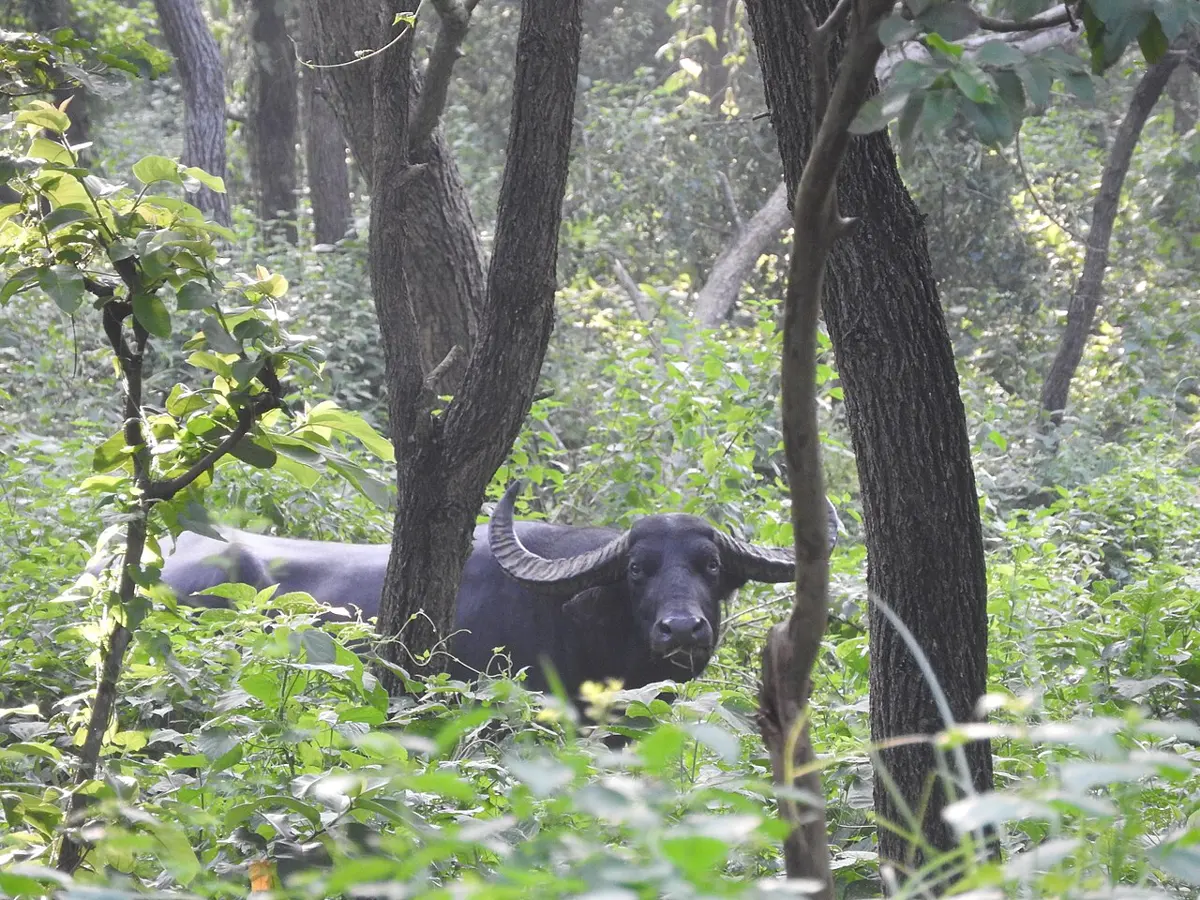
- Marsh or wet meadow. Land that is waterlogged or flooded only for part of the year, covered with tall grasses, sedges and rushes: the home of grazing animals such as the wild water buffalo (arna) of Koshi Tappu, and of cranes, snipes and storks.
- Swamp forest and the bank. On the edge of the wetland, trees that can stand wet feet, such as jamun and figs, and then the forest of the dry land beyond.
Hydrilla: Alex Abair, CC BY 4.0
Lotus: F. M. Blanco, Flora de Filipinas (1880s), public domain
Pistia: W. H. Fitch, Curtis's Botanical Magazine, public domain
Reeds: proportions from O. W. Thomé, Flora von Deutschland (1885), public domain
Grass: O. W. Thomé, Flora von Deutschland (1885), public domain
Tree: Philipola, CC0, via Wikimedia Commons
Carp: DataBase Center for Life Science (DBCLS), CC BY 4.0, via Wikimedia Commons
Snail: K8otter, CC0, via PhyloPic
Frog: LadyofHats, CC0, via Wikimedia Commons
Egret: Caleb M. Gordon, CC0, via PhyloPic
Its components
Abiotic components: the water (its depth, and whether it is still or flowing), the sunlight that reaches into it, dissolved oxygen and carbon dioxide, the temperature, and the mud at the bottom: soft, rich in organic matter and minerals, and low in oxygen just below its surface.
Biotic components:
- Producers: phytoplankton and algae; submerged plants (Hydrilla, Vallisneria); floating plants (lotus, water lilies, Pistia, duckweed); emergent plants (reeds, cattails, sedges); grasses of the marsh; trees of the swamp forest.
- Consumers: zooplankton, snails, insect larvae (mosquito, dragonfly, mayfly), crabs and prawns; fish such as rohu and other carps, catfish and eels; frogs, turtles and water snakes; mugger crocodiles; birds such as egrets, herons, kingfishers, storks, cranes, cormorants, ducks and geese; and mammals such as otters, fishing cats, the wild water buffalo and swamp deer.
- Decomposers: bacteria and fungi in the water and above all in the mud, which break down the dead plants and animals, much of it anaerobically.
Two kinds of food chain run through a wetland. A grazing food chain starts with living plants: phytoplankton → zooplankton → small fish → large fish → heron. A detritus food chain starts with dead matter: dead reeds and leaves → bacteria and fungi (and the detritus they coat) → snails, worms and insect larvae → small fish → kingfisher. In many wetlands, more of the energy flows through the detritus chains than through the grazing ones, since most of the reeds and grasses are never eaten alive.
Which plant of a wetland grows wholly under water, rooted in the mud?
Pick an answer to see why.
Why wetlands matter
- Homes for living things. Wetlands are among the richest ecosystems on Earth. Many fish breed only in the shallow, weedy edges, and millions of birds depend on them: in winter, ducks, geese and waders fly over the Himalaya from Central Asia and Siberia to the lakes and rivers of the Terai, and some go on south to India.
- Natural sponges. In the monsoon a wetland soaks up floodwater and lets it go slowly, so the rivers below flood less; in the dry season it slowly gives water back to streams and wells. It also lets water soak down to recharge groundwater.
- Natural filters. As water passes slowly through a marsh, mud settles out, and plants and microbes take up the extra nutrients and break down many pollutants, so the water leaving it is cleaner.
- Stores of carbon. Because dead plants decay so slowly in their airless mud, wetlands, and above all peatlands, store huge amounts of carbon: peatlands cover only about 3% of the world’s land, yet hold about twice as much carbon as all its forests.
- Livelihoods. Fish, snails, lotus seeds and stems, water chestnuts, reeds and grasses for thatch and mats, water for irrigation, and tourism (boating on Phewa, bird-watching at Koshi Tappu) support many families, especially the communities who have lived by them for generations, such as the Tharu, Majhi, Bote and Mallaha.
- Culture. Many of Nepal’s wetlands are sacred: thousands of pilgrims walk to Gosaikunda for Janai Purnima, and temples stand by Ghodaghodi, Mai Pokhari and Phewa’s Tal Barahi.
Threats to wetlands
- Encroachment and draining: wetlands filled in or drained for farms, houses and roads.
- Siltation: soil washed down from bare hillsides fills lakes up; Phewa Lake has lost a large part of its area this way since the 1950s.
- Pollution and eutrophication: sewage, detergents and fertilizers washed in from fields add nutrients that make algae and weeds grow out of control; when they die and decay, they use up the water’s oxygen, and fish suffocate.
- Invasive species: water hyacinth and other weeds that cover the water, and fish brought in from elsewhere.
- Overfishing, hunting and overgrazing, and fishing with poison or electricity, which kills everything.
- Dams and changed river flows, and climate change, which shrinks some high lakes and floods others.
Conserving wetlands
The Ramsar Convention on Wetlands was signed at the town of Ramsar, in Iran, on 2 February 1971; that date is now World Wetlands Day. Countries that join it list wetlands of international importance, called Ramsar sites, and promise to use them wisely. Nepal’s first Ramsar site, Koshi Tappu, was listed on 17 December 1987. As of 2026, Nepal has ten Ramsar sites:
| Ramsar site | Where | Listed | Known for |
|---|---|---|---|
| Koshi Tappu | Sunsari, Saptari, Udayapur | 1987 | Nepal’s last natural herd of wild water buffalo (arna); hundreds of bird species, waterbirds above all |
| Beeshazar and associated lakes | Chitwan | 2003 | a cluster of lakes in the forest of Chitwan’s buffer zone; mugger crocodiles |
| Ghodaghodi Lake area | Kailali | 2003 | many lakes and marshes in the far-western Terai; turtles, waterbirds |
| Jagdishpur Reservoir | Kapilvastu | 2003 | a reservoir built for irrigation, now a winter home for waterbirds |
| Gokyo and associated lakes | Solukhumbu | 2007 | glacier-fed lakes at about 4,700–5,000 m in Sagarmatha National Park |
| Gosaikunda and associated lakes | Rasuwa | 2007 | high sacred lakes in Langtang National Park |
| Phoksundo Lake | Dolpa | 2007 | Nepal’s deepest lake, deep turquoise, in Shey Phoksundo National Park |
| Rara Lake | Mugu | 2007 | Nepal’s largest lake |
| Mai Pokhari | Ilam | 2008 | a sacred lake in the eastern hills |
| Lake Cluster of Pokhara Valley | Kaski | 2016 | nine lakes, among them Phewa, Begnas and Rupa |
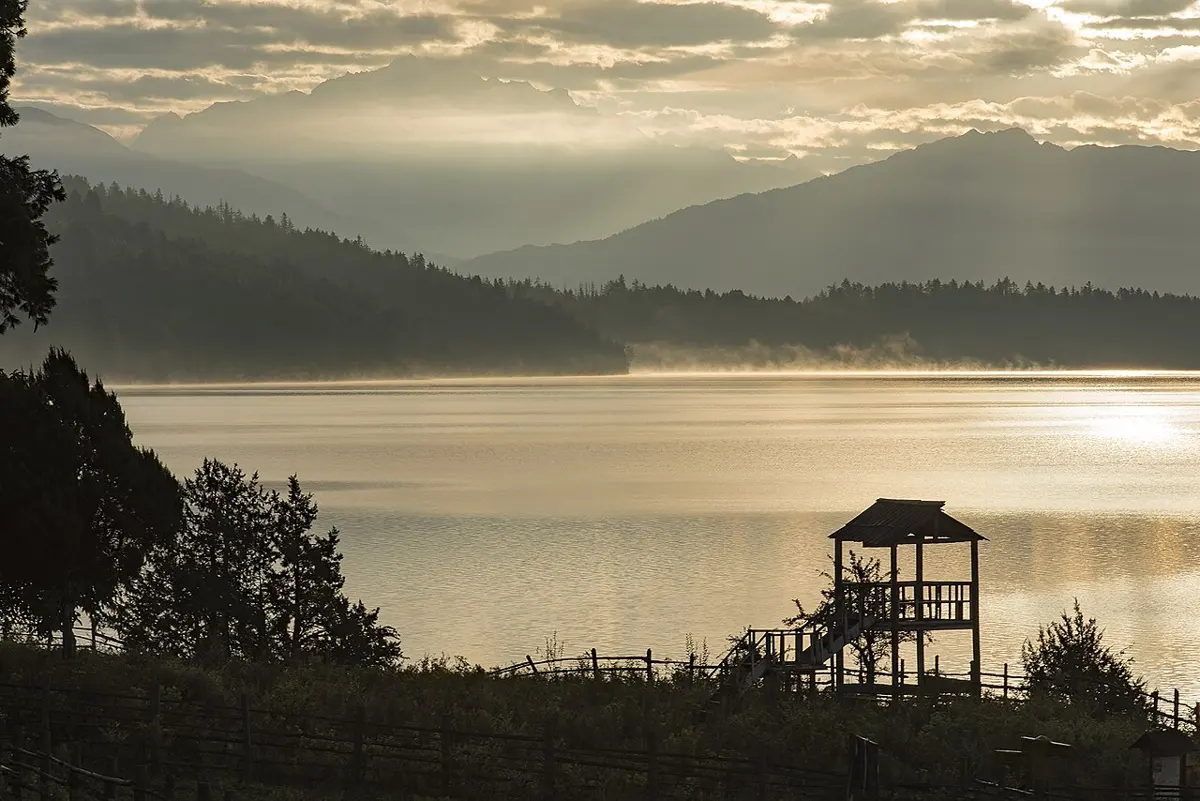
Other ways to protect wetlands are as important as the list: keeping their catchments forested to stop silt; treating sewage before it reaches them; removing invasive weeds; letting local people use them in ways that last (fishing with nets of a proper mesh, cutting reeds in season); and teaching visitors not to disturb the birds. Nepal adopted a National Wetlands Policy in 2012 for this.
Exercise
1. Choose the correct option
a. The term “ecology” was first used by:
Pick an answer to see why.
b. A group of organisms of the same species living in the same area at the same time is a:
Pick an answer to see why.
c. In the food chain grass → rabbit → fox, most of the foxes are killed. What happens to the grass?
Pick an answer to see why.
d. Which of these are true decomposers?
Pick an answer to see why.
e. The dark, crumbly organic matter formed in the soil during decomposition is called:
Pick an answer to see why.
f. Which decomposers can break down lignin, the substance that makes wood hard?
Pick an answer to see why.
g. A gas given out by the anaerobic decomposition of organic matter in a flooded paddy field is:
Pick an answer to see why.
h. Nepal’s first Ramsar site, listed in 1987, is:
Pick an answer to see why.
i. Which of these plants floats freely on water, its roots hanging in it?
Pick an answer to see why.
2. Give reasons
A food web is more stable than a single food chain.
Hint
Answer
Bacteria and fungi are called decomposers, but earthworms are not.
Hint
Answer
Dead leaves decompose faster in the Terai in the monsoon than on a Himalayan slope.
Hint
Answer
Wetlands are called the kidneys of the landscape.
Hint
Answer
Dead plants in a peat bog or a deep swamp decompose very slowly.
Hint
Answer
3. Differentiate between
Population and community
Hint
Answer
Food chain and food web
Hint
Answer
Bacterial decomposition and fungal decomposition
Hint
Answer
Natural ecosystem and artificial ecosystem
Hint
Answer
4. Answer the following questions
What is ecology? Define population, community and ecosystem, with an example of each from one place.
Hint
Answer
Describe, with the help of a food chain, the effects of a decrease in the population of one species on the others.
Hint
Answer
How is a food web affected when the population of a predator increases? Explain with an example.
Hint
Answer
What is decomposition? Describe its steps.
Hint
Answer
Explain the role of bacteria and fungi in decomposition. Why is their work important for an ecosystem?
Hint
Answer
Write any four factors that affect the rate of decomposition.
Hint
Answer
What is a wetland? Describe the wetland ecosystem with its biotic and abiotic components.
Hint
Answer
Write the importance of wetlands. What are the main threats to Nepal’s wetlands, and how can they be conserved?
Hint
Answer
5. Apply and think
Anjila put three net bags of dry sal leaves, 25.0 g each, in different places and weighed the dried leaves after eight weeks: on moist soil under a hedge, 17.5 g; on dry, sunny ground, 23.0 g; inside a compost heap, 11.5 g. Find the percentage of mass lost in each place, and explain the differences.
Hint
Answer
In a forest food web, leopards eat deer, monkeys and wild boar; deer and wild boar eat grass and shrubs; monkeys eat fruit and leaves. Poachers kill most of the leopards. Predict the effects on the other populations, and say why the forest’s young trees might suffer.
Hint
Answer
Think: Sudip says, “Vultures are decomposers, because they clean up dead animals.” Is he right? What happened in South Asia when the vultures disappeared?
Hint
Answer
Printable PDFs
- The unit as a book (A5) 27 pages Answers as an A4 booklet, 7 sheets
- Study notes 3 pages
- Worksheet 5 pages Answer key
- Harder practice questions 2 pages Answer key
Practice every question in the book, and keep track of the ones you miss →
Found a mistake? Please tell us.