
Stand in the sun on a winter morning in Kathmandu and your skin warms, but it doesn’t burn. Stay out at Everest Base Camp for the same time and it can burn badly, though the air there is freezing. Leave a blue shirt in strong sunlight for a season and its color fades; leave it under a bright red lamp for as long and it hardly fades. Light is not just “more” or “less”. Something about its color, its frequency, decides what it can do to matter.
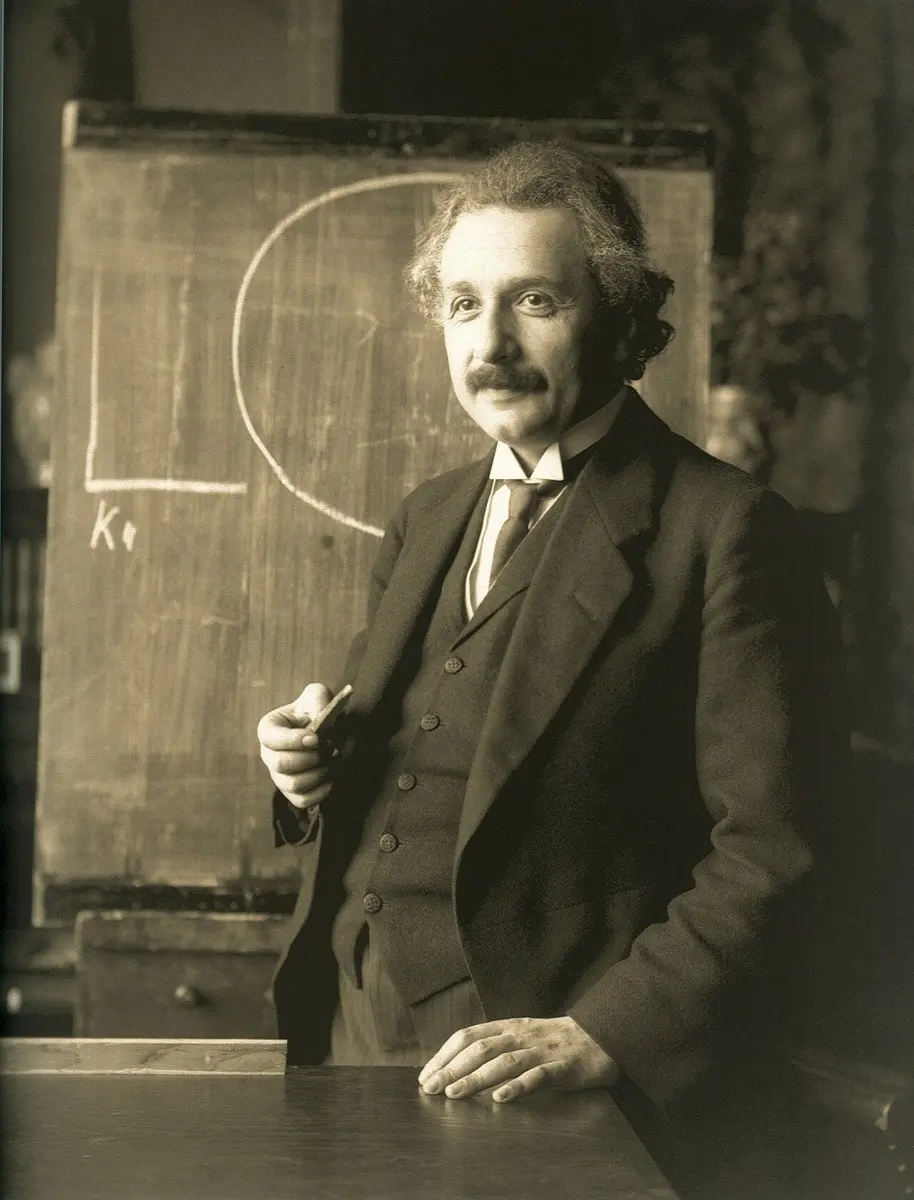
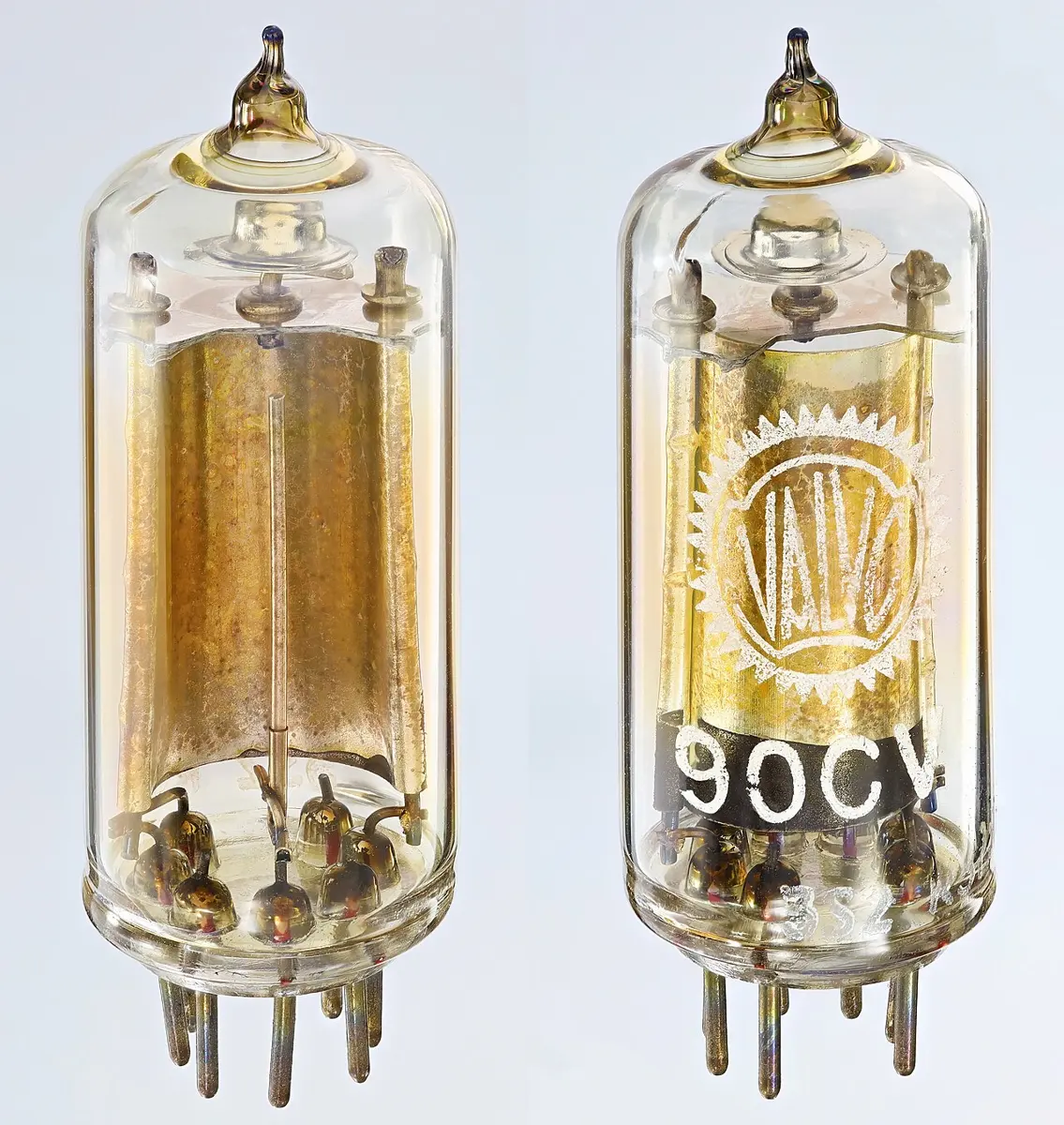
This unit is about that something. In 1900 Max Planck suggested, almost in despair, that light’s energy is given out in small packets. In 1905 a 26-year-old clerk in the Swiss patent office, Albert Einstein, took the idea seriously: light travels as packets, now called photons, and one photon gives all its energy to one electron. With that one idea he explained a puzzle no wave theory could, the photoelectric effect, in which light knocks electrons out of a metal. It is the effect at work in the tubes that count single flashes of light in physics laboratories, and in the photocells of old film projectors and automatic doors.
21.1 Quantum theory of radiation
At the end of the nineteenth century, physics seemed nearly finished, but a few results refused to fit. The most stubborn was the light given out by a hot body, blackbody radiation: the classical theory predicted that a hot body should pour out endless energy as ultraviolet light, which it plainly doesn’t.
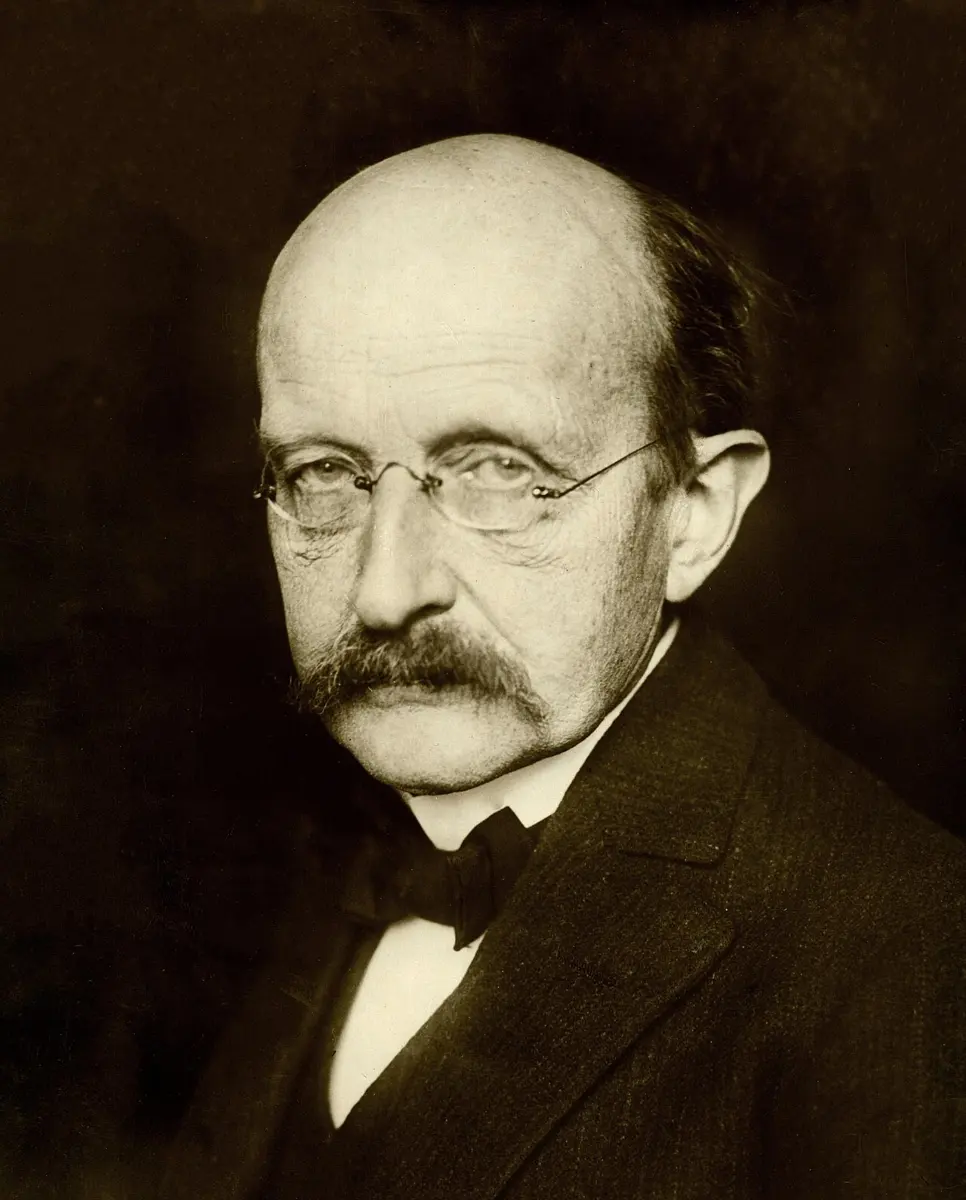
In 1900 the German physicist Max Planck found a formula that fitted the measurements exactly. To explain it, he had to assume something no one had dared to: the vibrating charges in a hot body can give out or take in energy only in definite, separate amounts, not any amount at all. Each smallest amount, a quantum (plural quanta), has energy
where is the frequency of the radiation and is a new constant of nature, Planck’s constant,
Energy is given out or taken in as , never as . Just as charge comes only in whole numbers of (Millikan’s drops, Unit 20), the energy of radiation of one frequency comes only in whole numbers of . This idea is the quantization of energy, and Planck’s proposal is the quantum theory of radiation. Planck received the Nobel Prize in Physics for 1918 (the full story).
The quantum idea went on to explain, one after another, things the classical theories could not:
- why the specific heat capacities of solids fall at low temperatures;
- the photoelectric effect, in which light ejects electrons from a metal (this unit);
- the Compton effect, the scattering of X-rays by electrons;
- the separate lines of the hydrogen spectrum (Unit 23);
- the origin and structure of X-ray spectra.
Together these successes led, in the 1920s, to quantum mechanics, the physics of atoms and everything built from them.
The photon
Planck thought only the giving out and taking in of light came in packets. Einstein went further: light travels as packets. A packet of electromagnetic radiation is called a photon. A photon of light of frequency and wavelength has energy
since . A photon has no rest mass: there is no such thing as a photon at rest. It exists only moving at the speed of light.
It still carries momentum. Relativity gives the momentum of anything moving at the speed of light as its energy divided by :
A memory aid many books give: put into to get an “equivalent mass” , and then . It leads to the right momentum, but don’t take the “mass” literally: a photon has no mass, rest or otherwise; it has energy and momentum.
Blue light has a shorter wavelength than red light. Compared with a photon of red light, a photon of blue light has:
Pick an answer to see why.
21.2 Photoelectric effect
In 1887 the German physicist Heinrich Hertz, busy proving that radio waves exist, noticed that sparks jumped across a gap more easily when ultraviolet light shone on it. A year later Wilhelm Hallwachs made it clear: a clean zinc plate on an electroscope, negatively charged, slowly lost its charge when ultraviolet light fell on it. A positively charged plate did not. Visible light, however bright, did nothing. The ultraviolet light was knocking negative charges out of the zinc; once J. J. Thomson had found the electron (1897), it was clear that these were electrons. Philipp Lenard then studied the effect carefully, with light of different frequencies and brightness.
The ejection of electrons from a metal surface when light of high enough frequency falls on it is called the photoelectric effect. The electrons ejected are called photoelectrons, and the current they carry a photoelectric current.
As you will see, the effect shows that light gives up its energy in packets, photons, each carrying its own amount of energy.
21.3 Experimental study of photoelectric effect
Lenard’s apparatus, in the form found in school laboratories, is drawn in Figure 21.4. An evacuated glass tube holds two electrodes: C, the emitter, a metal plate on which light falls, and A, the collector. (They are often called the cathode and the anode.) The air is pumped out so that the electrons are not stopped by collisions with air molecules.
When light of a suitable frequency falls on C (the incident light), electrons come out of it in all directions, with all kinds of speeds up to some largest one. Those that reach A make the current read on the microammeter.
Now make A negative compared with C. The field between them pushes the electrons back: the p.d. is now a retarding potential. Only electrons that start with enough kinetic energy can climb the “hill” and reach A, so the current falls. Make A more and more negative, and at a certain p.d. not even the fastest electron gets there: the current drops to zero. This reverse p.d. is the stopping potential, .
An electron that just fails to reach A has lost all its kinetic energy climbing a p.d. of : it has done work against the field. So the fastest electron’s kinetic energy is
Since is the same for every electron, : measuring the stopping potential, in volts, measures the maximum kinetic energy, in electronvolts. A stopping potential of 1.5 V means the fastest electrons left the metal with 1.5 eV.
Laws of photoelectric emission
Experiments like this gave four results, often called the laws of photoelectric emission.
(i) There is a threshold frequency. Photoelectrons come out only when the frequency of the light is above a certain value, the threshold frequency , which is different for each metal. Lower the frequency step by step, and the stopping potential needed gets smaller and smaller (Figure 21.5); at the current stops even with no reverse p.d. at all. Below , no electrons come out, however bright the light and however long it shines.
(ii) There is no delay. Emission begins the instant the light falls on the metal, even when the light is very dim: the delay has been measured to be less than s. (Many books quote “less than s”, which is also true and fine in an exam.)
(iii) The maximum kinetic energy depends on the frequency, not on the brightness. Light of one frequency at two intensities and gives the curves of current against p.d. in Figure 21.6. Both cut off at the same reverse p.d., : the fastest electrons are no faster in the brighter light. Light of two frequencies and , with , gives different stopping potentials (Figure 21.7): the higher frequency gives the larger , and so the faster electrons.
(iv) The number of electrons depends on the brightness. The photoelectric current (with A positive, so that every electron emitted is collected: the flat part of the curves, the saturation current) is proportional to the intensity of the light. In Figure 21.6 the brighter light gives the larger saturation current.
Worked examples
21.4 Einstein’s photoelectric equation
Einstein’s explanation takes three ideas.
- Light of frequency arrives as photons, each of energy .
- A metal’s free electrons move about inside it, but they can’t leave on their own: the metal pulls them back at its surface. The least energy needed to free an electron from the surface is the metal’s work function, .
- One photon gives all its energy to one electron, at once. (Never half a photon, never two photons adding up for one electron, in ordinary light.)
If is more than , the electron gets out, and what is left over, , is its kinetic energy. The electrons right at the surface leave with all of that; electrons from deeper inside lose some energy in collisions on the way out, so they come out slower (Figure 21.8). The fastest therefore have
or, in words, energy of the photon = work function + maximum kinetic energy:
This is Einstein’s photoelectric equation. Here is the electron’s mass and the maximum speed of the photoelectrons.
The work function is a property of the metal (and of how clean its surface is), not of the light. A photon with exactly frees an electron with no kinetic energy to spare; its frequency is the threshold frequency :
So the equation can also be written
and, with and ,
All three forms are Einstein’s photoelectric equation. With (equation 21.1) it also reads .
The laws, explained
- Threshold. The kinetic energy can be positive only if , that is . Below , no single photon has enough energy, and since one electron can’t collect the energy of two photons, no number of photons helps.
- Faster electrons for higher frequency. rises in a straight line with .
- More electrons for brighter light. Brighter light of the same frequency has more photons each second; one photon frees at most one electron, so more photons free more electrons, each with the same energies.
- No delay. The photon’s energy is handed over in one go, the moment it is absorbed; nothing needs to build up.
Light of a certain frequency ejects electrons from a metal. The light is made three times as bright, its frequency unchanged. What happens?
Pick an answer to see why.
Work function (φ)
The work function of a metal, also called its threshold energy, is the least energy that must be given to an electron to free it from the metal’s surface. It is different for different metals, and it is usually given in electronvolts:
| Metal | Work function (eV) | Metal | Work function (eV) |
|---|---|---|---|
| Cesium | 1.9 | Calcium | 3.2 |
| Potassium | 2.2 | Copper | 4.5 |
| Sodium | 2.3 | Silver | 4.7 |
| Lithium | 2.5 | Platinum | 5.6 |
(Measured values vary a little with how the surface is prepared; tables differ by a few tenths of an electronvolt.)
If a photon of energy falls on a metal of work function :
- : no photoelectric effect;
- : electrons are just freed, with no kinetic energy;
- : electrons are freed, with kinetic energy up to .
The alkali metals, cesium to lithium, have the lowest work functions, so visible light frees electrons from them. Copper, silver and platinum need ultraviolet light. That is why the photocells used with visible light have cathodes coated with cesium compounds.
Threshold frequency (f₀)
The threshold frequency is the least frequency of light that can eject electrons from a metal; at they just come out, with no kinetic energy.
- : no electrons ejected, no photoelectric effect;
- : electrons are just ejected, with no kinetic energy;
- : electrons are ejected with kinetic energy.
Threshold wavelength (λ₀)
The threshold wavelength is the longest wavelength that can eject electrons from a metal. Longer waves mean lower frequency and less energy per photon:
- : electrons are ejected, with kinetic energy;
- : electrons are just ejected, with no kinetic energy;
- : no photoelectric effect.
Light of wavelength 450 nm falls in turn on cesium (φ = 1.9 eV), lithium (2.5 eV) and copper (4.5 eV). Which give photoelectrons?
Pick an answer to see why.
Worked examples
Test yourself
21.5 Experimental verification of Einstein’s equation
Einstein’s equation makes a sharp prediction: a graph of stopping potential against frequency must be a straight line, whose slope is the same for every metal, . In 1914–1916 Robert Millikan, the same Millikan as the oil drops of Unit 20, tested it with great care. He expected to prove Einstein wrong. Instead he found the equation right in every detail, and the slope of his line gave Planck’s constant directly.
Apparatus
The difficulty was the metal’s surface: in air, alkali metals tarnish within seconds, and a tarnished surface has a different work function. So Millikan built what he called a “machine shop in a vacuum” (Figure 21.9). Inside an evacuated chamber, a wheel D carried three cylinders of the alkali metals sodium, potassium and lithium. A knife K, worked from outside by a magnet, shaved a fresh, clean surface on a cylinder; the wheel then turned it to face the window W. Monochromatic light (one wavelength at a time, from a mercury lamp’s lines picked out by a spectrometer) shone through W onto the clean surface. The photoelectrons crossed to a collector C, a cylinder of wire gauze, whose potential against the metal was set with a potentiometer; a sensitive electrometer G showed whether any current flowed.
For each frequency, Millikan made C more and more negative until even the fastest electrons were turned back and G showed no current. That reverse p.d. is the stopping potential , and
where is the electron’s charge.
Theory
Put this into Einstein’s equation, , with :
This has the form : a graph of (up) against (across) must be a straight line with
- slope , the same for every metal;
- intercept on the axis .
Millikan’s graph was exactly such a straight line (Figure 21.10).
To find h. Measure the slope from a triangle ABC under the line: , so
Millikan found J s, within about 1% of today’s value, J s.
To find the work function. Where the line cuts the frequency axis, : electrons just come out with no energy to spare, so that frequency is the threshold frequency . Multiply by : . Or read where the line, drawn back, cuts the axis: that intercept is , and in volts it gives the work function in electronvolts directly.
For different metals the lines are parallel (same slope ) but cross the frequency axis at different places (different ): exactly what Einstein’s equation says.
On a graph of stopping potential against frequency, a second metal with a larger work function gives a line that is:
Pick an answer to see why.
Worked examples
Test yourself
Exercise
Choose the correct option
- Einstein’s photoelectric equation is . Here is the:
Pick an answer to see why.
- The emission of electrons from the surface of a metal by the action of light on it is called:
Pick an answer to see why.
- Infrared, visible and ultraviolet radiation of the same intensity fall in turn on a clean zinc plate (work function about 4.3 eV). Which gives the largest photocurrent?
Pick an answer to see why.
- A photon is a:
Pick an answer to see why.
- The photoelectric current can be increased by:
Pick an answer to see why.
- The study of the photoelectric effect is useful in understanding:
Pick an answer to see why.
- A metal with a work function of 0.6 eV is lit by light of photon energy 2 eV. The stopping potential is:
Pick an answer to see why.
- The work function of a metal is 2.51 eV. Its threshold frequency is:
Pick an answer to see why.
- The threshold frequency of a metal is . Light of frequency falls on it. The maximum kinetic energy of the photoelectrons is:
Pick an answer to see why.
- Ultraviolet radiation of photon energy 6.2 eV falls on an aluminum surface of work function 4.2 eV. The kinetic energy of the fastest electrons is about:
Pick an answer to see why.
Answer these questions
- a.Define threshold frequency, stopping potential and work function in photoelectric emission.
- b.Show that the existence of a threshold frequency is evidence in favor of the quantum theory.
Answer
When electromagnetic radiation falls on the surface of a metal, electrons leave the surface. But when the radiation’s frequency is below a certain value, no electrons are emitted.
- a.Explain why no electrons are emitted if the frequency is below a certain value.
- b.State two other observations of the photoelectric effect which suggest that electromagnetic radiation has particle properties.
- c.The work function of the metal is 3.8 eV.
- i.Calculate the least frequency of electromagnetic radiation that causes photoelectric emission.
- ii.An electron at the surface of the metal is emitted with a kinetic energy of J. Calculate the energy of the photon that freed it, in eV.
- d.Mention two uses of the photoelectric effect in everyday life.
Answer
- a.Describe Millikan’s experiment to find the value of Planck’s constant.
- b.The work function of potassium is J. Light of wavelength 5000 Å falls on it. Find (i) the stopping potential, (ii) the kinetic energy of the most energetic electrons, and (iii) their speed.
Answer
- a.What is the photoelectric effect? Obtain Einstein’s photoelectric equation, and state and explain the laws of photoelectric emission from it.
- b.A sheet of silver is lit by monochromatic ultraviolet radiation of wavelength 1810 Å. The threshold wavelength of silver is 2640 Å. What is the maximum kinetic energy of the emitted electrons?
Answer
- a.Explain Einstein’s theory of photoelectricity, and use it to arrive at Einstein’s photoelectric equation.
- b.Photosynthesis starts in certain plants when they are put in sunlight, but not if they get only infrared light. Explain.
Answer
A parallel beam of monochromatic light of wavelength 660 nm has an intensity of 0.25 mW/m². It falls normally on a surface that absorbs it totally. For a cross-sectional area of 1.2 cm² of the beam, find (a) the number of photons passing through it each second, (b) the momentum of one photon, and (c) the force exerted on the surface by the light. ( J s, m/s.)
Answer
Electrons are emitted from a metal surface when it is lit by suitable electromagnetic radiation.
- a.Name the effect.
- b.The graph above shows how the maximum kinetic energy of the emitted electrons varies with the frequency . Use it to find (i) the threshold frequency of the radiation, and (ii) a value for the Planck constant.
- c.On the graph, draw a line to show how varies with for a second metal with a lower work function.
- d.The kinetic energy of the electrons is described as the maximum. Suggest why the emitted electrons have a range of kinetic energies for any one frequency.
Hint
Answer
A stationary, isolated nucleus emits a γ-ray photon of energy 0.51 MeV.
- a.State what is meant by a photon.
- b.For the γ-ray photon, calculate (i) its wavelength, and (ii) its momentum.
- c.For this nucleus, find the change in mass Δm during the decay that gives rise to the energy of the γ-ray photon.
Answer
- a.Explain what is meant by the photoelectric effect.
- b.One wavelength of the radiation from a mercury vapor lamp is 436 nm. Calculate the photon energy for this wavelength.
- c.Light from the lamp falls, separately, on surfaces of cesium and tungsten. Their work functions are given in the table. Calculate the threshold wavelength for photoelectric emission from (i) cesium and (ii) tungsten.
| Metal | Work function (eV) |
|---|---|
| Cesium | 1.4 |
| Tungsten | 4.5 |
d. Use your answers to (c) to say, with reasons, whether light of wavelength 436 nm from the lamp will cause photoelectric emission from each metal.
Answer
Printable PDFs
- The unit as a book (A5) 23 pages Answers as an A4 booklet, 6 sheets
- Study notes 3 pages
- Worksheet 5 pages Answer key
- Harder practice questions 2 pages Answer key
Quiz yourself: Matter, Atoms and Reactions, Grades 5–12 →
Practice every question in the book, and keep track of the ones you miss →
A companion to your textbook, not a replacement for it: study from the book your school uses, and where the two differ, follow your teacher. Found a mistake? Please tell us.