
Stand at a window in Bhaktapur on a winter morning. Sunlight crosses 150 million kilometers of empty space in about eight minutes, slips through the glass, bends a little as it goes in and out, and throws a sharp-edged patch on the floor. What is it that made that journey? For three hundred years the best scientists in the world argued over two answers: a stream of tiny particles, fired like bullets, or a wave, spreading like the rings on a pond.
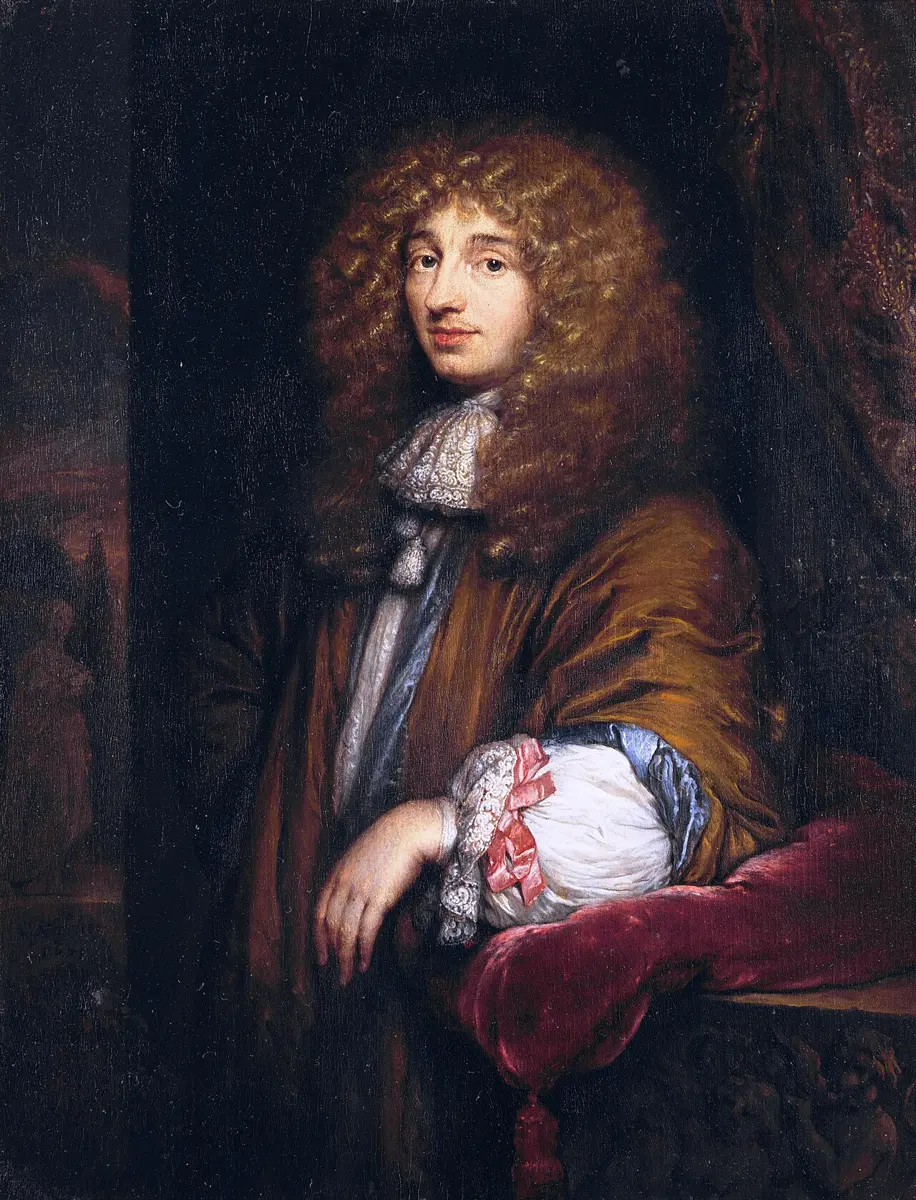
This unit is about the wave answer and the simple rule behind it. In 1678 the Dutch scientist Christiaan Huygens imagined that every point a wave reaches becomes a new little source of waves. From that one idea you will build any wavefront’s next position with a compass and a ruler, and prove the laws of reflection and refraction, which Unit 15 of Grade 11 could only state. The next units use the same wavelets to explain how light adds up and cancels (Unit 11) and how it bends round edges.
10.1 Introduction
Light is an electromagnetic wave: an electric field and a magnetic field, at right angles to each other and to the direction it travels, oscillating together. It needs no medium, and crosses a vacuum at about 3 × 10⁸ m/s. Like every wave, it has a wavelength, a frequency and an amplitude: visible light has wavelengths from about 400 nm (violet) to 700 nm (red).
Yet light also behaves like a stream of particles. Look at what it does:
- It makes plants grow, and it also runs a solar calculator: it hands over its energy in little lumps, like particles.
- It casts sharp shadows, yet it also bends a little round the edges of obstacles, like a wave.
- It reflects from mirrors, refracts in water, and paints the colors in a soap bubble, which only waves can do.
So we study light not only as particles, as Newton believed, but also as waves, starting with Huygens’ principle: every point on a wavefront acts as a source of secondary wavelets, and the new wavefront is the surface that touches (the envelope of) all these wavelets. This one principle accounts for the way light travels, and for reflection, refraction, interference and diffraction.
10.2 Nature and propagation of light
The nature of light is dual. It shows wave properties (interference, diffraction, polarization) and particle properties (photons). It travels in straight lines in a uniform medium, and changes direction by reflection, refraction and diffraction when it meets other materials. How it spreads and forms patterns is the heart of optics and of modern physics.
Newton’s corpuscular theory (1704, in his book Opticks) said that light is a stream of tiny, very light particles, corpuscles, shot out by a luminous body at enormous speed. In a uniform medium they travel in straight lines. They bounce off a mirror as a perfectly elastic ball bounces off a wall, which gives the law of reflection. At the surface of water or glass they are pulled towards it, which turns them towards the normal: refraction. The theory explained reflection, refraction and straight-line travel, but it could not explain interference and diffraction, the typical wave behaviors. And it made a prediction that turned out wrong: to bend towards the normal, the corpuscles had to go faster in the denser medium.
Huygens’ wave theory (1678) said that light is a wave, spreading through an all-filling medium he and his followers called the ether. He brought in two new ideas, wavefronts and secondary wavelets, and with them explained reflection and refraction, with light going slower in the denser medium. A century later, Thomas Young and Augustin Fresnel joined his wavelets to the idea of interference, and the same wavelets then explained interference and diffraction too.
The story went on. Young’s double-slit experiment (early 1800s) and Fresnel’s mathematics of diffraction (1818) established that light is a wave. Maxwell’s electromagnetic theory (1865) showed it is an electromagnetic wave, needing no ether at all. Then Planck’s quantum theory (1900) and Einstein’s explanation of the photoelectric effect (1905) showed that light’s energy comes in packets, photons. The quantum theory of light now unites both pictures, and it is the base of modern physics.
| Newton’s corpuscular theory | Huygens’ wave theory | |
|---|---|---|
| Light is | a stream of tiny particles | a wave in a medium (the ether) |
| Straight-line travel | easily explained | explained only roughly, with a puzzle about the backward wavelets |
| Reflection, refraction | explained | explained |
| Speed of light in water or glass | faster than in air | slower than in air (correct) |
| Interference, diffraction | not explained | explained, once Young and Fresnel added interference |
| Photoelectric effect | (not known then) | not explained (needs photons) |
Which measurement settled the argument between Newton’s and Huygens’ explanations of refraction?
Pick an answer to see why.
10.3 Wave theory of light
The wave theory of light says that light behaves as a wave, not as a stream of particles. Huygens first proposed it in the 17th century, through his principle: every point on a wavefront sends out secondary waves, which spread and form the new wavefront. Wavelets spreading out from the edge of an opening also explain why light bends round obstacles (diffraction) and spreads out after passing through small openings.
One of the strongest pieces of evidence came from Thomas Young. Between 1801 and 1803 he showed the Royal Society that two beams of light from one source can cancel each other, and in his lectures of 1807 he described the form of the experiment now named after him: light through two closely spaced slits makes a pattern of bright and dark bands on a screen. (Exam answers usually give the year as 1801.) Only waves can do this: where the waves from the two slits arrive in step, they reinforce each other (constructive interference); where one arrives a crest when the other brings a trough, they cancel (destructive interference). The bands were a major confirmation that light has wave properties.
Two more effects point the same way. Polarization shows that light’s vibrations are across its direction of travel and can be confined to one direction, which you can show by passing light through two polarizing filters and turning one of them. Diffraction, the bending of light round edges and through narrow slits, is a wave effect too. Interference, polarization and diffraction together strongly suggest that light is a wave, and Huygens’ principle is the framework that explains them in classical physics.
Wavefront and wavelet
Phase
To say what a wavefront is, you need phase. As a wave passes, each particle of the medium (for light, the electric field at each point) vibrates. Its phase is the stage it has reached in its vibration: where it is and which way it is going, written as an angle. In the phase is . One whole vibration is a change of phase of (360°). Two points whose vibrations are exactly in step are in phase; two points half a cycle apart, one at a crest while the other is at a trough, are out of phase by (180°).
Along the direction the wave travels, the phase falls behind by for every wavelength. So two points a distance apart along the wave differ in phase by
This phase difference decides what happens when two waves meet: in phase they add up, out of phase they cancel. Unit 11 is built on it.
Wavefront
A wavefront is an imaginary surface joining all the points of a wave that are in the same phase, vibrating in the same way at the same time: all on a crest, say. A wave’s crests are a set of wavefronts, one wavelength apart. In a uniform medium the wave travels at right angles to its wavefronts: the lines along which the wave travels, the rays, are always perpendicular to the wavefronts. The shape of the wavefronts depends on the source and on how the wave spreads (Figure 10.2).
- Spherical wavefront. A point source, such as a small bulb, sends light out equally in all directions; at any instant the points in the same phase are all at the same distance from the source, so the wavefronts are spheres centered on it, and the rays spread out along the radii. A spherical wavefront can be diverging (spreading out from a point, as here) or converging (shrinking towards a point, as after a convex lens, towards its focus).
- Plane wavefront. Far from a source, a small piece of a huge sphere is practically flat. Sunlight reaching Earth, or the beam of a laser, has flat, parallel wavefronts, and its rays are parallel.
- Cylindrical wavefront. A long, narrow source, such as a lit slit or a long tube light, sends out wavefronts that are cylinders around it, with the source along their axis.
Light from a distant star reaches a telescope on Earth. Its wavefronts there are:
Pick an answer to see why.
Wavelet
A wavelet is a small, secondary wave sent out from a point on a wavefront. In Huygens’ picture every point a wavefront reaches starts vibrating, and so becomes a new source sending out its own small waves, in the same medium and at the same speed as the original wave. As time goes on, these wavelets spread out and together build the new wavefront. Wavelets spreading from the edges of an opening explain how waves spread out beyond it (diffraction), and where wavelets from different places overlap they can add up or cancel, making interference patterns.
10.4 Huygens’ principle
Huygens’ principle gives the position of a wavefront at any later time, if you know where it is now. It has two parts:
- Every point on a wavefront (the primary wavefront) acts as a source of secondary wavelets, which spread out in all directions with the speed of the wave in that medium.
- The new wavefront at any later time is the envelope of these secondary wavelets: the surface that touches all of them, in the forward direction.
The construction (Figure 10.3). A point source S sends out a spherical wavefront; AB is a part of it at time . To find where it is a short time later:
- Mark many points on AB: a, b, c, d, e.
- Around each one, draw a sphere (in the drawing, a circle) of radius , the distance the wave travels in , where is its speed.
- Draw the surface that touches all these spheres on the far side from S. This is the new wavefront A′B′ at , a sphere centered on S, larger by .
- A second surface also touches the spheres, on the side towards the source: A″B″. It would be a wave running backwards, towards S. No such wave exists, and Huygens simply discarded it.
The same construction moves a plane wavefront: wavelets of equal radius drawn from points on a flat front all touch a flat surface ahead of it (Figure 10.4). So a plane wave stays plane, and travels straight on, at right angles to its fronts.
Why light travels in straight lines
The plane construction is Huygens’ explanation of the rectilinear propagation of light: a wide wavefront rebuilds itself, flat and parallel, step after step, so the light goes straight on along its rays. Now let it pass a wide opening. The wavelets from the edges of the opening spread sideways into the shadow too. Taken alone, they would blur every shadow, and that was the strongest objection to the wave theory. The answer, worked out by Fresnel in 1818, is interference: in the shadow region the wavelets from different parts of the front arrive with all sorts of phases and very nearly cancel, except within a few wavelengths of the shadow’s edge. Since light’s wavelength is under a thousandth of a millimeter, the blurred band at the edge of an ordinary shadow is far too thin to notice, and light seems to travel in straight lines. Sound, with wavelengths of about a meter, bends easily round a doorway; light, with wavelengths a million times shorter, hardly bends at all.
The backward wavelets
Why is there no backward wave A″B″? Huygens had no reason; he just left it out, and this was a weakness of his theory. The answer came from the mathematics of Fresnel and of Gustav Kirchhoff (1882): a secondary wavelet is not equally strong in all directions. Its amplitude falls off with the angle θ from the forward direction, in proportion to the obliquity (or inclination) factor
which is 1 straight ahead (θ = 0) and zero straight back (θ = 180°). So the backward wave has no energy, and there is none to see. The wavelets are best thought of as a way of working out where the wave goes, not as real little waves running off backwards.
Limitations of Huygens’ theory
As Huygens left it, the theory had real gaps:
- It had no reason for leaving out the backward wavelets (put right by the obliquity factor, above).
- It needed a medium, the ether, to carry light through empty space. No ether was ever found; Maxwell showed that light is an electromagnetic wave that needs no medium, and in 1887 Michelson and Morley’s experiment found no sign of one.
- Huygens’ waves were a series of pulses with no wavelength, so on their own they did not explain interference, diffraction or colors; that needed Young’s and Fresnel’s periodic waves.
- He took light to be a longitudinal disturbance, like sound, which can’t explain polarization; light’s waves are transverse.
- No wave theory explains the photoelectric effect, black-body radiation or the line spectra of atoms, which need light’s energy to come in packets, photons.
In Huygens’ construction, the new wavefront is:
Pick an answer to see why.
10.4.1 Applications of Huygens’ principle
Huygens’ principle applies to every kind of wave: light, sound, ripples on water. For sound, each layer of air that a compression reaches pushes on the next, so it acts as a source of sound wavelets in turn; the envelope gives the next wavefront, and sound spreads from a speaker as spheres. Because sound’s wavelengths are large (34 cm at 1000 Hz), its wavelets spread well beyond the edges of a doorway, and you hear a radio round a corner. On a clear night, the air near the ground is cooler than the air above it, and sound travels faster in warmer air: the upper part of each wavefront runs ahead, the front tilts downwards, and a distant bus or temple bell sounds unusually clear. Huygens’ construction gives each of these.
For light, the principle proves the two laws you have so far only been told: the laws of reflection and of refraction.
1. Reflection of light
When a wavefront meets a mirror, each point it reaches becomes a source of wavelets that go back into the first medium. Their envelope is the reflected wavefront. There are two laws of reflection:
- The incident ray, the normal at the point of incidence and the reflected ray all lie in the same plane.
- The angle of incidence equals the angle of reflection.
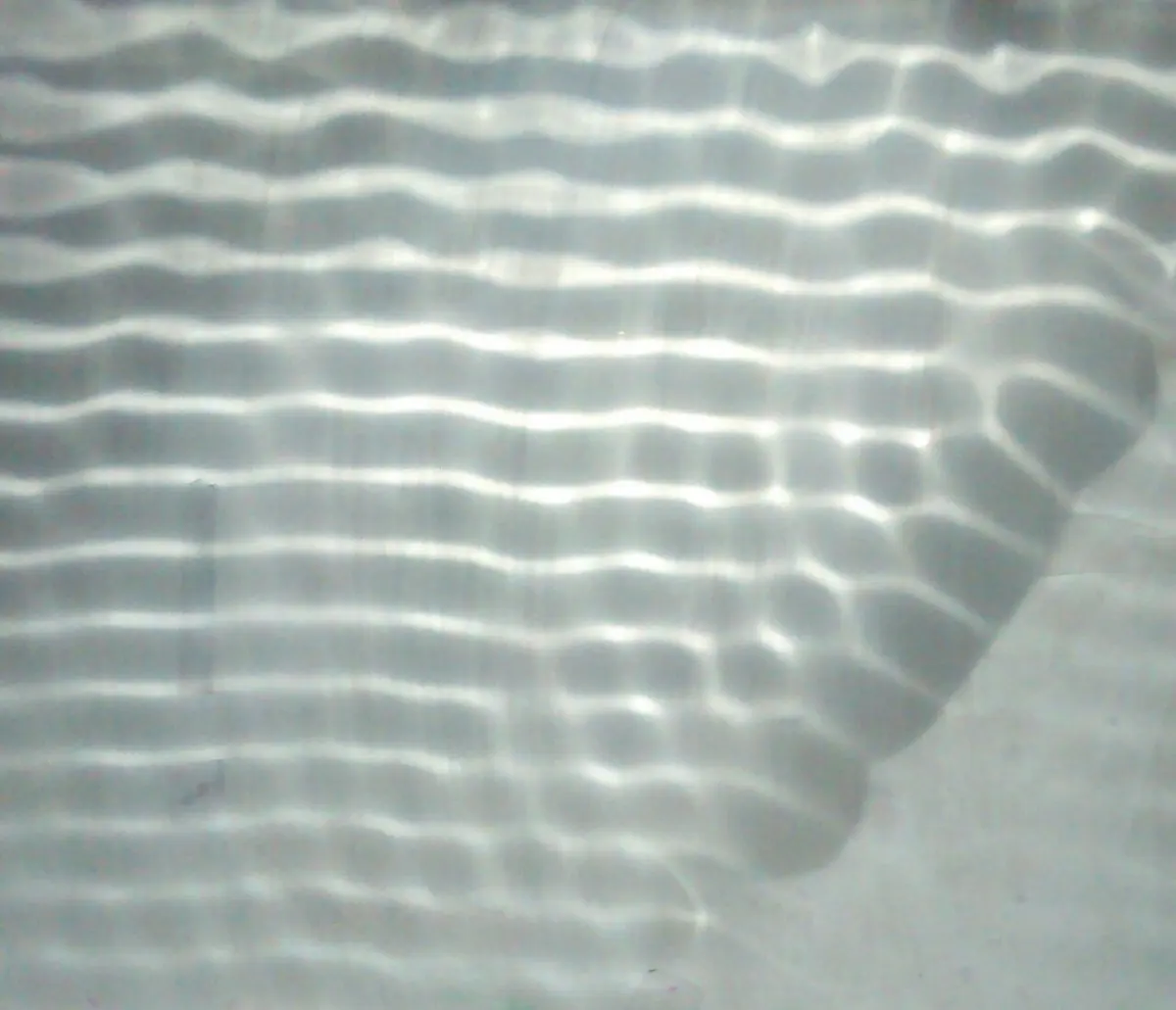
Proof of the laws of reflection (Figure 10.6). Let XY be a plane reflecting surface, and AB a plane wavefront meeting it at an angle. Rays 1, 2 and 3, perpendicular to AB, are the incident rays.
- At , the end A of the wavefront touches the surface. The other end B is still a distance BB′ from the surface; it reaches the surface at B′ a time later, so , where is the speed of light.
- Meanwhile A, struck at , has been sending out a wavelet back into the same medium, at the same speed . By time it is a hemisphere of radius .
- Each point between them, such as D (whose ray strikes the surface at P), sends out a wavelet from P as soon as the front reaches it; by time that wavelet is smaller, since it started later. All of them touch one plane through B′: draw the tangent from B′ to the wavelet from A, touching it at A′. A′B′ is the reflected wavefront, and the wavelet from P touches it at D′.
- The reflected rays 1′, 2′ and 3′ are perpendicular to A′B′.
The angle between a wavefront and the surface equals the angle between its ray and the normal (each is the other turned through 90°). So the angle of incidence is , between the incident wavefront and the surface, and the angle of reflection is , between the reflected wavefront and the surface.
Compare the right-angled triangles and :
- (a ray is perpendicular to its wavefront, and AA′ is the ray from A);
- the hypotenuse is common to both;
- .
So the triangles are congruent (right angle, hypotenuse, side), and their corresponding angles are equal: , that is,
The angle of incidence equals the angle of reflection. Also, the incident wavefront AB, the reflected wavefront A′B′ and the surface XY are all perpendicular to the plane of the paper, so the incident ray, the normal and the reflected ray all lie in the plane of the paper: the first law.
2. Refraction of light
Refraction is the change in the direction of light as it passes at a slant from one medium into another, because its speed changes. (At normal incidence the speed still changes, but the direction does not.) The laws of refraction:
- The ratio of the sine of the angle of incidence to the sine of the angle of refraction is a constant for a given pair of media (Snell’s law), , where the constant is the refractive index of the second medium with respect to the first.
- The incident ray, the normal at the point of incidence and the refracted ray all lie in the same plane.
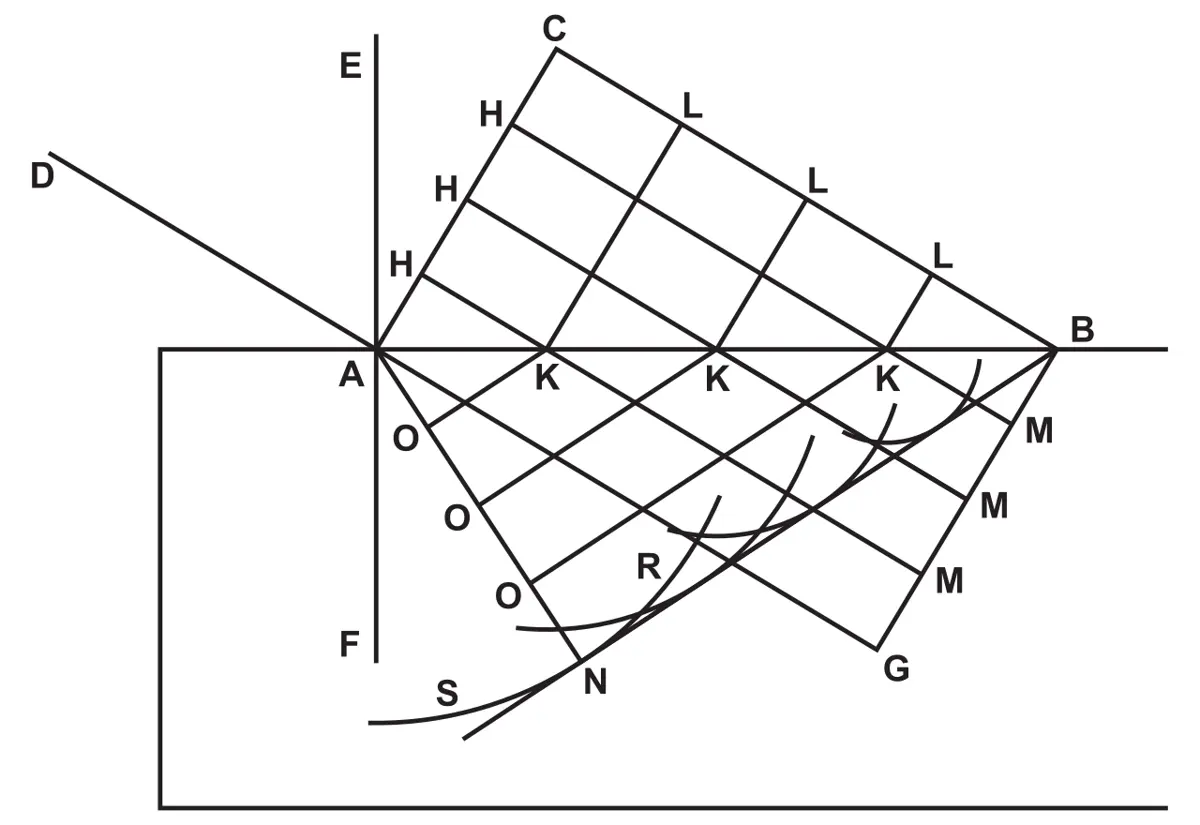
Proof of the laws of refraction (Figure 10.7). Let XY be the boundary between two media: medium 1 above (rarer, light’s speed ) and medium 2 below (denser, speed , with ). AB is a plane wavefront in medium 1, and rays 1, 2, 3, perpendicular to it, are the incident rays. NA is the normal at A.
- At , A touches the boundary. B reaches the boundary at B′ a time later: .
- In that time the wavelet from A grows in medium 2, where it travels at : its radius is , smaller than BB′.
- A point E on AB reaches the boundary at F, and its wavelet in medium 2 reaches G by time . Draw the tangent from B′ to the wavelet from A, touching it at A′: the wavelet from F touches the same plane at G. A′B′ is the refracted wavefront, and the refracted rays 1′, 2′, 3′ are perpendicular to it.
- Draw the normal N′B′ at B′. The angle of incidence is (between the incident front and the boundary), and the angle of refraction is (between the refracted front and the boundary).
In the right-angled triangle (right angle at B),
In the right-angled triangle (right angle at A′),
Dividing (10.1) by (10.2),
The ratio , the speed of light in the first medium divided by its speed in the second, is a constant for a given pair of media: it is the refractive index of the second medium with respect to the first, . So
which is Snell’s law, the first law of refraction. And since the incident front AB, the refracted front A′B′ and the boundary XY are all perpendicular to the plane of the paper, the incident ray, the normal and the refracted ray all lie in that plane: the second law.
The proof shows why light bends: the end of the front that enters the glass first slows down first, and the front swings round, as a line of marching students turns when the ones at one end step onto mud. It also shows that : the refractive index of glass, 1.5, means light goes 1.5 times slower in glass than in air. This is the prediction Foucault confirmed in 1850. It also explains total internal reflection: going from glass into air, the wavelet from A grows in air at , faster than B travels to the boundary in glass (BB′ = vt, while AA′ = ct). If , the wavelet from A is already wider than AB′ by the time B arrives, no tangent can be drawn from B′ to it, and there is no refracted wavefront: all the light is reflected. And because light of different colors travels at slightly different speeds in glass, each color has its own and its own angle of refraction: dispersion.
Build both constructions yourself:
Light passes from air into water (μ = 1.33). According to the wave theory, its speed in water is:
Pick an answer to see why.
Exercise
Choose the correct option
- Which of the following phenomena cannot be explained by Newton’s corpuscular theory of light?
Pick an answer to see why.
- According to Huygens’ principle, light propagates as:
Pick an answer to see why.
- According to Newton’s corpuscular theory, light travels faster in:
Pick an answer to see why.
- Which phenomenon observed in Young’s double-slit experiment supports Huygens’ wave theory?
Pick an answer to see why.
- Why does Huygens’ wave theory, on its own, fail to explain the rectilinear propagation of light completely?
Pick an answer to see why.
- According to Huygens’ wave theory, why does light bend around obstacles (diffraction)?
Pick an answer to see why.
- Which of the following observations disproved Newton’s corpuscular theory?
Pick an answer to see why.
- Which statement about Huygens’ principle is correct?
Pick an answer to see why.
- The idea of wavefronts in Huygens’ theory is used to explain:
Pick an answer to see why.
- What is the fundamental difference between Newton’s and Huygens’ theories of light?
Pick an answer to see why.
Answer these questions
While studying how light travels through different media, it is important to understand wavefronts and their role in describing light’s propagation.
- a.What is a wavefront?
- b.Describe the different types of wavefronts, with suitable examples.
- c.How is the direction of propagation of light related to the shape of the wavefront?
Answer
When studying light, Huygens’ principle gives a powerful way to understand how light waves propagate through space.
- a.Define Huygens’ principle.
- b.How does Huygens’ principle explain the rectilinear propagation of light?
- c.Differentiate between the wave theory and the particle theory of light, in terms of the nature of light and its propagation.
Hint
Answer
Huygens’ principle is essential in understanding how light waves propagate and interact with obstacles.
- a.Describe the construction of a new wavefront according to Huygens’ principle.
- b.Explain how Huygens’ principle helps to describe the nature and propagation of light.
- c.State two limitations of Huygens’ wave theory of light.
Answer
When studying waves, the idea of phase helps to explain how different points on a wave relate to each other as it propagates.
- a.What is meant by phase in a wave?
- b.What is the phase relationship of all points on a wavefront? Explain.
- c.How does a phase difference affect the propagation of light waves?
Answer
Understanding how wavefronts advance helps to explain the propagation of waves in different media.
- a.What principle is used to determine the new position of a wavefront?
- b.Explain how the new position of a wavefront is constructed using Huygens’ principle.
- c.What shape of wavefront is formed by a point source in a homogeneous medium?
Answer
Huygens’ principle involves wavelets that appear to travel backwards, which raises questions about their physical meaning.
- a.What are backward wavelets in Huygens’ principle?
- b.Why are backward wavelets not observed in practice?
- c.What theoretical assumption removes the effect of the backward wavefronts?
Answer
Huygens’ principle explains not only the propagation of light but also other waves such as sound, and effects such as refraction.
- a.How can Huygens’ principle be applied to explain the propagation of sound waves?
- b.Use Huygens’ principle to explain the refraction of light.
- c.How is the new position of a wavefront found using secondary wavelets?
- d.Why is it physically impossible for two wavefronts to cross?
Hint
Answer
Printable PDFs
- The unit as a book (A5) 15 pages Answers as an A4 booklet, 4 sheets
- Study notes 3 pages
- Worksheet 4 pages Answer key
- Harder practice questions 2 pages Answer key
Quiz yourself: Energy, Heat, Light and Sound, Grades 5–12 →
Practice every question in the book, and keep track of the ones you miss →
A companion to your textbook, not a replacement for it: study from the book your school uses, and where the two differ, follow your teacher. Found a mistake? Please tell us.