
Your phone is charging. In the cable, more than ten billion billion electrons pass any point every second. In the screen, each tiny pixel lights because electrons are pushed through it. On the Sun’s glowing surface, sunlight is given out as electrons are knocked free of atoms and caught again. Yet no one has ever seen an electron, and until 1897 nobody even knew it existed.
This unit is about how we found out. You will follow two of the most famous experiments in physics. J. J. Thomson bent a beam of “cathode rays” with electric and magnetic fields and showed it was made of particles far lighter than any atom. Robert Millikan watched single drops of oil float between two charged plates and weighed, in effect, the charge of one electron. On the way you will work out how an electron moves in an electric field (along a parabola, like a thrown ball) and in a magnetic field (round a circle, like a stone on a string).
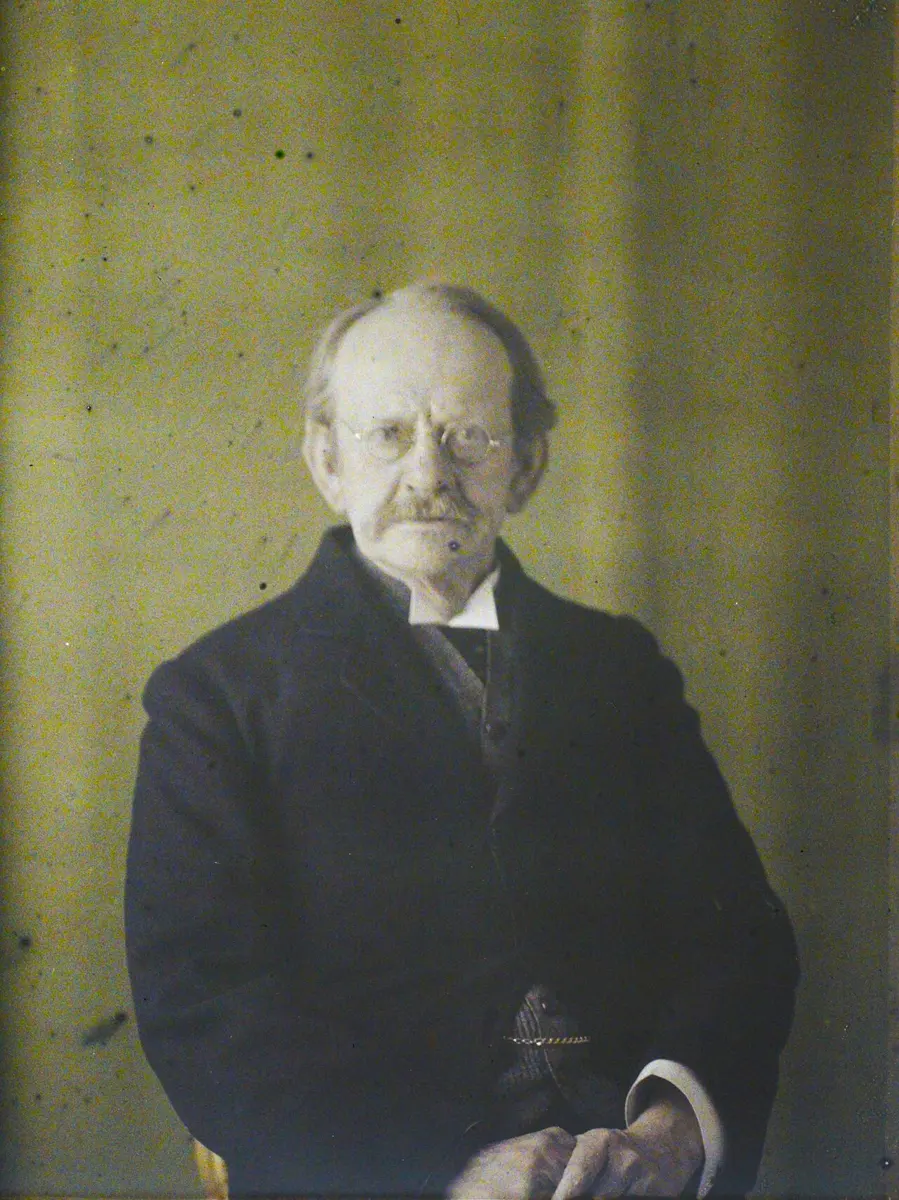
20.1 Introduction
The electron is one of the smallest pieces of matter we know. Its mass is kg, about 1840 times smaller than a proton’s, and it carries a negative charge of C. Every atom has electrons, held round its tiny, heavy nucleus in definite energy levels (shells). How those electrons are arranged decides how the atom bonds with others, and so the whole of chemistry.
Electrons also do most of the work in physics around us:
- A current in a metal wire is a drift of free electrons.
- Magnetism in iron comes from the electrons’ own spin.
- Electrons behave as waves too, the key idea of quantum mechanics; the electron microscope uses this.
The electron’s discovery in 1897 began modern atomic physics. In this unit you will see how its charge and its specific charge were measured, and how a beam of electrons moves in electric and magnetic fields.
A proton and an electron have charges of the same size. Which is true?
Pick an answer to see why.
20.2 Millikan’s oil drop experiment
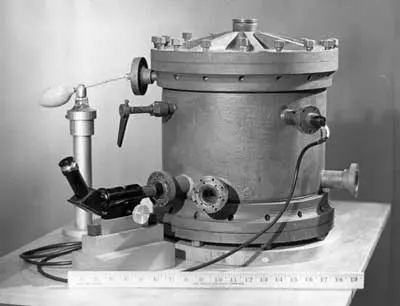
By 1900 physicists knew the electron was negative and knew its , but not itself. In 1909 the American physicist Robert A. Millikan, working with his student Harvey Fletcher at the Ryerson Physical Laboratory of the University of Chicago, found a way to measure it. The experiment also showed that charge always comes in whole-number multiples of one smallest amount: C. Millikan received the Nobel Prize in Physics in 1923.
Principle
A drop of oil a micrometer across, falling through air, quickly stops speeding up: the air’s drag grows with its speed until it balances the drop’s weight, and from then on the drop falls at a steady terminal velocity. Stokes’ law gives that drag on a small sphere,
where is the viscosity of the air, the drop’s radius and its speed. If the drop carries a charge and sits in an electric field, a fourth force joins its weight, the air’s upthrust and the drag. Measuring the drop’s steady speeds with and without the field gives first its size, then its charge.
Apparatus
- A closed chamber holds two large, round, horizontal metal plates, A on top and B below, about 22 cm across and a centimeter or two apart. A has a small hole in its middle.
- A is connected to the positive terminal of a high-voltage supply (a few thousand volts) and B is earthed, so between them there is a uniform field , pointing down.
- An atomizer sprays fine drops of clock oil (an oil that hardly evaporates) above A. A few drift through the hole.
- Window W₁ lets in light to make the drops shine against a dark background; window W₂ lets in X-rays, which ionize the air between the plates, so the drops pick up (or lose) electrons; through window W₃, at right angles to the light, a microscope with a scale in its eyepiece watches one drop, a bright point against the dark.
- The chamber is surrounded by a water jacket that keeps the temperature constant: the viscosity of air changes with temperature, and uneven warming would stir the air with currents.
A drop that has picked up extra electrons is negative. In the field, which points down from A to B, the force on it is up, towards the positive plate.
Theory
The experiment has two stages. First the drop falls with the field switched off; then it moves with the field on.
First stage: the drop falls under gravity alone
Let the drop have radius and density , and let the air have density and viscosity . Three forces act on it:
- its weight, down:
- the upthrust of the air, up (the weight of the air it pushes aside):
- the viscous drag, up, against its motion (Stokes’ law):
Within a fraction of a millisecond the drop reaches its terminal velocity , when the net force is zero:
- Downward force = upward force:
2. Put in the three forces:
3. Divide by and solve for : , so
Timing the drop as it falls between two lines of the eyepiece’s scale gives , and equation (iii) gives its radius: far too small to measure with a ruler, but measured all the same.
Second stage: the drop moves in the field
Now the field is switched on. The electric force on the drop, with charge (n extra electrons), is
where is the p.d. between the plates and their separation. It points up for a negative drop. The drop soon reaches a new, smaller terminal velocity , still falling:
- Downward force = upward forces (drag and electric force both up):
2. The left side is , by (ii):
3. So
4. Put in from (iii):
Every quantity on the right is known or measured, so is found.
If the electric force is bigger than the drop’s weight, the drop rises at a steady speed . The drag now acts down, against its motion:
If the drop is held still (the p.d. adjusted until it hangs motionless), there is no drag at all, and (leaving out the upthrust, which is about a thousand times smaller than the weight for oil in air)
Millikan watched single drops for hours, changing their charge again and again with X-rays and measuring it each time. Thousands of measurements on hundreds of drops all came out as whole-number multiples of one value,
the elementary charge: the size of the charge on one electron.
In the second stage, a negatively charged drop falls more slowly than it did with the field off. Which way does the electric field between the plates point?
Pick an answer to see why.
Significance of Millikan’s oil drop experiment
- It measured the charge of the electron. It was the first direct and accurate measurement of the elementary charge, C.
- It showed that charge is quantized. Every charge measured was a whole-number multiple of : , with . No drop ever carried or .
- It supported the atomic theory. Charge, like matter, comes in separate, countable pieces.
- It gave the electron’s mass. Thomson had measured C/kg (Section 20.5); with known,
Worked examples
20.3 Motion of an electron beam in an electric field
A horizontal beam of electrons, moving with speed , enters the space between two parallel plates at right angles to their field . The plates are a distance apart with a p.d. between them, so , pointing down from the + plate to the − plate. The field acts over the plates’ length .
The field is vertical, so there is no horizontal force: the beam keeps its horizontal speed all the way. Vertically, the force on each electron is constant,
so it has a constant upward acceleration
This is the same as a ball thrown horizontally off a cliff, with the electric force in place of gravity, and the same mathematics follows.
The path is a parabola
Let the electron enter at the origin, and reach a point after a time .
- Horizontally, constant speed:
2. Vertically, it starts with no vertical velocity () and constant acceleration :
3. So
Since , , and are constant, is a constant, and is the equation of a parabola. Once the electron leaves the plates, no force acts on it, and it travels on in a straight line along the parabola’s tangent at the exit.
The velocity and direction as it leaves
After a horizontal distance , the vertical velocity is
while the horizontal velocity is still . The speed there is
and the beam’s direction makes an angle θ with the plates, where
At the far end of the plates, put : the beam leaves deflected by , at the angle .
In the widget the plates are 5.0 cm long and 2.0 cm apart, and the screen is 4.0 cm past them, all drawn to scale. Check your grazing setting with : it should hold to within the widget’s steps.
20.4 Motion of an electron beam in a magnetic field
A charge moving through a magnetic field feels a force, the magnetic Lorentz force. For an electron (charge ) moving with velocity in a field ,
where θ is the angle between and . The force is always at right angles to both the velocity and the field. Its direction is given by Fleming’s left-hand rule (for the conventional current, which flows the opposite way to the electrons) or by the right-hand palm rule.
Because the force is always at right angles to the velocity, it changes the electron’s direction but never its speed: it does no work, so the electron’s kinetic energy stays the same.
Entering at right angles: a circle
Let the beam enter with speed at right angles to a uniform field . The force on each electron has the constant size
and is always at right angles to its velocity. A force of constant size always at right angles to the motion is exactly what keeps a stone on a string going round in a circle (Grade 11, 6.4 Centripetal force). So the electron moves in a circle of radius , and the Lorentz force provides the centripetal force:
- Lorentz force = centripetal force:
2. Cancel one and solve for :
A faster electron goes round a bigger circle; a stronger field makes a smaller one.
The period. The time for one full turn is the circumference divided by the speed:
The speed has canceled: the period does not depend on the speed or on the radius. A faster electron goes round a bigger circle in exactly the same time. The frequency of revolution and the angular frequency are
This frequency, the cyclotron frequency, is what a cyclotron (a machine that speeds up protons for treating cancer, among other uses) is tuned to: it pushes its particles once each half turn, and because the period stays the same as they speed up, one fixed frequency keeps in step with all of them.
At other angles: a straight line or a helix
- Velocity along the field (θ = 0°) or exactly against it (θ = 180°): , so . The beam goes straight through, undeflected.
- Any other angle: split the velocity into a part along the field, , and a part across it, . The part along the field feels no force and stays the same; the part across it makes a circle of radius . Together the electron moves along a helix (a spiral like a spring’s), going round at while it moves along the field at . In each period it moves forward a distance (the pitch) .
20.5 Thomson’s experiment to find the specific charge of the electron
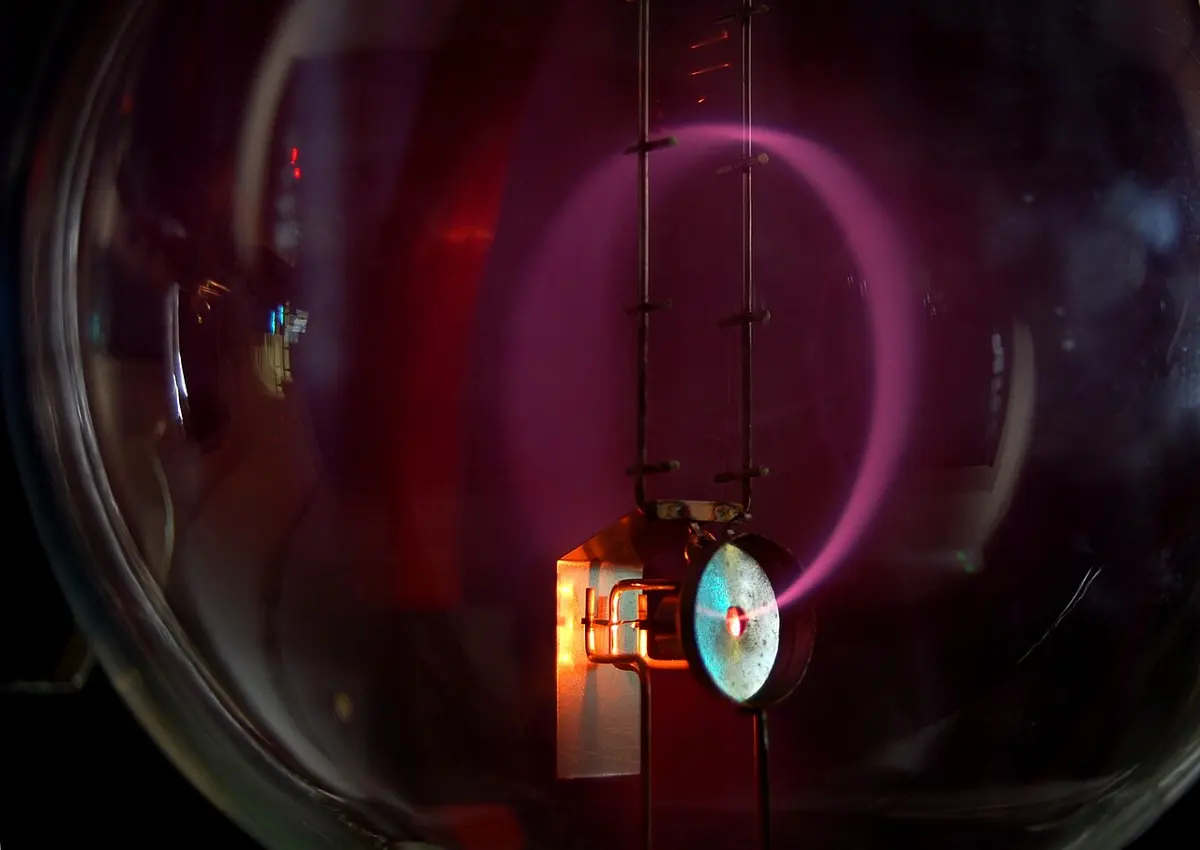
The specific charge of a particle is its charge per unit mass, , in C/kg. In 1897 J. J. Thomson measured it for the electron.
Principle. A beam of electrons is passed through an electric field and a magnetic field at right angles to each other and to the beam (crossed fields). Each field alone deflects the beam; the fields are adjusted until their forces cancel, and the beam goes straight through as if no force acted. That balance gives the electrons’ speed; the voltage that accelerated them then gives .
Apparatus
- A glass tube is pumped down to a very low pressure (about 0.01 mm of mercury), so the electrons rarely hit a gas molecule.
- At one end, a high p.d. between the cathode C and the anode A (from an induction coil in Thomson’s day) accelerates electrons from the cathode. A narrow beam passes through a hole in the anode (and a second slit, to make it narrower).
- The beam passes between two parallel plates P₁ and P₂, a distance apart, with a p.d. : a uniform electric field , from P₁ (+) to P₂ (−).
- Coils outside the tube make a uniform magnetic field over the same region, at right angles to the electric field and to the beam (into the page in the figure).
- The beam strikes a fluorescent screen at the far end, which glows where it is hit.
Theory
- No fields. The beam goes straight and hits the screen at S.
- Magnetic field alone. The beam is bent down and hits the screen at S₁. The magnetic force on each electron is
3. Electric field alone. The beam is bent up, towards the positive plate, and hits at S₂. The electric force is
4. Both fields together. Thomson adjusted the fields until the spot came back to S: the two forces are equal and opposite.
Notice that cancels: the balance gives the speed of any charged particle, whatever its charge or mass. A pair of crossed fields used like this is called a velocity selector.
5. The accelerating p.d. In falling through the p.d. from cathode to anode, each electron loses potential energy and gains the same kinetic energy (it starts almost at rest):
6. Put in :
Knowing , , and , Thomson found . Today’s value is
(Thomson’s own measurements in 1897 were rougher, but already showed about a thousand times larger than for a hydrogen ion.)
In a velocity selector, electrons moving at exactly go straight through. A slower electron, entering the same crossed fields, is bent:
Pick an answer to see why.
Exercise
Choose the correct option
- What is the kinetic energy of an electron accelerated through a p.d. of 100 V?
Pick an answer to see why.
- In J. J. Thomson’s experiment, the charge-to-mass ratio of the electron was found using:
Pick an answer to see why.
- Which property of the electron was established by Millikan’s oil drop experiment?
Pick an answer to see why.
- In Thomson’s experiment, the magnetic field is doubled while the electric field is kept the same. For the beam still to go undeflected, the speed of the electrons must be:
Pick an answer to see why.
- In Millikan’s experiment, the electric field is made stronger, and a drop still stays suspended. Compared with a drop held still in the weaker field, its charge must be:
Pick an answer to see why.
- An electron moves in a straight line through perpendicular electric and magnetic fields. If the electric field is suddenly switched off, the electron will:
Pick an answer to see why.
- In a CRT, the deflection on the screen is greater with the electric field alone than with the magnetic field alone. What can you conclude?
Pick an answer to see why.
- In Millikan’s experiment, an oil drop carrying a charge Q is held stationary by a p.d. of 2400 V between the plates. To hold a drop of half the radius stationary, the p.d. has to be 600 V. The charge on the second drop is:
Pick an answer to see why.
- A Thomson tube run at 2 kV gives an electron beam a speed of m/s. What is the speed when it is run at 8 kV?
Pick an answer to see why.
- A horizontal beam of electrons passes between two horizontal parallel plates 2.0 cm apart, as shown. The upper plate is at +4.0 V and the lower plate at −4.0 V. What is the force on each electron between the plates?
Pick an answer to see why.
Answer these questions
- a.Discuss the motion of an electron in a uniform magnetic field, and show that if a free electron moves at right angles to the field, its path is a circle and its period of revolution does not depend on its speed.
- b.Prove that the path of a horizontal beam of electrons entering midway between two oppositely charged plates is a parabola.
- c.A beam of electrons moving at m/s enters midway between two horizontal parallel plates, in a direction parallel to the plates. Each plate is 5 cm long; they are 2 cm apart, with a p.d. of 90 V between them. Show that the beam just grazes the edge of the positive plate, and find its speed as it does. ( C/kg.)
Hint
Answer
- a.What is the specific charge of an electron? Describe J. J. Thomson’s experiment to find it.
- b.An oil drop of density 960 kg/m³ and radius m is driven vertically upward through air by an electric field of V/m, at a constant velocity of m/s. The viscosity of air is N s/m². Find the number of electronic charges on the drop. (Neglect the upthrust of the air.)
Hint
Answer
- a.Using a sketch of Millikan’s apparatus (Figure 20.3), draw free-body diagrams for an oil drop moving down at a constant speed, first with no electric field and then in an electric field, showing the forces on it.
- b.Find an expression for the charge on an oil drop of radius which falls at a constant velocity with no field and at a constant velocity in a field .
- c.Find the charge on an oil drop of radius m whose terminal velocity changes from 0.25 mm/s to 0.10 mm/s (still falling) when an electric field of V/m is switched on. The viscosity of air is N s/m².
The textbook gives the radius as 1.5 × 10⁻⁶ mm, which would give a charge of 7.6 × 10⁻²² C, smaller than one electron’s, so the book’s numbers don’t work. A drop that falls at 0.25 mm/s has a radius of about 1.5 × 10⁻⁶ m (equation iii), which is used here.
Answer
- a.What is meant by quantization of charge?
- b.In Millikan’s experiment, an oil drop of weight N is held stationary between plates 10 mm apart by a p.d. of 470 V.
- i.State the condition for the drop to stay stationary, and sketch the forces on it.
- ii.Calculate the charge on the drop.
- iii.Explain what would happen if the drop were suddenly struck by a stray alpha particle.
Answer
A beam of electrons passes through crossed fields: a p.d. of V across two parallel plates 4 cm apart, and a magnetic field of T, at right angles to each other. (Mass of the electron: kg.)
- a.State the condition for the beam to go undeflected, and sketch the forces on an electron.
- b.If the two fields produce no deflection, find the speed of the electrons.
- c.Explain what happens to the beam if the electric field is made zero.
Answer
In Millikan’s apparatus, a charged oil drop is balanced between two parallel plates by adjusting the electric field.
- a.What is the use of X-rays in this experiment? Also discuss the physical principle involved.
- b.What happens if a falling drop suddenly experiences zero net force?
- c.Name the forces that play an important part in the drop’s motion through the air, and sketch them.
- d.A drop falls with a terminal velocity of m/s in air. The density of the oil is 920 kg/m³ and the viscosity of air N s/m². Find the radius of the drop. (g = 9.8 m/s²; neglect the upthrust.)
Answer
Millikan’s oil drop experiment found the charge of the electron.
- a.State a fundamental property of charge that this experiment suggested.
- b.Two parallel metal plates P and Q are in a vacuum, horizontal, 5.4 mm apart, as in the figure. The lower plate P is earthed; the p.d. between the plates can be varied. An oil droplet of mass kg stays stationary between the plates when Q is at +850 V.
- i.Suggest why the plates P and Q must be parallel and horizontal.
- ii.Calculate the charge, with its sign, on the droplet.
- c.The procedure in b was repeated for three more droplets. The sizes of their charges were C, C and C. What value do these data and your answer to b ii suggest for the charge of the electron? Explain.
Answer
A proton moving with constant velocity enters a uniform magnetic field that is at right angles to its motion, as in the figure. A uniform electric field is applied in the same region so that the proton passes through undeviated.
- a.On a copy of the figure, draw an arrow labeled E to show the direction of the electric field.
- b.The proton is replaced by other particles; the fields stay the same. State and explain the deviation, if any, of:
- i.an alpha particle with initial velocity ;
- ii.an electron with initial velocity .
Hint
Answer
The figure shows a beam of electrons, two charged plates and a screen, inside an electron tube (not drawn). The beam hits the screen at the point P.
- a.On a copy of the figure: i. complete the path of the electron beam; ii. mark the charges on the two plates; iii. mark with an arrow labeled C the direction of the conventional current in the beam.
- b.Two plane metal plates 4.0 cm long are held horizontally 3.0 cm apart in a vacuum, one above the other. The upper plate is at a potential of 300 V and the lower plate is earthed. Electrons with a speed of m/s are injected horizontally midway between the plates, along their length. Calculate the vertical deflection of the beam as it leaves the plates. ( C/kg.)
Answer
Printable PDFs
- The unit as a book (A5) 25 pages Answers as an A4 booklet, 7 sheets
- Study notes 3 pages
- Worksheet 4 pages Answer key
- Harder practice questions 2 pages Answer key
Quiz yourself: Matter, Atoms and Reactions, Grades 5–12 →
Practice every question in the book, and keep track of the ones you miss →
A companion to your textbook, not a replacement for it: study from the book your school uses, and where the two differ, follow your teacher. Found a mistake? Please tell us.