
An ambulance races down the Araniko Highway towards you, siren wailing. The moment it passes, the wail drops, as if someone had turned a knob. Nothing changed in the siren. What changed was the motion between it and your ear. A few seconds later, a fighter jet you can’t yet hear tears across the sky, and then, long after it has gone over, a bang like a door slamming in the clouds.
Both are acoustic phenomena: things sound does on its way from a source to a listener. This unit measures sound the way your ear does, by its pressure; works out how much energy a sound wave carries and why your ear needs a logarithmic scale, the decibel, to cope with it; separates the physical quantities (intensity, frequency) from what we hear (loudness, pitch, quality); and ends with the Doppler effect, which shifts the siren’s note, measures the speed of a cricket ball, the blood in a baby’s heart and the galaxies running away from us.
9.1 Introduction
Sound waves are mechanical waves: they need a medium (a solid, a liquid or a gas) and are made by vibrating particles of that medium. As the particles crowd together and spread apart, the pressure of the medium rises and falls a little above and below its normal value, and it is these pressure changes that our ears detect as sound (Units 6 and 7).
Acoustic phenomena are the ways sound behaves: how it is produced, how it travels (is propagated), how it is reflected, refracted, diffracted, interferes and is absorbed, and how it is heard. Some are natural, like an echo across a valley or the rumble of thunder; some are made by people, like the notes of a madal or a bansuri, or the noise of a crowded bus park. They include the Doppler effect (a change of pitch when the source and the listener move relative to each other) and the stationary waves of musical instruments (Unit 8).
Every sound has a few measurable properties: its pressure amplitude and its intensity (which set how loud it is), its frequency (which sets its pitch) and its waveform (which sets its quality). This unit takes them one by one.
Acoustics is the branch of physics that studies sound. Hearing is one of an animal’s most important ways of staying alive, and speech is one of the most distinctive things about human beings and their cultures; both are acoustic. Acoustics has several branches:
- Architectural acoustics: designing and controlling sound inside buildings, so that a concert hall, a theater, a classroom or an office sounds clear and comfortable.
- Musical acoustics: how musical instruments make sound, and how their material, shape and size give each its tone and quality.
- Bioacoustics: how animals (humans included) make and hear sounds, how they communicate with them, and how sound affects their behavior and their habitats.
- Medical acoustics: sound used in health care, mostly ultrasound: in diagnosis (scans), in therapy (physiotherapy) and in treatment, such as lithotripsy, breaking up kidney stones with focused sound waves.
9.2 Pressure amplitude [maximum excess pressure] of sound wave
When a sound wave passes through air, each layer of air moves back and forth about its usual place, and the pressure at each point rises and falls above and below the normal (atmospheric) pressure. So a sound wave can be described in two ways:
- by how far the particles move: the greatest distance a particle moves from its mean position is the displacement amplitude, ;
- by how much the pressure changes: the greatest rise (or fall) of pressure above (or below) normal is the pressure amplitude.
Pressure amplitude is the maximum increase or decrease of pressure in a medium, from its normal value, as a sound wave travels through it. It is also called the maximum excess pressure, .
Our ears respond to the pressure changes: the eardrum is pushed in and out by them. So although the displacement is a perfectly good description of the wave in the medium, it is the pressure amplitude that matters for hearing, and it is the one microphones measure. The pressure varies sinusoidally, at the same frequency as the displacement. Let’s find how big the pressure amplitude is.
Pressure variation in a sound wave
Take a thin cylinder of air of cross-section and length , lying along the direction in which a sound wave travels with speed and displacement amplitude (Figure 9.2). As the wave passes, the layer at the left end of the cylinder is displaced by and the layer at the right end by .
1. The change of volume. The cylinder’s volume was . Its length has changed by , so its volume has changed by . If is positive the cylinder has stretched and the pressure in it falls; if negative, it has been squeezed and the pressure rises.
2. The bulk modulus links the two. The pressure change is a stress and a volume strain, so by the definition of the bulk modulus of the air,
The minus sign says that when the volume increases, the pressure decreases, and the other way round.
3. Strain from the displacement.
For a very thin cylinder, :
so from (9.1) and (9.3),
4. Put in the wave. Let the displacement be
where is the angular frequency ( is the frequency of both the displacement and the pressure variation) and the wave number. Differentiating with respect to ,
5. The pressure. From (9.4) and (9.6),
This is how the pressure of the medium varies as the sound wave travels. It is greatest when , so the pressure amplitude is
and
6. In terms of the air’s density. The speed of sound is , so ( is the density of the air); and , so . Then
For a given medium and frequency, is constant, so : the pressure amplitude is directly proportional to the displacement amplitude.
Compare (9.5) and (9.7): the displacement goes as a sine, the pressure as a cosine. They are 90° () out of phase: where the displacement is greatest the pressure change is zero, and where the displacement is zero the pressure change is greatest (Figure 9.3). Look at the layers in the figure: at a compression, the layers on either side have moved towards it (the one on the left moved right, the one on the right moved left), but the layer at its center hasn’t moved at all.
At a compression in a sound wave, the displacement of the air there is:
Pick an answer to see why.
9.3 Intensity of sound
A loud sound carries more energy than a soft one. How much energy it delivers to a surface each second is its intensity.
Intensity of sound at a point is the average rate at which sound energy flows through unit area held normal (at right angles) to the direction of the wave at that point. Its SI unit is the watt per square meter, W/m².
Intensity is proportional to the square of the wave’s amplitude (shown below), and, for a source that sends sound out equally in all directions, inversely proportional to the square of the distance from it (section 9.5).
Intensity in terms of the amplitude
1. Power as force times velocity. The air on one side of the area pushes on the air on the other side with an extra force , and that air moves with the particle velocity . The power delivered is force × velocity, so
2. The pressure and the particle velocity. For the wave
the pressure variation is (9.7),
and the particle velocity is
( is how fast the air itself moves back and forth, not the speed of the wave.)
3. Average the product. From (9.12), (9.14) and (9.15), writing ,
Over a whole cycle, averages , so
4. In terms of the air’s density. With and ,
5. In terms of the pressure amplitude. Since , , and
So for a given medium and frequency, : double the amplitude and the intensity becomes four times. The last form, with the pressure amplitude, is the one a microphone or a sound meter uses.
9.4 Threshold of hearing and threshold of pain
Threshold of hearing is the lowest intensity of sound that the average (normal) human ear can detect, at a frequency of about 1000 Hz. Its value is about
the quietest sound most people can hear under ideal conditions. It is taken as the zero of the decibel scale (0 dB, section 9.7) and as the reference for measuring sound intensity level. It is also called the audibility threshold.
Note: sounds of the same intensity at different frequencies don’t sound equally loud: our hearing depends on the frequency as well as the intensity. The ear is most sensitive between about 2000 and 5000 Hz and much less sensitive at very low and very high frequencies, so the threshold of hearing is quoted for a pure tone of about 1000 Hz.
Threshold of pain is the intensity (or intensity level) at which sound becomes physically painful. It is taken as about 1 W/m², an intensity level of 120 dB; for some people sound becomes painful only nearer 130 dB (10 W/m²).
9.5 Inverse square law
A source that sends sound out equally in all directions, in open air with nothing to reflect or absorb it (a free field), spreads its power over the surface of a sphere that grows as the sound travels. At a distance the sphere’s area is , so if the source’s power is ,
Twice as far, the same power is spread over four times the area, and the intensity is a quarter; three times as far, a ninth (Figure 9.4).
Inverse square law: the intensity of sound at a point is inversely proportional to the square of the distance of the point from the source.
You stand 2 m from a speaker and then walk back to 8 m. The intensity becomes:
Pick an answer to see why.
9.6 Loudness
Loudness is a perceptual quality (a sensation of hearing) of sound: how strong or weak a sound seems to a human ear. It depends on the sound’s intensity, its frequency and the sensitivity of the listener’s ear.
Intensity is an objective physical quantity, measured with an instrument. Loudness is subjective: the same sound may seem louder to one person than another, and louder in a quiet room than beside a busy road. Two sounds of the same intensity at different frequencies can seem different in loudness. Loudness grows with intensity, but it is not proportional to it (section 9.7).
Difference between intensity and loudness
| Intensity | Loudness |
|---|---|
| a physical quantity: energy per second per unit area | a sensation: how strong the sound seems to a listener |
| objective: the same for everyone | subjective: depends on the listener’s ear and hearing |
| measured with an instrument (a sound meter), in W/m² | judged by the ear; compared through the intensity level in decibels |
| depends only on the wave (amplitude, frequency, medium) and the distance | depends on intensity, frequency, background noise and the listener |
9.7 Relation between intensity and loudness [Weber–Fechner law]
If you double the intensity of a sound, it doesn’t sound twice as loud: it sounds only a little louder. Our senses respond to ratios: going from 1 to 10 units feels like the same step as going from 10 to 100. The Weber–Fechner law puts this into a formula: the loudness of a sound at a point is proportional to the logarithm of its intensity at that point.
where is a constant. Choosing the unit of loudness so that ,
If is the loudness at the threshold of hearing, ,
Subtracting (9.19) from (9.18),
says how far a sound’s loudness is above the faintest sound we can hear. An absolute loudness on its own means little; this difference is what is used. It is called the intensity level or sound level, .
Intensity level () is the logarithm of the ratio of the intensity of a sound, , to the threshold of hearing, . Being the logarithm of a ratio of two intensities, it has no dimensions; its unit, the bel (B), is named after Alexander Graham Bell, the inventor of the telephone.
If , bel. So a sound has an intensity level of one bel if its intensity is 10 times the threshold of hearing.
The bel is too large for everyday use, so intensity levels are usually given in decibels (dB), one tenth of a bel:
Every 10 dB more means 10 times the intensity; every 20 dB, 100 times; every 3 dB, about twice ().
At the threshold of hearing, and dB.
At the threshold of pain, W/m² and
| Sound | Intensity level | Intensity |
|---|---|---|
| threshold of hearing | 0 dB | W/m² |
| leaves rustling | about 20 dB | W/m² |
| a whisper | about 30 dB | W/m² |
| a quiet room at night | about 40 dB | W/m² |
| normal conversation | 60–70 dB | – W/m² |
| busy road traffic, at the roadside | about 80 dB | W/m² |
| a bus’s pressure horn close by | about 110 dB | W/m² |
| a rock concert near the speakers; threshold of pain | about 120 dB | 1 W/m² |
| a jet engine 30 m away | about 140 dB | 100 W/m² |
A whisper (about 30 dB) seems soft; ordinary conversation (60–70 dB) moderately loud; a rock concert near the speakers (about 120 dB) extremely loud, at the threshold of pain.
Comparison of intensity levels of sound
If and are the intensities, and and the intensity levels, of a sound at distances and from its source,
so the difference in level is
The threshold cancels: a difference of levels depends only on the ratio of the intensities. By the inverse square law, , so
Each time you double your distance from a source, the level falls by dB.
Move away from a speaker and watch both laws at once:
A sound’s intensity is made 1000 times as great. Its intensity level rises by:
Pick an answer to see why.
Two identical machines each make 80 dB at your ear. With both running, the level is about:
Pick an answer to see why.
Factors affecting loudness
- Amplitude of the sound: loudness increases as the amplitude increases ().
- Surface area of the sounding body: a larger vibrating surface sets more air moving, and the sound is louder. (A tuning fork pressed on a table sounds louder; so does a guitar string, because of the guitar’s body.)
- Distance between the source and the listener: loudness decreases as the distance increases.
- Motion of the medium: sound carried along by the wind is louder downwind and quieter upwind.
- Reflecting or absorbing bodies nearby: reflections add to the loudness (a voice is louder in an empty hall), absorption reduces it (curtains, carpets, a crowd).
- Frequency of the sound: at the same intensity, a sound in the range where the ear is most sensitive, about 2000–5000 Hz, seems louder than one at a low or a very high frequency.
9.8 Pitch
Pitch is the sharpness or shrillness of a sound: how high or low it sounds. Like loudness, it is a perceptual quality, a sensation rather than a physical quantity; it can’t be measured directly the way length or mass can. But it depends mainly on something we can measure, the frequency: a high frequency is heard as a high pitch, a low frequency as a low pitch.
Pitch lets us tell two sounds apart by their frequency. A referee’s whistle (about 3000 Hz) has a high pitch and a bass drum (about 50 Hz) a low one. A mosquito’s whine is high, an elephant’s rumble low. Women’s voices are usually higher than men’s and children’s higher than adults’, because their vocal cords are shorter and lighter and vibrate faster. A bansuri plays higher notes as more holes are opened (a shorter air column, Unit 8), and on a guitar or sitar a thinner string sounds higher.
Difference between frequency and pitch
| Frequency | Pitch |
|---|---|
| a physical quantity: the number of vibrations per second | a sensation: how high or low the sound seems |
| objective: the same for every listener | subjective: judged by the listener’s ear |
| measured with instruments, in hertz (Hz) | not measured directly; compared by ear (in music, as notes) |
| exists for any vibration, even one we can’t hear (infrasound, ultrasound) | exists only for sounds we can hear |
| doubling it always doubles the number | doubling the frequency raises the pitch by one octave, the same step whatever the starting note |
Infrasonic, audible and ultrasonic sound
Infrasonic (infrasound): mechanical vibrations of frequency below 20 Hz, too low for human ears to hear. They are made by very large vibrating things: earthquakes, volcanoes, storms, ocean waves, even the wind over mountains. Some animals use infrasound to communicate over long distances: elephants (including those of Chitwan) rumble to one another across several kilometers of forest at frequencies down to about 15 Hz, and large whales, the blue and fin whales, call at 10–40 Hz, sounds that travel hundreds of kilometers through the ocean.
Audible sound: sound that human ears can hear, from about 20 Hz to 20 kHz (20 000 Hz). The upper limit falls with age: many adults can’t hear above about 15 kHz.
Ultrasonic (ultrasound): mechanical vibrations of frequency above 20 kHz, too high for human ears. They are made by small, fast-vibrating sources, such as a small quartz crystal made to vibrate by an alternating voltage (the piezoelectric effect). Many animals use ultrasound for echolocation, navigation, hunting and communication where seeing is hard, in the dark or under water: bats catch insects in the dark by their echoes, and dolphins and other toothed whales hunt the same way. Ultrasound is used:
- to find the depth of the sea (echo sounding, sonar);
- for communication between ships and submarines under water;
- to see an unborn baby in the womb (an ultrasound scan);
- to kill bacteria in liquids;
- to find faults and cracks inside metals;
- to diagnose diseases inside the body;
- to weld plastics;
- to clean hidden parts of instruments and jewelry (ultrasonic cleaners).
Supersonics
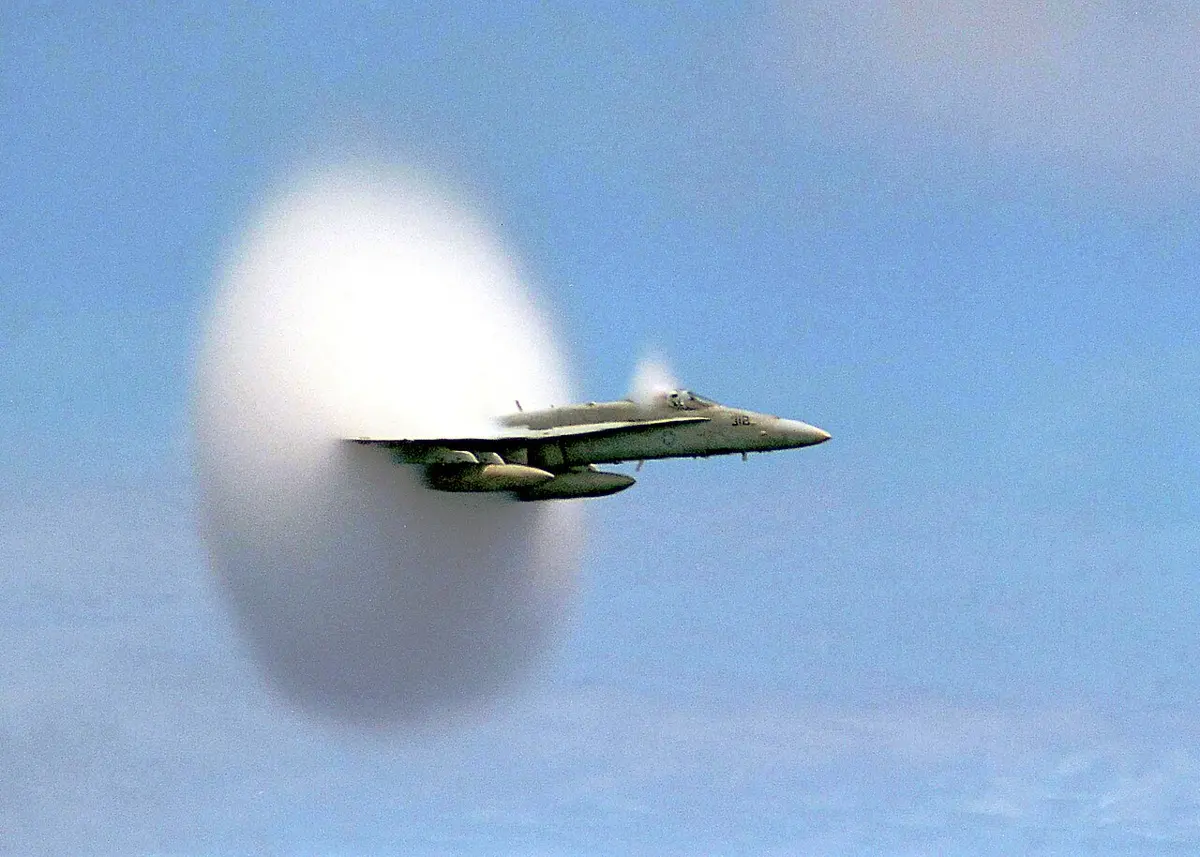
An object moving faster than sound in the same medium is supersonic: in air, faster than about 340 m/s. Fighter jets such as the F-22 Raptor, and the Concorde airliner (which flew passengers from 1976 to 2003), are supersonic. A rifle bullet and the crack of a whip’s tip are too.
A source moving faster than its own sound outruns the waves it makes. Each wave starts as a sphere from where the source was when it sent it; all these spheres are left behind the source, and they pile up along a cone with the source at its tip (Figure 9.5). Along the cone’s surface the waves arrive together and add up: a thin, intense pressure jump called a shock wave. When the cone sweeps over you on the ground, you hear it as a sudden, very loud bang, a sonic boom. The boom isn’t made only at the moment the plane “breaks the sound barrier”: a supersonic plane drags its cone, and its boom, along the whole of its path.
The speed of a supersonic object is given by its Mach number:
From Figure 9.5: in a time the source moves while its first wave grows to radius , and the cone’s edge touches that wave, so the cone’s half-angle has
The faster the object, the narrower the cone. Supersonic objects have Mach numbers from 1 to about 5; at Mach 5 and above an object is called hypersonic: hypersonic missiles, and spacecraft and other vehicles re-entering Earth’s atmosphere.
A jet flies at Mach 2. The half-angle of its Mach cone is:
Pick an answer to see why.
9.9 Quality (Timbre)
Why does a piano sound different from a violin when both play the same note? What gives each instrument its own sound?
Quality (or timbre) of a sound is the characteristic that lets us tell apart two sounds of the same pitch and loudness coming from different sources. Hardly any instrument makes a single pure frequency. Each sounds its fundamental (which sets the pitch) together with overtones (Unit 8), and which overtones it makes, and how strong each is, depends on the instrument, its material and shape, and how it is played (plucked, bowed, struck or blown). Together they give the wave its shape, its waveform. A violin and a bansuri playing the same note give different waveforms, because they produce different overtones; we hear that as their different quality.
Quality is the “color” or “texture” of sound. It is how we recognize whether a note comes from a piano, a guitar or a human voice, even when they play the same note at the same loudness; and how we recognize a voice: whether it is a man’s, a woman’s or a child’s, and whose. If a friend rings you from an unknown number, you know who it is from the quality of the voice. Forensic acoustics uses the same idea: experts analyze recorded sounds to identify a speaker or a source, and to check whether a recording has been tampered with.
Hear the same note with different overtones:
Two instruments play the same note at the same loudness, yet you can tell them apart. They differ in:
Pick an answer to see why.
9.10 Doppler’s effect
Have you noticed that the pitch of an ambulance’s siren rises as it comes towards you and falls as it goes away?
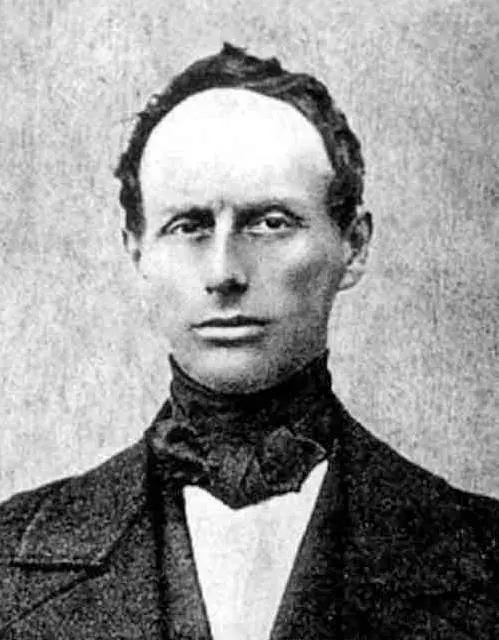
When a source of waves and an observer move relative to each other, the frequency the observer receives differs from the frequency the source sends. The apparent change in the frequency of a wave received by an observer, because of the relative motion of the source and the observer, is called the Doppler effect (or Doppler shift). For sound it is heard as a change of pitch when a source moves towards or away from you. It is noticeable only when the relative speed is a fair fraction of the wave’s speed: for sound, tens of meters per second. It happens with all waves, including light and other electromagnetic waves. It was first proposed by the Austrian physicist Christian Doppler in 1842.
When a source of sound or light moves towards an observer, the waves arrive crowded together, with a shorter wavelength and a higher frequency: a higher pitch for sound, a blue shift for light. When the source moves away, the waves arrive stretched apart, with a longer wavelength and a lower frequency: a lower pitch, a red shift. A train’s whistle sounds higher as the train comes towards you, and lower once it has passed. Police radar guns use the Doppler effect to measure the speeds of vehicles: the gun sends a radio wave at a car, and from the change in the frequency of the reflected wave, it works out how fast the car is going.
Doppler’s effect in sound
Why does a train whistle seem to change as the train moves? There are three cases of relative motion between a source of sound and a listener. Throughout, is the speed of sound in the (still) air, the frequency the source sends, the speed of the source and the speed of the listener, both along the line joining them.
(a) Source in motion, listener at rest
A source (a car blowing its horn) sends out sound of frequency and wavelength , traveling at :
The source is at S and the listener at rest at L. Now let the source move with speed .
i. Source moving towards the stationary listener. In one second the source sends out waves. The first of them travels a distance towards the listener in that second; meanwhile the source follows it, moving to S′. So the waves that would have filled the distance are squeezed into the distance between S′ and the front of the first wave (Figure 9.7). The waves are crowded: the wavelength ahead of the source is shorter. They still travel to the listener at the speed of sound (the speed depends only on the air, not on the source), so if is the new wavelength, the listener receives the frequency
where
From (9.25) and (9.26),
Since , : when a source of sound moves towards a stationary listener, the frequency heard is higher than the real frequency.
ii. Source moving away from the stationary listener. Now the source moves away from the listener while it sends the waves, so they are spread over a distance on the listener’s side. The waves are stretched, and the listener receives
where the wavelength is now longer:
so
Since , : when a source of sound moves away from a stationary listener, the frequency heard is lower than the real frequency.
Watch the waves crowd and spread, and hear the note change:
A source moving towards a listener changes the frequency the listener receives because:
Pick an answer to see why.
(b) Listener in motion, source at rest
Now the source stays at S and sends out sound of frequency and wavelength :
and the listener moves with speed . The source isn’t moving, so the waves in the air are not squeezed or stretched: the wavelength stays . What changes is how fast the waves pass the listener. In one second, a still listener meets the waves that fill a distance : of them. A listener moving towards the source also runs into the waves that fill the extra distance he covers (Figure 9.8). So the listener receives the waves at the speed of sound relative to the listener, , and the frequency heard is
more or fewer than waves a second.
i. Listener moving towards the stationary source. The sound and the listener move in opposite directions, so the speed of the sound relative to the listener is
From (9.31), (9.32) and (9.33),
Since , : when a listener moves towards a stationary source, the frequency heard is higher than the real frequency.
ii. Listener moving away from the stationary source. The sound and the listener move in the same direction, so
and
Since , : when a listener moves away from a stationary source, the frequency heard is lower than the real frequency.
(c) Both source and listener in motion
When the source and the listener both move, both changes happen at once: the source’s motion changes the wavelength reaching the listener, and the listener’s motion changes the speed of the waves relative to him. The frequency heard is then
where is the speed of the sound relative to the listener and the wavelength of the waves reaching the listener.
i. Source and listener moving towards each other. The listener moves towards the source, against the sound: . The source moves towards the listener, so the waves are crowded: . From (9.37),
Since , : when the source and listener approach each other, the frequency heard is higher than the real frequency.
ii. Source and listener moving away from each other. The listener moves away from the source, with the sound: . The source moves away, so the waves are stretched: . So
Since , : when they move apart, the frequency heard is lower.
iii. Source following the listener. Both move the same way, the source behind. The source moves towards the listener (waves crowded, ); the listener moves away from the source, with the sound ():
If (the source is faster, catching up), then and : the frequency heard is higher. If (the listener is faster, pulling away), then and : it is lower.
iv. Listener following the source. Both move the same way, the listener behind. The listener moves towards the source, against the sound (); the source moves away from the listener (waves stretched, ):
If (the listener is catching up), then and . If (the source is pulling away), then and .
In iii and iv, if the two move at the same speed, : the distance between them doesn’t change, and there is no Doppler effect.
One formula for every case
All the cases above are one expression:
Use the upper signs (, ) for motion towards the other one, and the lower signs (, ) for motion away from it. A quick check: anything moving towards the other one must raise the frequency.
Limitations of Doppler’s effect
- If the source and the observer are both at rest, or move in the same direction at the same speed, there is no change in frequency or wavelength, and no Doppler effect. The same holds whenever the distance between them isn’t changing, as when one moves at right angles to the line joining them.
- For sound, the shift depends on the medium: the speed of sound changes with temperature and humidity, and a wind changes the speeds of the source and listener relative to the air. Changes in these conditions change the shift.
- The formulas hold only while the source moves slower than sound. An object moving faster than sound makes a shock wave and a sonic boom; a listener ahead of it hears nothing until the cone arrives.
- The formulas assume steady motion along the line joining the source and the listener. If the motion is along a curve or speeding up, or not along that line (a car passing at a distance, an object moving in a circle), the shift changes from moment to moment and must be worked out at each point from the part of the velocity along the line.
Doppler’s effect in electromagnetic waves [light]
Light from a star or a galaxy is shifted too. When it moves away from the Earth, the dark lines in its spectrum are shifted towards the red end (longer wavelengths): a red shift. When it moves towards us, they are shifted towards the violet end (shorter wavelengths): a blue shift. Measuring the shift gives the speed of the star along our line of sight.
Light needs no medium, and only the motion of the source and the observer relative to each other matters. For speeds much less than the speed of light , the result is like (9.29). Let be the wavelength a star would send if it were at rest relative to us, and the wavelength we receive while it moves away from us with speed :
Knowing (from the same line measured in a laboratory) and the shift , we find the star’s speed. A positive (red shift) means it is receding; a negative one (blue shift), approaching, and then the same formula gives a negative . (Only for ; near the speed of light, relativity changes the formula.)
Light from distant galaxies is red-shifted (): the galaxies are moving away from us, and the farther away a galaxy, the faster it recedes. This is the evidence that the universe is expanding.
Doppler’s effect in the case of an echo
i. Source and listener moving towards the reflector. A bus on a mountain road drives towards a tall cliff, sounding its horn. The source (the horn) and the listener (the driver) are both in the bus. The cliff reflects the sound as a plane mirror reflects light: the echo seems to come from an image of the bus behind the cliff face, as far behind it as the bus is in front (Figure 9.9). As the bus moves towards the cliff, this image moves towards the cliff from the other side at the same speed. So it is as if the source (the image) and the listener (the driver) were approaching each other, both at the bus’s speed :
Bus: traced from a photo by Saiphani02, CC BY 4.0, via Wikimedia Commons
The same result comes in two steps: the cliff, at rest, receives and sends back that frequency, which the driver, moving towards it, hears as times as much. Note: the source and the listener can also be in different vehicles moving at different speeds; then is the source’s speed and the listener’s.
ii. Source and listener moving away from the reflector. If the bus drives away from the cliff, the image moves away from the cliff too, at the same speed: it is as if source and listener were moving apart, both at :
A bat flying at 10 m/s towards a wall sends out 40 kHz. The echo it hears from the wall is (speed of sound 340 m/s):
Pick an answer to see why.
Applications of the Doppler effect
- Radar and speed detection: police radar guns.
- Medical ultrasound: Doppler ultrasound shows how fast and which way blood flows in arteries and veins.
- Astronomy: measuring the red and blue shifts of stars and galaxies, and so their speeds towards or away from us (and finding planets round other stars from the wobble they give their star).
- Weather forecasting: Doppler radar tracks storms, rain and the winds inside them.
- Sonar systems: detecting objects under water, and their speeds.
- Traffic monitoring: measuring the speeds of vehicles with Doppler radar.
- Navigation systems: satellite navigation (GPS) uses the Doppler shift of the satellites’ signals to find a receiver’s velocity and help fix its position.
- Acoustic studies: measuring the speed of sound in different conditions, and the speeds of moving air or water.
- Echocardiography: Doppler ultrasound of the heart measures how fast blood flows through its chambers and valves.
Exercise
Choose the correct option
- The intensity of a sound wave is directly proportional to which of the following?
Pick an answer to see why.
- The pitch of a sound depends primarily on:
Pick an answer to see why.
- If the intensity of a sound wave is increased by a factor of 100, how much does the sound level in decibels (dB) increase?
Pick an answer to see why.
- A source emits a sound of frequency 500 Hz. If the source moves towards a stationary observer with a speed of 50 m/s (speed of sound in air = 340 m/s), what is the frequency heard by the observer?
The textbook prints the options 525, 540, 580 and 620 Hz, but the answer is 586 Hz, so the book’s options don’t work. Option c is corrected.
Pick an answer to see why.
- An observer moves with a speed of 20 m/s towards a stationary sound source of frequency 400 Hz. What frequency does the observer perceive? (Speed of sound in air = 340 m/s)
Pick an answer to see why.
- A train moving at 30 m/s blows a whistle at 600 Hz. What frequency is heard by a stationary observer standing in front of the train? (Speed of sound in air = 340 m/s)
Pick an answer to see why.
- Two trains approach each other, each moving at 20 m/s. One train blows a whistle of 500 Hz. What is the frequency heard by the driver of the other train? (Speed of sound in air = 340 m/s)
The textbook prints the options 520, 550, 580 and 600 Hz, but the answer is 562.5 Hz, so the book’s options don’t work. Option b is corrected.
Pick an answer to see why.
- A person hears a sound of frequency 450 Hz. If the source is moving away with a speed of 30 m/s, what was the original frequency of the sound? (Speed of sound in air = 340 m/s)
The textbook prints the options 480, 470, 460 and 450 Hz, but the answer is 490 Hz, so the book’s options don’t work. Option a is corrected.
Pick an answer to see why.
- A supersonic jet moves towards an observer at a speed of 400 m/s while emitting a sound of frequency 1000 Hz. What frequency does the observer hear? (Speed of sound in air = 340 m/s)
Pick an answer to see why.
- A stationary observer hears a frequency of 550 Hz from a moving car. If the actual frequency of the horn is 500 Hz, what is the speed of the car? (Speed of sound in air = 340 m/s)
The textbook prints the options 30, 40, 50 and 60 m/s, but the answer is 30.9 m/s, about 31 m/s, so the book’s options don’t fit. Option a is corrected.
Pick an answer to see why.
- A police speed detector sends a sound wave of frequency 1000 Hz towards a moving car, which reflects the wave back. If the car is approaching at 30 m/s and the speed of sound is 340 m/s, what is the frequency of the reflected wave received by the police?
The textbook prints the options 1088, 1094, 1100 and 1110 Hz, but the answer is 1194 Hz, so the book’s options don’t work. Option d is corrected.
Pick an answer to see why.
- A ship heading straight towards an underwater cliff sends an ultrasonic wave of frequency 40 kHz ahead of it, towards the cliff. If the reflected wave is received with a frequency shift of 400 Hz due to the motion of the ship, what is the speed of the ship? (Speed of sound in seawater = 1500 m/s)
Pick an answer to see why.
Answer these questions
- a.Define pressure amplitude. How does it relate to sound wave propagation?
- b.A sound wave has a pressure amplitude of 0.5 Pa and travels through air of density 1.2 kg/m³ at 340 m/s. Find the intensity of the wave.
Answer
- a.Differentiate between intensity and loudness of sound. How are they measured?
- b.A sound of intensity 1.0 × 10⁻⁸ W/m² is increased to 1.0 × 10⁻⁵ W/m². By how many decibels has the loudness increased?
Answer
- a.Explain the concepts of pitch and quality of sound. Give examples of how different instruments produce sound with different quality.
- b.A source of sound emits uniformly in all directions with a total power of 2 W. What is the intensity at a distance of 3 m?
Answer
- a.How does the intensity of sound vary with distance from the source?
- b.The sound from a speaker has an intensity of 1.0 × 10⁻⁶ W/m² at a distance of 2 m. What is the intensity at 4 m from the source?
Answer
- a.Discuss how the human ear perceives loudness and its logarithmic relation with intensity.
- b.State and explain the Doppler effect. What factors influence the observed frequency?
- c.An observer moves towards a stationary source of frequency 600 Hz with a speed of 20 m/s. What is the frequency heard? ( m/s)
Answer
- a.Derive the expression for the Doppler effect when: i. the source is moving and the observer at rest; ii. the observer is moving and the source at rest; iii. both are moving.
- b.The source and the observer move towards each other. The source emits sound of frequency 440 Hz and moves at 30 m/s; the observer moves at 20 m/s. Find the apparent frequency. ( m/s)
Answer
- a.What is the significance of the Doppler effect in real life? Mention at least three applications.
- b.A source of sound approaches a stationary observer. What happens to the frequency heard? Explain why.
- c.A source emitting sound of frequency 400 Hz is moving away from an observer at rest with a speed of 40 m/s. What frequency is heard? ( m/s)
Answer
- a.What is the condition under which no Doppler shift is observed even if there is relative motion?
- b.A whistle of frequency 500 Hz moves towards a stationary observer with speed 30 m/s. The speed of sound is 340 m/s. What frequency does the observer hear?
Answer
Printable PDFs
- The unit as a book (A5) 39 pages Answers as an A4 booklet, 10 sheets
- Study notes 3 pages
- Worksheet 4 pages Answer key
- Harder practice questions 2 pages Answer key
Quiz yourself: Energy, Heat, Light and Sound, Grades 5–12 →
Practice every question in the book, and keep track of the ones you miss →
A companion to your textbook, not a replacement for it: study from the book your school uses, and where the two differ, follow your teacher. Found a mistake? Please tell us.