
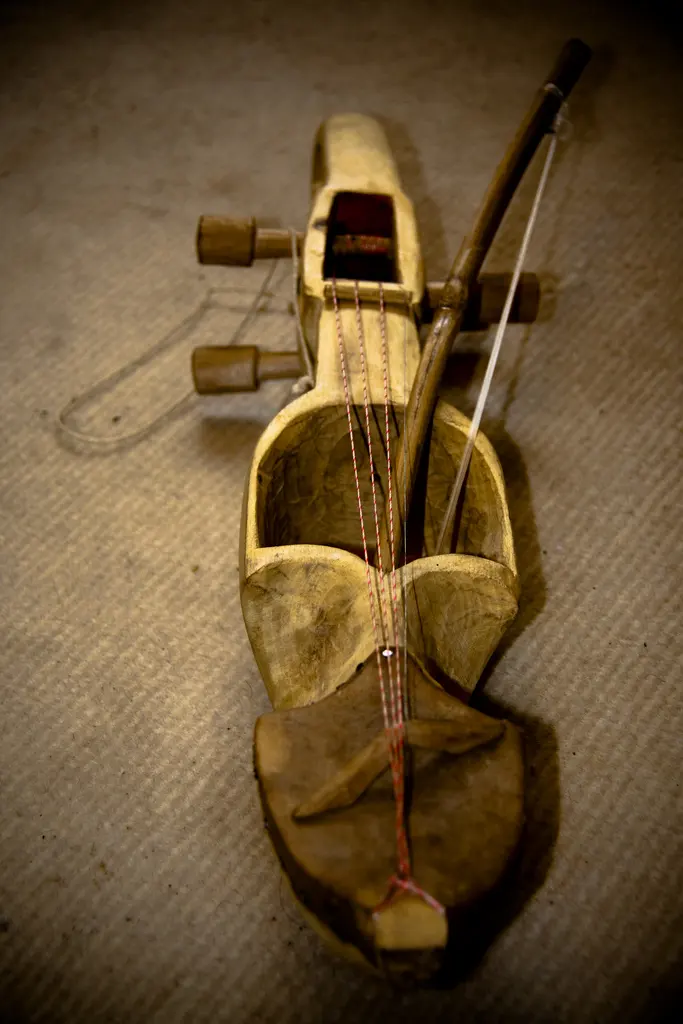
A Gandharva musician draws a bow across the strings of a sarangi and slides a fingernail along them; a bansuri player lifts one finger and the note jumps. Blow across the mouth of a test tube and it hoots; pour in some water and the hoot goes higher. Every one of these is a stationary wave (Unit 6) trapped between two ends, and every note it can play is fixed by where its nodes and antinodes are allowed to sit.
This unit fits stationary waves into air columns, the organ pipes, flutes and resonance tubes, and onto stretched strings, the sitar, sarangi and sonometer. It finds the notes each can play, explains why a flute sounds richer than a pipe closed at one end, corrects for the air that spills out of an open end, and arrives at the three laws that every string player uses without thinking.
8.1 Introduction
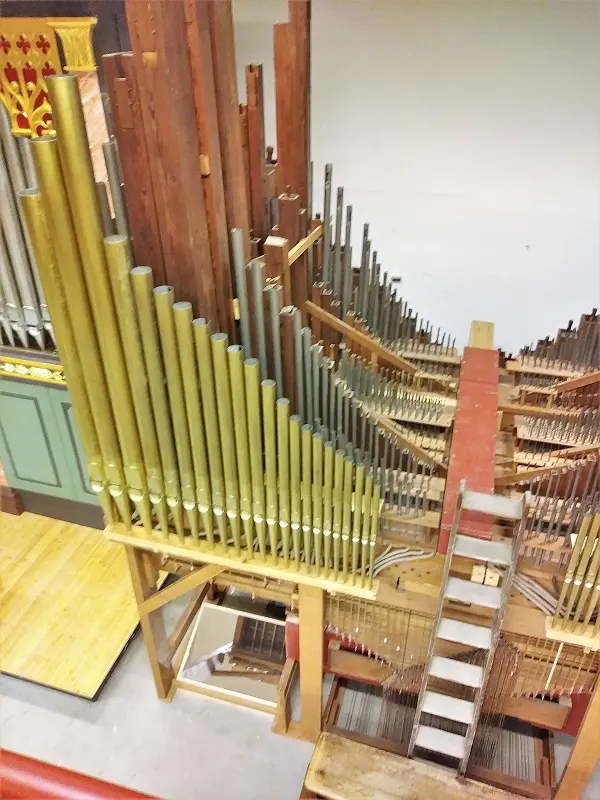
Organ pipes are hollow tubes used as wind instruments to make sound. They can be made of wood, plastic or metal, and are mainly of three shapes: cylindrical, conical and rectangular. To sound a pipe, air is blown into it at one end, which sets the air column inside vibrating.
A longitudinal wave travels from that end along the pipe and is reflected at the other end. The wave going one way and the reflected wave coming back superpose and form a stationary wave. Organ pipes are designed to set up such a stationary wave in their air column. They resonate at particular frequencies, the natural frequencies of the air column, which depend on the pipe’s length, its shape and how it is made. The air flowing in at the mouth keeps the column vibrating at one of these frequencies.
Organ pipes are of two types: open and closed.
8.2 Open and closed organ pipes
Open organ pipe
A pipe with both ends open is an open organ pipe. It has an antinode (the greatest displacement) at each open end. Its frequency depends on its length and its diameter. A flute, and the organ’s octave pipes and open diapason, are open pipes.
Closed organ pipe
A pipe with one end closed and the other open is a closed organ pipe. It has an antinode at the open end and a node at the closed end. Its frequency, too, depends on its length and diameter. A resonance tube, an organ’s stopped pipes (capped at the top, as in the stopped diapason) and a test tube you blow across are closed pipes. (A round bottle with a narrow neck is different: its air works as a spring and its neck’s air as a mass, a Helmholtz resonator, so its note doesn’t follow the pipe rules.)
8.3 Harmonics and overtones
The lowest frequency at which a vibrating system (a string, an air column) naturally vibrates is its fundamental frequency, .
Harmonics are the whole-number multiples of the fundamental frequency. If the fundamental of a string or an air column is 100 Hz, its harmonics are: first harmonic 100 Hz (the fundamental itself), second harmonic 200 Hz, third harmonic 300 Hz, fourth harmonic 400 Hz, and so on.
Overtones are the frequencies, higher than the fundamental, that a system actually produces. The fundamental is not counted as an overtone. For a string or air column of fundamental 100 Hz that can produce every harmonic: first overtone 200 Hz (the second harmonic), second overtone 300 Hz (the third harmonic), third overtone 400 Hz (the fourth harmonic), and so on.
| Harmonics | Overtones | |
|---|---|---|
| Meaning | whole-number multiples of the fundamental frequency, | the frequencies a system produces above its fundamental |
| Use | mainly in physics, to name vibrational modes by their frequency | in acoustics and music, for the notes above the fundamental |
| Counting | 1st (the fundamental), 2nd, 3rd, 4th… | 1st overtone, 2nd overtone…; the fundamental isn’t one |
| Example, fundamental 100 Hz, all harmonics present | 1st 100 Hz, 2nd 200 Hz, 3rd 300 Hz | 1st overtone 200 Hz (2nd harmonic), 2nd overtone 300 Hz (3rd harmonic) |
8.4 Stationary waves in closed organ pipe
Hold a vibrating tuning fork just above the open end of a closed pipe. The air column starts vibrating at that end; the vibration travels down to the closed end and is reflected. The wave going down and the wave coming back superpose and form a stationary longitudinal wave. The closed end is always a node (the air there can’t move) and the open end always an antinode, but between them the column can hold one, two, three or more quarter-wavelengths, so even a pipe of one length can vibrate in different modes, each with its own frequency. The modes differ in their number of nodes and antinodes. Let the air column be long and let be the speed of sound in the air (Figure 8.3).
First, or fundamental, mode. The column vibrates at its lowest possible frequency, with the longest possible wavelength: a node at the closed end, an antinode at the open end, and nothing in between (Figure 8.3 a). If is the wavelength and the frequency,
where is the ratio of the specific heat capacities of the air, its pressure and its density. This is the frequency of the fundamental mode, also called the first harmonic.
Second mode. The column holds one more node and one more antinode than in the fundamental (Figure 8.3 b): three quarter-wavelengths. With wavelength and frequency ,
This is the third harmonic, or the first overtone.
Third mode. The column holds three nodes and three antinodes (Figure 8.3 c): five quarter-wavelengths. With wavelength and frequency ,
This is the fifth harmonic, or the second overtone.
In the same way, the higher modes have , , and so on:
Conclusions
- The frequency of the th mode of vibration is .
- The frequency of the th overtone is .
- The even harmonics are missing.
- With the even harmonics missing, the sound of a closed pipe is poorer in quality: hollower, less rich.
8.5 Stationary waves in open organ pipe
Hold a vibrating tuning fork just above one end of an open pipe. The vibration travels along the air column to the other end and is reflected there too (an open end reflects sound back into the pipe, a compression returning as a rarefaction). The wave going one way and the reflected wave superpose to form a stationary longitudinal wave, now with an antinode at each open end. Again the column can vibrate in different modes (Figure 8.4).
First, or fundamental, mode. The lowest possible frequency and the longest wavelength: an antinode at each end and one node between them (Figure 8.4 a). With wavelength and frequency ,
This is the first harmonic. It is twice the fundamental of a closed pipe of the same length: an open pipe sounds an octave higher.
Second mode. One more node and one more antinode (Figure 8.4 b): a whole wavelength. With wavelength and frequency ,
This is the second harmonic, or the first overtone.
Third mode. Three nodes and four antinodes (Figure 8.4 c): one and a half wavelengths. With wavelength and frequency ,
This is the third harmonic, or the second overtone.
In the same way, , , and so on:
Conclusions
- The frequency of the th mode of vibration is .
- The frequency of the th overtone is .
- Both odd and even harmonics are present.
- With all the harmonics present, the sound of an open pipe is richer in quality.
A pipe closed at one end has a fundamental frequency of 150 Hz. Which of these can it not produce?
Pick an answer to see why.
Try both pipes, and hear them:
8.6 End correction in pipes
So far we have assumed that the antinode forms exactly at the open end of a pipe. In fact it forms a little way outside the open end. The air at the open end is free to move, and its vibration carries on a short distance beyond the pipe before it spreads out into the open air. So the acoustic (effective) length of the pipe is greater than its physical length, and a wavelength worked out from the physical length alone is a little wrong.
The distance from the open end of the pipe to the true position of the antinode is the end correction, written (sometimes or ). To find the wavelength, the end correction is added to the length at each open end (Figure 8.5).
An open pipe has an antinode at both ends, so the end correction is added at both. For its fundamental,
A closed pipe has an antinode only at its open end, so the end correction is added once:
Lord Rayleigh studied the end correction with pipes of different diameters and found
where is the internal diameter of the pipe and its internal radius: the Rayleigh end correction. With it, (8.7) and (8.8) become
So, for the same length, a wider pipe gives a lower note: the frequency falls as the internal radius grows (though it isn’t inversely proportional to the radius, since is only added to ). Organ builders use this: a wide pipe of the same length sounds slightly lower, and a pipe is trimmed to tune it.
8.7 Velocity of transverse wave along a stretched string
A string, in physics, is a wire that is perfectly flexible and very thin, of the same diameter all along its length. Set vibrating, it carries transverse waves along its length. In musical instruments, the guitar, sitar and sarangi, strings are fixed at both ends and sound is made by plucking, striking or bowing them.
Let a string of length and mass , fixed at both ends, be under a tension . If it is perfectly flexible, a transverse wave travels along it with speed
where is the mass per unit length of the string, also called its linear mass density (unit kg/m). For a wire of cross-section , radius , diameter and density ,
The tension pulls a displaced piece of the string back (the elastic factor); its mass per unit length resists being moved (the inertial factor), just as in (Unit 7).
Two wires of the same steel are under the same tension; one has twice the diameter of the other. Waves on the thicker wire travel:
Pick an answer to see why.
8.8 Stationary waves in stretched string
Let a string of length , mass per unit length , be fixed between two rigid supports and kept under tension (Figure 8.6). When it is plucked at any point, transverse waves travel along it towards both ends and are reflected there. The reflected and incoming waves superpose and form a stationary transverse wave. Since the string is fixed at both ends, both ends are nodes.
First, or fundamental, mode. The string vibrates in one loop: nodes at the two ends and an antinode at the middle (Figure 8.6 a). If is the wavelength,
This is the fundamental, or first harmonic.
Second mode. The string vibrates in two loops (Figure 8.6 b):
This is the second harmonic, or first overtone.
Third mode. The string vibrates in three loops (Figure 8.6 c):
This is the third harmonic, or second overtone.
In the same way, , , and so on: .
Conclusions
- The frequency of the th mode of vibration is , where
- The frequency of the th overtone is , where
- Both odd and even harmonics are present.
- With every harmonic present, a string’s sound is rich in quality.
8.9 Laws of transverse vibration of stretched string
Why does tightening a guitar string raise its note? Why does a shorter string sound higher? The fundamental frequency of a stretched string is
where is its vibrating (resonating) length, its mass per unit length and its tension. Three laws follow from it.
1. Law of length. The frequency is inversely proportional to the vibrating length, when and are kept constant:
Example: on a guitar or a sitar, pressing the string down on a fret nearer the body shortens its vibrating length, and the note rises. Halving the length raises the note an octave.
2. Law of mass. The frequency is inversely proportional to the square root of the mass per unit length, when and are kept constant:
Example: on a guitar the thicker strings (the bass strings) play lower notes than the thinner ones, even at the same length and tension. A heavier string vibrates more slowly.
3. Law of tension. The frequency is directly proportional to the square root of the tension, when and are kept constant:
Example: turning the tuning pegs of a violin or sitar to tighten a string raises its note. Four times the tension doubles the frequency.
The laws are tested in the laboratory with a sonometer: a wire stretched over two bridges on a hollow wooden box, pulled tight by a weight hanging over a pulley. The bridges are moved until the wire resonates with a tuning fork (a small paper rider on the wire jumps off).
Exercise
Choose the correct option
- What is the fundamental frequency of a closed organ pipe of length if the speed of sound in air is ?
Pick an answer to see why.
- Which of the following statements is true for an open organ pipe?
Pick an answer to see why.
- The end correction in an organ pipe is due to:
Pick an answer to see why.
- The third harmonic of a closed pipe corresponds to which overtone?
Pick an answer to see why.
- If the length of a vibrating string is doubled while its tension and linear density stay the same, the frequency:
Pick an answer to see why.
- A string fixed at both ends vibrates in its fundamental mode. What is its displacement at the center?
Pick an answer to see why.
- Two strings of the same material but different lengths and diameters are stretched under the same tension. Which factor most affects their vibrational frequency?
Pick an answer to see why.
- A flute and a guitar string produce sound of the same frequency. Which statement must be true?
Pick an answer to see why.
- A closed pipe has a fundamental frequency of 220 Hz. What will be the frequency of its first overtone?
Pick an answer to see why.
- A string 1.5 m long, stretched under tension, vibrates with a fundamental frequency of 150 Hz. What is the speed of the wave along the string?
Pick an answer to see why.
- The fundamental frequency of a stretched string is 100 Hz. If the tension is made 4 times as large, what will the new frequency be?
Pick an answer to see why.
- A closed pipe resonates at 300 Hz and 500 Hz but not at 400 Hz. What is the fundamental frequency of the pipe?
Pick an answer to see why.
- Two strings of the same length but different tensions are vibrating. The first has 4 times the tension of the second. If the fundamental frequency of the second string is , what is that of the first?
Pick an answer to see why.
- A pipe closed at one end produces a sound of wavelength 1.2 m in its fundamental mode. What is the length of the pipe, if the speed of sound is 340 m/s?
Pick an answer to see why.
Answer these questions
- a.Define harmonics and overtones.
- b.Differentiate between harmonics and overtones with respect to closed and open organ pipes.
- c.A closed organ pipe has a fundamental frequency of 200 Hz. What is the length of the pipe? (Speed of sound = 340 m/s)
- d.A string has linear density 0.01 kg/m and is under a tension of 144 N. What will be its fundamental frequency if its length is 0.6 m?
Answer
- a.Explain the formation of stationary waves in closed and open organ pipes.
- b.How do boundary conditions affect the formation of nodes and antinodes?
- c.How does changing the length of an organ pipe affect the pitch of the sound it produces? Explain using wave theory.
- d.An open organ pipe is 85 cm long. Calculate its fundamental frequency. (Speed of sound = 340 m/s)
Answer
- a.Derive the expressions for the fundamental frequency and overtones in: i. a closed organ pipe; ii. an open organ pipe.
- b.A closed pipe resonates with a tuning fork of frequency 256 Hz in its first harmonic. What is the length of the pipe? ( m/s)
Answer
- a.Why are only odd harmonics present in closed pipes, while all harmonics are present in open pipes?
- b.Compare the harmonic content of a pipe open at both ends and one closed at one end, and explain how this affects the quality of sound.
- c.An open pipe resonates in its second harmonic at 680 Hz. What is its length? ( m/s)
- d.Calculate the frequency of the third harmonic of a closed pipe of length 0.4 m. ( m/s)
Answer
- a.Explain the concept of end correction in resonance tubes.
- b.Derive the expression for the effective length of a pipe including the end correction.
- c.A resonance tube has an actual length of 0.75 m. If the end correction is 0.03 m, what is the effective length of the pipe?
Answer
- a.Mention the factors affecting the velocity of transverse waves along a stretched string.
- b.Explain the laws of vibration of a stretched string.
- c.How do length, tension and mass per unit length affect the fundamental frequency of transverse vibration of a string?
- d.A string of length 1.2 m has a mass of 0.01 kg and a tension of 100 N. Find the velocity of the transverse wave.
Answer
- a.A string is vibrating in its third harmonic. Sketch the wave pattern and explain the number of nodes and antinodes formed.
- b.Find the frequency of the fundamental mode of a stretched string 1 m long, under a tension of 150 N, with mass per unit length 0.005 kg/m.
- c.A stretched string vibrates in its second overtone at 300 Hz. What is its fundamental frequency?
Answer
Printable PDFs
- The unit as a book (A5) 14 pages Answers as an A4 booklet, 4 sheets
- Study notes 3 pages
- Worksheet 4 pages Answer key
- Harder practice questions 2 pages Answer key
Quiz yourself: Energy, Heat, Light and Sound, Grades 5–12 →
Practice every question in the book, and keep track of the ones you miss →
A companion to your textbook, not a replacement for it: study from the book your school uses, and where the two differ, follow your teacher. Found a mistake? Please tell us.